One hour of yoga a week built measurable upper-body strength and core endurance in 12 weeks. No gym. No equipment. Just this sequence.
A controlled study published in Evidence-Based Complementary and Alternative Medicine tested 173 adults over 12 weeks of Hatha yoga. The results surprised a lot of people. Men in the yoga group improved their push-up performance by 31%. Women improved theirs by 183% from their baseline—starting from fewer push-ups overall, but still reaching meaningful functional gains. Core endurance—measured by curl-up counts—also rose significantly in both groups.
This wasn’t a casual flow class. It was a structured, weekly 60-minute program. And the results were real, measurable, and backed by peer review.
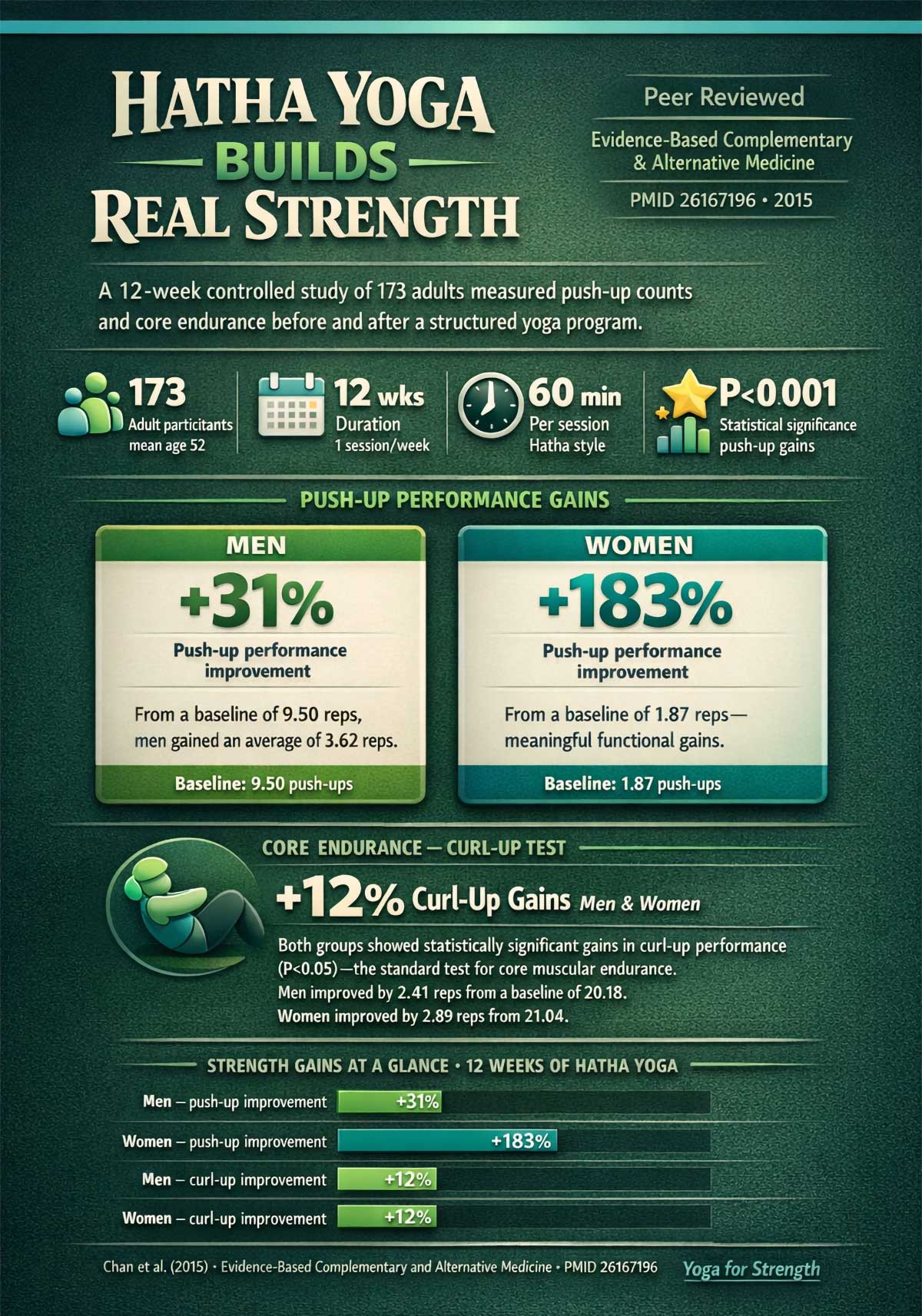
So if you’ve been told yoga can’t build functional strength, it’s time to look at what the data actually shows.
1. The Science Behind Yoga and Strength
Why the “Yoga Is Just Stretching” Myth Persists
The confusion is understandable. Yoga looks soft compared to lifting weights. There’s no barbell. No DOMS the next morning (usually). No chalk-dusted hands.
But what yoga does—especially Hatha yoga—is place muscles under sustained tension. That’s the key.
When you hold a Plank for 45 seconds or lower slowly into Chaturanga, your muscles are working hard. The load is your own bodyweight. The challenge is time.
Time Under Tension: Yoga’s Secret
In weight training, a bicep curl might last two seconds per rep. A set of 10 reps gives you roughly 20 seconds of muscle work.
In yoga, a single held pose can keep muscles firing for 30 to 60 seconds straight. That’s called time under tension, and it’s one of the key drivers of muscle adaptation.
Traditional weightlifting uses isotonic movement—muscles shorten and lengthen under load. Yoga uses more isometric work—muscles fire without changing length. Both approaches build strength. They just do it differently.
The Hong Kong study showed that just one 60-minute session of Hatha yoga per week was enough to trigger real, measurable strength gains over 12 weeks. That’s a low time commitment for a significant return.
2. The 60-Minute Weekly Protocol
One Session. Real Results.
The study protocol was simple: one 60-minute Hatha yoga class per week for 12 weeks. No gym. No equipment. No second session required.
That’s worth pausing on. A single weekly session—done consistently—produced statistically significant gains in upper-body strength and core endurance for both men and women across a range of ages.
Why Hatha Yoga Specifically?
Hatha is the foundation of most yoga styles practiced today. It focuses on two things: postural alignment and sustained holds.
That combination is what makes it effective for strength. Alignment ensures the right muscles are doing the work. Sustained holds create the time under tension needed for adaptation.
Faster-paced styles like Vinyasa or Power Yoga can also build strength, but Hatha’s slower pace makes it easier to focus on mechanics—especially if you’re new to bodyweight training.
How to Progress Without Weights
Traditional strength training adds load by increasing weight. Yoga adds load by increasing time.
A 20-second Plank hold becomes a 40-second hold. A slow Chaturanga descent becomes a three-count hover before lowering. The muscle challenge grows without a single piece of equipment.
This is the progressive overload principle applied to bodyweight training. It works.
3. The Upper Body and Core Circuit
These six poses—three focused on upper-body strength, three on core endurance—directly target the muscles measured in the Hong Kong study. Practice them in sequence: Plank and Chaturanga flow together naturally, followed by Boat Pose and balance work, finishing with Side Plank for trunk stability. Together they form the backbone of your 60-minute session.
Pose 1: Plank (Phalakasana)
Plank is the starting point for upper-body work in yoga. It looks simple. It isn’t.
To do it well, spread your fingers wide and press into all four corners of each hand—especially the base of the index finger. This is called Hasta Bandha (hand lock), and it protects your wrists while activating the forearms.
Draw your shoulder blades slightly apart (this is called scapular protraction). Pull your belly button toward your spine. Keep your hips level—not sagging, not raised.
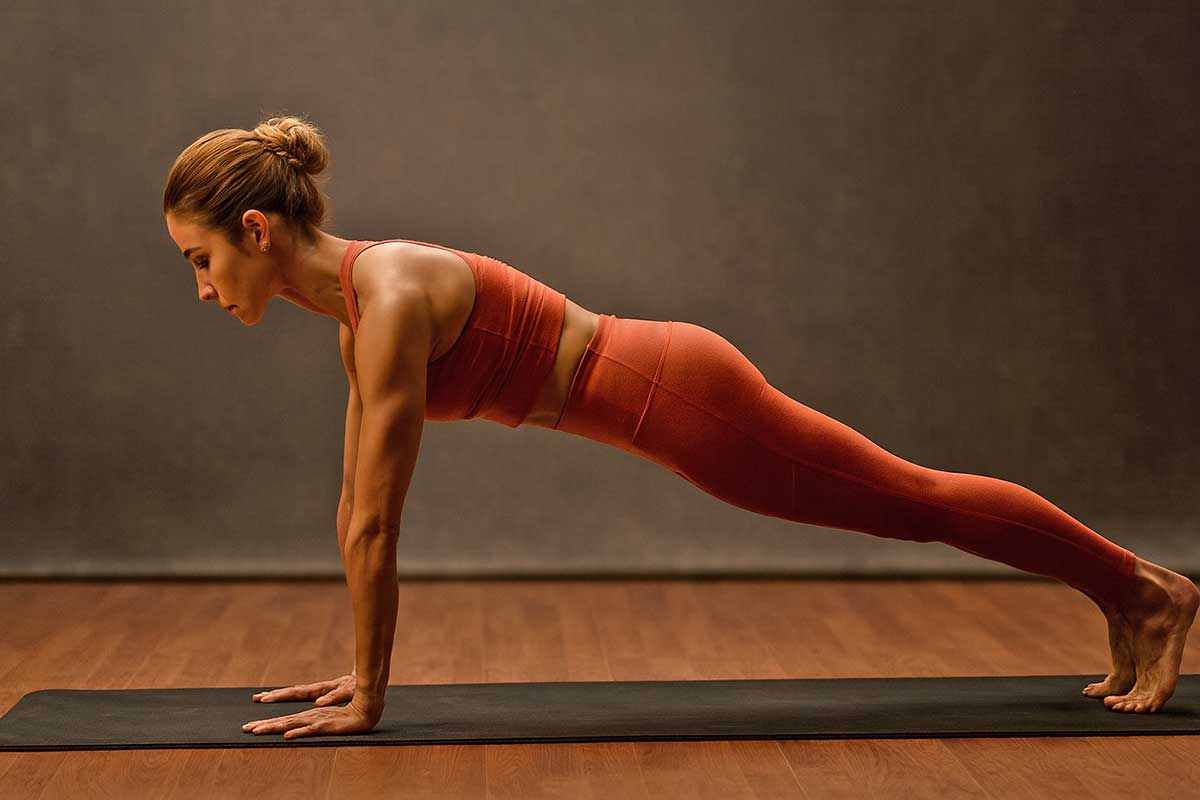
Start with 20–30 second holds. Work up to 60 seconds as you progress through the 12 weeks.
Pose 2: Four-Limbed Staff Pose (Chaturanga Dandasana)
This is the yoga push-up—and it’s harder than it looks.
From Plank, shift forward onto your toes and slowly lower your body until your elbows hit 90 degrees. Your body stays in one straight line. Elbows hug close to your ribs.
This movement directly works the triceps and the serratus anterior—the muscle that runs along the side of the rib cage. Both are heavily involved in push-up performance, which explains why regular Chaturanga practice drove the gains seen in the study.
If a full Chaturanga is too much at first, drop your knees. The knees-down version trains exactly the same muscles—triceps, serratus anterior, chest—just with less load. It’s a genuine modification, not a shortcut. Quality of movement matters more than ego.
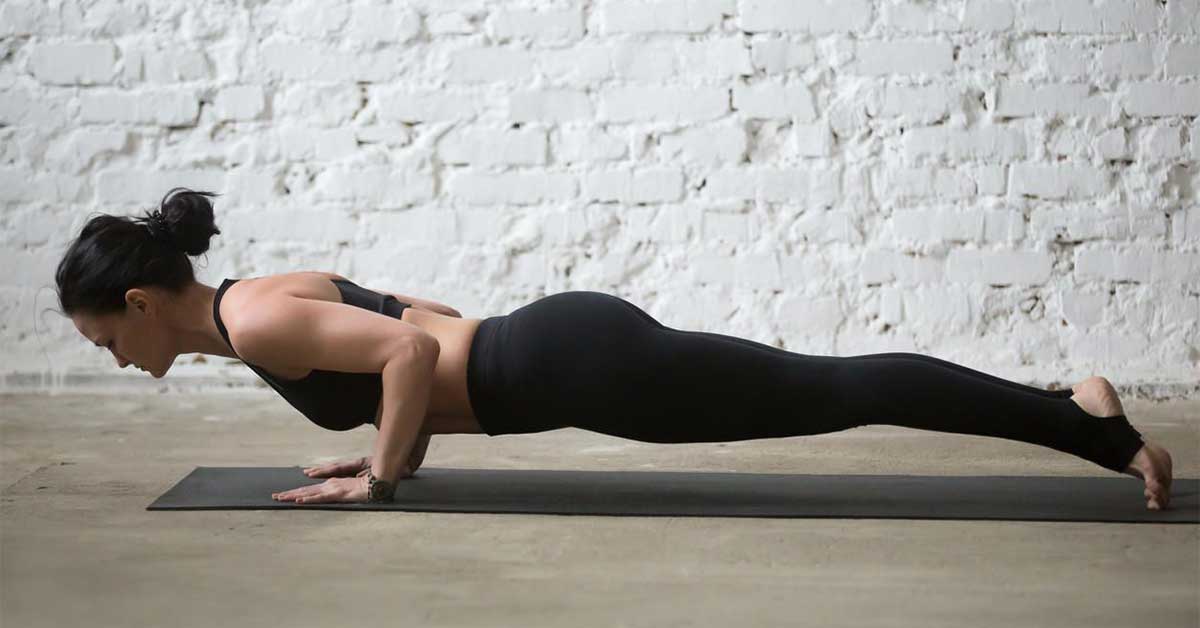
Start with 3–5 slow repetitions. Work toward a slow 5-count descent.
Pose 3: Upward-Facing Dog (Urdhva Mukha Svanasana)
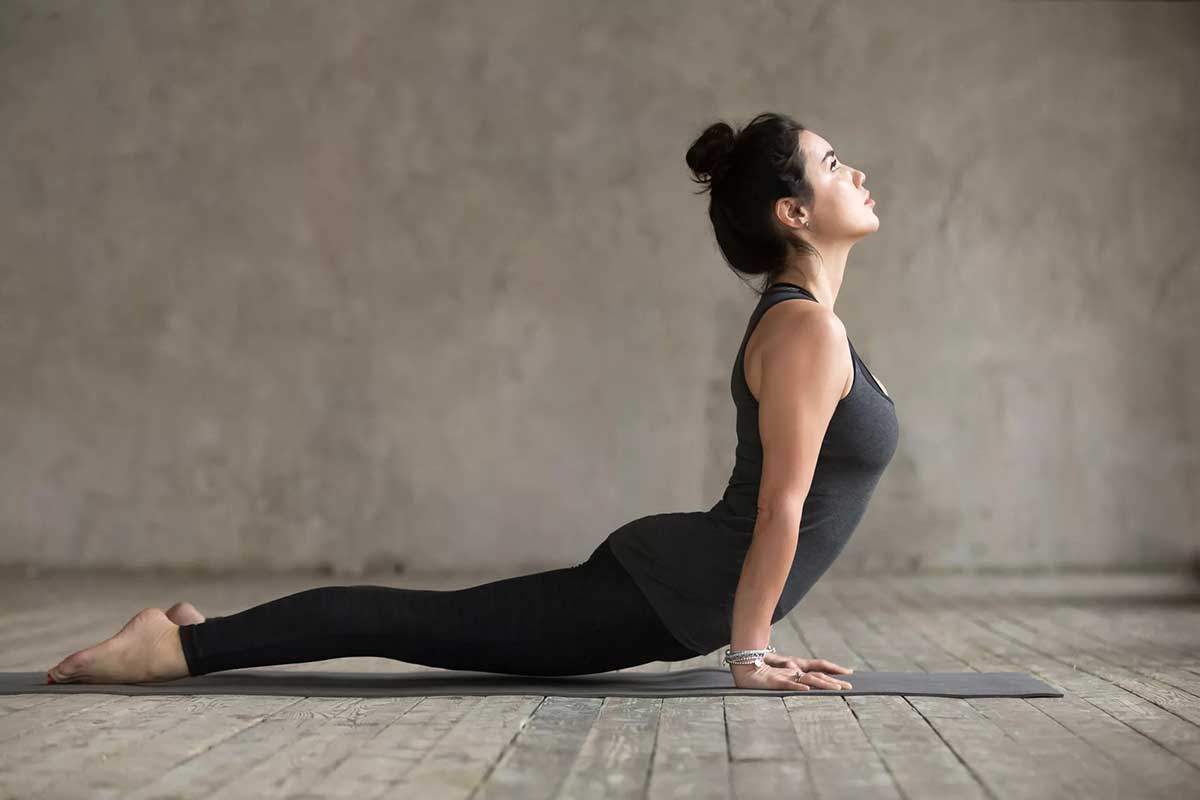
After lowering into Chaturanga, you push back up and away—arching the chest open, pressing the tops of the feet into the mat, and lifting the thighs off the floor.
Upward Dog creates active tension through the arms and chest while stretching the hip flexors and abdominals. This stretch-under-tension combination is what helps yoga develop functional strength rather than just isolated muscle size.
Think of it as the “return” phase of a push-up—but with more range of motion and a deliberate pause at the top.
4. The Core Endurance Circuit
The study measured core strength using curl-up tests. Yoga improved those numbers too. These three poses are why.
Pose 4: Boat Pose (Navasana)
Sit on the floor, lean back slightly, and lift your feet so your shins are parallel to the ground. Arms reach forward alongside the legs. Your spine stays long—not rounded.
This position directly trains the rectus abdominis and hip flexors under sustained load. It’s the closest yoga equivalent to a curl-up test, which explains why it correlates so well with the study’s core endurance measurements.
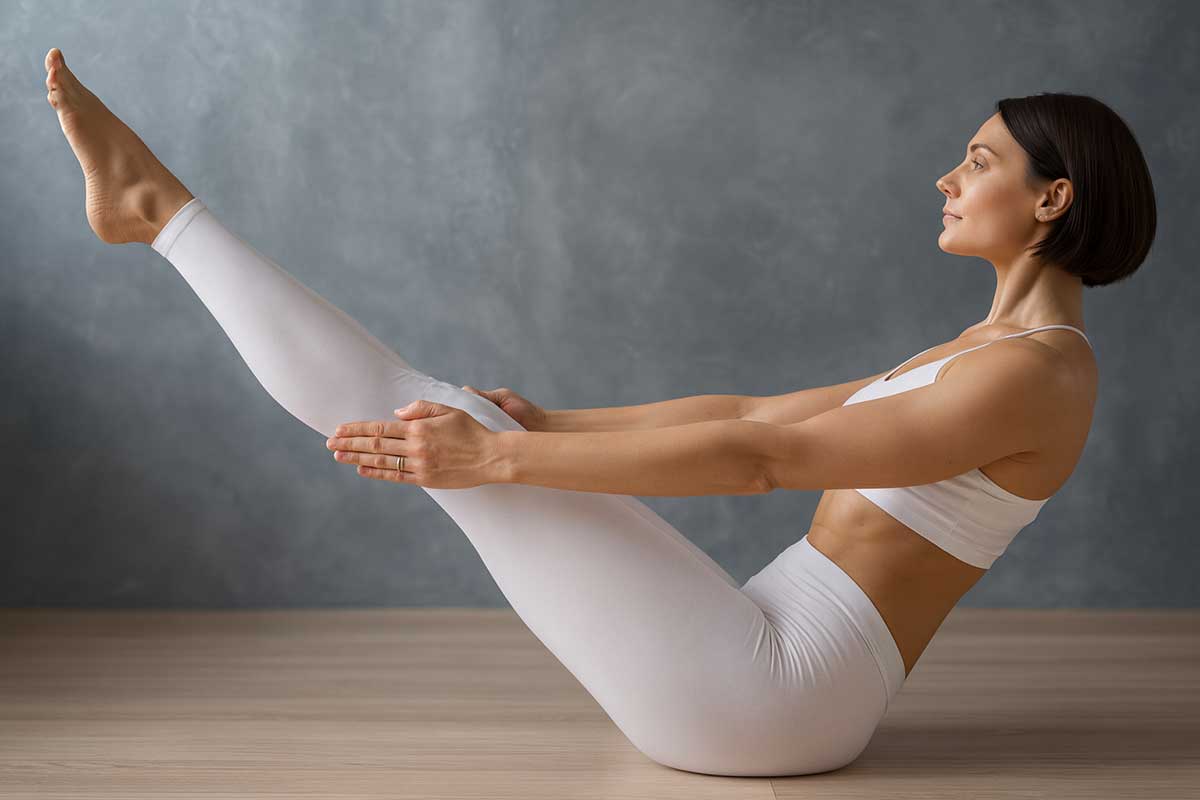
Hold for 20–30 seconds. Rest and repeat twice. Build up hold time over the 12 weeks.
Pose 5: Warrior III (Virabhadrasana III)
From standing, hinge forward at the hips and lift one leg behind you until your body forms a T-shape. Arms can extend forward or rest on the hips.
This is a balance pose—and balance poses are deceptive. To hold this position, your transverse abdominis (your deep core stabilizer) has to work constantly. It’s not glamorous, but it’s the muscle that holds everything together during any athletic movement.
Training balance in this way also builds proprioception—your body’s sense of where it is in space. That translates directly into better movement quality both on and off the mat.
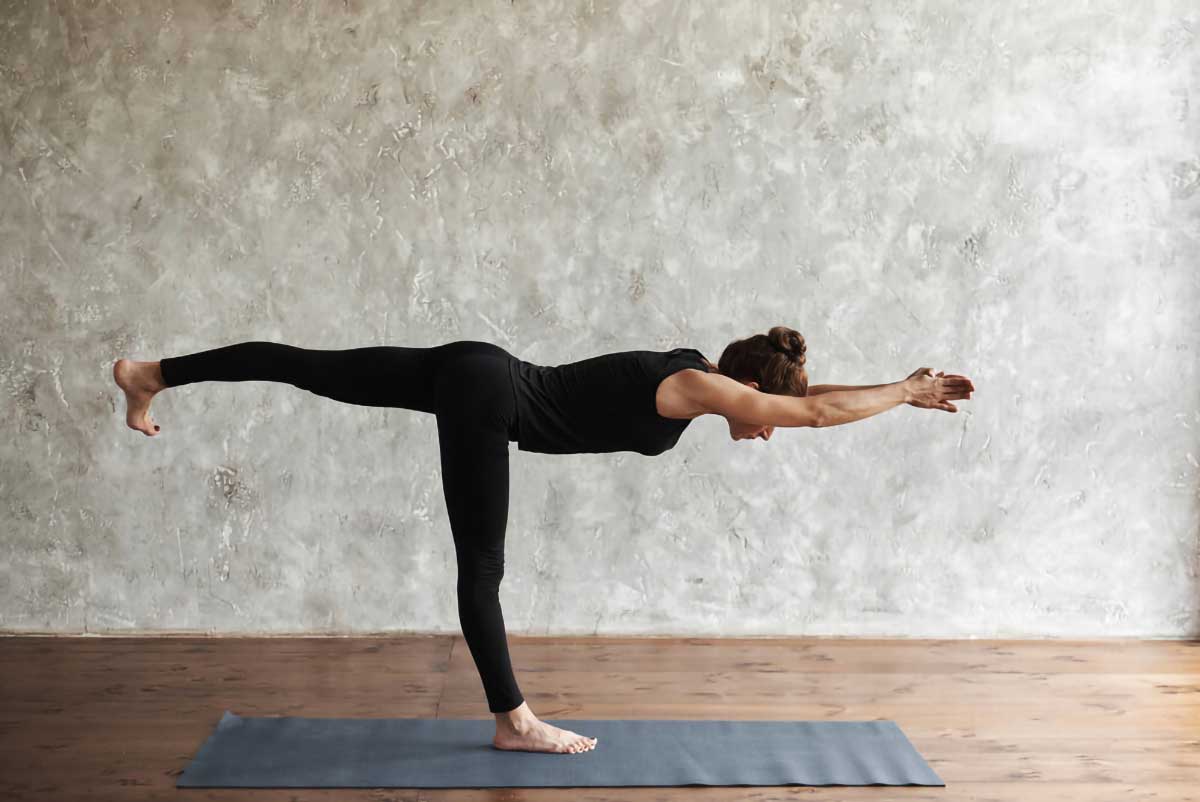
Hold for 20–30 seconds per side. Focus on a steady gaze point to help with balance.
Pose 6: Side Plank (Vasisthasana)
From a regular Plank, rotate onto the outer edge of one foot and stack your feet. Lift the top arm toward the ceiling. Hold.
Side Plank targets the obliques—the muscles that run diagonally along your torso—as well as the quadratus lumborum (deep back stabilizer). Together, these muscles control rotational movement and lateral trunk stability.
Strong obliques mean a more stable core, better posture, and reduced lower-back strain. The study’s improvements in postural control likely owe something to consistent lateral core work like this.
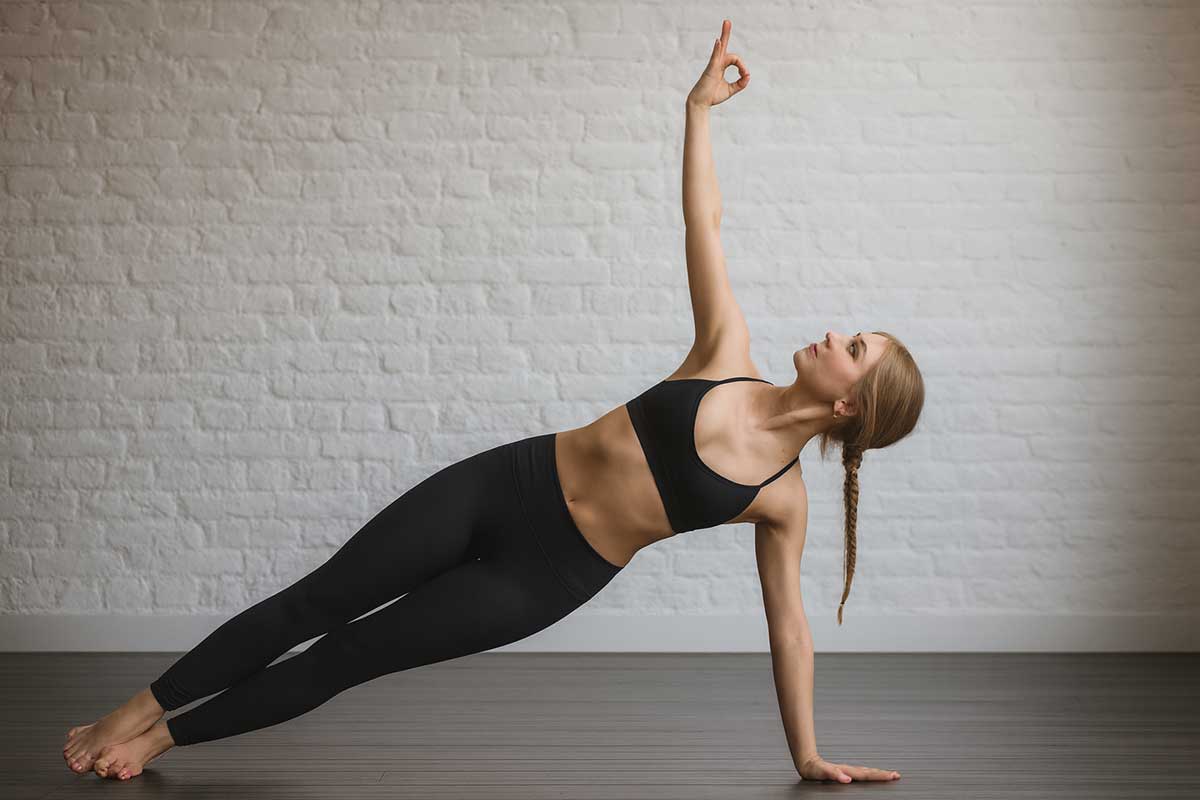
Start with 20 seconds per side. Work up to 45–60 seconds over the program.
5. Functional Gains Beyond the Muscle
Flexibility and Strength: Not Either/Or
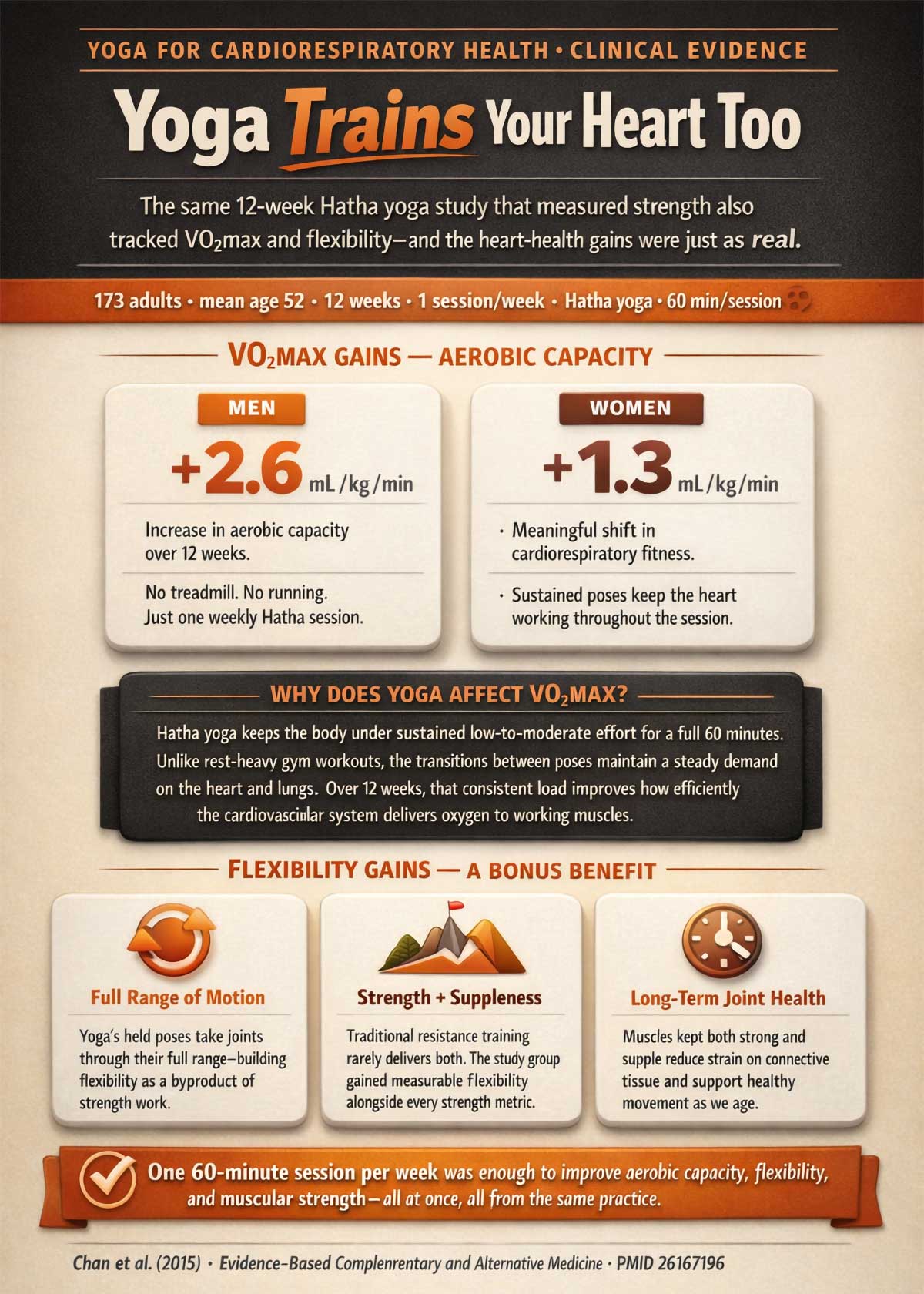
One of the most interesting findings in the Hong Kong study was this: participants gained both strength and flexibility over the 12 weeks. Traditional resistance training rarely delivers both at once.
In weightlifting, muscles can become tight from repeated shortening under load. Yoga’s combination of holds and full-range movements keeps muscles both strong and supple. That balance matters a great deal for daily movement, injury prevention, and long-term joint health.
You don’t have to choose between being flexible and being strong. Yoga makes that a false choice.
Heart Health Along the Way
The study also measured cardiorespiratory endurance—a measure of how well your heart and lungs deliver oxygen during sustained effort. The yoga group showed real improvements here. Men gained roughly 2.6 mL/kg/min in VO₂max over the 12 weeks. Women gained approximately 1.3 mL/kg/min. These are meaningful shifts in aerobic capacity—achieved without a single cardio machine.
A 60-minute Hatha session isn’t a sprint. But sustained poses, controlled transitions, and breath-focused movement keep the heart working steadily throughout. Over 12 weeks, that adds up.
This is good news for anyone who wants to take care of their heart health without running on a treadmill.
6. The 12-Week Implementation Roadmap
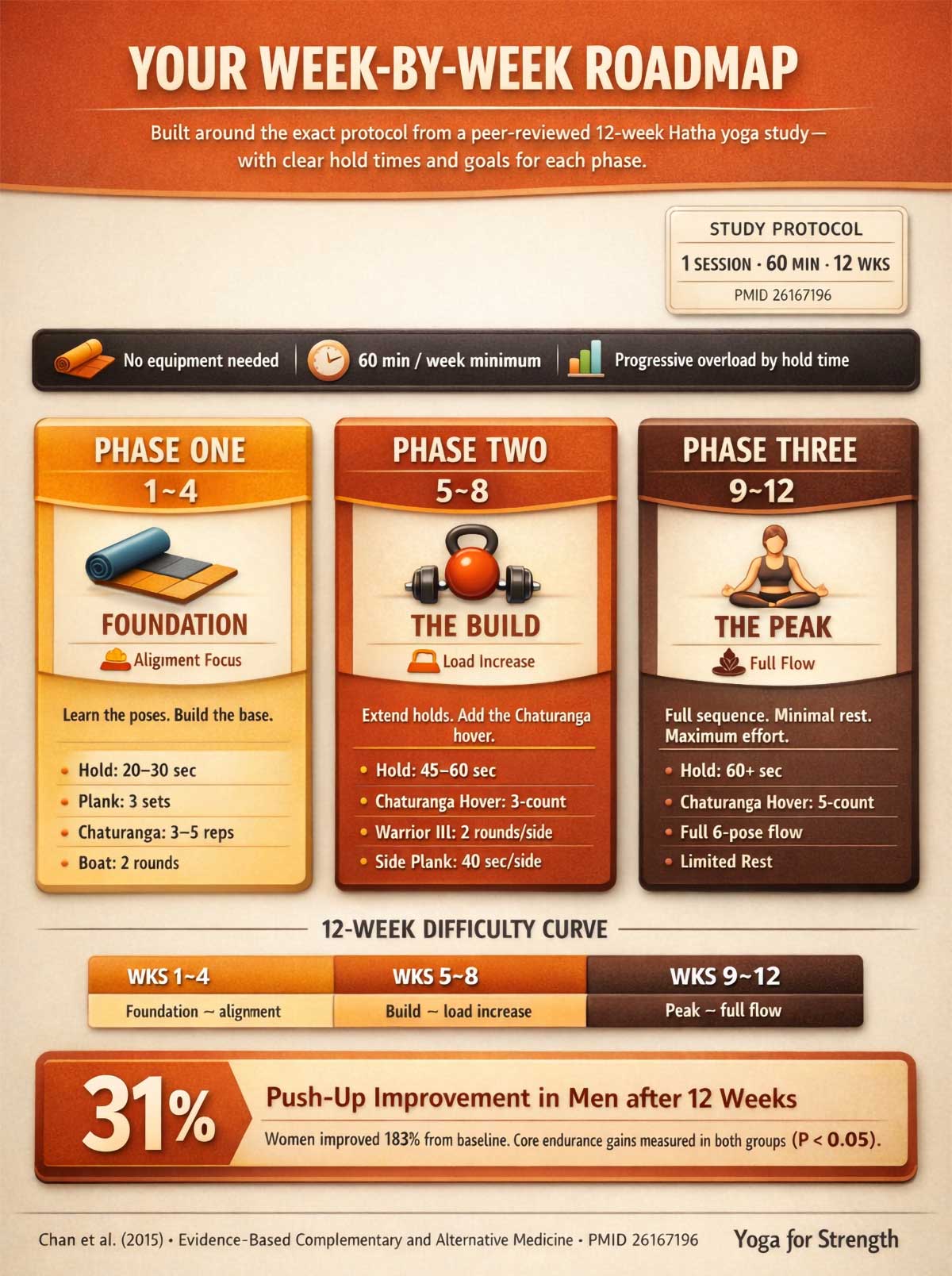
This roadmap mirrors the structure of the Hong Kong study while giving you a clear week-by-week progression to follow.
Weeks 1–4: The Foundation
Your focus in the first month is alignment, not intensity.
Move slowly through each pose. Learn where your weight should sit in Plank. Learn how to engage your core before you lower into Chaturanga. Get comfortable with Boat Pose before you try to hold it longer.
Hold times: 20–30 seconds per pose. Plank: 3 sets. Chaturanga: 3–5 reps.
Don’t push for longer holds yet. Let your joints adapt. Let your technique settle.
Weeks 5–8: The Build
Now you increase the challenge.
Extend your holds to 45–60 seconds. Add a “hover” transition in Chaturanga—pause two to three inches above the ground before lowering all the way. That pause is where the real strength work happens.
In Boat Pose, try extending your legs to a straighter angle. In Side Plank, aim for 40-second holds per side.
Hold times: 45–60 seconds. Chaturanga hover: 3-count pause. Warrior III: Add a second round per side.
Weeks 9–12: The Peak
This is where the work you’ve done starts to show up clearly.
Your 60-minute session should now flow with more ease and more challenge at the same time. You’ll notice that Plank feels steadier. Chaturanga feels more controlled. Boat Pose feels familiar.
Aim to move through the full sequence—Plank, Chaturanga, Upward Dog, Boat, Warrior III, Side Plank—with minimal rest between poses. The transitions themselves become part of the workout.
Hold times: 60 seconds or longer. Full flow: Limited rest between poses. Chaturanga hover: 5-count pause.
7. Common Pitfalls That Kill Progress
“Dumping” Into Your Joints
The most common mistake in Plank and Chaturanga is collapsing into the wrists and shoulders instead of actively holding the position.
You’ll know this is happening if your wrists ache after Plank or your shoulders creep up toward your ears in Chaturanga.
The fix: spread your fingers wide and press actively through the palm—especially that base of the index finger. This “Spider-Man grip,” or Hasta Bandha, distributes load across the whole hand instead of dumping it into the wrist joint. Pair that with drawn-in shoulder blades and an actively engaged core, and the position becomes much safer.
Wrist and shoulder injuries are almost always a technique problem, not a yoga problem.
Holding Your Breath
This one is subtle but important.
When poses get hard, most people hold their breath. It feels like it helps you brace. But held breath actually reduces the stability of your core, not increases it.
Controlled breathing—Pranayama in yoga terminology—keeps your diaphragm moving rhythmically, which maintains intra-abdominal pressure. That pressure is what stabilizes your spine during challenging poses. Think of it like the air pressure inside a tire. The air is what gives the tire its strength.
A steady, slow exhale through the nose is all you need. Aim for one natural exhale every three to four seconds during held poses like Plank, Boat, or Side Plank. If you find yourself holding your breath, the pose is too intense. Modify first.
8. Is Yoga Enough?
This is the fair question to ask at the end.
The Hong Kong study used just one weekly session over 12 weeks and produced statistically significant gains in push-up performance, core endurance, and flexibility. For a population of adults aged 45 to 60, that’s a meaningful result.
Can yoga replace the gym entirely? That depends on your goals. If you’re training for muscle size or maximal strength, you’ll likely need to add resistance training. Yoga’s load is limited by your bodyweight, and at some point, that ceiling can slow progress for advanced athletes.
But for most people—those who want to move better, stand taller, feel stronger, and keep their joints healthy as they age—a consistent Hatha yoga practice delivers real, measurable results. The study proves it.
One hour. One session per week. Twelve weeks.
That’s not a massive commitment. But if you’re consistent, the data suggests it’s enough to shift where your baseline sits.
Start with the Foundation phase. Learn the poses well. Let the progression take care of the rest.
The 12-week study used one session per week and delivered real results. Many practitioners find that adding a second or third weekly session speeds up progress without overtraining—especially once the Foundation phase is complete. Either way, consistency beats frequency every time.
This routine is based on research published in Evidence-Based Complementary and Alternative Medicine (Chan et al., 2015; PMID: 26167196). As with any new exercise program, speak with a healthcare provider before starting—especially if you have existing joint, wrist, or shoulder concerns.