


One of the most popular joint supplements in the world is supported by decades of research. The version most people buy is not the one used in those studies.
Glucosamine is one of the most purchased joint supplements. Most of the bottles sold contain glucosamine hydrochloride. The clinical research, though, is built almost entirely on glucosamine sulfate. Those are not the same compound. The difference in evidence is not minor.
That gap between what people are taking and what the research actually supports runs through the entire joint supplement market. Some products have decades of rigorous trials behind them. Others have a plausible mechanism, decent marketing, and a handful of small studies. A few are genuine surprises, effective in ways that most people, and many physicians, don’t expect.
The 10 supplements below are ranked by evidence quality and clinical consistency. The ranking reflects not just whether something works, but how reliably it works, for whom, and in what form. A supplement that performs well in three well-designed trials matters more than one with twenty studies of questionable methodology. Where the research is split, the article says so.
No supplement in this list will replace a damaged joint. What the evidence does support is a meaningful reduction in pain, slowed structural progression in some cases, and real improvement in daily function, for the right person, with the right compound, taken long enough to actually work.
Match your supplement to your condition
The evidence for joint supplements is not one-size-fits-all. Osteoarthritis and rheumatoid arthritis have different mechanisms, and the supplements that address them differ accordingly.
For osteoarthritis, the classic combination of glucosamine sulfate and chondroitin sulfate has the longest track record. MSM adds complementary support. Together, these three address cartilage breakdown from multiple angles. For rheumatoid arthritis, the autoimmune driver shifts the priority toward anti-inflammatory supplements. Omega-3 fatty acids and curcumin are first choices here, with clinical evidence specifically in RA populations.
For athletes and active individuals, collagen peptides combined with MSM support recovery and reduce activity-related pain. Research by Zdzieblik and colleagues at the University of Freiburg found measurable reductions in joint discomfort in physically active young adults taking specific collagen peptides, a population distinct from the typical OA study group. For general prevention, a simpler combination of collagen peptides and omega-3 fatty acids covers broad protective bases before symptoms develop. For post-injury recovery, collagen peptides paired with boswellia for inflammation control give tendons and ligaments what they need to rebuild.
Quick reference: Supplement comparison
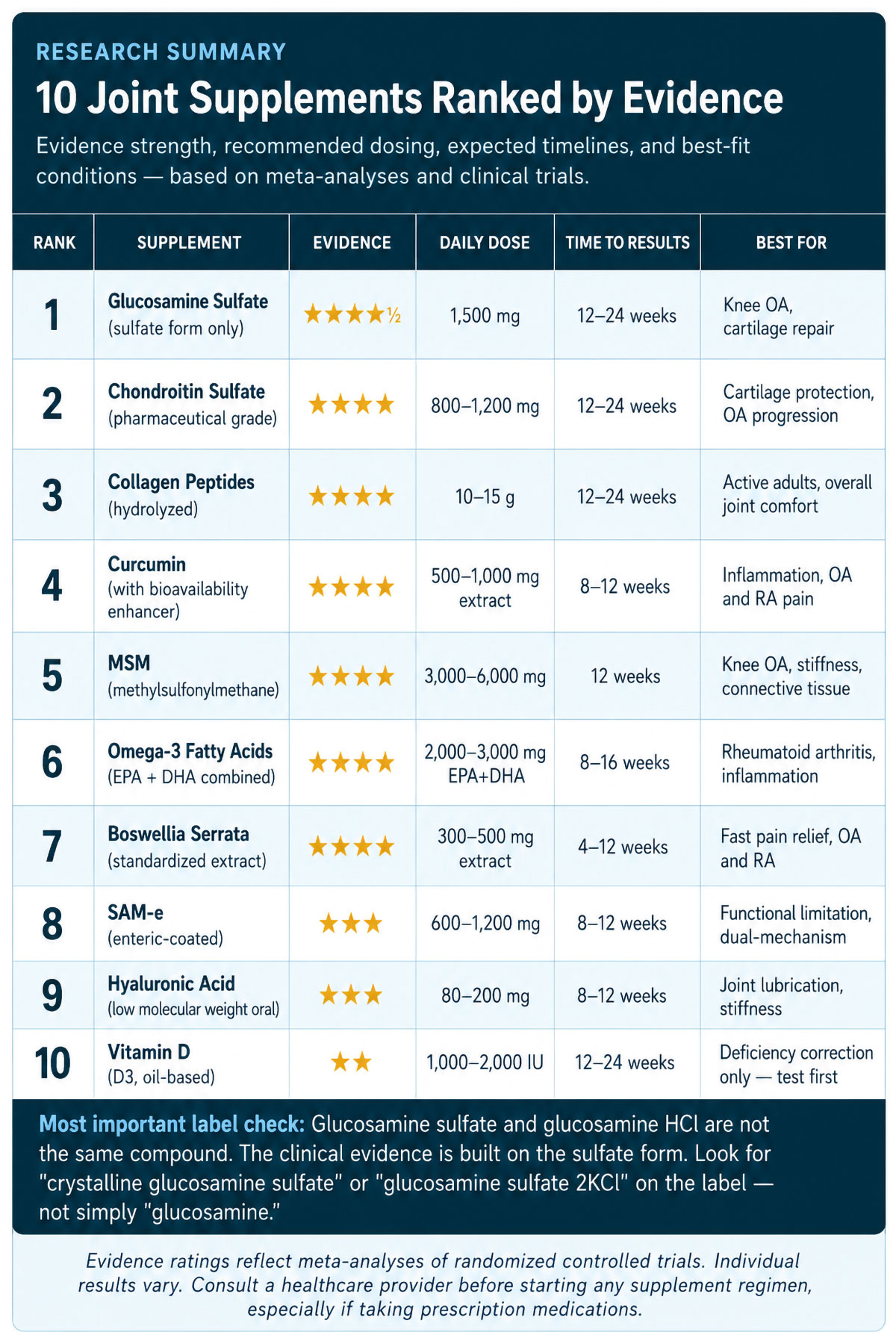
10. Vitamin D: Skip it unless a blood test says otherwise
Evidence strength: 2/5
Roughly 40% of adults are short on vitamin D, according to the National Center for Complementary and Integrative Health. For that group, correcting the deficiency can meaningfully change the picture. For everyone else, vitamin D does close to nothing for joint pain directly, which is why it sits last on this list despite being one of the most heavily marketed “joint health” ingredients on shelves.
A post hoc analysis of the VIDEO trial, a four-year study of 413 people with knee osteoarthritis published in the American Journal of Medicine, found something that should worry anyone skipping their blood test: participants who maintained sufficient vitamin D levels over the study period had less cartilage loss and better physical function than those who didn’t. A pattern, not a guarantee. Whether correcting a deficiency reverses cartilage damage that’s already occurred is a separate question this study can’t answer. It just shows the two tracking together.
A ten-minute blood test settles whether this applies to you. If levels are low, 1,000–2,000 IU of vitamin D3 in an oil-based softgel, taken daily for 12–24 weeks, is the standard correction. If levels are normal, the money is better spent elsewhere on this list.
9. Hyaluronic acid (oral): The one that shouldn’t work but does
Evidence strength: 3/5
Hyaluronic acid is a sugar molecule, and swallowing a sugar molecule and expecting it to end up lubricating a knee joint sounds like exactly the kind of supplement claim worth being skeptical of. Injections, which deliver hyaluronic acid directly into the joint space, have solid clinical backing. Oral versions have to survive digestion first, and for years, that was reason enough to dismiss them.
A systematic review of 13 reports on oral hyaluronic acid trials found that patients on a high-purity HA regimen reported meaningful improvement in knee pain compared to placebo, with benefits typically appearing within 8 to 12 weeks. The trial data doesn’t fully explain why this works as well as it does. What seems to matter is molecular weight: formulations under 50 kDa appear to absorb more readily, and most labels that specify a molecular weight indicate this.
The dose range from trials is 80–200 mg daily, and stiffness tends to improve before pain does, which makes the first month feel like nothing is happening. People with allergies to bird proteins should be cautious, since some hyaluronic acid is derived from rooster combs. Plant-fermented versions sidestep that issue entirely.
8. SAM-e: The one with a mood side effect that’s also a feature
Evidence strength: 3/5
SAM-e is the odd one on this list. It does two things most joint supplements don’t even attempt, reducing inflammation and helping protect cartilage directly, and it also affects mood, which is either a bonus or a complication depending on what else is in your medicine cabinet.
A 2002 meta-analysis in the Journal of Family Practice reviewed 11 randomized trials and found SAM-e performed comparably to NSAIDs for functional limitation, meaning what people could actually do with their joints day to day. The pain-reduction result was directionally positive but didn’t reach statistical significance, so the popular claim that SAM-e works “as well as ibuprofen for pain” overstates what the evidence shows. The functional improvement is the real finding, and it stands on its own.
Onset is slow, usually 8 to 12 weeks. Enteric-coated tablets (600–1,200 mg daily, split into two doses) protect the compound from stomach acid, and it degrades quickly with heat and moisture.
7. Boswellia serrata: Some people feel this one in a week
Evidence strength: 4/5
Most of the supplements on this list require patience. Boswellia is the exception. A 2020 meta-analysis by Yu and colleagues in BMC Complementary Medicine and Therapies, pooling seven trials and 545 participants, found that some people reported meaningful pain relief within a week of starting boswellia extract, faster than anything else ranked here. The catch is that three of those seven trials used combination products rather than pure boswellia, so the isolated effect size carries some uncertainty even though the overall conclusion holds up.
The speed of improvement has a mechanistic explanation. Boswellia serrata has been used in Ayurvedic medicine for centuries to treat what we’d now call inflammatory arthritis, and its active boswellic acids turn out to be potent inhibitors of 5-LOX, an inflammatory enzyme that NSAIDs and curcumin don’t directly touch. That’s also why boswellia stacks well with both rather than competing with them.
The standard dose is 300–500 mg of extract daily, standardized to at least 30–40% boswellic acids, with AKBA specifically called out on the label since it’s one of the most active components. The same immune-modulating effect that makes boswellia work fast is also why it’s not a free pass for everyone. Anyone on blood thinners or managing an autoimmune condition should loop in a physician before starting, since the mechanism cuts both ways.
6. Omega-3 fatty acids: Where RA evidence gets hard to argue with
Evidence strength: 4/5
A 2025 systematic review in Frontiers in Pharmacology, drawing on 41 randomized controlled trials and nearly 3,800 participants, found omega-3 supplementation produced a clinically significant drop in pain intensity, with benefits that kept improving for up to six months. That’s a long timeframe for a supplement, and it’s worth thinking about: most interventions plateau well before six months, but this one apparently doesn’t.
An earlier, narrower analysis tells a related but distinct story. A 2023 review of nine trials in the Journal of Orthopaedic Surgery and Research, focused specifically on osteoarthritis rather than the broader arthritis category, also found meaningful pain reduction and improved joint function. The RA evidence is still the stronger of the two, but the OA finding closes a gap that used to leave omega-3s looking like an RA-only recommendation.
Mechanistically, EPA and DHA convert into resolvins and protectins, anti-inflammatory compounds that help offset the pro-inflammatory omega-6 fats common in Western diets. In RA populations, this translates into a reduced reliance on NSAIDs, which isn’t a minor side benefit. For people trying to limit long-term NSAID exposure, it’s often the primary goal.
Look for products providing at least 2,000–3,000 mg of combined EPA and DHA daily, not total fish oil, since filler oil makes up a large share of cheaper products. IFOS (International Fish Oil Standards) certification is the most useful purity marker here. Give it 8–16 weeks. Algae-based EPA and DHA work for anyone avoiding fish.
5. MSM: Underrated because sulfur sounds unglamorous
Evidence strength: 4/5
If glucosamine has a marketing department, MSM doesn’t. Methylsulfonylmethane is a naturally occurring sulfur compound, and sulfur is essential to building collagen and the glycosaminoglycans that make up healthy cartilage. Nobody puts “sulfur” on a supplement label and expects it to sell, which may be part of why MSM stays in glucosamine’s shadow despite a solid evidence base of its own.
A 2006 randomized controlled trial led by Kim and colleagues in Osteoarthritis and Cartilage enrolled 50 people with knee osteoarthritis and found that 6 grams of MSM daily for 12 weeks significantly reduced pain and improved physical function compared to placebo. A 2011 trial by Debbi and colleagues in BMC Complementary and Alternative Medicine replicated the functional improvements at a lower dose, 3.375 grams daily. Together, these suggest a dose range of 3 to 6 grams split into two daily doses, with products recommending much less, operating below where the evidence actually sits.
MSM pairs well with glucosamine and chondroitin, and several combination products have tested the trio together with consistent results in knee OA. OptiMSM, a distillation-purified branded form, shows up across multiple studies and is a useful reference point when comparing labels. Side effects are mostly a non-issue, some stomach grumbling at higher doses, easily managed by starting at 1–2 grams and working up over two weeks. The real risk with MSM isn’t tolerability. It’s that most people stop around week 8, just before the 12-week mark, where the trials actually found their results.
4. Curcumin: Comparable to ibuprofen, with a catch most labels ignore
Evidence strength: 4/5
A teaspoon of turmeric contains roughly 200 mg of curcumin. Clinical trials use 500 to 1,000 mg of curcumin extract. That gap is the whole reason “eat more turmeric” advice and “take a curcumin supplement” advice point to very different things, even though they sound like the same recommendation.
A 2021 meta-analysis by Dai and colleagues in Phytotherapy Research reviewed 15 randomized controlled trials and found curcumin extract significantly reduced pain and improved physical function in people with arthritis. Several of those trials ran head-to-head against NSAIDs and found comparable pain relief, without the gastrointestinal or cardiovascular risks that come with long-term NSAID use.
A broader 2022 analysis in Frontiers in Pharmacology, covering 29 trials and nearly 2,400 participants, reached a similar conclusion. Reading these together, the picture is consistent rather than dramatic: curcumin performs reliably across a lot of small trials, but “a lot of small trials” is also the honest description of the evidence quality. Researchers still don’t have the large, definitive trial that would settle the question completely.
The bigger practical issue is absorption. Curcumin on its own barely gets into the bloodstream, which is why the same anti-inflammatory action that makes it useful also shapes who should be careful with it: combination with piperine (black pepper extract), phytosome forms like Meriva, and phospholipid-enhanced forms like BCM-95 are the three delivery systems with real research support, and a bottle without one of these is likely delivering a fraction of what the label promises.
That stronger absorption is also why people with gallbladder disease (curcumin stimulates bile production) or those on blood thinners (curcumin has antiplatelet effects at higher doses) need to take the dosing more seriously, not less.
3. Collagen peptides: Not just a skincare ingredient anymore
Evidence strength: 4/5
For most of its commercial life, collagen was sold as a beauty product. The joint research changed that, though it took a while for the supplement aisle to catch up. Hydrolyzed collagen, also labeled “collagen peptides,” breaks down into short amino acid chains during digestion that travel to the joints, where they appear to signal chondrocytes, the cells that build cartilage, to increase production of type II collagen and related structural proteins.
A 2021 study by Zdzieblik and colleagues at the University of Freiburg, published in Nutrients, found that specific collagen peptides reduced activity-related joint pain in young, physically active adults, a population almost nobody studies in this context. That finding took a while to sink in: most joint research focuses on older adults with diagnosed osteoarthritis, and here was a meaningfully different group showing benefit.
Separately, earlier research has looked at collagen’s effect on COMP, a biomarker of cartilage turnover, with some studies suggesting supplementation changes cartilage tissue markers rather than just easing symptoms. That’s still an open question, not a settled one, but it points to collagen possibly doing something structural rather than purely palliative.
The trial dose range is 10–15 grams of hydrolyzed collagen daily. Undenatured type II collagen, or UC-II, is a completely different animal: it’s dosed at just 40 mg and works through immune modulation rather than supplying raw material, so the two forms aren’t interchangeable and shouldn’t be dosed as if they were. Bovine and marine sources perform similarly in trials, and collagen is one of the gentler supplements on this list, with allergy to the source animal being the main consideration.
2. Chondroitin sulfate: Good evidence, if the product is what it claims to be
Evidence strength: 4/5
Here’s the complication with chondroitin: the research and the retail shelf aren’t always describing the same product. A 2015 Cochrane review by Singh and colleagues, analyzing 43 trials and over 9,000 participants, found that chondroitin reduced pain and improved function compared to placebo, with some evidence for slowed joint space narrowing.
But a separate 2019 meta-analysis found the joint space narrowing effect to be modest at best, and flagged significant variation depending on product quality. Cheaper products often contain less active ingredient than labeled, or use poorly absorbed forms. The brands actually used in clinical trials, Condrosulf and CosaminDS, are pharmaceutical-grade. If a product doesn’t specify grade or source, there’s limited reason to expect it will replicate trial results.
What chondroitin does, mechanistically, is draw water into cartilage to keep it hydrated and resilient, while also helping suppress the enzymes that break cartilage down. That dual role, structural and protective, is why EULAR conditionally recommends pharmaceutical-grade chondroitin for knee osteoarthritis despite the product-quality caveats above.
Eight weeks of use can bring pain relief, if it’s forthcoming. The slowed-joint-space-narrowing part, the reason chondroitin gets called a “disease modifier” rather than just a painkiller, takes roughly two years to show up. Almost nobody takes a supplement for two years expecting to feel nothing different for most of that time, which is probably why the structural benefit gets mentioned far less than it should.
The standard dose is 800–1,200 mg daily. People on warfarin or other blood thinners need physician oversight, since chondroitin is structurally similar to heparin and can affect clotting, and those with shellfish allergies should check the source, since most chondroitin comes from shellfish cartilage.
1. Glucosamine sulfate: The strongest evidence and the most important label distinction
Evidence strength: 4.5/5
Glucosamine sulfate takes the top position not because it is dramatically superior to everything below it, but because its evidence base is the deepest, oldest, and most consistently replicated in the joint supplement field. It provides the raw material for cartilage synthesis, has a mild anti-inflammatory effect, and, in the crystalline sulfate form, has been tested in large-scale trials that smaller supplements simply haven’t undergone.
A 2018 systematic review and meta-analysis by Simental-Mendía and colleagues in Rheumatology International, and a 2023 systematic review published in Healthcare covering 15 trials, both confirm that glucosamine significantly reduces pain in knee osteoarthritis compared to placebo. The Cochrane review covers the foundational literature. Some long-term trials suggest the possibility of slowed cartilage loss over time, a genuinely rare finding for any supplement.
The evidence, though, comes with a critical qualification: it is built almost entirely on crystalline glucosamine sulfate at 1,500 mg/day, not on glucosamine hydrochloride (HCl). The Arthritis Foundation’s position is direct: evidence supports glucosamine sulfate, not hydrochloride, for knee osteoarthritis. Mayo Clinic researchers echo this. A 2008 pharmacokinetic study by Meulyzer and colleagues in Osteoarthritis and Cartilage (cited 143 times) showed that synovial fluid concentrations were significantly higher one hour and six hours after glucosamine sulfate compared to the HCl form, meaning more of the compound reaches the joint itself.
Why most products use the wrong form
Glucosamine hydrochloride is the dominant form in pharmacy and grocery store products for a structural reason: it contains a higher concentration of pure glucosamine per gram (approximately 99% vs. 74% for the sulfate form). It is also cheaper and more stable without additives. Glucosamine sulfate requires stabilizing salts, sodium or potassium chloride, to remain shelf-stable, which adds to production cost and reduces glucosamine concentration per gram.
The tradeoff the research shows is that despite lower glucosamine concentration, the sulfate form reaches joint tissue more effectively. The sulfur component appears to facilitate absorption and utilization in joint fluid. Higher purity in the bottle does not translate to higher bioavailability in the cartilage.
Check the label carefully. Look for “crystalline glucosamine sulfate” or “glucosamine sulfate 2KCl” (the potassium-stabilized form used in research). If the label says glucosamine HCl, or simply “glucosamine” without specifying sulfate, the product is almost certainly the HCl form. That distinction matters more than brand, price point, or the number of trials cited on the packaging.
People with shellfish allergies should note that most glucosamine is derived from shellfish shells. Vegetarian options made from corn fermentation are available and appear to be biochemically equivalent.
Supplement stacking: How to combine for better results
Taking multiple supplements together can address joint health from several angles simultaneously. The key is starting one at a time, if you begin with five supplements at once, you won’t know which one is helping when something changes.
Weeks 1–12 (foundation): Start with glucosamine sulfate (1,500 mg/day) and chondroitin sulfate (1,200 mg/day). These are the most evidence-backed structural supplements and work on the same cartilage mechanisms in complementary ways. Take with food to reduce any digestive discomfort.
Weeks 13–24 (anti-inflammatory layer): Add curcumin with a bioavailability enhancer (500–1,000 mg/day) and, if inflammation is a significant component of your symptoms, omega-3s (2,000–3,000 mg combined EPA/DHA daily). These address the inflammatory side of joint degradation that the structural supplements don’t directly target.
Week 25 onward (full stack, where appropriate): MSM (3,000–6,000 mg/day, split into two doses) rounds out the connective tissue support. The glucosamine-chondroitin-MSM trio has been tested in combination studies with consistent results in knee osteoarthritis.
Timing note: Fat-soluble supplements (curcumin formulations, vitamin D, omega-3s) are absorbed better with a meal containing fat. Water-soluble supplements (glucosamine, MSM) can be taken with or without food, but food helps tolerance.
Critical drug interactions you need to know
Several supplements on this list interact with medications in ways that are clinically significant, not just theoretical.
Blood thinners (warfarin, aspirin therapy): Omega-3 fatty acids, glucosamine, chondroitin, and boswellia all carry increased bleeding risk in combination with anticoagulants. Omega-3s at doses above 3 grams/day have the strongest evidence for this interaction. Anyone on blood-thinning therapy should discuss supplement plans with a physician before starting.
Diabetes medications: Glucosamine may affect glucose metabolism in some individuals. Monitoring blood glucose during the first 4–6 weeks of use is advisable for anyone managing blood sugar levels with medication.
Antidepressants and MAOIs: SAM-e affects serotonin and dopamine pathways. Taking it alongside antidepressants, particularly SSRIs, SNRIs, or MAOIs, carries a risk of serotonin syndrome. Physician oversight is required, not optional.
NSAIDs: Curcumin’s COX-2 inhibiting properties overlap with NSAID mechanisms. Combination use may amplify effects and should be discussed with a prescriber, particularly for people on prescription-strength anti-inflammatory drugs.
Joint Supplement Interaction Checker
Select the supplements you are taking or considering, then select any medications that apply. The checker will flag known clinical interactions.
This tool provides general educational information about known supplement-drug interactions. It is not a substitute for advice from a physician or pharmacist. Always review your complete supplement and medication list with a healthcare provider before making changes.
What to expect: The timeline for results
One of the most consistent findings across the joint supplement literature is that results take time. Most people abandon supplements before they have had a realistic chance to work.
Weeks 1–4: The building phase. Your cells are taking up structural components, but nothing noticeable is likely to happen yet. This is the phase where most people conclude the supplement doesn’t work. It is also the phase where the research says keep going.
Weeks 5–8: Subtle changes, reduced morning stiffness, slightly easier movement on certain days. Boswellia and curcumin may produce noticeable anti-inflammatory effects earlier in this window. Structural supplements (glucosamine, chondroitin) are still in accumulation mode.
Weeks 9–12: This is where clinical trials typically begin to see statistically significant differences between supplement and placebo groups. Meaningful pain reduction and functional improvement are realistic targets in this window for most supplements on this list.
Week 13 onward: Full therapeutic effect. Some benefits, particularly structural effects like slowed joint space narrowing, only become measurable over 12–24 months of consistent use. These are effects that trial participants themselves may not directly feel, but that matter for long-term joint health.
Tracking progress matters. Keep a brief weekly note on pain level, morning stiffness duration, and what activities you can do that you couldn’t before. This gives you an evidence base for your own body’s response, not just the trial data.
The broader picture: What supplements can’t replace
Joint supplements are most effective as part of a larger approach, not as a standalone intervention. The research is clear on this point, and it’s a position the Arthritis Foundation, AARP, and Stanford Lifestyle Medicine all share: supplements address specific biochemical mechanisms but don’t address the mechanical and systemic factors that drive joint deterioration.
The 4-to-1 load rule for knees explains why, for every kilogram of excess body weight, roughly four kilograms of additional force lands on the knee joint with each step. Weight management has the most direct mechanical effect of any non-surgical intervention for knee osteoarthritis.
Movement, even moderate and gentle movement, maintains synovial fluid circulation and preserves the cartilage integrity that supplements are trying to support. The evidence for structured low-impact exercise, cycling, swimming, and targeted strength training for the muscles surrounding the joint is stronger than for any single supplement. The two approaches compound each other; neither replaces the other.
Sleep matters too. The body’s cartilage repair processes are most active during sleep, which is part of why poor sleep consistently worsens pain perception in arthritis populations.
When to see your doctor
Several scenarios call for medical evaluation before or during supplementation. Joint pain that developed suddenly, is accompanied by significant swelling, warmth, or redness, or has worsened progressively over weeks without an obvious mechanical cause, warrants a clinical assessment before treating it as a supplement question. RA requires diagnosis and often disease-modifying medication that supplements do not replace.
If you are currently taking prescription medications for any condition, run your supplement plans past your prescriber or pharmacist. The interactions listed above are not exhaustive, and a pharmacist can run a full interaction check in minutes.
For people managing diagnosed osteoarthritis, most evidence-based guidelines consider glucosamine sulfate and chondroitin reasonable adjunctive approaches, not replacements for physical therapy, weight management, or, where appropriate, medical treatment.
Special populations: Who needs extra caution
Pregnant and nursing women: No joint supplement on this list has sufficient safety data for pregnancy. The default position for any supplement without established pregnancy safety data is avoidance. Discuss with an OB-GYN if joint pain during pregnancy requires management.
Children and adolescents: The clinical trial populations for every supplement in this list are adults, almost universally over 40. Joint supplement use in people under 18 is not supported by pediatric evidence. Growth-related joint pain in younger people typically has different causes than adult OA and warrants different management.
Older adults (70+): Slower metabolism means slower onset of effect; timelines may be longer than those reported in trials with middle-aged populations. Interaction risk with multiple medications increases with age. Pharmacist review is particularly worthwhile in this group.
People with chronic conditions: Kidney disease affects vitamin D and calcium metabolism. Liver disease affects how supplements are processed. Autoimmune conditions beyond RA require physician guidance before adding immune-modulating supplements such as boswellia or SAM-e.
Common mistakes to avoid
The most common mistake is buying glucosamine HCl when the evidence supports glucosamine sulfate. The second most common is giving up after four weeks. Third is buying products without knowing the dose of active ingredient per serving, many combination products contain less than clinical doses of each component, spreading the investment across five ingredients rather than delivering therapeutic amounts of two.
Starting multiple supplements simultaneously makes it impossible to know what’s working. Starting too low a dose to avoid side effects means staying below the range where the evidence operates. And spending on supplements before addressing sleep, movement, and weight management is spending in the wrong order.
The label is what matters
Most of the people who tried glucosamine and felt nothing were probably taking glucosamine hydrochloride. Most of the people who gave up on curcumin after three weeks were working against a supplement that needs three months. Most of the people who never noticed a difference from omega-3s weren’t taking enough of the active compound.
Joint supplements work, when they work, within specific parameters: the right compound, the right form, the right dose, long enough to reach the joint tissue and do something there. Those parameters are in the research. They are often not on the packaging.
The form question is the part that no brand has an incentive to advertise clearly. A label that says “glucosamine 1,500 mg” and a label that says “crystalline glucosamine sulfate 1,500 mg” are legally similar. Biologically, for the joint, they are not.
FAQs
Can I take multiple joint supplements together?
Yes, with some planning. Glucosamine sulfate and chondroitin are specifically well-studied in combination and are often sold together for that reason. Adding MSM to that pair is the most evidence-backed three-way combination. The main practical rule is introducing new supplements one at a time, two weeks apart, so you can identify what’s working and catch any side effects early.
Are there any side effects?
Most supplements on this list are well-tolerated at recommended doses. The most common issues are mild digestive discomfort (most easily managed by taking supplements with food) and, for SAM-e, mood effects that can be significant for people with bipolar disorder or on certain antidepressants. The drug interactions detailed in the interactions section are the most clinically important concerns.
How long does it take to see results?
Boswellia and curcumin have the fastest onset, and some people notice anti-inflammatory effects within 2–4 weeks. Structural supplements (glucosamine, chondroitin, collagen) typically require 12–24 weeks for meaningful results. The full timeline section above provides supplement-specific guidance.
Will insurance cover these supplements?
In the United States, most joint supplements are not covered by standard health insurance. However, many are eligible for reimbursement through Health Savings Accounts (HSA) and Flexible Spending Accounts (FSA) when purchased for the treatment of a diagnosed condition. Check with your plan administrator and keep purchase receipts.
What if I’m a vegetarian or vegan?
Glucosamine from corn fermentation is available as a shellfish-free alternative to the standard shellfish-derived form. Marine collagen is not suitable for vegans; bovine collagen is not suitable for vegans; plant-based collagen boosters (providing vitamin C and amino acids rather than collagen itself) have limited direct evidence. Algae-based omega-3s provide EPA and DHA without fish. Curcumin, boswellia, SAM-e, and MSM are all suitable for vegetarians and vegans.
What supplements should I take with tirzepatide or other GLP-1 medications?
GLP-1 medications, including tirzepatide, are associated with rapid weight loss, which can reduce joint load substantially, a benefit for knee and hip OA. The supplements on this list do not have known interactions with tirzepatide specifically. However, rapid weight change can alter how some supplements are distributed and metabolized. The most important consideration is ensuring adequate protein and collagen-supporting nutrients during weight loss on GLP-1 therapy to preserve lean tissue. Discuss supplement plans with the prescribing physician.
Is glucosamine sulfate or HCl better?
The clinical evidence is built almost entirely on glucosamine sulfate, not glucosamine HCl. Pharmacokinetic research shows that glucosamine sulfate reaches the joint fluid at higher concentrations. Both the Arthritis Foundation and Mayo Clinic researchers specifically recommend the sulfate form for knee osteoarthritis. The HCl form has a higher glucosamine concentration per gram, but lower bioavailability at the target tissue. Look for “crystalline glucosamine sulfate” or “glucosamine sulfate 2KCl” on the label.
Can I get these nutrients from food alone?
Not at therapeutic doses. Bone broth and chicken skin contain collagen precursors, but not in amounts comparable to clinical doses. Fatty fish provides omega-3s, and two to three servings weekly can contribute meaningfully, but supplementation is typically required to reach the 2,000–3,000 mg EPA/DHA threshold the research uses. Turmeric in food provides far less curcumin than therapeutic supplement doses. Glucosamine and chondroitin are not meaningfully present in typical diets.
Do supplements prevent arthritis?
There is no good evidence that any supplement prevents arthritis in people who are not already showing signs of it. The evidence is strongest for managing existing osteoarthritis symptoms and, in some cases, slowing structural progression once it has started. Prevention claims in supplement marketing go well beyond what the research supports.
Why do some studies show supplements don’t work?
Several reasons. The most important is product quality: trials using pharmaceutical-grade crystalline glucosamine sulfate show consistent results; trials using generic glucosamine (often HCl or unstandardized sulfate) show inconsistent results. Study duration is another factor, short trials often miss effects that appear at 12–24 weeks. Industry funding bias affects a subset of the positive literature as well, which is why the evidence sections above note where contested findings exist and where the evidence is genuinely mixed.