Does eating an avocado every day actually make you sharper? The answer isn’t as simple as yes or no. New research shows that avocados can boost certain brain functions, but the effects depend on your age, how long you eat them, and what type of mental skill you want to improve.
Let’s look at what the science really says.
What you’ll learn in this guide:
- How avocados improve attention, focus, and memory based on clinical trials
- Why whole avocados beat lutein supplements for brain health
- Exactly how long it takes to see cognitive improvements
- Brain-boosting recipes that maximize nutrient absorption
- Who benefits most and when to be cautious
Avocado Cognitive Benefits at a Glance
| Cognitive Benefit | Who Benefits Most | Timeline to See Results | Study Support | What It Means for You |
|---|---|---|---|---|
| Sustained Attention | Adults 50+ | 6 months | Scott et al., 2017 (RCT, n=40) | Better ability to stay focused on tasks without mental fatigue |
| Attentional Inhibition | Adults 25-45 with overweight | 12 weeks | Edwards et al., 2020 (RCT, n=84) | Improved ability to tune out distractions and focus on what matters |
| Working Memory | Adults 50+ | 6 months | Scott et al., 2017 (RCT, n=40) | Better ability to hold and manipulate information mentally |
| Word Recall & Verbal Fluency | Adults 60+ | Varies (observational) | Taylor et al., 2021 (n=2,886) | Stronger performance remembering and retrieving words |
| Visual Processing Speed | All adults | 4 months | Bovier et al., 2014 (RCT, n=92) | Faster reaction times and visual information processing |
The Lutein Connection: Your Brain’s Secret Weapon
Most people know lutein as the nutrient that keeps your eyes healthy. It sits in your retina and filters out harmful blue light. But here’s what most articles miss: lutein also accumulates in your brain.
Scientists measure this by looking at something called macular pigment density, or MPD. Think of MPD as a window into your brain. When your eye pigment goes up, so does the lutein in your brain tissue.
Why does this matter? Lutein acts like sunscreen for your brain cells. It fights off damage from free radicals and keeps cell membranes flexible. This protection helps your neurons fire faster and communicate better.
Your brain needs about 1-2 mg of lutein daily for optimal function, but most Americans get only 0.5-1 mg from their diet. Avocados pack about 0.5 mg of lutein per fruit. That might not sound like much, but it’s the delivery method that makes them special.
Unlike leafy greens that provide lutein in a water-based matrix, avocados deliver it in a fatty package. This makes all the difference for absorption.
Why Avocados Beat Supplements
You can buy lutein pills at any health store. So why bother with avocados?
The answer lies in fat. Lutein is fat-soluble, which means your body needs fat to absorb it. When you pop a lutein pill with water, most of it passes through your system unused.
A 2005 study by Unlu and colleagues tested this directly. They recruited 11 healthy adults and fed them salads with and without avocado in a controlled crossover design. Each person ate both versions on different days, and researchers measured carotenoid levels in their blood every hour for 9.5 hours. The results were striking. Adding just 75 grams of avocado (about half a fruit) increased lutein absorption by more than 5 times. Beta-carotene absorption jumped 15-fold. Alpha-carotene went up 7-fold.
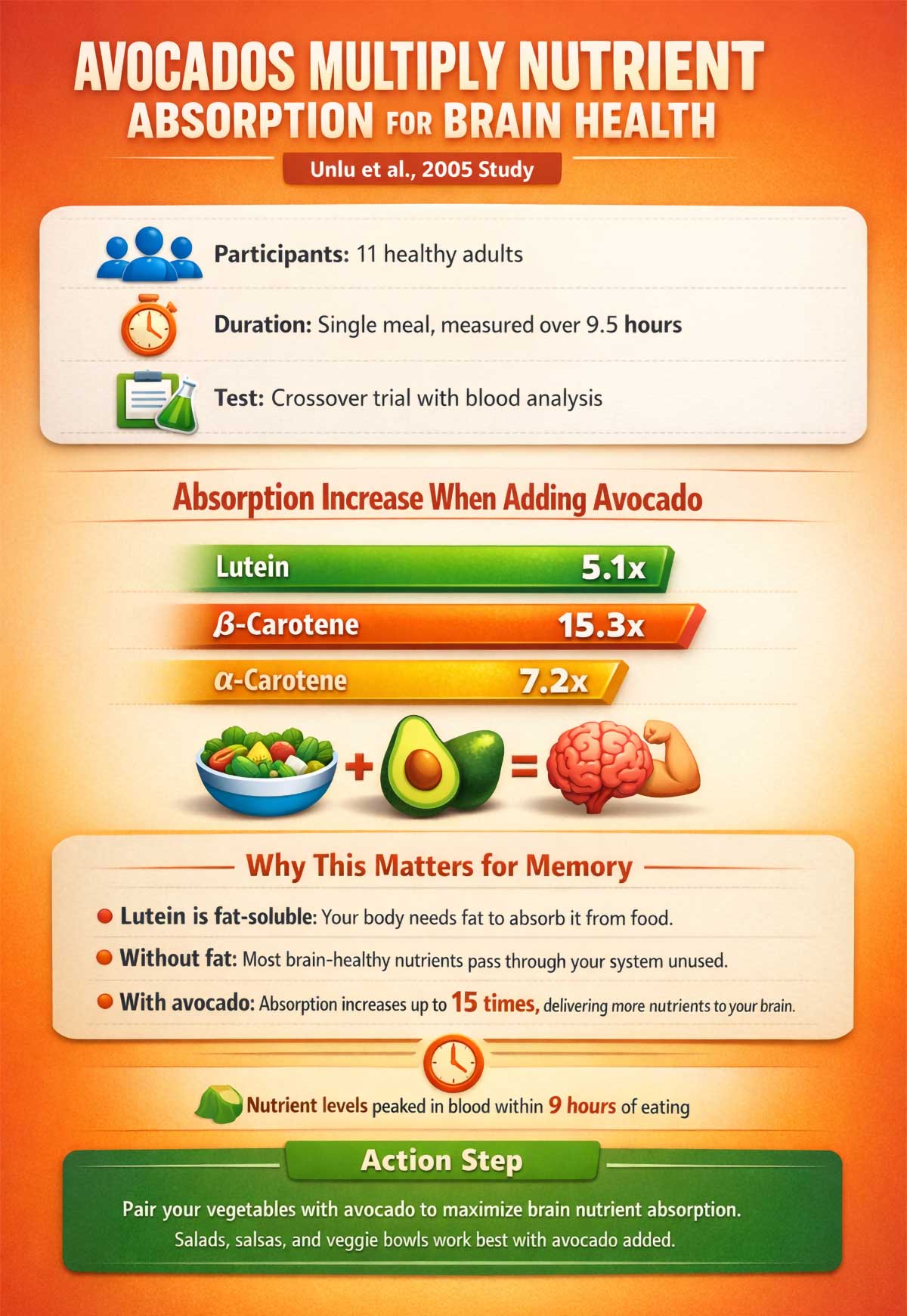
The healthy fats in avocados create what scientists call a “lipid matrix.” This fatty environment helps your intestines grab and transport carotenoids into your bloodstream. Within 9 hours of eating an avocado-rich meal, blood levels of these nutrients spike.
Think of it like this: lutein supplements are like trying to mail a letter without a stamp. The avocado provides the stamp, envelope, and express delivery all in one package.
Avocado vs. Lutein Supplement: Absorption Showdown
| Nutrient Source | Lutein Content | Absorption Rate | Additional Brain Nutrients | Cost per Serving | Convenience Score |
|---|---|---|---|---|---|
| Whole Avocado | 0.5 mg | High (enhanced by natural fats) | Folate, Vitamin E, healthy fats, fiber, B vitamins | $1.00-2.00 | Medium (requires prep) |
| Lutein Supplement Alone | 10-20 mg | Very Low (no fat present) | None | $0.15-0.30 | High (just swallow) |
| Lutein Supplement + Fat Source | 10-20 mg | Medium (depends on fat type) | Varies by fat source | $0.20-0.40 | Medium (need to pair) |
| Avocado + Colorful Vegetables | 1.5-3 mg total | Very High (synergistic effect) | Full spectrum of carotenoids, vitamins, minerals | $2.00-3.00 | Low (more prep needed) |
Sharper Focus for Older Adults
Let’s talk about what happens when people over 50 eat avocados daily for six months.
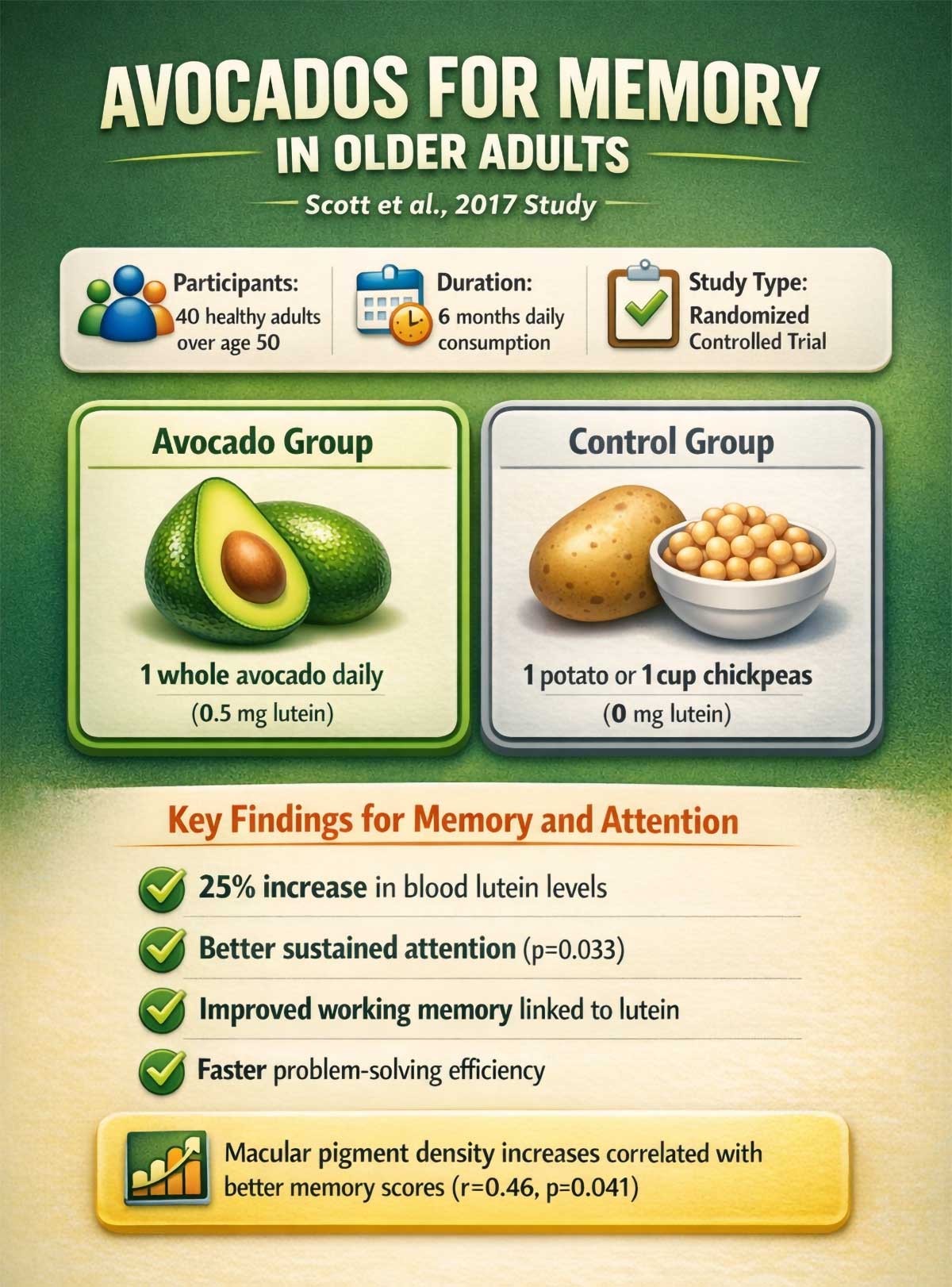
Researchers at Tufts University ran a study with 40 healthy older adults. Half ate one avocado per day. The other half ate either a potato or a cup of chickpeas daily. Both groups got the same calories, so any differences couldn’t be blamed on eating more or less food.
After six months, the avocado group showed something interesting. Their serum lutein levels rose by 25%. Their macular pigment density also increased significantly.
But did this translate to better brain function?
Yes, but in specific ways. The avocado group showed improved sustained attention. This is your ability to stay focused on a task without getting distracted. Think of it as mental stamina.
The study used computer tests to measure this. Participants had to respond to targets on a screen while ignoring distractions. The avocado eaters got better at filtering out the noise and staying locked in. The improvement reached statistical significance (p=0.033), meaning it wasn’t due to chance.
In real-world terms, this means better performance during long meetings, safer driving on long trips, and fewer errors when working on detailed tasks. You can read a book for longer without your mind wandering. You can follow conversations in noisy restaurants more easily.
There’s more. When researchers looked at macular pigment density and cognitive scores together, they found strong links. Higher pigment levels matched up with better working memory (r=0.46, p=0.041) and faster problem-solving (r=0.47, p=0.036).
Working memory is like your brain’s scratch pad. It’s what you use to hold information while you solve a problem. For older adults, this type of memory often declines. The avocado intervention seemed to slow or reverse this decline.
One important note: both groups improved on general memory tests. This suggests that some benefits came from practice, not just the avocados. The real avocado advantage showed up in attention and working memory linked to lutein increases.
The Attention Boost for Younger Adults
Brain health isn’t just for seniors. A 2020 study looked at what happens when younger adults with overweight eat avocados daily.
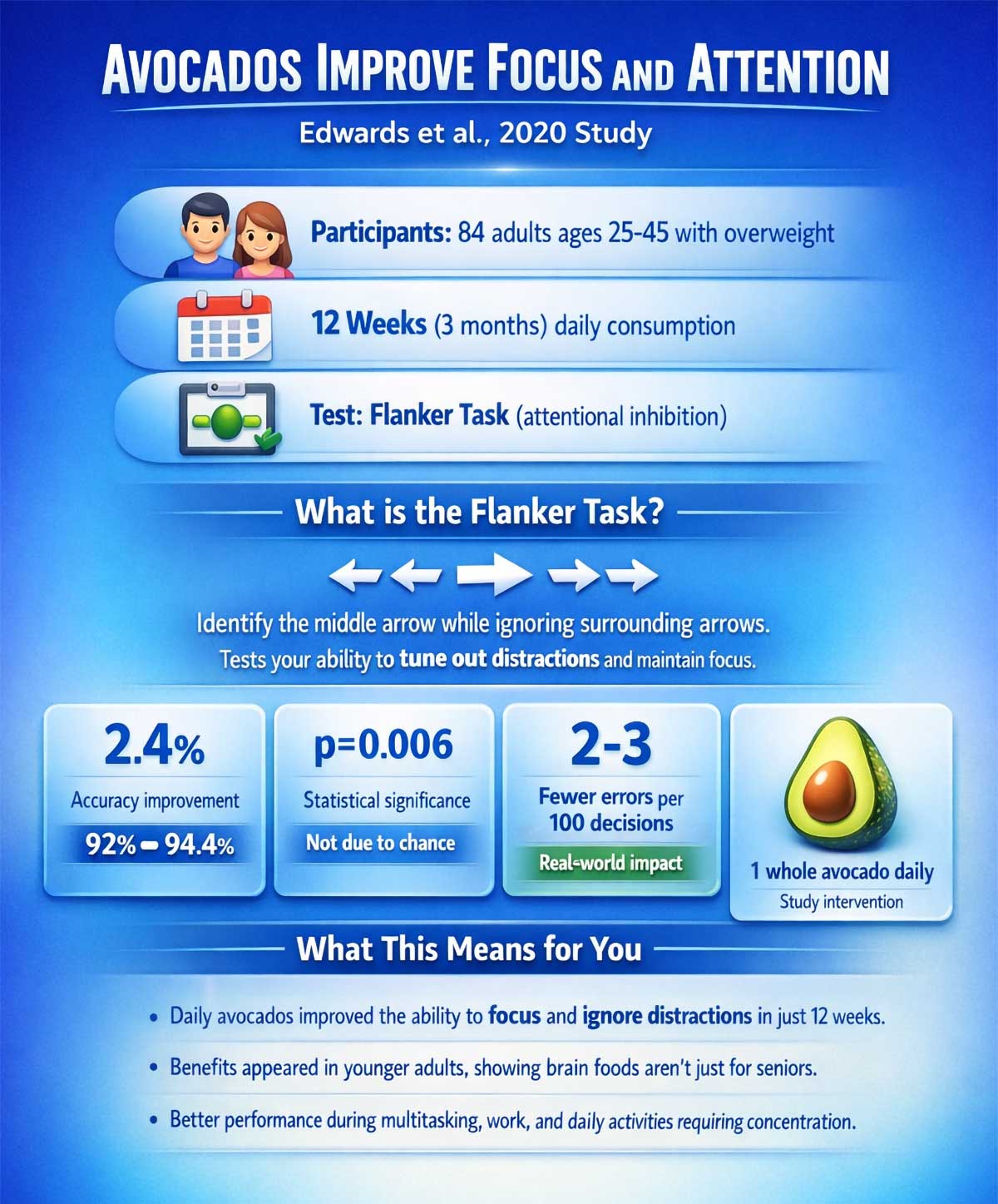
Researchers at the University of Illinois tested 84 people between ages 25 and 45. Half ate one avocado daily for 12 weeks. The other half ate a meal with the same calories but no avocado. The study was carefully controlled to isolate the avocado’s effects.
The test focused on something called attentional inhibition. This is your brain’s ability to tune out distractions and focus on what matters. Scientists measure it with the Flanker task.
In this test, you see arrows on a screen. Your job is to identify the direction of the middle arrow while ignoring the surrounding ones. It sounds easy, but it requires sharp mental control. When the surrounding arrows point in the opposite direction, your brain has to work harder to ignore them.
After 12 weeks, the avocado group improved their accuracy by 2.4%, moving from about 92% to 94.4% correct responses (p=0.006). That might seem small, but it represents about 2-3 fewer errors per 100 decisions. In real-world settings, this matters.
Better Flanker scores mean you can concentrate during phone calls even when coworkers are talking nearby. You make fewer mistakes when multitasking. You’re less likely to get distracted by your phone when trying to work. You can study more efficiently because random thoughts don’t derail your focus as easily.
Here’s the surprising part: the cognitive benefits showed up even though macular pigment density didn’t change significantly. The improvements happened faster than the physical changes in the eye. This tells us something important.
The brain benefits from avocados probably work through multiple pathways. The monounsaturated fats support brain cell membranes. The fiber stabilizes blood sugar, keeping your brain’s energy steady. The folate supports neurotransmitter production. You don’t have to wait for lutein to accumulate to feel sharper.
This matters for anyone juggling work deadlines, studying for exams, or trying to stay productive in our distraction-filled world. The 12-week timeline is achievable. You can feel the difference in three months.
Real-World Evidence: What Avocado Eaters Show Us
Clinical trials are great, but what about people eating avocados in their normal lives?
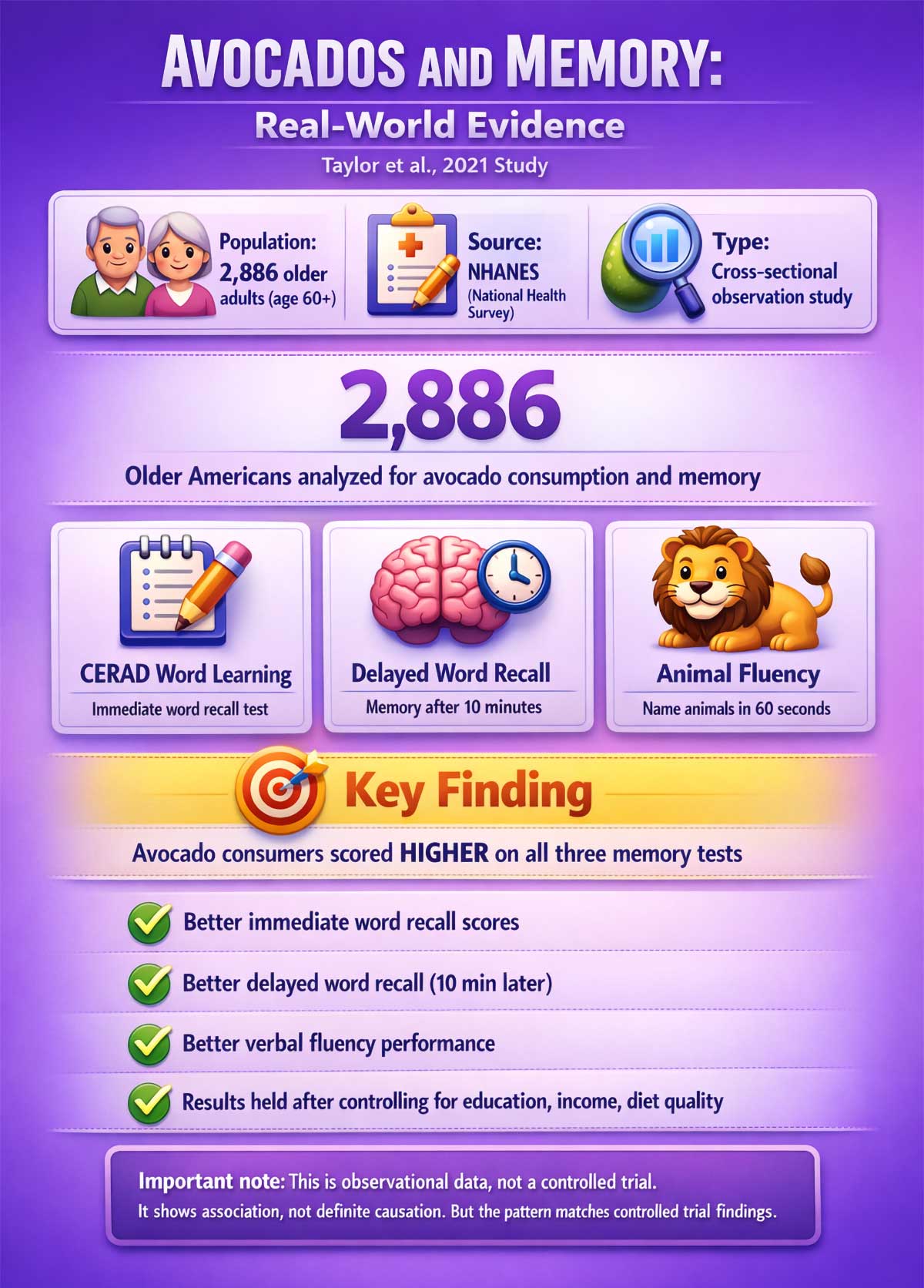
A 2021 study by Taylor and colleagues analyzed data from 2,886 older Americans (age 60 and up) who participated in the National Health and Nutrition Examination Survey. This wasn’t a controlled trial where researchers told people what to eat. Instead, researchers looked at people’s normal eating habits and cognitive test scores.
They compared avocado eaters to non-eaters using three standard memory tests that doctors and researchers use to screen for cognitive problems.
The CERAD Word Learning test checks how many words you can remember immediately after hearing them. You listen to a list of 10 words, then recall as many as you can. The test measures your brain’s ability to take in and store new information quickly.
The Delayed Word Recall test checks the same thing 10 minutes later. This measures whether information sticks in your memory or fades away quickly. It’s one of the earliest skills to decline in age-related memory loss.
The Animal Fluency test measures how many animals you can name in 60 seconds. This taps into semantic memory (your knowledge bank) and processing speed. It shows how quickly you can retrieve stored information.
Avocado consumers scored higher on all three tests. The effects were strongest for word recall, both immediate and delayed. Even after accounting for factors like education, income, overall diet quality, exercise habits, and health conditions, the avocado advantage remained.
The immediate recall scores showed avocado eaters remembering about one more word on average. The delayed recall showed similar patterns. These differences might sound small, but they’re clinically meaningful. On population screening tests, a one-point difference can separate normal aging from early cognitive decline.
This doesn’t prove that avocados cause better memory. People who eat avocados might have other healthy habits that researchers couldn’t fully account for. But it does show a consistent pattern that matches the clinical trial data.
The observational evidence suggests that regular avocado consumption over years, not just months, associates with better cognitive aging. It’s not about a short-term fix. It’s about long-term brain health.
What’s Actually in One Avocado?
Avocados don’t just deliver lutein. They provide a package of brain-supporting nutrients working together.
| Nutrient | Amount per Avocado | % Daily Value | Brain Health Role | Synergy Effect |
|---|---|---|---|---|
| Lutein | 0.5 mg | Not established | Protects neurons from oxidative damage, improves neural efficiency | Works with healthy fats for absorption |
| Monounsaturated Fat | 20g | Not established | Builds brain cell membranes, supports myelin, reduces inflammation | Enhances absorption of all fat-soluble vitamins |
| Folate | 163 mcg | 41% | Supports neurotransmitter synthesis, reduces homocysteine (brain toxin) | Works with B vitamins for methylation |
| Vitamin K | 42 mcg | 35% | Supports sphingolipid metabolism in brain, may protect against cognitive decline | Enhanced by healthy fats |
| Vitamin E | 4.2 mg | 21% | Antioxidant protection for brain lipids, supports cell signaling | Works synergistically with lutein |
| Fiber | 13.5g | 48% | Stabilizes blood sugar for steady brain energy, feeds gut bacteria that produce neurotransmitters | Slows sugar absorption from other foods |
| Potassium | 975 mg | 21% | Supports electrical signaling between neurons, regulates fluid balance | Works with sodium for nerve function |
| Magnesium | 58 mg | 14% | Supports synaptic plasticity, regulates stress response, aids sleep quality | Enhances vitamin D function |
| Vitamin B5 | 2 mg | 20% | Produces acetylcholine (learning and memory neurotransmitter) | Part of B-vitamin complex |
| Vitamin B6 | 0.5 mg | 25% | Produces serotonin, dopamine, GABA (mood and cognition regulators) | Works with folate and B12 |
The Fat Factor
Your brain is about 60% fat, and the quality of those fats matters. Healthy fats keep cell membranes flexible, which helps neurons communicate. The monounsaturated fats in avocados are the same type found in olive oil and linked to better brain aging in Mediterranean diet studies.
These fats also build myelin, the protective coating around nerve fibers that speeds up signal transmission. Think of myelin like insulation on electrical wires. Better insulation means faster, clearer signals.
The Folate Connection
Low folate levels are linked to memory problems and age-related cognitive decline. Folate helps your body break down homocysteine, an amino acid that damages blood vessels when levels get too high. High homocysteine is a risk factor for dementia.
One avocado provides about 41% of your daily folate needs. That’s more than most fruits and vegetables. The folate in whole foods is also better absorbed than folic acid in supplements.
The Fiber Advantage
The fiber in avocados helps stabilize blood sugar. This keeps your brain’s energy supply steady throughout the day. Your brain uses about 20% of your body’s energy, and it runs exclusively on glucose. Sharp blood sugar swings can impair concentration and memory.
The fiber also feeds beneficial gut bacteria. These bacteria produce compounds that communicate with your brain through the gut-brain axis. Some of these compounds are precursors to neurotransmitters that affect mood and cognition.
This multi-nutrient approach might explain why the benefits show up relatively quickly. You’re not just waiting for one compound to accumulate. You’re supporting your brain through several different pathways at once.
How Fast Your Brain Processes Information
Visual processing speed might sound technical, but it affects everything you do. It determines how quickly you can read, drive, react to changes, and process what you see.
A 2014 study by Bovier, Renzi, and Hammond tested whether lutein and zeaxanthin (another carotenoid found in avocados) could speed up visual processing. They recruited 92 young healthy adults ages 18 to 32 and randomly assigned them to three groups: zeaxanthin supplement (20mg daily), mixed carotenoid supplement (8mg lutein plus 26mg zeaxanthin plus omega-3s), or placebo. The study lasted four months and was double-blind, meaning neither participants nor researchers knew who got what until the end.
The supplement groups improved their critical flicker fusion thresholds by about 12%. This test measures how fast your brain can distinguish between separate flashes of light. Researchers show you a light that flickers faster and faster until it looks solid. Higher scores mean faster neural processing. The improvement was statistically significant compared to placebo.
They also improved visual-motor reaction time by about 10%. That’s the speed at which you can see something and physically respond to it. In practical terms, it’s the difference between hitting the brakes in time or not, catching a ball or missing it, typing quickly or hunting for keys.
The researchers found strong correlations between macular pigment density and these cognitive measures. For every unit increase in eye pigment, processing speed improved proportionally.
While this study used supplements rather than whole avocados, it shows that the carotenoids in avocados have direct effects on brain processing speed. Your brain uses lutein and zeaxanthin in areas responsible for processing visual information. More carotenoids mean more efficient signaling between neurons in these regions.
The four-month timeline is consistent with the other avocado studies. It takes time for these compounds to accumulate in your brain tissue, but once they do, the functional improvements are measurable and meaningful.
Your 6-Month Avocado Brain Journey: What to Expect Week by Week
If you start eating an avocado daily, what should you expect?
Based on the research, here’s a realistic timeline:
| Time Period | Physical Changes | Cognitive Changes You Might Notice | What’s Happening in Your Brain | Action Tips |
|---|---|---|---|---|
| Week 1-2 | Blood carotenoid levels start rising within hours of each meal | Possibly more stable energy, less afternoon brain fog | Fat-soluble nutrients being absorbed, blood sugar stabilizing, anti-inflammatory processes beginning | Track your baseline: note current focus ability, memory challenges, energy patterns |
| Week 3-4 | Carotenoids accumulating in tissues, slight increases in serum lutein detectable | May notice slightly better focus during demanding tasks | Neural membranes incorporating healthy fats, antioxidant protection starting, gut bacteria shifting | Pair avocados with colorful veggies to maximize benefits, stay consistent |
| Week 5-8 | Continued buildup in serum and tissue levels, body adjusting to new nutrient profile | Some people report clearer thinking, fewer “senior moments” | Lutein accumulating in visual processing centers, working memory circuits benefiting from folate | Keep a simple journal: note any changes in concentration, distractibility, word finding |
| Week 9-12 | Measurable changes in attentional control for younger adults | Improved ability to ignore distractions, fewer careless errors, better multitasking | Enhanced neural efficiency in attention networks, faster signal transmission | First checkpoint: compare current abilities to Week 1 baseline, adjust if needed |
| Month 4-5 | Macular pigment density beginning to increase, visual processing areas enriched | Processing speed improvements, quicker reactions, better sustained focus | Structural changes in retina and visual cortex, increased neural protection | Continue consistency, try challenging cognitive tasks to test improvements |
| Month 6 | Significant increases in lutein levels and macular pigment density for older adults | Working memory improvements, better problem-solving, enhanced word recall | Peak neural protection, optimal carotenoid concentrations in brain tissue | Second checkpoint: compare to baseline and Month 3, decide on long-term plan |
The dose matters too. Every study that found cognitive benefits used one whole avocado per day. That’s about 150-200 grams of fruit. Eating half an avocado or having guacamole once a week probably won’t produce the same results.
The effects seem to build over time. The longer you maintain the habit, the more your brain benefits. This isn’t a quick fix. It’s a gradual optimization of your brain’s hardware.
Tracking Your Progress
You can’t feel neurons accumulating lutein. But you can notice the functional changes that result.
Here are simple ways to track whether avocados are working for you:
Focus and Attention Metrics:
- Can you work for longer stretches without checking your phone?
- Do you finish tasks with fewer interruptions?
- Can you follow conversations in noisy environments more easily?
- Do you make fewer careless errors at work?
Memory Markers:
- Do you remember where you put your keys more consistently?
- Can you recall names after meeting someone once?
- Do you walk into rooms and remember why you went there?
- Can you follow multi-step instructions without re-checking?
Processing Speed Indicators:
- Do you read faster with the same comprehension?
- Can you respond to texts or emails more quickly?
- Do you feel less mentally sluggish in the afternoon?
- Can you switch between tasks more smoothly?
Self-Assessment Questions (Week 12 and Month 6):
- Rate your focus ability now vs. when you started (1-10 scale)
- Count how many times you got distracted during a 30-minute work session
- Try the animal naming test: how many animals can you name in 60 seconds? (Average is 15-20)
- Note your energy levels at 3 PM compared to when you started
Don’t expect overnight transformations. The studies showed benefits building gradually over weeks and months. If you notice even small improvements by 12 weeks, you’re likely on track. By six months, the effects should be more obvious.
If you don’t notice any changes by 12 weeks, consider these factors: Are you eating a whole avocado daily? Are you pairing it with other healthy foods? Are you getting enough sleep? Are you managing stress? These factors all influence whether dietary changes translate to cognitive improvements.
Making Avocados Work Harder
You can boost the cognitive benefits by pairing avocados with the right foods.
Remember that 2005 study about nutrient absorption? It showed that avocados help you absorb carotenoids from other foods. When you eat an avocado with a salad, you absorb more lutein from the leafy greens. The same goes for tomatoes, carrots, and peppers.
The mechanism is simple. Carotenoids dissolve in fat. When you eat vegetables without fat, the carotenoids pass through your digestive system mostly unabsorbed. The fat from avocado creates tiny droplets called micelles that carry carotenoids across your intestinal wall.
Foods highest in brain-supporting carotenoids include:
- Spinach and kale (lutein and zeaxanthin)
- Sweet potatoes (beta-carotene)
- Tomatoes (lycopene)
- Red and orange peppers (multiple carotenoids)
- Carrots (alpha and beta-carotene)
- Broccoli (lutein)
Meal Timing Strategy:
Some research suggests that eating avocados at breakfast provides more stable energy and better focus throughout the morning. The combination of healthy fats, fiber, and protein (if paired with eggs) keeps blood sugar steady during peak cognitive demand hours.
Eating avocados at lunch can prevent the afternoon slump. The fiber slows digestion of other foods, preventing the blood sugar spike and crash that leads to 3 PM brain fog.
There’s no strong evidence that timing matters more than consistency. Pick the meal that makes daily avocado consumption easiest to maintain.
Raw vs. Cooked:
Heat doesn’t significantly damage lutein or monounsaturated fats in avocados. You can add avocado to warm dishes without losing benefits. But high heat (grilling, roasting) for extended periods might reduce some antioxidant content.
For maximum benefit, eat most of your avocados raw or lightly warmed. Save the cooking oil for other purposes.
What About Avocado Oil?
Avocado oil contains the same healthy fats as whole avocados. It’s great for cooking and provides cardiovascular benefits. But it doesn’t contain lutein, folate, fiber, or most other brain-supporting nutrients. The oil is extracted, leaving behind the compounds that make whole avocados special for cognition.
Use avocado oil in your cooking, but don’t count it as your daily avocado serving for brain health.
Brain-Boosting Avocado Recipes
These recipes combine avocados with other cognitive-supporting foods. Each one provides multiple brain nutrients in one meal.
Focus-Fuel Breakfast Bowl
Prep time: 10 minutes
Serves: 1
Ingredients:
- 1 whole avocado, sliced
- 2 eggs (scrambled or fried)
- 1 cup fresh spinach
- 1/2 cup blueberries
- 2 tablespoons pumpkin seeds
- 1 tablespoon olive oil
- Salt, pepper, red pepper flakes to taste
Instructions:
- Heat olive oil in a pan over medium heat.
- Wilt spinach for 2 minutes, then push to the side.
- Cook eggs to your preference in the same pan.
- Arrange spinach and eggs in a bowl.
- Top with sliced avocado, blueberries, and pumpkin seeds.
- Season with salt, pepper, and red pepper flakes.
Why this combination works: Eggs provide choline, a building block for acetylcholine (the memory neurotransmitter). Spinach adds extra lutein. Blueberries contribute anthocyanins that protect brain cells. Pumpkin seeds provide zinc and magnesium for synaptic function. The avocado fat helps you absorb all the fat-soluble nutrients.
Brain nutrients per serving: Approximately 1.2 mg lutein, 20g healthy fats, 300 mg choline, 250 mg omega-3s, high antioxidant content.
Memory-Boost Lunch Salad
Prep time: 12 minutes
Serves: 1
Ingredients:
- 1 whole avocado, cubed
- 3 cups mixed greens (arugula, spinach, kale)
- 4 oz grilled salmon or canned wild salmon
- 1/4 cup cherry tomatoes, halved
- 1/4 cup shredded carrots
- 1/4 cup red bell pepper, chopped
- 2 tablespoons pepitas (pumpkin seeds)
- Lemon juice, salt, pepper
Instructions:
- Arrange mixed greens in a large bowl.
- Top with salmon, avocado cubes, tomatoes, carrots, and peppers.
- Sprinkle pepitas on top.
- Squeeze fresh lemon juice over everything.
- Season with salt and pepper.
- Toss gently before eating.
Why this combination works: Salmon provides DHA and EPA omega-3 fatty acids that support brain structure and reduce inflammation. The mixed greens contribute multiple forms of lutein and zeaxanthin. Colorful vegetables add a spectrum of carotenoids. Pepitas provide zinc for neurotransmitter function. The avocado maximizes absorption of all fat-soluble nutrients.
Brain nutrients per serving: Approximately 2.5 mg lutein, 1,500 mg omega-3s (from salmon), 25g healthy fats, high folate, B vitamins, and antioxidants.
Attention-Sharpening Smoothie
Prep time: 5 minutes
Serves: 1
Ingredients:
- 1/2 whole avocado
- 1 cup fresh or frozen blueberries
- 1 cup kale or spinach
- 1/4 cup walnuts
- 1 cup unsweetened almond milk
- 1 tablespoon ground flaxseed
- 1 teaspoon honey (optional)
- Ice cubes
Instructions:
- Add all ingredients to a blender.
- Blend on high for 60-90 seconds until smooth.
- Add ice for desired consistency.
- Drink immediately for best nutrient preservation.
Why this combination works: The avocado makes the smoothie creamy while providing healthy fats for nutrient absorption. Blueberries contribute anthocyanins that cross the blood-brain barrier. Leafy greens add lutein and folate. Walnuts and flaxseed provide plant-based omega-3s (ALA). The combination delivers sustained energy without blood sugar spikes.
Brain nutrients per serving: Approximately 1 mg lutein, 15g healthy fats, 2,000 mg omega-3s (ALA), high antioxidants, 80 mcg folate.
Quick Brain-Health Snack
Prep time: 3 minutes
Serves: 1
Ingredients:
- 1 whole avocado
- 1 medium tomato, diced
- 2 tablespoons hemp seeds
- 1 slice whole grain sourdough, toasted
- Lime juice, salt, red pepper flakes
Instructions:
- Mash avocado with a fork in a small bowl.
- Mix in diced tomato.
- Add lime juice, salt, and red pepper flakes to taste.
- Spread mixture on toasted bread.
- Sprinkle hemp seeds on top.
Why this combination works: Tomatoes provide lycopene, another carotenoid with neuroprotective effects. Hemp seeds contribute complete protein, magnesium, and omega-3s. Whole grain bread provides B vitamins and sustained glucose release. The combination is fast to prepare and easy to eat regularly.
Brain nutrients per serving: Approximately 0.8 mg lutein, 22g healthy fats, 10g complete protein, 1,000 mg omega-3s, high lycopene.
How to Select, Store, and Prep Avocados for Maximum Benefits
Getting avocados into your daily routine requires some practical knowledge.
Choosing Ripe Avocados:
Hold the avocado in your palm and squeeze gently. Don’t poke it with your finger, as this causes bruising.
- Too hard: Rock solid. Needs 4-5 days to ripen at room temperature.
- Almost ready: Yields slightly to pressure. Needs 1-2 days.
- Perfect: Yields to gentle pressure but not mushy. Ready to eat today.
- Too ripe: Feels very soft or mushy. May be brown inside.
For daily consumption, buy a mix of ripeness levels. Get 2-3 ready to eat now, 2-3 that need a few days, and 2-3 that are still hard.
Ripening Timeline:
Avocados ripen faster at room temperature, slower in the refrigerator. To speed ripening, place avocados in a paper bag with a banana or apple. These fruits release ethylene gas that triggers ripening. Check daily.
Hard avocados typically take 4-5 days to ripen. Once ripe, they stay at peak quality for about 2 days at room temperature or up to a week in the refrigerator.
Storage Tips to Prevent Waste:
Store unripe avocados on the counter away from direct sunlight. Once ripe, move them to the refrigerator to slow further ripening. This extends their usable life by several days.
If you cut an avocado and don’t eat all of it, leave the pit in the unused half. Brush the exposed flesh with lemon or lime juice. Wrap tightly in plastic wrap, pressing it directly against the flesh to exclude air. Store in the refrigerator for up to 2 days.
Preventing Browning:
Avocado flesh browns when exposed to air due to enzyme reactions. Citrus juice (lemon, lime) slows this by lowering pH and adding antioxidants. Keeping the pit in contact with the flesh also helps by limiting air exposure.
For cut avocado in salads or recipes, add a squeeze of citrus juice and toss. The browning is cosmetic, not a sign of spoilage. Brown avocado is still safe to eat.
Freezing Guidance for Convenience:
Freezing changes avocado texture, making it less appealing for slicing. But frozen avocado works perfectly in smoothies, mashed preparations, or cooked dishes.
To freeze: Mash the avocado with a tablespoon of lemon juice. Divide into single-serving portions (about 1/2 to 1 cup). Store in airtight containers or freezer bags. Label with the date. Use within 4-6 months.
Thaw in the refrigerator overnight or at room temperature for a few hours. Stir well before using, as water may separate during freezing.
Cost-Saving Strategies:
Avocados can be expensive, especially if you’re eating one daily. Here are ways to reduce costs:
Buy in bulk when on sale. Avocados at different ripeness levels store well if managed properly.
Consider joining a warehouse club (Costco, Sam’s Club) if you have one nearby. The per-avocado cost drops significantly in larger bags.
Look for “ugly” avocados or smaller sizes. Cosmetic imperfections don’t affect nutritional value. Smaller avocados cost less but still provide substantial cognitive benefits.
Buy seasonally. Avocados are cheapest from February through September when supply peaks. Prices often double in winter months.
Grow your own if you live in USDA zones 9-11. Avocado trees take 3-5 years to produce fruit, but then yield dozens of avocados annually.
Compare conventional vs. organic. Avocados have thick skins that protect the flesh from pesticides. They consistently rank on the “Clean 15” list of produce with lowest pesticide residues. Conventional avocados are fine for most people.
At an average cost of $1.50 per avocado, daily consumption costs about $45 per month. Compare this to cognitive supplements ($20-50 monthly) that lack the full nutrient spectrum and the additional health benefits avocados provide.
What the Studies Didn’t Test
Science is powerful, but it has limits. Here’s what we don’t know about avocados and cognition:
Effects in people with diagnosed cognitive impairment: The studies included healthy adults. We don’t have controlled trial data for people with mild cognitive impairment, early Alzheimer’s, or vascular dementia. Observational studies hint that healthy dietary patterns might slow progression, but we need specific research.
Benefits for athletes or students during high-demand periods: The studies measured baseline cognitive function, not performance under stress or during intense mental work. We don’t know if avocados help you study better for exams or perform better in competitions.
Interaction with medications: Avocados contain vitamin K, which can interfere with blood thinners like warfarin. They’re high in potassium, which matters for people with kidney disease or on certain medications. Always tell your doctor about dietary changes if you take prescription medications.
Effects when combined with other nootropics: Many people use caffeine, L-theanine, creatine, or other cognitive enhancers. No studies have tested whether avocados work synergistically with these compounds or whether combinations provide added benefits.
Long-term effects beyond 6 months: The longest controlled trial was six months. Do benefits continue to increase beyond that point? Do they plateau? Do they require ongoing consumption or create lasting changes? We don’t know.
Optimal avocado varieties: Most US studies likely used Hass avocados, the most common variety. Other varieties (Fuerte, Reed, Pinkerton) have slightly different nutrient profiles. Whether these differences matter for cognition is unknown.
Dose-response relationship: Studies tested one avocado daily. Would half an avocado provide half the benefits? Would two avocados provide double the benefits? The dose-response curve hasn’t been mapped.
These gaps don’t invalidate what we do know. They simply remind us that science is ongoing. The evidence we have is solid. But there’s always more to learn.
Who Should Be Cautious?
Avocados are safe for most people. But some individuals need to consider potential issues:
Latex-Fruit Allergy Cross-Reactivity:
People allergic to latex are often allergic to certain fruits including avocados, bananas, and kiwis. This happens because latex and these fruits share similar proteins. If you have latex allergy and experience itching, swelling, or hives after eating avocado, you may have cross-reactivity. Talk to an allergist before consuming avocados regularly.
Warfarin and Blood Thinner Interactions:
Avocados contain vitamin K, which helps blood clot. If you take warfarin (Coumadin) or similar blood thinners, vitamin K can reduce medication effectiveness. You don’t have to avoid avocados completely, but maintain consistent intake. Don’t suddenly start eating a daily avocado without telling your doctor. Inconsistent vitamin K intake makes it harder to manage medication dosing.
Low FODMAP Diets:
Some people with irritable bowel syndrome follow low FODMAP diets. Avocados contain polyols, a type of FODMAP. Small portions (1/8 avocado) are usually tolerated, but whole avocados may trigger symptoms in sensitive individuals. If following a low FODMAP diet, work with a dietitian to determine your tolerance.
Kidney Disease Considerations:
Avocados are high in potassium. People with advanced kidney disease often need to limit potassium intake because damaged kidneys can’t remove excess efficiently. High potassium can cause dangerous heart rhythm problems. If you have chronic kidney disease, ask your doctor or renal dietitian whether daily avocados fit your meal plan.
Calorie Concerns for Weight Management:
One avocado provides about 240 calories. If weight loss is your goal, these calories need to replace other foods, not add to your total intake. The studies that found cognitive benefits used isocaloric diets, meaning avocado calories replaced other calories. Don’t just add avocados on top of your current diet and expect weight loss.
When to Consult a Doctor First:
Talk to your healthcare provider before starting daily avocado consumption if you:
- Take warfarin or other blood thinners
- Have chronic kidney disease
- Have severe IBS or digestive disorders
- Are allergic to latex
- Take medications that interact with vitamin K
- Have concerns about calorie intake
For most healthy adults, avocados are safe and beneficial. But individual health conditions matter. When in doubt, ask a professional.
Is the Daily Avocado Worth It? Breaking Down the Numbers
Let’s look at the practical investment required for this dietary change.
Monthly Financial Investment:
At average prices:
- Budget option (conventional, bulk buying): $30-35 per month
- Mid-range option (conventional, regular store): $45-50 per month
- Premium option (organic): $60-75 per month
Monthly Cost of Alternative Approaches:
Cognitive supplements attempting similar benefits:
- Lutein supplement (20mg): $15-20
- Omega-3 fish oil: $20-30
- B-complex vitamins: $12-18
- Vitamin E: $10-15
- Multi-nutrient “brain formula”: $40-80
Total supplement approach: $50-90 monthly, without providing fiber, whole-food benefits, or guaranteed absorption.
Time Investment:
Daily prep time: 3-5 minutes
- Cutting an avocado: 1 minute
- Incorporating into meal: 2-4 minutes
- Cleanup: 1 minute
Monthly time investment: 90-150 minutes (1.5 to 2.5 hours)
Compare to supplement routine: 1-2 minutes daily (opening bottles, swallowing pills), but without meal satisfaction or food enjoyment.
Calorie Trade-Off:
One avocado adds 240 calories and 22g fat to your daily intake. To maintain weight, you need to reduce something else:
Replace these with one avocado:
- 2 tablespoons salad dressing (saves money, adds nutrients)
- 3 tablespoons peanut butter
- 1/3 cup nuts
- 2 tablespoons mayo plus 1 tablespoon butter
The trade is favorable because avocado provides more nutrients per calorie than these alternatives.
Long-Term Value:
If daily avocados help you maintain cognitive function, the value extends beyond monthly costs. Consider the alternative costs:
Cognitive decline can lead to:
- Reduced work productivity: potentially thousands in lost earnings
- Medical appointments and testing: $500-2,000 annually
- Medications if decline progresses: $1,000-5,000 annually
- Eventual care needs: $50,000+ annually for assisted living
Prevention has enormous economic value. Spending $360-600 annually on a dietary intervention with proven cognitive benefits is a tiny investment compared to managing cognitive decline.
Non-Financial Returns:
Money isn’t the only currency. Consider:
- Increased confidence in your mental abilities
- Better work performance and potentially career advancement
- Stronger relationships due to better communication and memory
- Greater independence as you age
- Reduced anxiety about cognitive decline
- Overall better health (heart, digestion, inflammation)
These benefits are hard to quantify but contribute significantly to quality of life.
The Verdict:
For most people spending $30-60 monthly on a dietary change that improves cognitive function, provides additional health benefits, and may prevent future cognitive decline is worthwhile. The investment is comparable to cognitive supplements but provides better absorption, more nutrients, and actual food enjoyment.
If budget is tight, buy conventional avocados in bulk, purchase only when on sale, or eat them 4-5 days per week instead of 7. Some avocado is better than none.
How Avocados Stack Up Against Other Brain Foods
Avocados aren’t the only food that supports cognitive function. How do they compare to other popular brain foods?
Avocados vs. Blueberries:
Blueberries provide anthocyanins, powerful antioxidants that cross the blood-brain barrier and accumulate in brain regions responsible for learning and memory. Multiple studies show improved memory with daily blueberry consumption.
Advantages of blueberries: Lower calorie (85 vs 240 per serving), stronger antioxidant profile, more direct evidence for memory specifically.
Advantages of avocados: Provide healthy fats needed for nutrient absorption and brain structure, more fiber, better folate source, help you absorb nutrients from other foods.
Winner: Tie. They work through different mechanisms. Eat both.
Avocados vs. Fatty Fish (Salmon, Mackerel, Sardines):
Fatty fish provide EPA and DHA omega-3s, the forms most directly used by your brain. Fish omega-3s have stronger evidence for cognitive benefits than plant sources. They reduce brain inflammation and support cell membranes.
Advantages of fish: Higher quality omega-3 fats, complete protein, vitamin D, selenium.
Advantages of avocados: No mercury or contaminant concerns, suitable for vegetarians, fiber, easier to eat daily, less expensive per serving.
Winner: Fatty fish has stronger cognitive evidence, but avocados are more practical for daily consumption. Eat fatty fish 2-3 times weekly, avocados daily.
Avocados vs. Walnuts:
Walnuts provide ALA omega-3s, polyphenols, and vitamin E. Studies link walnut consumption to better cognitive function and slower age-related decline. They’re more concentrated than avocados (28g serving vs 200g serving).
Advantages of walnuts: More portable, longer shelf life, more concentrated nutrients, higher omega-3 content per weight.
Advantages of avocados: More satisfying as a food, broader nutrient profile, better fiber source, unique lutein delivery system.
Winner: Tie. Walnuts are better snacks. Avocados are better meal components. Eat both.
Avocados vs. Dark Leafy Greens (Spinach, Kale):
Leafy greens provide lutein, folate, vitamin K, and numerous antioxidants. They’re the richest lutein sources in the diet. Studies link leafy green consumption to slower cognitive decline.
Advantages of leafy greens: Higher lutein content per calorie, more vitamins and minerals, extremely low calorie, less expensive.
Advantages of avocados: The fat needed to absorb lutein from greens, more filling, easier for some people to eat daily, additional healthy fats.
Winner: They’re synergistic, not competitive. Eat them together. The avocado helps you absorb nutrients from the greens. One without the other is less effective.
The Synergy Principle:
Your brain needs diverse nutrients from multiple sources. No single food provides everything. The Mediterranean diet works because it combines multiple brain-supporting foods: fatty fish, olive oil, nuts, leafy greens, berries, and yes, avocados.
Don’t choose between brain foods. Build meals that combine them:
- Breakfast: Eggs with avocado and spinach
- Lunch: Salmon salad with avocado and mixed greens
- Snack: Walnuts and blueberries
- Dinner: Grilled fish with roasted vegetables drizzled with olive oil
This approach provides omega-3s (fish), lutein (greens and avocado), anthocyanins (berries), vitamin E (nuts), and healthy fats to absorb everything. The whole is greater than the sum of parts.
Conclusion
Can daily avocado consumption improve your cognitive function? Yes, but with important caveats.
The evidence shows that eating one avocado per day for at least 12 weeks can improve attention and focus. After six months, benefits extend to working memory and sustained attention, especially in older adults. The effects are real, measured in controlled clinical trials, and consistent across multiple studies.
These improvements are modest but meaningful. Don’t expect to become a genius overnight. Think of avocados as a tool that gives you a small but consistent edge. That edge compounds over time. Better focus means fewer errors at work. Better attention means safer driving. Better working memory means easier problem-solving. These small advantages add up to a better quality of life.
The benefits seem to come from multiple mechanisms working together. Lutein accumulates in your brain and protects neurons from oxidative damage. The healthy fats support brain cell membranes and myelin. The fiber stabilizes blood sugar, providing steady energy to your brain. The folate supports neurotransmitter production. The complete nutrient package creates effects that isolated supplements can’t match.
One avocado per day is the research-backed dose. The studies didn’t test smaller amounts, so we don’t know if half an avocado provides half the benefits. If you want results consistent with the research, eat a whole avocado daily. That’s about 150-200 grams of fruit, providing 0.5 mg lutein, 20g healthy fats, and a full spectrum of brain-supporting nutrients.
Pair your avocados with colorful vegetables to maximize nutrient absorption. The studies that measured carotenoid uptake showed that avocados increase absorption from other foods by 5 to 15 times. Eat your daily avocado with spinach, tomatoes, peppers, and other produce. This combination delivers more brain nutrients than eating foods separately.
Make avocados part of a balanced diet, not a replacement for other healthy foods. The research shows benefits when avocados replace less healthy foods, not when they’re simply added on top. If you’re eating an avocado daily, you might cut back on salad dressing, mayo, or less nutritious snacks. The calorie trade should be strategic.
Give the intervention at least 12 weeks before deciding if it works for you. The Edwards study showed attention benefits by that point in younger adults. For older adults or for working memory benefits, commit to six months. Track your focus, attention, and memory informally. Do you feel sharper? Can you concentrate longer? Are you making fewer mistakes?
The research suggests you probably will notice improvements. Your brain will thank you for the sustained supply of protective nutrients.
If you’re serious about long-term brain health, daily avocados are a practical, evidence-based strategy. They’re not magic. They’re not a cure for dementia. They’re not a substitute for sleep, exercise, stress management, or social connection. But they’re a solid piece of the brain health puzzle, backed by rigorous science and achievable for most people.
Start tomorrow. Buy a week’s worth of avocados at different ripeness levels. Add one to your breakfast or lunch. Keep it simple at first. Once the habit sticks, experiment with the recipes and combinations in this guide.
FAQs
Can I eat too much avocado for brain health?
The cognitive studies used one avocado daily. No research has tested whether more is better. One avocado provides about 240 calories and 22 grams of fat. While these are healthy calories and fats, they still count toward your total intake.
Eating multiple avocados daily could lead to excessive calorie consumption if you’re not reducing other foods accordingly. For most people, one per day provides optimal benefits without overdoing calories.
There’s no evidence of toxicity or harm from eating avocados daily. The only concern is calorie balance and dietary variety. Don’t let avocados crowd out other important foods.
Will frozen or pre-packaged guacamole work?
Frozen plain avocado works fine for brain health. The freezing process doesn’t destroy lutein, healthy fats, or most other nutrients. Use frozen avocado in smoothies, mashed preparations, or cooked dishes.
Pre-packaged guacamole is trickier. Check the ingredient list. Many commercial guacamoles contain more fillers (sour cream, mayo) than avocado. Look for products listing avocado as the first ingredient with minimal additives.
Some pre-made guacamoles contain preservatives to prevent browning. While these are generally safe, whole avocados provide the full nutrient profile without additives.
The convenience of pre-made products might help you maintain consistency, which matters more than perfection. A frozen avocado eaten daily beats fresh avocados eaten sporadically.
What if I don’t like avocados? Are there alternatives?
No single food replicates avocado’s complete nutrient package. But you can approximate the benefits:
For lutein: Eat cooked spinach or kale with olive oil (fat for absorption). Cook 1 cup of spinach, which concentrates lutein. Add a tablespoon of olive oil.
For healthy fats: Use extra virgin olive oil, eat fatty fish (salmon, mackerel), or consume nuts and seeds. These provide similar monounsaturated or omega-3 fats.
For folate: Eat lentils, beans, fortified grains, or leafy greens. Many foods provide good folate.
For the complete combination: You’d need to eat leafy greens with olive oil, plus fatty fish, plus high-folate foods, plus high-fiber foods. It’s doable but less convenient than one avocado.
Some people dislike avocado’s texture but tolerate it blended in smoothies where you don’t notice it. Try starting there.
Can avocados help with brain fog?
Brain fog isn’t a medical diagnosis, but people use it to describe fuzzy thinking, poor concentration, and mental fatigue. Several mechanisms suggest avocados might help:
The fiber and healthy fats stabilize blood sugar, preventing energy crashes that worsen brain fog. The B vitamins support neurotransmitter production. The antioxidants reduce inflammation that might contribute to cognitive sluggishness.
If your brain fog stems from poor diet, inadequate healthy fats, or nutrient deficiencies, avocados might improve it within a few weeks. If it stems from poor sleep, chronic stress, or medical conditions, diet alone won’t fix it.
Pay attention to the Week 3-4 mark in the timeline. That’s when some people report clearer thinking and less afternoon mental slugginess.
Do I need to eat avocados at a specific time of day?
The research doesn’t specify timing. Studies had participants eat avocados with meals but didn’t control which meal.
Eating avocados at breakfast might provide better morning focus by stabilizing blood sugar from the start of your day. Eating them at lunch might prevent afternoon energy crashes.
The most important factor is consistency. Pick the meal where you’re most likely to eat an avocado every single day. For many people, that’s breakfast or lunch rather than dinner.
Will avocados help if I already have memory problems?
The studies tested healthy adults without diagnosed cognitive impairment. We don’t know if avocados help people with mild cognitive impairment, Alzheimer’s disease, or other forms of dementia.
That said, the mechanisms (antioxidant protection, healthy fats, folate) are relevant to brain health at all stages. The Mediterranean diet, which includes avocados, associates with lower dementia risk in large population studies.
If you have diagnosed memory problems, talk to your doctor before using diet as an intervention. Avocados are unlikely to harm, but they shouldn’t replace medical treatment. They might be a helpful addition to your overall care plan.
How much does one avocado cost vs. cognitive supplements?
Avocado costs vary by location and season. National averages:
Conventional avocado: $1.00-2.00 each
Organic avocado: $2.00-3.00 each
Bulk/warehouse club: $0.75-1.25 each
Monthly cost for daily avocados: $30-60
Cognitive supplement costs:
Basic lutein supplement: $10-20 per month
Fish oil omega-3: $15-30 per month
B-complex vitamins: $10-15 per month
Multi-ingredient “brain supplement”: $30-70 per month
If you tried to replicate avocado’s benefits with supplements, you’d need lutein, omega-3s (or take separately), B-vitamins, vitamin E, and fiber. The total would cost $40-80 monthly and still wouldn’t include all the beneficial compounds in whole food.
Avocados provide better value when you consider the full nutrient profile, lack of processing, and additional health benefits (heart health, digestion, inflammation).
Can children eat avocados for brain development?
Avocados are excellent foods for children. They provide healthy fats needed for brain growth, fiber for digestion, and nutrients that support development.
Babies can start eating mashed avocado around 6 months when starting solids. The soft texture and mild flavor make it ideal for early eaters. The healthy fats support myelin development during critical brain growth periods.
No studies have tested daily avocado consumption specifically for cognitive development in children. But the nutrients in avocados support healthy brain maturation. Children don’t need a whole avocado daily. Serving sizes should match their age and appetite.
For toddlers: 1/4 to 1/2 avocado per day
For school-age children: 1/2 to 3/4 avocado per day
For teenagers: 3/4 to 1 whole avocado per day
Children’s brains are still developing, making nutrient intake especially important. Avocados provide building blocks for cognitive growth.