You’ve probably experienced several of these body quirks for years without knowing what they’re called, why they happen, or when they matter.
Something happens between waking and sleep. The muscles soften, the breath slows, and the brain begins to let go. Then a jolt fires through the body. Arms tense. Eyes open. The heart strikes once against the ribs. Fully awake, with nothing genuinely wrong.
Nothing was ever wrong. That jolt has a name. So does the growl that the stomach makes in a quiet meeting, the chill from a piece of music that half the people nearby cannot seem to feel, the tingling that settles into a leg after twenty minutes in the wrong position, the specks drifting across a bright afternoon sky. These are not glitches. They are named, studied biological events with established mechanisms, and, in most cases, a satisfyingly plain explanation.
Most of them are entirely normal. One of them is not. That distinction is worth knowing.
Which of These Do You Experience?
Check every sensation you recognize. You may be surprised how many have names.
1. The Sleep Jolt: Hypnic Jerk
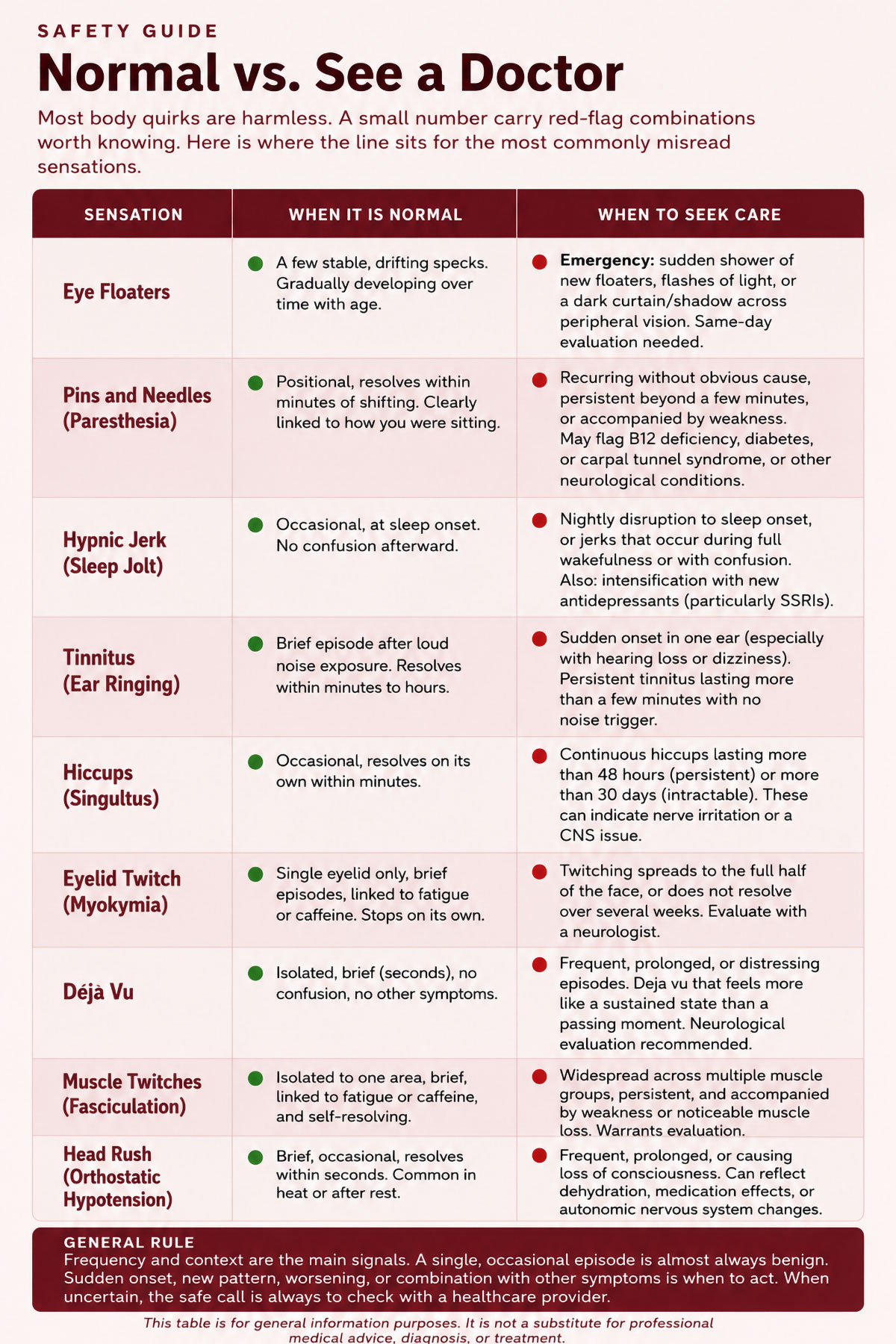
That jolt is called a hypnic jerk, also known as a hypnagogic jerk or sleep start. More technically, it is a form of sleep myoclonus, the category for involuntary muscle movements that occur during or around sleep. According to the Sleep Foundation, roughly seven in ten people experience it at least occasionally. Most of them assume something went wrong.
During the transition from wakefulness to Stage 1 sleep, the brain sometimes interprets the normal relaxation of muscles as a falling sensation. The reticular brainstem sends a corrective signal. The muscles contract. You jolt awake.
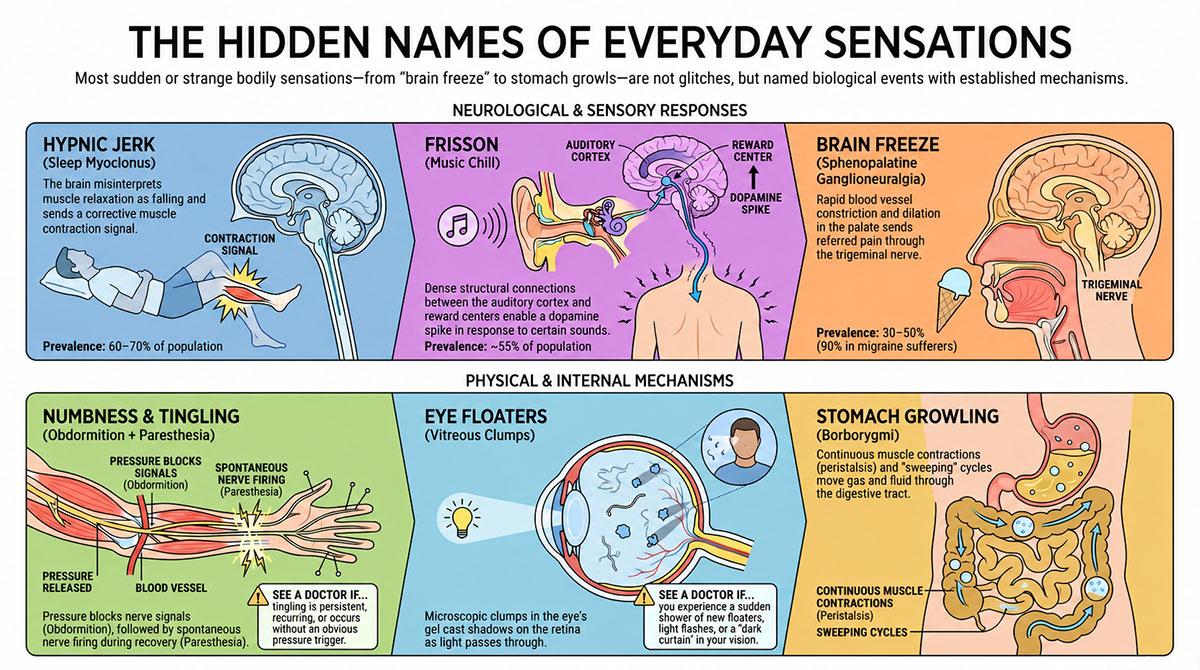
Occasional hypnic jerks need no treatment. Caffeine, poor sleep, stress, and vigorous exercise close to bedtime are established triggers. The Cleveland Clinic notes that certain antidepressants, particularly SSRIs, can increase their frequency in some people. If hypnic jerks are occurring nightly and disrupting sleep, that is worth discussing with a doctor.
2. The Limb That Falls Asleep: Obdormition and Paresthesia
When a limb falls asleep, two separate things are happening, and they have two distinct names.
The first phase is called obdormition (ob-dor-MISH-on), from the Latin obdormire, meaning “to fall asleep.” This is the numbness itself: the heavy, dead quality that settles into an arm or leg when sustained pressure blocks nerve signals from reaching the brain. The second phase, the tingling that follows when you shift and the pressure releases, is called paresthesia (par-es-THEE-zhuh).
According to the Cleveland Clinic, the pins-and-needles sensation indicates nerve recovery: the nerves are firing spontaneously as function returns. Few people are aware that the two-stage sequence has separate names.
A positional episode that resolves in a few minutes is harmless. But the Cleveland Clinic also identifies a less reassuring pattern: persistent or recurring tingling not clearly linked to any pressure can indicate vitamin B12 deficiency, diabetes, carpal tunnel syndrome, and certain neurological conditions. If tingling recurs without an obvious trigger, it is worth discussing with a doctor.
3. The Music Chill: Frisson
About half the population does not feel it. That is not a flaw. It is a structural difference in how the brain connects hearing to reward.
Frisson (FREE-sawn, French for “shiver”) describes the chill some people feel from music, film, or art: a wave of goosebumps, a shudder from scalp to spine, sometimes a catch in the breath. Researchers at the Montreal Neurological Institute documented the dopamine mechanism behind it in detail. A 2011 paper in Nature Neuroscience by neuroscientist Valorie Salimpoor found a two-stage release: one dopamine spike during the buildup toward an emotional peak, and a second the moment it arrives.
People who experience frisson regularly show denser connections between the auditory cortex and the brain’s reward centers, according to neuroimaging research from the University of Southern California. The roughly 50 percent who do not feel it are not emotionally deficient. Imaging shows a difference in wiring rather than a deficit.
A 2016 study in the journal Psychology of Music connected frisson to the personality trait of openness to experience. Despite persistent social media claims, it does not indicate high IQ, autism, or ADHD. MIT Media Lab researchers describe it more precisely as a somatic marker: the body physically registering an emotion, the same way nausea registers disgust.
4. Brain Freeze: Sphenopalatine Ganglioneuralgia
The formal name for brain freeze is sphenopalatine ganglioneuralgia (sfen-oh-PAL-uh-teen gang-lee-oh-nyoor-AL-jee-uh). It translates as “pain of the sphenopalatine ganglion,” a cluster of nerves located behind the nasal passages. The pain itself does not come from cold reaching the brain.
When something extremely cold touches the roof of the mouth, the sphenopalatine nerves register the temperature drop and signal blood vessels to constrict. Blood vessels then dilate rapidly to push warm blood back to the area, and that constriction-and-rush cycle sends referred pain through the trigeminal nerve to the forehead and temples. Neuroscientist Dwayne Godwin at Wake Forest Baptist Medical Center described the episode as the body putting on the brakes: a protective slowdown signal.
One finding associated with brain freeze is more interesting than the headache itself. People with migraines experience it at a markedly higher rate: research puts the figure at roughly 90 percent of migraine sufferers, compared to around 30 to 50 percent of those without a migraine history. The shared mechanism is thought to involve elevated sensitivity in the trigeminal nerve system, though the precise cause is not yet confirmed.
5. Eye Floaters
The specks, strings, and cobwebs drifting across the visual field on a bright afternoon are called eye floaters. They form when clumps develop inside the vitreous, the clear gel filling the interior of the eye.
Those clumps cast shadows on the retina as light passes through. What you see is the shadow, not the clump itself.
Most floaters are a normal consequence of aging. The American Academy of Ophthalmology describes posterior vitreous detachment (PVD), in which the vitreous slowly shrinks and pulls away from the retina over time, as one of the most common age-related changes in the eye. Floaters do not fully disappear, but the brain adapts to disregard them, and they fade from conscious awareness.
No supplement, eye drop, or eye exercise has credible clinical support as a remedy for typical floaters. Surgery exists for severe, vision-disrupting cases but carries its own risk profile and is not appropriate for most presentations.
One combination of symptoms is different, and it is an emergency. A sudden shower of new floaters, flashes of light, and a dark curtain moving across peripheral vision are all warning signs of a potential retinal tear or detachment, and the National Eye Institute states that any of them requires same-day ophthalmology evaluation. Left untreated, retinal detachment can cause permanent vision loss.
6. Stomach Growling: Borborygmi
The stomach growl has a name borrowed from ancient Greek, and it is onomatopoeic. Borborygmi (bor-buh-RIG-mee) is an attempt to spell out the sound. The plural is standard because the noise tends to come in bursts rather than a single sustained rumble.
Two processes produce it. The first is peristalsis, the continuous muscular contractions that move food, gas, and fluid through the digestive tract. The second is the migrating motor complex (MMC), a stronger sweep through the gut roughly every 90 minutes between meals that clears debris and inhibits bacterial buildup.
An empty stomach amplifies the sound because there is nothing inside to muffle it. A widely repeated claim holds that the growl signals a calorie deficit or active fat-burning. It does not: research confirms the MMC runs on its own mechanical schedule, independent of energy balance, which is why the stomach produces borborygmi after a full meal and during a fast alike.
The Others You’ve Experienced But Couldn’t Name
7. Goosebumps: Piloerection
Goosebumps are called piloerection (py-loh-ee-REK-shun). Tiny arrector pili muscles contract at the base of each hair follicle, pulling the hair upright and dimpling the skin around it.
In animals with thick fur, the response adds insulation or makes the animal appear larger to potential predators. In humans, the body hair is too fine for either effect. The muscles contract regardless. The response is an evolutionary holdover that the body never abandoned.
8. Sneezing at Sunlight: Photic Sneeze Reflex
About one in four people sneeze when stepping from shade into bright sunlight, and this reflex has a genuine acronym: ACHOO, standing for Autosomal Compelling Helio-Ophthalmic Outburst. The mechanism involves the trigeminal nerve, which governs facial sensation, cross-activating the sneeze pathway when the visual system detects an intense burst of light.
The trait is inherited, runs in families, and is documented in the scientific literature.
9. Contagious Yawning: Echopraxia
The involuntary mimicry of another person’s actions is called echopraxia (ek-oh-PRAX-ee-uh). Contagious yawning is one of its most familiar expressions, driven by mirror neurons that prompt automatic behavioral matching.
Research has found the reflex correlates with empathy scores: people who score higher on empathy assessments are more susceptible to it, and the response does not fully develop until around age four. It has also been documented in response to reading about yawning, which makes this the least convenient sentence in the article.
10. Pruney Fingers: Digital Vasoconstriction
The wrinkling that develops on fingertips during water immersion is called digital vasoconstriction. The nervous system deliberately contracts blood vessels in the fingers, drawing the skin inward to create ridged grooves. This is not passive osmosis.
Research published in Biology Letters found that participants moved wet objects significantly faster with wrinkled fingertips than with smooth ones. The pattern resembles tire treads in rain. That resemblance is thought to reflect its functional purpose.
11. Hiccups: Singultus
The Latin medical term for hiccups is singultus (sin-GUL-tus), from a word meaning “to catch your breath.” The mechanism involves a diaphragm spasm followed immediately by the sudden closure of the vocal cords, which produces the sound. What triggers the diaphragm spasm in the first place is not fully settled.
Occasional hiccups are normal. Hiccups that persist for more than 48 continuous hours, known as persistent hiccups, can reflect nerve irritation or a central nervous system issue and should be evaluated medically.
12. Eyelid Twitch: Myokymia
A spontaneous, repetitive flutter of the eyelid has a clinical name: orbicularis oculi myokymia (my-oh-KIM-ee-uh). The term refers to the ring-shaped muscle around the eye.
It occurs when a motor neuron serving that muscle fires without a movement command. Fatigue, caffeine, stress, and dry eyes are the most common triggers, and the twitch almost always stops on its own.
Twitching confined to the eyelid is benign. Twitching that spreads to involve the full half of the face, or that does not resolve over several weeks, should be assessed by a neurologist.
13. Ear Ringing: Tinnitus
Tinnitus (TIN-ih-tus, or tin-EYE-tus, with both pronunciations accepted) describes any perceived sound with no external source: ringing, buzzing, hissing, or whooshing. A brief episode after leaving a loud concert is near-universal and resolves within minutes to hours.
The American Tinnitus Association notes that persistent tinnitus, lasting beyond a few minutes outside of clear noise exposure, affects roughly 15 percent of adults and has multiple potential causes. Sudden-onset tinnitus in one ear, particularly when accompanied by hearing loss or dizziness, warrants prompt evaluation.
14. The Head Rush on Standing: Orthostatic Hypotension
The brief lightheadedness from standing up quickly has a name: orthostatic hypotension, with orthostatic meaning “related to standing upright.” Blood pools in the legs as the body shifts from horizontal to vertical, and blood pressure in the brain dips briefly before the cardiovascular system compensates. The episode typically resolves in a few seconds.
Brief, occasional head rushes are common and usually harmless, especially in warm weather or after prolonged rest. Frequent or prolonged episodes, or any that cause fainting, are worth discussing with a doctor.
A Few More Worth Mentioning
15. Déjà Vu
Clinical neuroscience calls déjà vu (day-zhah-VOO, French for “already seen”) a familiarity response error: the experience of a new moment appearing to be a precise memory, with no actual memory to explain it. Several competing theories exist, and none is fully settled. The most useful research clues have come from studying people with temporal lobe epilepsy, who experience prolonged déjà vu as a seizure precursor.
An isolated, brief episode is normal. Frequent, prolonged, or distressing déjà vu should be evaluated by a neurologist.
16. The Phantom Throat Lump: Globus Pharyngeus
Globus pharyngeus (GLOH-bus fare-IN-jee-us) describes the persistent sensation of a lump or tightening in the throat with no physical obstruction present. Stress, anxiety, and acid reflux are the most commonly identified contributing factors. The sensation often feels more pronounced when swallowing saliva than when swallowing food, which many patients find counterintuitive.
Globus is common and almost always benign. Difficulty swallowing solid food, pain, or unintended weight loss alongside globus should prompt medical evaluation.
17. Muscle Twitches: Fasciculation
A brief visible twitch beneath the skin of a calf, thigh, eyelid, or hand is called a fasciculation (fass-ik-yoo-LAY-shun). It occurs when a motor neuron fires spontaneously and causes a small cluster of muscle fibers to contract. Caffeine, fatigue, dehydration, and exercise are the most common triggers.
Isolated, occasional fasciculations are benign and extremely common. Widespread, persistent twitching across multiple muscle groups, especially when paired with weakness or visible muscle loss, is clinically significant and warrants evaluation.
18. The Second Wind
The second wind, the shift during prolonged exercise when near-unbearable effort suddenly becomes manageable, has no single established medical name but is well-documented in exercise physiology. It is attributed to a combination of the body’s transition from carbohydrate to fat as a primary fuel source, a rise in circulating endorphins, and the cardiovascular system reaching a more stable steady state. Timing varies between individuals and is not guaranteed.
19. Mouth Watering Before Food Arrives: Anticipatory Salivation
The mouth beginning to water at the thought, smell, or anticipated arrival of food is called anticipatory salivation, a Pavlovian conditioned response. The vagus nerve carries the brain’s signal to the salivary glands before any food is present. Ivan Pavlov’s experiments were specifically about this process: not hunger itself, but the way learned cues trigger a complete digestive preparation.
The fluid is more than water. Saliva contains digestive enzymes that begin breaking down food before the first bite. The mouth is more prepared than it looks.
What Actually Matters to Know
What these sensations share is a tendency to be seen as symptoms of something worse. A sleep jolt is sometimes mistaken for a seizure. A music chill prompts questions about being wired wrong. Stomach growls prompt speculation about fat metabolism. A floater sits in the corner of vision while the person quietly decides whether it is worth mentioning.
For eighteen of these nineteen, the answer that emerges from the research is reassuring: named, normal, and requiring nothing but the satisfaction of finally knowing what to call it. The exception has been named. A sudden shower of new floaters with flashes of light or a dark curtain moving across peripheral vision is not a quirk to look up later. This one requires immediate medical attention. Knowing that distinction may be the most useful thing any of these names can offer.