Does eating Greek yogurt actually change muscle growth, or is it just another fitness myth? One controlled trial set out to answer that question.
Most articles about Greek yogurt and muscle tell you the same thing: it’s packed with protein, it helps you recover, and eat more of it. They cite a landmark study and round up the numbers.
What they rarely mention is that there’s only one randomized controlled trial that has ever directly tested whether eating Greek yogurt while lifting weights changes anything measurable in the human body.
One study. Thirty participants. All male, all in their early twenties, none of whom had trained before.
The results were real. The men who ate Greek yogurt gained nearly twice as much upper-arm muscle thickness as the men who ate a calorie-matched carbohydrate pudding instead, and their total strength gains outpaced the control group by a wide margin.
But the numbers that circulate online about this trial often don’t match what the researchers at Brock University actually published in Frontiers in Nutrition in 2019. Before you build a nutrition plan around those figures, it’s worth knowing what they really found.
🥛 Greek Yogurt Protein Calculator
Get personalized recommendations based on the 12-week study
Your Personalized Recommendations
Optimal Timing Schedule
Is Greek Yogurt Good for Muscle Growth?
Yes, and the reason goes beyond raw protein content. A single serving of plain nonfat Greek yogurt delivers roughly 15 to 20 grams of protein, depending on the brand and serving size. That protein is a natural combination of fast-absorbing whey and slow-digesting casein, which means your muscles get an immediate post-meal spike in amino acids followed by a sustained release that lasts for hours.
The other factor is leucine. Greek yogurt provides approximately 1.8 to 2.5 grams of leucine per serving. Research by Oliver Witard and colleagues at Maastricht University identified roughly 2.5 to 3 grams per meal as the minimum dose needed to fully activate the mTOR pathway, the molecular switch that initiates muscle protein synthesis.
A cup of Greek yogurt won’t cross that threshold alone for most people, but paired with even a small amount of additional protein at the same meal, it reliably gets you there.
The Two Proteins in Every Spoonful
Think of whey as your sprint runner. It hits the bloodstream fast, flooding muscle cells with amino acids within the first hour or two after you eat.
Casein is the marathon runner. It clots in the stomach and releases its amino acids slowly, feeding muscle repair over a much longer window.
Most protein sources give you one absorption speed or the other. Greek yogurt gives you both in one food, and the ratio leans heavily toward casein.
A 2009 trial published in the Journal of Applied Physiology by Tang and colleagues at McMaster University compared the post-exercise muscle protein synthesis response to whey, casein, and soy. Whey produced a higher peak, roughly double the rate of casein in the hours right after exercise. But casein’s slower release kept amino acid levels elevated for longer.
That combination matters most overnight, which is also where the evidence gets messier than the analogy suggests. Eating Greek yogurt before bed means casein is supporting muscle repair while you sleep, spanning the longest protein-free window most people experience in a 24-hour cycle.
What the sprint runner / marathon runner framing doesn’t quite capture is that the race doesn’t have a clean handoff. The leucine from whey triggers the muscle-building signal, and casein sustains the response while whey’s amino acids are long gone. Whether that translates to meaningfully more muscle than casein alone is a question the Bridge trial wasn’t designed to answer.
What a 12-Week Trial Actually Measured
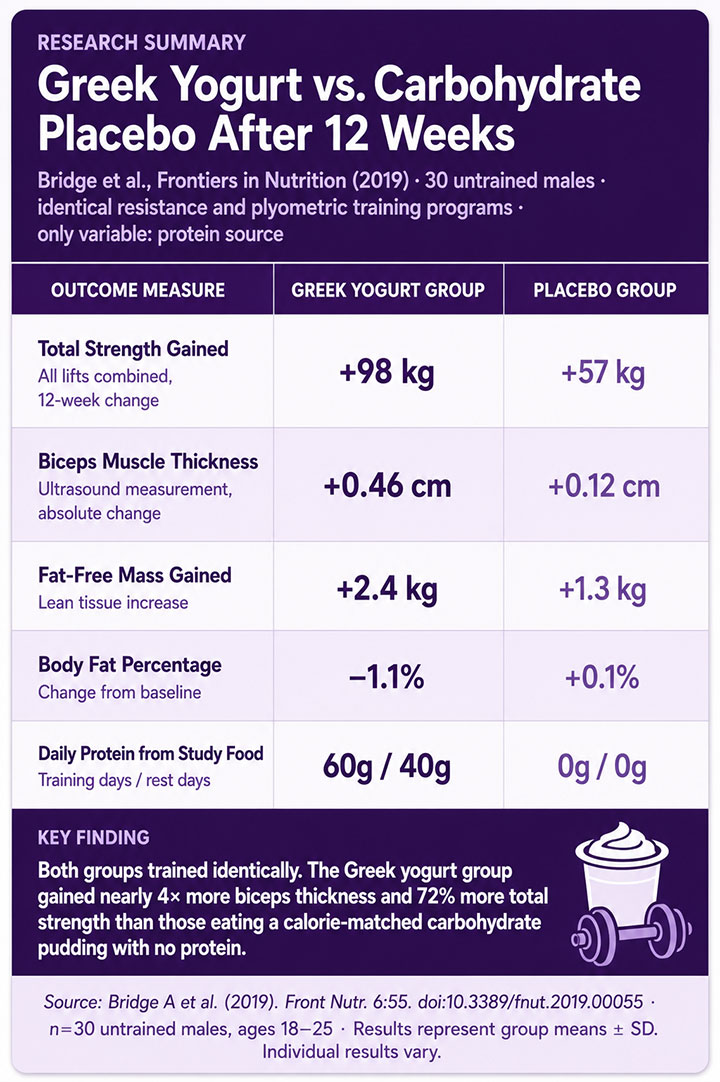
Aaron Bridge and colleagues at Brock University in Ontario enrolled 30 untrained men, average age 20, and randomized them into two groups. Both groups followed the same supervised program: full-body resistance training twice a week and plyometric training once a week for twelve weeks.
One group consumed fat-free plain Greek yogurt (three servings on training days for a total of 60 grams of protein, two servings on rest days for 40 grams). The other group ate an isoenergetic carbohydrate-based pudding with zero protein.
That dosing detail matters. The study wasn’t testing whether 200 grams of yogurt per day changes your body. It was testing whether 40 to 60 grams of additional dairy protein, consumed alongside a training program, produces a different outcome than the same calories from carbohydrate.
After twelve weeks, both groups gained strength and muscle. Training works regardless of what you eat around it. But the Greek yogurt group’s gains were measurably larger on every metric the researchers tracked.
The Real Numbers
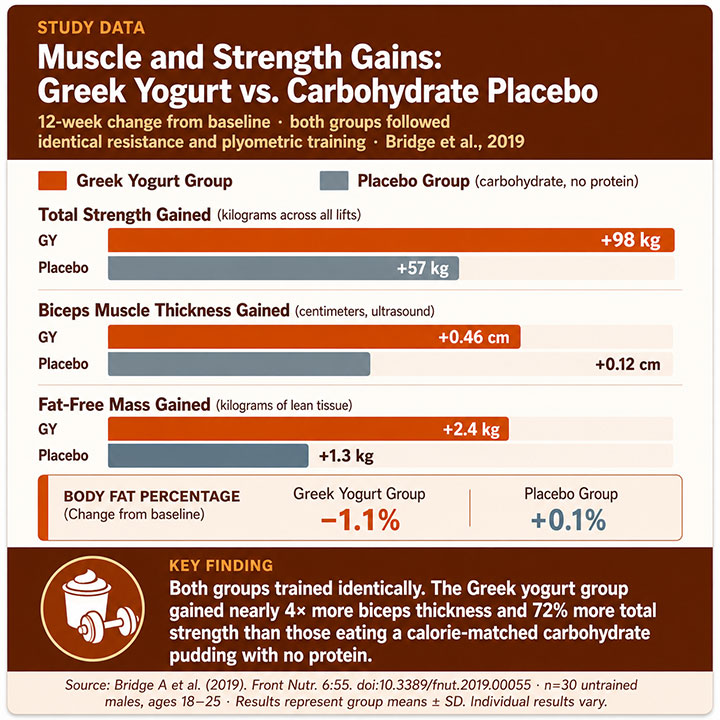
The Greek yogurt group gained 98 kilograms of total strength across all tested lifts, compared to 57 kilograms in the placebo group. Upper-arm muscle thickness increased by 0.46 centimeters in the yogurt group versus 0.12 centimeters with the placebo.
Fat-free mass rose by 2.4 kilograms with yogurt and 1.3 kilograms without. Body fat percentage dropped by 1.1 percentage points in the yogurt group while it barely moved in the control group.
Those are the actual figures from the published study. You’ll find other accounts of this trial elsewhere online that break the results into week-by-week percentages, showing progressive gains at weeks four, eight, and twelve. The researchers measured participants once before the program and once after.
The week-by-week tables that circulate online don’t come from this trial.
What the Study Does Not Tell You
Thirty people is a small sample. All participants were young men who had never trained before, which means they were in the phase where the body responds most dramatically to any new stimulus.
The results may not translate directly to trained athletes, women, or older adults. A 2025 secondary analysis of the same cohort, published in Nutrients, examined inflammation markers and confirmed the research program is still active, but the core muscle data remains from this single trial.
That’s worth sitting with for a moment. The entire popular narrative about Greek yogurt as a muscle-building food rests on one well-designed but narrow study.
The finding is legitimate, and the mechanism is well-understood. But anyone who tells you Greek yogurt will increase your strength by 25 to 30 percent is overstating what a trial of 30 untrained college-aged men can claim for a general population.
How It Compares to Other Protein Sources
Greek yogurt’s advantage isn’t that it contains more protein per gram than chicken or whey isolate. It doesn’t.
The advantage is that it delivers a complete amino acid profile (all nine essential amino acids), a near-threshold dose of leucine, and a whey-casein blend in a form that requires no cooking, no blender, and no shaker bottle. It’s also cheaper per gram of protein than most supplement powders.
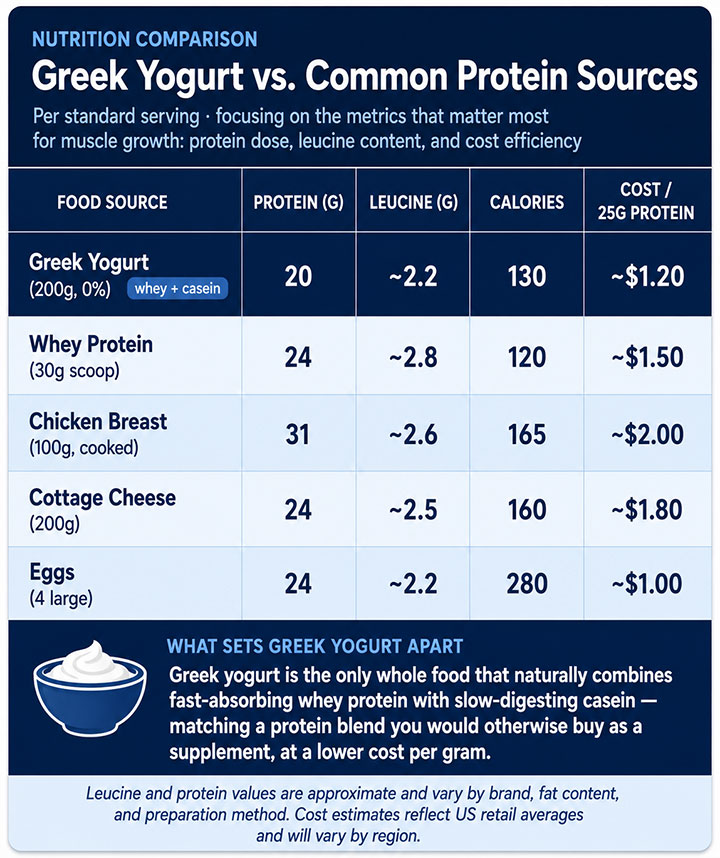
Where it falls short is calorie efficiency. If you’re in a steep caloric deficit and need to get the most protein per calorie, nonfat Greek yogurt is competitive, but a pure whey isolate will beat it.
If you’re eating at maintenance or in a surplus, the extra calories from Greek yogurt come with calcium, phosphorus, potassium, B vitamins, and up to a billion colony-forming units of live probiotic cultures. A scoop of whey isolate doesn’t carry any of that.

Timing, Dose, and What the Labels Tell You
The Bridge trial had participants eat Greek yogurt three times on training days and twice on non-training days, timed around workouts. That’s more regimented than most people need, and recent evidence suggests the window for post-exercise protein is wider than older research claimed.
A 2023 trial in Cell Reports Medicine by Trommelen and colleagues at Maastricht University tracked what happens to 100 grams of protein over twelve full hours after a resistance workout. Muscle protein synthesis was still elevated at the twelve-hour mark, with no ceiling detected.
Rates were roughly 20 percent higher in the first four hours and approximately 40 percent higher from hours four through twelve compared to a 25-gram dose. The old idea of a 30-minute anabolic window is an artifact of earlier studies that stopped measuring after three to five hours.
That doesn’t mean timing is irrelevant. It means you have more room than the supplement industry suggests.
A serving after training and another before bed cover both the acute post-exercise period and the overnight fast. On rest days, one or two servings spread through the day keep protein synthesis ticking over.
Reading the Label
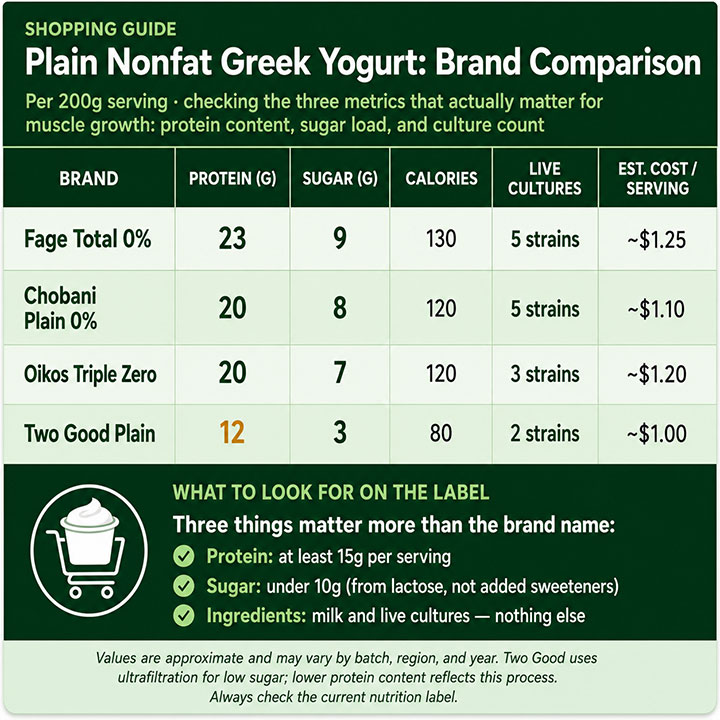
The study used plain, nonfat Greek yogurt. When you’re shopping, three things matter more than the brand name: protein content (at least 15 grams per serving), sugar (under 10 grams, from lactose alone rather than added sweeteners), and ingredients (milk and live cultures, full stop).
If the ingredient list includes thickeners, modified starches, or protein concentrates, the product may not deliver the same whey-casein ratio that makes Greek yogurt nutritionally distinct from regular yogurt.
Full-fat versus nonfat is a goal-dependent choice, not a quality one. If you’re trying to add mass and need extra calories, 2% or full-fat versions are fine and may keep you fuller. If you’re in a cut and counting every calorie, nonfat gives you the protein without the overhead.

Five Recipes Worth Making
The fifteen-recipe lists that populate articles like this one are rarely curated. They’re generated. Here are five that solve an actual problem, each one chosen because it fits a specific scenario where Greek yogurt makes more sense than the alternative.
The Post-Workout Recovery Bowl (roughly 35g protein)
200g nonfat Greek yogurt, one banana, a handful of mixed berries, and a tablespoon of honey. This hits a roughly 3:1 carb-to-protein ratio, which is what your muscles need after a hard session.
It takes sixty seconds and doesn’t require a blender. Eat it in the car if you have to.
Overnight Protein Oats (roughly 28g protein)
150g nonfat Greek yogurt, half a cup of rolled oats, a tablespoon of chia seeds, a teaspoon of vanilla. Mix it in a jar the night before, refrigerate overnight, grab it on the way out.
This is the recipe that actually gets eaten on a Tuesday morning, which is the only metric that matters for consistency.
The Pre-Bed Casein Feed (roughly 20g protein)
200g nonfat Greek yogurt with a small handful of walnuts. Nothing else. The casein digests slowly while you sleep, and the fat from the walnuts slows gastric emptying further.
No recipe blog would feature this because it’s boring. That’s why it works every night.
High-Protein Tzatziki (roughly 15g protein per half cup)
200g nonfat Greek yogurt, one grated and drained cucumber, two minced garlic cloves, two tablespoons of fresh dill, a tablespoon of lemon juice, salt to taste. This turns Greek yogurt into a savory condiment that goes on grilled chicken, roasted vegetables, or a wrap. If you only eat Greek yogurt sweet, you’re missing the version where Greek yogurt replaces sour cream, mayo, and ranch at a fraction of the calories.
The Travel Container (roughly 20g protein)
One single-serve cup of plain Greek yogurt, a small bag of mixed nuts, a piece of fruit. No prep. No refrigeration needed for a few hours.
This isn’t a recipe. Consistency on the road matters more than perfection at home, and this is the version that survives an airport.
FAQs
Is it okay to eat 400 grams of Greek yogurt after a workout?
For most people, yes. Four hundred grams of nonfat Greek yogurt provides roughly 40 grams of protein and 260 calories, well within what your body can use after a resistance session.
If you experience bloating or discomfort at that volume, split it into two servings two to three hours apart. There’s no metabolic penalty for spacing it out.
I’m lactose intolerant. Can I still eat Greek yogurt?
Many people with lactose intolerance handle Greek yogurt better than milk. The straining process removes a significant portion of the lactose, and the live bacterial cultures help digest what remains.
Start with 50 grams and increase gradually. If that still causes problems, lactose-free Greek yogurt brands deliver identical protein with the lactose pre-broken by added lactase enzyme.
Does it matter whether I choose Greek yogurt or regular yogurt?
For muscle growth, the difference is dose, not type. Greek yogurt typically provides 15 to 20 grams of protein per serving because the straining process concentrates the solids. Regular yogurt delivers 5 to 9 grams per serving.
You could eat enough regular yogurt to match the protein, but you’d consume considerably more sugar and calories to get there. The practical advantage of Greek yogurt is that one serving brings you close to the leucine threshold, while a single serving of regular yogurt falls well short.
Should I eat it on rest days?
Yes. The Bridge trial had participants consuming Greek yogurt daily, including non-training days (two servings instead of three). Muscle protein synthesis stays elevated for 24 to 48 hours after a resistance session.
Consistent protein intake on rest days supports the recovery already underway. Skipping protein on off days doesn’t save meaningful calories, and it may slow the adaptation you’re trying to build.
Is Greek yogurt better for bulking or cutting?
Both, and the version you buy barely changes the protein math. A cup of nonfat delivers roughly 130 calories for 20 grams of protein, putting it near the top of the calorie-efficiency ranking for whole foods. Full-fat adds 80 to 100 calories from fat.
If you’re cutting, nonfat. If you’re bulking and eating enough is the actual problem, the extra calories from full-fat serve a purpose. The choice is real but rarely as significant as the fitness internet makes it sound.
Can I use flavored Greek yogurt?
You can, with a caveat. Flavored varieties often add 10 to 15 grams of sugar per serving, which reduces the protein-to-calorie ratio that makes Greek yogurt worth choosing in the first place. If plain tastes too tart, a teaspoon of honey or a handful of berries adds sweetness without the processed sweeteners.
Check that the protein content on a flavored container still reads at least 15 grams per serving. Below that, the straining was likely less thorough and you’re paying yogurt prices for a dessert.
What This Actually Means for Your Training
The case for Greek yogurt isn’t dramatic. It won’t transform your physique in twelve weeks the way a clickbait headline might promise. What a single controlled trial showed is that consistent, adequate protein from a whole food source, consumed around a structured training program, produces measurably better outcomes than the same calories without the protein.
That finding is unsurprising to anyone who has studied protein metabolism. What’s interesting is how accessible the delivery vehicle is.
No subscription required. No blender, no shaker bottle, no timing spreadsheet. All you need is a tub of plain Greek yogurt and enough consistency to eat it most days for long enough that the protein does its work.
The study ran twelve weeks. The habit, if it sticks, runs longer than any trial can measure.