Most people assume an MCI diagnosis is the beginning of an inevitable decline. But nearly one in three people recovered normal cognition. What made the difference?
The diagnosis seems like a verdict, but the research tells a different story. Somewhere between 15 and 30 percent of people diagnosed with mild cognitive impairment eventually test normal again.
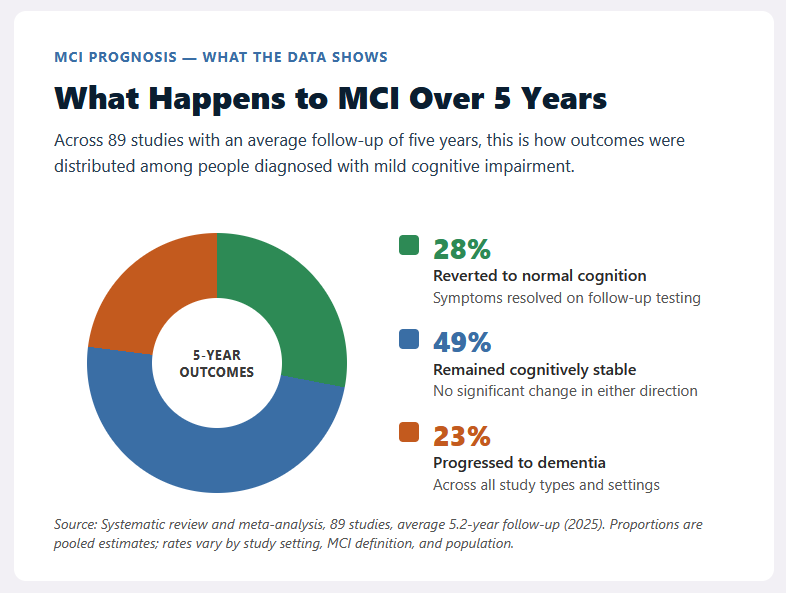
A 2025 systematic review pooling data from 89 studies with an average follow-up of 5 years found that roughly 30 percent of participants in population-based studies reverted to normal cognition, while about half remained stable.
That reversal rate is not a rounding error. It means the brain, even at 70, retains the capacity to recover ground most people assume is permanently lost.
The question that matters is not whether reversal happens. It does. The question is what separates the people who improve from those who don’t. Three daily habits keep appearing in the research, and none of them require a prescription.
How Fast Does Mild Cognitive Impairment Progress?
Not as fast as most people fear, and not as predictably as most articles suggest. Annual conversion rates vary depending on which study you read, which population it tracked, and how strictly MCI was defined at enrollment.
Clinical settings tend to report higher progression. Population-based studies, which capture a wider range of MCI severity, report lower rates. Across both, the data converge on a rough range: 10 to 15 percent of people with MCI develop dementia in any given year, compared with 1 to 2 percent of the general population over 65. Your risk is elevated, not fixed.
The average age for a mild cognitive impairment diagnosis falls in the late 60s to mid-70s, though it can appear earlier. About 15 to 20 percent of adults over 65 have some form of MCI, according to prevalence data from the National Institute on Aging.
MCI comes in two main types. Amnestic MCI affects memory primarily. You forget conversations, appointments, or where you left things. Non-amnestic MCI targets other functions: language, attention, spatial awareness, or decision-making. A smaller number of cases are classified as mild cognitive impairment of uncertain or unknown etiology, meaning the underlying cause has not been identified.

The type matters because it shapes what happens next. Amnestic MCI carries a somewhat higher statistical risk of progressing to Alzheimer’s disease. Non-amnestic forms may point toward other conditions. But in both cases, progression is not guaranteed, and the same lifestyle factors influence outcomes.
MCI Risk Assessment
12 questions across two areas: current symptoms and lifestyle habits
Move Your Body to Feed Your Brain
Your brain consumes roughly 20 percent of your body’s blood supply. When circulation drops, neurons lose access to oxygen and glucose at the exact moment they need it most. Exercise is the simplest, most consistently supported way to restore that supply.
Think of your brain like a garden. Blood flow is the irrigation. Without it, the healthiest soil still dries out.
Laura Baker, a researcher at the University of Washington School of Medicine, tested this directly. Her team enrolled 33 adults with amnestic MCI in a six-month randomized controlled trial published in Archives of Neurology in 2010. Half did high-intensity aerobic exercise. The other half stretched. The aerobic group showed improvements in executive function, and the women in that group also had lower cortisol and better insulin sensitivity. Both of those protect the hippocampus, the brain’s memory center.
That was a small trial. Thirty-three participants. The findings were promising, not definitive.
A larger study tried to scale those results. Takao Suzuki and colleagues at the National Center for Geriatrics and Gerontology in Japan enrolled 100 older adults with MCI in a six-month multicomponent exercise program, published in PLOS ONE in 2013.
The exercise group combined aerobic work, strength training, and balance exercises twice a week. On the primary cognitive measures, the study found no significant difference between the exercise group and the control group. But subgroup analysis told a more specific story: among people with amnestic MCI specifically, the exercise group showed improvements in logical memory and reduced brain atrophy.
That mixed result is worth consideration. That finding does not disprove the exercise benefit. It narrows who benefits most, and suggests that the type of MCI you have may determine how much exercise helps your cognition directly.
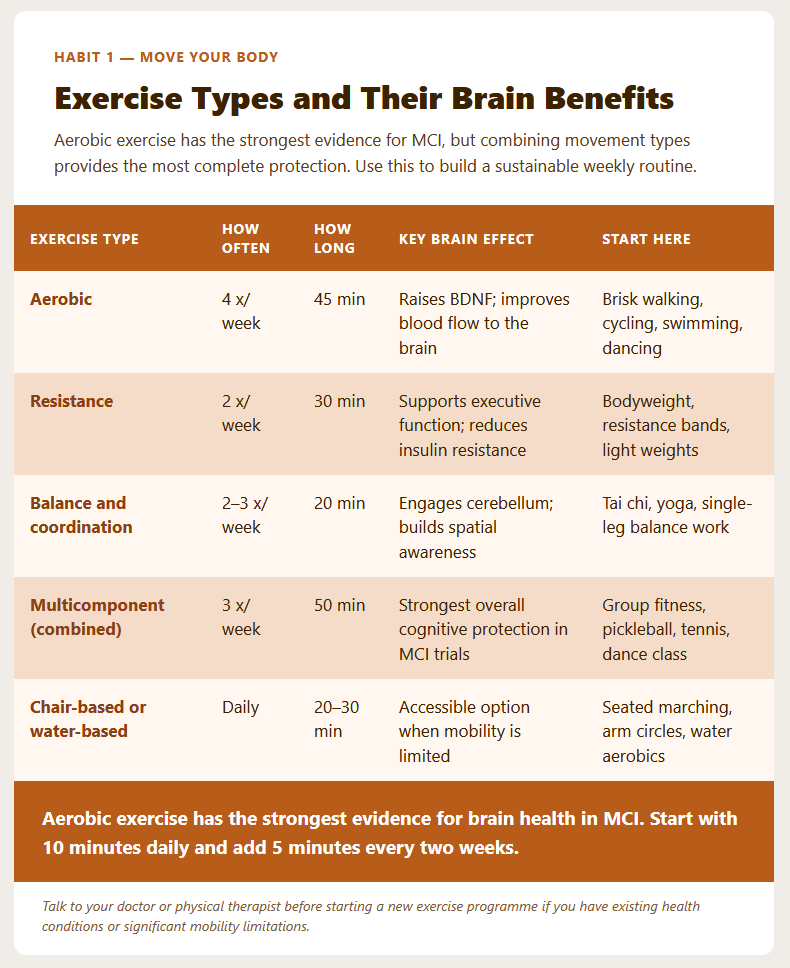
The mechanism behind the benefit is a protein called brain-derived neurotrophic factor, or BDNF. Think of BDNF as fertilizer for neurons. It helps them grow, survive, and form new connections. Aerobic exercise raises BDNF levels reliably. Higher BDNF means a brain with more capacity to repair.
Getting Started When You Haven’t Moved in Years
Begin with 10-minute walks. Not 30. Not an hour. Ten minutes at a pace that feels purposeful but manageable.
Use the “talk test” to gauge intensity. If you can sing, go faster. If you can’t speak in full sentences, slow down. The target sits between those two points.
Add five minutes every two weeks. By month three, you’ll be walking 25 to 30 minutes without overthinking it. Morning works best for most people because cortisol peaks naturally in the early hours, your body temperature is rising, and you finish before the day derails your plans.
When Mobility Is Limited
Chair exercises can raise your heart rate. Seated marching, arm circles, and seated dancing all count, as long as the effort is sustained. Water aerobics takes pressure off joints while the water pushes back against every movement. Adapted yoga and tai chi improve balance and coordination while keeping the body active. Many community centers run classes designed for people with limited mobility.
Eat Like Your Brain Depends on It
Food is not just fuel, it is chemical instruction that shapes inflammation levels, blood sugar stability, and the structural integrity of blood vessels that feed the brain. The wrong inputs create conditions neurons cannot work in for long.
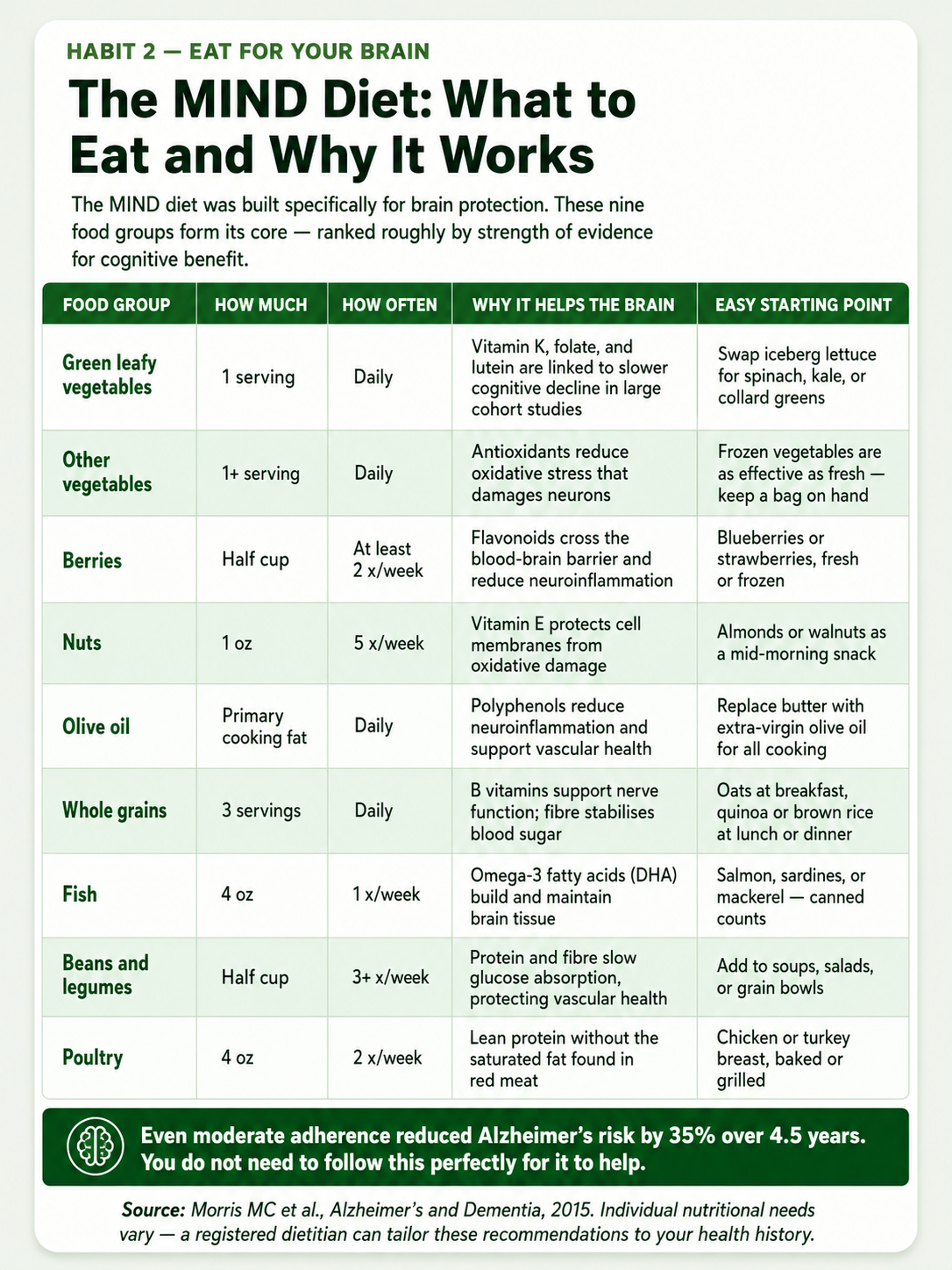
Martha Clare Morris, a nutritional epidemiologist at Rush University Medical Center, spent years developing a diet specifically targeted at brain protection. Her team called it the MIND diet, a hybrid of the Mediterranean and DASH eating patterns, fine-tuned for cognitive health.
In 2015, Morris and her colleagues published the results of tracking 923 older adults for an average of 4.5 years in Alzheimer’s and Dementia. People who followed the MIND diet closely had a 53 percent lower risk of developing Alzheimer’s disease. People who followed it only moderately still had a 35 percent reduction.
What makes the MIND diet different from generic “eat healthy” advice is its specificity. It identifies exactly which foods protect neural tissue and ranks them by strength of evidence. Green leafy vegetables sit at the top.
Studies on aging cohorts have found that daily consumption of spinach, kale, or collard greens is the single strongest dietary predictor of slower cognitive decline. Berries come next, specifically blueberries and strawberries, because they contain flavonoids that cross the blood-brain barrier and reduce neuroinflammation. Two servings a week make a measurable difference in the data.
Olive oil replaces other cooking fats in this framework. Elena Martínez-Lapiscina and her colleagues at the University of Navarra ran a randomized substudy within the larger PREDIMED trial. They assessed 522 participants at high vascular risk over 6.5 years, publishing in the Journal of Neurology, Neurosurgery and Psychiatry in 2013.
The group assigned to a Mediterranean diet supplemented with extra-virgin olive oil scored higher on cognitive tests and had lower rates of MCI compared to the control group eating a standard low-fat diet.
You do not need to follow the MIND diet perfectly. The Morris data showed a dose-response relationship: the closer people adhered, the stronger the protection. Even moderate adherence moved the needle. That is a meaningful finding for anyone who finds strict diets unsustainable.
What to Limit
Red meat: fewer than four servings per week. Butter and margarine: less than a tablespoon daily. Cheese: less than one serving per week. Pastries and sweets: fewer than five servings per week. Fried or fast food: less than one serving per week. These categories share a common mechanism. They increase systemic inflammation, damage vascular walls, and drive insulin resistance, all of which accelerate cognitive decline.
Challenge Your Brain with Something Unfamiliar
The same crossword puzzle every morning will not protect your brain. Neurons need novelty and complexity to build what scientists call cognitive reserve, a kind of backup capacity that helps the brain compensate when some areas start to decline.
Learning a completely new skill forces multiple brain regions to cooperate simultaneously. When you try to speak French for the first time, you activate language centers, memory systems, and motor areas controlling your mouth and tongue. When you learn piano, you coordinate vision, hearing, fine motor control, and timing. That multi-region demand builds resilience in a way that repeating a familiar task does not.
A 2011 meta-analysis published in Ageing Research Reviews pooled 17 cognitive intervention studies in people with MCI. The findings showed that training improved both overall cognition and self-reported functioning. People reported real changes in their daily lives, not just better scores on laboratory tests. The gains were modest but statistically significant, and they held up at follow-up.
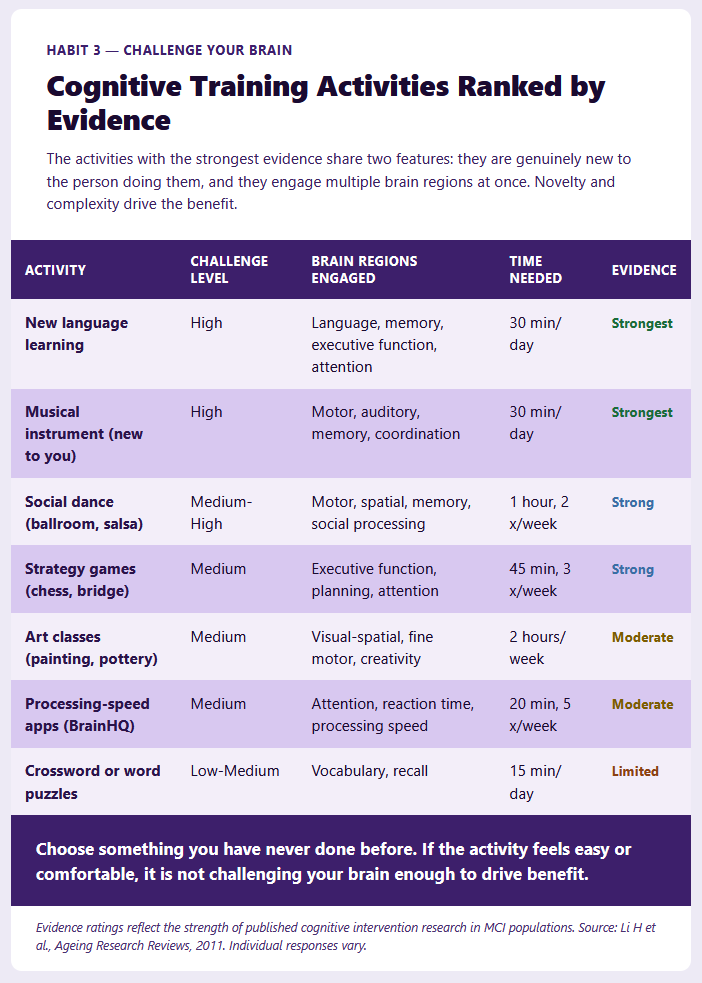
The catch: the training has to be challenging. If the activity feels easy, your brain has already adapted to it and the neurological benefit plateaus. Speed-of-processing exercises, which require quick decisions under time pressure, improve executive function more effectively than memory drills alone.
How to Pick Your Challenge
Choose something you have never done before. If you played piano as a child, try guitar instead. The unfamiliarity is the point.
Prioritize activities with a social component. Group classes consistently outperform solo work in the research. Social interaction adds an additional layer of cognitive demand: you have to listen, respond, coordinate with others, and navigate social dynamics while simultaneously learning the new skill.
Aim for frustration, not mastery. If the activity feels comfortable, it is not working. That feeling of mental strain is the same signal your muscles send when lifting weights that are heavy enough to trigger growth. Rotate activities every six months to maintain novelty.
Apps such as BrainHQ and Lumosity show modest benefits in research for daily processing-speed practice. But real-world activities engage more senses. Learning guitar means feeling strings under your fingers, hearing notes, reading music, and coordinating both hands simultaneously.
That multi-sensory richness creates stronger neural connections than a screen-based exercise alone. Combine both. Use apps for daily 15-minute sessions and take in-person classes once or twice a week for deeper learning.
The Factors People Overlook
Social isolation belongs near the top of any risk-reduction plan. A large-scale analysis led by researchers at Florida State University, pooling data from more than 600,000 participants across 21 longitudinal studies, found that loneliness raised the risk of dementia by 31 percent.
That effect held even after controlling for depression and social isolation, which are related but distinct constructs. Three close friends you speak with weekly may protect you more than 30 acquaintances you see once a year. The depth of the connection matters more than the size of your network.
Hearing loss is another underrecognized factor. Frank Lin and colleagues at Johns Hopkins tracked 639 dementia-free adults and found that mild hearing loss roughly doubled the risk of incident dementia over a median follow-up of nearly 12 years, published in Archives of Neurology in 2011.
When your brain struggles to decode sounds, it diverts resources away from memory, reasoning, and executive function. Treating hearing loss with properly fitted aids may reduce that drain. Get your hearing checked annually after 60.
Everything else depends on vascular health. High blood pressure damages small vessels in the brain. Type 2 diabetes accelerates cognitive decline through multiple pathways. Cholesterol contributes to plaque buildup that restricts blood flow.
Smoking damages capillaries throughout the brain, and people who quit even in their 60s see vascular improvements within months. Control these, and the three main habits get a clearer path to work.
Medications Worth Reviewing
Some common medications impair cognition without anyone noticing the connection. Anticholinergic drugs block acetylcholine, a neurotransmitter your brain needs for memory and learning.
They include diphenhydramine (the active ingredient in Benadryl and most over-the-counter sleep aids), some tricyclic antidepressants, and certain overactive-bladder medications. Some beta-blockers cause mental fog in higher doses. Pain medications, particularly opioids and muscle relaxants, can produce confusion.
Bring a complete medication list to your next appointment, including over-the-counter drugs and supplements. Ask your doctor directly: “Could any of these affect my memory or thinking?”
Sleep and Stress
The brain runs its maintenance overnight. While you sleep, a network of channels called the glymphatic system flushes metabolic waste, including beta-amyloid proteins that contribute to Alzheimer’s pathology when they accumulate. When sleep quality drops, that cleaning cycle shortens. Over weeks and months, the buildup becomes measurable.
Sleep apnea deserves special attention. Repeated breathing pauses during the night deprive the brain of oxygen in cycles, and many people with MCI have undiagnosed apnea. Treating it can sometimes improve cognitive symptoms on its own. If you snore heavily, wake gasping, or feel exhausted after a full night, get tested.
Cortisol is supposed to be a short-term visitor. When you are stressed, it surges. When the threat passes, it withdraws. The problem with chronic stress is that cortisol never fully recedes. It stays elevated for weeks, months, sometimes years.
The hippocampus, which is both acutely sensitive to cortisol and the brain’s primary memory-forming structure, takes the worst of it. Brain imaging studies show that chronically stressed individuals have smaller hippocampal volumes. The encouraging part: that shrinkage can reverse when stress decreases.
Depression and anxiety overlap with MCI symptoms to a degree that makes diagnosis difficult. Poor concentration, memory problems, difficulty with decisions. Treating the mood disorder, through therapy, medication, or both, often improves cognitive function in ways that look like MCI reversal but are actually resolution of the underlying psychiatric condition.
If you have been diagnosed with MCI but also feel persistently low, anxious, or withdrawn, raise that with your doctor.
What to Expect and When
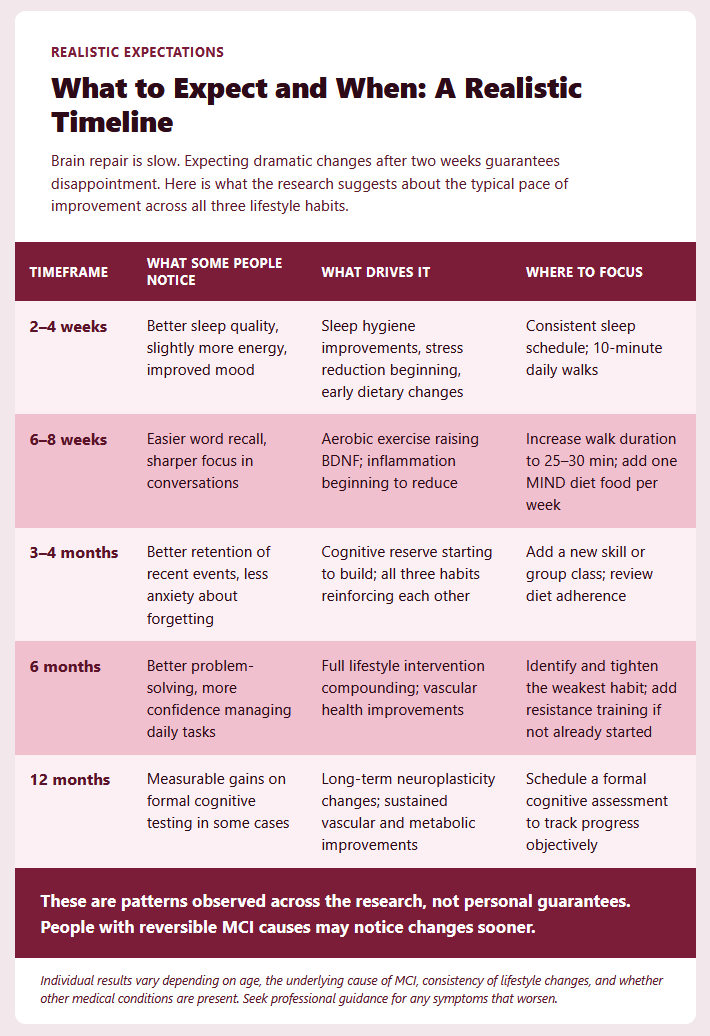
Brain repair is slow. Expecting dramatic changes after two weeks guarantees disappointment and increases the odds of quitting.
People whose MCI is driven by reversible causes, including medication side effects, vitamin deficiencies, depression, or untreated sleep apnea, often notice improvements within weeks of addressing the cause.
For lifestyle-driven changes, a more realistic timeline runs longer. Better sleep and energy tend to appear first, within two to four weeks. Word recall and conversational focus often improve within six to eight weeks. Measurable gains on formal cognitive testing typically require six to twelve months of consistent effort.
Some people never see complete reversal. Some forms of MCI represent early neurodegenerative disease that will progress despite the best lifestyle interventions. Even in those cases, the same habits can slow progression and extend the period of functional independence. Doing nothing guarantees decline. Action gives you a fighting chance.
Working with Your Doctor
You can make lifestyle changes independently, but a doctor adds advantages you cannot replicate. They can rule out reversible causes, adjust medications, and order formal testing such as the Montreal Cognitive Assessment (MoCA) to track progress objectively.
A mild cognitive impairment test administered annually provides data your subjective experience cannot match. You might feel worse on a bad week while your scores are actually stable, or feel fine while tests catch a decline you have not noticed.
There are no FDA-approved medications specifically for MCI. The drugs used for Alzheimer’s disease, such as cholinesterase inhibitors, show mixed results for MCI and carry side effects including nausea and gastrointestinal problems.
Lifestyle interventions remain the first-line approach, and most doctors will support a structured plan built around exercise, diet, and cognitive training if you propose one.
If you have vascular risk factors, though, medication to control blood pressure, cholesterol, or blood sugar is not optional. Those medications do not treat MCI directly. They protect the infrastructure your brain depends on.
When to Call Your Doctor Immediately
Sudden worsening of memory or confusion, getting lost in very familiar places, inability to manage medications or finances you could handle before, personality or mood changes, visual hallucinations, significant balance or walking problems, or difficulty swallowing. These could signal a stroke, a medication reaction, or rapid progression requiring immediate evaluation.
Mild Cognitive Impairment vs. Dementia
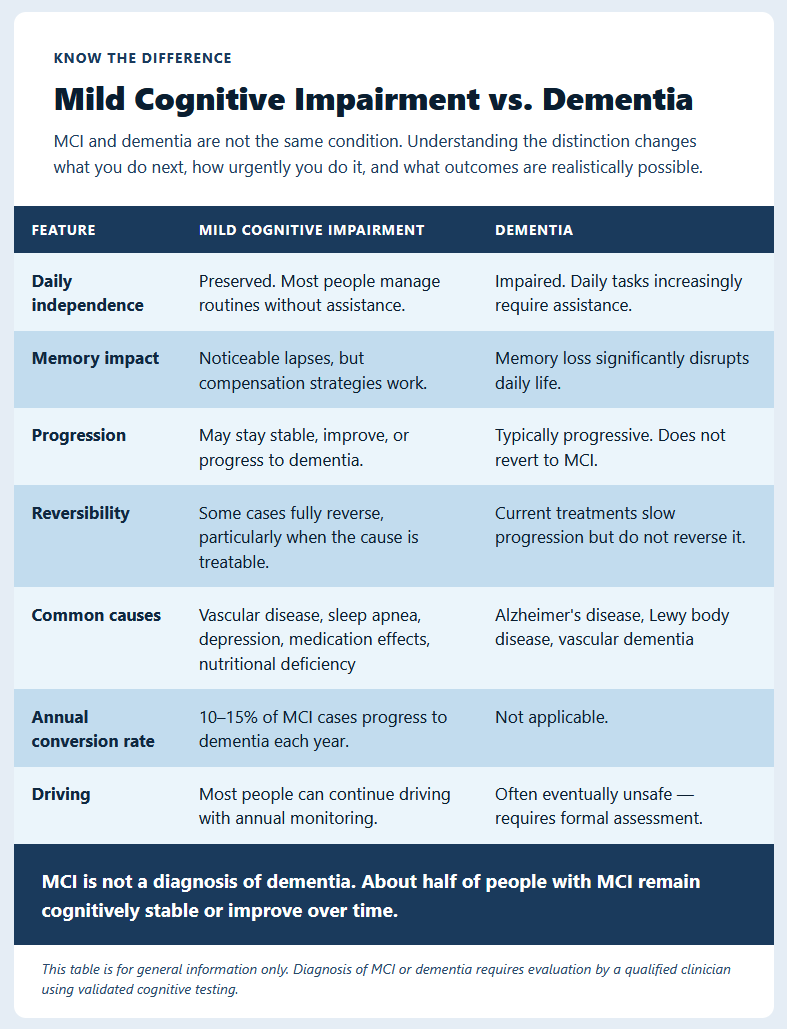
People often conflate the two, but the distinction matters because it shapes what you do next and how urgently you do it.
MCI means your cognitive abilities have declined enough that you or others notice the difference, but not enough to interfere with your independence. You can still manage your finances, drive safely, cook, and handle daily routines.
Dementia crosses that line. It means cognitive decline significant enough to interfere with independent daily functioning, requiring assistance with tasks you previously managed alone.
MCI has multiple possible causes, many of them treatable. Dementia is a syndrome typically driven by progressive neurodegenerative disease, most often Alzheimer’s, and current treatments can slow progression but not reverse it. MCI does not always become dementia. Dementia, once established, does not revert to MCI.
Taking Back Control
Mild cognitive impairment is a warning light on your dashboard. It tells you something needs attention. It does not tell you the engine is beyond repair. That distinction is not small. The people who treat an MCI diagnosis as a verdict stop here. The people who treat it as a signal start working. Talk to your doctor. One change this week is enough to begin.
Frequently Asked Questions
Can mild cognitive impairment go away on its own?
Yes. Pooled data from multiple systematic reviews estimate that 15 to 30 percent of people with MCI return to normal cognition over time. This happens most often when MCI was caused by something reversible: medication side effects, vitamin B12 deficiency, depression, sleep apnea.
Waiting passively is not a strategy. Active intervention through lifestyle changes raises the probability of improvement.
Does MCI always lead to dementia?
No. About 10 to 15 percent of people with MCI progress to dementia in any given year. That means 85 to 90 percent do not progress in that year. Some remain stable for years. Others improve. The outcome depends on the underlying cause and how aggressively risk factors are managed.
What is the life expectancy with mild cognitive impairment?
MCI itself is not a terminal condition. People with MCI generally have life expectancies similar to their age-matched peers, though the risk of eventually developing dementia is higher, and dementia does shorten life expectancy. The more relevant question is quality of life, which is where lifestyle interventions have their strongest impact.
Is MCI the same as early Alzheimer’s?
No. MCI is a clinical syndrome with many possible causes. Alzheimer’s disease is one specific cause, but vascular disease, Lewy body disease, depression, medication effects, and thyroid disorders can all produce MCI. Only specialized testing, sometimes including biomarker analysis or brain imaging, can determine whether Alzheimer’s pathology is the underlying driver.
What is the best exercise for brain health?
Aerobic exercise that raises your heart rate provides the strongest evidence. Brisk walking, cycling, swimming, and dancing all qualify. The key is intensity: you should breathe hard enough that talking takes effort.
Research supports 45 minutes of moderate-to-vigorous activity four times per week. Combining aerobic exercise with strength training and balance work appears to offer additional protection.
Can you still drive with mild cognitive impairment?
Most people with MCI can drive safely, but the answer depends on which cognitive functions are affected. If reaction time, spatial awareness, or judgment are impaired, driving may become unsafe before you realize it. Discuss this honestly with your doctor. A formal driving evaluation can provide an objective answer.