Neurologists now know that the brain’s “processing clock” begins to slow down a decade before you ever forget a name. Here is the midlife warning sign that 100% accuracy on a memory test can’t hide.
Most people think cognitive decline starts when you forget where you put your keys or blank on a familiar name. Neurologists have known for years that this picture is wrong. By the time memory starts failing in noticeable ways, the brain has usually been changing for a decade or more. The memory loss is the ending, not the beginning.
What actually comes first is quieter and more technical. It shows up in how fast your brain processes what’s in front of it, not in what it can or can’t store. Understanding this difference matters, because it completely changes what you should be paying attention to and when.
The Memory Myth Worth Dropping
The standard checklist for early cognitive decline puts memory loss at the top. Short-term memory problems, misplacing objects, forgetting appointments. These are real symptoms, but they belong to a later phase of decline called Mild Cognitive Impairment, or MCI. By the time someone hits that stage, the preclinical phase, the years of quiet, measurable change before any diagnosis, is already well behind them.
A 2018 systematic review by Karr and colleagues, published in Psychology and Aging, pulled together data from dozens of longitudinal studies on change points in cognitive decline preceding MCI, dementia, and death. Their analysis confirmed that older adults who ultimately develop dementia experience accelerated cognitive decline long before diagnosis, in some measures, nearly a decade ahead of any clinical presentation.
Crucially, what declines earliest is not memory. Visuospatial ability and executive function show the first measurable drops, with episodic memory following considerably later. By the time someone notices they are forgetting things, the preclinical window has already been open for years.
This matters because it shifts the frame entirely. The question worth asking is not “am I forgetting things?” It’s “how fast is my brain working?”
What Processing Speed Actually Means
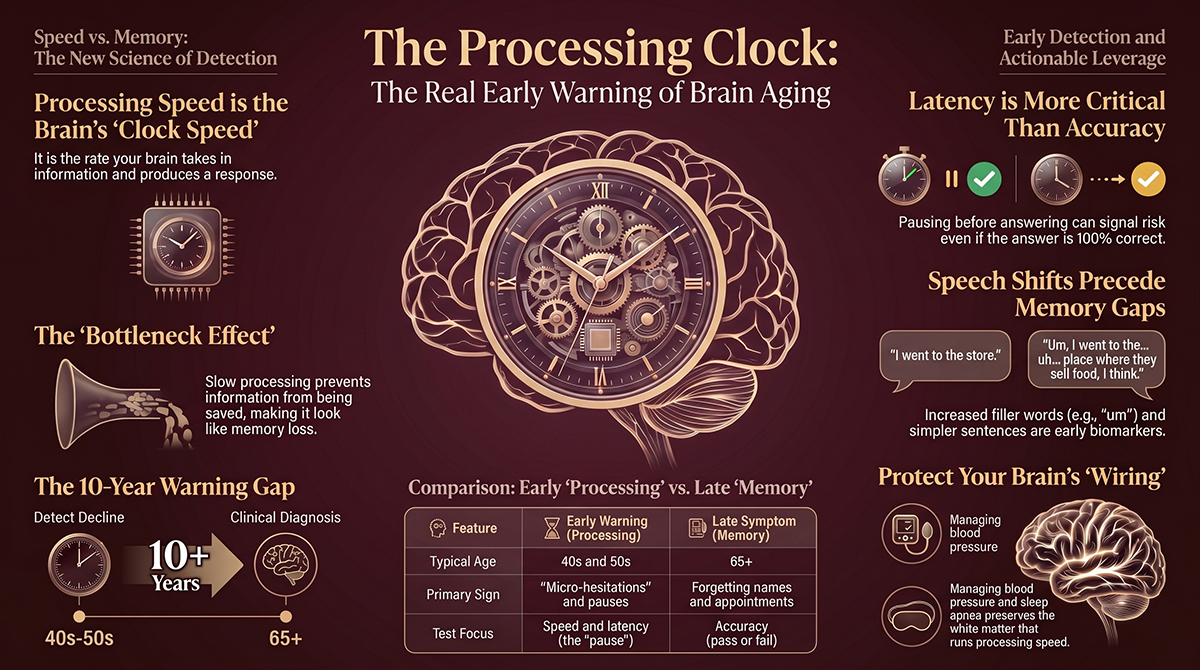
Processing speed is the rate at which your brain takes in information, makes sense of it, and produces a response. Think of it as the clock speed of your mental processor. It affects everything downstream: how well you follow a complex conversation, how quickly you can react to something unexpected, how easily you can hold multiple pieces of information in your head at once.
When this speed drops, something interesting happens. It does not immediately look like a speed problem. It looks like a memory problem.
This is what researchers call the bottleneck effect. If your brain is not encoding information fast enough, it simply does not get stored properly in the first place. You are not losing access to memories. The information is not being written at all.
A large Dutch study published by Jaarsma and colleagues in the Journal of Prevention of Alzheimer’s Disease (2023) tracked 9,666 adults across three population cohorts for up to 23 years. The researchers modeled how processing speed changed over time and which risk factors predicted steeper decline.
Their data showed that processing speed decline accelerates with age and acts as an early driver of the broader cognitive changes that follow. When processing speed falters, other cognitive functions tend to follow.
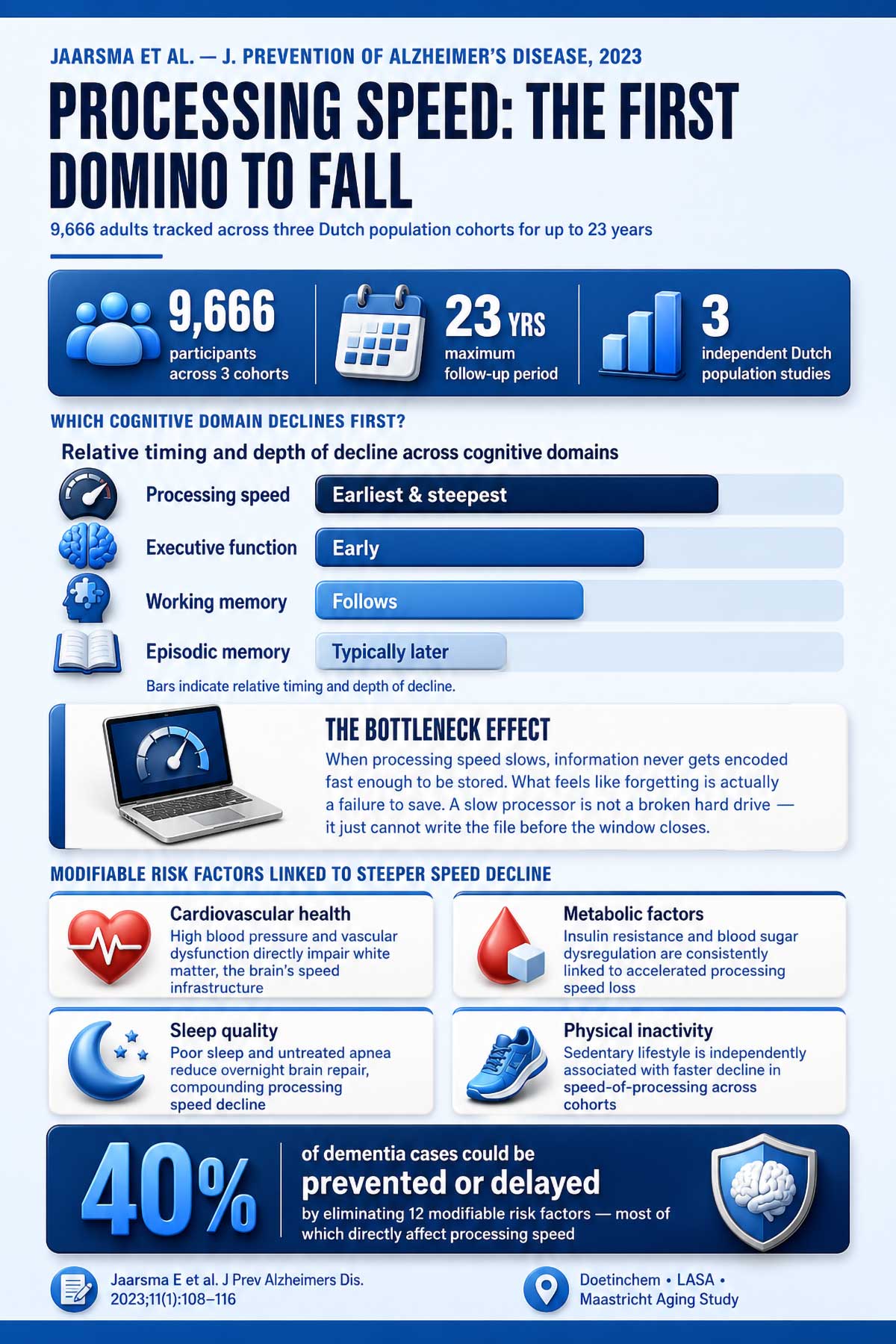
The analogy that fits best: a slow computer processor that can’t save a file before the window closes. The file is not corrupted. It was never saved.
This Starts in Midlife, Not Old Age
One of the most important shifts in cognitive aging research over the last two decades is the recognition that relevant changes begin well before what most people consider “old age.” This is not a disease that starts at 65 and spares everyone younger.
The psychologist Timothy Salthouse has spent decades studying how processing speed relates to broader cognitive aging. His processing-speed theory, published in Psychological Review in 1996 and now among the most cited papers in cognitive aging research, argues that much of what looks like age-related memory loss is, at its root, a downstream consequence of slowing central operations.
When researchers statistically control for processing speed, the apparent memory effects often shrink substantially in early stages. The speed decline is the upstream cause. Memory complaints are often an artifact of it.
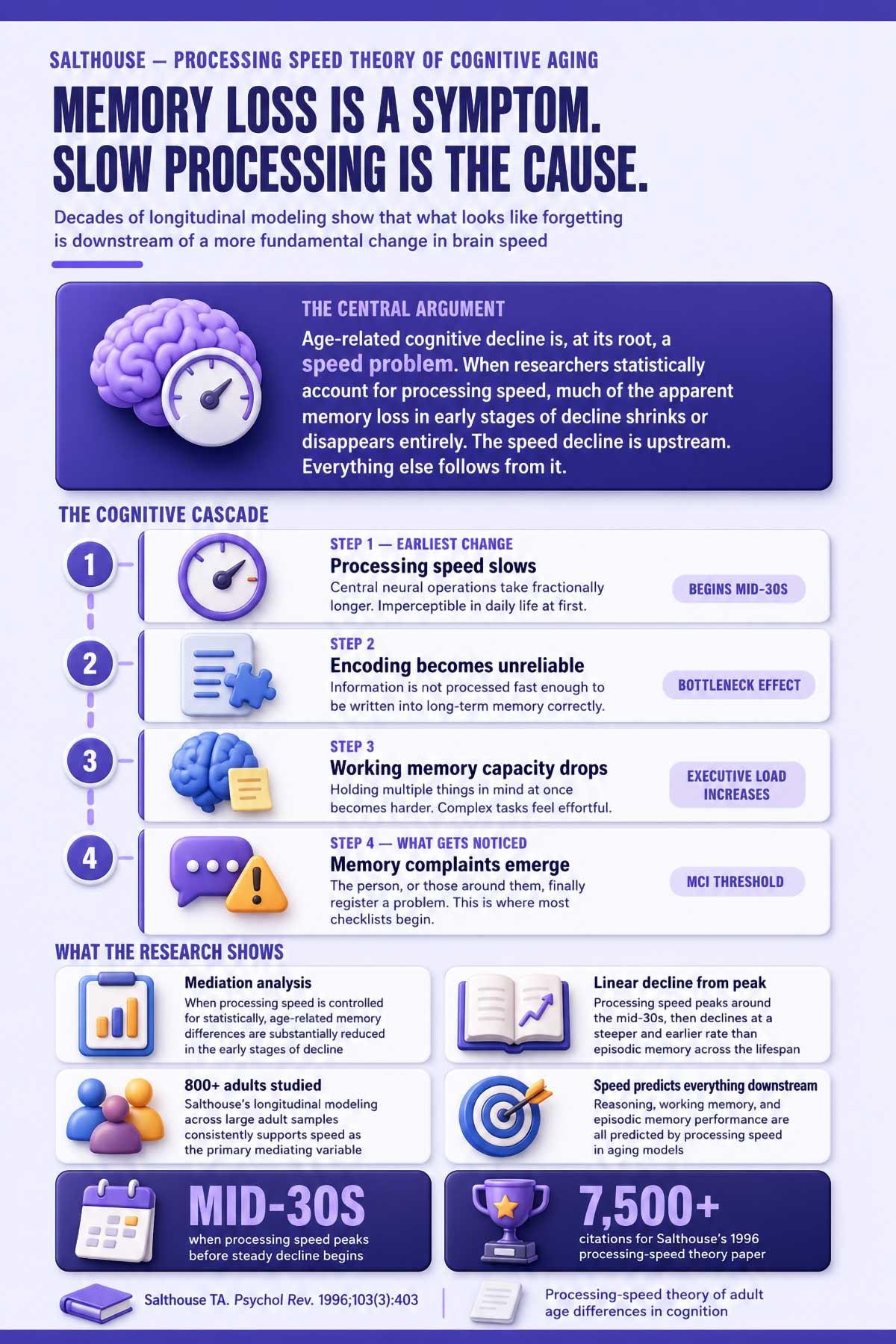
Cross-sectional and longitudinal studies consistently show that processing speed reaches peak efficiency around the mid-30s, then begins a gradual but measurable decline. A 2017 paper by Ebaid and colleagues in Frontiers in Aging Neuroscience tested cognitive processing speed across adults ranging from 18 to 81 and found significant age-group differences in motor-dependent processing tasks between younger and older adults, with the older group starting at age 40.
The takeaway: the kind of speed slowdown that predicts later cognitive risk is already present in middle age, long before anyone would think to raise a concern.
This is the part that catches most people off guard. The preclinical window, the years when something could actually be done, is not your 70s. It is your 40s and 50s.
The Pause Before the Answer
Here is where the science gets particularly interesting. Traditional cognitive tests measure whether you can complete a task correctly. Can you draw a clock face with the hands at the right positions? Can you recall a list of words? Pass or fail.
But a growing body of research suggests that accuracy alone misses something important. What matters just as much, sometimes more, is the time it takes you to start.
Research published in 2025 in the Journal of Alzheimer’s Disease by neuropsychologists David Libon and Rod Swenson examined what they call latency-based digital biomarkers.
These are the pauses and reaction times between actions when someone is responding to a cognitive test prompt. Libon and Swenson found that even when a person answers a question with 100% accuracy, the time it takes them to begin their response can itself be a meaningful indicator of cognitive impairment risk.
As Libon stated: “Just because an individual answers a question on a digital assessment 100% correctly does not mean a 0% risk of cognitive impairment.”
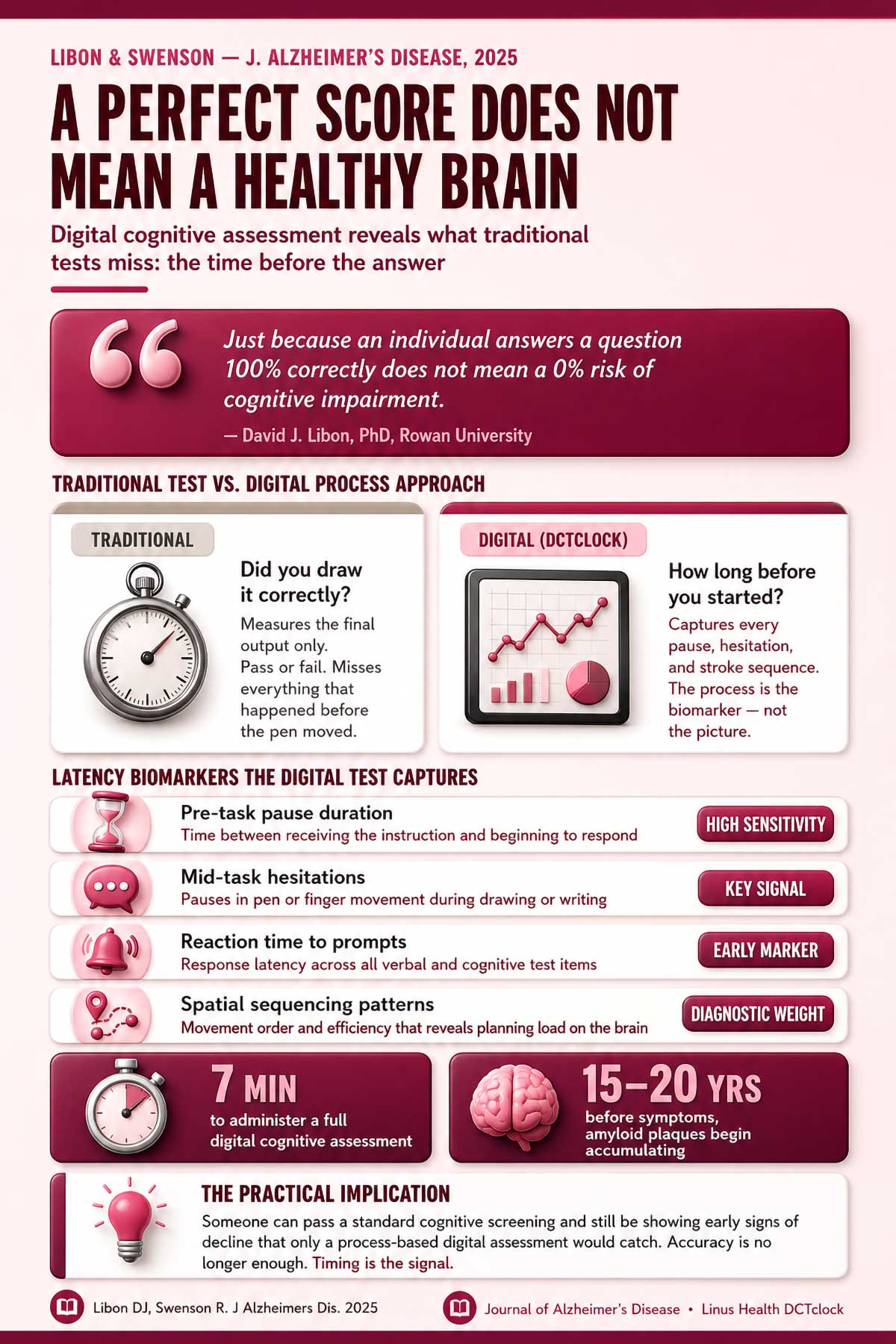
Using a digital version of the classic clock-drawing test, their platform captures not just the final clock drawn on screen but the entire process: where the pen hesitates, how long the person pauses before starting, the timing of each mark. These behavioral signatures, invisible on a paper test, turn out to carry real diagnostic weight.
The practical implication: someone could pass a standard cognitive screening and still be showing early signs of decline that only a process-based digital assessment would catch.
Your Speech Is Changing Before You Notice
The same pattern shows up in language. Not in what you say, but in how you say it, and how quickly.
A 2025 study in Communications Medicine confirmed that changes in acoustic and linguistic characteristics slower speech rate, increased disfluencies, reduced vocabulary diversity, and a shift away from specific nouns toward pronouns and filler words are detectable markers of early cognitive change.
These disruptions, including tiny pauses, repetitions, and hesitations, often appear before more obvious semantic or syntactic problems emerge. Increasingly, this kind of analysis is happening through smartphone apps that record a short speech sample and flag patterns a human listener would never catch.
A 2025 systematic review in npj Digital Medicine looking at AI methods for speech-based cognitive detection found that machine learning models analyzing acoustic and linguistic features have reached AUC values of 0.76–0.94, with the broader literature reporting accuracies above 90% in distinguishing cognitively normal individuals from those with dementia.
The speech patterns that feed these models include things most people would never consciously register: a slight elongation of pauses before complex words, a gradual flattening of sentence structure, a quiet drift away from the kind of descriptive language used easily a few years earlier.
None of these changes feel dramatic from the inside. You might chalk it up to tiredness, or the particular stress of the week. But the pattern, measured consistently over time, tells a different story.
Things to listen for in yourself or someone you care about:
- Taking noticeably longer to find a specific word mid-sentence, more often than before
- More filler phrases (“you know,” “um,” “the thing”) in place of specific nouns
- Starting sentences and then restarting them slightly differently
- Shorter, simpler sentences where more detailed language was natural before
- Pausing before answering questions that would previously have had an immediate response
None of these alone means anything. As a pattern over months and years, they are worth taking seriously.
What You Can Actually Do About It
The reason this preclinical framing matters is not to make you anxious earlier. It is to give you a longer runway. If the earliest detectable changes happen a decade or more before a diagnosis, that is a decade where lifestyle factors, vascular health, and cognitive habits can make a real difference.
Processing speed, unlike many other cognitive functions, responds to the factors you have some control over.
Vascular health is probably the most underrated lever here. The brain relies on tight, clean blood flow to process information quickly. The part most sensitive to that flow is white matter, the brain’s wiring system, a dense network of insulated nerve fibers that carry signals between regions. White matter is what processing speed actually runs on, and it is the first structure to show damage when blood flow is compromised. High blood pressure, insulin resistance, and cardiovascular disease all degrade this infrastructure quietly, often years before a scan would raise a flag. These conditions are modifiable. Treating hypertension, managing blood sugar, and staying physically active are not just good for your heart. They are, in a direct physiological sense, good for your processing speed.
Sleep apnea deserves special attention. Untreated sleep apnea causes repeated drops in blood oxygen during the night, and research consistently links it to accelerated cognitive decline. It is also widely underdiagnosed, particularly in people who do not fit the classic profile. If you snore heavily or wake up unrefreshed even after a full night’s sleep, getting screened is worth the trouble.
The quality of cognitive challenge matters, not just the quantity. There is an important distinction between passive cognitive activity and genuine mental effort. Daily crossword puzzles are fine, but they tend to train familiarity rather than push the brain into new processing territory. Learning a new language, picking up an instrument, or taking on skills that require you to build new neural pathways rather than rehearse old ones creates the kind of neural demand that appears to help maintain processing speed over time. The brain adapts to what it is asked to do.
Track changes over time, not just snapshots. Cognitive health is not a pass/fail test. Digital tools for cognitive assessment are now available directly to consumers and in primary care settings. What matters most is not your score on any given day, but whether that score is shifting over time. Establishing a baseline in your 40s or early 50s, before any symptoms appear, gives you meaningful data to compare against later.
The picture that emerges from this research is not grim. It is actually the opposite. The preclinical phase of cognitive decline is not a countdown. It is a window. The brain starts showing subtle changes in how fast it operates long before memory falters, and those changes can now be measured. That means the moment to pay attention is earlier than most people realize, and earlier is where most of the leverage actually lives.