Someone walks into a room and owns it. Loud, funny, magnetic. Everyone turns to look. Six months later? Nobody follows them anymore.
Then there’s the quiet one. The one who barely raised their voice during the crisis. The one who listened when everyone else was talking. The one people now turn to when things get hard.
What does that person have that the charismatic one doesn’t?
Emotional stability.
Not the flashiest trait. Not the one that wins parties. But research shows it’s the specific quality that turns fleeting attention into lasting respect. And most people completely underestimate it.
The Charisma Trap
We’re wired to notice the loudest person in the room. It’s biology. Loud signals confidence. Confidence signals competence. So we follow.
But here’s the problem. That initial spike in status doesn’t last unless it’s backed by something deeper.
A landmark study by Anderson and Kilduff (2009) followed 242 MBA students in group settings. Overconfident individuals gained early status, but that status was built on perception, not actual competence. There was no evidence of any sustained advantage over time.
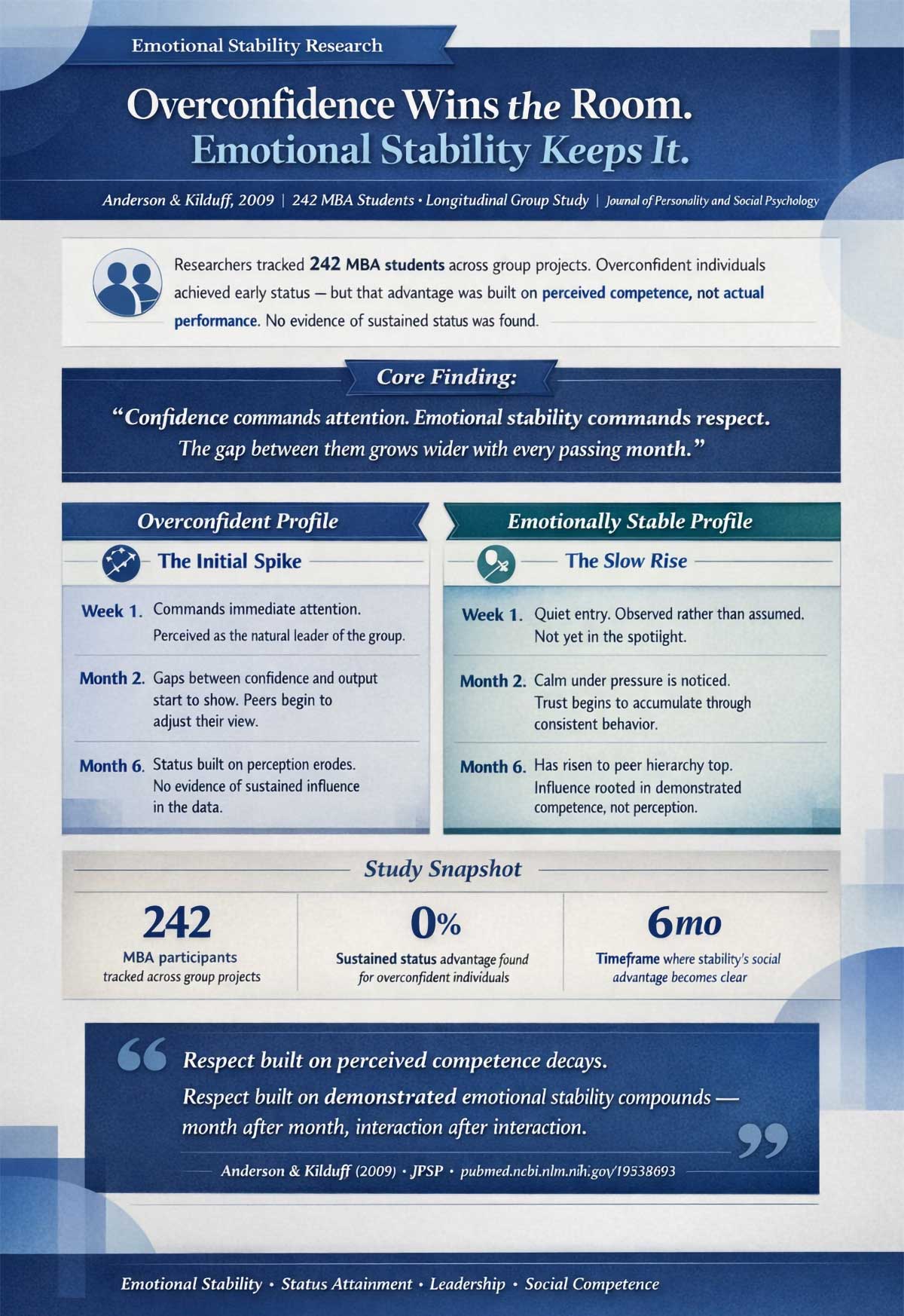
Confidence gets the spotlight. It doesn’t hold it.
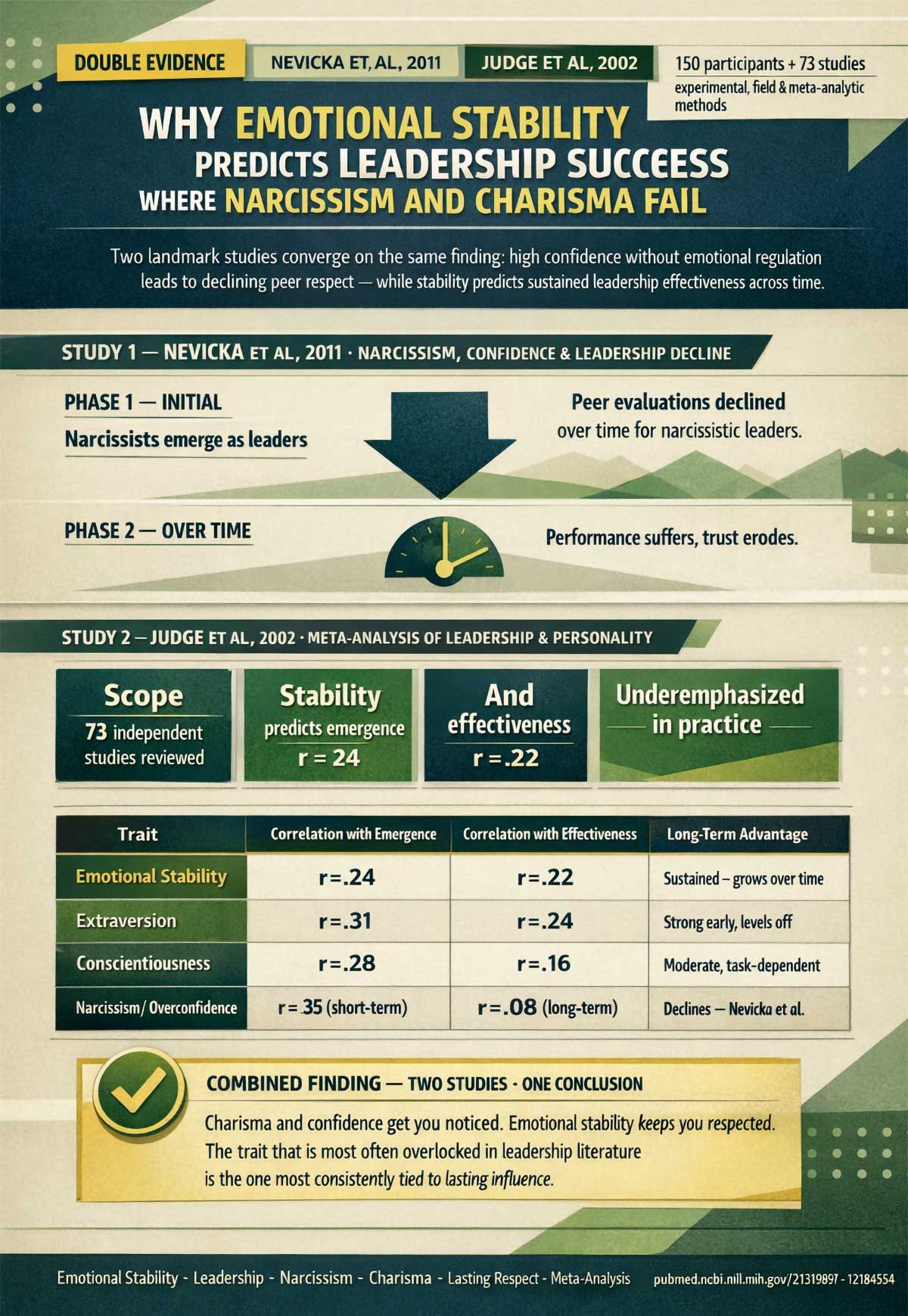
Charisma faces the same ceiling. Research by Nevicka and colleagues (2011) found that narcissistic individuals — those high in extreme confidence and social charm — emerged as leaders at first. But group performance suffered. And peer evaluations? They dropped over time. Without emotional stability underneath, the charisma cracked.
That study found something important: emotional stability predicted sustained positive evaluations, long after the initial shine wore off.
This is the charisma trap. You get the room. You lose the room. And you often don’t even know why.
The “Cooling” Effect: Why Calm Reads as Competence
Think about the last time you watched someone stay completely composed during a stressful situation. No raised voice. No visible panic. Just clear, measured action.
What did you think of them?
Almost certainly, you thought they knew what they were doing. That reaction isn’t random. It’s deeply rooted in how humans assess one another.
Susan Fiske and colleagues (2007) reviewed decades of cross-cultural research on social judgment. Their conclusion was clear: respect is tied to perceived competence, not likability. Warmth makes people like you. Competence makes people respect you. And calm, reliable behavior is one of the clearest signals of competence we have.
When someone doesn’t overreact to chaos, they send a silent message: “This situation is smaller than my ability to handle it.” That signal is hard to fake. And people read it immediately.
But there’s a catch. Suppressing emotions doesn’t work the same way as actually regulating them — and the difference is visible to everyone around you.
Suppression sounds like: “I’m fine. It’s fine.” Said through a tight jaw while quietly seething. Regulation sounds more like: “I’m frustrated this happened, but getting angry won’t help me solve it. What’s the actual problem here?” One buries the feeling. The other processes it and moves forward.
Research by Gross and John (2003) tracked 278 university students over three months. Those who used suppression saw their social relationships deteriorate over time. Those who used reappraisal — actually changing how they thought about a situation — built stronger relationships as the months passed. The effect grew stronger over time.
Suppression looks stiff. Regulation looks grounded. One is a mask. The other is a skill.
A study by Kalokerinos and colleagues (2017), spanning 2,385 participants across five separate studies, sharpened this point further. People who amplified their emotions were rated as less competent. But consistent, measured emotional responses — neither forced nor over the top — predicted higher competence ratings. It’s worth noting these studies used controlled scenarios rather than live workplaces, but the consistency of results across five separate experiments strengthens the finding considerably.
Stable authenticity, not emotional theater, is what earns respect.
The Trust Algorithm: Predictability Beats Intensity
Excitement creates romance. Consistency creates trust. And trust is the foundation of lasting respect.
This might be the most underrated insight in all of social psychology. People don’t just need to like you or admire you. They need to be able to predict you. When they can’t predict your reaction, they can’t trust you. And when they can’t trust you, they quietly stop relying on you — regardless of how talented you are.
Think of two types of leaders. The first is the Rollercoaster: high energy when things go well, visibly stressed when they don’t. Being around them is exciting, but also exhausting. You never quite know what version you’ll get. The second is the Anchor: steady across conditions. Not emotionless. Just reliable. Being around them gives you energy rather than draining it.
Research by Colquitt and colleagues (2007) — a meta-analysis drawing on 190 independent samples — found that trust is the bridge between who someone is and how much respect they receive. Leader integrity and consistent behavior were the strongest predictors of trust across all the samples studied. Emotional stability signals both.
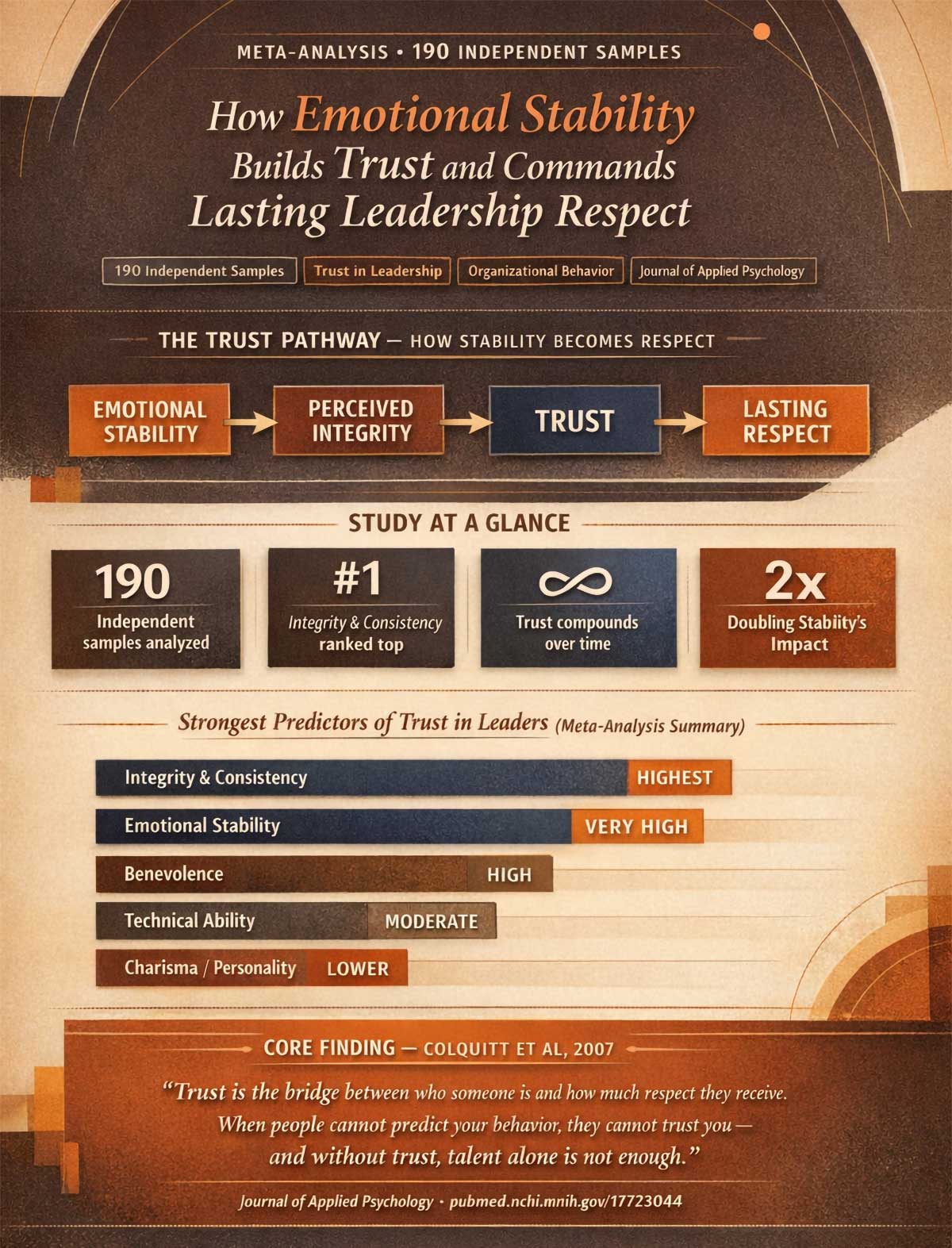
When your behavior is predictable, people stop bracing for impact around you. They relax. They think more clearly. And they associate that clarity with your presence.
Being “boring” in your behavioral patterns isn’t a weakness. It’s a signal of strength.
The 6-Month Rule: When Charisma Fades, Stability Rises
The timeline of social status follows a pattern. It’s consistent enough that researchers have tracked it across different group settings.
In the first week, the loud and confident individual gets the most attention. They set the tone. They control the conversation. By month two, cracks start showing if the confidence isn’t backed by emotional regulation. By month six, something else has happened. The emotionally stable person — the one who absorbed pressure without projecting it — has quietly risen.
A study by Côté and colleagues (2010) captured this exact pattern. They followed 114 work teams over six months, tracking how individuals gained status over time. People who managed their emotions effectively in team settings gained status as the months passed. Critically, the effect was stronger at six months than at the start of the study.
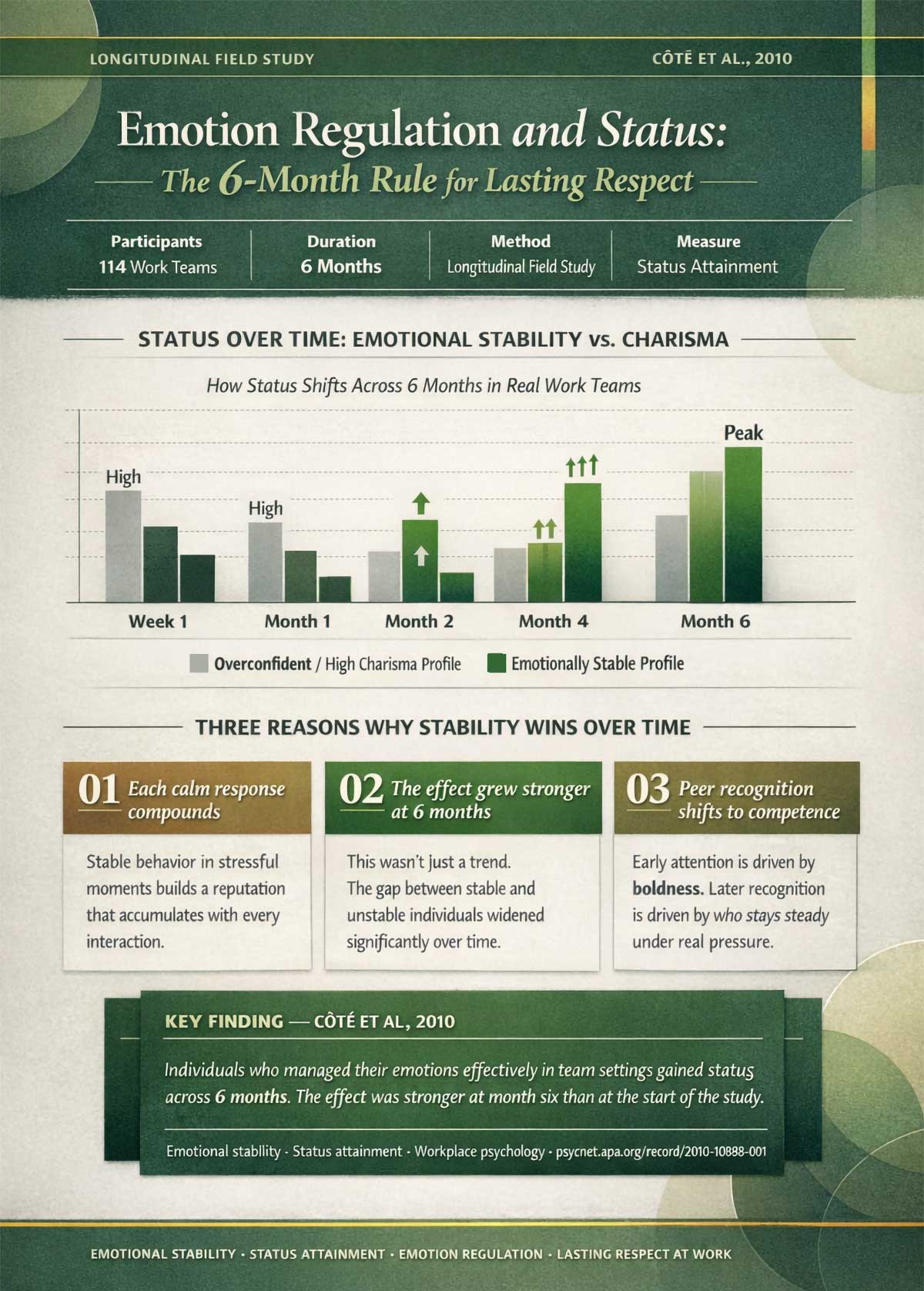
This is the compounding interest of social capital. Each calm response, each steady moment under pressure, each instance of not losing control adds to an invisible account. And that account earns interest.
A broader look at leadership confirms it. A meta-analysis by Judge and colleagues (2002), reviewing 222 correlations across 73 studies, found that emotional stability consistently predicted both leadership emergence and effectiveness. The effect was consistent. And, as the researchers noted, it was underemphasized in popular leadership writing relative to its actual importance.
Charisma wins the sprint. Stability wins the marathon. And most careers are marathons.
Resilience as a Service: Containing the Anxiety of Others
Here’s something that often goes unnoticed. Emotions are contagious.
In any high-stress environment, fear spreads. Panic multiplies. When one person stays calm while those around them start to spiral, something important happens: their composure gives others something to hold onto. Your steadiness becomes scaffolding for everyone else’s emotional regulation. Psychologists call this affective containment — and it’s one of the most socially valuable things a person can provide.
You don’t just manage your own emotional state. You act as a circuit breaker for the group’s anxiety. Not by dismissing the stress, but by not adding to it. By staying functional when others can’t.
This matters for respect because of something simple: we respect people who make us feel safe. When someone remains stable in a crisis, those around them can think more clearly. They make better decisions. And they know, even if they don’t say it, exactly who made that possible.
Research by Bono and Judge (2004) studied 282 leaders and 761 of their direct reports in real business environments. Emotional stability predicted transformational leadership behavior, and follower satisfaction was significantly higher with emotionally stable leaders over time. When people feel steadied by your presence, they don’t just respect you. They want to keep working with you.
This quality compounds. The more consistently you provide that steady presence, the more others seek it out. And the more they seek it out, the more central you become.
Uy and colleagues (2017) tracked 101 entrepreneurs over eight weeks using real-time experience sampling. Emotionally stable individuals maintained their effort and strategic thinking even after setbacks. The mechanism? Lower volatility in negative affect. They didn’t swing as hard when things went wrong. That steadiness kept them moving when others stalled.
In a world where setbacks are constant, that capacity becomes indispensable.
The Feedback Loop: Listening Without Defense
Here’s the real test of emotional stability. It’s not how you handle a crisis. It’s how you handle criticism.
When feedback lands, most people do one of two things. They get defensive, or they shut down. Both responses are driven by the same thing: an emotional reaction that overrides rational processing. The message gets lost in the noise of the feeling.
A stable ego does something different. It separates the discomfort of hearing the feedback from the value of what’s being said. It takes the message apart to find what’s actually true, rather than attacking the person who delivered it.
This behavior has a remarkable side effect. When people know you won’t react badly to the truth, they stop hiding it from you. You become someone who is safe to be straight with. And that creates what might be called an information advantage.
Stable leaders know what’s actually happening in their teams, their organizations, and their relationships. Because people aren’t afraid to tell them. That knowledge sharpens their decisions. Better decisions create better outcomes. And better outcomes cement respect.
Cuddy and colleagues (2011), in a review of research on social judgment, mapped out the behavioral results of being seen as both warm and competent. The combination produces admiration — the behavioral form of lasting respect. And emotional stability contributes to both dimensions. It signals reliability, which reads as competence. It signals safety, which reads as warmth.
Being open to feedback isn’t a sign of weakness. It’s a strategy for staying respected as the months and years accumulate.
The Compounding Returns of a Stable Reputation
At the highest levels, the evidence is equally clear. Hambrick and colleagues (2017), in a meta-analysis of executive personality, found that emotional stability in CEOs predicted consistent firm performance and lower outcome volatility. Charismatic traits, by contrast, predicted higher variance. Higher highs. But also lower lows.
Stakeholders — employees, partners, investors — don’t just want exciting results. They want reliable ones. The leader who can be counted on year after year commands a deeper, more durable form of respect than the one who occasionally dazzles but can’t be trusted to stay steady.
This is the long game. And emotional stability is how you play it.
The “3-Second Rule”: A Practical Starting Point
Understanding emotional stability and actually possessing it are different things. The research is clear on what it does. Less clear is how someone without it develops it. There’s no shortcut. But there is a starting point.
When something frustrating happens, before you say anything or do anything, pause for three seconds. That’s it. Three seconds.
This tiny gap between stimulus and response is where emotional regulation lives. It’s where you choose your reaction instead of just having one. The pause doesn’t fix everything. But it interrupts the automatic pattern long enough to give your rational mind a chance to catch up with your emotional one.
Over time, that gap gets easier to create. And the people around you will notice the pattern — even if they can’t name it.
That’s how the quiet reputation starts. One measured response at a time. One moment of not reacting the way everyone expected. One instance of staying steady when the situation called for panic.
Respect is not demanded through volume. It’s built through the refusal to be shaken.
Confidence gets you in the door. Emotional stability keeps you at the head of the table. And once you see how it compounds, you’ll never overlook it again.