Harvard researchers found the longevity edge didn’t come from exercising more. It came from a structural habit that most fitness advice seldom mentions.
Most people believe that logging more hours at the gym is the surest path to a longer life. Count the minutes, hit the targets, repeat the routine. It’s a clean formula, and the fitness industry has built an entire economy around it, with structured programs, personal bests, and streak counters. The logic of more effort in, more years out seems airtight.
So it’s interesting that after following more than 111,000 people for three decades, researchers found a powerful habit linked to living longer that operated almost entirely independently of how much total time people spent exercising.
It had to do with how many different ways they moved.
What the 30-Year Cohort Actually Found
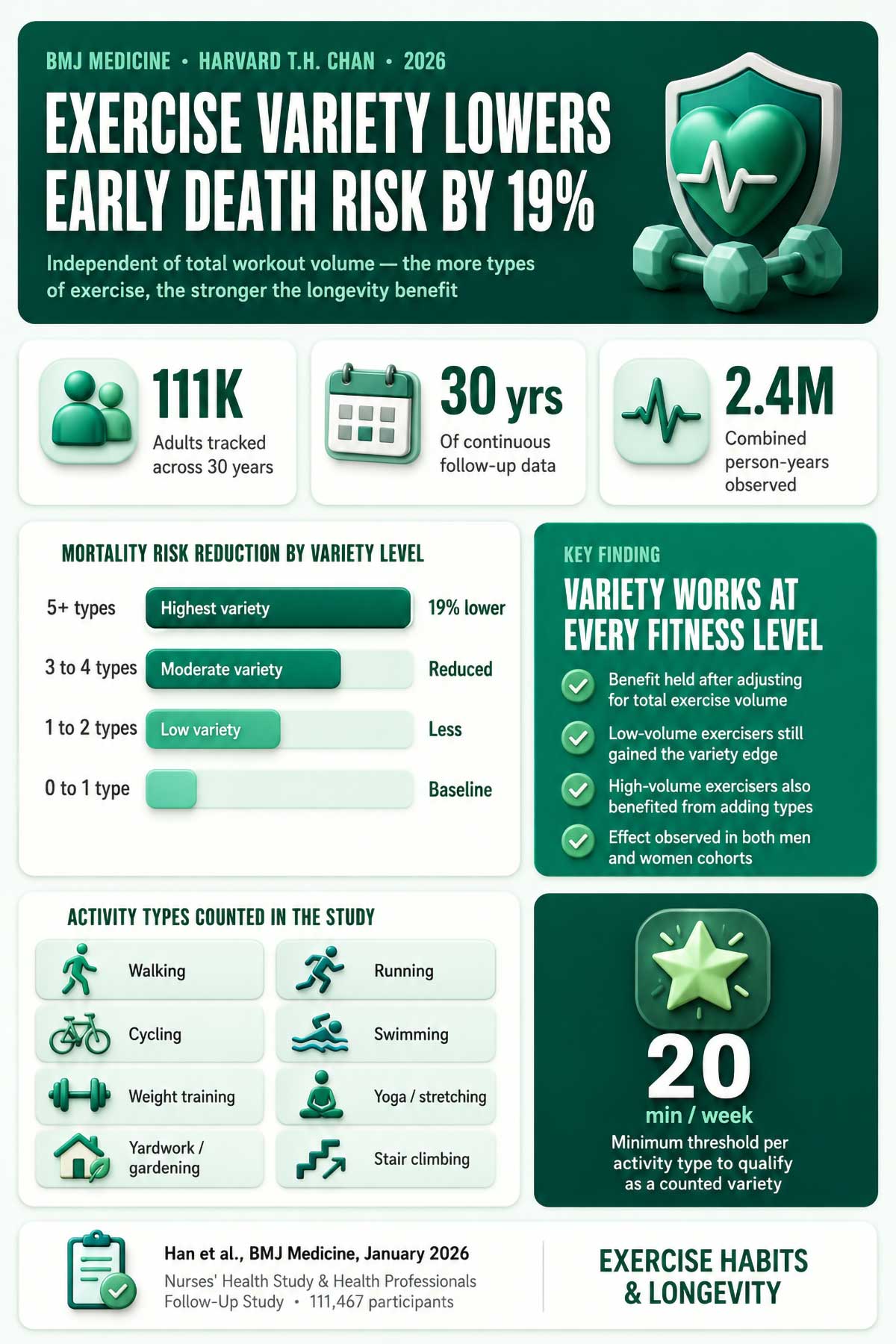
Published in 2026 in BMJ Medicine, the Han et al. study on physical activity types, variety, and mortality drew on data from two of the longest-running health cohort studies in the world: the Nurses’ Health Study (70,725 women) and the Health Professionals Follow-Up Study (40,742 men).
Participants reported their exercise habits over more than 2.4 million combined person-years. Researchers scored them not just on how much they exercised but also on how many distinct activity types they regularly engaged in, including walking, jogging, cycling, swimming, resistance training, yoga, gardening, stair climbing, and several others.
People who engaged in the highest variety of exercise types, five or more, had a 19% lower risk of dying early compared to those with the lowest variety. That held after researchers adjusted for total exercise volume. More hours at the gym didn’t cancel it out, and fewer hours didn’t eliminate it. The variety signal was independent.
The Harvard T.H. Chan School of Public Health press release confirmed what makes the finding so disruptive. The benefit applied across all levels of physical activity. People who exercised very little but varied their activities still showed the effect. So did people who exercised a lot. Variety wasn’t just a bonus for the highly active, it mattered regardless.
It’s Never Too Late to Broaden Your Habits
There’s a widespread assumption in fitness culture that your exercise trajectory is largely set by the time you are in your thirties. Train hard when you’re young, stay consistent, and you’ll bank the longevity benefits. Fall behind early, and you’re playing catch-up for life. That picture is much more forgiving than most people think.
A large 2019 cohort study published in JAMA Network Open, by Saint-Maurice et al., on physical activity across the adult life course, followed 315,059 adults and tracked their physical activity levels from adolescence through midlife. Adults who were inactive in early adulthood but meaningfully increased their activity levels during midlife saw a 32–35% reduction in mortality risk. People who had remained consistently active throughout their lives also saw reductions in a similar range (29–36%), suggesting that the two groups ended up in roughly the same place.
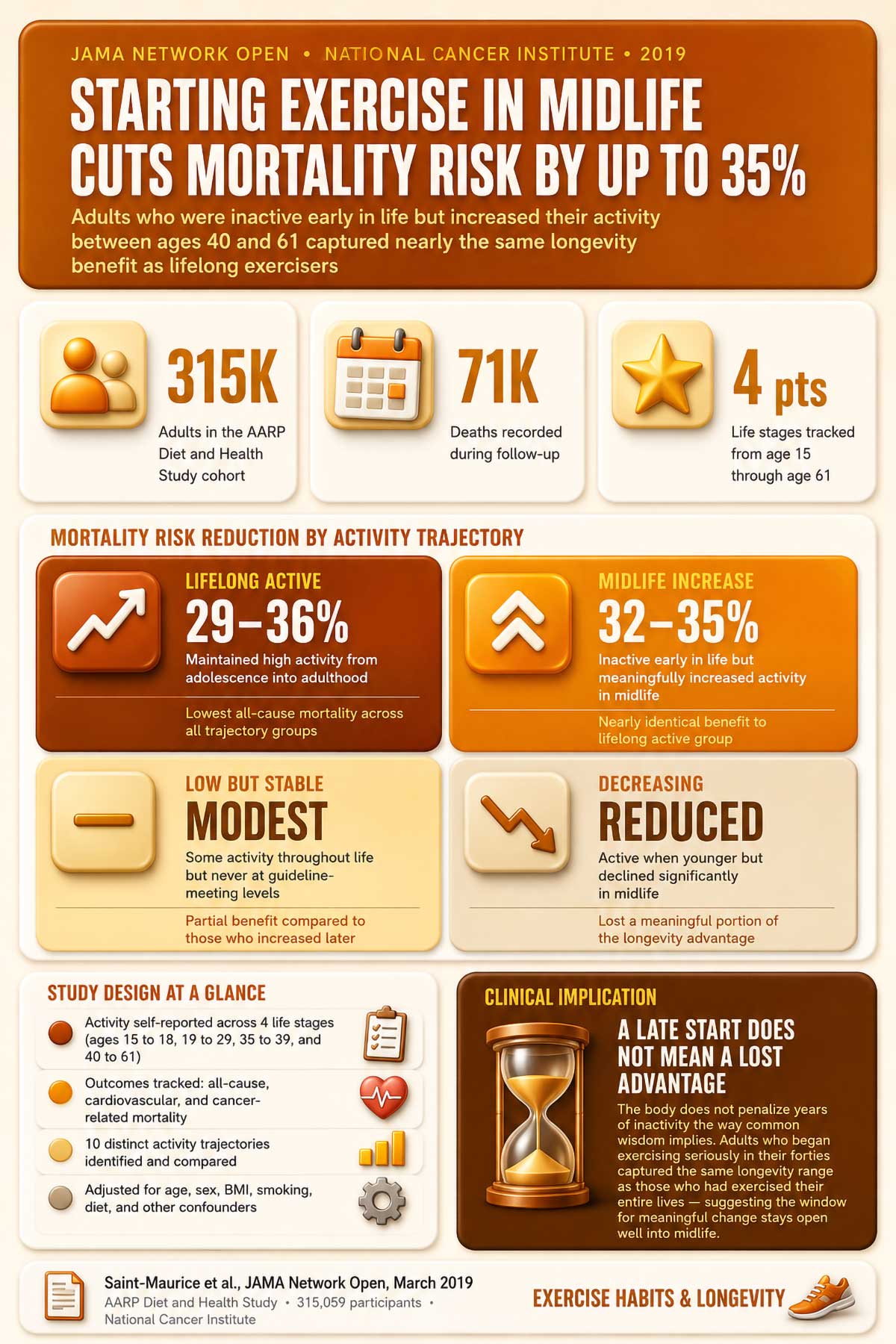
The body, it seems, doesn’t penalize a late start the way the fitness industry implies. What it responds to is a genuine shift toward moving more, across more dimensions, over time.
Why One Activity Isn’t Enough
The fitness industry has pushed hard toward specialization. Pick your identity as either a runner, CrossFitter, cyclist, or yogi. Build a practice and get better at it. The logic is compelling, but it runs against what exercise physiology actually shows about long-term health.
A systematic evidence review by the Physical Activity Guidelines Advisory Committee (2018) found strong evidence that combining aerobic activity, resistance training, and balance or flexibility work produces better functional health outcomes and lower injury risk than sticking to any single modality.
The human body has multiple systems that degrade independently with age, including cardiovascular capacity, muscle strength, bone density, coordination, and joint stability. No single activity stresses all of them. Running won’t build the strength your knees eventually need, and lifting won’t preserve your aerobic capacity. Yoga won’t protect your cardiovascular system on its own.
A varied routine reaches each of these systems, and a specialized one, by definition, doesn’t.
The Repetition Trap
There’s another mechanism at work beyond physiology that does not get nearly enough attention: repetitive exercise habits tend to self-destruct over time.
A comprehensive review in the Canadian Medical Association Journal by Warburton and Bredin (2006) confirmed a linear relationship between physical activity and health. More movement consistently predicts better outcomes. It also noted that single-modality training is a significant driver of overuse injuries and that multi-modal routines improve long-term adherence.
The implication is practical and a bit uncomfortable for anyone who’s ever been devoted to one sport or workout style: the routine you love most may be the one most likely to put you on the sidelines. Stress fractures, tendinopathy, repetitive strain, these are almost entirely creatures of repetition.
A habit that keeps you off your feet for three months every two years isn’t actually serving your longevity, even if the individual workouts are excellent. Variety provides a kind of structural protection that rigid routines don’t.
What “Variety” Actually Means in Practice
This isn’t an argument for chaotic, random movement. The researchers Han et al. defined exercise variety as meeting a minimum threshold of 20 minutes per week across five or more distinct activity types. That’s a specific and achievable bar. Walking counts, yardwork counts, and a weekly swim count alongside your regular strength sessions.
The finding doesn’t ask you to abandon what you love or train like a decathlete. It asks you to add. Someone who already runs three times a week, picks up a resistance-training habit twice a week, and occasionally cycles or swims is, by this research’s own criteria, doing exactly what the data support. The variety benefit isn’t reserved for people with unlimited time or athletic backgrounds. It’s accessible to anyone willing to move in more than one direction.
Volume Vs. Variety: Rethinking the Equation
The fitness world’s fixation on volume isn’t baseless. More exercise is broadly associated with better outcomes, and this relationship is well established. But what the 30-year Harvard cohort reveals is that volume alone is an incomplete metric. Two people could log identical weekly exercise totals and have meaningfully different mortality trajectories depending on how many types of activity they included.
That’s not a small conclusion; it changes what the most useful question actually is. For most people chasing longevity, the question “how much am I exercising?” may matter less than “how many different ways am I moving?” Adding a second or third type of activity to an existing routine may do more for lifespan than adding extra hours to the one you already do.
A Note Before Drawing Conclusions
The Han et al. study is large and well-controlled, but it has real limitations worth knowing. Exercise data were self-reported, which introduces measurement error. Both cohorts, the Nurses’ Health Study and the Health Professionals Follow-Up Study, consisted primarily of white health professionals, which limits the extent to which the findings can be applied across different populations. The study found an association, not a confirmed causal mechanism. Researchers at Harvard Chan School explicitly flagged these constraints.
The Saint-Maurice findings carry similar caveats: activity levels were self-reported retrospectively, and the cohort was drawn from AARP members aged 50–71. This population may not reflect the full adult age range.
None of that makes the findings less interesting or less actionable. It does mean the 19% figure should be understood as an association observed in a specific population, not a guarantee universally applicable to all people in all contexts.
The Actual Takeaway
Three decades of data, 111,000 people, and the clearest signal wasn’t about training harder or logging more hours. People who moved in more ways, not necessarily more often, lived longer, and the effect showed up at every level of fitness. That’s a genuinely different message than what most exercise advice delivers.
Yang Hu, the study’s corresponding author and a research scientist at Harvard’s Department of Nutrition, put it plainly: “There may be extra health benefits to engaging in multiple types of physical activity, rather than relying on a single type alone.” That’s not a sales pitch for a new program. It’s permission to mix things up, and a good scientific reason to do it.
Conclusion
The fitness industry sells identity as much as it sells exercise. Either a runner or a lifter, you’re committed to the practice. Broadening that identity to include a swim, a bike ride, or an afternoon of heavy yardwork can feel like dilution.
But the 30-year data suggests that attachment to one mode of movement, however disciplined and consistent, may actually be the thing narrowing your longevity ceiling. Specialization is how you get better at a sport. Variety may be how you stay alive long enough to keep playing it.