Your muscles haven’t shrunk as much as you think. The real culprit is invisible — and it responds to training faster than you’d expect.
You grab the grocery bags. Your legs feel heavier than they should. You stand up from a chair and have to push off the armrest. You reach the third step on the staircase and your thighs burn. Sound familiar?
Most people chalk it up to getting old. Some blame genetics. But neither of those is the full story.
There’s a specific biological process driving this shift — and it’s far more fixable than most people think. Once you understand what’s really happening inside your muscles, the path forward becomes clear.
The “Heavy” Feeling Isn’t Just Age
Here’s the part most fitness guides skip: your muscles may not be as small as you think. A major clue comes from a landmark study by Goodpaster and colleagues in 2006. They tracked nearly 1,900 adults aged 70 to 79 over three years. What they found turned a lot of assumptions on their head. Strength declined two to five times faster than muscle mass. In other words, the muscle was still there — but it wasn’t firing the way it should.
That’s not a muscle problem. That’s a communication problem.
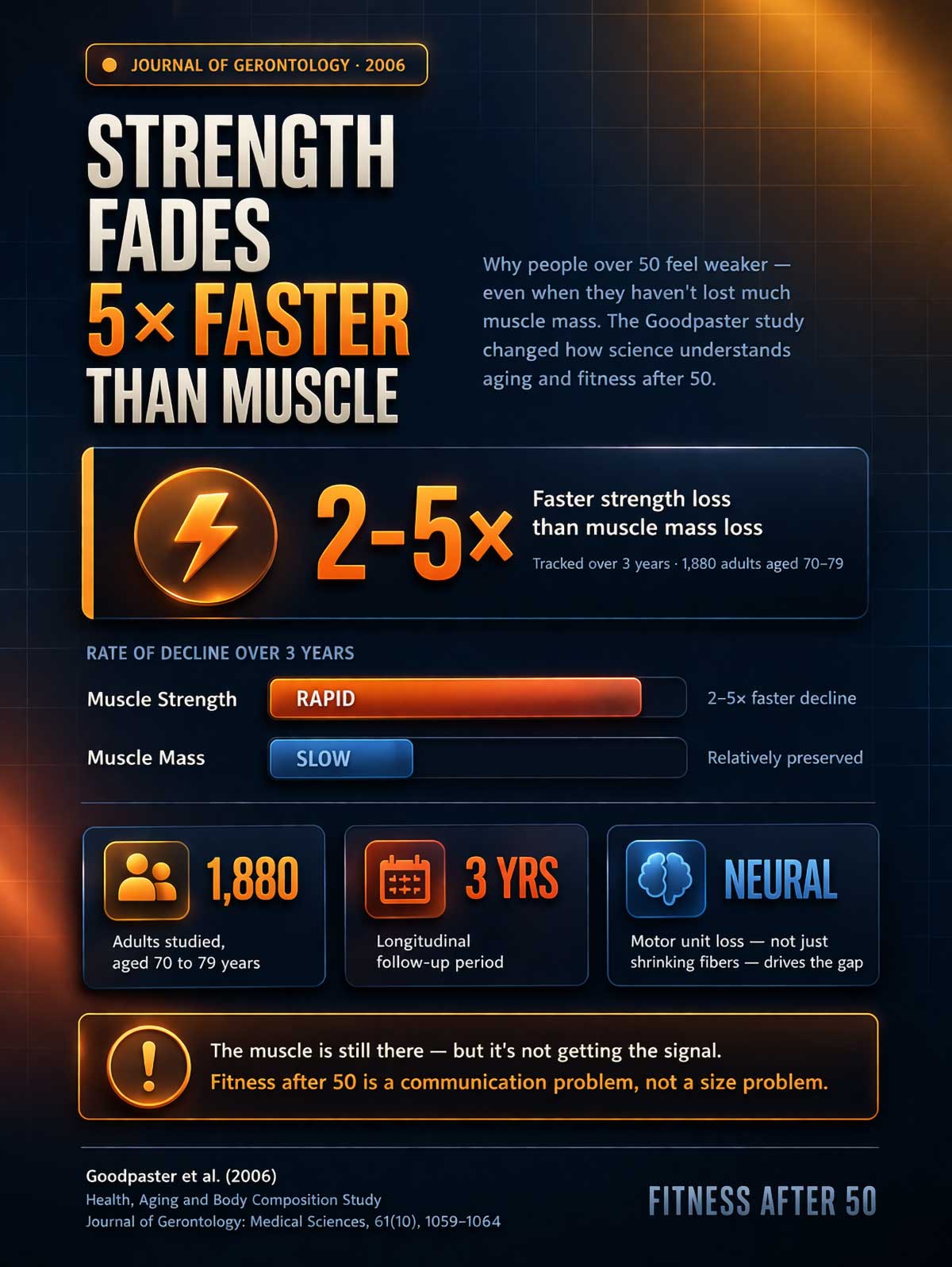
Your brain sends signals down the spine and into the nerves that connect to your muscles. Those signals tell your muscle fibers to contract. When that system works well, you stand up fast, catch yourself when you stumble, and carry bags without thinking. When it starts to break down, your muscles feel sluggish — even if they haven’t shrunk much at all.
So what’s actually breaking down? The answer lies in something called motor units.
Why Your Muscles Are “Sleeping”
A motor unit is a single nerve cell and all the muscle fibers it controls. Think of it like an electrical circuit. When your brain sends a signal, it “switches on” the circuit, and the muscle fibers in that unit contract together.
A 2016 review by Tracy and colleagues looked at the aging neuromuscular system in detail. It found that as we age, motor neuron cells in the spinal cord begin to die off. When a nerve cell dies, the muscle fibers it was connected to go quiet — they lose their power source. Some of those orphaned fibers get picked up by neighboring nerves, but not all of them. And the new connections aren’t always stable or fast.
The result? You have fewer, slower circuits firing when you try to move. Your body struggles to recruit enough motor units at the right speed. That’s the “heavy legs” feeling. That’s why a flight of stairs feels harder than it used to.
This isn’t inevitable shrinkage — it’s a loss of neuromuscular quality. And that distinction matters enormously, because it changes what you need to do about it.
It’s Not Strength. It’s Power.
Most fitness plans for people over 50 focus on strength — how much you can lift or push. That’s useful, but it misses something more important: power.
Power is how fast you can produce force. It’s not just about how strong your legs are. It’s about how quickly your nervous system can recruit motor units to fire together. That’s a neurological skill as much as a physical one — which is exactly why power fades faster than raw strength as motor units are lost.
Here’s why that matters in real life: when you trip on a step, your body has a fraction of a second to react. Your leg has to produce force fast enough to catch your weight before you fall. A strong muscle that responds slowly won’t save you. A powerful muscle that fires quickly will.
This is exactly what a 2008 study by Pijnappels and colleagues found. They studied older adults with an average age of 67 and measured how well they could recover from an induced trip. People with lower leg power fell in 25% of those trips — meaning 1 in 4 times, they couldn’t recover. People with adequate leg power fell less than 5% of the time. The difference wasn’t how much muscle they had. It was how rapidly they could generate force. Slow motor unit recruitment meant their muscles simply couldn’t brake the fall in time.
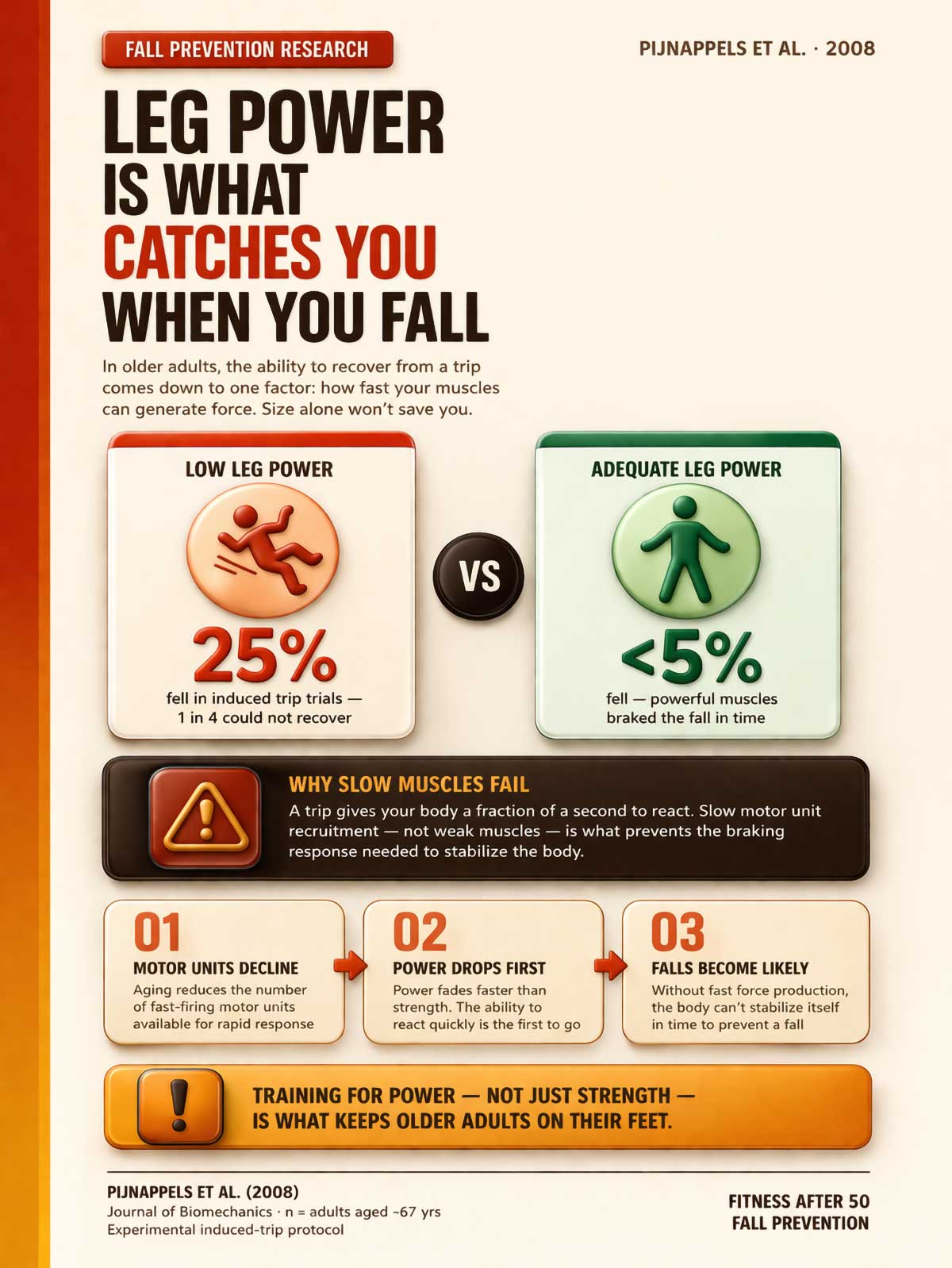
Power declines faster than strength. And strength declines faster than mass. This is the cascade most fitness programs for older adults completely ignore.
The Sit-to-Stand Litmus Test
Want a simple way to gauge where your functional strength stands right now? Try this: sit in a chair with your arms crossed over your chest. Stand up without pushing off with your hands. Sit back down. Repeat as many times as you can in 30 seconds.
This test is deceptively simple and remarkably telling. A 2006 review by Bohannon looked at sit-to-stand performance across aging studies. The results were striking. The inability to rise from a chair was strongly linked to losing independence, requiring care, and even higher rates of early death. Not because the test is magical — but because it requires exactly what aging chips away at: rapid force production, leg power, and neuromuscular coordination.
Older adults who struggle with this test are not just “out of shape.” They’re showing signs of the neuromuscular disconnect described above. Their circuits are going quiet.
The good news is the same tool that tests you can also train you.
Your Genes Aren’t Fixed
Here’s something that might surprise you: exercise doesn’t just build muscle. It can actually change how your genes behave.
In 2007, Melov and colleagues ran a six-month resistance training study on adults over 65. They measured gene expression in muscle tissue — essentially, which genes were “switched on” at the cellular level. Before training, the older adults showed a distinct pattern of gene activity compared to younger adults. Their mitochondria (the energy-producing structures in muscle cells) were underperforming. They had what researchers called an “aging transcriptional signature” — a specific pattern linked to energy loss, slower repair, and reduced muscle output across 179 genes.
After six months of resistance training, that signature reversed. The older adults’ gene expression profile shifted to resemble that of people roughly half their age. Their strength improved by about 50%, moving from 59% weaker than young adults to only 38% weaker. That’s not just better fitness — that’s a genuine biological change at the cellular level.
This tells us that the story of aging muscle isn’t just written in stone by your DNA. The way you move acts as an editor. It can rewrite the pattern.
Four Movements That Change Everything
Understanding the science is one thing. Applying it is another. Most traditional workout plans for people over 50 offer exercises like bicep curls or seated leg presses. These aren’t useless, but they train muscles in isolation. Real life doesn’t work that way. Real life asks your whole body to coordinate quickly, often under balance demands.
A 2005 randomized trial by de Vreede and colleagues made this point clearly. Older women were split into two groups: one did standard strength exercises, the other did task-based training — things like practicing sit-to-stand transitions, stair climbing, and functional reaching. After 12 weeks, the task training group outperformed the strength training group on every real-world movement test, including sit-to-stand speed and stair-climbing ability. The muscles weren’t just stronger. They had learned to work together in patterns that matched daily life.
Here are four movement categories worth focusing on:
The Power Rise This is the sit-to-stand, done with intent. Start seated in a chair. Lean forward slightly, then drive up as fast as you can in a single smooth motion. This trains rapid force production directly. Over time, progress to standing from a lower surface, removing arm support, and adding a small step forward as you rise.
Reactive Balance Training Trips happen. What matters is whether your nervous system can respond fast enough. Practice weight shifts: stand on one leg, hold for a few seconds, then step onto the other. Add small perturbations by shifting your weight unpredictably. This trains the reactive pathway — the one that fires when your foot catches a crack in the pavement.
Step-Down Work Most people focus on going up stairs. But the eccentric phase — the way down — is where your muscles absorb force and where control is hardest to maintain. Controlled single-leg step-downs train exactly this. Step onto a low surface, then lower yourself with one leg as slowly and steadily as you can. The downward motion under load is demanding in a way that walking up never is.
The Loaded Carry Pick up something moderately heavy — a bag, a box — and walk with it. This sounds simple, but it trains postural stability, grip strength, and leg drive simultaneously. It’s the closest gym-based analog to real-world load-bearing tasks.
Why “Light Weights and High Reps” Falls Short
There’s a persistent idea that people over 50 should stick to light weights and high repetitions to “stay safe.” This advice isn’t entirely wrong — but it’s incomplete, and for many people it’s actively unhelpful.
The Cochrane Review published by Liu and Latham in 2009 analyzed 121 randomized controlled trials involving older adults and resistance training. Their conclusion was clear: progressive resistance training — where load and difficulty increase over time — produced strength gains averaging 25 to 30%. More importantly, it improved functional ability: sit-to-stand speed, walking pace, and stair-climbing ability all improved significantly.
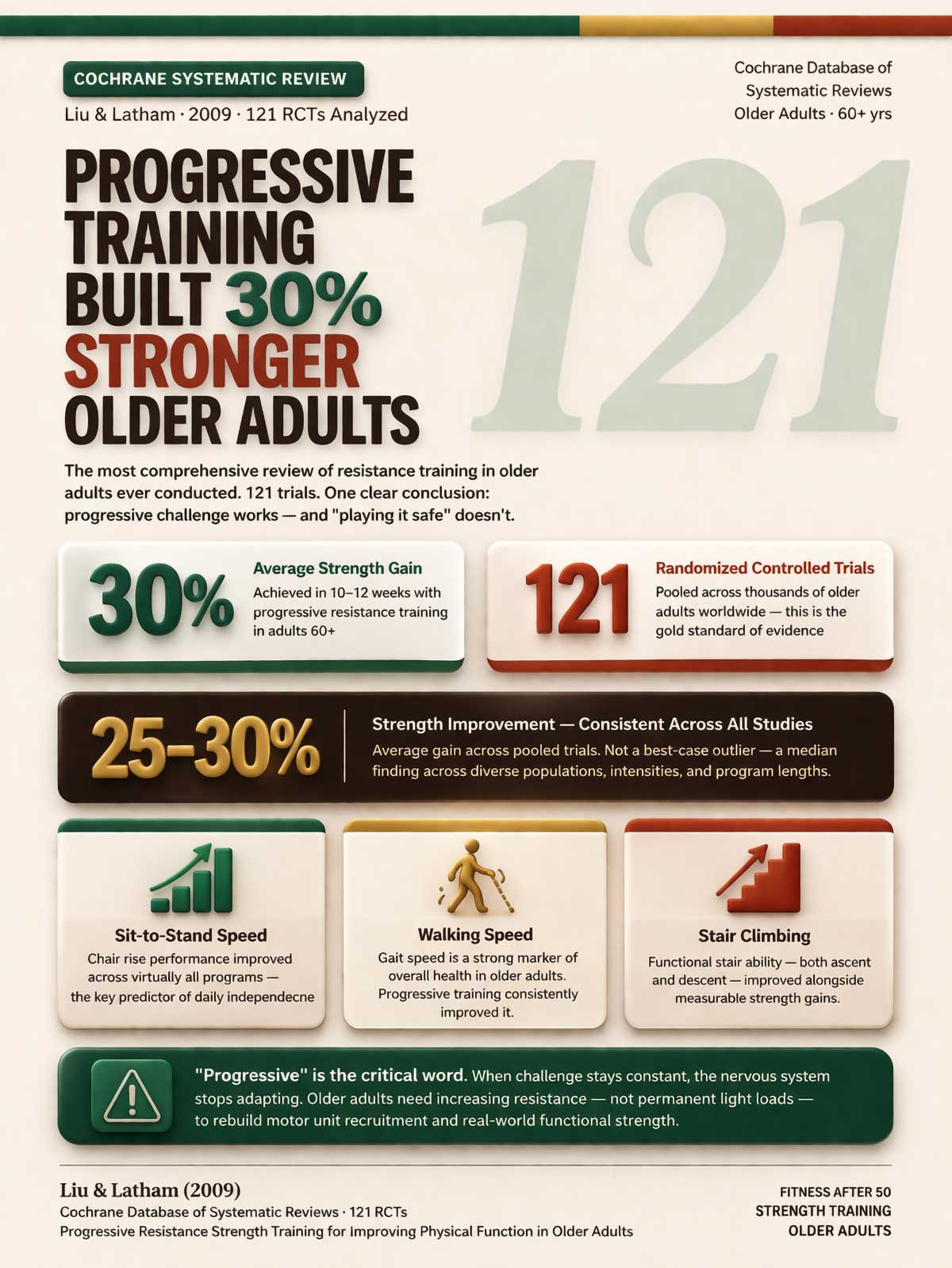
The word “progressive” is the key. If the challenge stays the same, the body adapts and stops changing. The nervous system only learns to recruit new motor units when it’s pushed to do so. That requires effort levels that feel genuinely challenging, not just tiring.
This doesn’t mean lifting heavy in a way that causes injury. It means consistently asking your body to do a little more than it did before — whether that’s more resistance, faster movement, or more demanding balance conditions.
A note from the InCHIANTI Study (Cesari et al., 2009) adds weight to this urgency. Among 900-plus adults aged 65 and older, those in the lowest physical performance group were four to five times more likely to become disabled within just one year compared to those with higher function. There appears to be a threshold below which decline accelerates rapidly. Staying above that threshold matters — and training with enough challenge is what keeps you there.
The 12-Week Roadmap
Reversing the neuromuscular decline isn’t a matter of finding the right stretch or the perfect supplement. It’s a structured process with three clear phases.
Phase 1: Neural Awakening (Weeks 1–4)
The first step is re-establishing the brain-muscle connection. Many older adults have motor units that haven’t fired under load for years. The goal in this phase isn’t muscle growth — it’s teaching the nervous system to recruit again.
Focus on basic functional movements with bodyweight or very light load — but performed with intentional speed and control on the rising phase. Light load is a starting point, not a ceiling. Sit-to-stands, step-ups, gentle single-leg balance holds, and controlled squats. Move with intention: slow on the way down, deliberate pause, then as fast and controlled as you can on the way up. Quality over quantity. Three sessions per week, 30 to 40 minutes each.
Also in this phase: pay attention to how your body coordinates. Do your hips and knees track together? Does one side feel weaker? These early sessions build body awareness as much as physical output.
Between all sessions, prioritize sleep and light mobility work — walking, gentle stretching, slow movement. Your nervous system needs recovery time to adapt. This isn’t laziness. It’s where the actual remodeling happens. That principle holds across all three phases.
Phase 2: Power Accumulation (Weeks 5–8)
Once basic patterns feel stable, shift focus to the speed of movement. This is where power training begins in earnest.
Add resistance gradually. Increase the speed of the rising phase in your sit-to-stands. Introduce low-box jumps or step-ups done with a quick, controlled drive upward. Begin loaded carries. Add stair step-downs with a single leg and a small dumbbell held at your side.
The aim is to start asking your neuromuscular system to fire faster. Not recklessly — but with purpose. At this stage, three to four sessions per week works well, alternating between movement-based sessions and balance-focused sessions.
Phase 3: Functional Mastery (Weeks 9–12)
In the final phase, take what you’ve trained and apply it to patterns that mirror real life. This is where task-specific training comes in.
Combine movements: a loaded carry followed by a step-up, or a balance hold that transitions into a squat. Practice rising from different surface heights. Walk over small obstacles. Carry bags while maintaining posture. These combinations teach your body to switch between patterns quickly — which is exactly what daily life demands.
Track your sit-to-stand test score at the end of the 12 weeks. Most people are genuinely surprised by the change.
A Different Way to Think About 50+
The research community is quietly shifting how it talks about aging and muscle. The old story was about managing decline, slowing the inevitable, staying safe. That story wasn’t wrong — it just wasn’t complete.
Rikli and Jones conducted a large-scale functional fitness study in 1999 involving more than 7,000 adults between the ages of 60 and 94. They found that lower-body strength and power were the single strongest predictors of whether someone could perform the activities of daily life: walking, rising from a chair, climbing stairs, carrying groceries. Not age alone. Not genetics alone. Physical capacity.
That’s a powerful finding, because it means the outcome isn’t fixed.
Physical capacity responds to training at any age. The neuromuscular system can be reactivated. Gene expression can shift. Power can be rebuilt. The same legs that feel heavy on a staircase today can feel entirely different six months from now — not because of a miracle, but because of a targeted, consistent training process.
Your genetics are your starting point. Your movement is what you build from there.
The “heavy” feeling isn’t a life sentence. It’s feedback. And feedback means there’s something you can do about it.
This article draws on peer-reviewed research published in the Journal of Aging and Physical Activity, the Journal of Gerontology, PLOS ONE, and Cochrane Reviews. For guidance specific to your health history, consult a physical therapist or fitness professional with training in aging-specific programming.