What happens inside your digestive system when you drink kefir every day? Which bacteria actually grow? Which ones decline? And how long does it take to see real changes?
Scientists wanted answers too. So they tracked people’s gut bacteria while they drank kefir daily. What they found goes beyond the generic “probiotics are good” advice.
The Bio-Tracking Studies: Moving Past Probiotic Buzzwords
Gut health isn’t just about adding good bacteria. It’s about changing your gut’s entire community.
Think of your gut like a garden. You can’t just toss seeds on concrete and expect flowers. You need the right soil, the right balance, and time for things to grow.
Researchers measured this balance using something called the Shannon index. It’s a score that shows how many different types of bacteria live in your gut. A higher score means more variety. And variety matters.
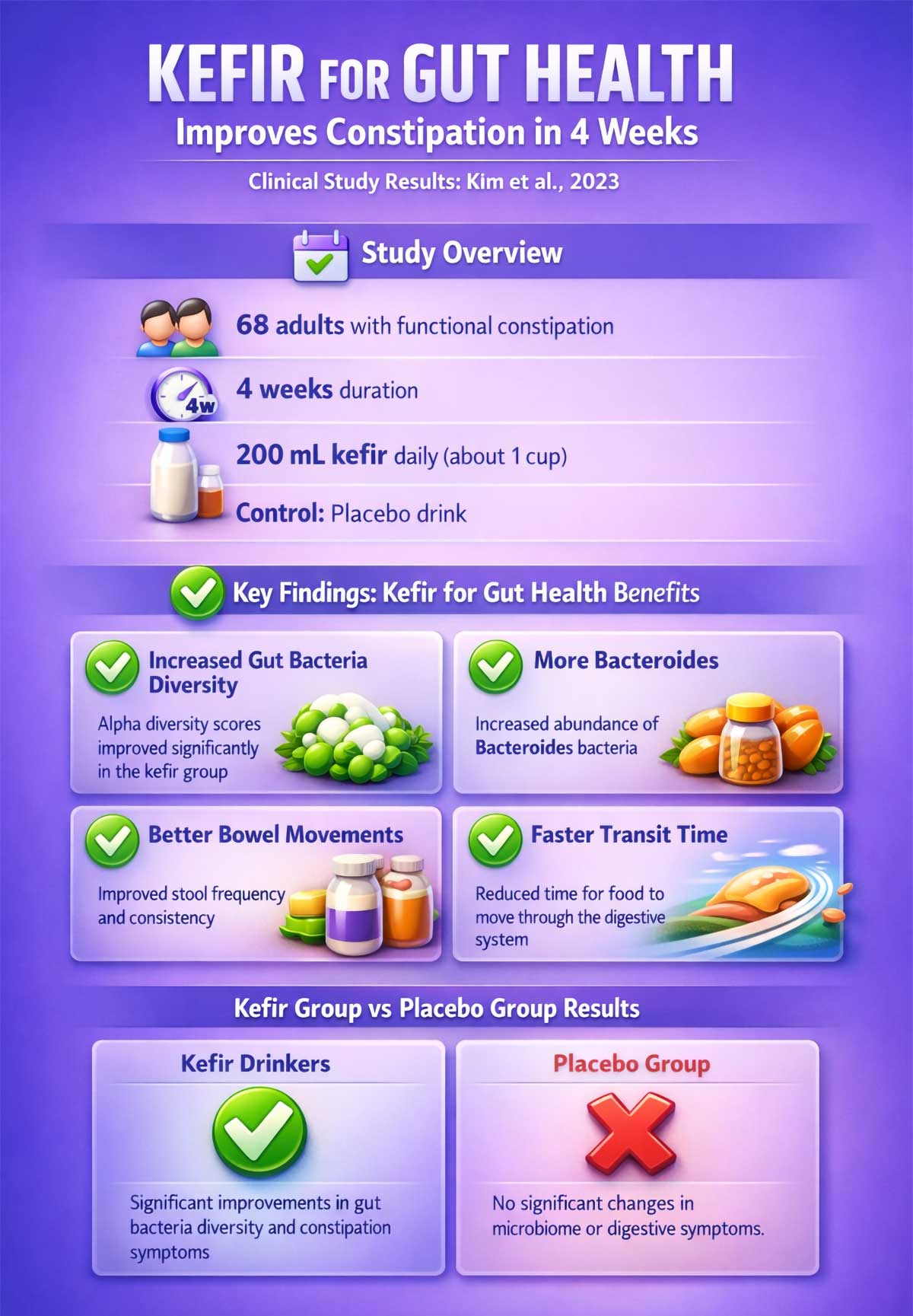
A 2023 study put this to the test. Scientists gave 68 adults with constipation either kefir or a placebo drink for four weeks. Each person drank 200 mL daily—about one cup.
The kefir group showed increased alpha diversity—a measure of how many different bacterial species live in the gut. Their microbial communities became richer and more varied. The placebo group? No change.
But diversity is just the start. The real story is about which specific bacteria changed.
Your Starting Point Matters
Before we look at specific bacteria, here’s something important: kefir doesn’t work the same way for everyone.
Your gut already contains trillions of bacteria. The mix is unique to you. What happens when you add kefir depends on what’s already there.
If your gut is low in certain beneficial bacteria, kefir can make a big difference. But if you already have plenty of those bacteria, the changes might be subtle.
It’s like watering a plant. A dry plant responds quickly. A well-watered plant? Not much happens.
A 2022 review of 10 kefir studies found mixed results. Some showed big bacterial changes. Others showed modest shifts. The differences came down to three factors: people’s starting gut bacteria, the type of kefir used, and how much they drank daily.
Live grain kefir contains more bacterial strains—sometimes up to 50 different types. Store-bought versions might have only 10 to 12 strains. And some commercial products are pasteurized after fermentation, which kills many beneficial bacteria.
Keep this variation in mind as we look at what the studies found.
The Arrival of a New Resident: Lactobacillus kefiranofaciens
Not all probiotics survive your stomach acid. Most die before they reach your intestines.
But Lactobacillus kefiranofaciens is different. This bacteria is unique to kefir grains. And it’s tough.
In a 2015 study, researchers gave 32 healthy adults either regular milk or milk fermented with L. kefiranofaciens M1. Both groups drank their assigned beverage for four weeks.
The fermented milk group showed a clear increase in lactic acid bacteria in their stool samples. Tests confirmed that L. kefiranofaciens had made it through the stomach and into the gut.
Why does this matter? Lactic acid bacteria create an acidic environment in your intestines. Bad bacteria don’t like acid. They struggle to grow in it. So when L. kefiranofaciens sets up shop, it makes your gut less friendly to harmful microbes.
It’s like installing a security system that runs 24/7.

The Eviction Notice: Reducing Harmful Bacteria
Kefir doesn’t just add good bacteria. It pushes out harmful ones.
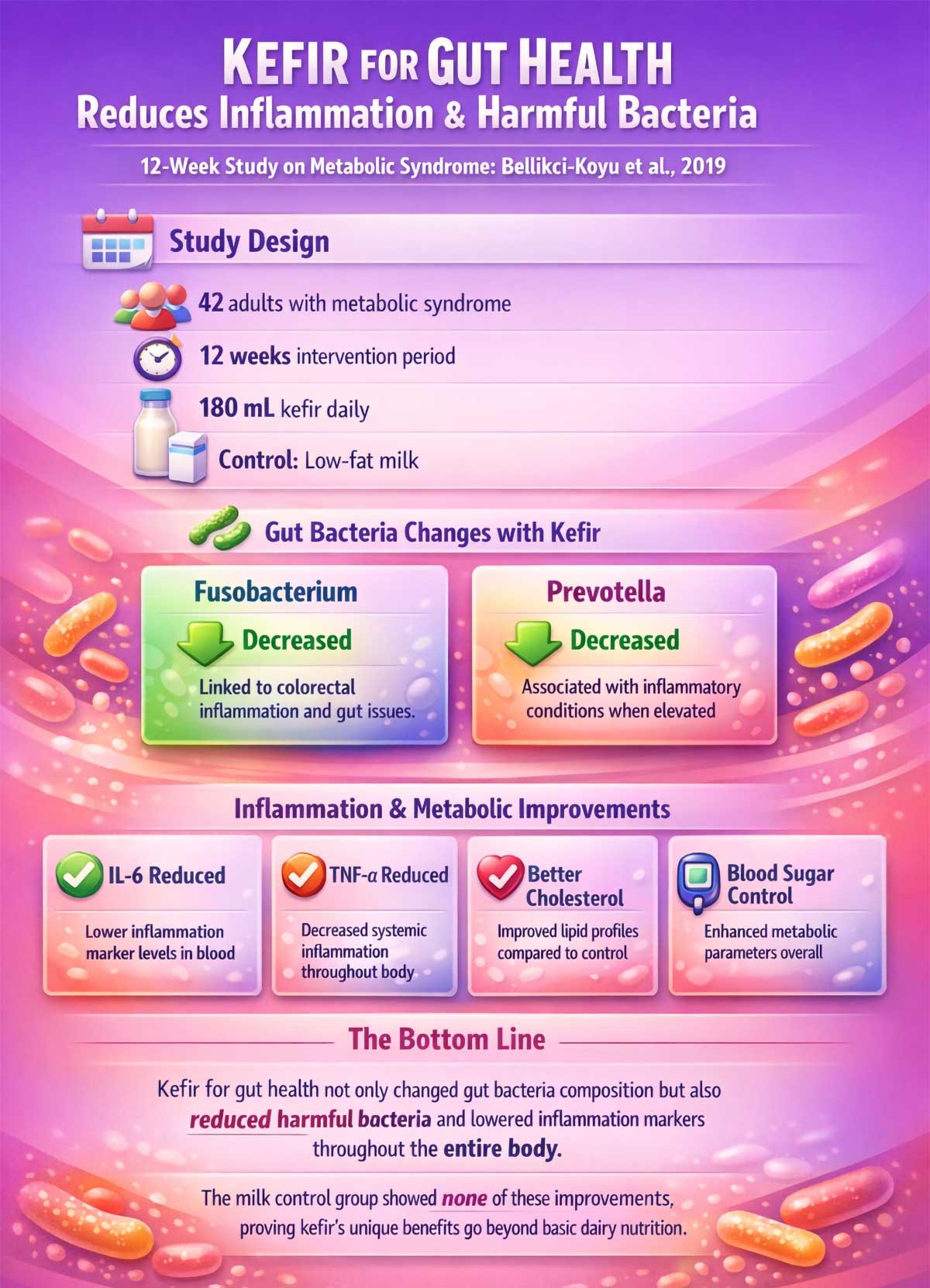
A 12-week study looked at 42 adults with metabolic syndrome. Half drank 180 mL of kefir daily. The other half drank low-fat milk.
After three months, the kefir group showed drops in two specific bacteria: Fusobacterium and Prevotella. This matters because Fusobacterium is linked to colorectal inflammation and other gut issues. Prevotella, in high amounts, has been associated with certain inflammatory conditions.
And the effects weren’t just in the gut. Blood tests showed drops in IL-6 and TNF-α—two markers of inflammation throughout the body. The kefir group also saw improvements in cholesterol and blood sugar levels.
The milk group? None of these changes happened.
This tells us something important. Kefir isn’t just a probiotic supplement. It actively reshapes your gut community. Bad bacteria lose their foothold. Inflammation drops. Your whole system responds.
The Constipation Fix: How Bacteroides Speeds Things Up
Let’s get specific about digestion. If you’re backed up, kefir might help. And we know exactly why.
That 2023 constipation study didn’t just measure bacteria. It tracked bathroom habits too.
The kefir group showed an increase in Bacteroides bacteria. These microbes help break down fiber and produce short-chain fatty acids. Those acids tell your intestines to move.
After four weeks, people drinking kefir had more frequent bowel movements. Their stools were softer and easier to pass. They scored higher on the Bristol Stool Scale—a medical tool that measures stool consistency.
The placebo group stayed the same.
Transit time—how long food takes to move through your system—improved too. Faster transit time means less constipation. And Bacteroides are key players in keeping things moving.
The IBS-D Shift: Calming an Overactive Gut
Diarrhea-predominant IBS (IBS-D) is the opposite problem. Your gut moves too fast. You have loose stools, cramping, and urgent bathroom trips.
Can kefir help with that too? A 2021 study tested this.
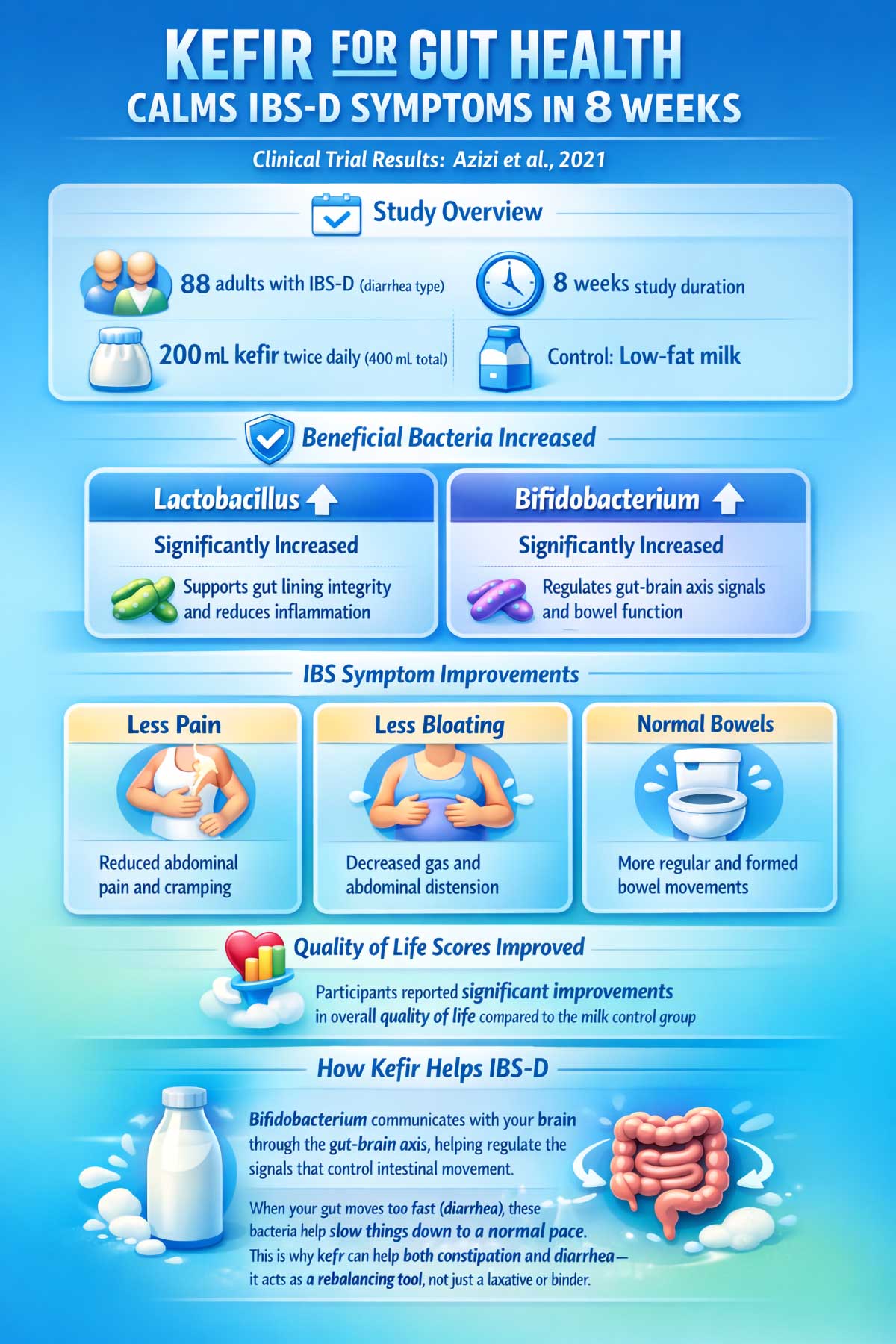
Researchers recruited 88 adults with IBS-D. Half drank kefir—200 mL twice daily. The other half drank low-fat milk as a control. This went on for eight weeks.
The kefir group showed increases in both Lactobacillus and Bifidobacterium. Both bacteria are known to support the gut lining and reduce inflammation.
But the real test was symptoms. Researchers used the IBS Symptom Severity Score—a validated questionnaire that measures pain, bloating, and bowel habits.
After eight weeks, the kefir group’s scores dropped significantly compared to the milk group. They had less pain. Less bloating. More normal bowel movements. Their quality of life scores improved too.
What’s happening here? Bifidobacterium doesn’t just stay in your gut. It communicates with your brain through the gut-brain axis. It helps regulate the signals that control how fast your intestines move. Too fast? It slows things down. Too slow? It speeds them up.
This is why kefir can help both constipation and diarrhea. It’s not a laxative or a binding agent. It’s a rebalancing tool.
Replicating Research Results
Want to replicate what the research showed? Here’s a practical guide based on the studies.
Week 1: Start Small
Don’t go all-in on day one. Your gut needs time to adjust.
Start with 100 mL (about half a cup) daily. Drink it with breakfast or lunch.
You might feel bloated or gassy. This is normal. Your gut bacteria are shifting. New bacteria are moving in. Old bacteria are dying off. This process creates gas.
If the bloating is uncomfortable, cut back to 50 mL for a few days. Then slowly increase.
Week 2: Increase to Research Dose
By week two, aim for 200 mL daily. This is the dose used in most studies.
Some research used twice-daily servings (100 mL morning and evening). Others used a single 200 mL serving. Both approaches worked. Pick what fits your schedule.
Look for kefir with live, active cultures. Check the label. It should say “contains live and active cultures” or list specific bacterial strains.
Avoid products with added sugar or artificial sweeteners. These can interfere with the bacterial benefits.
Week 3-4: Monitor Your Response
By week three, pay attention to changes. Keep notes if it helps.
Most studies showing clear benefits ran for at least four weeks. Some digestive improvements appeared in that timeframe. But metabolic changes—like reduced inflammation markers and better blood sugar control—took up to 12 weeks to show up in research.
What to watch for:
- Bowel movement frequency and consistency
- Energy levels throughout the day
- Digestive comfort after meals
- Skin clarity (gut health often shows up on your skin)
- Mood and mental clarity (gut-brain connection)
Some people notice differences sooner. Others need six to eight weeks. Be patient with the process.
Beyond Week 4: The Maintenance Question
Can you stop drinking kefir and keep the benefits?
Probably not. Most studies suggest the bacteria changes are temporary.
A 2016 study tracked 12 healthy adults who drank kefir for four weeks. They consumed 360 mL daily—more than most other studies.
The results were surprisingly modest. Researchers found no significant changes in overall diversity or major bacterial groups. L. kefiranofaciens appeared in a few participants’ gut samples. But the changes were inconsistent. And when people stopped drinking kefir, their bacteria returned to baseline within weeks.
This doesn’t mean kefir doesn’t work. It means your gut is constantly changing. Stop feeding it beneficial bacteria, and it reverts to its old patterns. The study also used healthy adults with presumably balanced microbiomes already. People with digestive issues might see bigger shifts.
Think of it like exercise. You can’t work out for a month and expect to stay fit forever. Consistency is what maintains the benefits.
Making Kefir Work: Practical Tips
Choose the Right Type
Fresh kefir from live grains beats store-bought versions. If you can’t make your own, look for brands that:
- Use live grains in fermentation
- Keep it refrigerated
- Have minimal ingredients (just milk and cultures)
- List multiple bacterial strains on the label
Timing Matters
Some people do better drinking kefir on an empty stomach. Others prefer it with food. Try both and see what feels best.
If you take medications, drink kefir at least two hours before or after. Some antibiotics and medications can interact with probiotics.
Temperature Tip
Cold kefir might be harder to digest for some people. Try letting it sit at room temperature for 10 to 15 minutes before drinking.
Pair It Right
Kefir works well with fiber-rich foods. The bacteria feed on fiber. So combining kefir with oatmeal, berries, or ground flaxseed gives them fuel to grow.
Avoid drinking kefir with very hot foods or beverages. High heat can kill the beneficial bacteria.
Conclusion
The research shows kefir can change your gut bacteria. But it’s not magic.
Studies found that four weeks of daily kefir consumption can:
- Increase gut bacteria diversity
- Boost levels of beneficial bacteria like Lactobacillus and Bifidobacterium
- Reduce harmful bacteria linked to inflammation
- Improve symptoms of constipation and IBS-D
- Lower markers of inflammation in people with metabolic issues
But individual results vary. Your starting microbiome, the type of kefir you choose, and how consistently you drink it all affect the outcome.
If you’re dealing with digestive issues, kefir is worth trying. Give it at least four weeks. Start with small amounts and build up. Pay attention to how your body responds.
And remember—kefir isn’t a substitute for medical treatment. If you have ongoing digestive problems, talk to your doctor. Kefir can support gut health. But it can’t fix everything on its own.
Your gut is a garden. Kefir is one tool for tending it. Use it consistently, along with a healthy diet and lifestyle, and you’ll likely see the benefits that research has documented.