It’s not about waking up earlier. High performers share a specific morning sequence that has nothing to do with discipline or motivation.
There’s a specific kind of exhaustion that comes not from working too little, but from working against yourself. You set the alarm early. You sit down. You try to force the thinking that used to come easily, and instead of clear output, you get something slow and murky. Productivity culture has a name for this problem. It calls it a lack of discipline. The actual answer is far more interesting.
What separates the brain that performs at its peak from the one that grinds is not willpower. It’s timing. Most popular advice tells you to eat the frog, wake at 4 AM, or check email first so nothing surprises you. That advice overlooks the biology. It tells you what to do while ignoring the “when” and the “why.” The research points in a very different direction.
High performers share specific morning patterns that map almost exactly onto what cognitive neuroscience predicts should work. And the first pattern begins before most people are even fully awake.
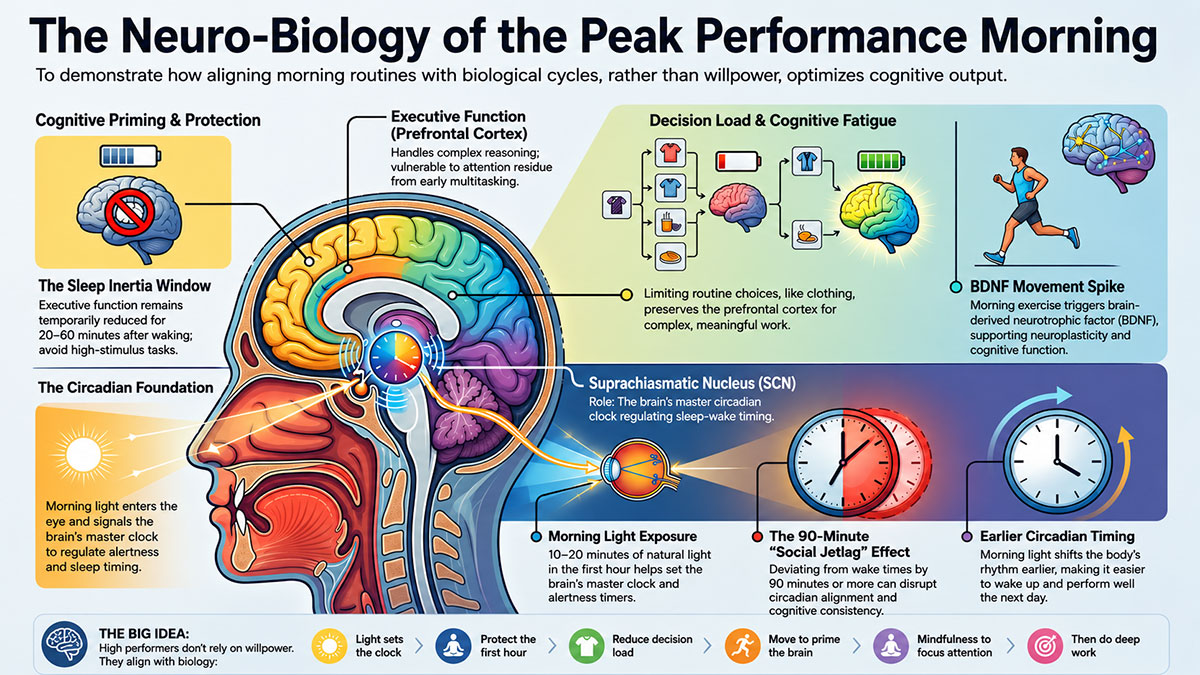
The Light Signal That Sets Everything in Motion
Your brain is not a computer. It doesn’t switch on cleanly at a set time. It runs on a biological clock built into every cell in your body, and that clock needs a signal each morning to stay accurate. That signal is sunlight.
When light enters the eye in the first hour after waking, it hits a group of cells in the retina called intrinsically photosensitive retinal ganglion cells (ipRGCs). These cells don’t form images. They measure light intensity and send that data to the brain’s master clock, the suprachiasmatic nucleus. This signal times the morning cortisol peak that drives alertness and starts a 16-hour timer for the melatonin release that prepares you for sleep. Skip the morning light, and that process fires too late or misses the mark entirely.
The effects carry through the whole day. Oxford circadian neuroscientist Russell Foster and colleagues (2013) found that waking at the same time each day stabilizes the molecular clocks in every cell of the body, not just the brain. When weekend sleep drifts even 90 minutes from weekday patterns (what researchers call “social jetlag”), those cellular clocks fall out of sync. The cost of re-syncing them across the week shows up in cognitive performance.
Columbia University researcher Michael Terman took this a step further. His work on circadian timing, published in the Archives of General Psychiatry (2001), showed that bright morning light can shift the body’s rhythm earlier. This “phase advance” makes it easier to wake up and perform well the next day. The light isn’t just setting today’s alertness window. It’s shaping tomorrow’s.
Ten to twenty minutes of natural light in the first hour after waking, ideally outside rather than through a window, is one of the most useful things a person can do for that day’s cognitive output. Not because it feels good. Because it’s how the clock gets set.
The Hour Your Brain Is Most Vulnerable (And Why Experts Protect It)
Almost no productivity advice mentions this: for the first 20 to 60 minutes after waking, the prefrontal cortex is not fully online. Sleep researchers call this period sleep inertia. It’s a real brain state, not just a way of describing morning grogginess.
During sleep inertia, blood flow and activity in the prefrontal cortex are reduced. This is the part of the brain that handles planning, complex reasoning, and judgment. Research by Wertz et al. (2006), examining prefrontal function under sleep disruption, confirmed that jumping into demanding tasks during this window puts people at a real disadvantage. Sleep scientist Matthew Walker’s work on sleep architecture supports the same point: high performers tend to let the brain warm up before loading complex work rather than pushing for full output from a cold start.
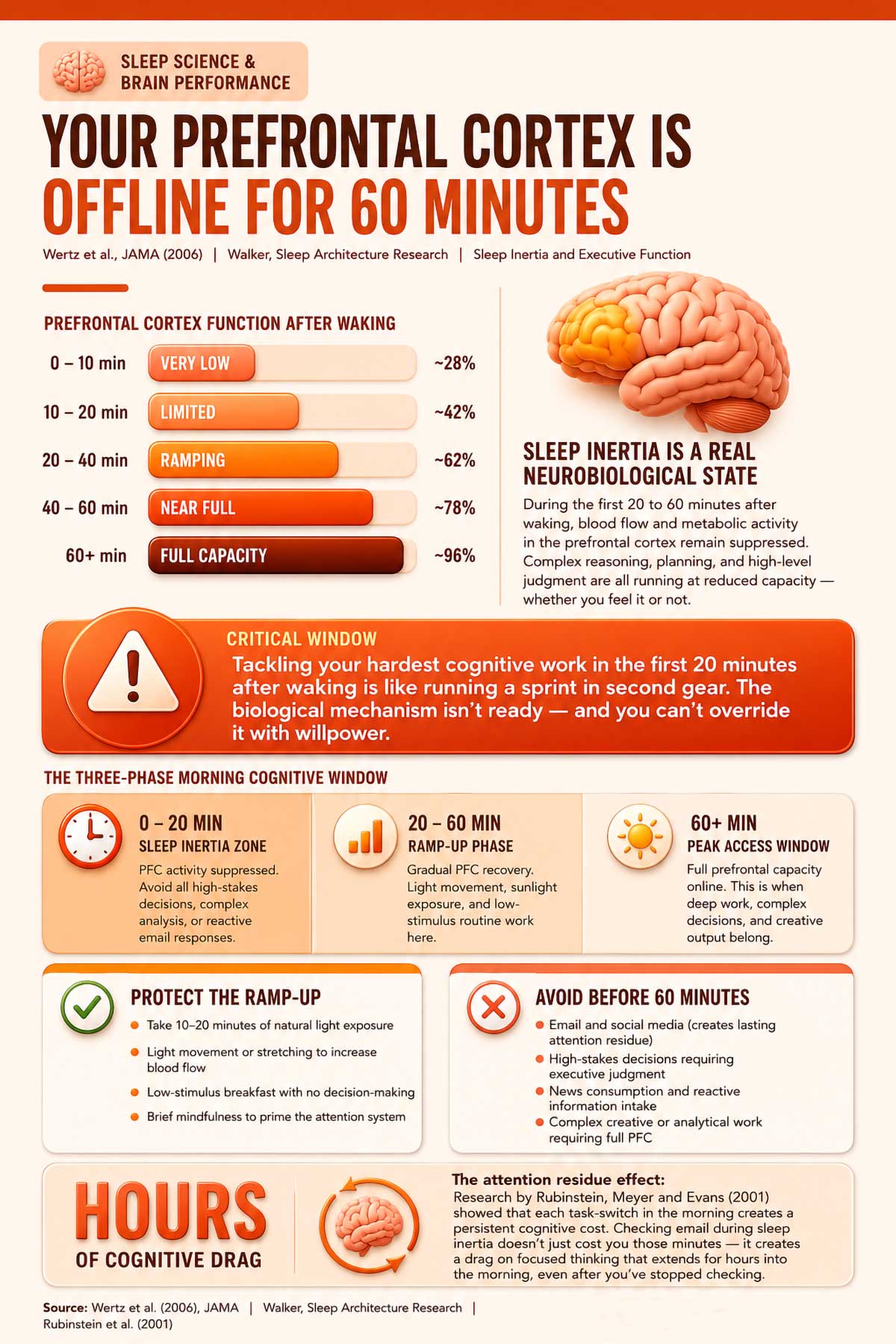
Checking email or social media in this window makes things worse. Jumping between tasks and information streams creates what researchers call “attention residue.” A 2001 study by Rubinstein, Meyer, and Evans measured the cost of this kind of task-switching and found that each shift carries a time and energy penalty that lingers long after you’ve returned to the original task. Starting the morning in a reactive, multi-threaded state creates a cognitive drag that follows you for hours.
The simpler approach is to keep the first hour low-stimulus. Let the brain come online at its own pace. Avoid news, email, and social feeds during this window. It looks like doing nothing. It’s actually precision.
How Routine Decisions Drain the Brain Before Noon
The prefrontal cortex handles more than deep thinking. It also runs self-control: the ability to make choices, override impulses, and direct attention. Like a muscle under load, it tires with use.
Psychologist Roy Baumeister and colleagues laid out the core evidence in their 1998 paper “Ego Depletion: Is the Active Self a Limited Resource?” Their experiments showed that repeated acts of self-control, including routine choices, deplete the same mental resource that hard decisions draw on later. Each small choice in the morning that didn’t need to be a choice (what to wear, what to eat, which route to take) spends some of that resource before it’s aimed at anything that matters.
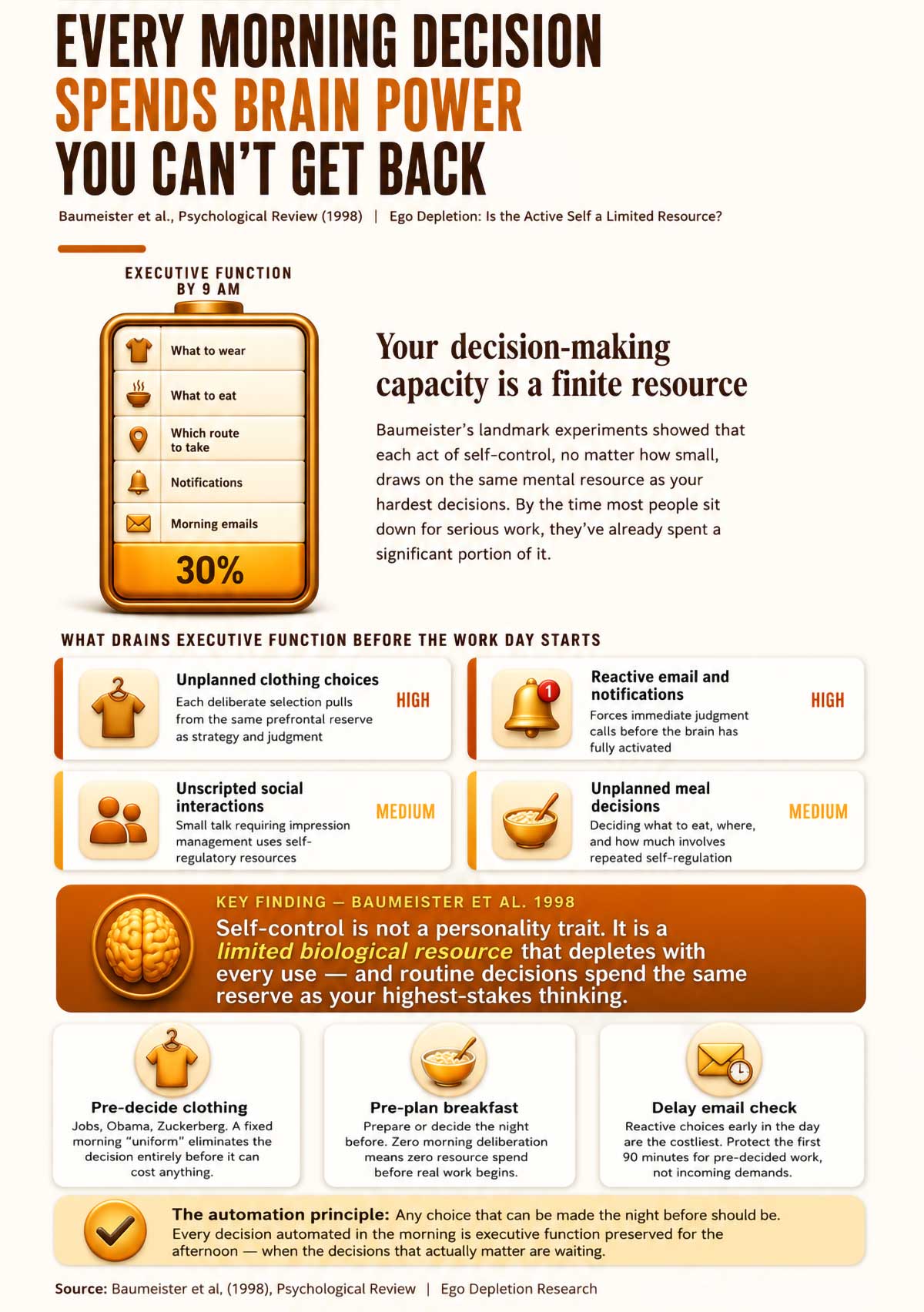
This is the logic behind what well-known leaders have called their “uniform” strategy. Steve Jobs wore the same black turtleneck. Barack Obama kept to gray suits. The goal was to cut the number of small decisions the brain had to run before the real work began. Pre-deciding morning choices like meals, clothing, and schedule structure keeps the prefrontal cortex fresher for the hours when it’s actually needed.
What You Eat, and When, Matters More Than You Think
The brain doesn’t only use light to set its internal clock. It also uses food timing. When you eat activates what biologists call “food-entrainable oscillators.” These are clocks spread across the brain and body that respond to feeding patterns on their own, separate from the light-dark cycle. When meal timing lines up with the body’s circadian state, metabolic signals become more coherent. Mental clarity appears to track with that coherence.
Research doesn’t point to one correct eating window for everyone. But it does show that planned meal timing, rather than eating out of habit or convenience, is a factor cognitive performance researchers are taking seriously.
Morning movement works through a different path but produces a strong brain benefit of its own. Exercise triggers the release of brain-derived neurotrophic factor (BDNF), a protein that supports neuron growth and the brain’s ability to form new connections. Multiple research reviews confirm that a single aerobic session produces a clear spike in BDNF levels, with harder effort showing the strongest effect.
Studies have found that older adults with sharp memory and strong cognitive health consistently reported vigorous physical activity as a regular habit. When that pattern is placed alongside the broader BDNF exercise data, the direction is clear: morning movement at real intensity sets up a favorable brain state for the hours that follow.
→ See why shorter workouts may be more effective after 50
The Transition Into Deep Work
Even a rested, low-stimulus, well-fueled brain doesn’t shift into focused, high-output work on its own. There’s a transition required. Brief mindfulness practice appears to be one of the more reliable ways to make that shift.
A 2007 study by Amishi Jha and colleagues at the University of Pennsylvania found that mindfulness training improved several attention systems, especially “conflict monitoring,” which is the brain’s ability to track competing information and stay on task. The brain region most involved in this is the anterior cingulate cortex, and mindfulness practice appears to increase its activity. Even short training periods produced real effects. In practical terms, 10 to 12 minutes of calm, focused attention practice in the morning acts like a warm-up for the brain’s attention system. It cuts emotional reactivity and prepares the brain for sustained work.
Psychologist Mihaly Csikszentmihalyi’s work on flow states, extended by Cal Newport’s analysis in “Deep Work” (2016), places the morning as the time most likely to support deep, focused work. Dopamine levels tend to be higher early in the day. Distractions are fewer. The brain is better set up for the kind of single-focus effort that produces strong output. Flow isn’t something any routine can guarantee. But the right conditions make it much more likely.
Why Most Productivity Advice Gets This Backwards
The hustle-culture model of morning performance is a willpower model. Wake up earlier. Push harder. Tackle the hardest task first, regardless of where your brain is in its biological cycle. This treats cognitive performance like a character trait rather than a biological state that can be shaped by timing.
The research tells a different story. High performers aren’t running on pure drive. They’re working with a morning structure that fits the brain’s biology: light that anchors the body clock, a protected wake-up window that lets the prefrontal cortex come fully online, fewer decisions early in the day, planned meal timing, movement that raises BDNF, and a short attention warm-up before the hardest work begins.
None of this requires waking at 4 AM. It requires sequencing. The question isn’t how early you start. It’s whether your first two hours are building toward peak function or quietly spending resources you haven’t yet earned.
The morning routine isn’t really about the morning. It’s about what those early hours are doing to the rest of the day. Every choice in that window either adds to your cognitive capacity or draws it down, well before the work that actually demands it arrives.