Your body doesn’t wait for your 40s. Several vital systems begin a quiet, measurable shift in your 30s, and most people mistake the signs for stress.
There’s a certain kind of confidence that manifests in your 30s: you feel settled, capable, and mostly unbothered by the fragility of youth. What you don’t see in the mirror are small, measurable shifts in biology, from muscle and aerobic power to deep sleep and collagen output, which usually start at this time. These changes are normally subtle and highly modifiable, which makes paying attention now especially important.
Not only decades from now. Measurable shifts begin in your 30s. The decade that feels like peak adulthood is also when several core physiological systems enter a long, quiet decline. No alarm sounds. Nothing breaks. But the biology has already started moving.
The body that feels so reliable at 35 is already different from the one you had at 25, in ways that matter far more than a few grey hairs. Understanding what’s actually happening, and when it starts, is not cause for panic. It is cause for paying attention sooner than almost anyone tells you to.
Muscle Mass and Strength
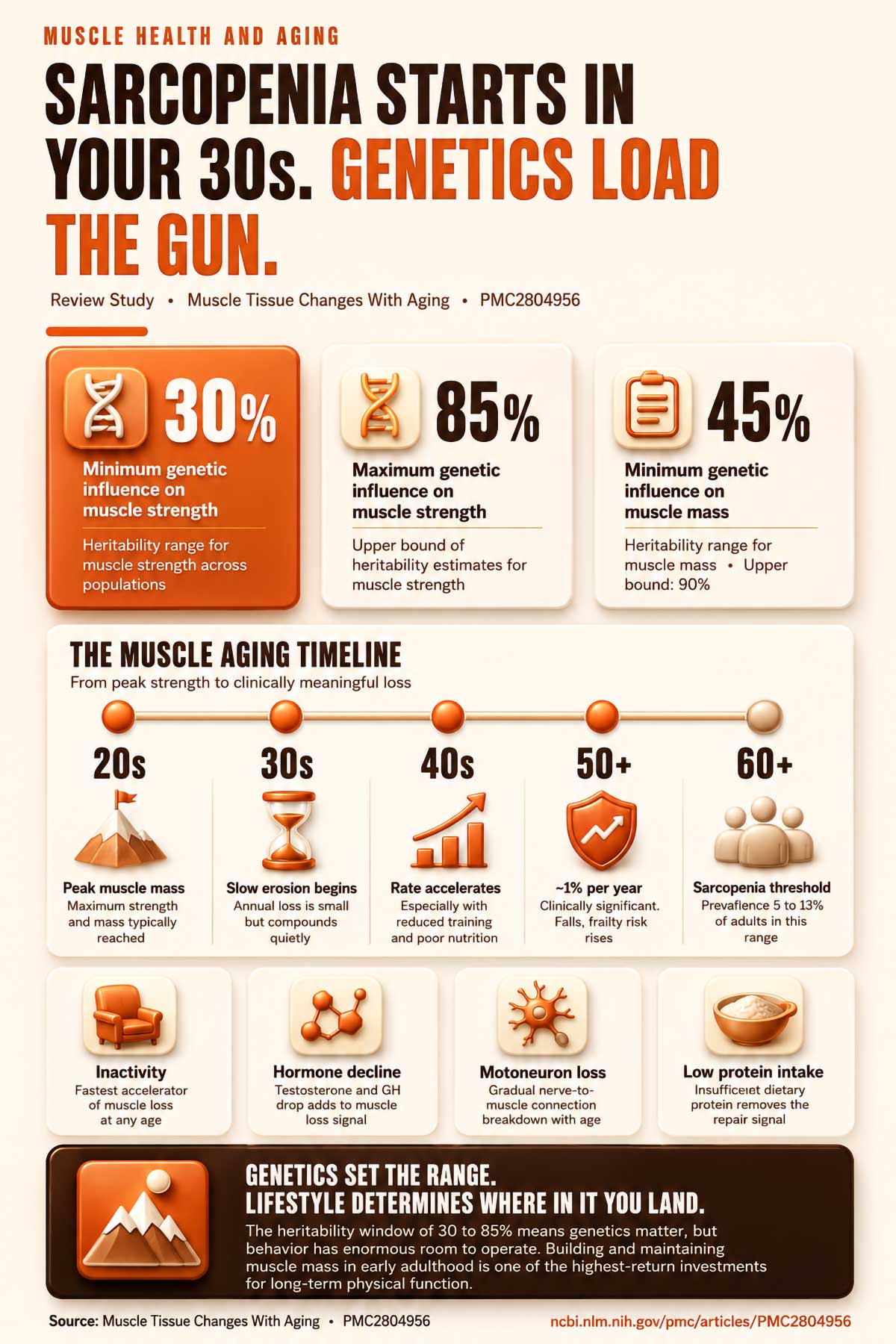
Strength peaks somewhere in the late 20s to early 30s, depending on training history and genetics. After that, a slow erosion begins. The process is called sarcopenia, the progressive loss of skeletal muscle mass and function, which comes with aging. Most people associate it with frailty in the elderly. Its biological roots reach back much further.
Research shows that muscle mass decline is tied to a complex interplay of genetics, hormone shifts, and physical activity levels. Genetic factors account for 30 to 85% of the variance in muscle strength across people.
Most people show some net loss over time unless they sustain high levels of targeted training and good nutrition. Typical loss in midlife is small year-to-year, a few percent annually, but it becomes clinically meaningful later if not offset.
The muscle loss itself tends to be slow enough in this decade that it goes unnoticed. The ease of maintaining existing mass shifts earlier, and the speed with which disuse accelerates that loss.
Cardiovascular Fitness (VO2 Max)
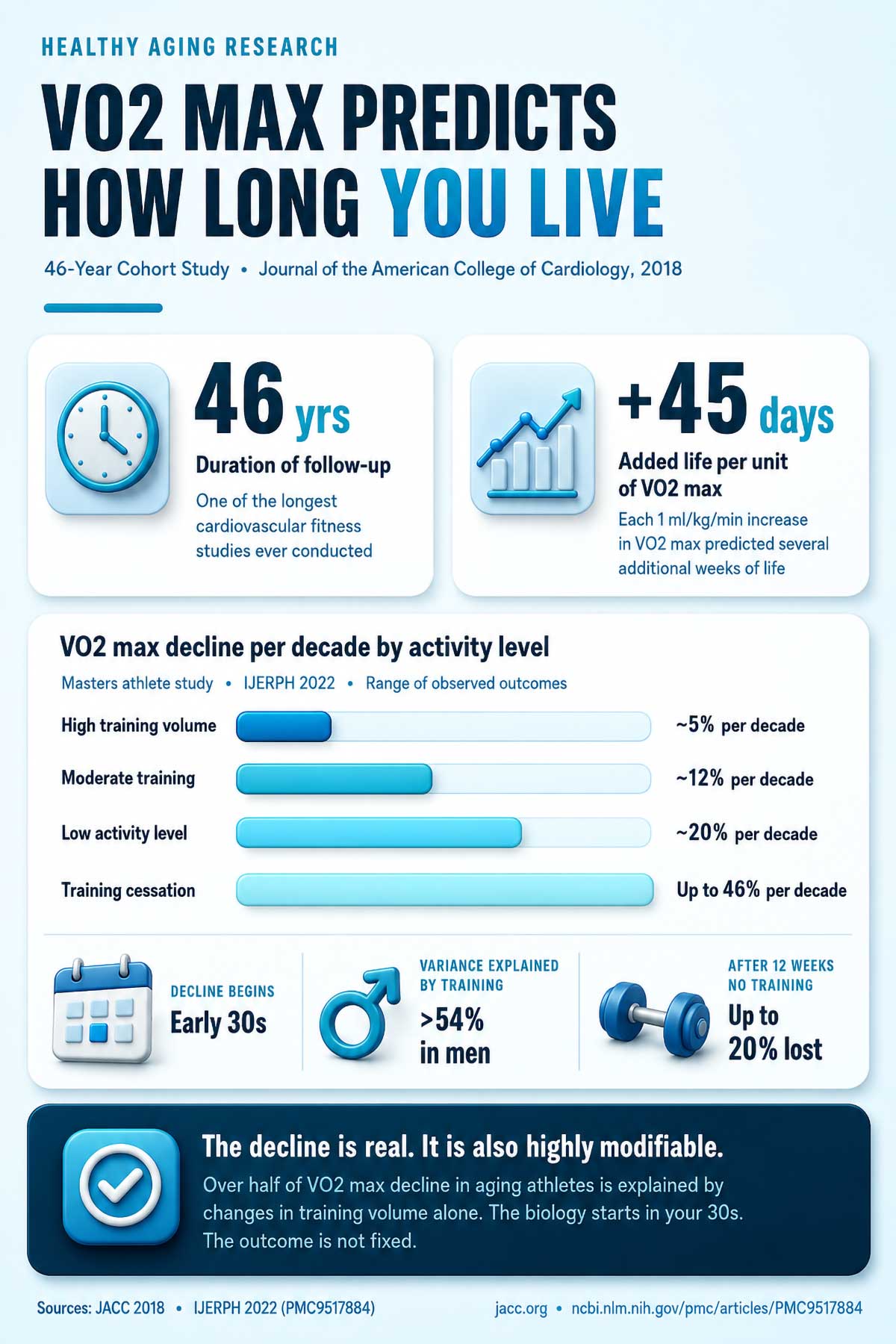
VO2 max measures how much oxygen your body can use during intense exercise. It is the single best marker of cardiovascular fitness, and it has a surprisingly early shelf life. Longitudinal data show that aerobic capacity begins a slow decline from the early 30s onward. In inactive people, the rate of loss runs roughly 5 to 20% per decade. In active people, that range narrows a great deal.
The critical variable is training. Research on masters athletes published in the International Journal of Environmental Research and Public Health found that VO2 max declines across athletes varied widely, from 5% to 46% per decade, and that over half of this variance in men was explained by changes in training volume alone. People who maintain high training volumes age very differently, cardiovascularly, than people who taper off. The biology is not inevitable. It just doesn’t wait for you to decide you care.
Why this deserves more attention is what VO2 max actually predicts. A 46-year follow-up study in the Journal of the American College of Cardiology found that each 1 ml per kg per minute higher VO2 max predicted roughly several additional weeks of life expectancy in a long-term cohort. In population studies, even modest differences in VO2 max associate with meaningful differences in long-term health and longevity.
Collagen Production and Skin Structure
The skin changes that people usually blame on stress, sun, or simply bad luck are largely the result of a real biological decline that starts in early adulthood. Collagen makes up roughly 30% of the body’s total protein and is the primary structural protein in skin. Its output doesn’t hold steady through adulthood and then suddenly falls. It begins dropping gradually from early adulthood onward.
Research published in The American Journal of Pathology measured type I procollagen production in dermal fibroblasts from young adults (18 to 29 years old) versus those over 80, finding significantly lower output in aged skin.
The study identified two distinct mechanisms: age-related changes in fibroblast function, and reduced mechanical stimulation in aging skin, where the collagen matrix is progressively fragmented. Sun exposure and smoking accelerate the degradation side of this equation, meaning the net deficit widens faster for those with cumulative UV exposure.
Visible changes typically lag behind these biochemical shifts by a decade or more. The underlying process starts well before the surface shows it.
Recovery Capacity After Exercise
This one is harder to quantify, and it deserves a shorter, more direct treatment because the science is less resolved than in other areas. Most of the available evidence is cross-sectional and drawn from small studies, so individual variability is large. What is reasonably clear is that recovery from hard exercise begins to slow during the 30s and 40s, especially in people who reduce their training load or become less consistent.
A review in Frontiers in Physiology points to several overlapping mechanisms: slower resolution of exercise-induced inflammation, declining hormonal responses to training stress, and reduced cellular repair capacity.
The practical experience is familiar to anyone who has tried to maintain the training habits of their early 20s past 35. Two days after a hard session no longer means feeling fine. The system still works; it just takes longer to reset.
Insulin Sensitivity and Glucose Regulation
The body’s ability to use insulin efficiently tends to decline with age. This shows up in cohort studies as a general inverse relationship between age and insulin sensitivity beginning in mid-adulthood. An important note applies.
Research suggests that age-related drops in insulin sensitivity are strongly driven by increases in visceral fat and declining activity levels rather than age itself. Active adults often keep insulin sensitivity close to what younger sedentary people have.
This is genuinely good news, with a sharp edge. It means the decline isn’t biologically fixed. It also means that the slow accumulation of body fat and the gradual reduction in physical activity that often happens through the 30s, both quietly, both socially normalized, are doing more damage than most people realize. The mechanism doesn’t particularly care whether the inactivity was chosen or simply happened by default.
Testosterone and Growth Hormone
Testosterone in men typically peaks in the late teens to early 30s, depending on how it is measured. After that, total and free testosterone fall at roughly 1 to 2% per year in many cohorts, according to data in the NCBI on age-related changes in the male reproductive system.
Growth hormone follows a similar arc. In women, estrogen and progesterone shifts are more dramatic and tied to a defined transition point, but anabolic hormone decline begins earlier and more gradually than most women are told.
The wellness industry has made a considerable business out of pathologizing this decline. That framing is worth resisting. A gradual reduction in testosterone and growth hormone is a normal part of physiological aging, not an immediate disease state.
Clinically low testosterone is defined by symptoms alongside lab values, not lab values alone. These hormones maintain lean mass, bone density, and metabolic function, and their slow decline is one of the mechanisms through which other changes on this list accelerate. They’re part of the story, not the whole story.
Sleep Quality and Architecture
The total amount of time most people spend in bed doesn’t change dramatically through the 30s. The changes happen during that time. Slow-wave sleep (deep sleep), the most physically restorative phase of the sleep cycle, begins to decline in midlife. Sleep efficiency, a measure of how much time in bed is actually spent asleep, drops alongside it.
According to data reviewed by the Sleep Foundation, these shifts in sleep architecture are detectable by middle age and are shaped by stress, lifestyle, and underlying health. The compounding problem is that poor sleep quality touches nearly every other system in this article.
Growth hormone is predominantly secreted during deep sleep. Muscle repair and glucose regulation both depend on sleep quality. Recovery from exercise is partly a sleep story. The changes here aren’t just about feeling tired. They interact with everything else happening simultaneously, which makes sleep one of the more powerful variables across all nine areas covered here.
Brain Processing Speed and Cognition
This is where the emotional stakes rise, so it deserves an honest account rather than a reassuring one. A close friend once described noticing, sometime around 37, that certain things which used to feel automatic, tracking two conversations at once, finding a word immediately, orienting quickly in a new space, now required a fraction more effort. Nothing broken. Just slightly less frictionless. That description maps reasonably well onto what the research shows.
A review published in Nature Reviews Neuroscience by Hedden and Gabrieli found that cross-sectional studies show small declines in processing speed beginning in midlife, while longitudinal data indicate that most cognitive domains remain stable until later decades for many people.
Semantic memory, vocabulary, and accumulated knowledge remain largely stable or improve across adulthood. The brain changes, but it doesn’t simply decline. It reorganizes. The speed of certain operations is what slows; what persists and grows is the depth of knowledge and pattern recognition. These are different cognitive tools, and midlife is when you start relying on the second set more than the first.
Bone Density and Peak Bone Mass
This section could easily be framed as reassuring. You feel nothing. Bone looks and behaves the same from the outside. And yet the biology here contains one of the starkest timing ironies in the entire physiology of aging.
Peak bone mass is usually reached by the late 20s to early 30s. After that, the net balance shifts toward slow, steady loss of mineral density.
The NIH Osteoporosis and Related Bone Diseases Resource Center describes this window clearly: the decisions made in adolescence and early adulthood, about nutrition, weight-bearing activity, and calcium intake, largely determine the skeletal capital that must last a lifetime.
In women, bone loss accelerates significantly after menopause. In men, the decline is slower but steady. For both, the biological deposit window closes in the early 30s.
The decade when the skeleton feels most solid and permanent, when most people give it zero thought, is the exact moment the deposits stop and the withdrawals begin.
What the Early Timeline Actually Changes
The instinct, on reading all of this, is to reach for a checklist. Resistance training for muscle. Sustained cardio for VO2 max. Daily SPF for collagen. These aren’t wrong. Evidence supports each of them. But treating this as a list of interventions misses the deeper point.
The physiological changes described above do not usually announce themselves. They accumulate quietly, over years, in ways that feel like personal choices, personality shifts, or simply getting older.
The person who stops exercising as hard at 34 isn’t usually thinking about VO2 max. The person who gains a few pounds each year in their mid-30s is unlikely to be giving insulin sensitivity much thought. The gradual decline of deep sleep doesn’t feel like a medical event. It feels like being busy.
The gap in how this topic is covered, across almost every mainstream health resource, is the early timeline. Prevention is framed as a retirement-age project. The biology doesn’t agree. The 30s are when the course is set, in measurable, meaningful ways, and for most of the systems described here, the rate of decline is far more modifiable in this decade than in any subsequent one.
A Final Word
Most coverage of healthy aging talks to people who are already managing decline. This piece is aimed at people who are still ahead of it, who have not yet noticed anything, and who therefore assume there is nothing to notice.
That assumption is where the real cost accumulates. The body at 35 is not the body at 25. Pretending otherwise is not optimism; it’s just a delay. The better position is knowing what’s changing, taking it seriously without catastrophizing it, and acting while the window to actually shift the course of decline is still wide open. Earlier than you think, but probably not too late.