Six studies. Seven years of data. The microbiome kept doing something researchers didn’t expect, and it starts happening in the first week before most people quit.
Somewhere between the third and fifth containers of yogurt, a lot of people wonder if they made a mistake. The bloating they didn’t have before. The gas that arrived uninvited. The mild cramping that nobody mentioned when they reached for the “digestive health” label at the grocery store. They were trying to fix something. This doesn’t feel like fixing.
What’s actually happening inside the gut during those first weeks is more interesting than the marketing copy suggests, and the full picture, established across a growing body of research, doesn’t support the simple story of eat yogurt, and you’ll fix your gut. It supports something more complex and conditional than that.
A cross-sectional study of 293 Japanese college students published in Frontiers in Microbiology by researchers at Juntendo University found that regular yogurt consumers had higher Lactobacillus abundance in their stool samples, with associations specific to the L. gasseri subgroup. The association differed by sex. That’s a meaningful signal, but the design is observational. It tells us that people who eat yogurt tend to have more of certain bacteria. It doesn’t tell us that yogurt caused it, or that it will stay.
Why Some People Feel Worse Before They Feel Better
Some people do notice more bloating or gas in the first week or two of eating yogurt daily, and there’s a plausible biological reason for it. Introducing a larger dose of lactic acid bacteria than your gut normally receives could temporarily increase fermentation activity, and gas is a natural byproduct of fermentation.
Your existing microbial community is dealing with a new input at a higher volume than usual. None of the studies cited here documented early GI discomfort as a universal or expected yogurt response. Some people experience it, while others don’t.
If you do experience discomfort, a conservative starting strategy would be to start with a smaller portion, about half a cup every day for the first week, and increase from there once your gut has had time to adjust. If symptoms are severe or persist for more than a couple of weeks, it would be worth raising the issue with a doctor or nutritionist.
The Bacteria Arrive. Then They Leave.
The most clarifying piece of research in this space is also the most quietly deflating. Nathan McNulty and colleagues at Washington University School of Medicine tracked seven pairs of identical female twins over four weeks before, seven weeks during, and four weeks after daily yogurt consumption. The Science Translational Medicine study found that the species and overall gene content of each participant’s gut community stayed remarkably stable throughout the entire period of yogurt intake. The microbiome didn’t shift. Within two weeks of stopping the yogurt, live bacteria from the product were undetectable.
That’s not a failure of the study. That’s the finding. The introduced strains were detectable in stool samples during the period of consumption and undetectable within two weeks of stopping, while each participant’s overall gut microbiome stayed stable throughout.
What the McNulty team also found in their mouse model is less discussed: even without permanent colonization, the transiting bacteria changed how the resident microbial community expressed its genes, particularly pathways involved in carbohydrate metabolism. The transient bacteria did not remain, but they altered microbial activity during transit.

What This Means Practically
The transience finding has a direct implication for how you use yogurt. If the bacteria don’t stay, then stopping doesn’t make much sense if gut support is the goal. A single course of yogurt eaten for two weeks and then abandoned is unlikely to leave a lasting trace. Consistency is what keeps the functional effect running, even if it never becomes permanent in the way colonization would.
Think of it less like planting a garden and more like watering one that already exists. The water doesn’t stay, but the plants need it regularly. Stop watering, and the effect disappears. Keep watering, and something real keeps happening.
Modest, Temporary, and Highly Variable
A 2014 study published in PLOS ONE by Veiga and colleagues followed 23 healthy adults through four weeks of yogurt consumption and found modest, temporary microbiome shifts with substantial variation from person to person. Some people’s microbial communities moved. Others barely registered a change. That person-to-person variation is not a footnote. It’s arguably the central story of yogurt and gut health research, and most product labels don’t have room for it.
The same year, a separate Nature study led by Lawrence David tracked ten participants through rapid dietary changes and confirmed that the gut microbiome responds to diet shifts within days, then trends back toward its original state when the diet reverts. That study wasn’t about yogurt specifically, but it frames a useful backdrop: the gut is responsive, and it has a kind of memory for where it started. Diet can move it. Removing the diet tends to move it back.
How to Read a Yogurt Label Without Being Misled
The label guidance below isn’t derived from the studies cited in this article. It’s general consumer information regarding what yogurt labels mean, included because the gap between what labels claim and what the product delivers is wide enough to affect whether the yogurt you’re buying has any live bacterial content at all.
The phrase “live and active cultures” is a starting point, but the product’s bacterial content at the time you eat it depends on storage history and sell-by date. “Made with live cultures” on a heat-treated product means the bacteria were killed during processing. Look for “contains live and active cultures” with a future use-by date, stored continuously cold.
Strain disclosure matters. The standard fermentation strains, usually Lactobacillus bulgaricus and Streptococcus thermophilus, may be accompanied by additional strains like Lactobacillus acidophilus or Bifidobacterium lactis. A product listing only the two fermentation strains offers a narrower bacterial input than one with four or five named strains, all else being equal.
Sugar content is worth checking independently of gut health claims. A high-sugar yogurt feeds the full range of gut bacteria, including ones you’re not trying to encourage. Plain yogurt containing live cultures, with fruit added at home if needed, gives you more control. Many flavored yogurts carry 15 to 25 grams of added sugar per serving.
What Sustained Consumption Actually Changes
Here’s where the picture gets more interesting, and more honest about what yogurt can and can’t do when eaten consistently over a longer period.
A 2021 randomized clinical trial published in Cell by Hannah Wastyk and colleagues at Stanford University assigned 36 healthy adults to either a fermented-food-rich diet or a high-fiber diet for ten weeks. The fermented-food group ate yogurt alongside kefir, kimchi, fermented cottage cheese, and other fermented vegetables. That group showed a steady increase in microbial diversity and a measurable decrease in 19 inflammatory proteins.
The high-fiber group showed neither effect. This is not a yogurt study. Yogurt was one ingredient among several, and the researchers made no attempt to isolate its contribution. What the trial does demonstrate is that a diet consistently high in varied fermented foods can produce measurable changes over ten weeks that a high-fiber diet alone doesn’t replicate.
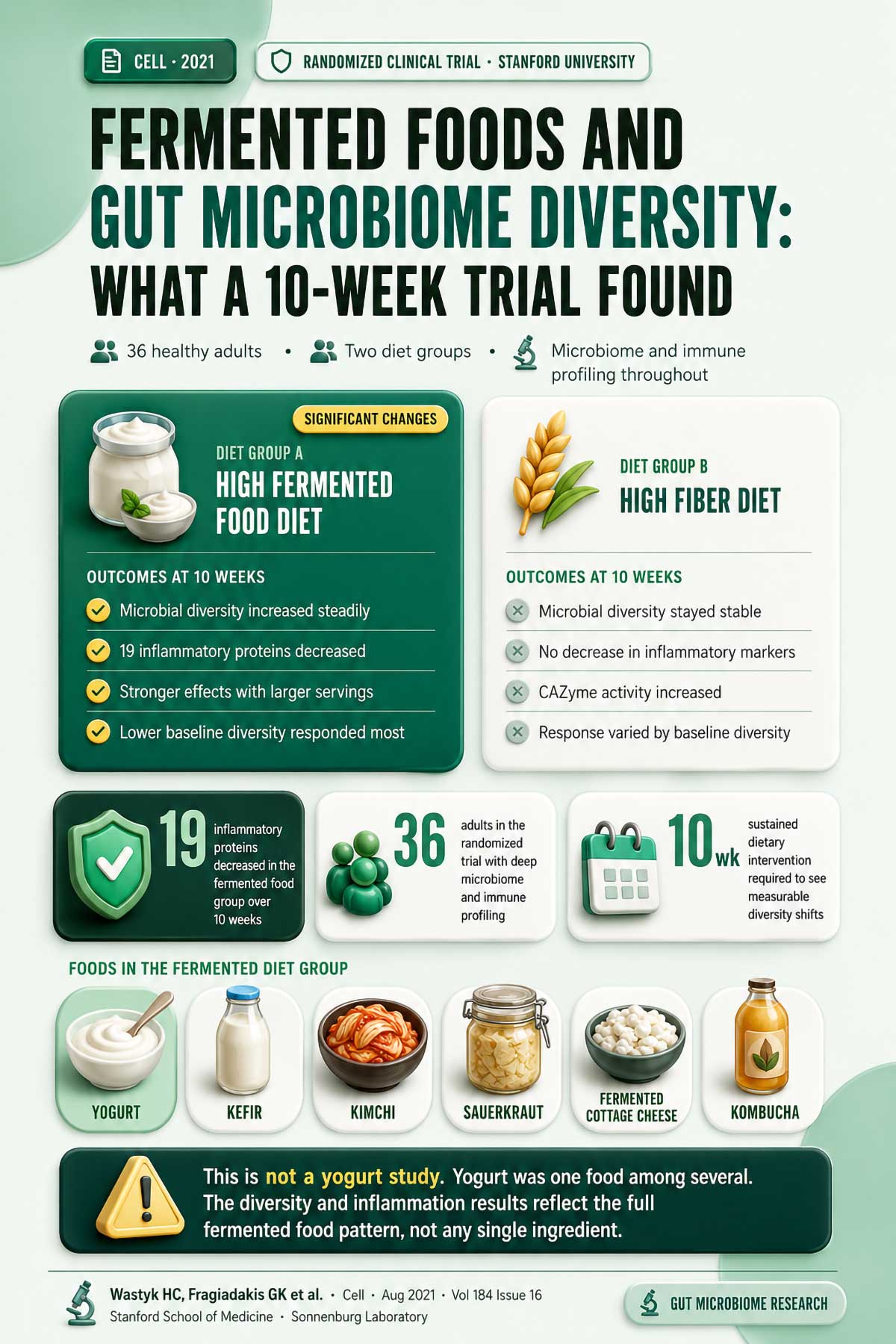
The takeaway isn’t that yogurt raises microbial diversity. It’s that rotating through multiple fermented foods appears to. Eating the same single product every day is a narrower biological input than what the Wastyk participants were actually doing.
Who Responds and Who Doesn’t
The Wastyk trial found something else worth sitting with. Participants with lower baseline microbial diversity at the start of the study showed larger shifts in response to the fermented-food diet. People who already had more diverse gut communities saw smaller changes. Again, this was a mixed fermented-food intervention, not a yogurt-only trial, so the finding can’t be attributed to yogurt alone. But it aligns with what the Veiga PLOS ONE data suggested about person-to-person variability in shorter-term yogurt studies.
If your gut community is already diverse and well-established, a daily cup of yogurt is probably not going to move it much. If it’s depleted, after antibiotics, after illness, after months of a very low-variety diet, the same cup of yogurt may do something genuinely measurable. The food hasn’t changed. The starting conditions have.
How to Know If It’s Actually Working
This is where most gut health content goes quiet, because measurable microbiome testing is expensive and not widely accessible for most people. But there are practical signals worth tracking that don’t require a lab.
Stool consistency and regularity are the most direct indicators that something in the gut environment has shifted. The Bristol Stool Scale, a clinical chart that categorizes stool form into seven types, is a useful reference: types 3 and 4 indicate a well-functioning gut transit. If you were inconsistent or tending toward types 1 and 2 (hard, slow transit) or types 6 and 7 (loose, fast transit) before starting daily yogurt, a shift toward the middle of that scale after four to six weeks is a meaningful signal. It’s not proof of specific microbiome changes, but it reflects gut function directly.
Bloating frequency and post-meal comfort are the other useful self-assessments. If any initial discomfort you noticed clears and you’re more comfortable after meals by week four than you were in week one, something functional may have changed. If you feel the same at week six as before starting, that’s worth paying attention to. The evidence is consistent that not everyone responds, and recognizing a non-response is useful information.
Keep a simple log for the first four to six weeks. Date, portion size, any symptoms, and general digestive comfort that day. It doesn’t need to be elaborate. Even a few words per day gives you something to look back at, and it prevents the common pattern where people can’t remember whether things actually improved or just feel like they should have because they kept eating the yogurt.
The Association That Keeps Showing Up
A 2022 study published in BMC Microbiology by Caroline Le Roy and colleagues at King’s College London analyzed data from over 1,000 predominantly female UK twins and found that yogurt consumers had lower visceral fat and a gut microbiome signature marked by higher transient abundance of Streptococcus thermophilus and sometimes Bifidobacterium animalis subsp. lactis. The researchers themselves described that increase as transient. Consumers also showed healthier overall dietary patterns.

That last detail matters. Yogurt consumers in observational studies tend to have healthier diets overall. Separating the yogurt effect from the rest of the diet is methodologically difficult, and the Le Roy study was observational, not a controlled trial. The association is real. The causality is messier.
The Long Game Is Also Complicated
A 2022 review in Nutrients by Leeuwendaal and colleagues examined multiple human studies on fermented foods and concluded that fermented foods can affect the gut microbiome in both short- and long-term contexts, but cautioned against interpreting any single food, yogurt included, as the mechanism. The review’s framing is careful for a reason: the studies are heterogeneous, the populations vary, and the products used across trials don’t always resemble the yogurt sitting in a home refrigerator.
What the longer-term picture suggests is that sustained intake may establish a new functional baseline, but that baseline tends to plateau without increasing variety. Eating the same product every day eventually produces diminishing returns at the microbial level. The gut adapts to the input.
Building Past the Plateau
If daily yogurt is the only fermented food in your diet, the plateau arrives faster and sits lower than it would with more variety. The practical fix is rotation, and it doesn’t require a dramatic overhaul of how you eat.
Adding a second fermented source once or twice a week exposes the gut to different bacterial strains and different fermentation byproducts. Kefir contains a broader range of strains than most yogurts and also includes beneficial yeasts that yogurt doesn’t carry. Fermented vegetables like kimchi, sauerkraut, or lacto-fermented pickles (the refrigerated kind, not vinegar-brined) introduce entirely different bacterial families. A tablespoon or two of any of these alongside a regular meal is enough to start introducing that variety without overhauling your diet.
Fiber matters here too. The beneficial bacteria that fermented foods temporarily introduce need something to metabolize, and a gut fed on low-fiber processed food doesn’t give transiting strains much to work with. Vegetables, legumes, oats, and fruit each contain different types of fiber that feed different bacterial populations. The Wastyk Cell trial found stronger microbiome and inflammatory changes in the fermented-food group than the high-fiber group over ten weeks, but that finding is about the variety of fermented foods, not about replacing fiber. A reasonable interpretation of the broader literature is that fermented foods and dietary fiber are complementary inputs, not competing ones.
Timing, Temperature, and a Few Things Worth Getting Right
When you eat yogurt matters less than most gut health content implies. There’s no strong evidence that timing within the day changes the probiotic effect meaningfully. Eat it when it fits your routine, and you’ll actually stick to it.
Temperature is more important than timing. Yogurt that has been left at room temperature for extended periods, or that has gone through temperature cycling, loses bacterial viability faster than yogurt kept consistently cold. Buy it cold, store it cold, and eat it before the use-by date. Frozen yogurt is a different category: freezing doesn’t kill all bacteria, but it does reduce viable counts and alters the product in ways that make it less useful as a probiotic source.
Eating yogurt with a hot drink is unlikely to matter much. The stomach is far more acidic than coffee, and bacteria that survive gastric acid can handle a warm beverage. On fat content: full-fat plain yogurt is a reasonable default if probiotic value is the primary reason you’re eating it, though the evidence for a meaningful survival advantage over lower-fat versions in humans is not strong. What is reasonably well-established is that the dairy food matrix in general, with its fat and protein structure, offers the live cultures more protection than a water-based delivery format would.
So What Does This Add Up To
The honest answer, drawn from the evidence as it actually exists, is that daily yogurt does something real but conditional, temporary but not meaningless. Probiotic strains don’t colonize permanently. They transit through and alter microbial gene expression along the way. Short-term microbiome changes are real but modest and highly individual. Longer-term benefits appear more strongly in people starting from a depleted baseline, and they’re more pronounced across a varied fermented-food diet than from any single source consumed repeatedly.
None of that is a reason to stop eating yogurt. It is a reason to stop expecting it to single-handedly fix a gut that took years to reach its current state.
The more productive reframe isn’t whether yogurt works. It’s recognizing that the microbiome responds to patterns, not individual foods. A daily yogurt as part of a varied diet, alongside other fermented sources and adequate fiber, is doing something real. A daily yogurt as the only deliberate gut intervention, surrounded by a low-diversity diet, is asking one food to carry a job designed for an entire dietary system. The gut biology is clear on which of those two scenarios produces meaningful change.