Research suggests people have between 6,000 and 70,000 thoughts per day. A significant portion of those thoughts are repetitive and skew negative. This isn’t a personal failing. It’s a pattern rooted deep in human biology. But that pattern can be changed.
The difference between helpful self-reflection and toxic self-talk matters. Helpful self-reflection asks: What can I learn here? Destructive self-talk says: You always mess things up. One builds awareness. The other chips away at it. And here’s the part most people get wrong — telling yourself to “just think positive” doesn’t fix it. Science says it can actually make things worse.
Why Your Brain Defaults to the Negative
The brain wasn’t designed for happiness. It was designed for survival. Thousands of years ago, scanning for threats — predators, social rejection, danger — kept early humans alive. That built-in alarm system is called the negativity bias, and it’s still running today.
The negativity bias means the brain weighs bad experiences more heavily than good ones. A single critical comment from a coworker hits harder than three compliments from friends. That’s not irrational — it’s wiring.
Negative self-talk often arrives as Automatic Negative Thoughts, or ANTs. These are fast, involuntary mental reactions that feel like facts but are usually distortions. I’m not smart enough. Nobody likes me. I’ll never figure this out. ANTs show up without permission. They’re not a character flaw. They’re a side effect of a brain that evolved to prepare for the worst.
What makes ANTs particularly tricky is their relationship to emotions. The thoughts we think shape the feelings we feel. When someone spirals into self-criticism, their emotional state drops with each loop of the cycle. Over time, this creates a feedback loop that’s hard to exit without a deliberate strategy.
The Science Behind Changing How You Think
Cognitive Behavioral Therapy, commonly called CBT, is one of the most studied psychological treatments in history. Its core idea is simple: how you interpret events — not the events themselves — determines how you feel.
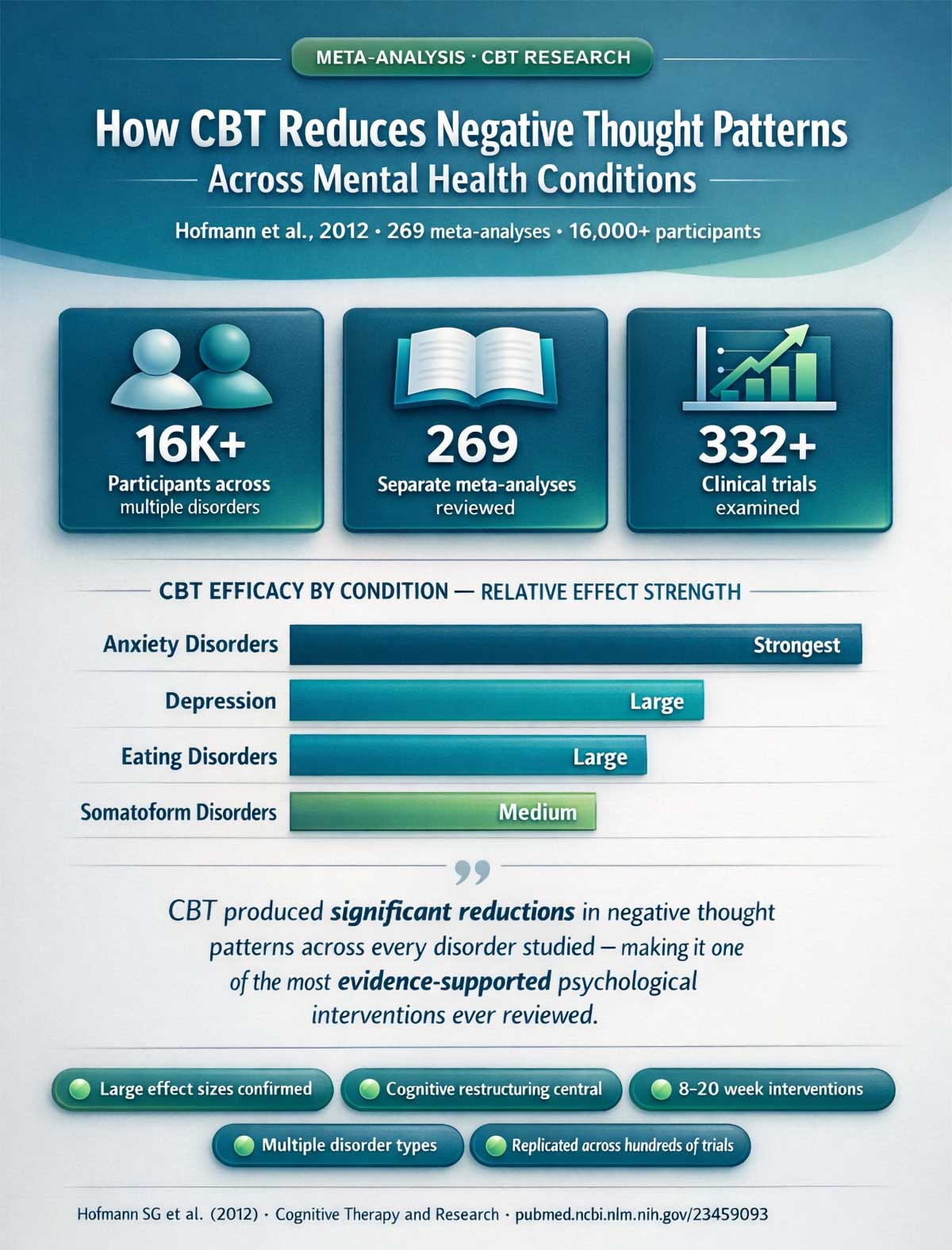
A landmark meta-analysis by Hofmann and colleagues in 2012 reviewed 269 separate meta-analyses covering more than 16,000 participants across multiple mental health conditions. The findings were clear. CBT significantly reduced negative thought patterns across anxiety disorders, depression, eating disorders, and more. The strongest effects were seen in anxiety. This wasn’t a small, niche study. It was a review of hundreds of clinical trials, making it one of the most compelling bodies of evidence in clinical psychology.
CBT works partly because it interrupts the automatic connection between a trigger and a thought spiral. It trains the brain to slow down, examine a thought, and question its accuracy. Over time, this rewires the brain’s default communication pathways — a concept known as neuroplasticity.
Neuroplasticity means the brain changes with repeated use. The more a thought pattern fires, the more automatic it becomes. But the reverse is also true. With consistent practice, new thought pathways get stronger, and old negative ones weaken. The brain can literally be trained to respond differently to stress.
Strategy #1 — Cognitive Reappraisal: The Re-Labeling Technique
Most people instinctively try to push unwanted thoughts away. This feels logical, but the research tells a different story. Suppressing a thought tends to make it return with more force — a phenomenon psychologists call the rebound effect. The classic example: try not to think about a white bear. What just happened?
A comprehensive meta-analysis by Webb, Miles, and Sheeran in 2012 compared thought suppression against cognitive reappraisal across more than 190 studies. The results were striking. Reappraisal strategies produced significantly better emotional outcomes than suppression did — with large effect sizes across contexts. Pushing thoughts away doesn’t work. Changing how you interpret them does.
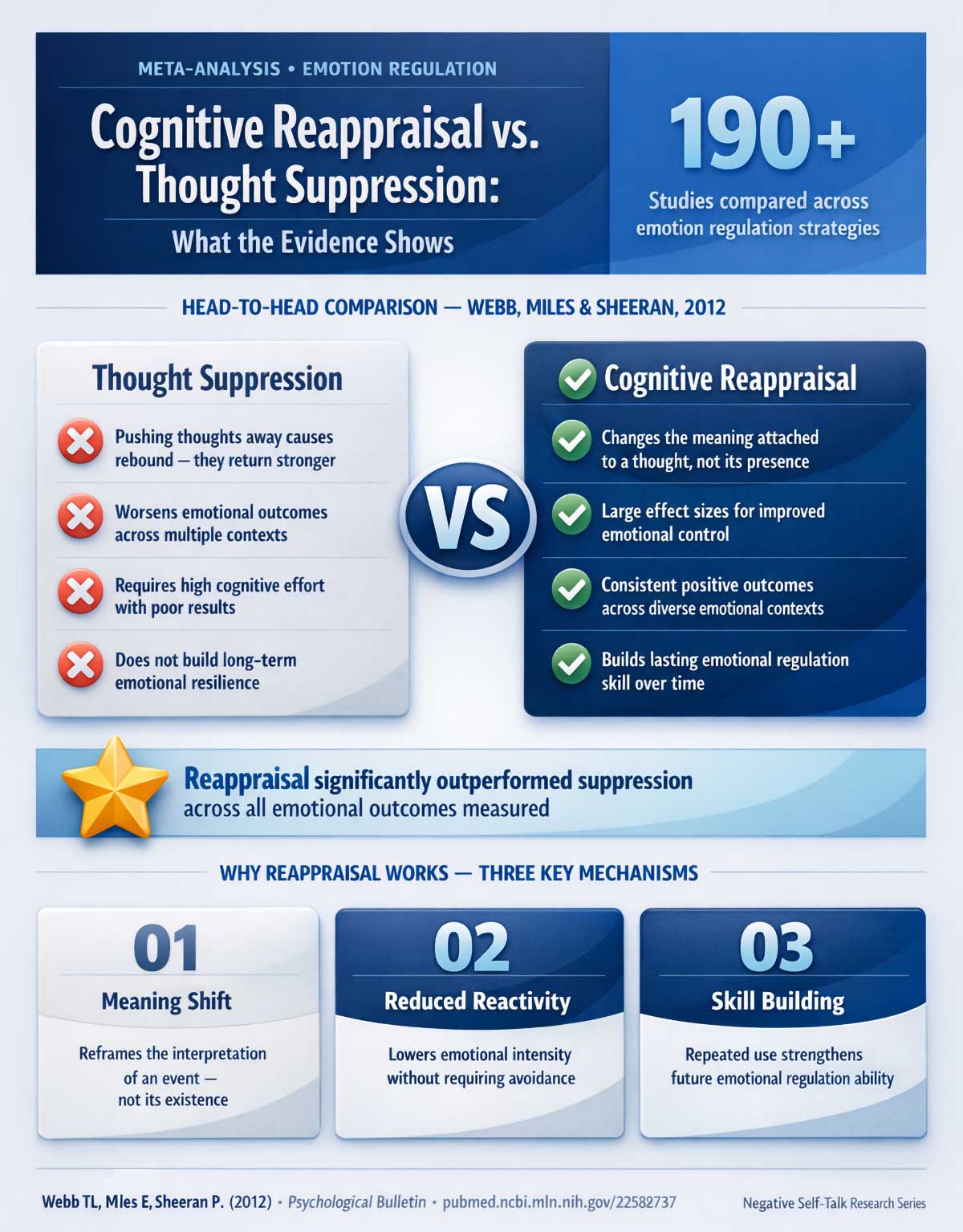
Cognitive reappraisal means deliberately shifting the meaning you attach to a situation. It’s not pretending everything is fine. It’s asking: Is there another way to look at this?
Here’s what that looks like in practice. A job rejection arrives. The immediate thought is: I’m a failure and I’ll never succeed. Reappraisal doesn’t deny the disappointment. Instead, it reframes the event: This didn’t work out. What can I take from this for next time?
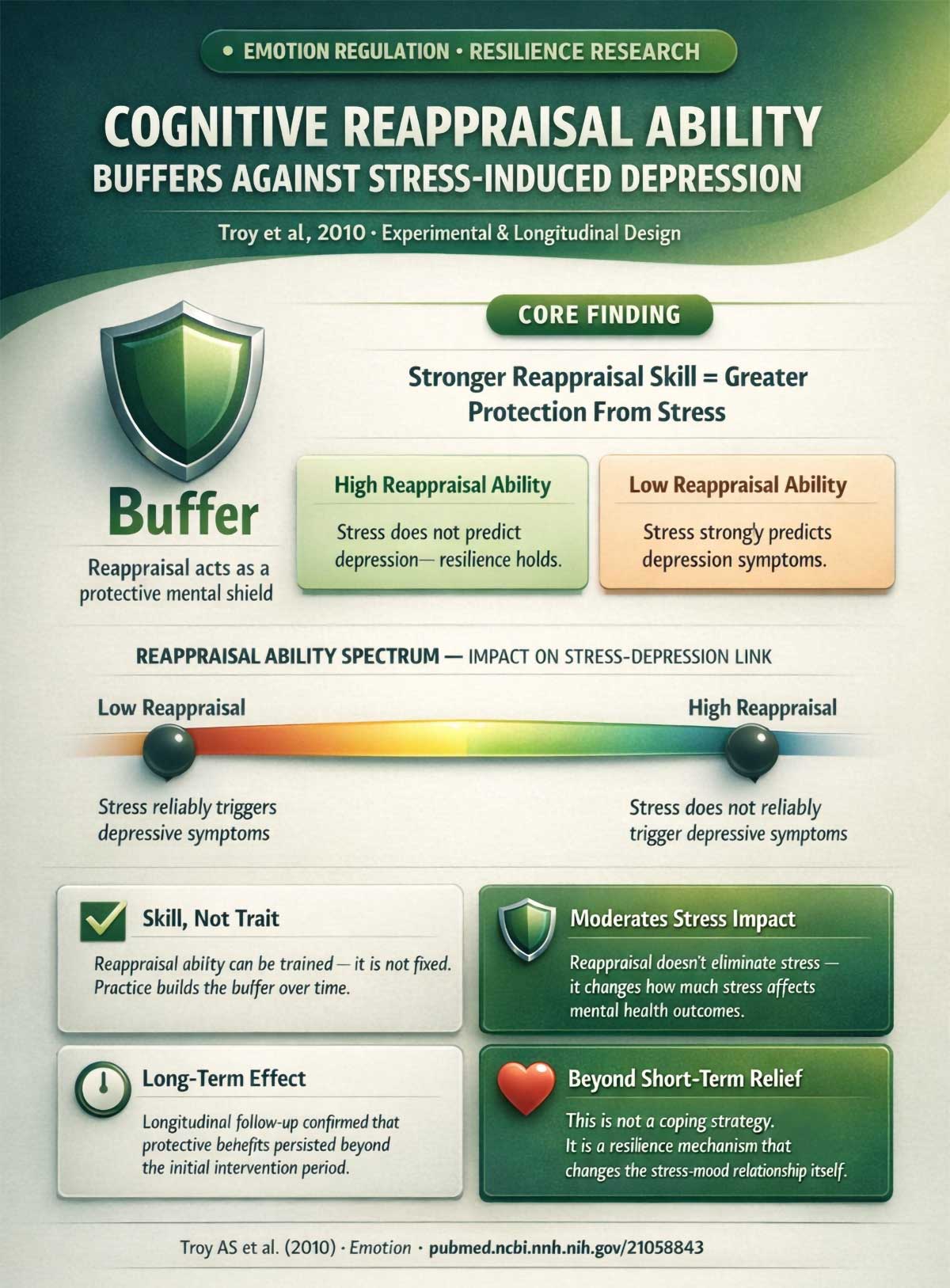
That shift — from threat to challenge — changes the emotional response that follows. And crucially, practicing reappraisal builds long-term resilience. A study by Troy and colleagues in 2010 found that people with stronger reappraisal ability showed greater resistance to stress-induced depression over time. The skill acts like a buffer. The more you use it, the more protected you become.
Strategy #2 — Identifying Cognitive Distortions: A Field Guide to Mental Traps
Not all negative thoughts are equal. Some are exaggerated. Some are selective. Some are flat-out wrong. Cognitive distortions are mental habits that twist the way we interpret reality — and they’re far more common than most people realize.
Here’s a quick field guide to the most frequent ones:
Catastrophizing means predicting the absolute worst outcome, then treating it as inevitable. A mildly awkward conversation at work becomes: Everyone thinks I’m incompetent and I’m going to get fired.
All-or-Nothing Thinking leaves no middle ground. Either something is perfect or it’s a complete disaster. A missed workout becomes: I have no discipline and I’ll never be healthy.
Personalization means taking blame for events that aren’t fully in your control. A friend cancels plans and the immediate thought is: They must be avoiding me. I’ve done something wrong.
Beck and Dozois’s foundational 2011 framework established that identifying and reframing Automatic Negative Thoughts is central to mood improvement — a principle since validated across hundreds of clinical trials. Their cognitive model of depression still guides therapy today, and it hinges on catching these distortions before they spiral.
The practical skill is learning to notice distortions as they happen. When a sharp, self-critical thought appears, pause and label it. That’s catastrophizing. That’s all-or-nothing thinking. Naming the pattern creates a split second of distance between you and the thought. That pause is where change begins.
Strategy #3 — Developing Metacognitive Awareness: How to Watch Your Thoughts
Most people are so caught up in the content of their thoughts that they never step back to observe the process. Metacognitive awareness — thinking about thinking — is the skill that makes that possible.
Mindfulness-Based Cognitive Therapy (MBCT) blends traditional CBT techniques with mindfulness practices. Its central insight is that you don’t have to believe every thought you have. Thoughts are mental events, not facts. Watching them pass is more effective than wrestling with them.
A review by Keng, Smoski, and Robins in 2011 examined multiple clinical and non-clinical studies on mindfulness practice. The evidence showed that mindfulness reduced both rumination and negative automatic thoughts. Crucially, their review found a double benefit: people who practiced mindfulness not only experienced a lower overall frequency of ANTs — when those thoughts did appear, they were significantly better at recognizing and releasing them without getting pulled in.
One useful way to understand this: imagine your thoughts as clouds moving across a sky. You are the sky, not the clouds. Clouds appear, shift, and move on. They don’t define the sky, and you don’t need to grab hold of each one. This isn’t avoidance — it’s disengagement. And there’s a critical mechanical difference between the two.
Arguing with a thought keeps you locked in the content. But what if it IS true? What if people really don’t like me? That’s a loop with no exit. Disengaging means recognizing: There’s that thought again. I don’t need to follow it. This short-circuits the rumination cycle before it builds.
Strategy #4 — Creating Psychological Distance: The Third-Person Technique
Here’s something that sounds strange but has solid evidence behind it: talking to yourself using your own name changes how your brain processes stress.
Psychologists call this psychological distancing or the “third-person technique.” When you refer to yourself in the third person — “Why is Sarah so worried about this?” instead of “Why am I so worried about this?” — the brain shifts from a reactive mode to a more analytical one. The emotional intensity drops. Problem-solving becomes easier.
This works because it mimics the mental position you’d naturally take when giving advice to someone else. You’d be calmer, more balanced, and less likely to catastrophize. Deliberately creating that distance applies the same perspective to your own inner dialogue. This technique, sometimes called “self-distancing,” has shown measurable effects on stress processing in laboratory studies, with participants showing lower emotional reactivity and better problem-solving when using it.
A closely related concept is self-compassion. Most people apply far harsher standards to themselves than they’d accept if directed at a friend. If a close friend made the mistake you’re mentally flogging yourself for, what would you say to them? Likely something measured, kind, and realistic. That same tone is available for your internal dialogue.
This isn’t a call to ignore accountability. It’s a recognition that self-criticism without compassion creates shame rather than growth. And shame is a notoriously poor motivator.
Strategy #5 — The Evidence-Checking Method: Putting Thoughts on Trial
One of the most practical CBT tools is treating a negative thought like a legal claim that needs to be proven. Psychologists call this the courtroom technique. You step into the role of a fair, neutral judge — not a defense attorney for the thought, and not a prosecutor trying to destroy it.
Three questions drive this process:
- What is the objective evidence that supports this thought?
- What is the evidence against it?
- Is this thought helpful, or is it just hurtful?
That third question is often the most revealing. Even if a thought has a grain of truth, asking whether it serves any useful purpose changes the relationship to it. I made a mistake on that report might be factually accurate. I’m terrible at my job and will always fail is neither accurate nor useful.
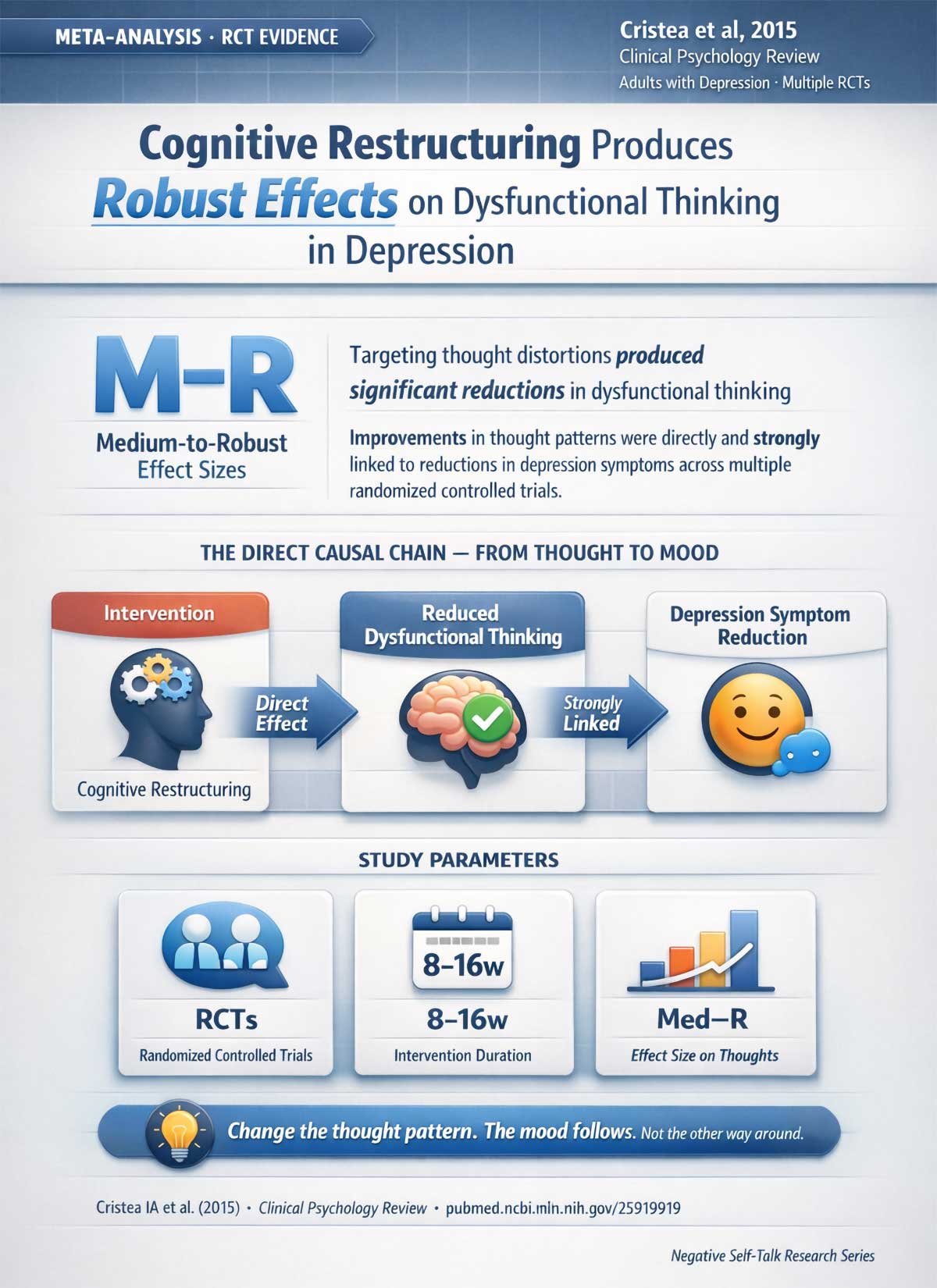
A 2015 meta-analysis by Cristea and colleagues examined cognitive restructuring interventions across multiple randomized controlled trials with adult patients experiencing depression. The results showed that targeting cognitive distortions produced medium-to-robust effects on dysfunctional thinking — and those improvements were strongly linked to reductions in depression symptoms. Changing the thoughts changed the mood.
The evidence-checking method is particularly useful for thoughts that feel certain and permanent. “Always” and “never” are red flags. Very few things in life are always or never true. Questioning the absolute language in a thought often reveals how little evidence there actually is.
Self-Assessment: Is Your Self-Talk Working Against You?
It helps to know your dominant inner critic style. Most people have a primary pattern. Review the five below and notice which one sounds most familiar.
1. The Catastrophizer — Your brain jumps straight to worst-case outcomes. Small problems become huge threats. Even things that haven’t happened yet feel certain and inevitable. This pattern often stems from hyperactive threat-detection — the brain’s alarm system firing at too-high sensitivity. Micro-intervention: Ask yourself, “What’s the most realistic outcome here?” — not the best or worst, but the most likely.
2. The Perfectionist — Good enough is never good enough. Anything less than perfect registers as failure. Effort doesn’t count if the result isn’t flawless. This style often reflects all-or-nothing thinking — the distortion that erases everything between “perfect” and “worthless.” Micro-intervention: Set a “good enough” threshold before starting a task. Define what acceptable looks like in advance.
3. The Comparator — Your internal measuring stick is always someone else. You compare your behind-the-scenes to their highlight reel. You’re always falling short. The brain’s negativity bias amplifies this — it’s quicker to register what others have than to register what you’ve built. Micro-intervention: Write down three things you’ve improved at over the past year. Shift the comparison to your past self.
4. The Mind Reader — You’re confident you know what others are thinking — and it’s never good. A short reply from a friend means they’re upset with you. A quiet room means you’ve done something wrong. The brain fills information gaps with negative assumptions by default — a direct product of the same threat-detection wiring described earlier. Micro-intervention: Ask yourself, “Is there concrete evidence for this, or am I filling in blanks?” Then look for neutral explanations.
5. The Self-Blamer — When things go wrong, it’s your fault — even when it isn’t. You carry responsibility for outcomes that involve other people, circumstances, or plain bad luck. This reflects the personalization distortion: the mind assigns causality inward even when the evidence doesn’t support it. Micro-intervention: List all the factors involved in a situation. Circle the ones actually in your control.
Moving From Critic to Coach
Negative self-talk doesn’t disappear overnight. It took years to build those mental habits, and replacing them takes consistent practice. The goal isn’t silence — it’s a shift in tone, from harsh critic to honest coach.
Consider the math: if a meaningful portion of your 6,000 to 70,000 daily thoughts repeat on a negative loop, retraining even a fraction of those patterns compounds over time. Small daily shifts create outsized long-term change. That’s not motivational language — it’s how neuroplasticity actually works.
A meta-analysis by Butler and colleagues in 2006 reviewed 16 separate meta-analyses covering CBT’s outcomes across a range of psychological conditions. The findings showed consistent, large effects on negative thinking patterns across multiple disorders. The evidence base is broad and robust. These techniques work. But they require repetition to stick.
A few principles make the practice more effective. First, catch the thought early. The earlier in the spiral you intervene, the less energy it takes to redirect. Second, consistency matters more than intensity. Five minutes of deliberate reappraisal daily beats one hour of reactive self-analysis once a week. Third, treat setbacks as data, not proof. Slipping back into old patterns isn’t failure — it’s part of the learning curve.
There are also situations where self-help reaches its limits. If negative self-talk is constant, severely affecting daily functioning, or linked to symptoms of anxiety or depression, working with a licensed psychologist or therapist provides a level of support these strategies alone can’t replace. CBT delivered by a trained clinician has a deeper evidence base than self-directed practice, and there’s no shame in using it.
Your inner dialogue is not fixed. It’s a habit — built through repetition, shaped by experience, and fully open to change. The brain that learned to be its own worst critic can learn to be something better. Not a cheerleader. Just a fair, grounded, honest voice that helps you move forward rather than holding you back.
That’s worth practicing for.
If you’re not sure where to start, go back to the inner critic profile that felt most familiar. Pick its micro-intervention and use it once today. One deliberate shift, repeated consistently, is how the inner dialogue changes.