Brain fog isn’t usually random. Research points to a handful of common triggers, and several can begin improving far sooner than most people realize once you know what to change.
Ask someone with brain fog what actually helps, and most describe the same pattern: wait it out, sleep more eventually, push through the day, and hope tomorrow feels clearer. That instinct is understandable. It is also vague.
Neuroscientists studying cognitive fatigue over the past decade have converged on something more specific and considerably more useful. Brain fog functions like a diagnostic signal: your brain reporting, in the only language it has, that a measurable system has fallen out of range: sleep, blood sugar, hydration, or inflammation. Fix the input, and the fog does not just fade. It often lifts within hours.
A waste-clearance system in your brain only switches on during deep sleep. A blood sugar swing you never notice can quietly derail your afternoon. A stress hormone, in high enough doses, acts almost like poison to the part of your brain responsible for focus. Most of these can shift starting today.
What Causes Brain Fog?
Brain fog isn’t a diagnosis on its own so much as a symptom, and it usually traces back to one of a small number of overlapping causes: poor sleep quality, chronic stress and elevated cortisol, blood sugar swings, low-grade inflammation, dehydration, and in some cases an underlying condition like a thyroid imbalance, iron deficiency, or Long COVID.
Most cases resolve with the lifestyle changes below. A smaller number point to something that needs a doctor’s attention, covered later in this guide. For a deeper look at the specific mechanisms behind each trigger, this breakdown of why brain fog happens goes further into the causal detail.

What Type of Brain Fog Do You Have?
Brain fog rarely feels the same for two people. Some wake up groggy and stay that way until mid-morning. Others feel sharp until lunch, then hit a wall. The symptoms overlap: difficulty concentrating, forgetfulness, trouble finding the right word, and a general mental sluggishness. But the timing usually points to a specific cause.
Identifying your pattern helps you decide which habit to start with first.
The Four Common Brain Fog Patterns
Type 1: The Morning Fog
- Symptoms: Waking up groggy, unable to think clearly until 10 am, needing multiple alarms
- Primary cause: Poor sleep quality or accumulated sleep debt
- Priority habits: Sleep optimization, morning hydration, resisting the snooze button
- Quick test: If you feel clear by the afternoon, this is your type
Type 2: The Afternoon Crash
- Symptoms: Strong clarity until lunch, then sudden fatigue and confusion by 2 to 3 pm
- Primary cause: Blood sugar dysregulation, often from lunch choices
- Priority habits: Blood sugar management, strategic breaks, avoiding high-carb lunches
- Quick test: Track what you eat for lunch and note your 2 pm mental state
Type 3: The Constant Haze
- Symptoms: All-day mental cloudiness, rarely feeling sharp, a baseline sense of confusion
- Primary cause: Chronic inflammation, stress, or an underlying medical condition
- Priority habits: An anti-inflammatory diet, stress reduction, and medical evaluation
- Quick test: If lifestyle changes bring no improvement in 6 to 8 weeks, see a doctor
Type 4: The Stress Fog
- Symptoms: Clear thinking until stress hits, then mental paralysis and overwhelm
- Primary cause: Cortisol spikes and sympathetic nervous system activation
- Priority habits: Breathwork, cognitive breaks, structured stress management
- Quick test: Notice whether the fog lifts on vacations or weekends
Simple Self-Assessment
Answer these five questions. When is your fog worst: morning, afternoon, all day, or during stress? Does it improve with rest? Did it start suddenly or gradually? Is it worse after certain foods? Do you wake up feeling refreshed?
Mostly morning issues paired with poor waking energy point to Type 1. Afternoon crashes tied to specific foods point to Type 2. All-day fog with a gradual onset points to Type 3. Stress-triggered fog that lifts during downtime points to Type 4.
All ten habits below help everyone to some degree. Knowing your primary pattern tells you where to start.
Habit 1: Turn On Your Brain’s Cleaning Crew
Your brain has a waste removal system that only runs while you sleep. Researchers didn’t confirm this until 2013, and what they found reframed how scientists think about rest entirely.
A team at the University of Rochester, led by neuroscientist Maiken Nedergaard, used real-time imaging in mice to watch the process directly. During sleep, the space between brain cells expanded by 60%, letting cerebrospinal fluid wash through and carry off metabolic waste, including amyloid-beta and tau, the same proteins that accumulate in Alzheimer’s disease.
The finding was later named the glymphatic system, and while it was first shown in animals, subsequent human imaging studies have found the same pattern of overnight clearance.
Without enough sleep, that waste piles up. Brain fog, at the cellular level, is your brain’s physical inability to clear its own trash.
The fix is simple but strict: 7 to 9 hours of sleep, consistently. Quality matters as much as quantity. Fragmented sleep does not switch on glymphatic cleaning the way unbroken deep sleep does, and missing even one night shows up in tomorrow’s mental clarity.
One habit that rarely gets mentioned alongside sleep timing: morning light exposure. Getting outside within an hour of waking, even for 15 to 20 minutes on a cloudy day, helps anchor the circadian signal that makes consistent bedtimes actually work.
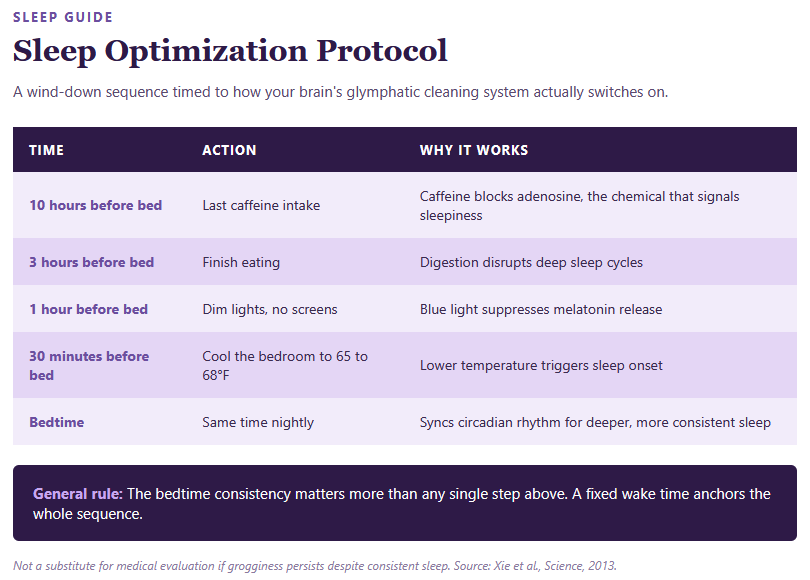
Why Sleep Quality Beats Quantity
Sleep moves through four stages roughly every 90 minutes. Stage 1 is a brief transition, five to ten minutes of light sleep where waking comes easily. Stage 2 makes up about half the night, and this is where memory consolidation begins.
Stage 3 is deep sleep, the stage where glymphatic cleaning actually happens, and growth hormone is released. REM sleep handles emotional processing and creative problem-solving, and your brain is nearly as active here as when you’re awake.
Here is why the extra hour matters. Six hours of sleep gets you close to four complete 90-minute cycles. Eight hours gets you five to six cycles, adding 30 to 40 extra minutes of deep sleep and REM combined. That extra stretch is where the fog actually clears.
Most sleep-tracking apps estimate stage percentages. Under 15% deep sleep suggests your glymphatic system isn’t getting enough working time. Above 20%, you’re in a solid range.
Waking up groggy despite a full 8 hours can point to sleep apnea or fragmented sleep quality that a tracker alone won’t catch. That’s worth mentioning to a doctor if it persists.
Habit 2: Grow New Brain Cells With 20 Minutes of Movement
Want to physically grow your brain? Move your body.
Kirk Erickson and colleagues at the University of Pittsburgh, publishing in PNAS in 2011, tracked 120 older adults for a year. Half walked briskly for 40 minutes, three times weekly. The other half did stretching and toning. Brain scans told the more interesting story: the walking group’s hippocampus grew by 2%, while the stretching group’s shrank by 1.4%.
That’s measurable brain tissue responding to a simple habit. A later critique of the same study flagged something separate: both groups actually improved on memory tests by similar margins, so the volume change and the memory benefit aren’t quite the same claim, even though they’re often reported together.
Exercise releases a protein called BDNF, which functions almost like fertilizer for brain cells, building new neural pathways and strengthening existing ones. You don’t need a gym membership. A brisk walk works.
The target: 20 to 30 minutes of moderate cardio, three to five times weekly. Your heart rate should climb, but you should still be able to hold a conversation. That’s the range where BDNF release peaks.
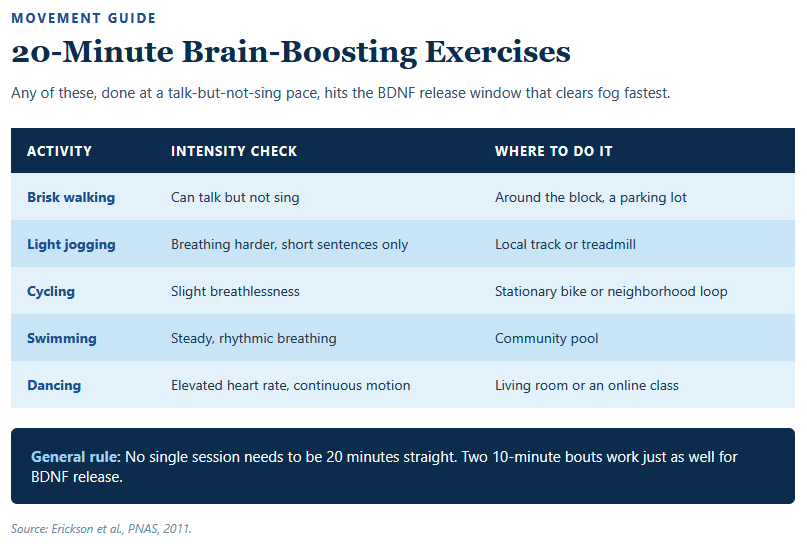
Timing Exercise to Your Fog Pattern
Morning exercise, 6 to 9 am, suits Type 1 morning fog best. It kickstarts the cortisol awakening response and primes BDNF release for the whole day. A 20-minute walk before breakfast is enough to start.
Midday exercise, 11 am to 2 pm, works for Type 2 afternoon crashes. It increases insulin sensitivity right when blood sugar tends to dip, so a walk after lunch beats sitting through the slump.
Evening exercise, 4 to 7 pm, fits Type 3 constant haze. It burns off accumulated cortisol and deepens sleep quality, though finishing at least 3 hours before bed avoids disrupting rest.
High-intensity intervals can accelerate the timeline for people who are already sleeping well and managing stress. If you’re already running on empty, though, adding intensity tends to backfire, spiking cortisol further and worsening fog temporarily. Build the foundation first.
Habit 3: Rehydrate Your Brain
Your brain is about 75% water. Even mild dehydration causes measurable shrinkage, and that shrinkage shows up as exactly the symptoms people call brain fog: poor attention, weaker working memory.
Lawrence Armstrong and colleagues at the University of Connecticut’s Human Performance Laboratory studied 25 young women and found that a fluid loss of 1.36%, well below the point where people report feeling thirsty, was enough to measurably worsen mood and concentration. Your brain registers dehydration before your throat does.
The target is 1.5 to 2 liters daily, adjusted for body weight, activity, and climate. Front-load the intake. Overnight fluid loss means the first glass of the day matters more than the fifth.
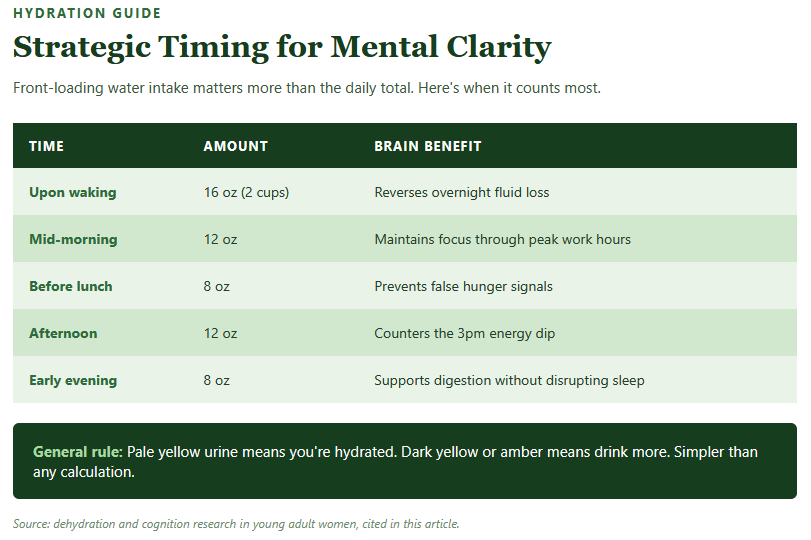
The Electrolyte Factor
Water alone isn’t always enough. Active people, heavy coffee drinkers, and anyone under chronic stress lose electrolytes faster than plain water replaces them.
Sodium maintains fluid balance and nerve signaling. Low sodium causes confusion and fatigue that mimic brain fog. Potassium works alongside it to regulate cell voltage so neurons fire correctly and shows up naturally in bananas, avocados, and potatoes.
Magnesium participates in over 300 biochemical reactions, including neurotransmitter production, and a shortfall is common enough that checking for it makes sense if fatigue persists despite good sleep. Calcium plays its own role in neurotransmitter release.
A simple homemade version covers most of this: 16 ounces of water, the juice of half a lemon, a quarter teaspoon of sea salt, and a teaspoon of honey if you want it. It performs about as well as commercial sports drinks, minus the added sugar and dye.
Habit 4: Quiet Your Mind’s Chatter
Your brain runs a background circuit that switches on when you zone out, worry, or ruminate. Neuroscientists call it the default mode network, and it’s active during almost everything that feels like fog.
Fadel Zeidan and colleagues at Wake Forest University School of Medicine wanted to know how little meditation practice it took to move the needle, so they tested complete novices over four days. After four 20-minute sessions, participants showed measurable gains in attention and processing efficiency, benefits that had previously only been documented in people with years of practice.
Their 2010 study in Consciousness and Cognition suggested the brain rewires its attention circuitry faster than most people assume.
Sit comfortably. Focus on your breath. When thoughts wander, and they will, bring attention back gently. That’s the entire practice. Do it once daily, ideally in the morning, though any time works.
If Sitting Still Doesn’t Work for You
Traditional seated meditation isn’t for everyone, and the default mode network responds to several other approaches equally well.
Walking meditation means walking slowly and deliberately, focusing on each foot touching the ground, noticing sounds and smells along the way. It suits people who feel restless sitting still and takes 10 to 15 minutes.
A body scan involves lying down and bringing attention to each body part in sequence, from toes upward, without judging the sensations. It works well as an evening wind-down and takes 10 to 20 minutes.
Single-tasking practice turns a mundane chore, such as washing dishes or folding laundry, into a meditation. Do it slowly, noticing water temperature or fabric texture. Five to ten minutes is enough, and it suits people who insist they don’t have time to meditate.
Counting breaths is the simplest entry point: breathe normally, count each exhale to ten, restart at one if you lose count. Five minutes covers it, and it’s a solid option during acute stress.
A 2007 PNAS study led by Yi-Yuan Tang found that five days of 20-minute integrative body-mind training improved attention and lowered stress-related cortisol. The specific method matters less than doing it consistently.
Habit 5: Steady Your Brain’s Fuel Supply
Your brain uses roughly 20% of your body’s total energy. When blood sugar spikes and crashes, your brain crashes with it. That post-lunch fog most people know intimately is, more often than not, a glucose crash in progress.
A study following older adults without diabetes found something researchers didn’t expect: even within a normal blood sugar range, people with lower average glucose levels had better memory performance and a larger hippocampus. High blood sugar, even short of a diabetes diagnosis, appears to physically shrink the brain’s memory center over time.
The acute effects arrive faster than that. Annelise Madison and colleagues at Ohio State, working in Janice Kiecolt-Glaser’s lab, found that a single high-saturated-fat meal measurably reduced sustained attention within hours of eating, compared to a meal matched for calories but lower in saturated fat. Whatever you had for lunch is quietly shaping your 2 pm mental state.
Pairing protein and healthy fat with every meal slows glucose absorption by an estimated 40 to 60%, which is usually enough to prevent the crash that causes fog. Add nuts to oatmeal. Pair fruit with cheese instead of eating it alone.
Reading the Glycemic Index for Mental Clarity
High-glycemic foods spike blood sugar fast, then crash it. White bread, most cereals, and mashed potatoes fall in this range. Low-glycemic foods, such as non-starchy vegetables, berries, legumes, and plain Greek yogurt, provide steadier fuel.
Combining a high-glycemic food with fat, protein, or fiber blunts its overall impact considerably. Toast alone spikes blood sugar sharply. Toast with avocado and egg produces a far gentler curve, giving your brain a steady supply for three to four hours instead of a one-hour spike followed by a crash.
Andrew Reynolds and colleagues, publishing in Diabetologia in 2016, found that a 10-minute walk within 30 minutes of finishing a meal significantly blunted the resulting blood sugar spike. The study was conducted in people managing type 2 diabetes, though the underlying mechanism, muscle contraction pulling glucose out of the bloodstream, applies just as well to anyone trying to avoid an afternoon crash.
Habit 6: Stop Task-Switching
You think you’re multitasking. You’re not. Your brain rapidly switches between tasks, and every switch costs energy, depleting glucose and raising stress hormones along the way.
Eyal Ophir, Clifford Nass, and Anthony Wagner at Stanford compared people who chronically juggle multiple streams of digital information against people who prefer single-tasking. Chronic multitaskers performed worse on tests of working memory and cognitive control, and struggled specifically to filter out irrelevant information.
Later replication attempts have found the effect real but smaller than the original study suggested, which is a fair caveat and doesn’t change the underlying advice much.
Pick one task. Set a timer for 45 minutes. Close every other tab and app. Work on that one thing until the timer ends.
Group similar tasks together. Check email twice a day instead of twenty times. This single change alone tends to noticeably sharpen mental clarity within a week.
Setting Digital Boundaries
Every notification is a task switch. Every open tab is a small cognitive load your brain keeps tracking, even when you’re not looking at it.
Adrian Ward and colleagues at the University of Texas at Austin, publishing in the Journal of the Association for Consumer Research in 2017, found that the mere presence of a smartphone on a desk, powered off or not, reduced available cognitive capacity compared to having it in another room.
Their explanation: part of your brain works to avoid thinking about the phone, and that suppression itself uses up mental resources. A later attempt to replicate this specific finding didn’t fully reproduce it, so treat it as a real but not universally confirmed effect. Either way, phone-in-another-room is a low-cost experiment worth trying for a week.
Batch communication into fixed windows: check email at 9 am, noon, and 4 pm, with notifications off in between. Close every browser tab at the end of each session, bookmarking anything you’ll want to revisit. When memory feels strained, externalize the load entirely. Calendars, written notes, and simple lists free up mental energy that would otherwise go toward remembering what you’re supposed to do next.
Habit 7: Feed Your Brain’s Wiring
Inflammation in your gut creates inflammation in your brain. The two systems communicate constantly through what’s called the gut-brain axis, and when one struggles, the other tends to follow.
Martha Clare Morris spent years chasing a fairly practical question: does any single eating pattern actually protect the aging brain, or is that wishful nutrition science?
Her answer became the MIND diet, a hybrid of Mediterranean and DASH eating patterns, and when she and her Rush University colleagues tracked 923 adults for an average of 4.5 years, the people who followed it most closely showed markedly slower cognitive decline.
Leafy greens daily, berries three times weekly, fatty fish twice weekly, nuts as snacks, olive oil instead of butter. It reads less like a diet and more like a maintenance schedule for your brain.
One caveat matters here: this was an observational study, not a controlled trial, and Morris herself noted that a proper dietary intervention trial would be needed before anyone could call the pattern confirmed rather than strongly suggestive.
You don’t need to follow it perfectly. Research on adherence patterns suggests that hitting the target about 80% of the time still delivers most of the anti-inflammatory benefit.

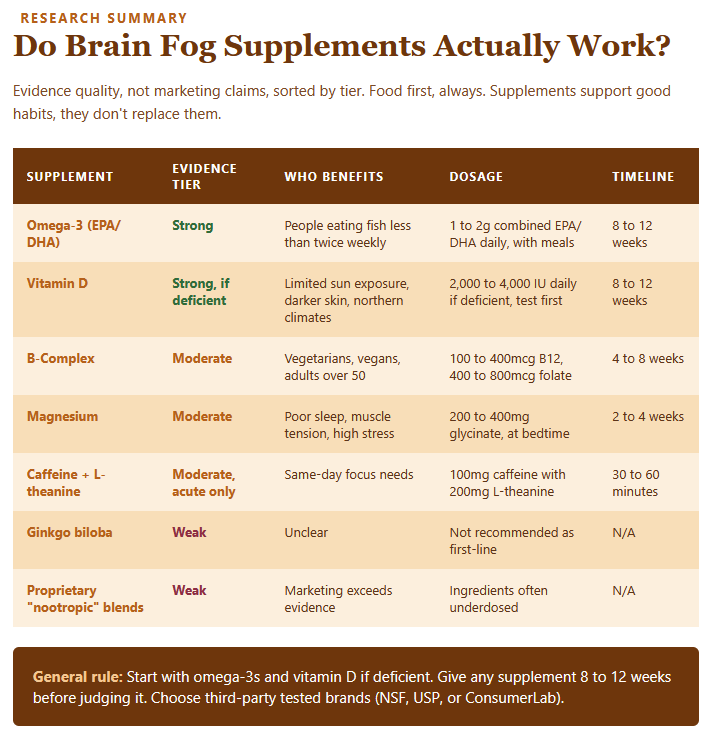
Do Brain Fog Supplements Actually Work?
The supplement aisle makes big promises. The evidence is more mixed than the marketing suggests, and it varies considerably by ingredient.
Omega-3s have the strongest backing. A 2010 trial funded by Martek Biosciences, the DHA supplement’s manufacturer, and led by Karin Yurko-Mauro, gave 485 adults with mild memory complaints either 900mg of algal DHA daily or a placebo for 24 weeks. The DHA group showed roughly double the improvement on a memory test compared to placebo.
The industry funding deserves a mention, since Martek both financed the trial and employed most of its authors. That said, the effect size has held up across independent reviews as well, which is a reasonable amount of corroboration for a supplement claim.
Vitamin D only helps people who are actually deficient, so testing beats guessing there. B-complex leans toward vegetarians, vegans, and adults over 50, whose B12 absorption declines with age. Magnesium is the cheap, low-risk one, worth a try if sleep or muscle tension is in the picture.
Ginkgo biloba and most proprietary “nootropic” blends have considerably weaker evidence behind them than their marketing implies. Save your money there. Caffeine paired with L-theanine, the combination found naturally in green tea, is genuinely useful for a same-day focus boost, though it’s a Band-Aid rather than a fix for chronic fog.
Habit 8: Take Breaks Before You Need Them
Your brain runs on 90-minute cycles of high focus followed by natural fatigue, sometimes called ultradian rhythms. Pushing through the dip is where fog sets in.
Atsunori Ariga and Alejandro Lleras at the University of Illinois had 84 people perform a repetitive 50-minute task. The group given two brief breaks maintained consistent performance throughout, while the group that worked straight through showed a clear, steady decline. The timing matters as much as the break itself: interrupting before exhaustion sets in works far better than waiting until focus has already collapsed.
Set a timer for 90 minutes. When it rings, step away for five. No phone. Look out of a window. Stretch. These breaks aren’t a lapse in discipline. They’re required maintenance that your brain runs on, whether you plan for it or not.
Habit 9: Lower Your Stress Ceiling
Chronic stress runs on cortisol, and by the time levels stay elevated for weeks rather than hours, the prefrontal cortex, the region behind decisions and sustained focus, is usually the first thing to suffer.
Julie Wetherell, Eric Lenze, and colleagues at Washington University and UC San Diego ran an eight-week mindfulness-based stress reduction program in 103 older adults with diagnosed anxiety or depressive disorders, comparing it to a health education program matched for time and attention. MBSR measurably eased worry and depression and showed some benefit for memory performance.
A caveat worth having: a much larger follow-up trial from the same Washington University lab, 585 older adults with general cognitive concerns rather than a diagnosed anxiety disorder, found no significant executive function or memory benefit from MBSR.
The anxiety-specific population in the original study may be exactly why it worked there and not in the broader trial, but it’s a real inconsistency, not a settled finding. Reducing stress in a diagnosed anxiety disorder does still appear to help the brain function that anxiety disrupts, which is a narrower and more honest claim than “meditation improves cognition.”
The fastest reset available is the physiological sigh: two inhales through the nose, a deep breath followed by a short top-off breath, then one long, slow exhale through the mouth. This works through simple respiratory mechanics rather than belief or practice, and it shifts your nervous system from stressed to calm within seconds. Use it before a meeting, mid-overwhelm, or whenever fog starts to descend.
Habit 10: Build Brain Backup Systems
Social connection and learning new skills build what researchers call cognitive reserve, making your brain more resistant to fatigue and age-related decline.
For a long time, the working assumption was that cognitive decline mostly came down to genetics and age, not much else. A Rush University Alzheimer’s Disease Center study complicated that considerably.
Tracking more than 1,100 older adults in the Chicago area for up to 12 years, researchers found that people who stayed socially active and regularly challenged their minds with new activities showed a meaningfully slower rate of cognitive decline than those who didn’t.
Your brain wants novelty and challenge. Learning something new, or connecting genuinely with another person, activates dormant neural pathways that function as backup circuits when your primary ones are running foggy.
Schedule face-to-face time weekly. Learn a small skill, a new recipe, or a few words of another language. Call a friend instead of texting them. Connection functions as cognitive protection as much as emotional comfort.
The Brain Fog Emergency Kit
Sometimes you don’t have weeks to build habits. You’re in a meeting, and your brain has stalled. A deadline is an hour away, and clear thinking feels out of reach. These strategies won’t fix the underlying pattern, but they buy real time.
Cold water reset, 2 minutes: Run cold water over your wrists for 30 seconds, splash your face a few times, then take three deep breaths. This triggers the mammalian dive reflex, slowing heart rate and increasing blood flow to the brain. Best for acute stress or a sudden mental shutdown.
Protein rescue, 20 minutes: A handful of almonds, a hard-boiled egg, or plain Greek yogurt stabilizes blood sugar fast. Skip fruit, crackers, or candy here. They spike blood sugar briefly, then crash you harder.
Movement jolt, 5 minutes: A single bout of exercise, 20 jumping jacks or a brisk walk around the building, increases cerebral blood flow by an estimated 15% for the next two to three hours.
Caffeine, with rules: 100 to 200mg works, roughly one strong coffee or two cups of green tea, but only before 2 pm and not on an empty stomach. Green tea’s natural L-theanine content provides alertness without the jitters.
What drink actually clears brain fog? Plain water beats anything else for the simple reason that most daytime fog has a dehydration component hiding underneath it. Green tea comes second, thanks to the caffeine and L-theanine combination. Sugary energy drinks and most “focus” beverages do the opposite over the following hour, once the initial spike wears off.
Oxygen boost, 3 minutes: Box breathing, four counts in, four held, four out, four held, repeated five to six times, increases blood oxygen and reduces the stress response.
Sensory reset, 5 minutes: Name five things you see, four you can touch, three you hear, two you smell, one you taste. This forces your brain out of panic mode and back into the present moment.
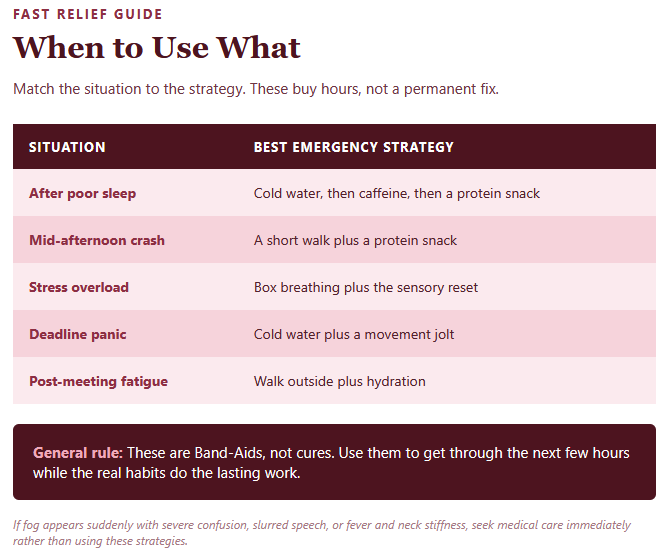
These are genuinely useful in a pinch. They are not a substitute for the habits above, which is exactly why they buy you two to four hours rather than solving anything permanently.
How Long Does Brain Fog Last?
The honest answer depends entirely on the cause, and it’s one of the most common questions people search for without finding a clear answer.
Fog tied to a rough night’s sleep or an acute stress spike usually resolves within a day or two once the trigger passes. Fog from ongoing poor sleep, blood sugar swings, or chronic stress tends to improve within one to two weeks of consistent habit changes, though full stabilization can take longer.
Fog following a viral illness, including a common cold or flu, typically clears within a week or two as the immune response settles. Long COVID brain fog behaves differently. It can persist for months, and most people see meaningful improvement within a year, though a smaller subset experiences symptoms lasting longer. Flag this to a doctor specifically if it followed a COVID infection, since some targeted interventions exist for that particular pattern.
Fog after a concussion or head injury has no single timeline. Some people clear within weeks. Others take months, and recovery depends heavily on injury severity and how early rehabilitation starts.
Is brain fog dangerous on its own? Rarely. The fog itself tends not to cause harm, though the underlying cause occasionally does, which is why fog that doesn’t budge after six to eight weeks of real lifestyle change deserves a medical conversation rather than more willpower.
Is it permanent? For the overwhelming majority of cases rooted in sleep, stress, diet, or hydration, no. It resolves once the underlying input is corrected. Chronic conditions require managing the condition itself, but even then, the same habits covered here still tend to help alongside medical treatment.
How to Build These Habits Without Overwhelm
Don’t try to adopt all ten at once. Stack them in order.
Week 1, Foundation: Fixed bedtime and 16 ounces of water immediately upon waking. Track both daily. These two habits make every habit that follows work better.
Week 2, Movement: Add a morning walk or 20-minute workout, keeping Week 1 habits running. Better sleep tends to make exercise motivation easier, not harder.
Week 3, Nutrition: Swap one meal daily to an anti-inflammatory pattern and add a blood-sugar-balancing snack. The energy from Week 2’s movement usually makes cooking feel less like a chore.
Week 4, Mind habits: Ten minutes of morning breathwork, plus 90-minute work blocks with real breaks. The physical foundation from the first three weeks supports the mental practices better than starting here would.
After four weeks, add whatever’s left, one habit at a time. Momentum does most of the remaining work.
What Success Looks Like
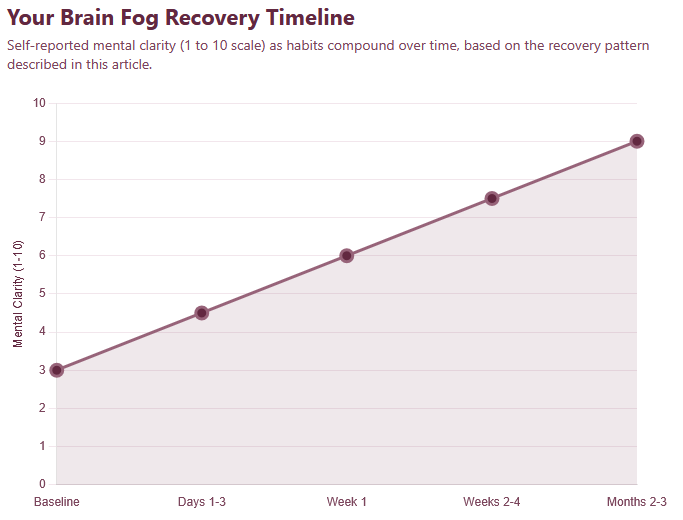
Brain fog didn’t appear overnight, and it won’t vanish overnight either. Here’s a realistic timeline.
Days 1 to 3 usually bring more energy from hydration alone, a slightly better mood, and less severe afternoon crashes if blood sugar is being managed. Track energy at 10 am, 2 pm, and 5 pm on a 1 to 10 scale.
Week 1 tends to bring sleep benefits online. Morning clarity often improves 30 to 40%, and the “wait, what was I doing?” moments become noticeably rarer, as consistent sleep timing starts regulating the circadian rhythm and glymphatic cleaning.
Weeks 2 through 4 bring compound effects. Energy holds steadier through the day, focus improves at work, and stress reactivity drops. This is the stage where habits start reinforcing each other: better sleep improves exercise motivation, exercise improves sleep quality, and steadier nutrition supports both.
By months 2 and 3, fog becomes the exception rather than the rule for most people. Quick thinking returns. Memory sharpens. Work starts feeling easier rather than effortful. Neuroplasticity has had time to build new pathways, and inflammation has had time to settle.
Measuring Your Progress
Rate yourself weekly on this scale.
1 to 2, Severe: Can’t focus for more than five minutes, forgets why they walked into rooms constantly, struggles to finish sentences.
3 to 4, Moderate: Focus holds for 15 to 30 minutes before slipping, forgets things several times daily, needs extra time on tasks.
5 to 6, Mild: Focus holds for 45 to 60 minutes, occasional word-finding trouble, some days noticeably better than others.
7 to 8, Minimal: Focus holds past 90 minutes, rarely loses their train of thought, fog shows up mainly during stress or poor sleep.
9 to 10, Clear: Sharp all day, strong recall, fast decisions, feeling like themselves again.
The realistic goal is to move one to two points per month. If six weeks of consistent habits produce no movement at all, that’s the signal to bring in a doctor rather than double down alone.
Medical Red Flags: When Brain Fog Needs Professional Help
Most brain fog responds to the habits above. A smaller share signals something that needs medical attention, and the distinction matters.
See a doctor immediately for sudden severe confusion, fog following a head injury, fog accompanied by fever and a stiff neck, or any difficulty speaking or understanding speech.
Schedule an appointment, without the same urgency, if fog persists past 6 to 8 weeks of genuine lifestyle changes, if it appeared alongside unexplained weight gain, if extreme fatigue continues despite 9 or more hours of sleep, if it started after a new medication, or if it’s accompanied by depression or anxiety.
Useful tests to ask about include a complete blood count, a thyroid panel, vitamin D and B12 levels, fasting glucose and A1C, and a sleep study if snoring or morning headaches are part of the picture.
Conditions to rule out include hypothyroidism, sleep apnea, chronic fatigue syndrome, Long COVID, perimenopause, autoimmune conditions like lupus or MS, depression, and medication side effects.
Does over-the-counter medication help? Ibuprofen and similar anti-inflammatories aren’t a treatment for brain fog itself. They may offer some relief if fog is riding alongside a headache or fever from an active illness, but there’s no meaningful evidence they clear cognitive fog on their own, and reaching for them as a fog fix specifically isn’t well supported.
Don’t self-diagnose. Don’t dismiss persistent symptoms either. Brain fog can be an early signal worth listening to.
Brain Fog Quick Reference
Do today: drink 16 ounces of water right now, set tonight’s bedtime, block 20 minutes for tomorrow’s walk.
This week: consistent sleep and wake times, water front-loaded in the morning, a 10-minute walk after lunch.
This month: swap one meal daily to an anti-inflammatory pattern, practice 10 minutes of breathwork, schedule one social connection.
Emergency fog lifters: 16 ounces of cold water, a 10-minute walk outside, three physiological sighs, a handful of nuts.
Maintaining Clarity: The Long View
Once the fog clears, the goal shifts from fixing to maintaining, and the standard is more forgiving than it sounds.
The 80/20 rule applies well here. Sleeping 7 to 9 hours five or six nights a week, exercising three to five times rather than seven, and eating well most days while allowing the occasional treat, all of this maintains most of the benefit. Three habits resist the 80/20 flexibility, though: consistent sleep timing, daily hydration, and avoiding chronic multitasking. These three compound too much to skip regularly.
Winter, high-stress periods, recovery from illness, and the years around perimenopause or age 50 all raise fog risk. During those windows, returning to stricter adherence for a stretch works like a seasonal tune-up.
Do an annual check-in covering resting heart rate, sleep quality, stress levels, exercise consistency, and a basic blood panel for thyroid, vitamin D, B12, and glucose. These markers tend to predict brain fog before it becomes a daily problem.
The Fog Was Never the Real Problem
Brain fog gets treated like a mystery because it feels like one from the inside: vague, unplaceable, hard to name. It almost never is: your brain is running an honest diagnostic and reporting back exactly what’s missing.
The habit that made the biggest difference for most people covered in the research behind this piece wasn’t a single supplement or a clever trick. It was sleep timing, unglamorous and almost embarrassingly simple, doing more work than anything else on this list. Start there if nowhere else, and let the rest follow once your brain has the one input it actually runs on.
Brain fog that persists despite consistent lifestyle changes, especially alongside other symptoms, is worth bringing to a doctor rather than managing alone.