Most people start taking omega-3 supplements with one goal in mind: a sharper brain. They expect to feel clearer, think faster, and maybe even remember where they left their keys. What actually happens is a lot more complicated—and more interesting.
The short version? The benefits are real. But the timeline might not match your expectations.
The 8–12 Week Window: Why Most People Quit Too Early
Omega-3 supplements don’t work overnight. They aren’t like caffeine, which hits your bloodstream in 15 minutes. Think of them more like a slow renovation—your brain cells are being rebuilt from the inside out.
EPA (eicosapentaenoic acid) and DHA (docosahexaenoic acid) are the two main omega-3 fats your brain uses. DHA makes up a significant part of your brain’s cell membranes. EPA plays a bigger role in mood and inflammation. When you start supplementing, these fatty acids need 8–12 weeks to reach a “steady state” in your blood before they can meaningfully influence your brain cell structure.
That’s a long time to wait—especially when nothing obvious is happening.
Here’s the thing: something is happening. You just can’t feel it yet.
Your Brain Changes Before Your Behavior Does
One of the most striking findings in omega-3 research comes from a 2022 study by Sittiprapaporn et al., which looked at 120 healthy children aged 6–12 over 12 weeks. Researchers used event-related potential (ERP) recordings—a tool that measures electrical activity in the brain—to track changes in attention and cognitive processing.
The results were striking. Fish oil improved measurable brain activity. The brain was firing more efficiently. But when researchers looked at actual task performance and behavior, there were no significant changes.
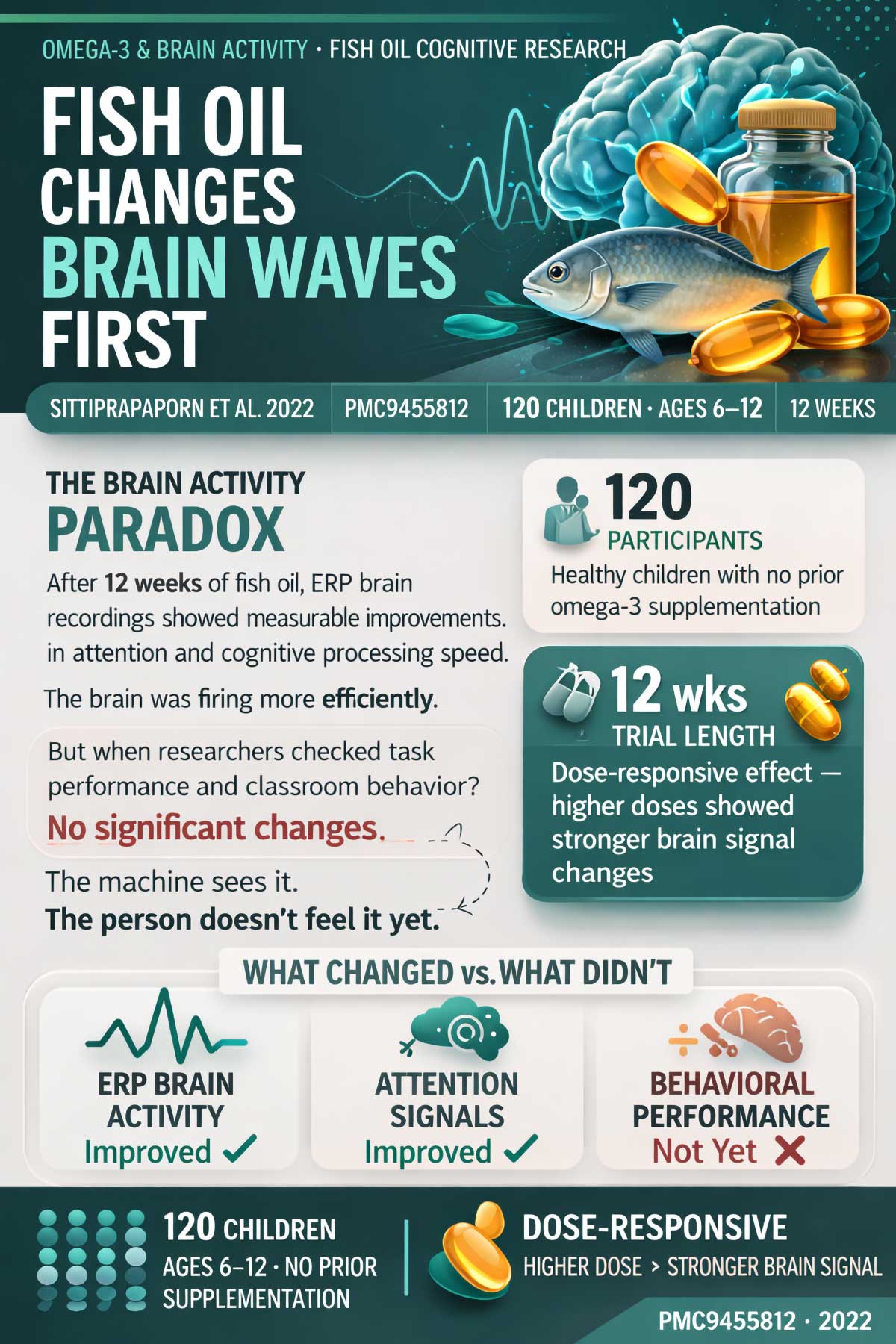
What does that mean for you? Your brain can be changing at a biological level before those changes show up in daily life. The machine sees it. You don’t feel it yet.
This is the brain activity paradox. Think of it like upgrading the engine in a car but not yet changing how you drive. The car is more capable—it just needs time on the road before that translates into better performance.
This research was done in children, so the findings don’t transfer directly to adults. But the pattern it points to—biological change preceding behavioral change—holds across the broader literature. The 12-week mark isn’t the finish line. It’s closer to the starting gun.
The Real Short-Term Win: Mental Stamina, Not IQ
If you’re hoping omega-3s will make you smarter in three months, you’ll likely be disappointed. That’s not what the short-term data shows—at least not for people who already get enough omega-3s in their diet.
A 2012 study by Jackson et al. followed 159 healthy adults aged 18–35 over 12 weeks. These participants had low fish intake—less than one portion per week, which means some degree of omega-3 deficiency was likely in play. The results showed no significant improvements in core cognitive function overall. An EPA-rich formula showed modest benefits in reducing subjective mental fatigue during demanding tasks—but that was about the extent of it.
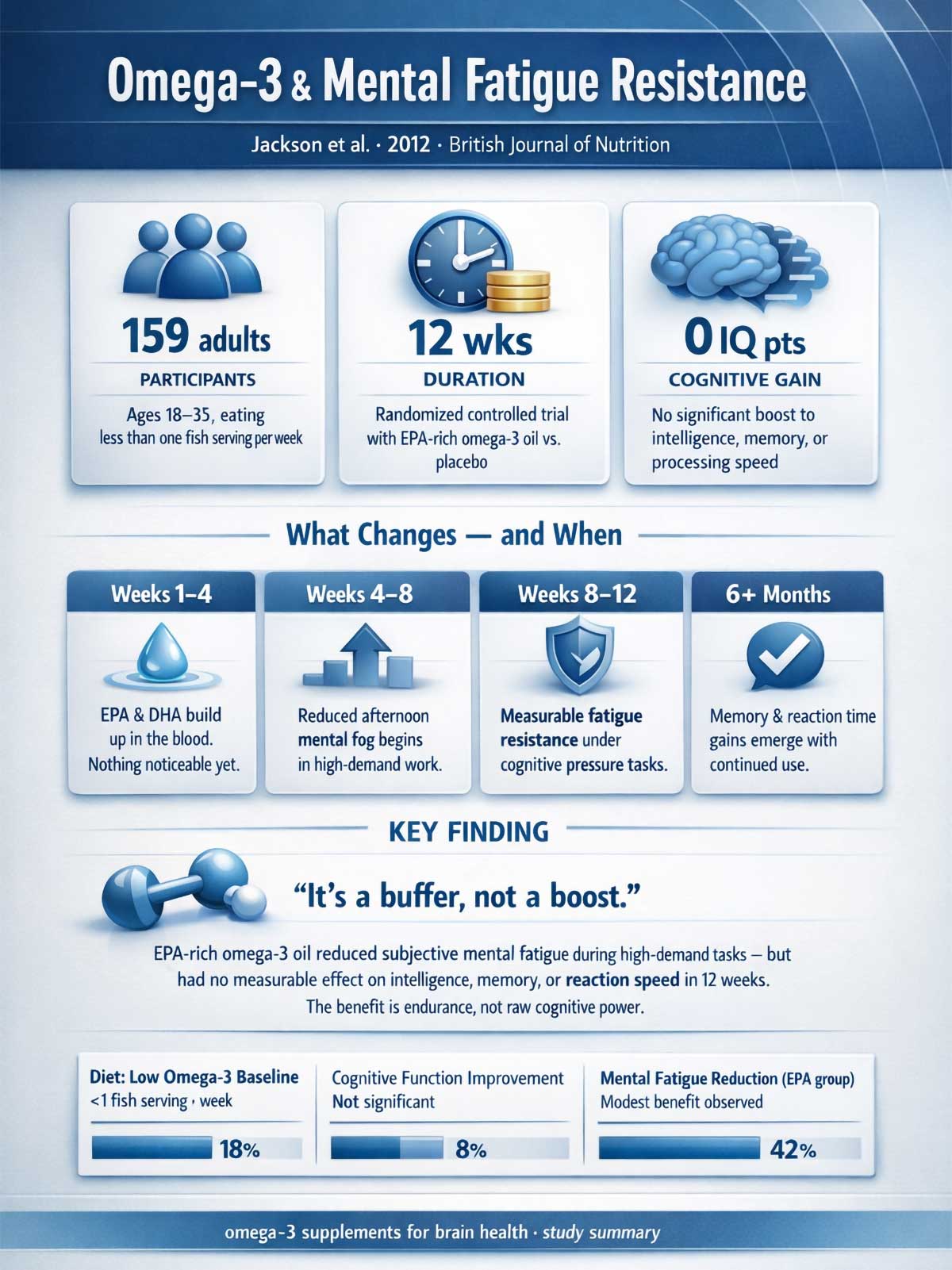
For people whose diets already contain adequate omega-3s, this suggests no meaningful boost to raw processing power in 12 weeks. The one measurable benefit was reduced fatigue under high cognitive demand. That’s an important distinction: the benefit isn’t to intelligence, but to mental endurance and fatigue resistance.
Omega-3s act more like a mental buffer than a mental booster. They help your brain hold up under pressure. Athletes call this kind of benefit “endurance.” For your brain, it means getting through a hard afternoon without feeling wiped out. For anyone doing mentally demanding work, that’s not a small thing.
Why It Works for Your Friend But Not You
You’ve probably heard this before. Someone raves about fish oil. You try it for two months. Nothing happens. Your friend swears their mood improved. You feel exactly the same.
This isn’t in your head. Genetics plays a real role.
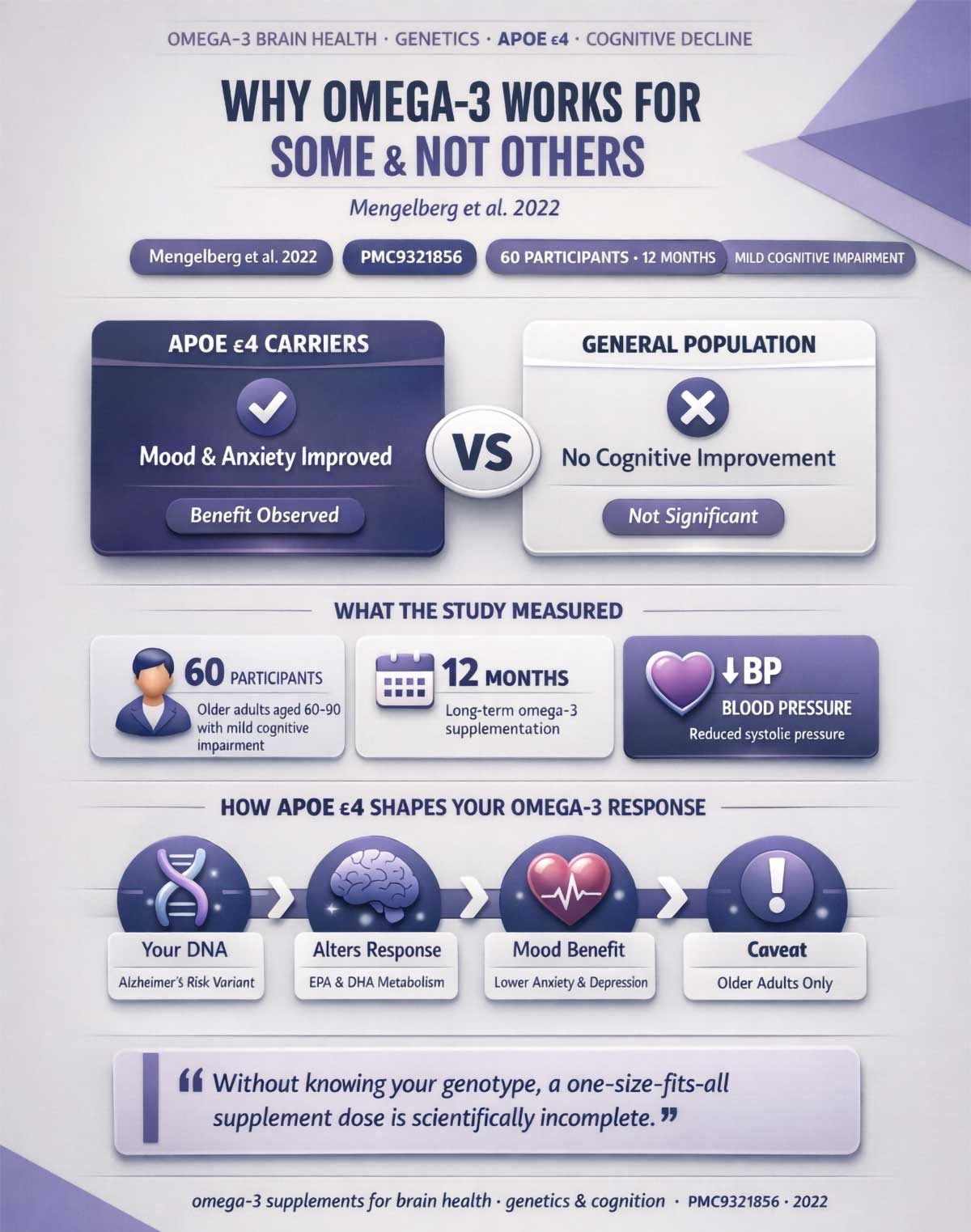
A 2022 study by Mengelberg et al. followed 60 older adults with mild cognitive impairment over 12 months. The researchers found no overall cognitive improvement from omega-3 supplementation. But when they looked at a specific genetic group—people carrying the APOE ε4 gene variant—something different emerged. Those carriers showed measurable reductions in depression and anxiety scores.
The APOE ε4 variant is best known as a risk factor for Alzheimer’s disease. But this study suggests it also shapes how the brain responds to omega-3s, particularly for mood and mental health.
Worth noting: this effect showed up in older adults who already had mild cognitive impairment. Whether it applies equally to younger, cognitively healthy people remains an open question. But it points to a broader truth. Your genetics shape your response to supplementation. A “one-size-fits-all” dose ignores that reality. Without knowing your genotype, you’re working with incomplete information. That’s a conversation worth having with a doctor, not a bottle label.
The Memory Story Takes Longer to Write
If you want the full picture on memory, you need to stay committed much longer than three months. Even the most positive short-term study on this topic required twice the 8–12 week window to show meaningful results.
A 2013 study by Stonehouse et al. put this to the test. Over six months, 176 healthy young adults aged 18–45 took either DHA supplements at 1.16 grams per day or a placebo. The DHA group showed real improvements in both working memory and reaction time compared to the placebo group. That dose—roughly 1–1.5 grams of DHA daily—lines up with what most studies showing benefits have used. It’s worth checking your supplement label against that benchmark.
Six months. Not six weeks.
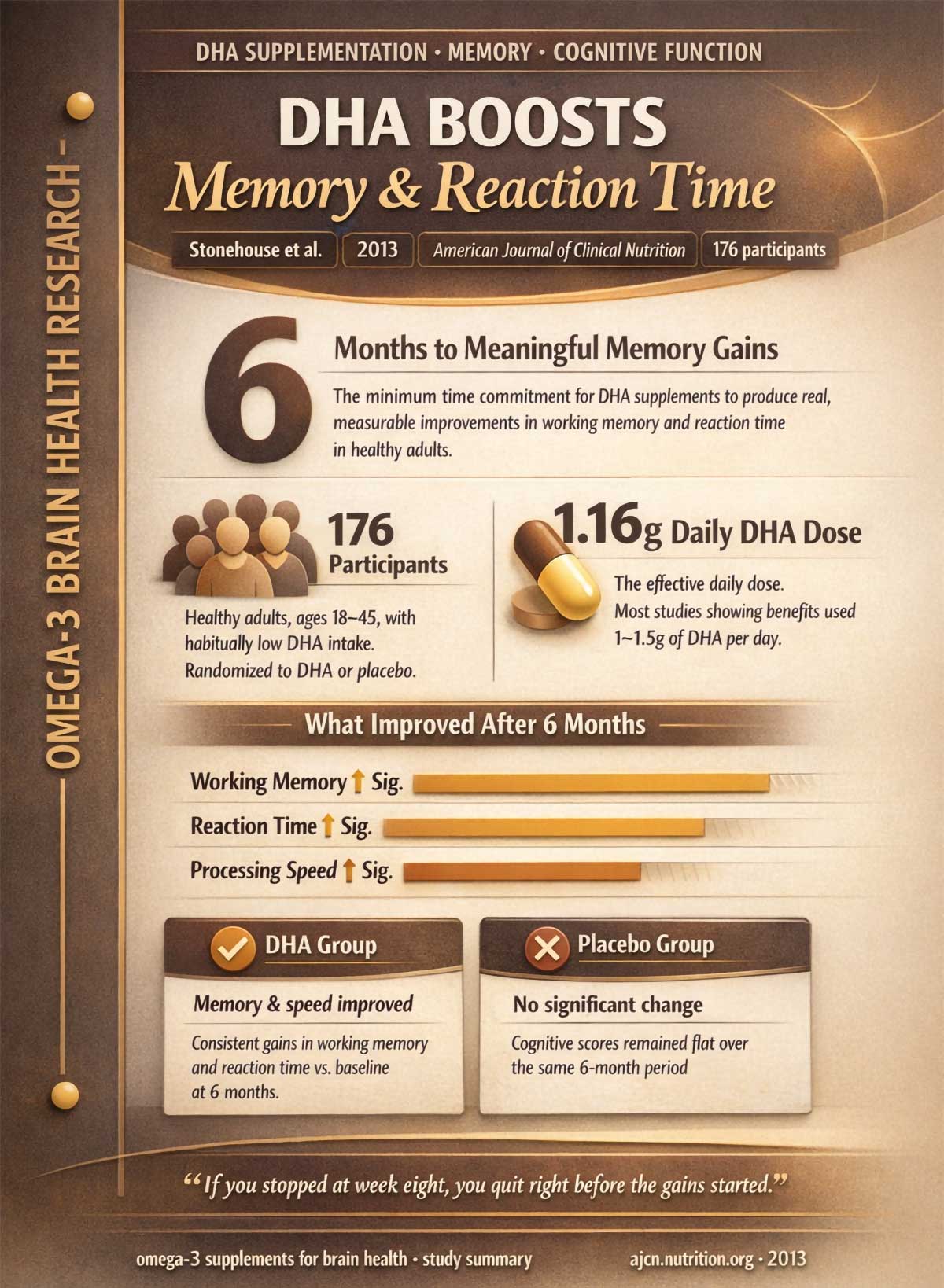
This tracks with how DHA works structurally. It takes time to rebuild cell membranes, improve signal transmission, and change the physical architecture of the brain. Omega-3s are more like a structural renovation than a fresh coat of paint. The results are durable—but they take time to show.
If you stopped at week eight because nothing felt different, you may have quit right before the gains started.
A Side Benefit You Probably Didn’t Expect
Here’s something that rarely gets attention in discussions about omega-3s and the brain: blood pressure.
The Mengelberg study also found a positive effect on systolic blood pressure in participants taking omega-3 supplements. That might seem unrelated to brain health—but it isn’t.
Your brain is one of the most blood-hungry organs in your body. It uses about 20% of your total blood supply. When blood pressure drops and blood flow improves, the brain benefits directly. Better circulation means more oxygen, better waste clearance, and a reduced risk of small vascular injuries that add up over years.
Some of what people call a “brain benefit” from omega-3s may actually be a vascular benefit working through the brain. The two are more connected than most people realize.
Supplements vs. Eating Fish: An Honest Look
Here’s something the supplement industry doesn’t highlight: the most compelling long-term data on omega-3s and brain health doesn’t come from supplement trials at all. It comes from studies of what people eat over decades.
A 2023 meta-analysis by Wei et al. analyzed data from 103,651 participants across 48 studies. People with higher omega-3 intake had roughly a 20% lower risk of all-cause dementia or cognitive decline. The evidence was rated as moderate-to-high quality.
But those findings were tied to long-term dietary patterns—years of eating fish regularly, not months of swallowing capsules. That distinction matters more than most articles acknowledge.
A systematic review by Del Moral et al. (2019) looked at 14 randomized controlled trials of omega-3 supplements and found that 10 of them showed improvements in at least one cognitive area—memory, processing speed, attention, or executive function. But the benefits depended heavily on the population. People with some existing cognitive decline tended to benefit more than healthy adults.
Randomized supplement trials show modest, shorter-term gains. Observational studies of people eating fish for decades show the larger protective picture. A supplement fills a nutritional gap. A fish-based diet builds the foundation.
Think of it this way: a supplement is defensive medicine. A diet built around fatty fish is preventive medicine. One plus one equals more than two—but only if you’re doing both.
Who Actually Benefits Most in 8–12 Weeks
Not everyone responds equally in the short term. Based on the current evidence, here’s where the clearest benefits tend to show up:
People with very low omega-3 intake: If your diet is genuinely deficient—little to no fatty fish—supplementation is most likely to produce noticeable results. You’re filling a real gap.
People doing cognitively demanding work: The fatigue-resistance benefit from the Jackson study is most relevant here. If your job or studies require sustained mental effort, reduced afternoon burnout is a meaningful gain.
People with the APOE ε4 variant and existing cognitive concerns: The mood and anxiety improvements from the Mengelberg study are the most genotype-specific finding in this space. It’s targeted, not universal.
Healthy young adults expecting a cognitive boost: This is where expectations most often outrun the evidence. Short-term gains in raw cognitive performance are minimal for people who are already cognitively healthy and reasonably well-nourished.
Week-by-Week: What to Actually Expect
Here’s a grounded timeline based on what the research actually supports:
Weeks 1–4: Nothing you’ll notice. This is the cellular integration phase. EPA and DHA are building up in your blood and beginning to work their way into your cell membranes. There’s no shortcut through this stage.
Weeks 4–8: You may start to notice less mental fog in the afternoons, especially during high-pressure work. This isn’t dramatic, but it’s the early sign of reduced mental fatigue that the Jackson study pointed to.
Weeks 8–12: Brain imaging tools might detect improved attention and cognitive processing at this stage, as suggested by research in younger populations. Behaviorally, improvements remain subtle. You may notice better focus stamina during demanding work, but standardized cognitive tests are unlikely to show significant gains yet.
Beyond 12 weeks: This is where the Stonehouse data becomes relevant. With consistent daily supplementation past the six-month mark—at roughly 1–1.5 grams of DHA daily—working memory and reaction time show meaningful gains. Combined with a diet rich in fatty fish, the long-term protection picture becomes clearer.
Conclusion
Omega-3 supplements for brain health aren’t a shortcut to being sharper. They’re more like insurance—slow-building, structural, and more powerful the longer you stay consistent.
The real benefit isn’t a boost. It’s a buffer. Omega-3s help your brain handle stress better, resist fatigue more effectively, and hold up against long-term decline more than a brain that’s been depleted of them.
For healthy adults in their 20s and 30s, short-term effects are modest at best. For people with mild cognitive impairment, low dietary omega-3 intake, or specific genetic variants like APOE ε4, the benefits may appear faster and in more targeted ways—particularly around mood, anxiety, and mental stamina.
If you’re thinking of starting: commit to six months if you’re cognitively healthy. Commit longer if you have cognitive concerns. Aim for 1–1.5 grams of DHA daily and pair supplementation with regular fatty fish intake—that combination outperforms either approach alone. And if mood is your main target and you carry genetic risk factors, that conversation belongs with a doctor or registered dietitian.
If you’re expecting to feel like a different person in a month, you’ll be disappointed. But if you’re building your brain’s long-term structure—one day, one meal, one capsule at a time—the evidence says you’re doing something right.
That’s not a small thing. It’s actually kind of the whole point.