You’d never ignore your partner on purpose. But relationship therapists say a specific daily habit signals exactly that, without either of you realizing it’s happening.
Two people at a dinner table. Both present. Both somewhere else entirely. One is typing. The other is watching them type and trying to decide whether it’s worth saying something again.
That moment, that specific, quiet version of being alone in the same room as someone, has a clinical name. Partner phubbing (short for phone snubbing) is what researchers call it when a romantic partner uses or is visibly distracted by their phone during time you’re sharing together. The word sounds almost comic. The research behind it does not.
What makes partner phubbing harder to talk about than other relationship friction is the plausible deniability built into every instance. The phone was for work. It was just a second. Nothing about those explanations is dishonest, exactly, and yet the person on the other side of the table still feels it. That gap between intention and impact is where most of the damage lives.
The Interruption That Doesn’t Feel Like an Interruption
Brandon McDaniel and Sarah Coyne coined the term “technoference” in their 2016 study in Psychology of Popular Media Culture to describe exactly this: the everyday intrusions that technology creates inside couple relationships. Among the 143 married and cohabiting women they surveyed, the majority reported that devices, phones, computers, and TV regularly interrupted their shared time. Mealtimes. Conversations. Leisure. The small daily rituals that couples use to feel like a unit.
What McDaniel and Coyne’s research showed was that these interruptions don’t need to be dramatic to cause real harm. More technoference predicted more conflict over technology use, lower relationship satisfaction, more depressive symptoms, and lower life satisfaction. The mechanism matters: the conflict over tech use came first, and it was that conflict, not the phone use itself, that drove down relationship satisfaction.
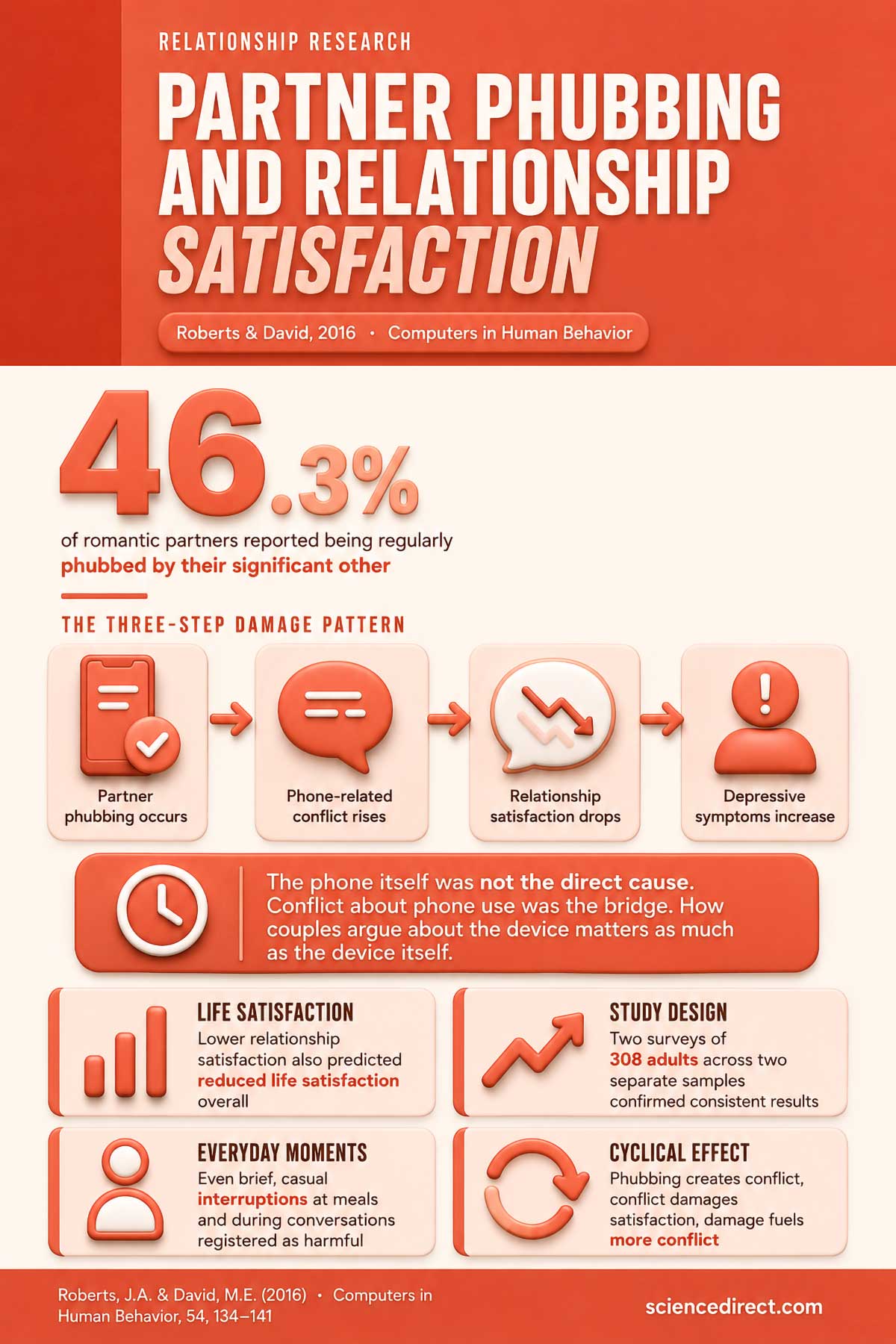
Roberts and David’s 2016 study in Computers in Human Behavior put a number on the extent of this problem. Nearly half of all participants (46.3%) reported being phubbed by their romantic partner. And the pattern those researchers found ran in the same direction as McDaniel and Coyne’s: phubbing triggered phone-related conflict, that conflict degraded relationship satisfaction, and lower relationship satisfaction predicted increased depressive symptoms. A three-step drop, triggered by one person checking a screen.
The Phone Doesn’t Even Have to Be in Use
Here is the part that catches most people off guard. You can put your phone face down on the table, not touch it once during dinner, and it can still affect the quality of the conversation you’re having.
Psychologists Andrew Przybylski and Netta Weinstein tested exactly this in their 2013 study published in the Journal of Social and Personal Relationships. In two experiments, they found that the mere presence of a phone on a table inhibited the development of interpersonal closeness and trust and reduced the empathy people felt from the person they were talking with. The effect was strongest when the conversation was personally meaningful, exactly the kind of conversation partners most need to feel close.
This finding has since had mixed replication results, so it’s worth holding with some caution. Several later studies failed to reproduce the same effect under lab conditions. What appears more consistently is the related “iPhone Effect” documented by Misra and colleagues in 2014 in a naturalistic coffee shop experiment, simply having a mobile device visible during conversation was associated with lower empathetic concern among participants. Whether it’s the physical presence of the device or just the psychological awareness that an alert could pop up at any second, the tax on human connection is real enough to show up in the real world.
Being Phubbed Feels Like Rejection, Because It Is
Chotpitayasunondh and Douglas conducted an experimental study in 2018 that reframed phubbing from a social habit to something closer to social exclusion. Their findings showed that people who were phubbed experienced it as a form of rejection, with interaction quality dropping sharply as a result. This wasn’t a mild inconvenience. It triggered the same psychological responses as ostracism.
The attachment consequences are where it gets genuinely painful. A 2021 paper by David and Roberts in the Journal of Social and Personal Relationships traced how partner phubbing connects directly to romantic jealousy. The loss of eye contact and the withdrawal of presence that comes with phone checking can activate attachment anxieties, leading partners to read the behavior as emotional withdrawal, or something worse. Someone whose attachment style already leans anxious is especially vulnerable to this misread. The phone goes down, but the suspicion doesn’t.
The Loop Nobody Talks About
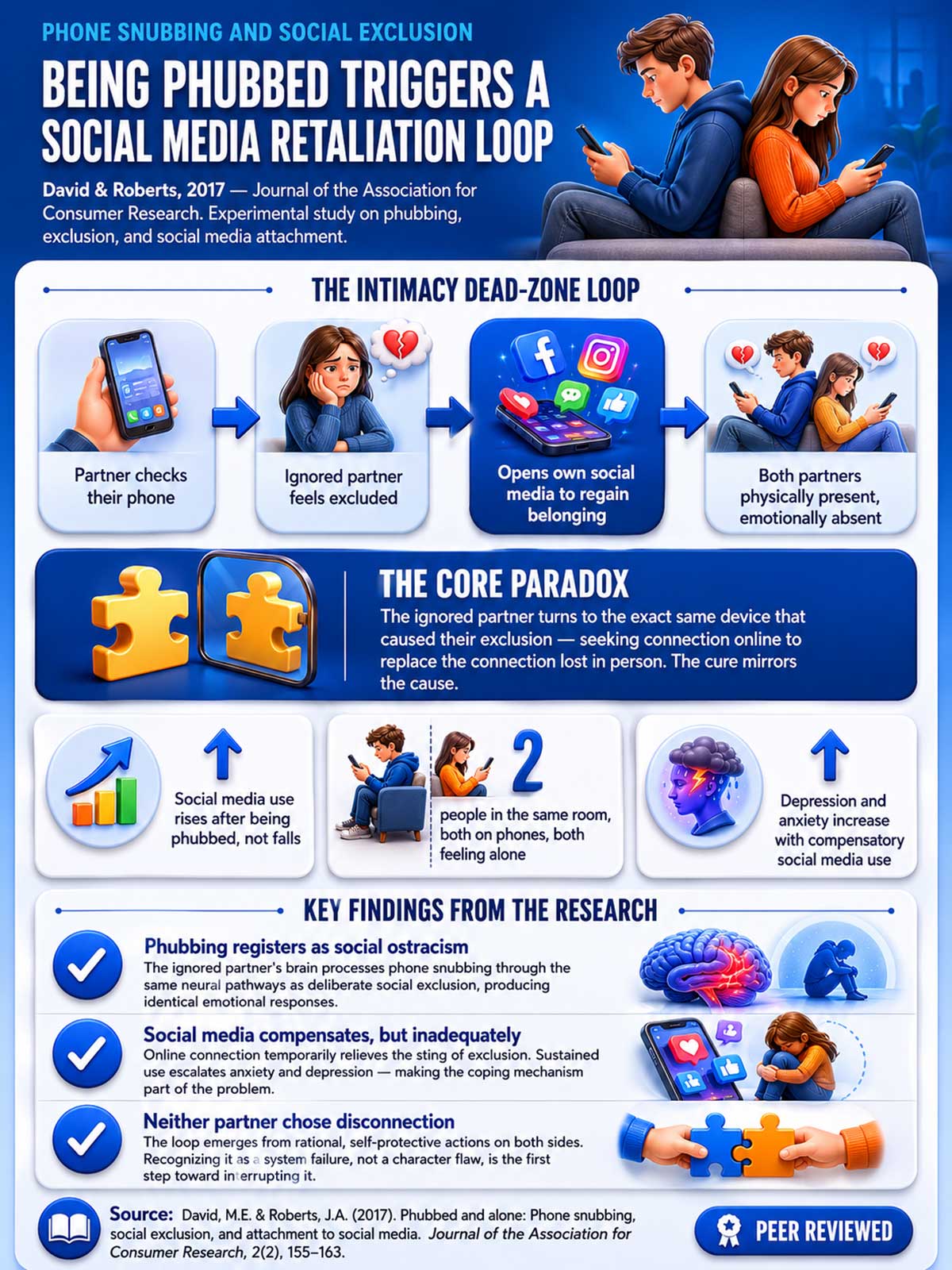
Perhaps the most quietly destructive part of the partner phubbing dynamic is what the ignored person does next. David and Roberts’ 2017 paper, “Phubbed and Alone,” in the Journal of the Association for Consumer Research, found that when people are phubbed, they tend to respond by picking up their own devices. Being excluded drives people toward social media to restore their sense of belonging, even though that same behavior caused the exclusion in the first place.
Two people, sitting together, both on their phones, both feeling alone. Neither of them chose this outcome. Both of them got there through a completely logical sequence of actions. That is what makes the loop so difficult to interrupt. It feels like a mutual drift rather than a choice anyone made.
The Everyday Cost Nobody Measures
Separate from the relationship damage and the attachment spirals, there’s a more mundane cost that accumulates in the background. A 2018 study led by Ryan Dwyer and Kostadin Kushlev at the University of British Columbia recruited over 300 people to share a meal with friends or family at a restaurant. Half were assigned to leave their phones on the table; the other half were asked to put them away.
The phone-present group felt more distracted and consistently reported enjoying the time less. They were in worse moods. And the effect held when the researchers followed up with experience sampling throughout participants’ daily lives: phone use during in-person interactions reliably lowered enjoyment, regardless of setting.
This isn’t about a catastrophic relationship breakdown. It’s about the slow subtraction of pleasure from ordinary shared moments, the Sunday morning coffee, the commute together, the hour before sleep. Multiply that across months and years, and what you lose isn’t one big thing. It’s an accumulation of small ones.
What Actually Reduces the Damage
Relationship therapists working with couples affected by partner phubbing consistently point toward one intervention that the research supports: structural change, not willpower. Deciding to use your phone less rarely survives contact with a notification. Agreeing on specific phone-free windows, mealtimes, the first 30 minutes after both people are home, and the hour before bed, removes the friction from the moment it’s hardest to make.
The evidence on conflict resolution matters here as well. Because the path from phubbing to relationship damage runs through conflict over technology use (not directly through phone use itself), how couples talk about it carries real weight. Framing phubbing as a symptom of disconnection rather than a character flaw creates a different conversation. Saying “I feel like I’m losing you to that thing” lands differently than “you’re always on your phone.”
For partners dealing with attachment-driven jealousy responses, where the phone checking reads as something hidden or emotionally withdrawing, therapy that addresses the underlying anxiety directly tends to be more effective than negotiating phone rules alone. The rules help. They don’t reach the root.
A Note on the Research
There’s a reasonable argument that phubbing is simply what proximity looks like now, that the phone is just another presence in a relationship, like a TV or a book, and that couples who struggle with it are struggling with something older than the device. That argument is coherent. It’s also, based on the available evidence, wrong.
What distinguishes partner phubbing from other competing demands on attention is that the phone carries an entire social world inside it, including other people, other conversations, other versions of connection, and its presence signals all of that, whether or not you mean it to. A book doesn’t make your partner wonder who you’re talking to.