You don’t procrastinate because you don’t care. You procrastinate because your brain is protecting something far more important than a deadline.
You finish big projects. You lead teams. People rely on you, and you deliver. Yet here you are at 11:00 PM, staring at a blank screen, the same screen you avoided all day. The deadline is tomorrow. Your stomach is in knots.
This isn’t laziness. It isn’t poor time management. It’s something far more specific — and far more common among high achievers than most people realize. There’s a psychological pattern at work here, one that standard productivity advice doesn’t just fail to fix. It actually makes it worse.
Let’s talk about what’s really going on.
But first, an important distinction. Research draws a line between two groups. On one side are truly high performers who don’t actually procrastinate — they work differently under pressure, plan with intention, and feel in control. On the other side are high-achieving perfectionists: people with strong track records and visible success who delay anyway, despite their capability. Chowdhury and colleagues highlighted this separation, noting that the delay pattern isn’t about performance level — it’s about identity fusion. It affects people whose sense of worth is tightly bound to their output. That’s who this article is for.
When “Productive” People Can’t Start
Most articles on procrastination patterns treat delay as a discipline problem. They assume you lack structure, motivation, or a good enough planner. So they hand you a Pomodoro timer and tell you to “break tasks into smaller steps.”
If you’re a high achiever, you’ve probably tried this. And you’ve probably noticed it doesn’t work — or worse, it makes you feel more anxious.
That’s not a coincidence. It’s a clue.
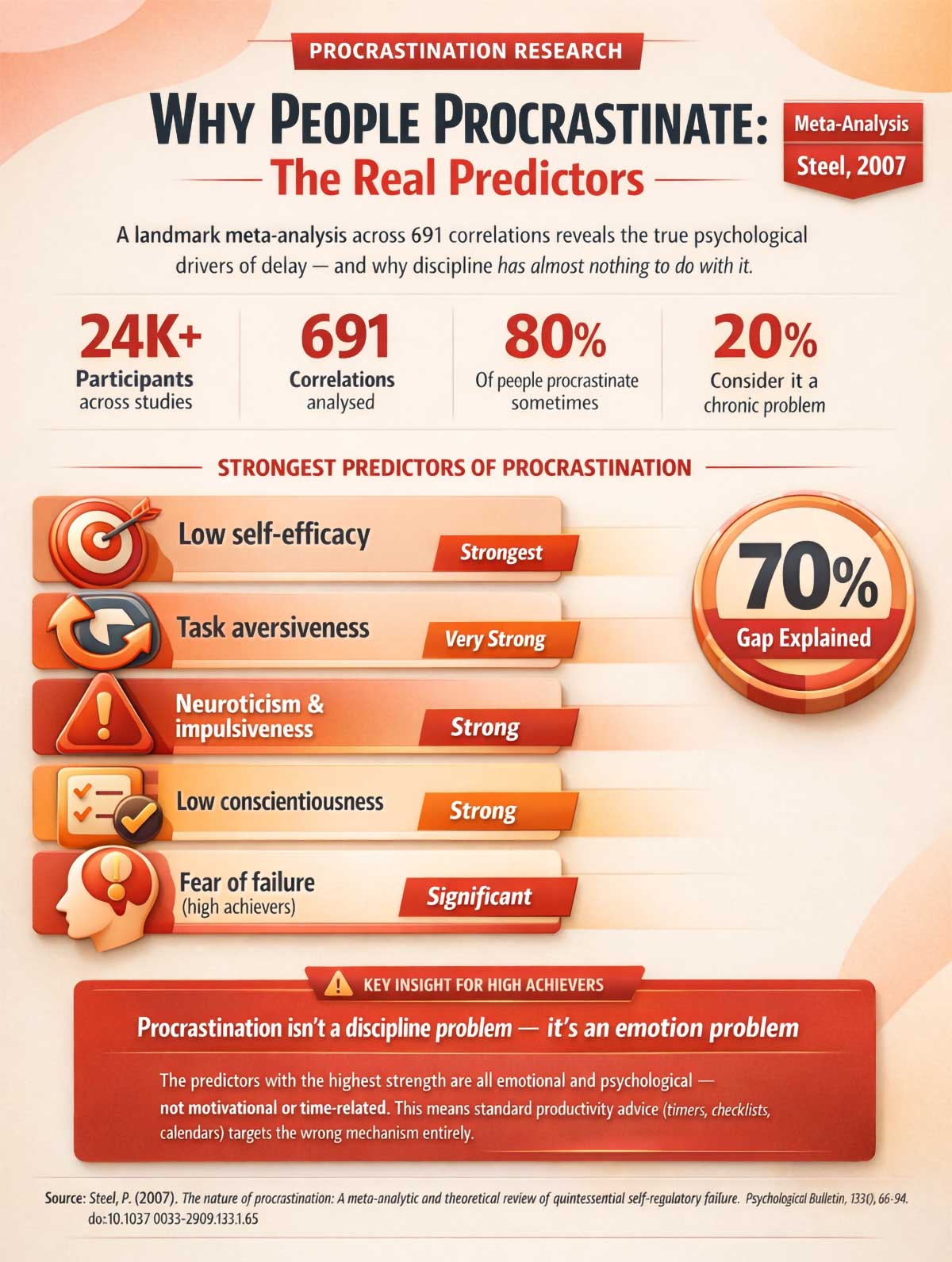
A landmark 2007 meta-analysis by Steel, covering over 24,000 participants across 691 correlations, found that procrastination correlated most strongly with neuroticism, low self-efficacy, impulsiveness, and low conscientiousness — not discipline or motivation. For high achievers specifically, fear of failure and evaluation anxiety emerge as distinctive drivers. That’s because their reputations and identities are more visibly tied to outcomes.
When your sense of worth is bound to what you produce, starting a task isn’t just starting a task. It feels like stepping into a test you might fail.
The Identity Shield: Why High Achievers Delay
Here’s the core mechanic driving procrastination patterns in high performers.
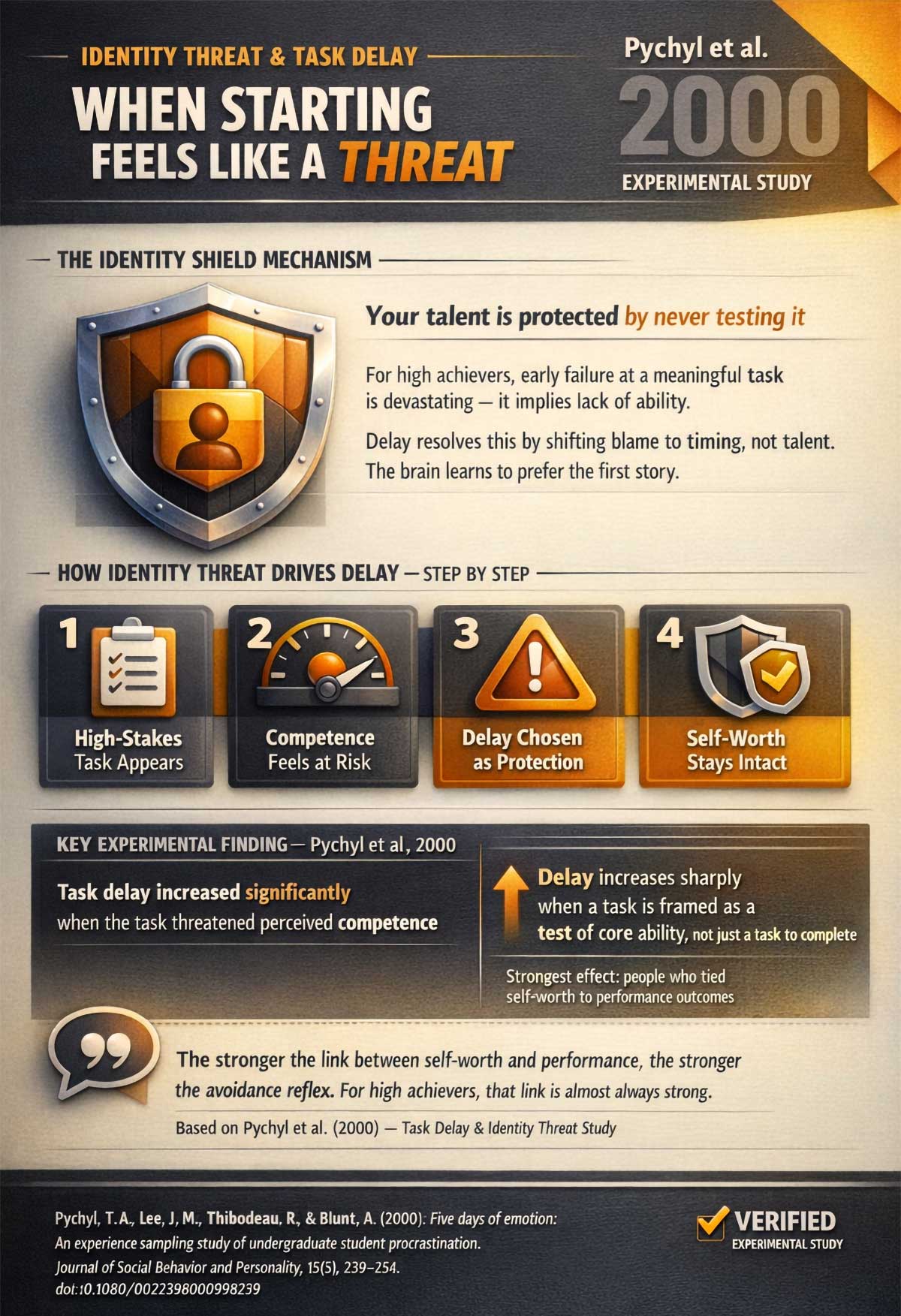
If you start a project early and it turns out poorly, what does that say about you? In your mind, it might suggest you lack the ability. But if you start at the last minute and it turns out poorly? You can blame the time pressure. Your talent stays protected.
This is what researchers call an “identity shield.” The delay isn’t random — it’s strategic, even if it’s not conscious. By waiting, you preserve a story where your potential is still intact, untested, and safe.
Pychyl and colleagues demonstrated this in a 2000 study on task delay and identity threat. They found that people were significantly more likely to delay when a task threatened their sense of competence. The stronger the link between self-worth and performance, the stronger the avoidance reflex. For high achievers, that link is almost always strong.
So the delay isn’t weakness. It’s a defense mechanism — one that protects your self-image at the cost of your performance.
The Emotion Behind the Avoidance
It’s worth saying plainly: procrastination is not a time management problem. It’s an emotion management problem.
Sirois and Pychyl made this case clearly in their 2013 review. They found that procrastination functions as a short-term mood repair strategy. When a task creates anxiety, frustration, or self-doubt, the brain looks for relief. Scrolling, reorganizing your inbox, watching one more video — these all feel better right now than sitting with the discomfort of an unstarted task.
The problem is that relief is temporary. Twenty minutes later, the task is still there. And now there’s guilt on top of the anxiety.
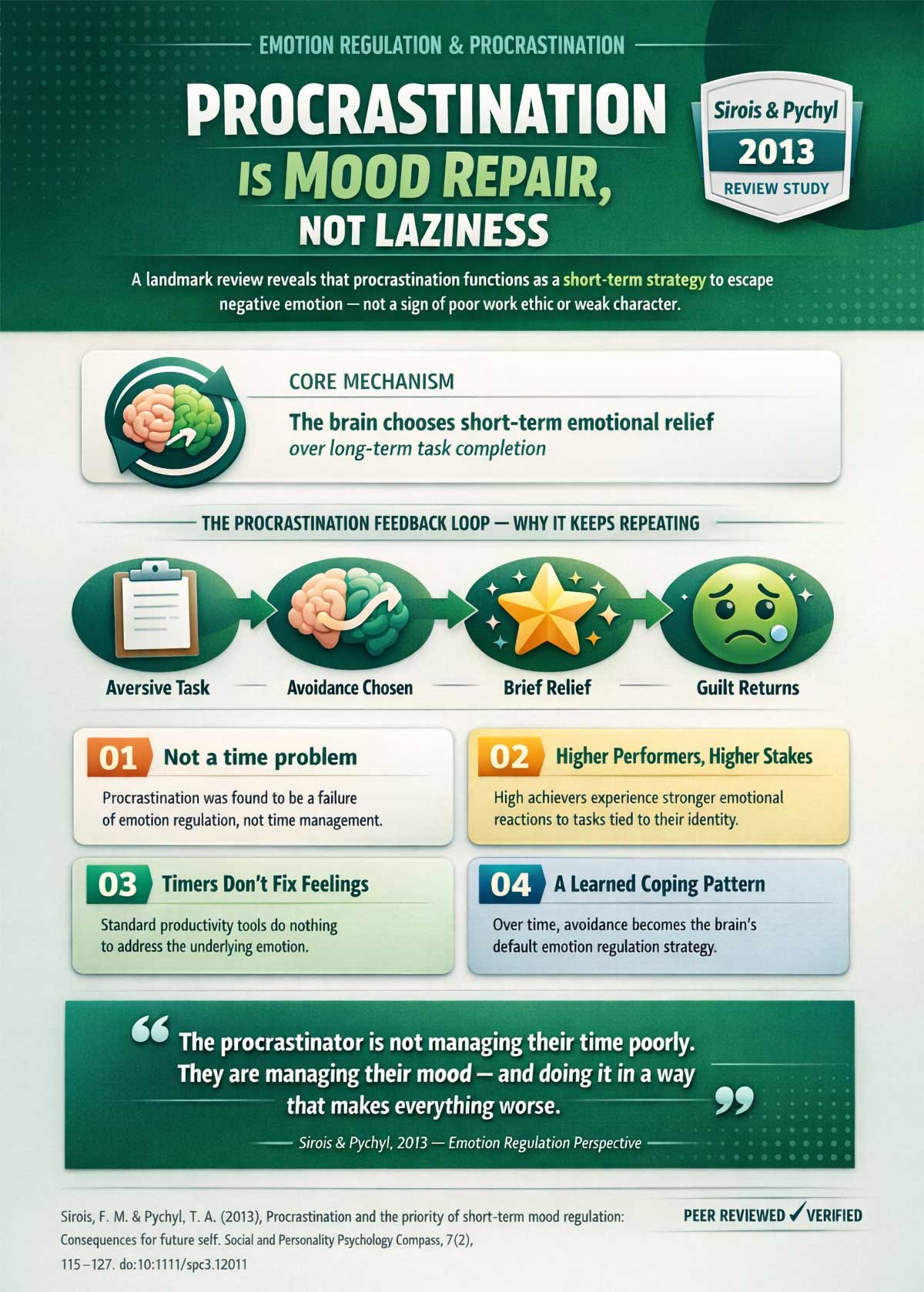
This feedback loop is central to understanding why high performers get stuck. They’re not avoiding the task itself. They’re avoiding the feeling the task creates. This creates what researchers call an avoidance coping cycle: when a task triggers negative emotion, the brain learns to distract rather than sit with the discomfort. Over time, avoidance becomes the default emotion regulation strategy — and it’s one that no calendar or timer can interrupt. Standard productivity systems — timers, checklists, calendar blocks — don’t address feelings. They address minutes.
5 Procrastination Patterns Unique to High Achievers
Not all procrastination looks the same. High performers tend to fall into specific patterns that are easy to miss — because from the outside, they often look like productivity.
1. The High-Stakes Simulation
You don’t start working until the fear of the deadline outweighs the fear of the task. You create an internal crisis to force focus. The pressure of 48 hours until submission feels like the only thing strong enough to override the anxiety of beginning.
This works — until it doesn’t. The quality suffers. The stress accumulates. And each time you use this pattern, you need a bigger crisis to get the same result.
2. The Productive Side-Quest
You spend two hours color-coding your files, clearing your inbox to zero, or reorganizing your bookmarks. You feel busy. You feel accomplished. But the one project that actually matters hasn’t moved an inch.
This is avoidance dressed up as productivity. It’s not rest — it’s strategic distraction. It’s particularly common in high achievers because it doesn’t feel like procrastination. It feels like preparation.
3. The Polished-to-Death Loop
You spend four hours on the font choice for a presentation slide deck because the actual content — the argument, the ideas, the thing that exposes your thinking — feels too vulnerable to commit to paper.
Perfectionism shows up here as a gatekeeper. The real task gets blocked by endless refinement of the surface layer. Research by Stoeber and Otto in 2006 drew a sharp line between two types of perfectionism: the kind that drives growth and the kind that drives avoidance. High achievers with rigid standards and a wide gap between expectations and performance sit squarely in the second group — and show the highest risk of chronic delay.
4. Socially Prescribed Pressure
This pattern isn’t about your own standards. It’s about theirs.
Research by Flett, Hewitt, and colleagues dating back to 1992 identified three subtypes of perfectionism. The most damaging one — socially prescribed perfectionism — is when you believe others hold impossibly high standards for you. The procrastination here isn’t fear of your own judgment. It’s fear of public failure, of letting others down, of not living up to a reputation.
This form is particularly toxic because the source of pressure is external. You can’t simply “lower your standards” to fix it. The expectations feel like they come from outside your control.
5. The Mood Repair Loop
You wake up feeling off. The task feels heavy before you’ve even opened your laptop. So you give yourself “just a few minutes” to decompress — and those few minutes turn into an afternoon.
This is the maladaptive mood repair cycle. The task creates a bad mood. The bad mood justifies avoidance. The avoidance creates guilt. The guilt creates a worse mood. And the cycle deepens.
Sirois’s 2014 research on procrastination and avoidance coping confirmed this loop directly. People with high performance expectations and emotional regulation difficulties were most likely to use avoidance as a coping tool — and most likely to suffer the consequences of that choice over time.
Why Standard Productivity Advice Works Against You
The most popular procrastination fixes are built for a different kind of person. Here’s why they often backfire for high achievers.
The “Break It Down” Fallacy
This advice sounds reasonable. A big project is overwhelming, so divide it into 20 smaller tasks.
But for a perfectionist, 20 smaller tasks means 20 smaller opportunities to fall short. Each item on the list becomes a judgment point. Instead of reducing anxiety, the list multiplies it. The cognitive load goes up, not down.
A 2025 systematic review by Chen, looking at maladaptive perfectionism in students, confirmed that fear of failure combined with rigid standards and self-worth tied to outcomes strongly predicts procrastination. Structural interventions alone — like task-breaking — don’t address the underlying cognitive patterns or emotion regulation deficits that drive the delay. Only approaches targeting those emotional drivers directly, such as cognitive restructuring, mindfulness, and self-compassion, showed measurable reduction in procrastination.
The Time Management Myth
You probably know how to use a calendar. You know how to block time. The issue isn’t scheduling — it’s that when you sit down in that blocked time, the feelings are still there. The anxiety doesn’t check your calendar.
Treating a mood regulation problem with a time management solution is like treating a broken leg with a bandage. The structure is wrong for the problem.
The “Active Procrastinator” Trap
You may have come across the idea that some people actually thrive as procrastinators — that working under pressure is a personality type, not a flaw. Chu and Choi’s 2005 research did identify what they called “active procrastinators”: people who delay deliberately, maintain high self-efficacy, and still deliver strong results.
Here’s the important distinction. Active procrastinators in that research chose to delay and felt confident doing so. They didn’t lie awake the night before. They didn’t spiral.
That’s a very different experience from the high-achiever who delays because starting feels like a threat. Labeling anxious delay as “active procrastination” can actually be harmful — it normalizes a pattern that’s causing real psychological cost. Chowdhury and colleagues questioned the framing directly, suggesting that truly high performers may not actually procrastinate at all — they plan differently. The anxious high achiever who delays isn’t an “active procrastinator.” They’re a perfectionist in distress. And the pattern, over time, leads to what researchers call high-functioning burnout: sustained output with rising internal cost.
An Emotion-First Way Out
If the problem is emotional, the solution has to be emotional too. Here’s a framework that works with your psychology rather than against it.
Step 1: Uncouple Your Output From Your Worth
The identity shield exists because your brain has connected what you produce with who you are. That connection needs to weaken.
This isn’t about low standards. It’s about recognizing that a flawed draft doesn’t define your intelligence, and a late start doesn’t mean you’re lazy. Your value as a person is not on the line every time you open a document.
Practice naming the belief out loud when it appears: “I’m delaying because I think a bad result will mean I’m not capable.” Naming it takes some of its power away. Cognitive defusion techniques — drawn from Acceptance and Commitment Therapy — work well here, helping you observe the thought without being controlled by it.
Step 2: The Minimum Viable Mess
Instead of aiming for quality in the first session, set a goal of volume. Write badly on purpose. Produce a rough version that no one will ever see. The goal of the first 15 minutes is simply to put words on a page — not good words, not final words, just words.
This approach bypasses the perfectionist gatekeeper. Once something exists on the page, it’s far easier to improve it than it was to start it. The blank screen is the enemy. A messy draft is raw material.
This is the most practical application of what the research points to: reduce the emotional threat of beginning by lowering the stakes of the first attempt.
Step 3: Compassion After a Wasted Morning
This one sounds counterintuitive, but it’s backed by evidence.
When you spend a morning in avoidance and guilt, the worst response — though the most instinctive — is self-criticism. “I wasted the whole morning. I’m terrible at this. I have no discipline.” That internal narrative increases negative emotion, which increases the urge to avoid further, which extends the cycle.
Chen’s 2025 review specifically listed self-compassion as one of the evidence-based interventions for perfectionist procrastination. Being kind to yourself after a difficult morning isn’t giving up on standards. It’s the only psychological path to a productive afternoon. Harsh self-judgment creates the exact emotional conditions that made you avoid the task in the first place.
Step 4: Reframe the Task as Data, Not a Test
High achievers delay tasks that feel like evaluations. So stop treating them as evaluations.
A first draft isn’t a test of your writing ability. It’s data — information about what you think, what’s missing, what needs development. A rough presentation isn’t a judgment of your expertise. It’s a first pass you’ll iterate on.
This reframe shifts the task from “prove yourself” mode to “explore and gather” mode. The pressure drops. The start becomes easier. Over time, this mental shift can genuinely reduce the frequency and intensity of delay.
A New Protocol for High Performers
The changes above are internal. But there are practical habits that support them.
One note before we go further: if you have ADHD or significant executive function challenges, these patterns look different. The emotion regulation strategies here can help, but you may also need external structure or medical support. This article focuses on procrastination driven by perfectionism, not neurodevelopmental delay.
Mood-map your schedule. Instead of time-blocking tasks purely by clock, notice your emotional capacity throughout the day. Most people have a narrow window — often in the morning — when their anxiety is low enough to tackle high-stakes creative work. Guard that window fiercely. Don’t fill it with email.
Use the Five-Minute Forgiveness rule. When you catch yourself in a procrastination spiral, stop. Spend five minutes acknowledging what happened without judgment. Then deliberately choose your next action. This interrupts the guilt-avoidance loop before it consumes the rest of the day.
Choose “good enough” on purpose. A B+ deliverable submitted on time almost always outperforms an A+ deliverable submitted late or under burnout conditions. The best performers know when to stop refining and start delivering. This isn’t settling — it’s strategy.
These aren’t productivity hacks. They’re emotion regulation tools dressed in practical clothing. That’s what actually moves the needle for high achievers.
There’s a reason emotion-first approaches aren’t the standard advice. They don’t scale easily. You can hand 10,000 people a Pomodoro timer. Teaching someone to manage an identity threat takes self-awareness and nuance. But for perfectionistic high achievers, it’s the only approach that addresses what’s actually causing the delay.
It’s also worth noting that most research on this topic comes from student populations. The underlying mechanism — identity threat tied to output — shows up consistently across ages and fields, but the specific triggers and patterns may look different in your context.
What’s Really at Stake
The procrastination patterns that trip up high performers are invisible to most of the people around them. You still deliver. You still perform. The damage is internal — the stress, the burnout, the quiet dread that follows you from project to project.
Understanding the real mechanism changes everything. Delay isn’t a character flaw. It’s a symptom of high standards operating without emotional support. The brain is trying to protect you. It just chose the wrong strategy.
By shifting from managing time to managing emotion — by naming the identity threat, lowering the stakes of starting, and responding to setbacks with self-compassion rather than judgment — you can break the cycle.
Not by becoming a different person. By understanding the one you already are.