Stress isn’t won or lost over months of habits. It’s decided in a 90-second window most people don’t even know they have.
You’ve probably heard the usual advice. Sleep more. Build a support network. Practice gratitude. Stay positive. It’s solid guidance, but it misses something critical.
Most people try to manage stress after they’re already deep in it. By then, the brain has taken over and rational thinking is harder to reach. The research points to a different strategy, and it starts much earlier than most people think.
The Myth of the Stress Sponge
We tend to admire people who seem to “take it all in stride.” We call them resilient and assume they were born with a thicker skin. But that framing is off.
Mental resilience isn’t about how much pressure you can absorb. It’s not a badge earned through years of suffering. And it’s not reserved for elite athletes or soldiers.
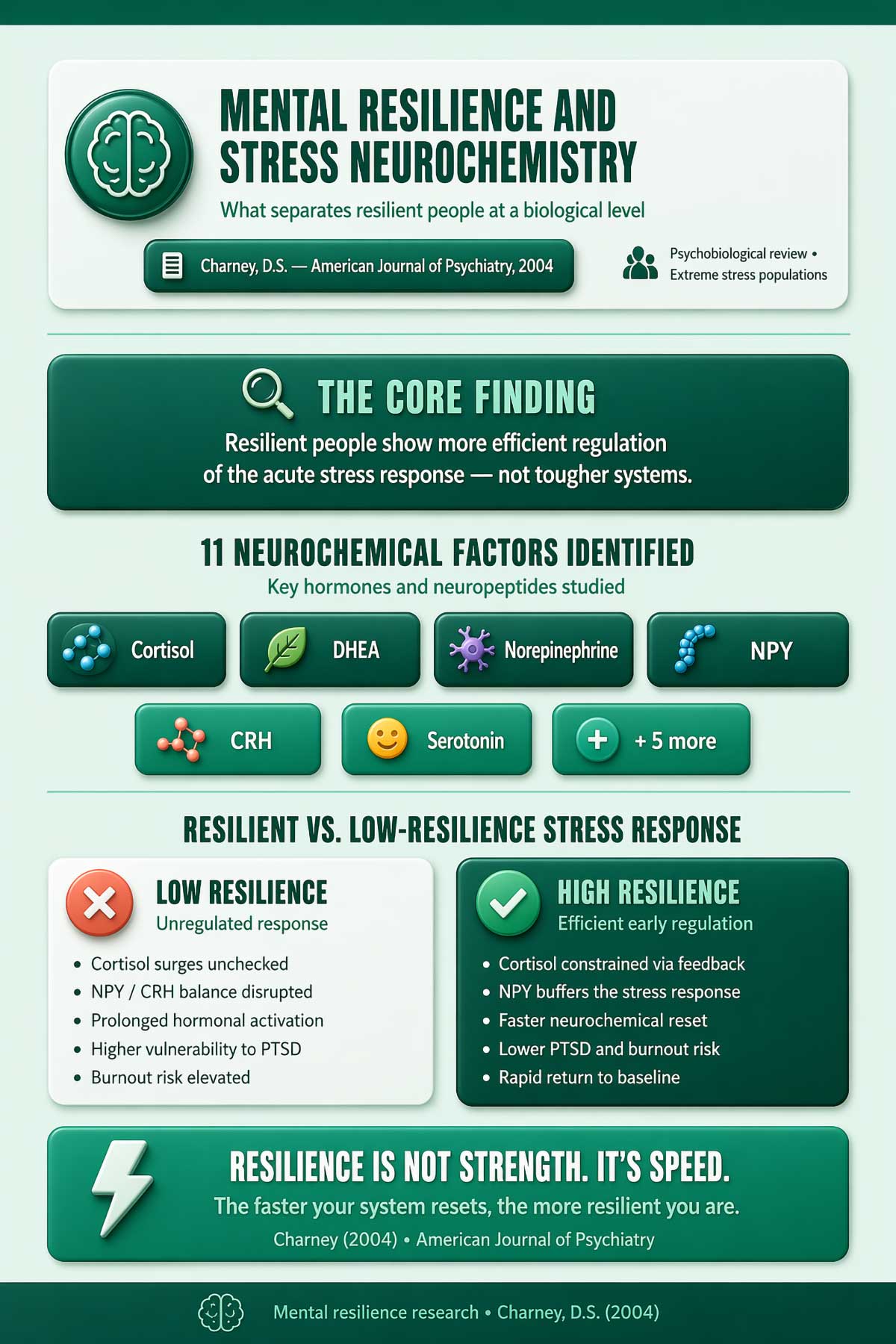
Psychobiological research by Charney (2004), published in the American Journal of Psychiatry, identified 11 neurochemical and hormonal factors linked to resilience versus vulnerability. The through-line was regulatory efficiency: resilient people show a better-controlled acute stress response, constraining excessive hormonal surges rather than letting them run unchecked. What sets them apart isn’t toughness. It’s the efficiency of their regulation.
The stress response itself isn’t the enemy. Your body’s built-in alarm system is an ancient, finely tuned survival tool. The problem is that modern life keeps triggering short-term alarms for long-term situations.
Why Your Brain Hasn’t Caught Up Yet
Think about what stress was designed to do. A predator appears. Your body floods with hormones. You run or fight. The threat passes. Your system resets.
Robert Sapolsky (2004), in his widely referenced book “Why Zebras Don’t Get Ulcers,” explains that the stress response evolved as a rapid, time-limited survival system. When it’s activated repeatedly, or held open unnecessarily, that same cascade starts causing cumulative physical damage.
The zebra runs from the lion, escapes, and goes back to grazing within minutes. Humans, however, replay the email argument from last Tuesday for the next three days. That prolonged re-activation is where chronic stress does its damage.
The good news is you have a natural off-switch. You just need to know when and how to use it.
The 90-Second Window That Changes Everything
Here’s the key insight that most resilience advice overlooks entirely.
When a stressor hits, your brain triggers a chemical flood that moves through your body. Neuroanatomist Jill Bolte Taylor, drawing on her own stroke recovery and decades of brain research, observed that the chemical component of an emotional reaction lasts roughly 90 seconds. It’s worth being precise here: that 90-second window refers to the initial neurochemical flush, not the full physiological stress arc. Hormones like cortisol take considerably longer to clear the system. But the triggering wave, the acute emotional chemistry, passes in about that time. After that window closes, if you’re still feeling stressed, it’s because you are actively re-triggering the stimulus through your thoughts.
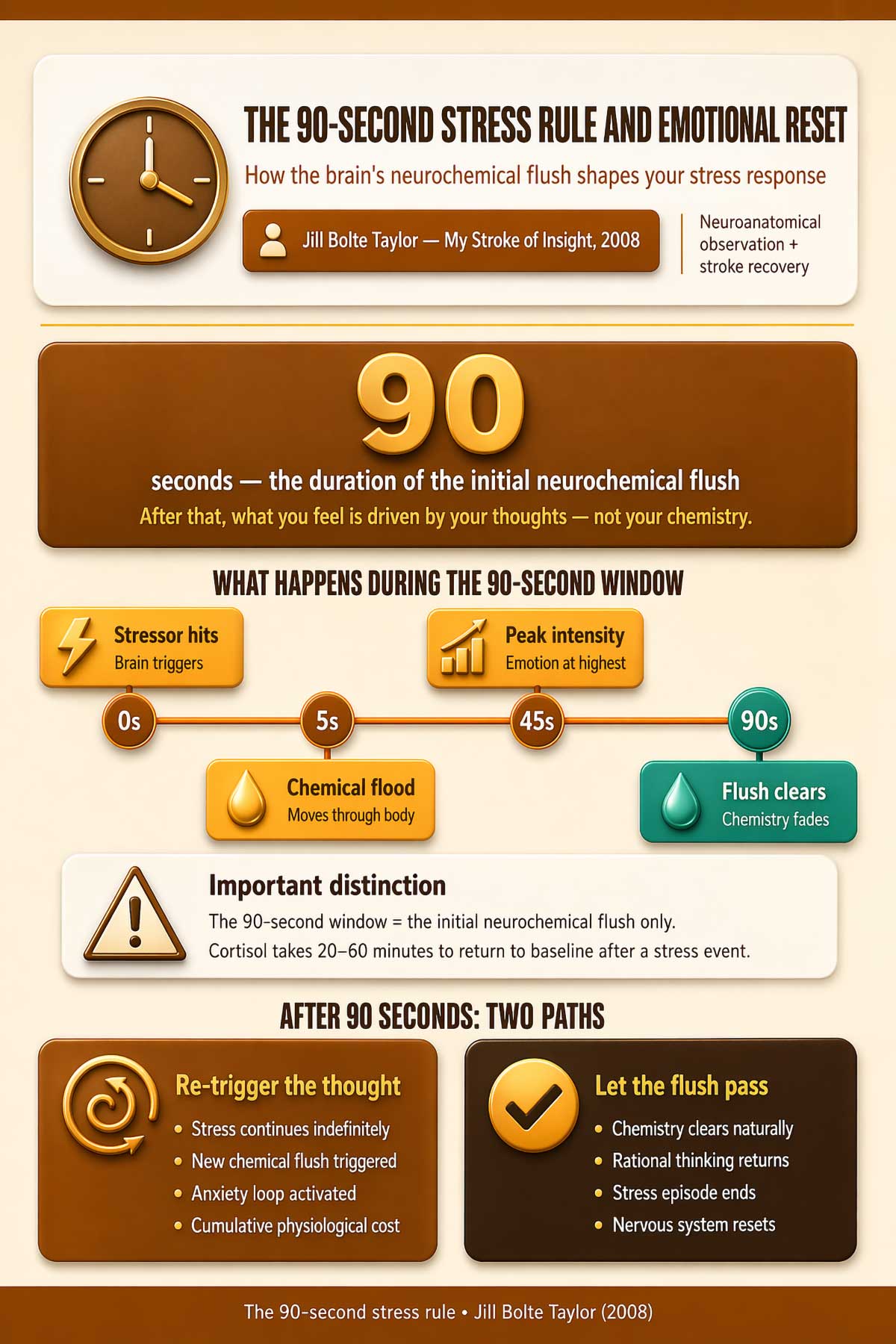
Read that again. After 90 seconds, the raw chemistry of the stress reaction fades. What keeps it going is the story you’re telling yourself about it.
This creates a window. A brief but real opening where you can interrupt the cycle before it snowballs.
The most practical thing you can do in that window isn’t to suppress the feeling or try to “calm down.” It’s simply to let the 90 seconds pass without adding a narrative to it. Don’t fight the sensation. Don’t catastrophize it. Clock it. Breathe through it. Let the chemistry do what it does.
That single shift can change whether the next 90 minutes feel unmanageable or workable.
Start Early, Not Late (This Is Where Most People Go Wrong)
Most people try to manage their emotions after the wave has already crested. That’s like trying to stop a sneeze after it’s already started.
Psychologist James Gross has studied emotion regulation for decades. His 1998 process model showed that early-stage regulation strategies are significantly more effective than late-stage ones. The model drew on both theoretical work published in the Review of General Psychology and experimental findings from a companion study in the Journal of Personality and Social Psychology. Strategies used before an emotional peak reduce both the subjective distress and the physical cost. Strategies applied after the peak, particularly suppression, actually increase physiological strain.
His 2002 experimental work went further. Reappraisal applied early on reduces distress and physiological arousal. Suppression applied late raises the physical cost and has negative social consequences.
The practical application is straightforward. In the first few seconds after a stressor hits, name what you’re feeling. Not in a dramatic, drawn-out way. Just a quick internal label. “This is frustration.” “This is fear.” “This is pressure.”
Neuroscientists Ochsner and Gross (2005) reviewed brain imaging studies and found that this kind of early cognitive engagement activates the prefrontal cortex and dials down the amygdala, the brain’s fear center. You’re using the logical part of your brain to influence the emotional response before it fully takes hold.
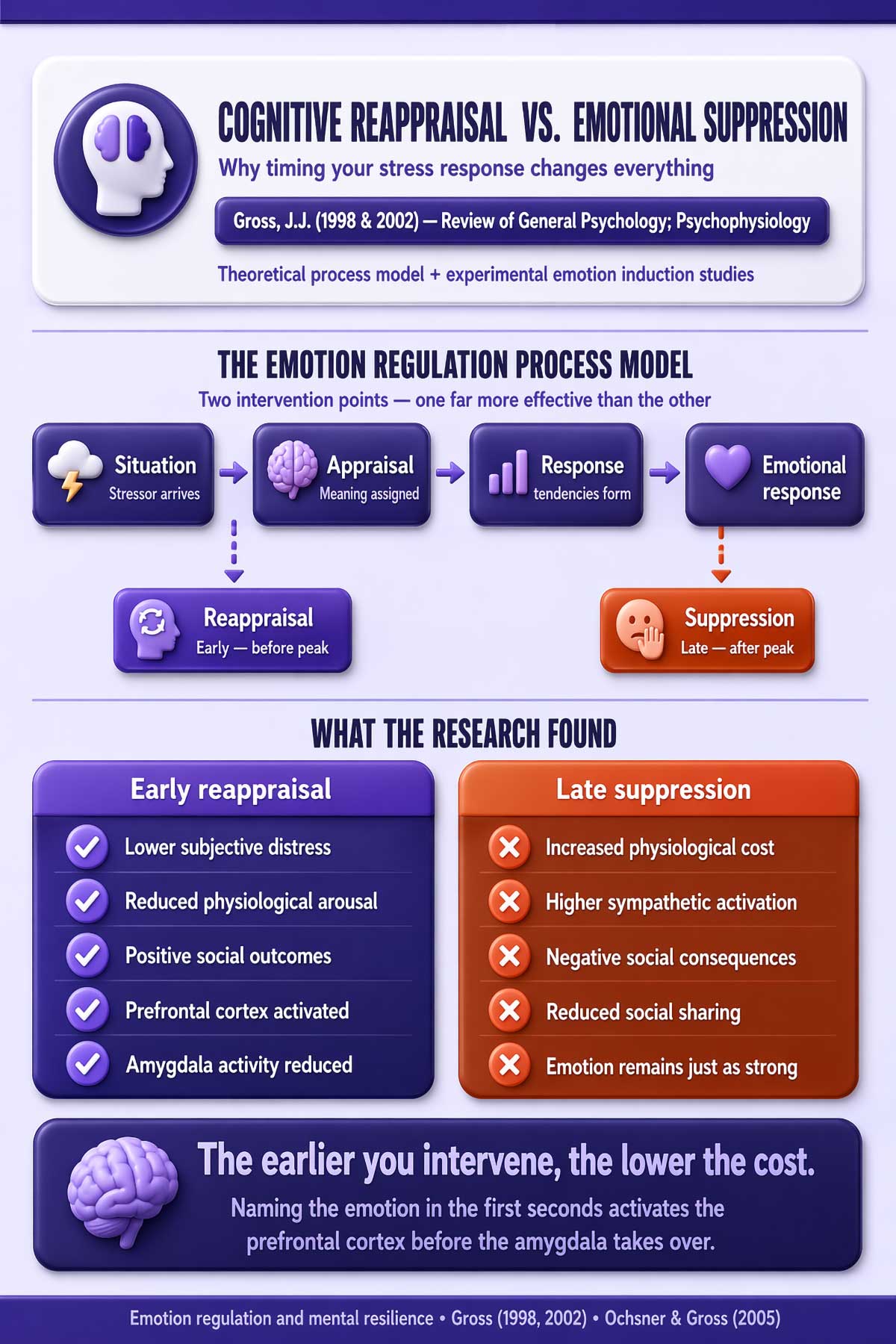
This is early reappraisal. It’s one of the most well-supported emotional regulation tools in psychology, and almost no one is using it in time.
Your Body Is Sending You False Alarms
Your chest tightens. Your heart rate jumps. You feel slightly short of breath. Most people interpret these signals as signs that something is wrong or that they can’t cope.
That interpretation is the problem, not the sensation itself.
A 2016 neuroimaging study by Haase and colleagues, published in Biological Psychology, found that low-resilience individuals show exaggerated early brain responses to aversive bodily signals. The intensity of the physical sensation itself was not significantly different between groups. What differed was the neural response: low-resilience individuals showed greater brain activation to the same stimulus, pointing to a mismatch between bodily awareness and neural processing that amplifies the stress experience from the inside.
High-resilience people read the same physical signals differently. A pounding heart becomes “readiness.” Shallow breathing becomes “alertness.” Tight muscles become “activation.”
The tool here is a quick body scan. When you notice physical arousal from stress, don’t diagnose it as panic. Try asking instead: “What is my body preparing me for?” Recognizing physiological arousal as biological readiness, rather than impending failure, shifts the entire experience.
This isn’t positive thinking. It’s accurate thinking. Your body is doing exactly what it was designed to do.
Anxiety and Excitement Use the Same Biology
There’s a well-known idea in psychology called stress reappraisal, and the research behind it is striking.
A 2012 study by Jamieson, Nock, and Mendes, published in the Journal of Experimental Psychology: General, put participants through a social stress task. Those who were coached to interpret their arousal as functional, rather than harmful, showed better cardiovascular efficiency and stronger cognitive performance under pressure. Their bodies were working with the stress rather than against it.
This builds on foundational work from Lazarus and Folkman (1984), who found that the impact of stress depends more on how an event is appraised than on what the event actually is. Two people can face the same situation and have entirely different psychological and physical experiences based on the story they assign to it.
A series of studies by Crum, Salovey, and Achor (2013), published in the Journal of Personality and Social Psychology, found that people who held a “stress-is-enhancing” mindset reported better health, wellbeing, and work performance in correlational research, and that this mindset could be shifted through brief interventions. In a laboratory study within the same paper, a stress-enhancing mindset was linked to more optimal cortisol reactivity and a greater desire for feedback under pressure, suggesting that how we frame stress shapes both our biology and our motivational response to it.
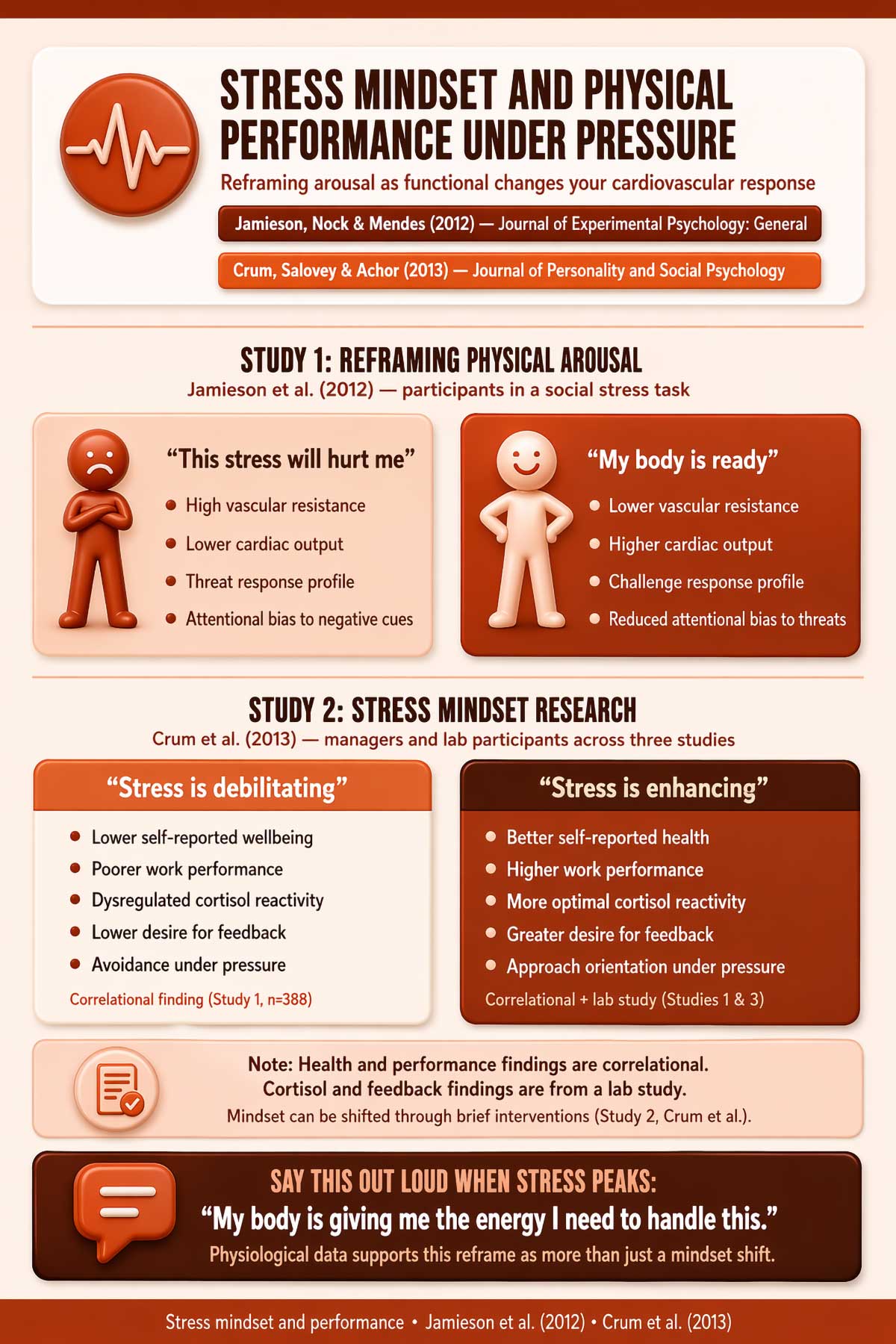
The next time your heart pounds before a difficult conversation or a high-stakes moment, try saying this out loud: “My body is giving me the energy I need to handle this.” It sounds almost too simple. But the physiological data suggests it changes your body’s actual response.
You Don’t Need to Build Resilience. You Already Have It.
Here’s something most resilience content gets completely wrong.
We treat resilience like a rare quality that only certain people possess. We talk about “building” it as if it’s a muscle most people lack. But the data tells a different story entirely.
George Bonanno (2004), in a landmark longitudinal study published in the American Psychologist, followed people who had experienced significant loss and trauma across multiple cohorts. His finding was clear: resilience is the most common human response to adversity, not the exception. Most people maintain their functioning. Most people adapt.
Resilience isn’t built from scratch. It’s your baseline. It’s what happens when you stop fighting your own biology and start working with it.
What blocks resilience isn’t weakness. It’s the accumulated story that you’re not strong enough to cope. That story gets re-triggered in the same way the stress chemistry does, through repetition and habit.
The shift Bonanno’s research suggests is moving away from rigid “mental toughness” and toward what he calls flexible regulatory coping. That means adjusting your response to what the situation actually calls for, not applying the same level of intensity to every stressor. Spilling coffee is not the same as a medical diagnosis. Your nervous system shouldn’t treat them the same way.
Charney’s (2004) psychobiological review reinforces this. Resilient people regulate their stress neurochemistry early and efficiently. They don’t have stronger systems. They have faster, more flexible ones.
What to Do the Next Time Stress Hits
The ideas above aren’t meant to live only in the abstract. Here’s what they look like in real time.
When a stressor first lands, your only job in the first 90 seconds is to not amplify it. Feel the sensation. Don’t build a narrative around it yet. Let the chemistry clear.
In the first few seconds, name the emotion. Keep it simple. “Anxiety.” “Anger.” “Overwhelm.” That single act of labeling starts pulling your rational brain back online.
Do a quick physical check. Notice where you feel the stress in your body. Then reframe what you’re noticing: tension as readiness, a fast heartbeat as focus, tightened breath as alertness.
Finally, remind yourself what the arousal is for. Your body is mobilizing resources. That’s not a malfunction. That’s support.
You don’t need years of therapy or meditation retreats to use these tools. They work in the moment because that’s where they’re designed to work.
The first 90 seconds shape the next 90 minutes. Most people let those seconds pass without making a single deliberate move.
Now you don’t have to.
References
Bonanno, G. A. (2004). Loss, trauma, and human resilience. American Psychologist, 59(1), 20-28. https://doi.org/10.1037/0003-066X.59.1.20
Charney, D. S. (2004). Psychobiological mechanisms of resilience and vulnerability. American Journal of Psychiatry, 161(2), 195-216. https://doi.org/10.1176/appi.ajp.161.2.195
Crum, A. J., Salovey, P., & Achor, S. (2013). Rethinking stress: The role of mindsets in determining the stress response. Journal of Personality and Social Psychology, 104(4), 716-733. https://doi.org/10.1037/a0031201
Gross, J. J. (1998a). The emerging field of emotion regulation. Review of General Psychology, 2(3), 271-299. https://doi.org/10.1037/1089-2680.2.3.271
Gross, J. J. (1998b). Antecedent- and response-focused emotion regulation: Divergent consequences for experience, expression, and physiology. Journal of Personality and Social Psychology, 74(1), 224-237. https://doi.org/10.1037/0022-3514.74.1.224
Gross, J. J. (2002). Emotion regulation: Affective, cognitive, and social consequences. Psychophysiology, 39(3), 281-291. https://doi.org/10.1017/S0048577201393088
Haase, L., Stewart, J. L., Youssef, B., May, A. C., & Paulus, M. P. (2016). When the brain does not adequately feel the body: Links between low resilience and interoception. Biological Psychology, 113, 37-45. https://doi.org/10.1016/j.biopsycho.2015.11.004
Jamieson, J. P., Nock, M. K., & Mendes, W. B. (2012). Mind over matter: Reappraising arousal improves cardiovascular and cognitive responses to stress. Journal of Experimental Psychology: General, 141(3), 417-422. https://doi.org/10.1037/a0025719
Lazarus, R. S., & Folkman, S. (1984). Stress, Appraisal, and Coping. Springer. ISBN 978-0826141910
Ochsner, K. N., & Gross, J. J. (2005). The cognitive control of emotion. Trends in Cognitive Sciences, 9(5), 242-249. https://doi.org/10.1016/j.tics.2005.03.010
Sapolsky, R. M. (2004). Why Zebras Don’t Get Ulcers (3rd ed.). Henry Holt. ISBN 978-0805073690
Taylor, J. B. (2008). My Stroke of Insight. Plume/Penguin. ISBN 978-0452295544