For years, neuroscientists thought stress mostly affected mood. Brain scans revealed something far more physical and surprisingly reversible.
There is a curl of tissue deep in the brain, roughly the size and shape of a seahorse, that keeps a running record of your life. It is called the hippocampus, and on an MRI scan, its volume can be measured in cubic millimeters. Under sustained stress, those measurements get smaller.
Most people file stress under feelings. A bad week, a tight chest, a short fuse. The harder finding, the one that took neuroscientists years of scanning to confirm, is that chronic stress is a physical event. Cortisol not only affects your mood. It reorganizes the architecture of brain tissue, and the change is visible on a scanner.
That last point is worth consideration. This is not a metaphor about feeling “scattered” or “fried.” It is structure.
The clearest account of the mechanism comes from the late Bruce McEwen, a neuroscientist at Rockefeller University who spent his career mapping how stress hormones act on the brain. In a widely cited 2017 review in the journal Chronic Stress, McEwen described the chain of events.
High cortisol pushes neurons to release excess glutamate, the brain’s main excitatory messenger. That flood overstimulates receptors on hippocampal cells, and the cells respond by pulling back their dendrites, the branching arms that form connections with other neurons.
Fewer branches mean fewer connections. Fewer connections, across millions of cells, mean a region that physically takes up less space. The hippocampus is where this shows up first, because it is dense with the receptors that cortisol binds to.
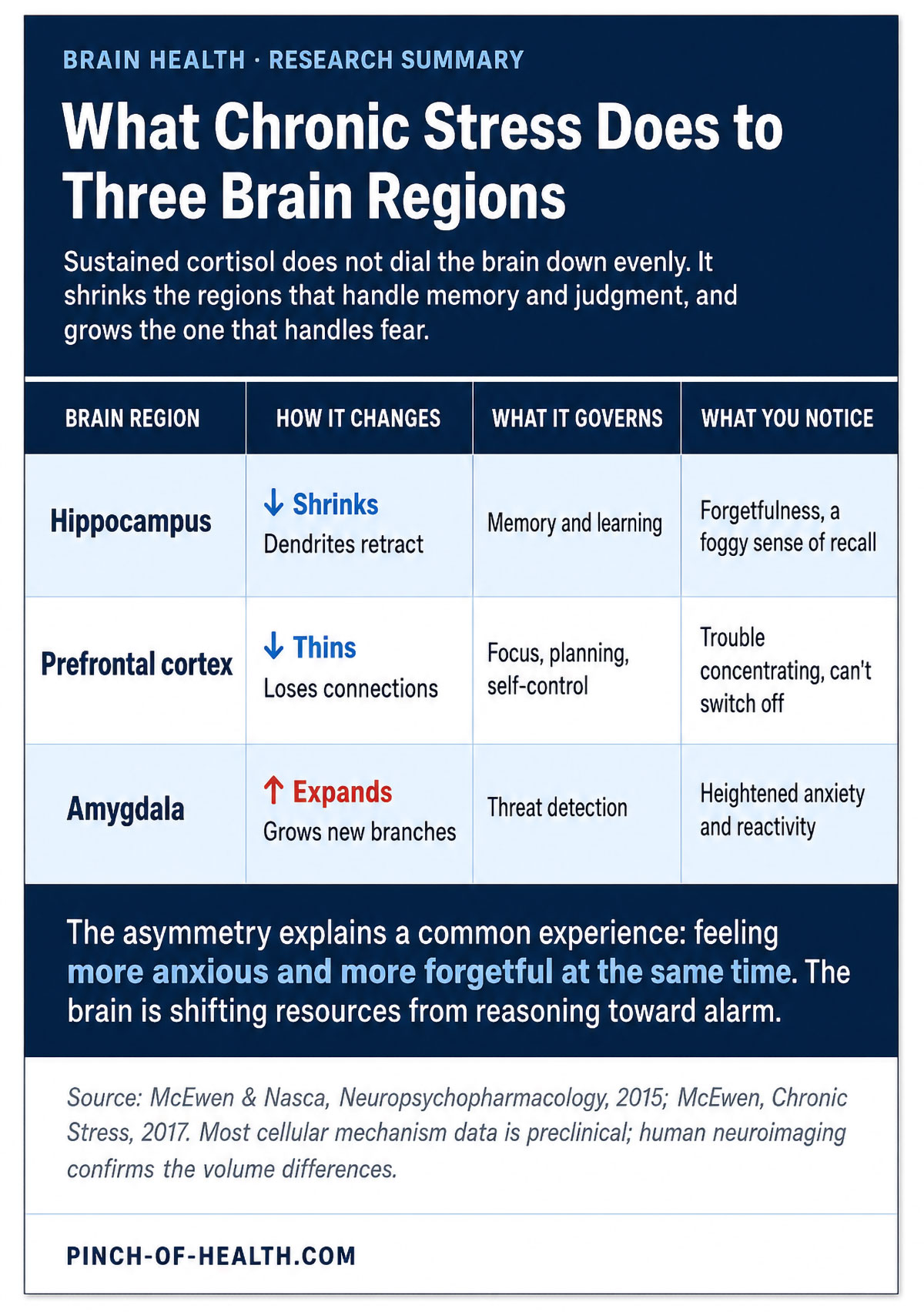
Three regions change at once, and not all in the same direction
Here is the part that reframes the whole picture. Chronic stress does not simply dial the brain down. It shifts it.
McEwen and his colleague Carmen Nasca laid this out in a 2015 paper in Neuropsychopharmacology. Under sustained cortisol exposure, two regions lose dendritic complexity: the hippocampus, which handles memory and learning, and the medial prefrontal cortex, the seat of focus, planning, and self-control. Both thin out.
The amygdala does the opposite. This is the brain’s threat-detection center, and under chronic stress, it grows new dendritic branches and becomes more reactive.
Consider that carefully. Stress shrinks the regions that handle memory and judgment, and it expands the region that handles fear.
That single asymmetry explains a complaint almost every chronically stressed person will recognize: feeling more anxious and more forgetful at the same time. It is not a personal failing or a coincidence. The brain is quietly reallocating resources away from reasoning and toward alarm. A nervous system braced for constant threat invests in the alarm and neglects the apparatus of memory.
The prefrontal thinning is the symptom that working-age adults tend to feel most sharply. It is the reason a stressed brain struggles to hold a plan, resist a distraction, or stop ruminating. The memory loss is real, but the loss of executive control is what shows up in a Tuesday afternoon meeting.
How long does it take?
This is the question with the least clean answer, and it deserves honesty rather than a tidy number.
The most direct timeline data come from a 2023 pilot study in Molecular Psychiatry, which tracked tree shrews with repeated MRI scans over 15 weeks while exposing them to either psychosocial stress or cortisol directly. Four weeks was enough to measurably impair hippocampus-based memory. A trend toward reduced hippocampal volume appeared later in the study.
One detail stands out. In the stressed animals, the memory impairment did not lift the moment the stress ended. It was still measurable seven weeks into recovery. The effect persisted beyond its cause.
The obvious caution: tree shrews are not people. This is preclinical work, and the precise human timeline is not pinned down. Human neuroimaging consistently shows the volume differences in chronically stressed populations, but no study can ethically dose people with stress and watch the clock. The direction is clear. The exact schedule is not.
Can the brain grow back?
Yes. The damage from chronic stress is largely reversible, because in most cases it is remodeling rather than cell death. New neurons can form in the adult hippocampus, and the regions that thinned can rebuild dendritic connections once cortisol comes down, though prolonged or severe stress can leave more lasting marks.
That short answer is the one most readers came for, and it rests on real evidence.
McEwen was deliberate about the word “remodeling.” His lab chose it precisely because the structural changes are not the death of neurons that the older “stress kills brain cells” framing implied. In animal work summarized in his 2000 paper in Biological Psychiatry, dendrites that had retracted during three weeks of stress regrew within roughly ten days once the stress stopped. The architecture reorganizes in both directions.
There is a catch worth naming. The window of easy reversibility appears to narrow the longer stress runs. Brief, recoverable remodeling can become more entrenched with chronic, unrelenting exposure. The damage can be undone, but earlier is better than later.
The one intervention with the strongest evidence
If you want the single best-supported way to rebuild hippocampal volume, it is not a supplement or an app. It is aerobic exercise.
Kirk Erickson, then a neuroscientist at the University of Pittsburgh, ran the trial that made the case. In a 2011 randomized controlled study published in PNAS, 120 older adults were assigned to either a year of moderate aerobic exercise or a year of stretching. The exercise group’s anterior hippocampus grew by 2 percent. The stretching group’s hippocampi shrank by about 1.4 percent, the decline you would expect from a year of aging.
A 2 percent gain sounds modest until you translate it. It effectively rolled back one to two years of age-related hippocampal loss. The brains that exercised became structurally younger.
The mechanism is a protein called BDNF, or brain-derived neurotrophic factor, which acts something like fertilizer for new neurons. Aerobic exercise raises it, and in Erickson’s trial the rise in BDNF tracked directly with the gains in hippocampal volume. (Worth flagging: a published critique by RoseAnne Kenny’s group questioned whether the trial proved a matching memory improvement. It did not dispute the volume finding itself, which has held up.)
“Moderate aerobic exercise” is achievable. In Erickson’s protocol, it meant walking, building up to about 40 minutes three times a week. A brisk walk that leaves you slightly out of breath counts. The intervention that grew these brains is the one that most people can start this week.
One Year, Two Different Brains
In a trial of 120 older adults, a year of moderate aerobic exercise grew the anterior hippocampus. A year of stretching let it keep shrinking.
Source: Erickson et al., Proceedings of the National Academy of Sciences, 2011. Change in anterior hippocampal volume over 12 months. A 2% gain reversed roughly one to two years of age-related loss.
Pinch-of-Health.com
What else moves the needle
Exercise is the headline, but it is not the whole story.
A 2024 contemplative-training study in eLife, led by Sofie Valk, followed more than 300 adults through different forms of mental training. Practices built around compassion and perspective-taking produced increases in specific hippocampal subregions, and those gains tracked with drops in daily cortisol output. The effects were subtle and differed by training type, but the direction lined up with everything else: lower cortisol, more hippocampal tissue.
Sleep belongs in the same conversation because poor sleep keeps the cortisol system switched on and undercuts the recovery that the other interventions are trying to produce. The honest framing is that these are not competing options. They stack.
What Chronic Stress May Be Doing to Your Hippocampus
A plain-language read on the research, not a diagnosis
This is illustrative only. It does not diagnose anything or describe your individual brain. Persistent stress or memory changes are worth discussing with a qualified health professional.
What this changes
The unsettling fact and the reassuring one are the same. The brain is plastic. That plasticity is what lets chronic stress carve volume out of your hippocampus, and it is the same property that lets a year of walking put some of it back. Tissue that responds to cortisol will respond to recovery.
So the question is no longer whether stress was “all in your head.” It was in your head, literally, in measurable cubic millimeters. The more useful question is what you do with a structure that is still listening and still able to change.
This article is for general information and is not a substitute for medical advice. If you are dealing with persistent stress, anxiety, or memory changes, talk to a qualified health professional.