The spray bottle of tea tree oil is doing exactly what it is supposed to. You can see dead bed bugs. The mattress seams look clear. And then, two weeks later, the infestation is back, just as dense as before.
What happened is not mysterious. Tea tree oil kills the bed bugs it touches. The problem is the ones it does not touch: the eggs, which resist its active compounds at the concentrations used in any DIY spray. Kill the adults, miss the eggs, and the next generation hatches undisturbed. The cycle starts over.
That gap between adult kill and egg survival is the most important thing to understand about tea tree oil and bed bugs. It determines whether you use tea tree oil as one layer of a real control strategy, or spend six weeks treating a problem that is quietly repopulating overnight.
How Tea Tree Oil Works Against Bed Bugs
Tea tree oil comes from the leaves of the Melaleuca alternifolia tree, native to Australia. Its insecticidal properties trace primarily to one compound: terpinen-4-ol, which makes up roughly 40 to 45 percent of the oil by concentration. Secondary compounds, including gamma-terpinene and 1,8-cineole, contribute additional repellent action.
Terpinen-4-ol disrupts the cell membranes of bed bugs on direct contact, causing dehydration. The oil also blocks spiracles (the small breathing pores along the underside of a bed bug’s abdomen), disrupting respiration. Beyond the contact kill, the oil’s sharp medicinal scent repels bed bugs from treated surfaces. That repellent effect is temporary, and it can quietly drive bugs deeper into hiding rather than eliminating them.
The operative phrase is “on direct contact.” Tea tree oil has no meaningful residual activity. It does not persist in cracks, seams, or wall voids at concentrations strong enough to affect hiding bugs. This single characteristic explains most of its limitations as a standalone treatment. The majority of bed bugs in any infestation are not in the open when you spray.
What the Research Actually Shows
The scientific picture of tea tree oil and bed bugs is more complicated than most guides suggest. Acknowledging it serves you better than a confident but misleading summary.
A 2022 systematic review published in Pharmaceutics, the first to assess tea tree oil against ectoparasites across multiple species, including bed bugs, found promising in vitro activity that translated reasonably well into clinical settings. The researchers at the University of Western Australia concluded that TTO and its components showed genuine antiparasitic efficacy. That is a real positive finding. It is also one derived primarily from controlled laboratory conditions, not from field trials inside real homes with established infestations.
The field-oriented research is less encouraging, and the Rutgers group’s 2017 study is worth sitting with. Changlu Wang and colleagues at Rutgers and the USDA Agricultural Research Service, publishing in the Journal of Economic Entomology, tested 18 essential oils and found that, as a category, they showed poor effectiveness against bed bugs.
What performed were silicone and paraffin oils, which work not through chemistry but by physically blocking the spiracles bugs breathe through. Tea tree oil did not distinguish itself from the others. The finding matters beyond this one oil: it suggests the popular category of natural essential oil bug killers is built on weaker ground than most consumers assume.
A separate Rutgers study from 2014, also in the Journal of Economic Entomology, evaluated nine commercial essential oil-based products sprayed directly onto bed bugs. Of all nine products tested, only two achieved kill rates higher than 90 percent on direct application: EcoRaider, which contains geraniol and cedar extract, and Bed Bug Patrol, which contains clove and peppermint oil. Plain tea tree oil alone was not among the standout performers.
The pattern across all three studies is consistent: laboratory promise, limited field translation. Terpinen-4-ol does have documented insecticidal properties in controlled conditions. At the concentrations achievable in a DIY spray, and given that bed bugs are almost always hiding rather than wandering exposed surfaces, the gap between laboratory results and bedroom results is large. Tea tree oil earns a place in integrated pest management. It does not replace the strategy.
The Egg Problem in Detail
Bed bug eggs are coated in a protective layer that essential oils penetrate poorly at household concentrations. Adults on a treated surface die on contact. Eggs in the same area generally do not. This is not a minor caveat. It is the central mechanical reason why single-substance essential oil treatment fails for established infestations.
A female bed bug lays between one and seven eggs per day under favorable conditions. The egg-to-adult cycle runs roughly six to ten weeks. Treat only the visible adult population for two weeks and stop, or treat inconsistently, and the next generation is already developing. The adults dying on the mattress seams are not the entire population. They are the visible fraction of it.
What the Research Cannot Tell You Yet
Very few studies have measured tea tree oil’s effectiveness in actual homes rather than laboratory settings. Lab conditions require direct contact between oil and insect, a situation that rarely occurs in a real bedroom where bugs occupy wall voids, box spring internals, and furniture joints that a spray bottle cannot reach. Study methodologies vary enough between papers that direct comparison is difficult. Long-term effectiveness data, beyond a few weeks of laboratory observation, do not exist.
Researchers also have not adequately studied concentration thresholds under real-use conditions, or whether bugs develop behavioral avoidance of repeated essential oil exposure over extended treatment periods. These are open questions, not settled ones.
How to Use Tea Tree Oil for Bed Bugs
If you are using tea tree oil as part of a bed bug strategy (and there are reasonable cases for doing so), concentration, consistency, and application method all matter.
Choosing the Right Tea Tree Oil
Look for 100% pure, undiluted tea tree oil with a terpinen-4-ol content of at least 30 percent, which is the Australian standard (AS 2782) minimum for pharmaceutical-grade oil. Products marketed as “tea tree blend” or with fragrance listed as an ingredient are diluted or synthetic and will underperform. Store the bottle away from direct light, which degrades terpinen-4-ol over time.
How to Dilute Tea Tree Oil for Bed Bugs
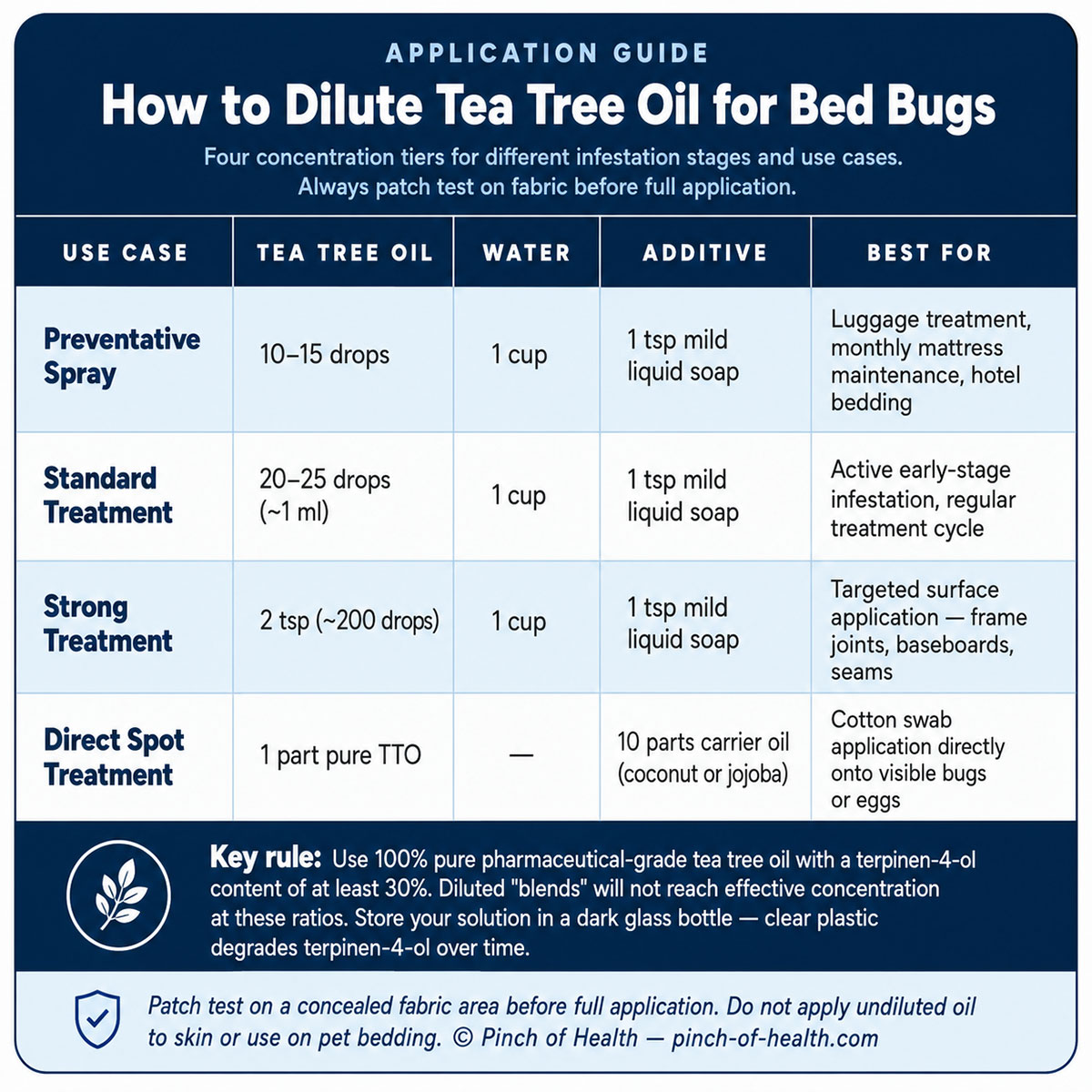
Tea tree oil at full concentration will irritate skin and may damage some fabric finishes. For general surface treatment, the standard ratio is 20 to 25 drops of pure tea tree oil (roughly 1 milliliter) combined with one cup of water and one teaspoon of mild liquid soap. The soap acts as an emulsifier, allowing the oil to distribute in water rather than floating on the surface. For direct spot treatment of visible bugs, apply a ratio of one part oil to 10 parts carrier oil (coconut or jojoba) with a cotton swab for higher local concentration.
DIY Tea Tree Oil Spray for Bed Bugs
Mix the solution in a dark glass bottle, since tea tree oil degrades in clear plastic. Shake before each use, as the oil will separate. Apply to mattress seams, tufts, and corners, box spring edges, bed frame joints, baseboards, and cracks in nearby furniture. Use a cotton swab for any visible individual bugs.
Adding 10 to 15 drops of tea tree oil to a hot washing machine cycle is one of the more effective applications for bedding, curtains, and pillow covers. The heat (140°F / 60°C or higher) kills the bugs and eggs. The oil then contributes repellent residue to freshly laundered fabric and helps reduce lingering odors.
Tea Tree Oil for Bed Bug Bites
Applied to bite sites after washing the area, diluted tea tree oil (at a 5 percent concentration in a carrier oil) can reduce inflammation and lower the risk of secondary infection at scratch marks. The antimicrobial and anti-inflammatory properties of terpinen-4-ol are well documented. Apply a small amount with a cotton ball rather than spraying. Do not use on broken skin or open sores.
Treatment Schedule
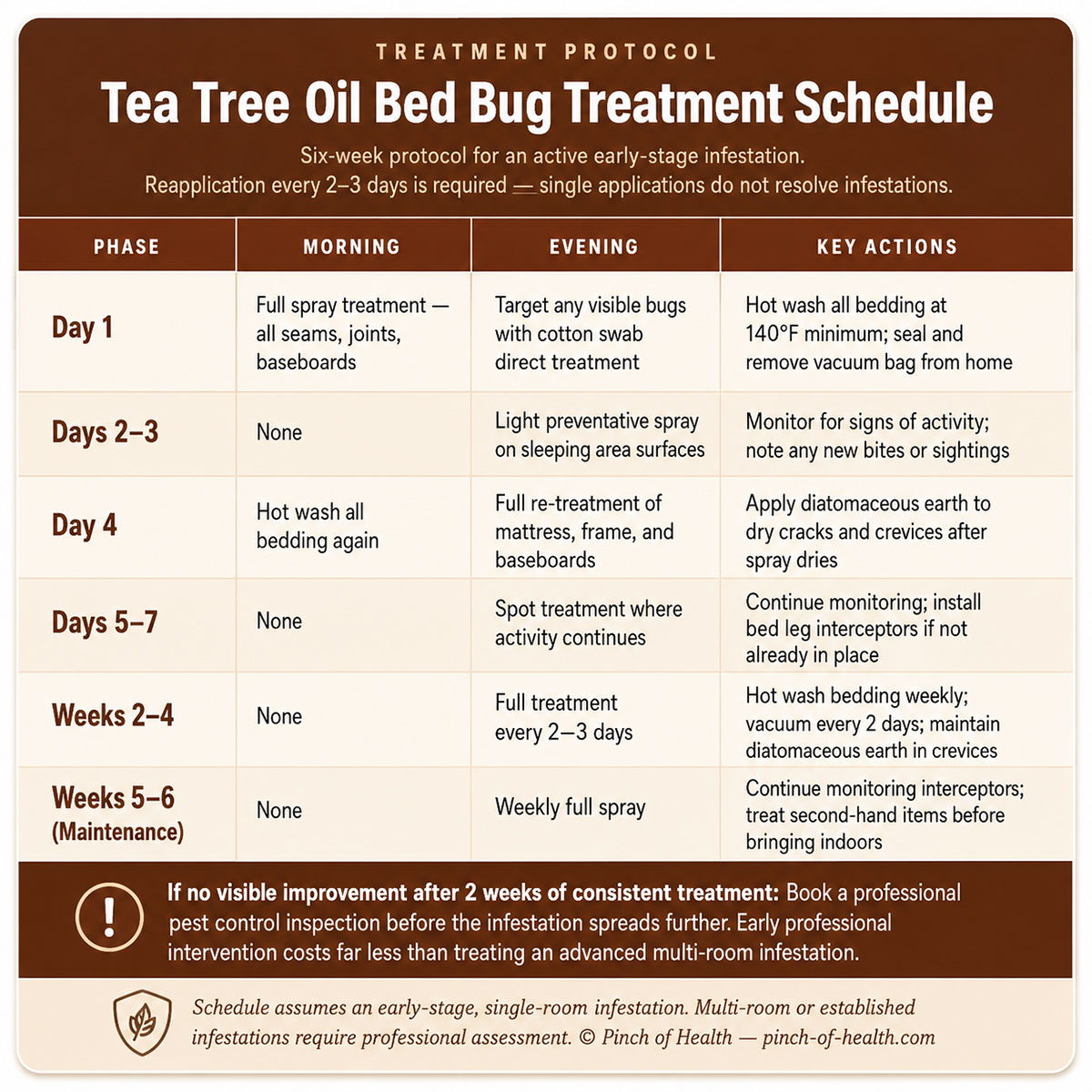
The repellent effect of tea tree oil fades within three to five days in laboratory measurements. In a real bedroom, with ventilation, fabric absorption, and the natural tendency to skip a night because the bugs seem gone, that window is almost certainly shorter.
Consistency is the whole game. For an active infestation, the minimum is daily treatment in the first week, followed by every two to three days for the next four to six weeks. Pair every application with thorough vacuuming (seal the vacuum bag and remove it from the home immediately afterward) and hot washing of any fabric that can withstand machine washing.
When Tea Tree Oil Works, and When It Won’t
Tea tree oil earns a real role in two situations: early-stage infestations that have not yet spread, and prevention. In everything beyond that, it does not have the residual activity, egg-kill capacity, or penetration depth to resolve an infestation on its own.
Where It Has a Genuine Place
Minor or recently discovered infestations, where the population is small and contained to one location, are where tea tree oil is most useful. Prevention is its other strong suit: spraying luggage before and after travel, treating mattress seams when moving into a new rental, or applying to second-hand furniture before bringing it inside. For anyone already in professional treatment, tea tree oil can extend coverage between pro applications and add a layer of protection against reinfestation.
What Smell Do Bed Bugs Hate Most?
Bed bugs respond to scent-based repellents, and tea tree oil is among the better-studied options. Lavender and peppermint oils also produce avoidance behavior in laboratory settings. Of these, tea tree’s terpinen-4-ol generates the most consistent documented repellent response in behavioral research. The practical caveat for all of them is the same: the effect is temporary, fades within days, and drives bugs away from treated surfaces rather than eliminating them. When repellents push bugs away from a treated mattress without killing them, the infestation may move deeper into walls or furniture rather than shrinking.
Combining Tea Tree Oil With Other Methods
The two combinations that most consistently improve outcomes are tea tree oil with diatomaceous earth, and tea tree oil alongside heat treatment. Diatomaceous earth is a fine mineral powder that works by abrasion on the insect exoskeleton, causing dehydration over days.
Apply the tea tree oil spray first. Once surfaces are dry, dust with food-grade diatomaceous earth in cracks, along baseboards, and under furniture. This creates an immediate contact-kill layer plus a longer-acting physical barrier.
Some people add isopropyl alcohol to their tea tree oil mixture at a ratio of roughly one part alcohol to two parts water with the standard tea tree oil drops. Alcohol evaporates quickly and kills on contact, similar to tea tree oil. It does not add residual activity. The combination targets a slightly wider range of surface conditions than either alone, particularly on non-porous surfaces.
Heat treatment using professional steam or sustained dryer cycles at temperatures higher than 140°F / 60°C addresses the egg stage that tea tree oil and most other natural treatments cannot. Mattress encasements (bed bug-proof zippered covers) prevent new bugs from entering and trap any remaining population inside, where they die. These are the structural components that make a natural treatment protocol work over time.
Should I Treat Bed Bugs at Home or Call a Professional?
Answer four questions to get a tailored recommendation based on your situation.
Your situation — early discovery, contained to one area, no prior failed treatments, no health vulnerabilities — is well-suited for a consistent natural treatment protocol. Tea tree oil as part of an integrated approach is a reasonable first step.
Your action plan:
- Strip and hot wash all bedding (140°F / 60°C minimum) immediately
- Vacuum thoroughly — seal the bag and remove from the home
- Apply diluted tea tree oil spray (20–25 drops per cup of water with 1 tsp liquid soap) to all seams, frame joints, and baseboards
- Dust dry areas with food-grade diatomaceous earth after the spray dries
- Install mattress encasements and bed leg interceptors
- Repeat every 2–3 days for six weeks and monitor closely
If the infestation has not clearly reduced within two weeks of consistent treatment, move to professional assessment before it spreads further.
Your situation suggests the infestation is beyond what tea tree oil alone can resolve, but may not yet require full professional extermination. A hybrid approach — intensive natural treatment combined with a professional inspection — is the most practical path.
Your action plan:
- Hot wash all fabric in every affected room immediately
- Apply tea tree oil spray and diatomaceous earth in all affected areas on the same day
- Book a professional inspection — many pest control companies offer free assessments — so you know the full scope before committing
- Install mattress encasements and interceptors in all affected rooms
- If the inspector confirms a manageable infestation, continue the natural protocol under their guidance
- If they identify spread into walls, multiple rooms, or high egg density, proceed with professional treatment
Do not delay the professional inspection. Early professional intervention is significantly less expensive than treating an advanced infestation.
Based on your answers, the infestation has characteristics that DIY methods — including tea tree oil — are unlikely to resolve: it has spread, persisted through prior treatment, or involves household members who should not be exposed to a prolonged untreated infestation.
Your immediate steps:
- Contact a licensed pest control company for an assessment as soon as possible — spread and established egg cycles make delay costly
- Hot wash and seal all fabric you can before the appointment to reduce the active population
- Install mattress encasements now to prevent further spread between rooms
- Ask about heat treatment specifically — sustained whole-room heat above 120°F is the only method documented to kill all life stages, including eggs, in one treatment
- After professional treatment, use tea tree oil as a prevention layer to delay reinfestation
Tea tree oil still has a role — as a maintenance and prevention tool after the professional treatment is complete, not as a substitute for it.
When to Call a Professional
If the infestation has spread beyond one room, if you have treated consistently for two to three weeks without visible reduction, if eggs or nymphs are present in multiple locations, or if anyone in the household has respiratory conditions or significant health vulnerabilities, professional extermination is the appropriate next step.
Professional heat treatment at sustained temperatures above 120°F throughout the entire room for at least 90 minutes is the only method documented to kill all life stages reliably. Essential oil treatment has not demonstrated that capability.
Safety and Precautions
Tea tree oil is toxic when ingested. Most poisoning cases involve children or pets exposed to undiluted oil, or oil improperly stored where it is accessible. Keep bottles sealed and stored out of reach. The US Poison Control Center is available at 1-800-222-1222 for any ingestion emergency.
Pet Safety, Including Cats
The toxicity risk to cats is significantly higher than to dogs or humans. Cats lack the liver enzyme glucuronosyltransferase, which processes terpenes. Even diluted tea tree oil on surfaces that a cat walks across and then licks from its paws during grooming can cause tremors, difficulty walking, and liver damage.
Keep cats out of any treated room until surfaces are completely dry. If a cat shows muscle weakness, drooling, or difficulty walking after potential exposure, contact a veterinarian immediately. For households with cats, other bed bug control methods should take priority, and tea tree oil should be used minimally, if at all.
Skin Application
Undiluted tea tree oil applied to skin causes irritation in a significant percentage of people, and contact dermatitis reactions are well-documented. A 5 percent concentration in a carrier oil is the appropriate upper limit for skin use.
The question of whether applying tea tree oil to skin prevents bed bug bites is frequently asked. The answer is that the repellent effect does not last long enough for overnight protection, and the skin irritation risk at effective concentrations outweighs the benefit. For eye contact, flush with running water for 15 minutes and seek medical attention.
Conclusion
Tea tree oil holds a specific, limited, and real position in bed bug management. The limitation is simply a description of what the oil actually is: a contact insecticide with short residual activity and poor egg penetration, which happens to smell medicinal and sit in a spray bottle. That description does not make it useless. It makes it a tool that works when it is understood and used correctly, as one part of an approach that addresses all life stages, all hiding spots, and all reentry routes. The people who get the most from tea tree oil are those who stop expecting it to do what it cannot do.
Frequently Asked Questions
Does tea tree oil get rid of bed bugs?
For a minor or very early infestation as part of a broader strategy, it can help. For an established infestation on its own, no. Tea tree oil can reduce the adult population in treated areas where direct contact occurs. It cannot penetrate hiding spots, does not work reliably at household concentrations for the full population, and does not effectively kill eggs.
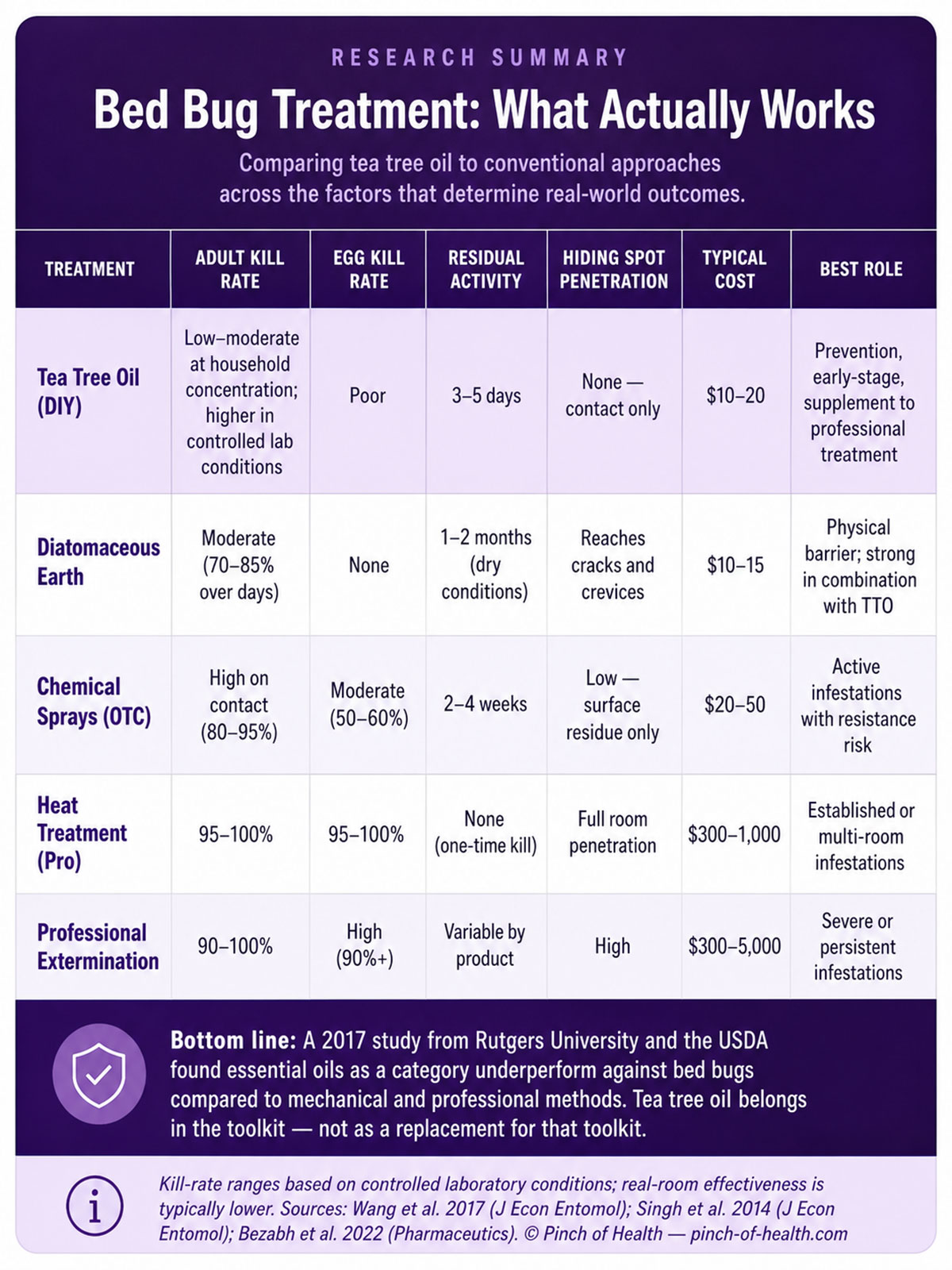
The 2017 Rutgers study found that essential oils, as a category, performed poorly against bed bugs compared to mechanical methods. Used as one layer alongside vacuuming, heat treatment, and mattress encasements, tea tree oil does useful work. Used alone as the primary strategy, it will not resolve the infestation.
Does tea tree oil kill bed bug eggs?
Not reliably. Bed bug eggs have a protective coating that resists penetration by essential oil compounds at DIY spray concentrations. This is the mechanical reason why consistent multi-week treatment is necessary, and why tea tree oil must be combined with methods that address the egg stage. Heat at temperatures higher than 140°F / 60°C kills eggs reliably. Tea tree oil at standard dilutions does not.
Can I spray tea tree oil on my mattress?
Yes. Dilute it first (20 to 25 drops per cup of water with a teaspoon of liquid soap), let it dry completely before sleeping, and focus on the seams, tufts, and corners rather than the broad surface. That is where bed bugs actually are. One practical note: test on a small hidden area first, since some mattress fabrics react to the oil’s terpene content.
Can I use tea tree oil on bed bug bites?
Yes, with proper dilution. A 5 percent concentration in a carrier oil applied to bite sites can reduce inflammation and lower the risk of secondary infection from scratching. Use a cotton ball rather than spraying, and do not apply to broken or open skin. For reactions that are severe, spreading, or welt-like, see a physician rather than managing them at home.
How long does the repellent effect of tea tree oil last?
Three to five days in laboratory conditions, and probably less in a real room. Ventilation, fabric absorption, and temperature variation all reduce active concentration faster than lab settings suggest. Plan for reapplication every two to three days during an active treatment phase.
Is tea tree oil safe around pets?
Not for cats. Cats cannot metabolize terpenes safely, and even diluted surface application poses a real risk through grooming. Dogs are less vulnerable but should also be kept away from wet treated surfaces. For households with cats, the toxicity risk is high enough that alternative approaches to bed bug control should take priority.