Your brain is constantly changing throughout life, and one everyday habit has been linked to changes in the area responsible for forming new memories.
A group of sedentary older adults in Pittsburgh started walking three times a week, and after a year their brains had done something no supplement or app has ever reliably managed: part of it grew back.
Not metaphorically. The hippocampus, the structure most responsible for turning a Tuesday into something you can call up later, measurably increased in volume. The comparison group, who did stretching instead, lost tissue at the rate aging usually demands.
That’s the easy finding. A stranger one, the kind most memory advice skips over, shows up later in a very different study, and it complicates a claim that brain-training companies have been selling for years.
1. Move Your Body, Grow Your Hippocampus
How a Year of Walking Reversed a Year of Brain Aging
Kirk Erickson, then a psychologist at the University of Pittsburgh, split 120 sedentary older adults, aged 55 to 80, into two groups. One walked briskly three days a week. The other did stretching and toning routines instead.
After a year, the walkers had gained about 2% more volume in the anterior hippocampus, the region most involved in forming new memories. The stretching group lost roughly 1.4%, which is the ordinary pace of decline for that age group.
One year of walking had erased more than a year of typical brain aging, according to the trial, which was published in the Proceedings of the National Academy of Sciences in 2011.
Aerobic exercise increases blood flow to the brain and raises levels of brain-derived neurotrophic factor, a protein that supports the growth, connection, and survival of neurons. Researchers still don’t agree on how much of the hippocampal growth traces to BDNF specifically versus the combined effect of better blood flow and reduced inflammation. The mechanism is probably layered rather than singular.
Building Up Safely: A 12-Week Plan
Jumping straight to 30 minutes a day rarely sticks if you’re not already active. A gradual build works better:
- Weeks 1-2: 15 minutes, three days a week.
- Weeks 3-4: 20 minutes, four days a week.
- Weeks 5-8: 25 minutes, five days a week.
- Weeks 9-12: 30 minutes, five days a week.
The starting target from there is 150 minutes of moderate aerobic activity a week, split however works for your schedule. Walking, swimming, cycling, and dancing all count equally. If you can hold a conversation but couldn’t sing through it, the intensity is about right.
Nobody has run a trial long enough to say whether five years of walking keeps compounding the hippocampal gain Erickson measured at one year, or whether the effect plateaus. That part is still an open question.
2. Let Sleep Do the Consolidation Work
What Actually Happens to Memory While You’re Unconscious
Why does one bad night of sleep leave you fumbling for a word you knew perfectly well the day before? Sleep does active work on memory rather than passive rest, and losing it interrupts a process that has no real substitute.
During sleep, especially its deeper stages, the brain replays and reorganizes what it learned that day, gradually shifting information from short-term storage into more durable long-term memory. Researchers Björn Rasch and Jan Born traced this process across decades of human and animal research in a wide-ranging review published in Physiological Reviews.
Researchers still don’t fully agree on how much of that reorganizing depends on REM sleep specifically, as opposed to the deep, slow-wave stages that dominate earlier in the night. Both appear to matter, just not equally for every kind of memory.
Sleep also supports the brain’s glymphatic system, the process that clears metabolic waste products, which build up during waking hours and can otherwise interfere with cognitive function.
Building a Sleep Sanctuary
- Keep bedroom temperature between 65 and 68°F.
- Install blackout curtains or use a sleep mask.
- Remove the TV and work materials from the bedroom.
- Use white noise or earplugs if outside noise is a problem.
- Choose a supportive mattress and pillow.
- Put your phone on silent or leave it in another room.
Put screens away at least 60 minutes before bed. The blue light from phones and tablets signals to your brain that it’s still daytime. Going to bed and waking at the same time every day, weekends included, helps regulate your circadian rhythm.
A consistent bedtime does more for memory than almost any supplement on the market. The harder question is whether a routine built around late-night screens is one most people are willing to give up.
3. Train Your Brain Like a Muscle
The Ten-Year Study That’s More Complicated Than It Sounds
Brain-training apps often imply that a skill you practice stays sharp indefinitely. The largest cognitive-training trial ever run on older adults suggests that’s only true for some skills, not all of them.
The Advanced Cognitive Training for Independent and Vital Elderly trial, generally known as ACTIVE, recruited 2,832 adults between the ages of 65 and 94 across six U.S. cities.
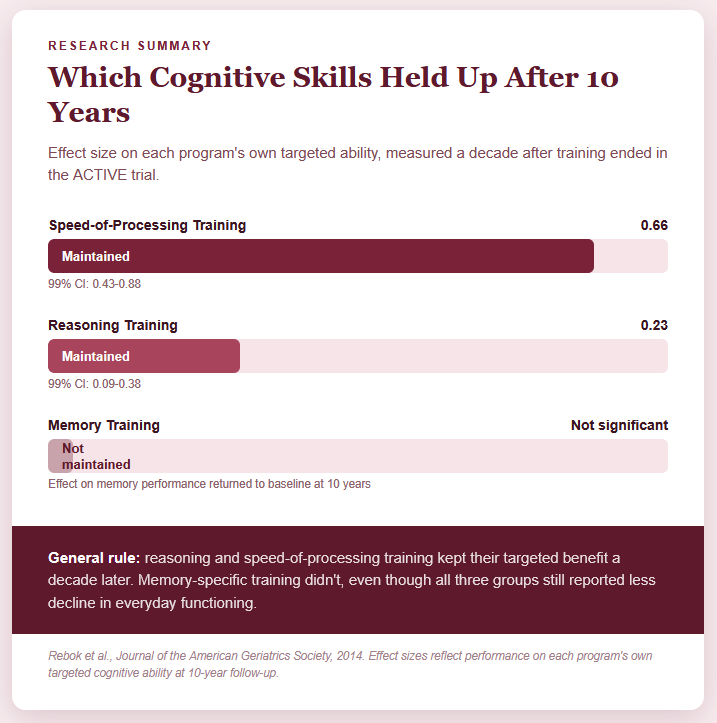
Researchers led by George Rebok at Johns Hopkins assigned participants to ten sessions of memory training, reasoning training, speed-of-processing training, or no training at all, then followed everyone for a full decade. The results were published in the Journal of the American Geriatrics Society in 2014.
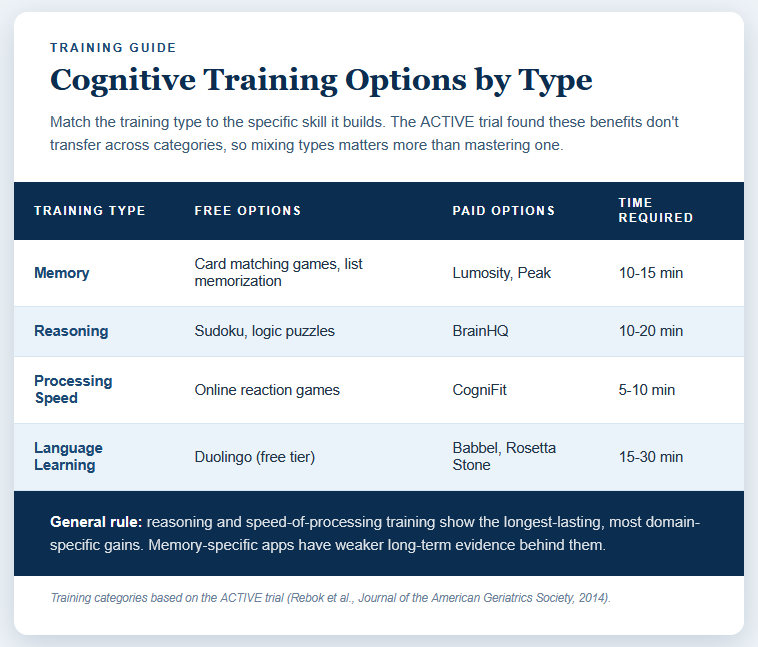
Reasoning training and speed-of-processing training both held their gains at ten years. Memory training did not. People who trained specifically on memory tasks showed no lasting advantage in memory performance a decade later, even though all three groups reported less decline in everyday functioning, like managing bills or preparing meals, than people who received no training at all.
The training effects that do last rely on neuroplasticity, the brain’s capacity to build new connections between neurons at any age. What the ACTIVE data suggests is that this capacity is domain-specific.
Practicing reasoning builds reasoning. Practicing speed builds speed. It doesn’t automatically transfer to memory, whatever the marketing for brain-training apps implies.
What’s Actually Worth Trying
Learning a genuinely new skill tends to outperform simple repetition. A foreign language, a musical instrument, chess, or bridge all require the kind of sustained novelty that repetition-based puzzles don’t.
Whatever you pick, look for programs that mix task types and get harder as you improve. Novelty is what the brain responds to, not repetition of something already mastered.
4. Eat for a Brain That Ages More Slowly
Two Studies, Not One, Behind the MIND Diet Numbers
The MIND diet’s most quoted statistic, a 53% drop in Alzheimer’s risk, gets attached to nearly every other claim about the diet floating around online, including some that come from a different study entirely. The two get treated as one so often that separating them almost feels unnecessary. It isn’t.
Nutritional epidemiologist Martha Clare Morris and colleagues at Rush University followed 923 older adults for an average of 4.5 years, tracking both what they ate and whether they developed Alzheimer’s disease.
People who most closely followed the MIND diet, a hybrid of the Mediterranean and DASH diets, had a 53% lower rate of developing Alzheimer’s than those who followed it least. Moderate adherence still produced a 35% reduction. The results were published in Alzheimer’s & Dementia in 2015.
A separate paper from the same research group, based on a study that followed 960 participants over 4.7 years, measured something different: the rate of general cognitive decline rather than Alzheimer’s diagnoses specifically.
People with the highest MIND diet scores declined at a rate equivalent to someone 7.5 years younger than people with the lowest scores. It’s a related finding built on an overlapping but distinct dataset, and it earns its own citation rather than getting folded into the Alzheimer’s number.
Researchers point to the diet’s density of flavonoids and antioxidants, compounds that appear to reduce inflammation and oxidative stress, two processes strongly linked to neuron damage over time.
What to Eat, and What to Limit
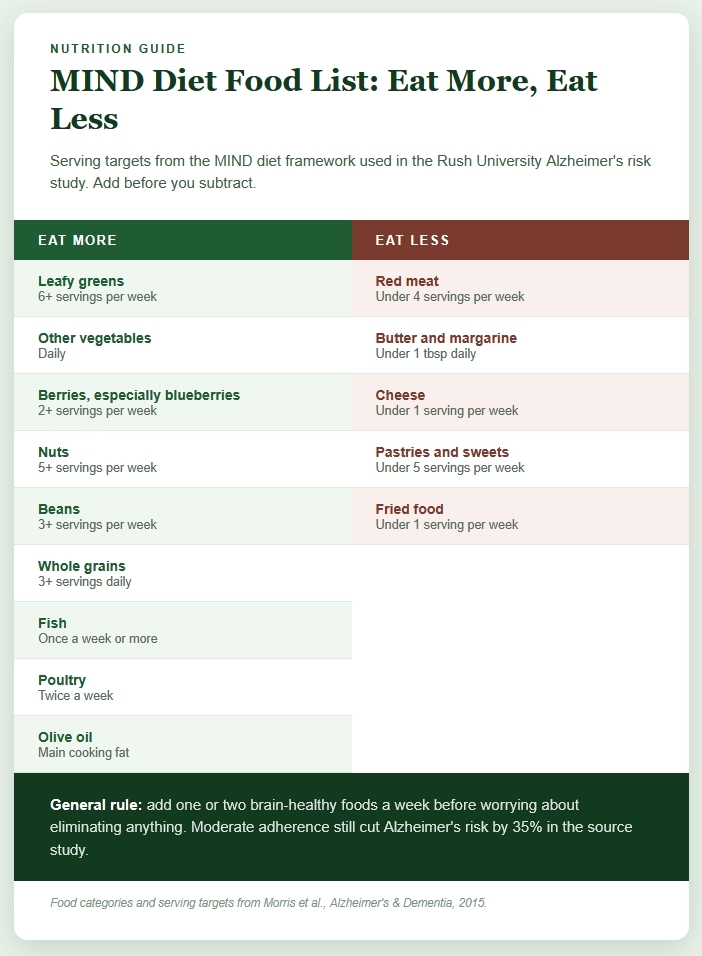
In practice, this means leaning towards leafy greens, other vegetables, berries, whole grains, fish, poultry, beans, nuts, and olive oil, while limiting red meat, butter, full-fat cheese, fried food, and pastries. You don’t need to hit every target right away. Adding one or two brain-healthy foods a week is enough to start shifting your eating pattern.
Recipes You Can Start This Week
Brain-Boosting Berry Smoothie (Prep: 5 minutes, serves 1)
Blend 1 cup frozen wild blueberries, 1 cup fresh spinach, 1/4 cup walnuts, 1 cup unsweetened almond milk, and 1 tablespoon ground flaxseed until smooth. The blueberries provide anthocyanins that protect brain cells, the spinach offers folate, and the walnuts deliver omega-3 fatty acids that support brain cell membranes.

Salmon and Quinoa Power Bowl (Prep: 25 minutes, serves 2)
Bake 8 oz wild salmon at 400°F for 12-15 minutes with a drizzle of olive oil, salt, and pepper. Divide 1 cup cooked quinoa and 4 cups mixed greens between two bowls, top with 1 cup chickpeas, halved cherry tomatoes, and sliced red onion, then add the salmon and a dressing of olive oil, lemon juice, and fresh herbs.
Simple Lentil Soup (Prep: 35 minutes, serves 6)
Sauté a diced onion, two chopped carrots, and two chopped celery stalks in olive oil for 5 minutes, then add minced garlic, cumin, and turmeric for 1 minute. Add 1 cup rinsed lentils, 6 cups vegetable broth, and a can of diced tomatoes, bring to a boil, then simmer for 25 minutes before stirring in chopped kale for a final 3 minutes.
Walnut and Berry Overnight Oats (Prep: 5 minutes, plus overnight chilling, serves 1)
Combine 1/2 cup rolled oats, 1/2 cup unsweetened almond milk, 1/4 cup Greek yogurt, and 1 tablespoon chia seeds in a jar, stir in half the blueberries and walnuts, then refrigerate overnight. Top with the remaining fruit and nuts, plus honey and cinnamon if you’d like, before eating.
Your First Week: A Sample MIND Diet Meal Plan
Monday: Berry smoothie, mixed green salad with grilled chicken, salmon and quinoa bowl, a small handful of almonds.
Tuesday: Walnut and berry overnight oats, lentil soup with whole grain bread, grilled chicken with brown rice and broccoli, carrots and hummus.
Wednesday: Whole grain toast with almond butter and strawberries, chickpea and quinoa salad, baked salmon with sweet potato and asparagus, fresh blueberries.
Thursday: Berry smoothie, turkey and avocado wrap, lentil soup with mixed greens, apple slices with almond butter.
Friday: Scrambled eggs with sautéed spinach and toast, leftover salmon bowl, grilled chicken tacos with black beans, mixed nuts.
Saturday: Walnut and berry overnight oats, vegetable and bean soup, baked cod with quinoa and Brussels sprouts, celery with hummus.
Sunday: Veggie omelet with toast, grilled chicken salad with berries and walnuts, turkey meatballs with whole-wheat pasta, fresh berries with walnuts.
None of this requires giving up flavor. Dark chocolate above 70% cocoa and a daily cup of coffee both fit comfortably inside MIND diet guidelines, which may be part of why people stay with it longer than diets built entirely around restriction.
5. Let Your Mind Settle, and Working Memory Follows
What Two Weeks of Mindfulness Did to a Group of College Students
Michael Mrazek, a psychologist at the University of California, Santa Barbara, wanted to know something specific: could two weeks of mindfulness training change how well people read, and how much their attention wandered while they were trying to?
Mrazek and his colleagues randomly assigned 48 undergraduates to either a mindfulness class or a nutrition class, matched for time commitment, then tested reading comprehension and working memory before and after.
The mindfulness group met for 45 minutes, four times a week, for two weeks, and practiced an additional 10 minutes daily on their own. The nutrition group received no mindfulness instruction at all.
Afterward, the mindfulness group’s accuracy on a GRE-style reading comprehension test improved by 16 percentile points relative to the nutrition group. Their working memory capacity improved too, and testing showed far fewer instances of participants catching their own minds wandering across both measures. The nutrition group showed no meaningful change on any measure. The results were published in Psychological Science in 2013.
Mrazek’s team traced the improvement to reduced mind-wandering, concentrated among participants who’d struggled most with focus before training started. Mindfulness practice appears to strengthen the prefrontal cortex’s role in sustaining attention, which is the mechanism working memory depends on most directly.
Two weeks is a strikingly short window for a measurable cognitive change. Whether the same effect holds up after two months, or whether these particular college students were unusually responsive to training, is something the original study wasn’t designed to answer.
A 5-Minute Mindfulness Practice for Beginners
- Sit comfortably, close your eyes, and take three deep breaths.
- Focus on your breathing for two to three minutes, noticing the air entering and leaving your nose.
- When your mind wanders, which it will, gently return your attention to your breath without judgment.
- After five minutes, open your eyes slowly and notice how you feel.
Mindfulness Practice Timer
Guided meditation for focus and calm
Excellent work on your practice.
The 5 Habits at a Glance
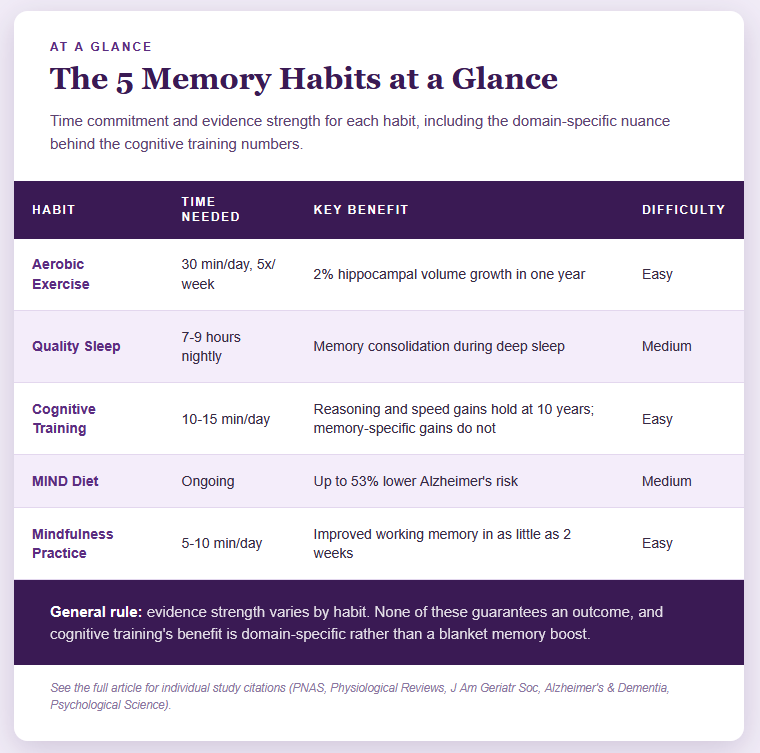
The table below summarizes the time commitment and evidence behind each habit, including the domain-specific nuance from the ACTIVE trial rather than a blanket claim about cognitive training.
Can You Reverse Memory Loss Naturally?
It depends on the cause. Age-related changes can often improve with the habits above, all of which have shown benefits for people experiencing normal age-related decline.
If memory loss traces back to poor sleep, low activity, or a poor diet, changing those habits can make a real difference. If it stems from a medical condition, such as depression, a thyroid disorder, or a vitamin deficiency, treating the underlying problem is usually what helps.
Alzheimer’s disease itself can’t be reversed, but the MIND diet and the other habits here may slow its progression and reduce the odds of developing dementia in the first place. Starting early, before problems appear, gives these habits the most time to work.
How Long Does It Take to Notice a Difference?
Most people notice changes in stages rather than all at once.
- Weeks 1-2: better focus and alertness, mostly from improved sleep and exercise.
- Weeks 3-4: less brain fog, easier recall of recent information.
- Weeks 8-12: noticeable improvement in working memory and learning new material.
- Month 6 and beyond: structural brain changes begin with consistent habits.
- Year 1 and beyond: measurable improvements in memory performance and cognitive resilience.
These are general timeframes. Results vary based on starting point, age, and consistency. Most people report better energy and focus within the first two weeks, well before any of the slower changes show up.
What Can Cause Poor Memory?
Occasional forgetfulness is normal at any age. It’s worth a conversation with a doctor when it starts interfering with daily responsibilities, or when someone close to you notices a change you haven’t.
Poor sleep, chronic stress, and heavy alcohol use are common lifestyle contributors to memory problems. Several medical conditions can also produce symptoms that look like early cognitive decline but are treatable once identified: thyroid disorders, depression, vitamin B12 deficiency, and undiagnosed sleep apnea among them.
Certain medications, including some sleep aids and anticholinergic drugs, list memory problems as a side effect.
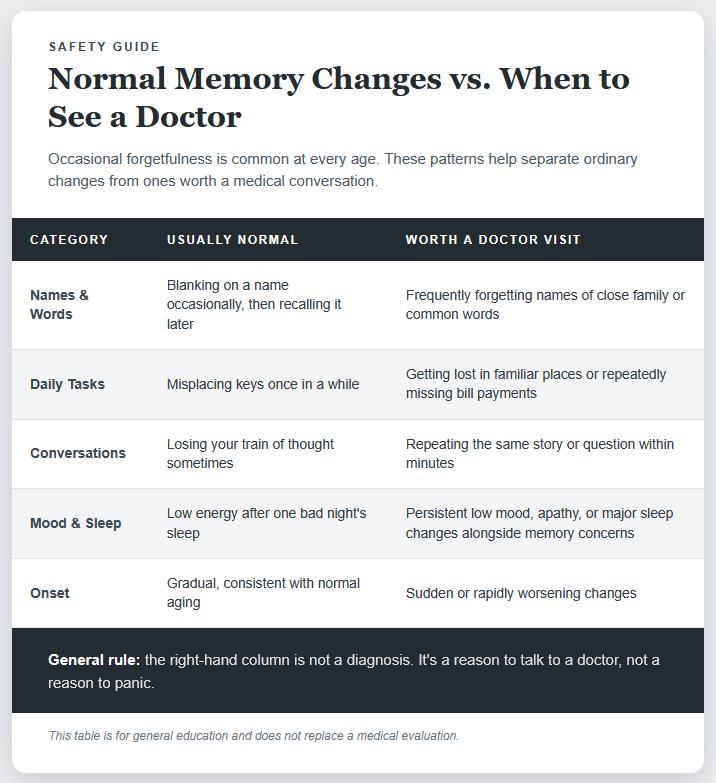
The distinction matters because treatable causes get missed when memory changes are assumed to be an unavoidable part of aging. A doctor can order bloodwork and a cognitive screening in a single visit, and ruling out a thyroid problem or a vitamin deficiency is far simpler than living with unnecessary worry.
Five Mistakes That Sabotage Your Memory Goals
- Going too hard, too fast sets most people up to quit. Pick one habit, build it for two weeks, and add another once it feels automatic.
- Skipping sleep to fit in a workout backfires. A well-rested brain learns better and focuses longer than a tired one that exercised. If you have to choose, choose sleep.
- Buying supplements instead of changing habits rarely helps. The supplement industry makes billions selling hope in a bottle, and for most people, food already provides what the brain needs.
- Assuming healthy eating means boring eating makes any diet hard to sustain. The MIND diet includes dark chocolate above 70% cocoa and daily coffee, both compatible with the eating pattern above.
- Measuring progress too soon leads people to quit early. Brain changes take months to show up reliably. Track whether you did the habit, not how you feel about it yet.
Memory Exercises That Actually Work
These exercises draw on the ACTIVE trial and related cognitive-training research.
Memory Training Exercises
- Learn a list of words, then recall them in order.
- Practice matching names to faces.
- Try the method of loci, sometimes called a memory palace, for holding onto ordered information.
- Play memory card games with increasing difficulty.

Reasoning Exercises
- Solve logic puzzles and riddles.
- Play strategy games like chess or Go.
- Work through Sudoku at increasing difficulty.
- Practice identifying patterns in sequences.
Processing Speed Exercises
- Use apps that require quick visual recognition.
- Play reaction-time games.
- Practice reading quickly while holding onto comprehension.
- Do timed mental math problems.
Mixing all three types keeps the brain engaged in different ways, and matches how the ACTIVE trial’s three training arms produced three separate, domain-specific benefits rather than one general one.
30-Day Memory Challenge Tracker
Use the interactive tracker below to check off daily and weekly goals across all five habits. Each week builds on the last, gradually increasing frequency and duration.
30-Day Memory Challenge Tracker
Check off each goal as you go. Your progress saves automatically.
Conclusion
The habit most people reach for first, cutting out sugar or buying a brain-training subscription, isn’t where the strongest evidence points to. Exercise and sleep did more in these studies than any single food or app, and they’re also the two habits people drop first when life gets busy. That’s worth consideration.
The Pittsburgh trial that this article opened with didn’t require a new supplement or a subscription. It required three walks a week and enough patience to wait a year for the scan. Most of what protects memory turns out to be unglamorous, repeatable, and already available to you tonight, tomorrow morning, and the next quiet hour you can find.
FAQs
How long before I notice results?
Most people notice better focus within 2-4 weeks. Memory improvements become clearer after 8-12 weeks, and brain structure changes take months. Better sleep and more movement tend to produce a feeling of alertness within the first two weeks, well before the slower changes arrive.
Can I do these habits if I’m young?
Yes. These habits protect the brain at any age, and starting early gives you decades of protection. The MIND diet benefits people in their 30s and 40s just as much as older adults.
What if I can’t exercise due to injury?
Talk to your doctor about safe options. Water aerobics and seated exercises can help, and swimming works especially well because it’s low-impact but still aerobic. Chair exercises, tai chi, and gentle yoga can also offer benefits.
Are brain training apps worth it?
Some are, particularly ones modeled on reasoning and speed-of-processing tasks, which is where the strongest long-term evidence sits. The evidence for memory-specific training holding up over years is weaker than the marketing for these apps often suggests. Look for programs with published research behind them rather than assuming any app will produce decade-long memory gains.
Do I need to follow the MIND diet perfectly?
No. Even moderate adherence cut Alzheimer’s risk by 35% in the Rush University study. Progress beats perfection. Start by adding brain-healthy foods before worrying about eliminating everything else.
Can these habits help if I already have memory problems?
They may help, but talk to your doctor first. Memory problems have many causes, and some are easily treated once identified, including thyroid disorders, depression, and vitamin deficiencies. These habits can support a treatment plan, but they shouldn’t replace medical care.
What’s the single most effective habit?
Sleep and exercise are about as close to tied for first place as any two habits here get, and both have outsized effects on brain health. If you can only change one thing, fix your sleep. Everything else becomes easier once you’re well-rested.
Do these habits prevent Alzheimer’s disease?
They reduce risk but don’t guarantee prevention. The Rush University MIND diet study showed up to a 53% risk reduction, and exercise and cognitive training show protective effects of their own. No lifestyle change eliminates Alzheimer’s risk completely, but these habits give the brain a real chance at staying healthy longer.
How much do genetics matter?
Genes influence risk, but lifestyle still matters enormously. Even people with genetic risk factors for Alzheimer’s benefit from healthy habits, since you can’t change your genes but you can change how they’re expressed.
Is it ever too late to start?
No. The exercise study included adults aged 55 to 80, and the ACTIVE cognitive-training study included participants up to age 94. The brain retains some capacity to change and adapt throughout life, so starting today beats waiting.
What are the 4 C’s of memory?
The 4 C’s (Concentration, Create imagery, Connect, and Continuous use) come from Kevin Horsley’s book Unlimited Memory rather than a clinical trial. It’s a popular mnemonic framework, not a peer-reviewed finding, but the underlying ideas, paying focused attention, forming vivid mental images, linking new information to what you already know, and repeating it over time, line up reasonably well with how memory researchers describe encoding and retrieval.
What is the 7-second trick to improve memory?
Versions of this claim circulate widely online, usually attached to a specific brain-training product, and the science behind the “7-second” framing hasn’t been verified in any study we could locate. A genuinely evidence-backed version of the underlying idea does exist: pausing for several seconds to consciously repeat or picture new information right after you encounter it, a technique called elaborative rehearsal, measurably improves the odds you’ll recall it later.