Studies show that eating blueberries every day for 12 weeks can lead to real, measurable gains in memory. This isn’t a maybe. It’s backed by multiple clinical trials. The key is knowing how to eat them, how much to eat, and why it works.
Why 12 Weeks Is the Sweet Spot
Twelve weeks — about 90 days — keeps showing up in blueberry research. It’s not random. It’s the window where the brain starts to respond in ways we can actually measure.
A 2018 study by Whyte and colleagues followed 37 older adults between the ages of 60 and 75. Half took a daily dose of wild blueberry powder. The other half took a placebo. After 12 weeks, the blueberry group showed clear gains in episodic memory. That’s the kind of memory that helps you recall specific events — like where you parked your car or what you had for dinner last Tuesday.
Another 12-week trial by McNamara and colleagues in 2018 confirmed this pattern. Forty adults aged 65 to 80 took the same 24-gram freeze-dried wild blueberry powder daily. The results? Better episodic memory and sharper executive function. Executive function is your brain’s ability to plan, focus, and make good decisions.
So why does 12 weeks matter? Think of it like watering a plant. A single glass of water won’t do much. But consistent daily watering over weeks — that’s when roots grow. The brain needs time to absorb blueberry compounds and build up their effects. Twelve weeks is when that buildup hits a tipping point.
Who Benefits the Most?
Adults aged 60 to 75 see the strongest results in these studies. People with Mild Cognitive Impairment — or MCI — also show meaningful gains. MCI is an early stage of memory trouble. It’s not full dementia, but it’s a sign that the brain needs support.
A 2018 study by Boespflug and colleagues looked at 13 adults aged 65 and older who had MCI. After 16 weeks of daily freeze-dried blueberry powder (equal to about 1 cup of fresh blueberries), these participants showed increased brain activity in regions tied to memory. Their actual memory performance also improved, though modestly.
The takeaway: if you’re over 60 — or if memory trouble runs in your family — blueberries are worth your attention.
How Blueberries Actually Change Your Brain
Most people have heard that blueberries are “good for the brain.” But the why behind that claim is far more interesting than the claim itself.
The Pigment That Does the Heavy Lifting
Blueberries get their deep blue color from a group of compounds called anthocyanins. These are a type of flavonoid — a plant pigment with powerful health effects. Anthocyanins are the stars of this story.
What makes them special? Research suggests that anthocyanins — or their metabolites — can reach the brain and interact with neural tissue. The blood-brain barrier is the tight wall of cells that protects your brain from harmful substances in your blood. Most compounds can’t get through. Scientists are still mapping exactly how anthocyanins cross into brain tissue. But the cognitive benefits are well-documented. Once these compounds get to work, the results speak for themselves.
Blood Flow Is the Key
Here’s something most people miss: blueberries don’t just fight damage inside the brain. They improve how blood reaches it.
The McNamara 2018 study found that 12 weeks of wild blueberry powder didn’t just boost memory scores. It also improved vascular function — meaning blood vessels were working better. Better blood flow means more oxygen and nutrients reach the brain’s neurons every single day.
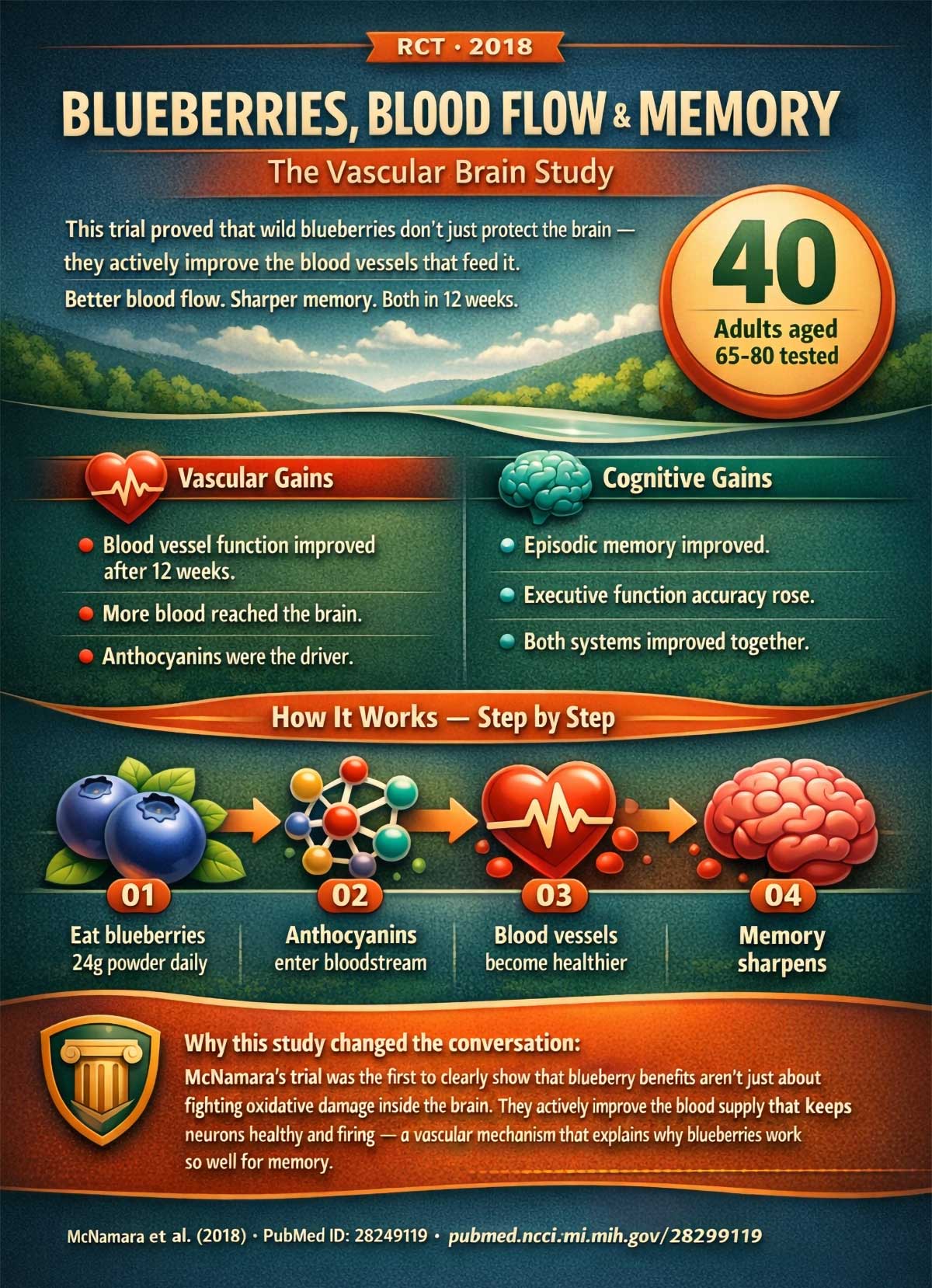
Think of your brain as a city. Neurons are the people living there. Blood vessels are the roads. If the roads are clogged or damaged, fewer supplies get through. Blueberry anthocyanins help keep those roads open and flowing smoothly. And when blood flow improves, the hippocampus — the brain region most tied to memory — benefits directly.
What Happens Inside the Brain
The Boespflug 2018 study used fMRI scans — a way to see which parts of the brain are active — to watch blueberry supplementation in action. After weeks of daily intake, participants showed more brain activity during memory tasks. The brain was literally firing up more in the areas that handle cognitive processing.
This is a big deal. It means blueberries aren’t just protecting what’s already there. They’re helping the brain do its job better, right in the moment.
Helping the Brain Grow New Connections
There’s an even deeper layer to this. Animal research suggests that blueberry compounds may support neuroplasticity — the brain’s ability to form new connections between neurons. This hasn’t been directly observed in living human brains yet. But the steady memory gains seen across human trials suggest something similar may be happening.
Picture your neurons as trees. Over time, those trees can grow new branches. Each branch is a potential connection to another neuron. More connections mean faster thinking and better recall — a stronger mind overall. Blueberry anthocyanins appear to encourage this kind of “brain branching.” It’s one reason why the effects of blueberries build up over weeks, not days.
The Dosage Guide: How Much Do You Actually Need?
This is where most health articles fall short. They say “eat more blueberries” and leave it at that. But the research uses very specific amounts. Here’s what the studies actually show.
The Clinical Gold Standard
The dose that shows up again and again in successful trials is 24 grams of freeze-dried wild blueberry powder per day. That’s the amount used in both the Whyte 2018 and McNamara 2018 studies. Both showed clear memory improvements at this dose.
24 grams of freeze-dried powder is roughly equal to 1 cup of fresh blueberries. So if you prefer whole fruit, aim for about a cup a day.
Wild vs. Farmed: Which One Wins?
Not all blueberries are created equal. There are two main types:
Wild blueberries (also called lowbush blueberries) are smaller and darker. They grow in the wild, mostly in places like Maine and Canada. Their small size means more skin per berry — and the skin is where anthocyanins live. Wild blueberries pack a higher concentration of anthocyanins per serving than their cultivated cousins.
Cultivated blueberries (also called highbush blueberries) are the larger, more common kind you find at most grocery stores. They’re still nutritious. But gram for gram, they have fewer anthocyanins than wild varieties.
The clinical trials that showed the strongest results used wild blueberry powder. If you can find wild blueberries — fresh, frozen, or as a powder — they’re the better choice for brain health.
That said, don’t let it stop you if wild blueberries aren’t available. Cultivated blueberries still contain anthocyanins. They’re just not as concentrated as wild varieties. Some blueberry is always better than none.
What About Blueberry Juice?
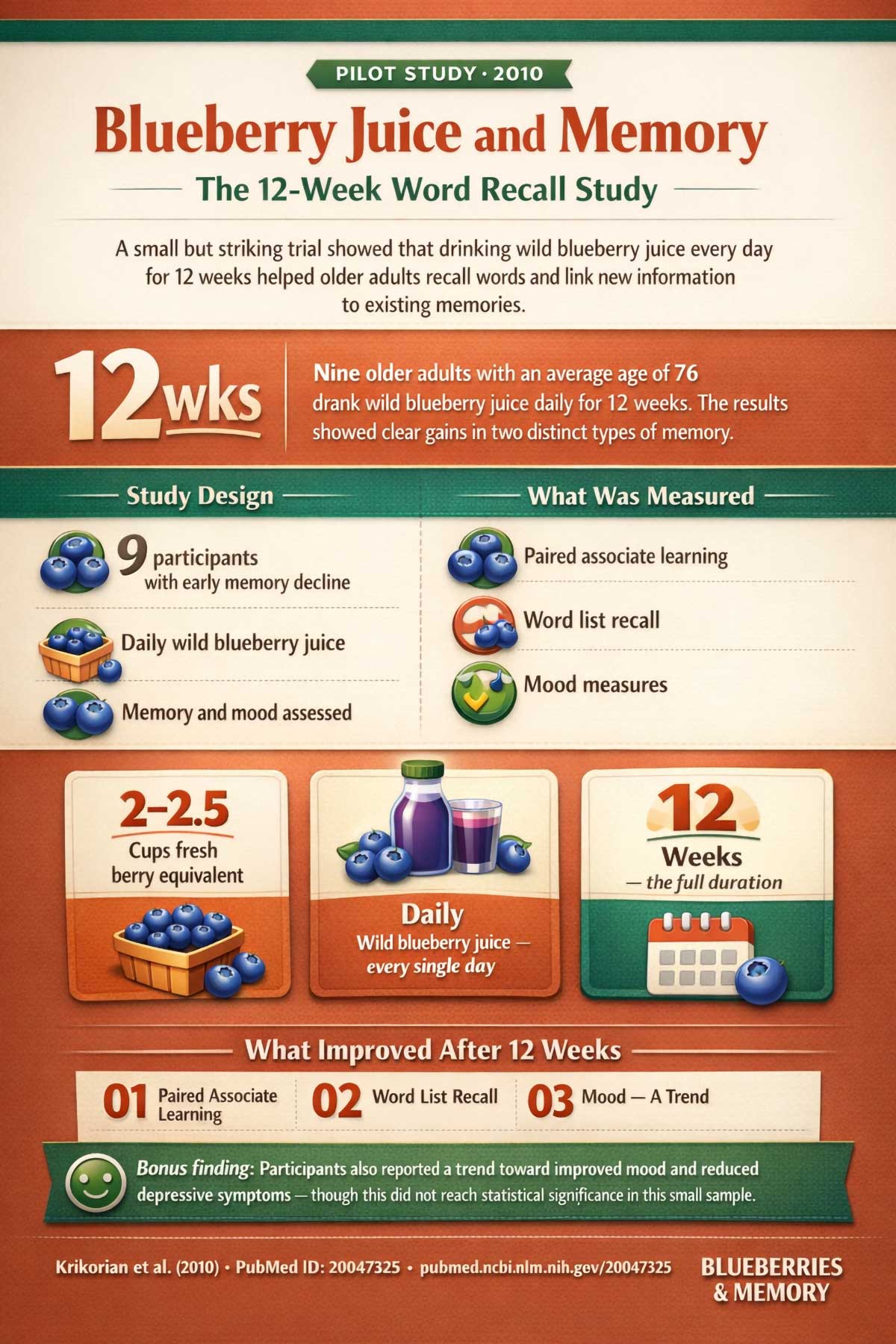
Juice is a valid option, too. A 2010 study by Krikorian and colleagues gave 9 older adults (average age 76) daily wild blueberry juice. The amount was equivalent to about 2 to 2.5 cups of fresh berries. After 12 weeks, participants showed improved paired associate learning — that’s the ability to link two things together in your memory, like matching a face to a name. Word recall also got better.
The catch? Juice has more sugar and fewer fiber than whole fruit. If you go the juice route, look for juice made from wild blueberries with no added sugar.
Clinical dose: This matches the 24g freeze-dried powder used in successful 12-week memory trials (Whyte 2018, McNamara 2018).
5 Ways Your Memory Gets Better After 12 Weeks
The research points to five specific types of memory improvement. Each one shows up in the studies mentioned above.
1. Sharper Episodic Memory
Episodic memory is your ability to recall specific past events — when and where they happened. This is the type of memory that improved most consistently in blueberry trials. The Whyte 2018 and McNamara 2018 studies both showed significant gains here after 12 weeks of daily supplementation.
In plain terms: recalling specific events from your past becomes easier.
2. Faster Word Recall
You know the feeling. A word is right on the tip of your tongue. You know you know it. But it just won’t come. That’s a word recall failure.
Blueberry supplementation appears to reduce these moments. The Krikorian 2010 study showed improved word list recall after 12 weeks of daily wild blueberry juice. The brain’s ability to pull up words quickly gets a boost.
3. Better Executive Function
Executive function isn’t just one skill. It’s a group of skills: planning, focusing, and making good decisions under pressure. The McNamara 2018 study found that 12 weeks of wild blueberry powder improved accuracy on executive function tasks.
Think of executive function as your brain’s project manager. Blueberries help that manager do a better job.
4. Improved Paired Associate Learning
Paired associate learning is a mouthful, but the concept is simple. It’s your brain’s ability to link two pieces of information together. A name and a face. A date and an event. A place and a memory.
The Krikorian 2010 study found clear improvements in this skill after 12 weeks of blueberry juice. This type of learning is foundational to how we build and use memories every day.
5. A Buffer Against Long-Term Decline
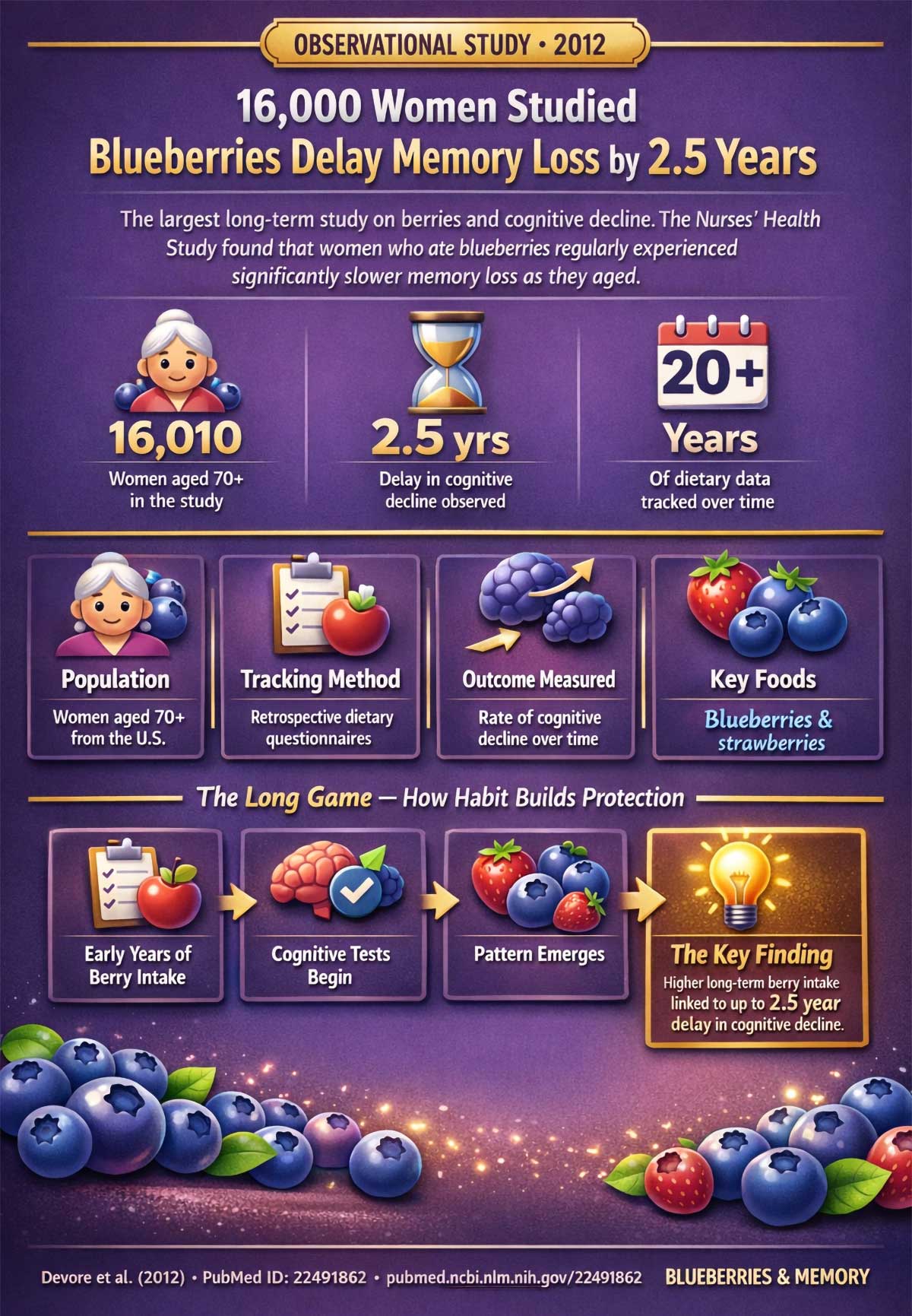
This one is about the big picture. A large study by Devore and colleagues in 2012 followed over 16,000 women aged 70 and older. Women who ate more blueberries and strawberries over the long term showed slower rates of cognitive decline. The difference? Up to 2.5 years of delay in age-related memory loss.
That’s not a small number. That’s years of sharper thinking. And it came from a habit — not a single dose.
How to Make Blueberries a Daily Habit
Knowing the science is step one. Actually eating blueberries every day is step two. Here’s how to make it stick — and how to get the most out of every bite.
Why Every Day Matters
Eating blueberries once a week won’t cut it. The studies that worked used daily supplementation. The brain needs a steady supply of anthocyanins to maintain and build on its benefits. Think of it like brushing your teeth. Doing it once a week won’t protect your smile. Doing it every day will.
Consistency is the single most important factor here. A small amount every day beats a large amount once in a while.
How to Prepare Blueberries Without Wasting Their Power
Anthocyanins are somewhat fragile. High heat can break them down. Here are some simple rules to keep their benefits intact:
Avoid prolonged high heat. Baking blueberries into muffins or pies at high temperatures for a long time degrades their anthocyanin content. A quick bake is less damaging than a long one, but fresh or frozen is still better for preserving these compounds.
Frozen works just as well as fresh. Freezing preserves anthocyanin content well. Frozen wild blueberries are often cheaper and easier to find year-round than fresh ones. Stock up and keep them in your freezer.
Skip the added sugar. Sugar doesn’t destroy anthocyanins directly, but it adds empty calories and can spike blood sugar. Choose plain blueberries or products with no added sugar.
Pair them with healthy fats. Fats help your body absorb certain nutrients from blueberries more effectively. Walnuts are a great pairing — they also contain omega-3 fatty acids, which are good for the brain on their own.
Three Easy Ways to Eat Blueberries Every Day
The 1-Minute Smoothie. Blend 1 cup of wild blueberries (fresh or frozen) with a handful of walnuts, a scoop of protein powder if you like, and enough milk or water to blend. Done in under two minutes. No cooking. No heat. Full anthocyanin power.
Overnight Oats. The night before, mix oats with milk (dairy or plant-based), a spoonful of chia seeds, and a pinch of cinnamon. Put it in the fridge. In the morning, top it with a cup of fresh or thawed blueberries. No heating required for the berries.
Freeze-Dried Powder. If fresh blueberries aren’t available — or if you want precision — freeze-dried wild blueberry powder is a solid option. Stir 24 grams into water, yogurt, or a smoothie. It’s shelf-stable, easy to travel with, and delivers the same dose used in clinical trials.
Beyond 12 Weeks: Playing the Long Game
Twelve weeks is where the initial gains show up. But the real payoff comes from sticking with it for months — and years.
Slowing the Clock on Memory Loss
The Devore 2012 study is the strongest evidence we have for long-term benefits. Over 16,000 women. Years of dietary data. The conclusion was clear: habitual blueberry and strawberry intake was linked to a delay of up to 2.5 years in cognitive decline.
That means the longer you make blueberries a part of your diet, the more protection your brain builds up. It’s not a one-time fix. It’s a long-term strategy.
Blueberries and the MIND Diet
Blueberries aren’t the only food that protects the brain. The MIND diet — short for Mediterranean-DASH Intervention for Neurodegenerative Delay — is an eating pattern specifically designed to support brain health. And blueberries are one of its cornerstone foods.
The MIND diet also includes leafy greens, fish, olive oil, nuts, and whole grains. Blueberries fit right in. Eating them daily isn’t just a standalone habit. It’s a piece of a bigger, well-researched puzzle.
Conclusion
Blueberries are small. They’re sweet. And they may be one of the most effective foods for protecting your memory as you age.
The science is clear on the basics: eat about 1 cup of fresh blueberries a day (or 24 grams of freeze-dried powder). Do it every day. Keep it up for at least 12 weeks. And if you can make it a lifelong habit, the payoff could be measured in years of sharper thinking.
Wild blueberries are the best option if you can find them. Fresh, frozen, or powdered — any form works, as long as you don’t destroy the anthocyanins with high heat.