The biggest surprise wasn’t whether dark chocolate helped. It was how quickly some changes appeared, which benefits took longer, and what never happened at all.
In 2008, researchers at Brigham and Women’s Hospital gave thirty-four people in their seventies a daily dose of flavanol-rich cocoa and pointed an ultrasound probe at the arteries feeding their brains. Within a week, blood flow through the middle cerebral artery had climbed measurably.
That finding, published by neurologist Farzaneh Sorond and her colleagues, kicked off a small but persistent body of research into what cocoa flavanols do inside an aging brain. Some of it holds up well. Some of it doesn’t hold up at all, and one prominent research foundation says plainly that the long-term evidence is thinner than headlines suggest.
How Cocoa Flavanols Actually Work
Dark chocolate contains a family of plant compounds called flavanols, chiefly epicatechin, catechin, and larger molecules called procyanidins. Your body absorbs them within about 30 minutes of eating chocolate.
Once in the bloodstream, flavanols trigger the production of nitric oxide in the lining of your blood vessels. Nitric oxide relaxes vessel walls, which widens them and lets more oxygen-rich blood reach active tissue, including the brain regions that handle memory and attention.
It’s the same mechanism that makes flavanol-rich foods useful for cardiovascular health generally. The brain simply happens to be one of the largest downstream beneficiaries of that improved flow.
There’s a second pathway worth knowing about. Theobromine, the stimulant compound unique to cocoa, appears to raise levels of brain-derived neurotrophic factor, or BDNF, a protein that supports the growth and survival of neurons.
Researchers at the University of Reading found that older adults who drank a high-flavanol cocoa beverage daily for twelve weeks showed significantly higher serum BDNF than a low-flavanol control group, and the increase tracked with better scores on cognitive tests. That’s a slower-building effect than the blood flow changes. It takes weeks of consistent intake, not hours.
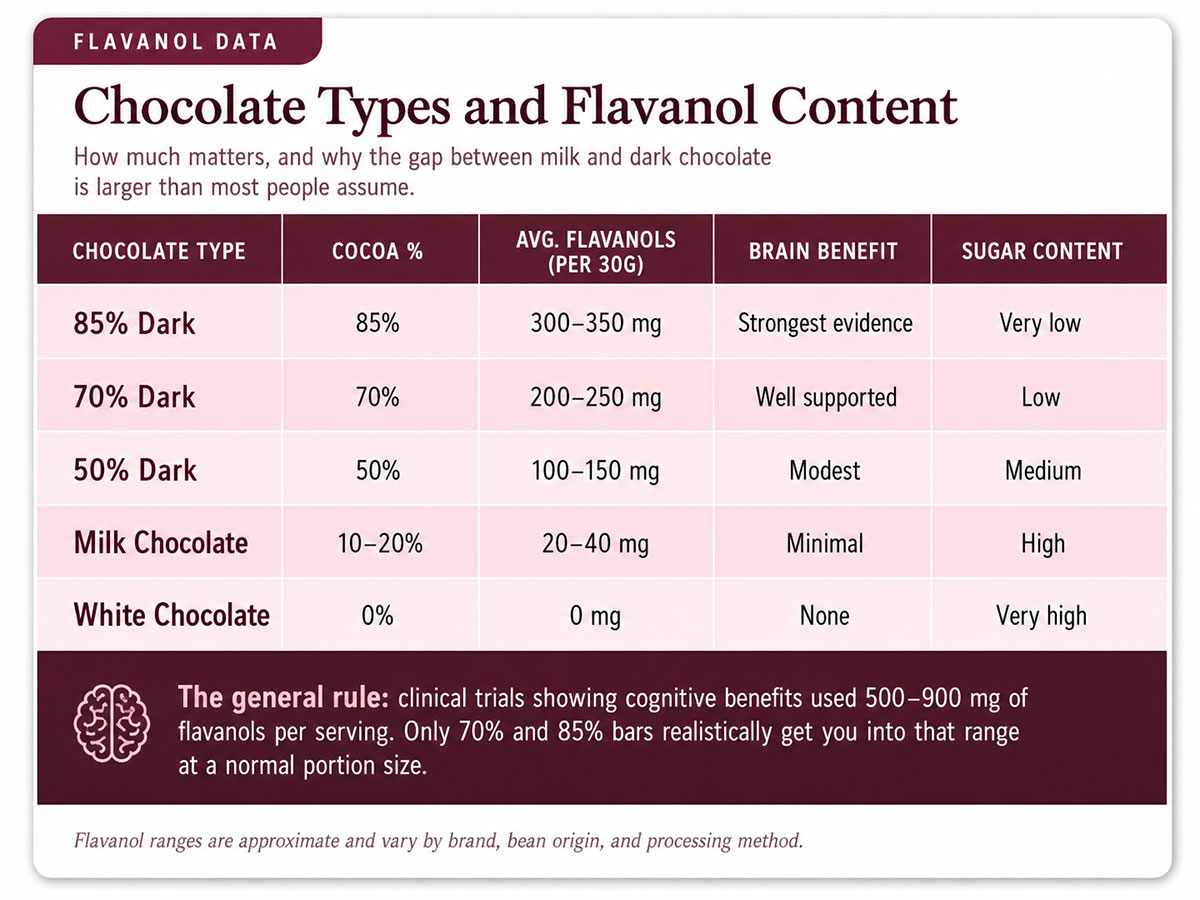
Dark chocolate carries roughly five times the flavanol content of milk chocolate. That gap is the entire reason percentage matters more than brand loyalty or surface-level bitterness when you’re shopping for brain benefits.
Choosing Chocolate That Actually Delivers Flavanols
Most bars on a grocery shelf won’t get you there. The clinical trials that found cognitive benefits used doses between 500 and 900 milligrams of flavanols per serving.
A 70% dark chocolate bar delivers roughly 200 to 250 milligrams per 30-gram portion. An 85% bar pushes that closer to 300 to 350 milligrams. Milk chocolate barely registers.
Two label details matter more than the marketing copy. First, the ingredient list should be short, led by cocoa mass or cocoa liquor, then cocoa butter, with sugar low on the list. Second, skip anything marked “Dutch-processed” or “alkalized.”
A 2008 study in the Journal of Agricultural and Food Chemistry found that alkalization strips 60 to 90% of a cocoa powder’s flavanol content, depending on how heavily it’s processed. Look for “natural cocoa” instead.
Heat is the other flavanol killer. Store your bar somewhere cool and dark, between 60 and 70°F. Skip the fridge. Moisture there causes the white bloom that makes chocolate look old even when it isn’t.
Find Your Brain-Boosting Chocolate
Five quick questions, a match built around real flavanol data
Your Match
Portion, Timing, and Cost
One to two squares daily, roughly 20 to 30 grams, delivers a meaningful flavanol dose without derailing your calorie count. Picture a single square as about the size of two stacked postage stamps.
Absorption plateaus around 300 milligrams of flavanols. Past that point, extra chocolate mostly adds calories rather than brain benefits.
Morning or early afternoon consumption works best if you’re sensitive to stimulants. A 30-gram serving carries 20 to 30 milligrams of caffeine, about a quarter of a coffee cup, plus theobromine that releases more slowly than coffee’s jolt.
If you’re not caffeine-sensitive, evening is fine too. Cut off by 2 p.m. if you notice any sleep disruption.
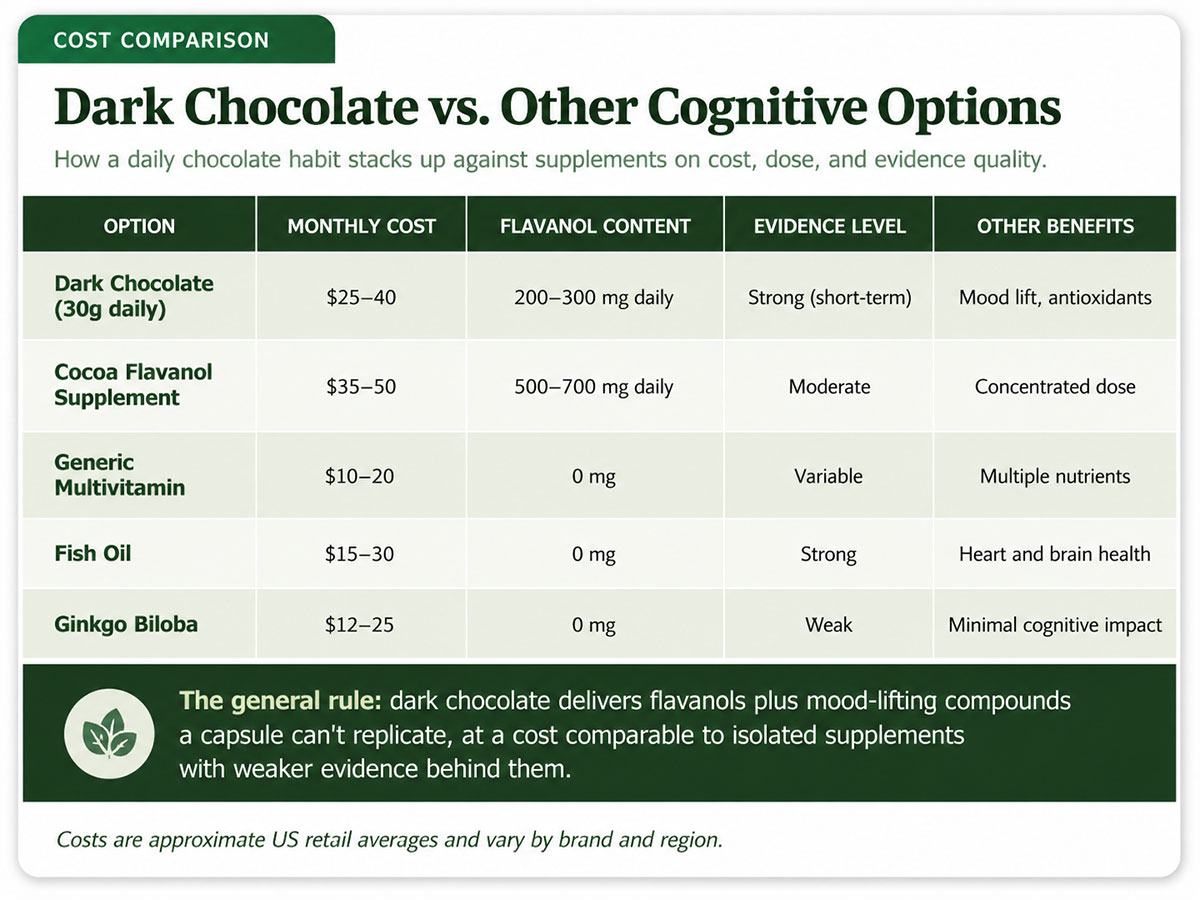
Dark chocolate’s advantage over isolated flavanol supplements goes beyond price. It delivers mood-lifting compounds like phenylethylamine alongside the flavanols, something a capsule can’t replicate.
Common Mistakes That Cancel Out the Benefits
A 50% bar is candy wearing a health halo. Half of it is sugar. Check the percentage on the front, and if it doesn’t say, put it back.
More isn’t better either, since absorption caps around 300 milligrams of flavanols per serving. Pairing chocolate with sugary snacks is its own trap: a blood sugar spike triggers inflammation that directly counteracts the flavanols’ effect. Pair with nuts, fruit, or plain coffee instead.
And don’t expect results by Tuesday. Mood shifts can show up on day one. Measurable cognitive change takes longer because brain tissue needs weeks to respond to a new intake pattern, not days.
The 30-Day Timeline: What Actually Changes
Four weeks isn’t an arbitrary length. It’s roughly how long it takes flavanols to move from an acute blood-flow effect to something closer to a structural one. But the four weeks don’t unfold identically, and treating them as an evenly spaced staircase misrepresents the research.
Week 1: The Blood Flow Actually Moves First
Sorond’s 2008 trial found the fastest, cleanest effect in this entire body of research: mean blood flow velocity in the middle cerebral artery rose 8% within one week of daily flavanol-rich cocoa, and 10% by the second week. That’s not a subjective impression. It’s a transcranial Doppler ultrasound reading.
You likely won’t measure your own cerebral blood flow, but you may notice its downstream effects. Tasks that require sustained attention can start feeling less effortful within the first few days, like someone turned up the brightness slightly.
Some people report a mild headache on day one or two as vessels adjust. It passes. Stay hydrated.
The mood lift arrives fastest of all. Phenylethylamine in chocolate triggers dopamine release almost immediately, which explains why day-one mood changes are common even before any measurable cognitive shift.
Sharper Focus, Lower Cortisol
By the second week, the mechanism shifts from acute vessel dilation to something slower: inflammation reduction and stress hormone changes.
Researchers at the Nestlé Research Center gave thirty adults 40 grams of dark chocolate daily for two weeks in 2009 and found reduced urinary excretion of cortisol and catecholamines, particularly in participants who rated themselves as highly stressed going in. Lower cortisol supports better focus and memory formation, since chronically elevated stress hormones interfere with both.
That mid-afternoon brain fog tends to lift around this point as well. Work that used to require several coffee breaks starts flowing with fewer interruptions.
A cortisol drop doesn’t announce itself the way a lifting headache does. The change still shows up in the biology, whether or not you feel it.
Where the Research Gets More Interesting: Memory and Learning
By week three, flavanols have had time to accumulate in the hippocampus, the seahorse-shaped structure that handles learning and memory formation. This is where a genuinely well-designed trial gives the clearest picture.
Field, Williams, and Butler ran thirty healthy adults through a crossover trial in 2011, giving each person 720 milligrams of cocoa flavanols in dark chocolate on one occasion and a matched dose of white chocolate on another, and found improved visual spatial working memory and choice reaction time relative to the control.
A larger, longer trial points in the same direction. Daniela Mastroiacovo and colleagues followed ninety elderly subjects for eight weeks in 2015 as part of the Cocoa, Cognition, and Aging study, and the two higher-dose groups showed clear gains in attention, processing speed, and verbal fluency. The lowest dose group didn’t.
Over a full 30-day period at 20 to 30 grams daily, cumulative flavanol intake lands somewhere between 6,000 and 9,000 milligrams, well inside the range both trials used to see benefits.
Try a fifteen-word recall test this week. Look at the list for 60 seconds, close your eyes, and recall as many as you can. Most people improve by three to five words compared to their first attempt.
Week 4: Where the Evidence Gets Interesting
This is also where the story gets more complicated, and it’s worth sitting with that rather than smoothing it over.
Adam Brickman and colleagues at Columbia published a widely cited 2014 trial in Nature Neuroscience. Fifty to sixty-nine-year-olds who drank a high-flavanol cocoa beverage daily for three months showed increased cerebral blood volume specifically in the dentate gyrus, a hippocampal region that typically weakens with age, along with better performance on a memory task tied to that same region.
Lead author Scott Small described it this way to reporters: a participant who started with the memory profile of a typical 60-year-old often tested closer to a 30- or 40-year-old by the end.
That’s a genuinely striking three-month result, but it isn’t proof that daily chocolate prevents Alzheimer’s disease, and the Alzheimer’s Drug Discovery Foundation’s Cognitive Vitality program says so directly: large controlled trials, it notes, have not found a direct benefit for brain health, cognition, or dementia risk, even though safety concerns are minor.
A separate 2022 study from Rush University’s Memory and Aging Project followed roughly 900 older adults for close to seven years and found that people with the highest intake of dietary flavonols, a broader compound category found in tea, berries, and leafy greens as well as cocoa, showed a modestly slower rate of cognitive decline than those with the lowest intake.
Modestly is the operative word. It was not a dramatic effect, and it measured a different, wider category of compounds than cocoa flavanols specifically.
The honest summary sits between those two findings. Short-term, mechanism-level evidence for blood flow and memory is strong and repeatedly replicated. Long-term, population-level evidence for dementia prevention specifically is thin and mixed. Both things are true at once.
Whatever you’re feeling by day 30, it’s a snapshot of a mechanism that’s well understood, sitting on top of a longer-term question that isn’t settled yet.
Dark Chocolate vs. Milk Chocolate: Does the Difference Actually Matter?
It does, and the gap is larger than most people assume. Milk chocolate typically contains 10 to 20% cocoa solids, which puts its flavanol content at roughly a tenth of what a 70% dark bar provides. Milk proteins may also bind to flavanols in the gut and reduce how much your body actually absorbs, a mechanism researchers are still working out the details of.
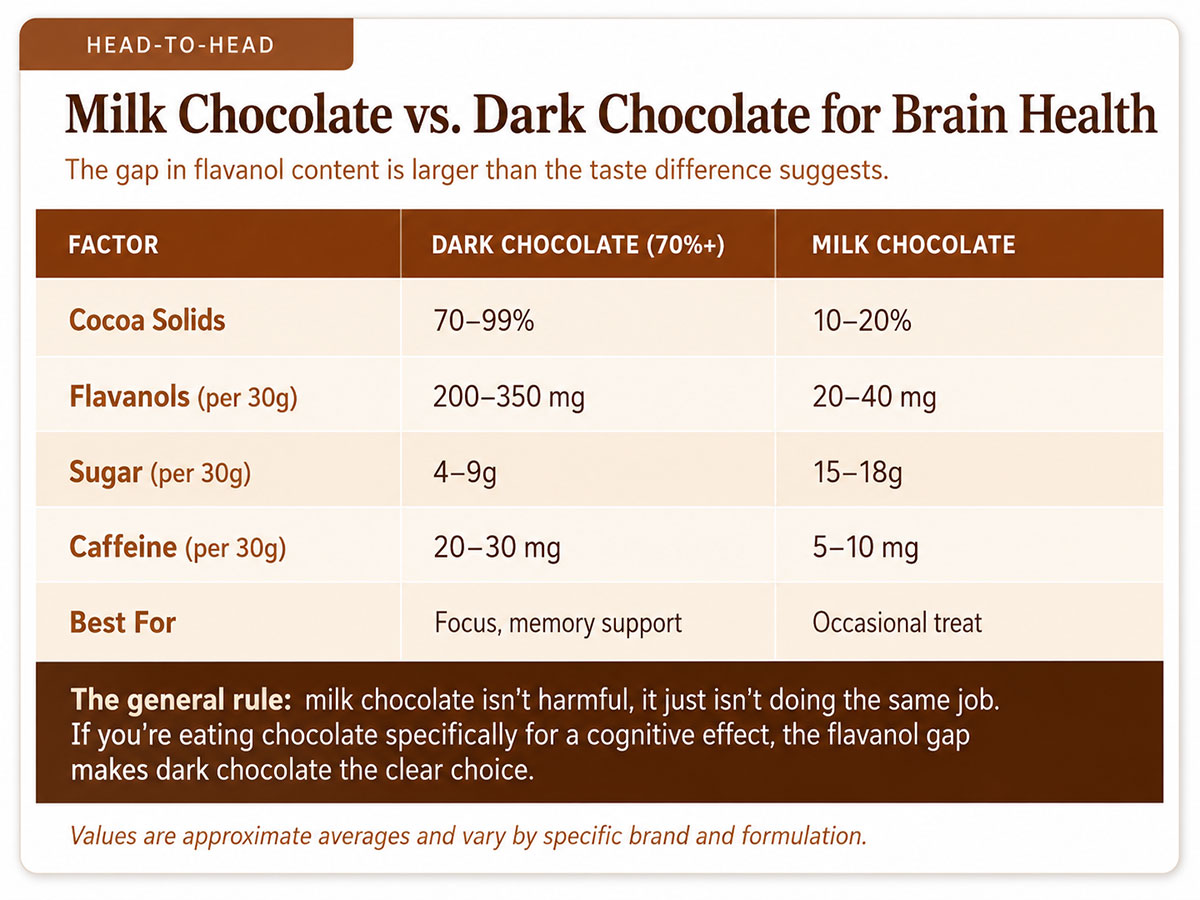
If you’re choosing chocolate specifically for a study session or a mentally demanding afternoon, the flavanol gap makes dark chocolate the clear pick. If you’re eating chocolate purely for pleasure, that’s a different, entirely legitimate reason to reach for milk instead.
Brain-Boosting Dark Chocolate Recipes
Eating the same square every day gets old fast. These five keep the flavanol dose intact while changing the format.
Morning Focus Smoothie
Ingredients:
- 1 square 85% dark chocolate, roughly chopped
- 1 cup unsweetened almond milk
- 1 frozen banana
- 1 tbsp almond butter
- Handful of fresh spinach
- 1 tsp flax seeds
- 4-5 ice cubes
Instructions:
- Melt the chocolate in the microwave for 15 seconds.
- Add all ingredients to a blender.
- Blend on high for 45 seconds until smooth.
- Pour and drink right away.
Why it works: Almond butter’s fat helps flavanol absorption, and at 280 calories this is the one worth building a morning around if you’ve got a demanding stretch of work ahead.
Energy-Sustaining Protein Bites
Ingredients:
- 1 cup Medjool dates, pitted
- 1/2 cup raw walnuts
- 3 squares 85% dark chocolate, finely chopped
- 2 tbsp unsweetened cocoa powder
- 1 tbsp chia seeds
- Pinch of sea salt
- 1 tsp vanilla extract
Instructions:
- Process dates and walnuts until crumbly.
- Add chocolate, cocoa powder, chia seeds, salt, and vanilla.
- Process until the mixture sticks together when pressed.
- Roll into 12 balls, about an inch each.
- Refrigerate in an airtight container for up to two weeks.
Why it works: At about 85 calories a bite, these travel well for an afternoon energy dip. Walnuts bring omega-3s into the mix too, working through a different mechanism than flavanols, strengthening cell membranes rather than blood flow.
Evening Wind-Down Hot Cocoa
Ingredients:
- 2 tbsp high-quality unsweetened cocoa powder, not Dutch-processed
- 1 cup warm milk, dairy or plant-based
- 1 small square 85% dark chocolate, chopped
- 1 cinnamon stick
- Stevia or monk fruit to taste, optional
- Tiny pinch of sea salt
Instructions:
- Warm milk over medium heat without letting it boil.
- Whisk in cocoa powder until dissolved.
- Add chopped chocolate and stir until melted.
- Drop in the cinnamon stick and steep for 2 minutes.
- Sweeten if you like, add the salt, and pour.
Why it works: This is the lightest of the five at about 150 calories, and the one to skip if you’re within two hours of bed. Caffeine sensitivity varies more than people expect.
Brain-Boosting Trail Mix
Ingredients:
- 2 squares 85% dark chocolate, chopped
- 1/4 cup raw almonds
- 1/4 cup raw walnuts
- 2 tbsp unsweetened dried blueberries
- 1 tbsp pumpkin seeds
- 1 tbsp cacao nibs
Instructions:
- Combine everything in a jar.
- Shake to mix.
- Store in the pantry for up to a week.
Why it works: A quarter cup delivers roughly one square’s worth of flavanols, plus the added antioxidants in blueberries. Good for a desk drawer stash when the urge to snack outpaces the desire to plan ahead.
Dark Chocolate Oatmeal
Ingredients:
- 1/2 cup rolled oats
- 1 cup water or milk
- 1 square 85% dark chocolate, chopped
- 1 tbsp almond butter
- 1/2 banana, sliced
- Sprinkle of cinnamon
- 1 tsp honey, optional
Instructions:
- Cook oats according to package directions.
- Remove from heat and stir in the chopped chocolate until melted.
- Top with almond butter, banana, and cinnamon.
- Drizzle with honey if you want it.
Why it works: Make this one before something that actually matters, an exam, a presentation, a long morning. Oats keep it low-glycemic, so there’s no sugar crash to undercut the flavanol benefit. About 320 calories.
Foods That Strengthen the Effect
None of these are required. Pairing chocolate with the right foods can meaningfully increase the payoff.
Berries, especially blueberries and strawberries, contain anthocyanins that work alongside flavanols to protect neurons, and the vitamin C in berries improves how well your body absorbs flavanols in the first place.
Green tea supplies its own catechins, plus L-theanine, which balances chocolate’s mild stimulation with a calmer kind of focus. Wait about 30 minutes after eating chocolate before you drink it.
Nuts like walnuts and almonds bring healthy fats that help flavanol absorption. Six to eight nuts alongside your chocolate is plenty.
Omega-3-rich fish works on an entirely different pathway. Omega-3s strengthen cell membranes while chocolate improves blood flow, so the two complement rather than duplicate each other. Aim for fish three to four times a week.
Beets are high in nitrates, which also raise nitric oxide production and strengthen chocolate’s vasodilating effect. Avocado adds monounsaturated fats that support blood flow along a similar path. Leafy greens bring folate and vitamin K, working through mechanisms distinct enough from flavanols that the combination protects better than either alone.
Life After Day 30
The initial experiment is over. Keep the habit at 1 to 2 squares daily rather than treating day 31 as a free pass to finish the bar. Consistency, not quantity, is what carries the benefits forward, and some research suggests cognitive improvements continue accumulating toward a three-month mark before plateauing.
Miss a day or two, and nothing much happens. Flavanol levels dip slightly, but the benefits don’t reset like a fasting streak. This isn’t that kind of habit.
Miss a full week and progress plateaus rather than reverses. Stop entirely, and effects fade over two to three weeks, with blood flow advantages lasting longest and memory gains fading first. Most people who restart notice mood and focus improvements again within three to four days.
Safety Considerations
Dark chocolate adds 100 to 150 calories daily. If that matters for your goals, cut elsewhere rather than skipping the chocolate. Swap out a less useful snack, or add fifteen minutes of walking to offset it.
Caffeine sensitivity is worth watching. Twenty to thirty milligrams per 30-gram serving isn’t much on its own, but stacked on top of three cups of coffee, it can tip some people into jitteriness or sleep trouble. If that happens, move chocolate to the morning, cut your coffee back slightly, or drop to one square.
Sugar matters for blood sugar management even in high-percentage bars. An 85% bar still carries 5 to 6 grams of sugar per 30-gram serving. Pairing chocolate with protein or fat slows absorption, and 90% chocolate cuts sugar content further if you’re managing blood glucose closely.
The migraine connection is more contested than most articles let on. A commonly cited figure holds that up to 22% of migraine sufferers name chocolate as a trigger, but a 2020 review in the journal Nutrients that pooled 25 studies found reported trigger rates ranging from 1.3% to 33%, depending entirely on study design.
Every controlled provocation trial, including double-blind chocolate-versus-carob comparisons, failed to find a real causal link once craving and recall bias were accounted for. One interpretation gaining traction among headache researchers: chocolate cravings may be an early symptom of the pre-migraine phase rather than a trigger of it, meaning people reach for chocolate because a migraine is already starting, not the other way around.
If you’re migraine-prone, the honest approach is still to track your own pattern for a couple of weeks rather than assume either story applies to you.
Who Should Be More Cautious
People prone to oxalate kidney stones should cap intake at around 20 grams daily and drink extra water. The MAOI interaction catches more people off guard: chocolate’s tyramine content can interact with those medications, and it’s not the first thing either drug’s warning label calls out.
GERD sufferers may find that chocolate relaxes the lower esophageal sphincter and worsens reflux, particularly within a few hours of lying down. Cocoa naturally contains nickel, which can trigger reactions in people with nickel sensitivity.
Moderate intake, around one square daily, is generally considered safe in pregnancy, though more than 40 grams daily isn’t recommended.
Conclusion
Sorond’s ultrasound probe found something real in that Boston lab in 2008: blood moving differently through aging arteries within a week of a food most people think of as indulgence rather than intervention.
Three studies later, a Columbia researcher was telling reporters that a 60-year-old’s memory could start resembling a 40-year-old’s after three months of the same habit.
None of that adds up to a guarantee against dementia, and the researchers who study this most closely are the first to say so. Dark chocolate is a well-evidenced, short-to-medium-term cognitive tool with a genuinely uncertain long-term ceiling. That’s a stronger, more honest claim than “brain food,” and it happens to be the one the evidence actually supports.
Quick Reference: At-a-Glance Dark Chocolate Checklist
Before You Buy:
- 70% minimum cocoa content, 85% ideal
- Short ingredient list, cocoa mass or liquor listed first
- “Natural” or “non-alkalized” on the label
- No vegetable oils or artificial flavors
Daily Routine:
- 1 to 2 squares, 20 to 30 grams
- Morning or early afternoon timing if caffeine-sensitive
- Pair with nuts, berries, or plain coffee
- Store cool and dark, never the fridge
Red Flags, When to Stop or Adjust:
- Sleep disruption
- Jitteriness or anxiety
- A noticeable uptick in migraines
- Digestive upset
Cumulative Flavanol Intake Over 30 Days
Based on 20–30g of 70–85% dark chocolate consumed daily
FAQs
Can I eat dark chocolate if I have migraines?
The trigger link is weaker than commonly claimed. A 2020 review of 25 studies in the journal Nutrients found reported trigger rates ranging from 1.3% to 33%, and no controlled provocation study has confirmed a causal effect. Start with half a square and track your headaches for two weeks. If nothing correlates, you’re likely in the clear.
Will this work if I’m already taking brain supplements?
Yes, largely because flavanols work through a different pathway than most supplements. Fish oil targets cell membranes, ginkgo biloba may affect blood viscosity, though the evidence is weak, and B vitamins support neurotransmitter production.
Flavanols mainly improve blood flow and reduce inflammation, so they complement rather than duplicate what you’re already taking. One caveat: stacking chocolate with high-dose vitamin E, 400 IU or more daily, may push your combined antioxidant load higher than necessary. Check with your doctor if that applies to you.
What if I don’t like the bitter taste?
Start at 70% rather than 85%. Taste buds adapt over two to three weeks, and most people find 85% palatable after a month of regular exposure. Letting chocolate melt slowly rather than chewing it softens the bitterness, and pairing it with coffee or a few berries helps too.
Is organic chocolate better for brain health?
Not automatically. Organic certification limits synthetic pesticide exposure, which is a reasonable health goal on its own, but it doesn’t guarantee higher flavanol content. Cocoa percentage and processing method matter more. A fresh, high-percentage non-organic bar beats a year-old organic one that’s been sitting in a hot pantry.
Can kids do a version of this?
A modified one. Ages 6 to 12 can handle half a square, about 10 grams, daily. Teens 13 to 17 can go up to a full square. Stick to 70% rather than 85%, since it’s more palatable for younger taste buds, and time it after school rather than before bed, given the caffeine content.
What about people with diabetes?
Portion control and timing matter more than avoidance. Start with one square, always paired with protein or fat to slow sugar absorption, and test blood sugar two hours after eating. Choose 85 to 90% chocolate for the lowest sugar content.
Research on whether cocoa flavanols meaningfully improve insulin sensitivity is mixed. Some trials found modest glucose benefits over 8 weeks. Others, including a 2018 randomized trial in patients with type 2 diabetes and hypertension, found no measurable change in glucose control at all. Treat any metabolic benefit as a bonus, not the reason to eat chocolate, and check with your doctor if you’re managing diabetes closely.
Does the origin of the cocoa beans matter?
Somewhat, though the processing method matters more. Even high-flavanol beans lose most of their benefit if they’re Dutch-processed afterward. If you want to push it further, look for single-origin labels, but get the percentage and processing right first.
Can I substitute cocoa powder for chocolate bars?
Yes, and natural cocoa powder is actually more concentrated in flavanols per gram than a chocolate bar. One square of chocolate, about 10 grams, roughly equals a tablespoon and a half of cocoa powder. Make sure it says “natural” or “non-alkalized,” since Dutch-processed powder loses the majority of its flavanol content.
Will this help with depression or anxiety?
It’s not a substitute for treatment, but there’s a real association worth knowing about. Sarah Jackson and colleagues at University College London analyzed data from 13,626 US adults in 2019 and found that people who reported any dark chocolate consumption had 70% lower odds of clinically relevant depressive symptoms than those who ate none.
That’s a striking number, and also an observational study, meaning it shows a correlation, not proof that chocolate caused the difference. Jackson herself has noted the reverse is plausible too: depression can reduce interest in food generally, including chocolate. Use chocolate as one piece of a broader approach, not a replacement for therapy, medication, exercise, or sleep.
How long can I keep this habit going?
Indefinitely, as far as the research suggests. Studies following participants for extended periods haven’t found tolerance developing the way it does with caffeine, and no adverse effects have shown up at moderate daily doses over the long term. Treat it like adding berries or leafy greens to your diet, a standing habit rather than a temporary experiment.
What if I’m allergic to chocolate?
A true chocolate allergy is rare but real, and there’s no workaround if you have one. What’s far more common is a reaction to milk, soy lecithin, or nuts processed in the same facility as the chocolate. If that’s your situation, dairy-free and soy-free dark chocolate brands, or pure cocoa powder blended into a smoothie, are usually fine.
Does dark chocolate help with ADHD symptoms?
The honest answer is that there isn’t solid direct evidence either way. Theobromine provides mild stimulation, and improved blood flow could plausibly support attention, but no well-designed trial has specifically tested high-flavanol cocoa in children or adults with ADHD.
Don’t substitute chocolate for prescribed medication. If you want to try it as a complementary strategy, time it around homework or focus-heavy tasks and watch for any increase in hyperactivity from the caffeine, and loop in your doctor first.
Can I eat dark chocolate while intermittent fasting?
Technically, it breaks a fast, since even a small amount of sugar and calories triggers insulin release. Save it for your eating window or for immediately after a fasted workout. Some people practicing looser “dirty fasting” allow up to 50 calories during a fast, and one square of 85% chocolate lands right around there, but purists would say it counts as breaking the fast regardless.
How does dark chocolate compare to coffee for brain benefits?
Different mechanisms entirely. Coffee delivers roughly 95 milligrams of caffeine per cup, compared with chocolate’s 20 to 30 milligrams per serving, so it hits faster and harder, sometimes with a crash afterward.
Chocolate’s stimulation is gentler and slower, and it comes packaged with flavanols that coffee doesn’t provide in any meaningful amount. Using both isn’t redundant: morning coffee for alertness, afternoon chocolate for sustained focus that won’t interfere with sleep.
Will this help prevent Alzheimer’s disease?
Not proven, and it’s worth being direct about that rather than implying otherwise. Oxidative stress and inflammation do contribute to Alzheimer’s development, and flavanols reduce both. Brickman’s 2014 trial showed improved hippocampal function over three months.
But the Alzheimer’s Drug Discovery Foundation states plainly that large controlled trials have not found a direct benefit for dementia risk specifically, and a 2022 Rush University study following nearly 900 older adults for close to seven years found only a modest association between broader dietary flavonol intake and slower cognitive decline, not the dramatic effect sometimes claimed online.
Chocolate is a reasonable part of a larger prevention strategy that includes exercise, sleep, and social connection. It isn’t a proven standalone defense against Alzheimer’s, and no current evidence supports treating it as one.