The trial wasn’t designed to prove mango was “healthy.” It was designed to test a simple question, and the results challenged one of nutrition’s most common assumptions.
Type the question into Google, and the answer depends on which result you’re reading. One says a mango has 201 calories. Two inches below it, the same page’s AI-generated summary says 60. Both are describing the same fruit.
The mismatch is leftover confusion from different serving sizes, older data revisions, and the fact that a “medium” mango means something different depending on who’s cutting it. Sort those out, and the real number holds still.
A cup of chopped mango has about 99 calories. A whole medium mango, once you’ve cut away the skin and pit, comes to about 120. The numbers below explain where that gap comes from and why so many sites don’t agree on it.
How Many Calories Are in a Mango, by the Numbers
The U.S. Department of Agriculture’s food composition database, the same one most nutrition sites are supposed to be pulling from, lists raw mango at 60 calories per 100 grams. That’s the anchor number. Everything else is a matter of how much mango you’re actually eating.
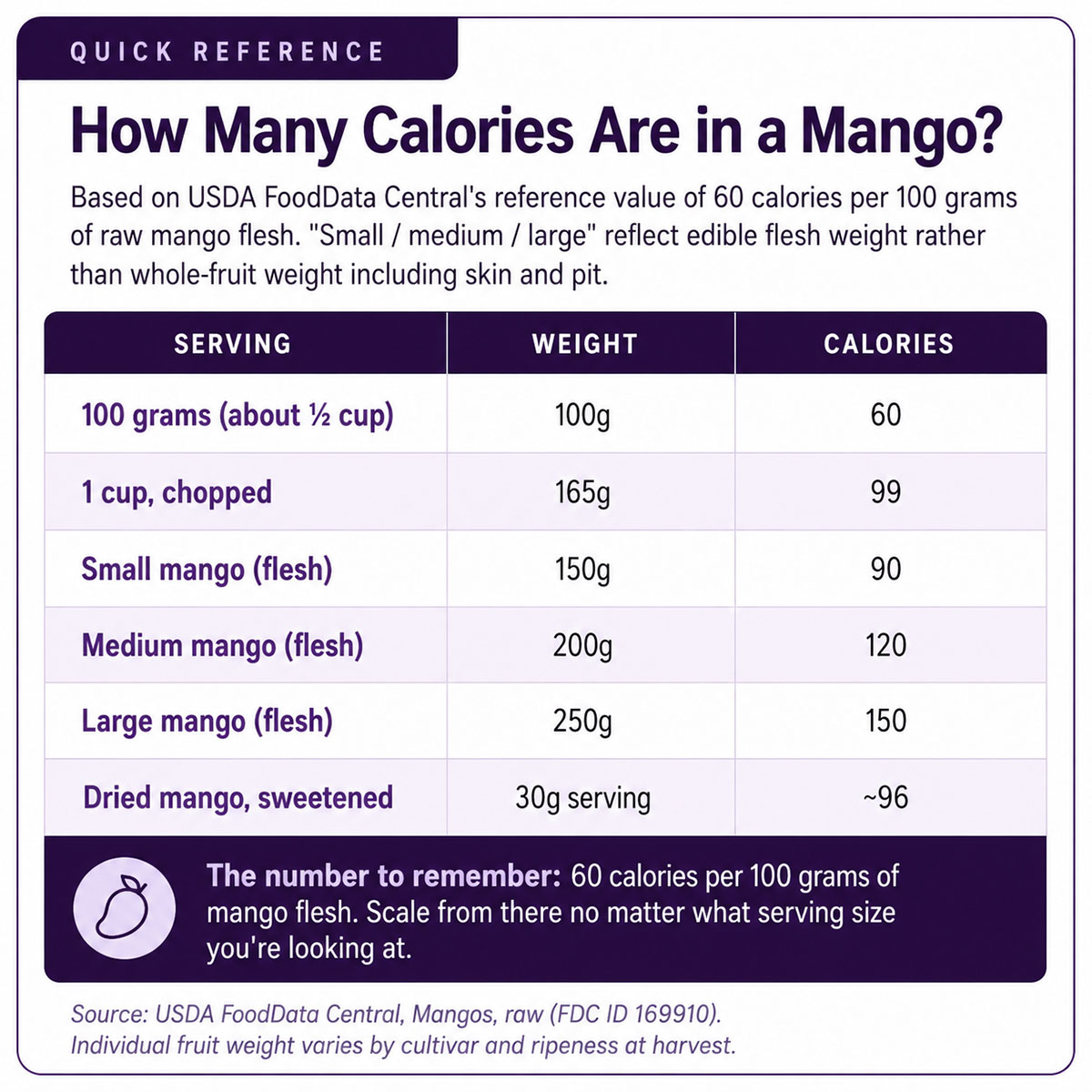
Notice that a “whole mango” isn’t a fixed unit the way a cup is. Fruit size varies by cultivar, growing conditions, and how ripe it was when picked, so a Tommy Atkins mango and a Honey mango of similar apparent size can differ by 50 calories or more once you account for how much of each is actually edible flesh versus skin and pit.
That variability is most of what’s driving the conflicting numbers you’ll find across the web. Mango.org reports a 336-gram mango at roughly 202 calories, using the full edible flesh weight. Hale Groves puts a 200-gram “medium” mango closer to 120 to 135 calories. Both are internally consistent. They’re just describing different mangoes.
If a single number is worth remembering, it’s this one: 60 calories per 100 grams of raw mango flesh. Scale up or down from there, and you’ll match the USDA’s reference food, no matter which serving size someone hands you.
What’s Actually in a Mango, Beyond the Calorie Count
A cup of chopped mango (165 grams) carries about 25 grams of carbohydrate, most of it natural sugar, alongside roughly 1.4 grams of protein and well under a gram of fat. It’s a carbohydrate-and-micronutrient food, and a dense one.
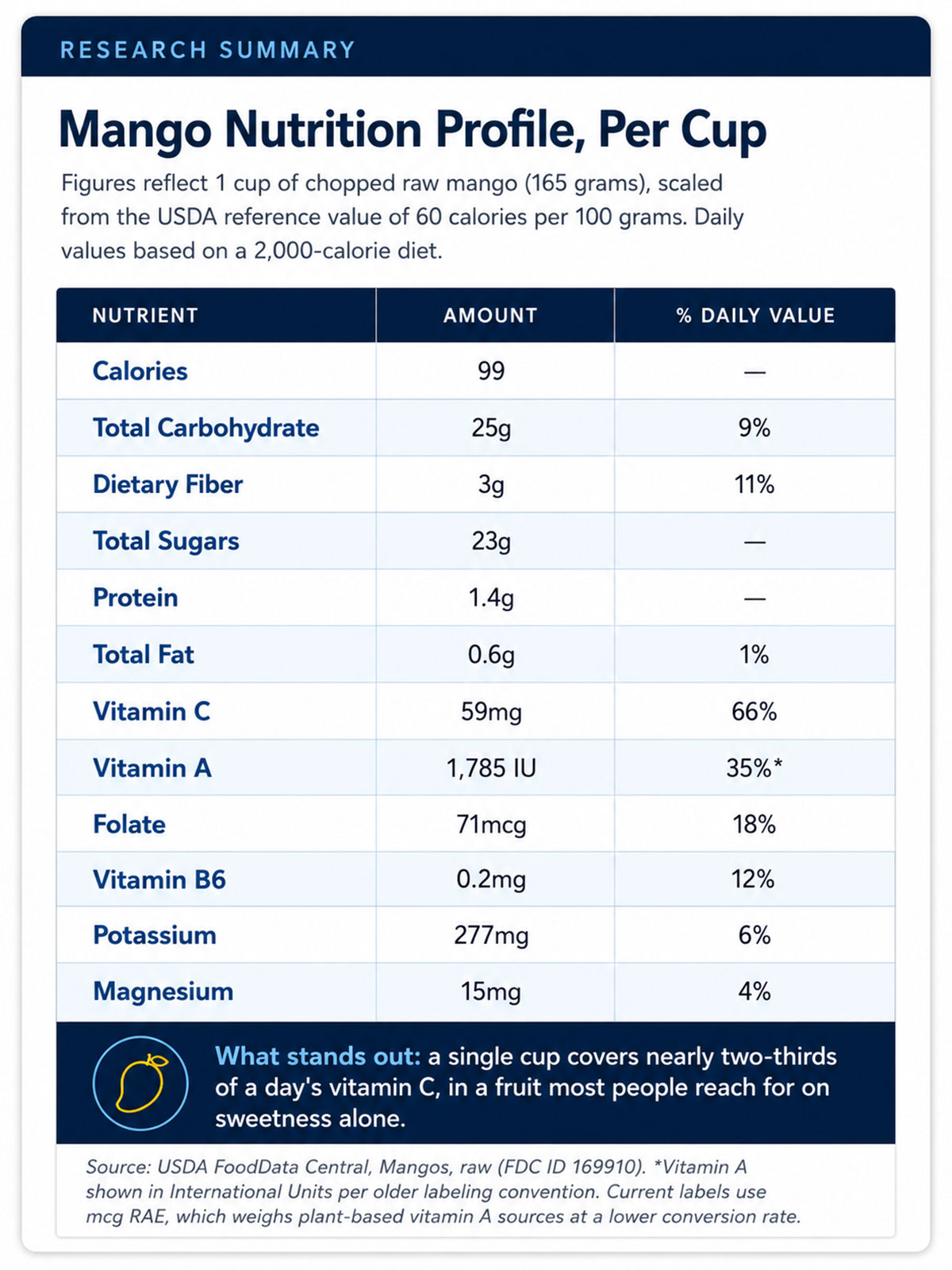
The standout is vitamin C. One cup provides close to two-thirds of the recommended daily intake, more than most people expect from a fruit better known for its sweetness than its nutritional value. Vitamin A shows up in similar force, largely from beta-carotene, the same pigment behind the fruit’s color once it ripens.
Mango also contains mangiferin, a plant compound found almost exclusively in the fruit and its bark. Animal and cell-culture research has linked mangiferin to anti-inflammatory and cardioprotective effects, including in a 2018 review in Molecular Medicine Reports. None of that work has been replicated in human trials yet, so treat mangiferin as a promising mechanism rather than a proven benefit.
Fiber comes in around 3 grams per cup, split between soluble and insoluble types. That’s enough to slow how quickly the fruit’s sugar reaches the bloodstream, which matters more than it sounds like once you get to the blood sugar section below.
Why the Same Mango Isn’t Always the Same Calorie Count
Variety matters more than most produce guides let on. A Tommy Atkins, the fibrous, tart-edged mango most common in U.S. grocery stores, differs slightly from a Honey mango, also sold as Ataulfo, or labeled Champagne or Yellow Mango in some markets, which is smaller, sweeter, and nearly fiberless by comparison.
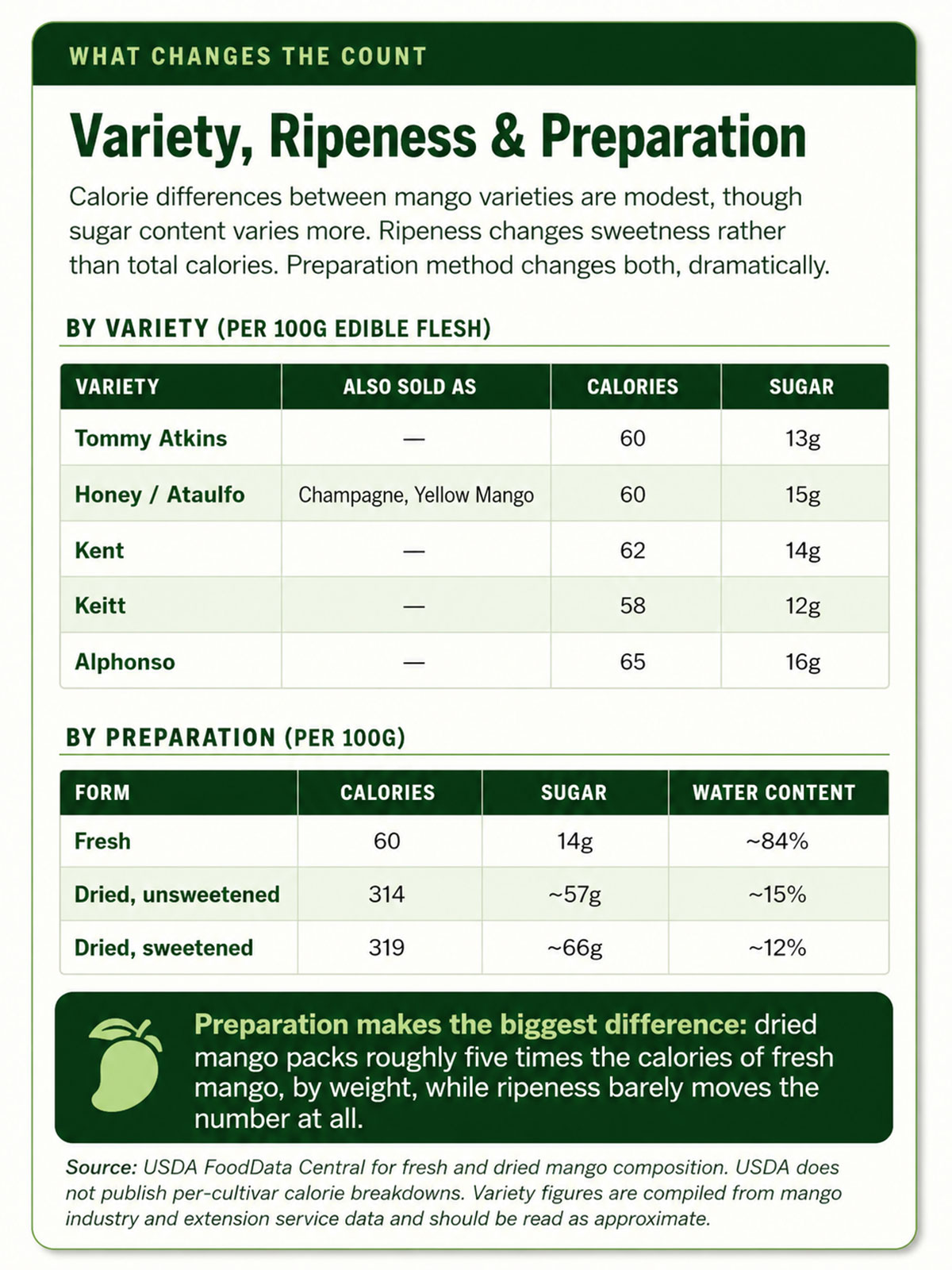
Ripeness shifts the number too, though less than people assume. As a mango ripens, enzymes inside the fruit, mainly alpha- and beta-amylase, convert stored starch into simple sugars. That conversion happens before the fruit is ever eaten, so the total calorie count barely changes either way. It’s why an unripe mango tastes starchy and a ripe one tastes sweet, a ripening effect rather than a digestive one.
Preparation method matters more than ripeness does. A cup of fresh mango and a cup of dried mango aren’t comparable foods. Drying removes water and concentrates everything else, pushing dried mango to roughly 314 calories per 100 grams unsweetened, or 319 if it’s been sugared during processing, according to USDA composition data. A small handful of dried mango can carry the same calories as an entire fresh one.
If you’re working from a specific mango sitting on your counter rather than a table average, the calculator below does the math for you.
Mango Calorie & Nutrition Calculator
Pick a form and a serving to see the actual numbers.
Mango and Blood Sugar: What a New Study Actually Found
Mango carries a glycemic index of about 51, which puts it in the moderate range, and a glycemic load of roughly 8 per typical serving, which is low. The distinction matters. Glycemic index measures how fast a food raises blood sugar. Glycemic load accounts for how much of that food a person is actually eating. A moderate-GI fruit in a modest portion produces a smaller blood sugar swing than the index number alone suggests, based o then glycemic index reference data built on the same testing standard researchers use for the University of Sydney’s index.
Fiber does some of the work here as well. The roughly 3 grams per cup slows gastric emptying enough to blunt the sugar spike that pure fruit sugar would otherwise cause on its own.
That distinction turned out to matter more than anyone expected.
Researchers at George Mason University wanted to know whether a food’s total sugar content was actually the right thing to worry about, or whether the surrounding package of fiber and nutrients changed the outcome.
They ran a 24-week trial in adults with prediabetes, assigning one group a fresh mango every day, about 32 grams of sugar, and another group an isocaloric granola bar, about 11 grams of sugar, then tracked blood glucose, insulin sensitivity, and body composition.
The 2025 trial, published in Foods, found the higher-sugar mango group ended up with better fasting glucose and insulin sensitivity than the lower-sugar granola bar group, whose blood sugar control measurably worsened over the same period.
The sample was small. Twenty-three people completed the full 24 weeks, and the study was funded by the National Mango Board, though the funder had no role in designing the trial or analyzing results, per the authors’ disclosure. That’s worth knowing. It doesn’t erase the finding, but it’s the kind of detail worth keeping in view before treating one small trial as the final word on fruit and blood sugar.
Pairing mango with protein or fat blunts its glycemic impact further, since both slow digestion and flatten the resulting glucose curve. A handful of almonds works well, and a couple of eggs alongside a bowl of mango does the same job at breakfast.

What Mango Does for the Rest of the Body
Vitamin C is the easy nutrient to overstate, and mango actually earns the claim: a cup supplies close to two-thirds of the daily recommended intake. That intake works through several mechanisms at once, skin barrier function and white blood cell activity among them, according to a 2017 review in Nutrients by researchers at the University of Otago. It’s probably why vitamin C anchors nearly every immune claim made about fruit, mango included.
The eye-health and skin-and-hair claims both call for the same kind of correction. Mango’s lutein and zeaxanthin accumulate in the retina, and observational research has linked higher dietary intake of both compounds to a lower risk of age-related macular degeneration. A 2017 review by University of Sydney researchers in Nutrients found the protective association is strongest for late-stage disease rather than for prevention.
Skin and hair benefits get attributed to mango nearly as often, with even less rigor behind them. What’s actually documented is more modest: the vitamin A and C content support collagen synthesis and normal skin cell turnover, the same mechanisms behind most produce marketed for skin health.
One thing that rarely makes it into mango content at all: the skin can cause a genuine allergic reaction in some people. Mango belongs to the same plant family as poison ivy and poison oak, and a compound in the skin cross-reacts with urushiol, the oil responsible for poison ivy rashes.
A 2021 review in the journal Medicina found documented cases of contact dermatitis in people with no prior mango exposure at all, simply because they’d been sensitized by poison ivy years earlier.
It’s rare. Most people handle mango skin without issue. But if you’ve had a bad reaction to poison ivy, that history is worth remembering before biting into an unpeeled mango.
How Many Mangoes Should You Actually Eat?
For most healthy adults, one to two cups of mango a day sits comfortably inside a balanced diet, providing real fiber and micronutrients without pushing sugar intake into excessive territory. Two whole mangoes a day, depending on variety and size, can mean 45 grams of sugar or more, worth noticing if the rest of the day’s eating is already sugar-heavy.
Eating an entire mango in one sitting isn’t inherently a problem for someone without blood sugar concerns. The fiber and water content make it far more filling, calorie for calorie, than something like a candy bar or a sugary drink carrying the same number.
People managing diabetes or prediabetes should lean toward the lower end of that range and pair mango with protein or fat, per the pairing strategy above. Pregnant women can eat mango safely and often benefit from its folate content, though anyone managing a kidney condition that requires potassium restriction should check with a doctor first, since mango carries a meaningful amount of it.
Mango vs. Other Fruits and Everyday Snacks
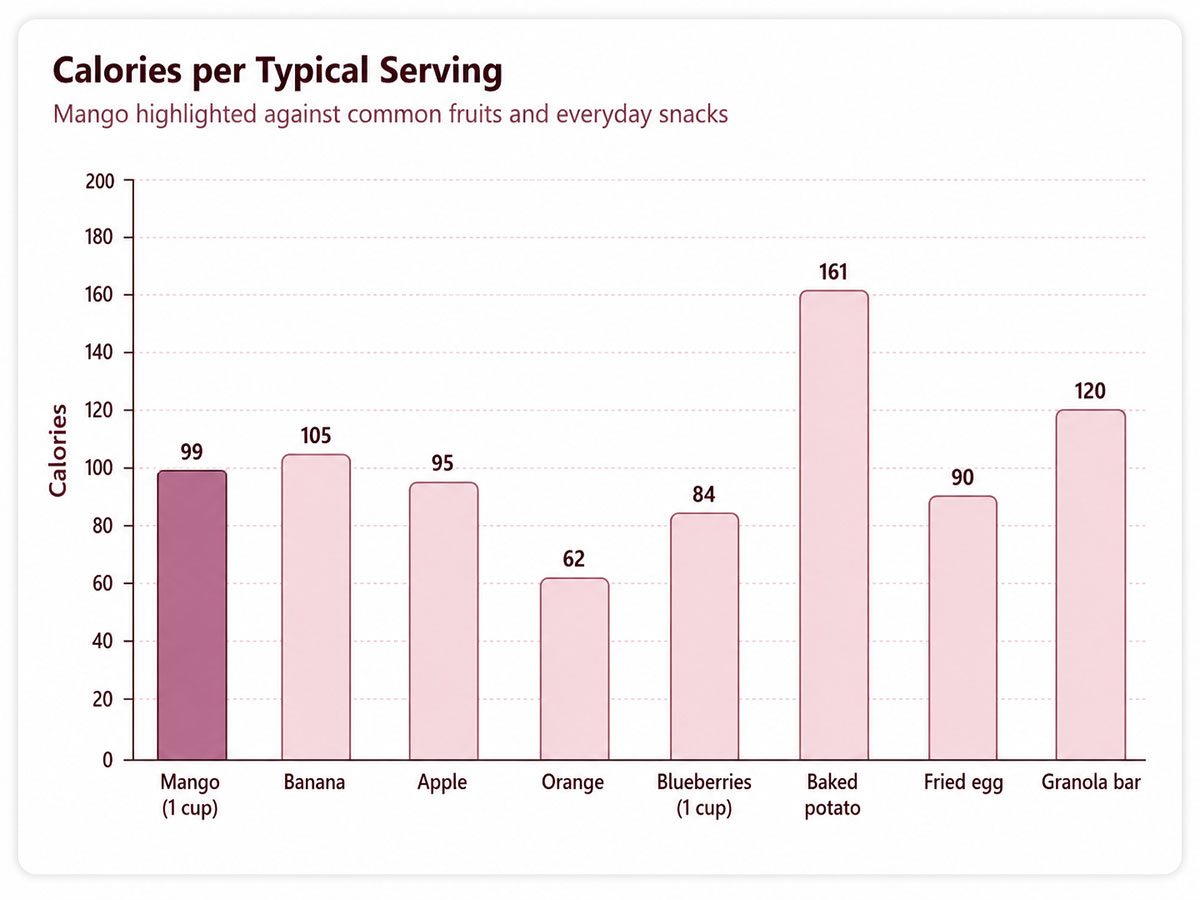
Weighed against the rest of the produce aisle, the mango sits in the middle of the pack. It carries more natural sugar than blueberries but less than a banana relative to size, and it delivers more vitamin C per cup than an orange.
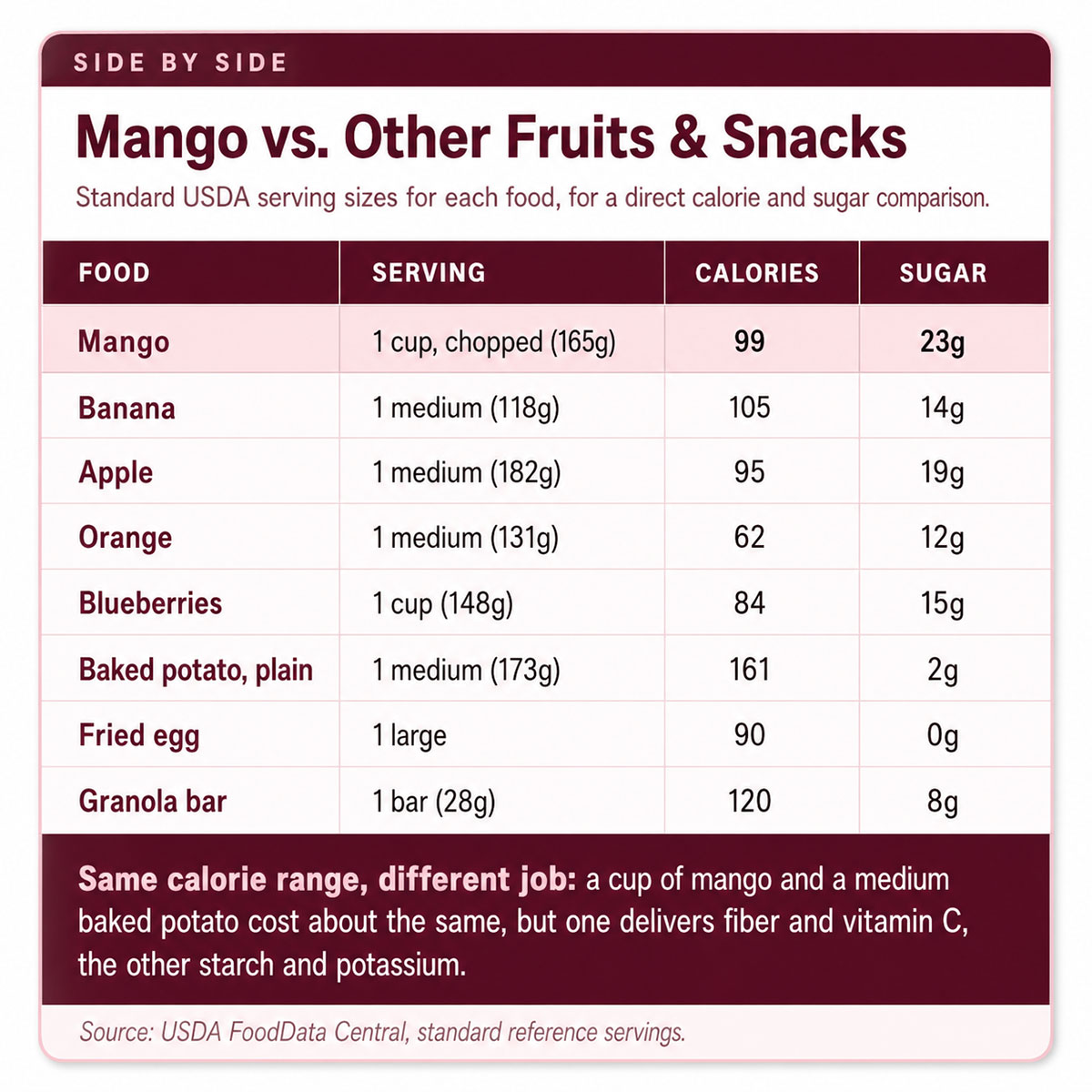
Against non-fruit snacks, the comparison gets more interesting. A cup of mango and a medium baked potato fall in a similar calorie range, but they do almost nothing else the same. One is mostly starch and potassium. The other is sugar, fiber, and vitamin C.

Choosing, Storing, and Cutting a Mango Without the Mess
Color is a poor ripeness indicator. Several popular varieties, including Keitt and some Kent mangoes, stay green even when fully ripe, so squeeze gently near the stem instead. A ripe mango yields slightly under light pressure, the way a ripe avocado does, and often smells faintly sweet at the stem end.
Store unripe mangoes at room temperature until they give slightly, then move them to the refrigerator, where they’ll hold for about five days. Cut mango keeps for roughly three days refrigerated in a sealed container.
To cut one cleanly, stand the mango on its narrow edge and slice downward on either side of the flat central pit, about a quarter-inch off center. Score each half in a crosshatch pattern without cutting through the skin, then push the skin inside out and slice the cubes free.
Mango Myths Worth Retiring
“Mango sugar is the same as the sugar in a candy bar.” Not quite. A cup of mango’s 23 grams of sugar arrives with 3 grams of fiber, water, and a full slate of vitamins attached, all of which slow absorption and change how the body processes it compared with sugar eaten alone.
“Riper mangoes have more calories.” Ripening converts starch to sugar. The total energy in the fruit doesn’t change, so the calorie count barely shifts from unripe to fully ripe.
“Mango is too high-sugar for anyone watching their blood sugar.” The 2025 George Mason trial complicates this one considerably. Whether that finding holds up in a larger trial is still an open question, but the assumption that all high-sugar fruit behaves identically in the body doesn’t hold up well against it.
The Actual Answer
A mango’s calorie count was never the mystery. What varied was the question underneath it: skin or no skin, ripe or green, cup or whole fruit. Ask a precise question, and mango turns out to be one of the more nutritionally generous fruits in the produce aisle, sugar and all.
The more interesting shift is in how that sugar gets treated. A fruit with 32 grams of natural sugar outperforming a low-sugar granola bar in a blood sugar trial isn’t a fluke worth dismissing. It’s a reminder that the number on a label was never the whole nutritional story, only the easiest part of it to print.
Frequently Asked Questions
How many calories are in a small mango?
A small mango, roughly 150 grams of edible flesh, runs about 90 calories, using the USDA’s standard 60-calories-per-100-grams figure as the baseline.
How many calories are in a large mango?
Around 150 calories for 250 grams of flesh, though “large” is doing more work here than a single number can capture. A big Kent with a small pit can out-calorie a bigger-looking Tommy Atkins with a fat one, and there’s no easy way to tell from the outside.
Does mango skin have calories?
Barely any. Mango skin is thin and mostly fiber and waxy compounds, contributing a negligible number of calories even if eaten, which most people don’t, given its bitter taste and, occasionally, the allergy risk covered above.
Is mango good for you if you’re trying to lose weight?
It can fit into a weight-loss plan without much friction. The fiber and water content make it filling relative to its calorie count, and a single serving rarely derails a calorie budget the way ultra-processed snacks with a similar calorie count tend to.
How many mangoes is too many in one day?
There’s no universal cutoff, but three or more whole mangoes in a day would put most adults well beyond 400 calories and 60 grams of sugar from a single food source, a fact that’s easy to lose track of even though nothing about it is dangerous outright.