For decades, the egg sat in dietary purgatory. Cardiologists warned against it. Public health campaigns demonized it. Then the guidelines shifted, and eggs were quietly rehabilitated.
Most people accepted the reversal without really understanding what had changed or why the original panic had happened at all.
The short version you’ll find almost everywhere: we were wrong about dietary cholesterol, saturated fat is the real culprit, and eggs are basically harmless. Tidy. Clean. And incomplete enough to be genuinely misleading.
Because here’s what that version skips: researchers have known for years that some people do see significant cholesterol changes from eating eggs. The blood work is real. The response is consistent. What makes this scientifically interesting and practically important is that it doesn’t happen to most people, and the reasons why have almost nothing to do with how many eggs someone eats.
Your Body Already Makes Most of Its Own Cholesterol
Blood cholesterol isn’t just a mirror of the cholesterol on your plate. The liver produces roughly 70 to 80 percent of the body’s cholesterol, regardless of what is consumed. Dietary intake makes up the remaining fraction.
Nutrition researcher Maria Luz Fernandez, reviewing human studies in Current Opinion in Clinical Nutrition and Metabolic Care in 2006, found that individuals differ substantially in how well they regulate cholesterol through two separate mechanisms: how much the intestines absorb from food, and how much the liver dials back its own production when dietary intake goes up. These aren’t minor variations. They’re the main reason why population-level studies on eggs and cholesterol keep producing wildly inconsistent results.
When one person eats three eggs, and their liver reduces endogenous synthesis to compensate, total cholesterol stays roughly stable. When another person’s liver doesn’t adjust, those same eggs can raise LDL-C (low-density lipoprotein cholesterol, often called “bad” cholesterol) by a noticeable amount. Same food. Same dose. Completely different physiological outcome.
The Hyper-Responder Phenomenon
Researchers have a name for people at the high end of this response curve: hyper-responders. Estimates suggest a substantial minority, roughly a quarter to a third of the population, shows strong LDL-C increases from added dietary cholesterol. The majority who eat eggs regularly show little meaningful change. That minority, though, is real, and their blood work looks different.
A controlled feeding study published in the Journal of Nutrition in 2002 by Herron and colleagues at the University of Connecticut gave participants a high-cholesterol diet and tracked changes in their lipid profiles. Hyper-responders showed increases in both LDL-C (low-density lipoprotein cholesterol, the less protective kind) and HDL-C (high-density lipoprotein cholesterol, the protective kind).
Hypo-responders, by contrast, showed almost no change in either. The critical finding, and the one most summaries quietly drop, is that even in hyper-responders, the LDL-HDL ratio remained essentially stable. Both values increased together in proportion.
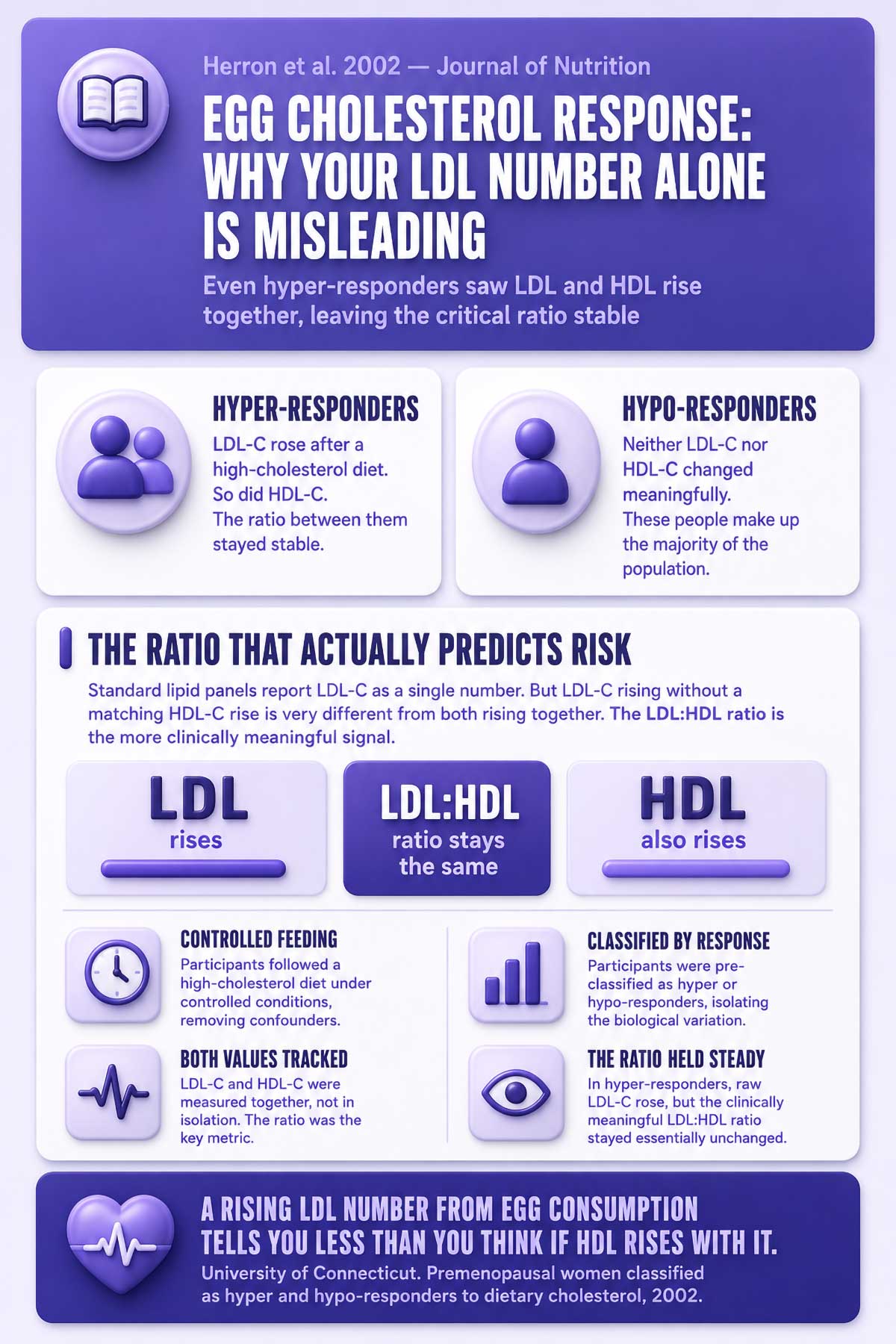
That ratio matters more than either number in isolation. A higher LDL-C is only concerning if HDL-C doesn’t rise to match it, because HDL helps clear cholesterol from artery walls. When both move upward at the same time, the overall risk picture doesn’t necessarily worsen. This doesn’t prove long-term cardiovascular safety in hyper-responders, but it does mean the lipid-ratio signal most commonly used in clinical risk scores changed far less than the raw LDL-C number alone would suggest.
A separate systematic review by Berger and colleagues, published in the American Journal of Clinical Nutrition in 2015, drew a similar conclusion from 17 cohort studies covering more than 360,000 subjects: dietary cholesterol does modestly raise total cholesterol and LDL-C at the population level, but was not significantly associated with coronary artery disease or stroke incidence in those cohorts, despite those lipid changes.
Not All LDL Is the Same
Standard cholesterol panels measure LDL-C as a single number. That number obscures something researchers consider far more relevant to actual cardiovascular risk: the size and density of LDL particles. Small, dense LDL particles are more likely to slip through arterial walls and contribute to plaque buildup. Large, buoyant LDL particles carry the same cholesterol load but are considered considerably less atherogenic (less likely to cause arterial damage).
Multiple studies have found that when dietary cholesterol from eggs increased LDL-C, it was predominantly the larger, less dangerous LDL particles that increased, with little rise in the small, dense fraction. This is a meaningful distinction. A rising LDL-C number that reflects more large particles is physiologically different from one driven by small, dense particles. The two scenarios look identical on a standard lipid panel but carry different implications for arterial health.
What Happened When Researchers Fed Eggs to People With Metabolic Syndrome
Metabolic syndrome is a cluster of conditions including high blood pressure, elevated blood sugar, excess abdominal fat, and abnormal cholesterol levels. It’s exactly the kind of metabolic environment where a high-cholesterol food would be expected to cause harm. What a research team at the University of Connecticut found instead was something most clinicians wouldn’t have predicted.
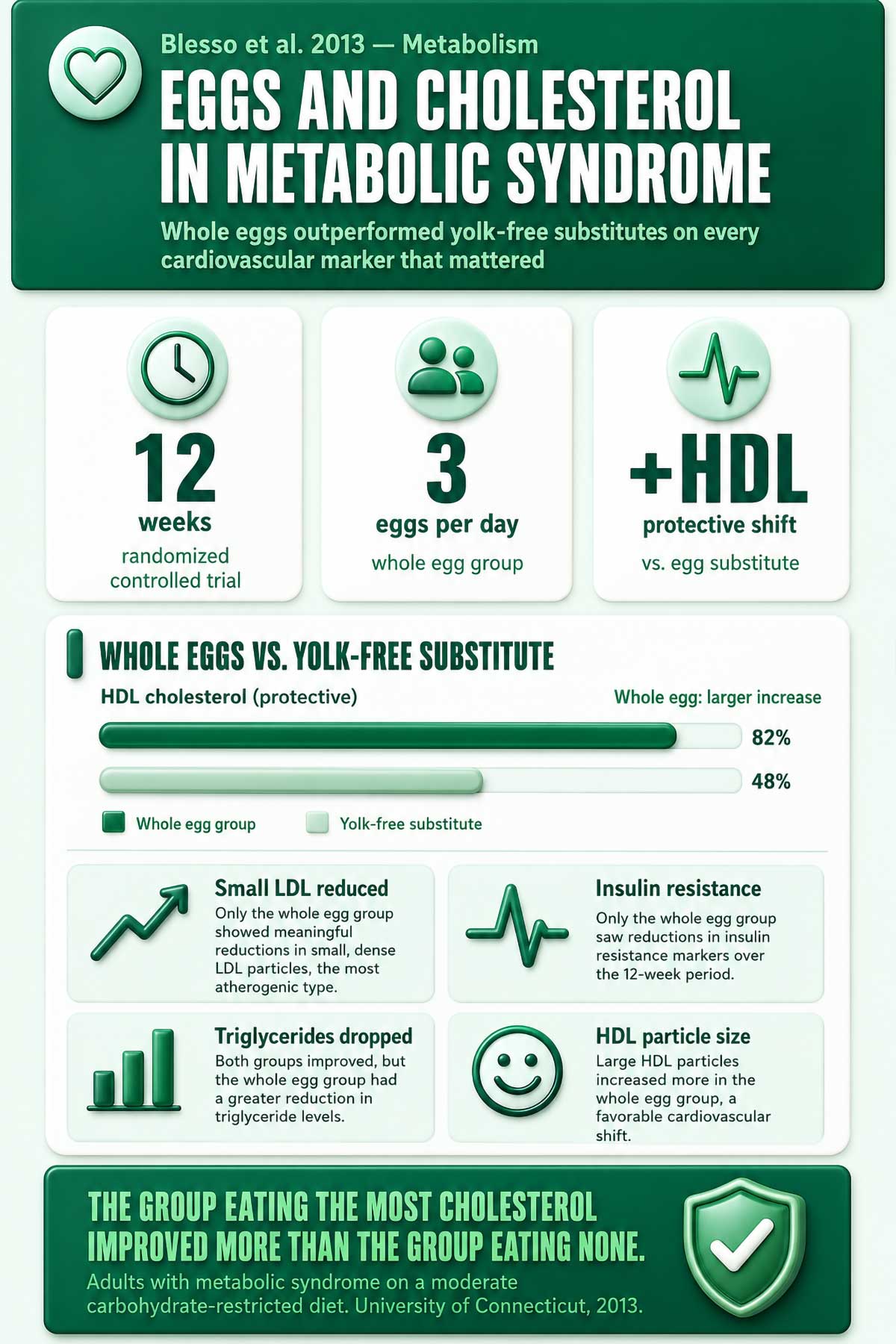
In a randomized controlled trial published in Metabolism in 2013, Christopher Blesso and colleagues assigned adults with metabolic syndrome to eat either three whole eggs per day or an equivalent amount of yolk-free egg substitute, alongside a moderately carbohydrate-restricted diet, for 12 weeks.
Both groups improved. Triglycerides dropped, HDL-C increased, and LDL particle size shifted favorably in all participants. But the whole-egg group improved more. They had greater increases in HDL-C and large HDL particles, larger reductions in small and medium LDL particles, and were the only group to show reductions in insulin resistance markers over the study period.
The group eating the most cholesterol had better cardiovascular markers than the group eating the least cholesterol. That result deserves to sit with you for a moment before you move on.
The Picture in Type 2 Diabetes
People with type 2 diabetes are typically told to be especially careful with dietary cholesterol, partly because their cardiovascular risk is already elevated. Research in this area is more contested than in healthy populations, and that caution isn’t unfounded. But a well-designed trial adds useful texture to the blanket warning.
The DIABEGG study, led by Nicholas Fuller and colleagues at the University of Sydney and published in the American Journal of Clinical Nutrition in 2015, followed 140 adults with prediabetes or type 2 diabetes for 3 months on either a high-egg diet (roughly 12 eggs per week) or a low-egg diet.
Lipid profiles, glycemic control, and cardiovascular markers were tracked throughout. The high-egg group showed no adverse changes in LDL-C, triglycerides, total cholesterol, or blood glucose compared to the low-egg group. Both groups achieved similar weight loss. The high-egg group reported considerably greater satiety, which, in a diabetic population managing energy intake, is no small practical advantage.
This doesn’t give people with type 2 diabetes blanket clearance to eat unlimited eggs. The longer-term picture is still being worked out, and individual metabolic context matters. But it does challenge the idea that eggs are a straightforward risk factor in this population when dietary quality is otherwise managed.
What the Conflicting Science Actually Means for You
The reason egg studies keep producing different answers is not that the research is sloppy. It’s because the question “Are eggs bad for cholesterol?” is the wrong question. The right question is closer to: “How does my body specifically regulate dietary cholesterol, and am I in the third of the population where that regulation is less efficient?”
A 2021 review by Sugano and Koba in Foods confirmed that compensatory mechanisms, including reduced intestinal absorption and suppressed hepatic synthesis, maintain the LDL-HDL balance relatively stable in most people with higher egg intake. For that majority, the evidence doesn’t support restriction. For hyper-responders, the picture is more complicated, not necessarily because eggs are dangerous for them, but because their lipid profiles warrant closer monitoring regardless of food source.
The practical implication is that a one-size-fits-all egg limit was always a blunt tool for a biologically variable problem. If your routine blood work shows stable lipids despite regular egg consumption, the population-level warnings were never really about you. If you’re in the minority who respond strongly to dietary cholesterol, that’s worth knowing and discussing with a physician, regardless of how many eggs you eat per week.
A Note on What This Research Doesn’t Settle
Lipid panels measure cholesterol in the blood. They don’t directly measure arterial plaque accumulation, long-term cardiovascular event rates, or the interaction between dietary cholesterol and saturated fat in the same meal. Most egg studies run for weeks or months, not decades. The long-term observational data are mixed, partly because people who eat a lot of eggs in the real world also tend to eat them with bacon, processed meat, and refined carbohydrates, making it nearly impossible to isolate the effect of eggs.
The science here is genuinely incomplete in ways that matter. What’s no longer credible is the original claim that dietary cholesterol maps cleanly onto cardiovascular risk in the same way for everyone. The biology simply doesn’t support that.
The Relevant Question
Decades of dietary advice treated the public as a single biological unit with identical cholesterol metabolism. That assumption was always wrong, and the egg debate is one of the clearest examples of where it broke down.
The real story isn’t that eggs are safe or unsafe. It’s that the human body’s response to dietary cholesterol is far more individualized than any single guideline can capture, and a blood test showing your LDL went up after changing your diet tells you less than you think it does without knowing whether your HDL went up with it, what type of LDL particles changed, and whether your body’s compensatory systems were functioning normally to begin with.
That’s a more relevant conversation to have than a daily egg limit. It’s also a more honest one.