The two largest scientific reviews on whey protein don’t even agree on how much muscle you should gain after eight weeks. Here’s what they do agree on, and why the timeline matters more than the marketing.
Most people buying a tub of whey protein expect a straight-line result: shake today, visible muscle by week eight, steady progress the whole way through. The real data is messier than that. Somewhere around the three or four-week mark, progress stalls convincingly, and the two meta-analyses researchers cite most often to describe an eight-week timeline don’t even agree with each other on how much muscle a person should expect to gain.
This guide walks through what actually happens across eight weeks of daily whey protein combined with resistance training, using the real numbers behind the two most-cited studies on the subject rather than the rounder, more flattering figures that tend to circulate online.
Whey protein itself is simple enough: a fast-digesting, complete protein extracted from milk, containing all nine essential amino acids muscle tissue needs for repair. The timeline for what it actually does inside the body is the part worth slowing down for.
Understanding the Science Behind Whey Protein Powder
Whey’s advantage comes down to speed and leucine content. Leucine is the amino acid that triggers muscle protein synthesis most directly, and whey delivers more of it, faster, than slower-digesting proteins like casein or most plant sources, according to the International Society of Sports Nutrition’s position stand on protein and exercise.
Whether that speed advantage translates into meaningfully faster muscle growth, rather than faster digestion alone, is a separate question. It’s one the phase-by-phase breakdown below tries to answer honestly.
Whey Protein Types: Complete Comparison
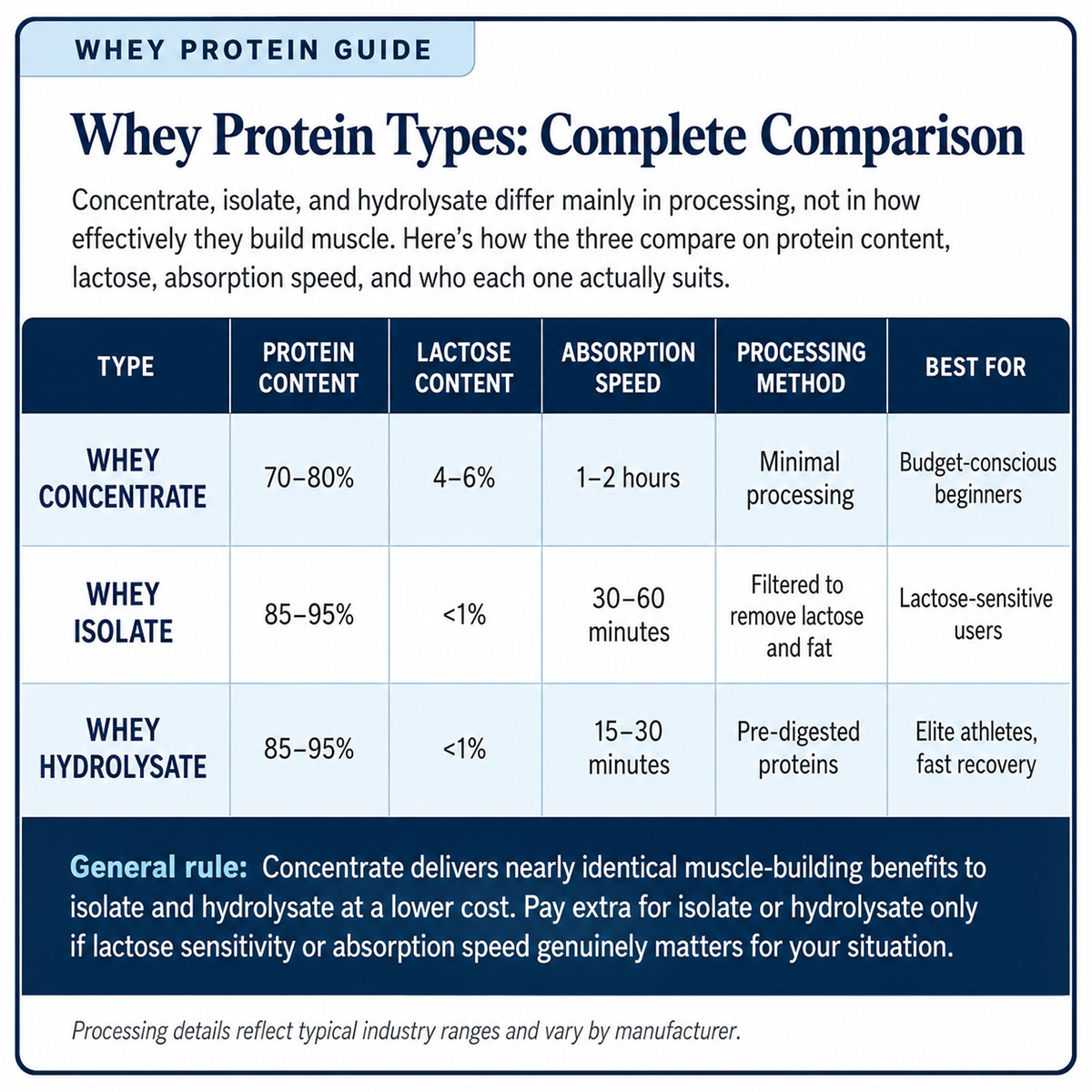
Whey concentrate and whey isolate protein powder differ mainly in how much lactose and fat are filtered out during processing, not in how well either one builds muscle. Someone with mild lactose sensitivity gains little from paying extra for hydrolysate. Concentrate delivers nearly identical amino acid content at a lower price, which is why it remains the default recommendation for most beginners.
How long it actually takes to build noticeable muscle, with or without a whey supplement, comes down to the same handful of variables: training consistency, total protein intake, and genetics.

Whey Protein Dosage and Safety
The International Society of Sports Nutrition’s position stand puts the useful ceiling for a single protein dose at roughly 20 to 40 grams for most adults. Beyond that range, the extra amino acids are used less efficiently, and some people notice digestive discomfort, mild headaches from under-hydration, or a diet that’s suddenly short on fiber and micronutrients because whey has crowded out other foods.
Potential Side Effects and Solutions
A handful of side effects show up often enough to plan around. Digestive upset is the most common one, and starting with half doses before working up to a full scoop usually resolves it within a week or two. Bloating tends to respond well to switching to whey isolate, which strips out most of the lactose that causes it.
Headaches after a shake are more often about hydration than the protein itself, so increasing water intake is the first fix worth trying. Skin breakouts, when they happen, are more commonly linked to dairy-based mixers than to whey itself, and swapping in water or a plant milk resolves this for most people.
Whey Protein and GLP-1 Medications Like Ozempic or Zepbound
Anyone taking a GLP-1 medication for weight loss can generally take whey protein alongside it. No pharmacokinetic interaction between GLP-1 drugs and dietary protein has been documented, and protein supplementation may help offset the lean muscle loss that sometimes accompanies rapid weight loss on these medications.
The appetite suppression from GLP-1 drugs can also make it genuinely difficult to hit a daily protein target from food alone. That’s exactly where a whey shake tends to earn its place: a concentrated dose of protein that doesn’t require much appetite to get down.
Protein Calculator for Muscle Growth
The numbers above are useful as a general reference, but body weight, training frequency, and goal all shift the right dose in ways a static table can’t capture. The calculator below builds a personalized target from the same 1.6 to 2.2 grams per kilogram range that the research above supports.
Protein Calculator for Muscle Growth
Grounded in the 1.6–2.2 g/kg range supported by sports nutrition research
Weeks 1-2: The Priming Phase
Your body spends the first two weeks adapting to having high-quality protein available right when it needs it most. Nothing dramatic happens yet, and that’s expected.
The most noticeable early change is usually less muscle soreness after training. That brutal delayed-onset muscle soreness that used to keep you hobbling for two days tends to ease up, and recovery between sessions starts feeling faster.
A realistic benchmark for this stretch is a 20 to 30 percent reduction in post-workout soreness, along with the ability to train the same muscle group with somewhat less rest between sessions. A meaningful share of people also report better sleep during this window, though the mechanism isn’t well studied, and it probably has more to do with reduced soreness than with the protein itself.
Every training session creates small tears in muscle fibers, and repairing them requires amino acids delivered soon after the tear occurs. Whey reaches the bloodstream within 30 to 60 minutes, which lines up well with the window when muscle protein synthesis is most responsive.
Precisely how much faster this happens compared with other proteins is difficult to pin down. Individual digestion speed, total daily protein intake, and meal timing all move the number more than the specific protein source does.
A few common frustrations show up in these first two weeks. Feeling nothing yet is normal, since most of what’s happening right now is invisible. An upset stomach usually means the dose needs to be cut in half and increased gradually. Forgetting doses is best solved with a phone alarm and shakes prepped the night before.
Power-Packed Whey Recipes for Weeks 1-2
Post-Workout Recovery Shake: Blend 25g whey protein powder, one medium banana for fast-digesting carbs, one cup low-fat milk for additional casein, one tablespoon honey, and ice. Consume within 30 minutes of finishing a workout.
Beginner-Friendly Morning Smoothie: Blend 20g whey protein powder, half a cup of rolled oats for slow-release energy, half a cup of mixed berries, one tablespoon of almond butter, and a cup of water or almond milk. This gentler combination suits anyone new to whey protein.
Weeks 3-4: The Plateau Phase
Weeks three and four are when most people consider quitting. The early wins from weeks one and two, less soreness and faster recovery, have already leveled off, and visible muscle gain hasn’t caught up yet. That gap is normal. It’s also the single biggest reason people abandon a whey protein routine before it has had a real chance to work.
A modest 5 to 10 percent increase in total workout volume is a realistic marker for this stretch, not the more visible changes the following weeks promise. Exactly when lean mass starts accumulating varies by person, and researchers haven’t nailed down a precise week when it begins for any given individual. Some people notice fuller-looking muscles after training within the first three weeks. Others don’t see it until closer to six.
If progress feels stalled, a 5 to 10 percent increase in training intensity is usually the more productive move than adjusting the shake. Gaining weight faster than expected is worth checking against total calorie intake before assuming the protein is the cause.
Advanced Recipe: Fat Loss Formula
Blend 30g whey isolate, one cup of spinach, half an avocado for healthy fats, one tablespoon of MCT oil, and ice and water. This combination suits anyone pairing muscle gain with simultaneous fat loss.
The avocado is doing more work than it looks like: MCT oil alone digests fast enough to blunt satiety on its own, and the fat from the avocado is what actually keeps this shake from leaving you hungry an hour later.
Weeks 5-6: The Acceleration Phase
This is where gains start becoming harder to ignore. Clearer increases show up in the weights being lifted, and physique changes become noticeable enough that other people start commenting: more defined shoulders, a fuller chest.
A 2012 meta-analysis out of Maastricht University pooled 22 separate trials and found that people combining protein supplementation with resistance training gained an average of 0.69 kilograms, about a pound and a half, more lean mass than those who trained without supplementing.
That’s a real, statistically significant effect, and it’s also a long way from the five-pound transformation some marketing implies. Worth sitting with that gap for a moment before reading further.
A realistic benchmark here is a 10 to 15 percent improvement in major lifts, alongside half an inch to a full inch of growth in arm or chest measurements. Taking whey protein every day, not only on training days, appears to matter here, since muscle recovers and grows during rest periods too. It’s worth supplementing as consistently as you already train.
High-Performance Recipe: Pre-Bed Recovery
Blend 25g whey protein, half a cup of Greek yogurt for additional casein, a handful of mixed nuts, and a teaspoon of vanilla extract. Consuming this one to two hours before bed supports overnight muscle repair.
Weeks 7-8: The Optimization Phase
By this point, strength gains across major lifts are usually measurable, and body composition has often shifted enough that clothes fit differently: more muscle, less fat around the midsection.
A larger, more recent meta-analysis led by Robert Morton pooled 49 studies with 1,863 participants and found a smaller average effect: 0.30 kilograms of additional lean mass and a 2.49-kilogram improvement in one-rep max strength.
Morton and his co-authors also found that protein intake beyond roughly 1.6 grams per kilogram of body weight per day stopped producing further gains in lean mass, a ceiling worth knowing before assuming more protein is always better.
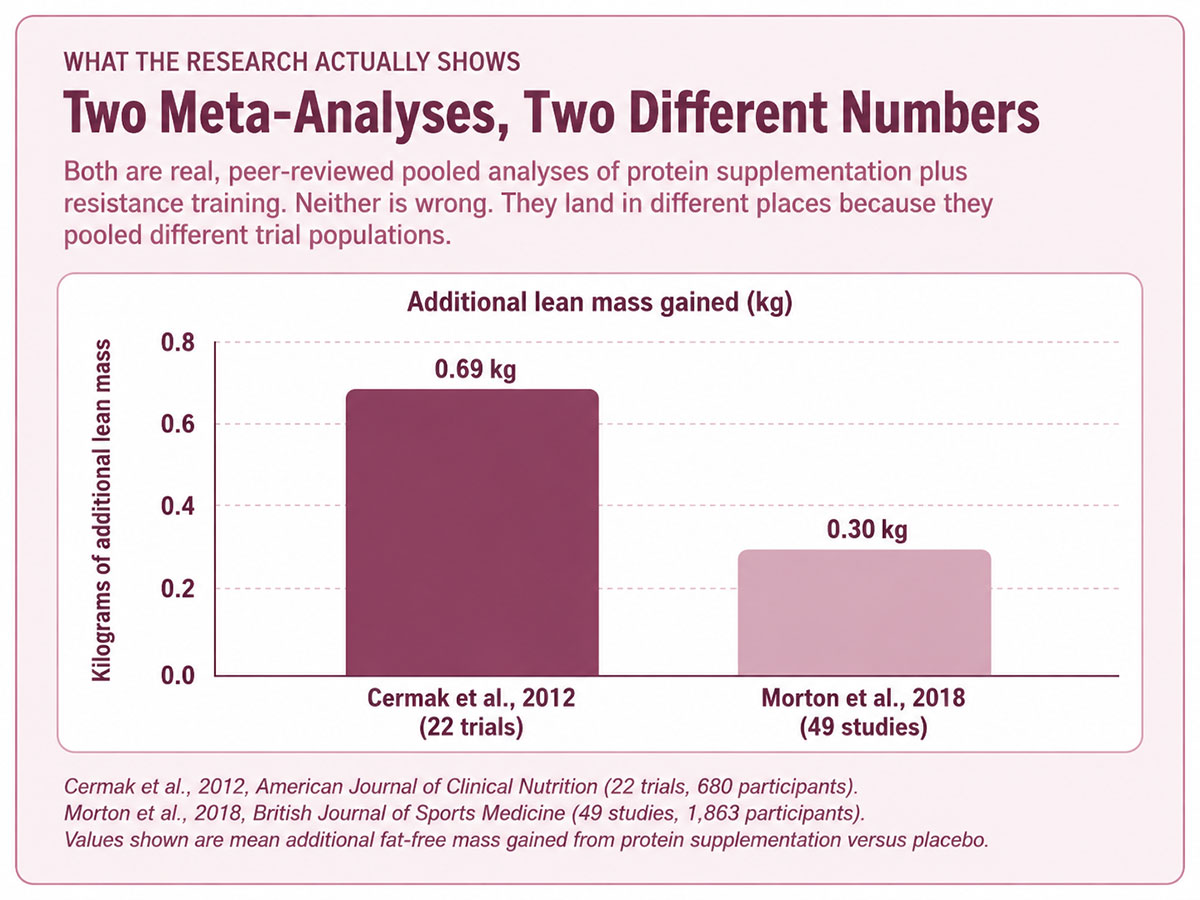
Cermak’s trial pool and Morton’s are measuring close to the same question and landing on different numbers, less than half a kilogram apart at the low end but more than double at the high end, depending on which analysis gets cited.
Neither number is wrong. They likely differ because Morton’s pool included far more untrained participants across a wider range of training durations, which pulls the average down. The honest takeaway is that 0.3 to 0.7 kilograms of extra lean mass over six to eight weeks is a defensible range to expect, not a guarantee, and certainly not the five pounds sometimes advertised.
Championship Recipe: Meal Replacement Powerhouse
Blend 35g whey protein powder, half a cup of rolled oats, one tablespoon of natural peanut butter, one cup of milk, half a frozen banana, and a teaspoon of cinnamon. This works as a complete meal replacement, delivering roughly 40g of protein alongside complex carbs and healthy fats.
8-Week Progress Tracker
Numbers on a page are one thing. Watching your own measurements move, or stall, week over week is what actually makes a timeline like this feel real. The tracker below logs body measurements, strength benchmarks, and recovery scores across all eight weeks.
8-Week Progress Tracker
Log your numbers week by week to see the real pattern, not just the highlight reel
Beyond 8 Weeks: Long-Term Considerations
Who Should Adjust Their Approach
Sex differences in whey protein response haven’t been studied as thoroughly as the general population data above. What evidence exists suggests women respond to protein supplementation similarly to men, though baseline protein intake tends to run lower for women, which can make the relative improvement feel more noticeable in practice.
Adults over 40 lose muscle mass at an accelerating rate, a process called sarcopenia, and adequate protein intake is one of the few interventions with consistent support for slowing it. Older adults often benefit from doses at the higher end of the range, closer to 30 to 35 grams per serving, due to a natural decline in how efficiently the body converts protein into new muscle.
The specific claim that whey protein improves bone density independent of muscle mass isn’t well established, so it’s fair to expect muscle-related benefits here without assuming a bone-density bonus on top.

Anyone avoiding dairy has reasonable alternatives in pea protein isolate, rice and hemp protein blends, or soy protein isolate, which offers a complete amino acid profile closer to whey’s than most other plant sources.
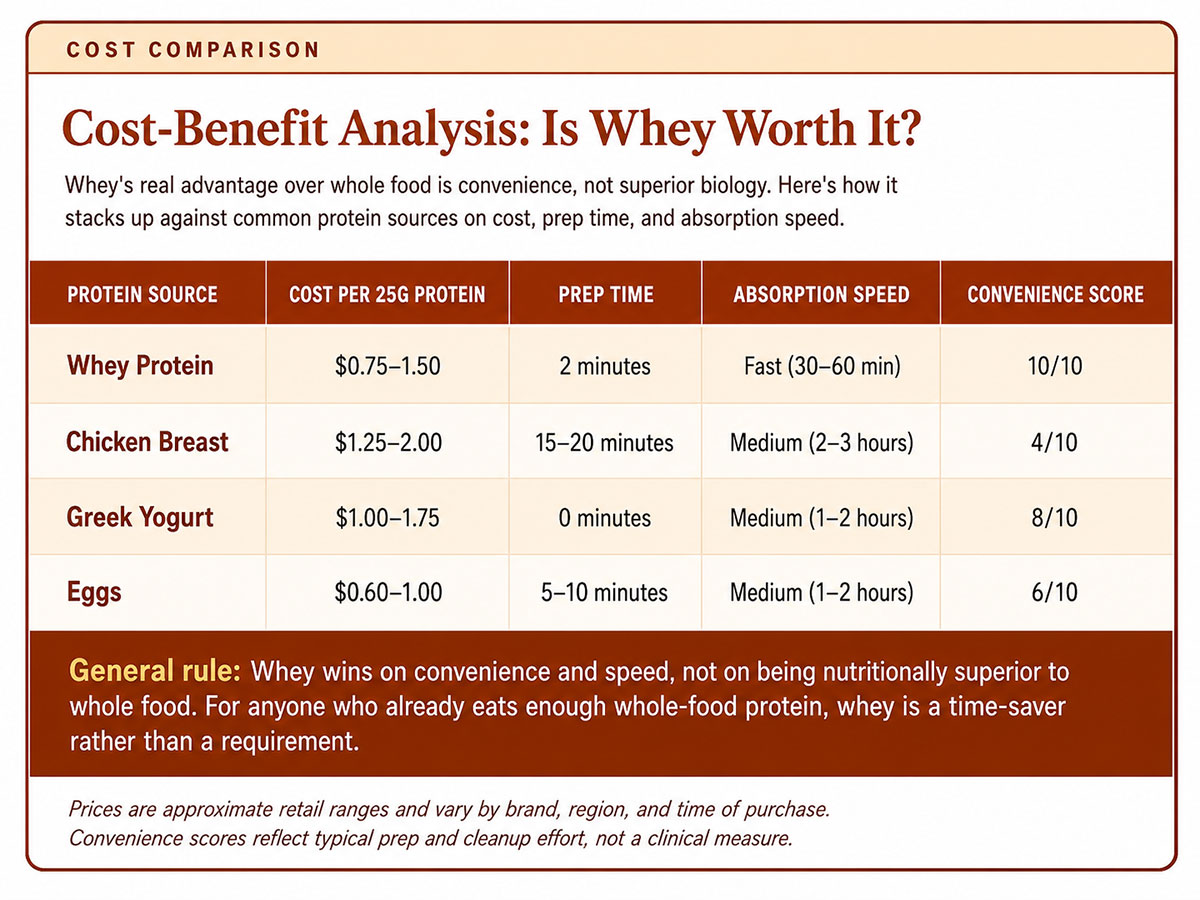
Cost-Benefit Analysis: Is Whey Worth It?
Whey protein’s advantage over whole-food protein sources is convenience, not superior biology. The table below compares typical costs and preparation time across common protein sources, using approximate retail pricing that will vary by brand and region.
Choosing a Product
Beginners tend to do fine with a basic whey concentrate delivering 20 to 24 grams of protein per serving. Look for third-party testing on the label rather than chasing a specific brand name.
Serious trainees who want faster absorption and minimal lactose usually move toward isolate or hydrolysate, often with digestive enzymes included. Grass-fed and organic formulas carry a higher price for modestly higher omega-3 content or fewer artificial ingredients, and hydrolyzed formulas are worth the extra cost specifically for anyone with a sensitive stomach.
Troubleshooting Common Plateaus
The scale isn’t moving. This usually means muscle is being built while fat is being lost at close to the same rate, which cancels out on a bathroom scale. Weekly measurements and progress photos catch this kind of change far better than body weight alone.
Gaining weight faster than expected typically traces back to total calorie intake rather than the protein itself. Tracking daily calories for a week and adding two to three cardio sessions usually corrects course within a few weeks.
Stalled strength gains are rarely about the supplement. Progressive overload, adding weight or reps over time, inadequate rest between sessions, and exercise form all matter more than whether the shake is isolate or concentrate. Working with a qualified trainer for a session or two is often the fastest way to identify which one is the actual bottleneck.
Frequently Asked Questions
Does whey protein cause kidney damage?
No. A 2018 meta-analysis by Devries and colleagues found no difference in kidney function between healthy adults on higher versus normal protein diets. Anyone with existing kidney disease should still consult a healthcare provider before increasing protein intake.
Why do some doctors push back on whey protein?
It’s rarely about the protein itself. True milk allergy is uncommon but can be serious, and doctors are right to screen for it. The more common concern is that whey ends up replacing whole foods in someone’s diet, crowding out fiber and micronutrients that a shake doesn’t provide, or that someone with undiagnosed kidney disease increases protein intake without medical guidance first.
Can I build muscle without whey protein?
Yes, but it takes more planning. Whey provides convenience and amino acid timing that’s genuinely difficult to replicate with whole foods alone, especially right after a workout, when matching a single 25g scoop means eating roughly four eggs or a cup and a half of Greek yogurt on the spot. Chicken, eggs, cottage cheese, and legumes can cover the same daily total. They just take more prep and more chewing to hit the same post-workout window.
Morning vs. evening consumption, does it matter?
Post-workout timing matters more than time of day. Train in the morning, take it then. Evening consumption pairs well with overnight recovery regardless of when the workout happened.
How does whey compare to casein for overnight recovery?
Casein digests slowly, providing a steady trickle of amino acids overnight. Whey acts fast, which is why many people save casein or Greek yogurt for bedtime and whey for right after training.
Can I cook with whey protein?
Yes, though heat denatures some of the protein structure. Adding it to pancakes, muffins, or oatmeal after cooking preserves more of it than baking it directly into a batter.
What’s the shelf life after opening?
Properly stored whey protein lasts 12 to 18 months. Keep it cool, dry, and sealed tightly between uses, and treat clumping or a sour smell as a sign that moisture got in, not something a bigger scoop will fix.
Can I take whey protein with medications, including GLP-1 drugs like Ozempic?
Generally, yes. Whey protein and GLP-1 medications haven’t shown any documented interaction, and protein can help offset muscle loss during rapid weight loss on these drugs. Anyone on blood thinners or diabetes medication should still run any new supplement by their healthcare provider first.
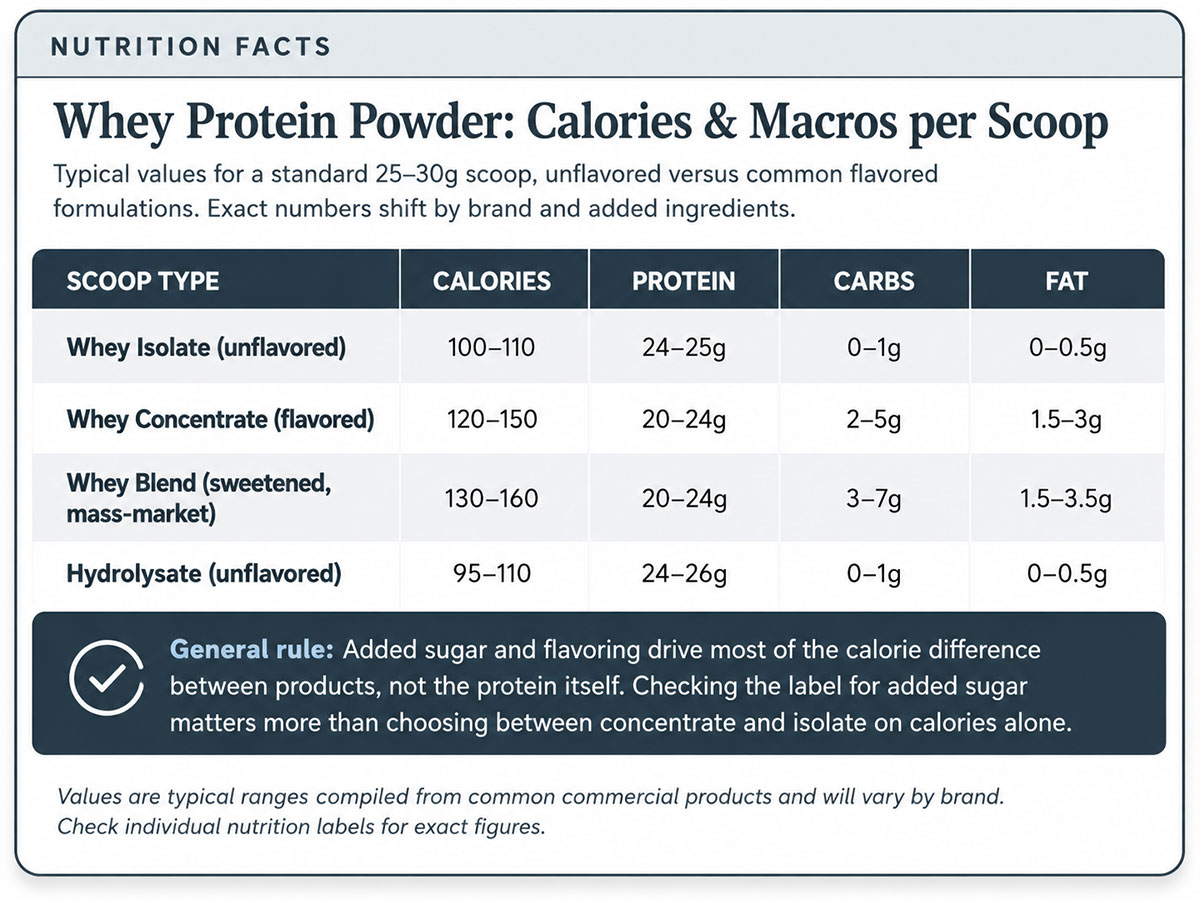
How many calories are in a scoop of whey protein powder?
Most standard scoops run 100 to 150 calories for 20 to 25 grams of protein, though this varies by brand and whether flavoring or added sugars are included. The table below breaks down typical macros per scoop.
Why am I not seeing results after 4 weeks?
Check training consistency first, ideally three or more sessions weekly. Total calorie intake, sleep of 7 to 9 hours, and dosing matched to body weight all matter more than most people expect at this stage.
Can I take more than 40g per day for faster results?
Not recommended. The evidence points to diminishing returns and a higher chance of digestive side effects above that range, without a corresponding boost in muscle growth.
The five-pound transformation this topic is often sold on doesn’t hold up against the actual meta-analyses. What does hold up is smaller, slower, and still worth doing: somewhere between half a pound and a pound and a half of additional lean mass over two months, alongside a real, measurable strength gain, for the cost of a daily shake and consistent training.
That’s a less dramatic story than most marketing tells. It’s also the one that the research actually supports, which is the only version worth building a habit around.