Researchers found this sense can begin declining decades before most people expect, yet many early signs are dismissed as stress, fatigue, or normal aging.
Somewhere in your early forties, you start holding the menu a little farther from your face. The restaurant lighting gets blamed first. Then your arms, the joke goes, got too short.
Most people, asked which sense fades first, say hearing. It feels like the safe answer, the one tied to hearing aids and turned-up televisions and asking people to repeat themselves. Sight gets there first. For almost everyone, near vision is the earliest sense to measurably decline, and it begins around the age of 40.
That gap between what we assume and what actually happens shapes the whole timeline of getting older. The senses do not fade together, and they do not fade in the order folklore suggests. Knowing the real sequence tells you what to watch for, and when.
The sense that goes first starts slipping at 40
The change has a name: presbyopia, the gradual loss of near focus. Inside the eye sits a flexible lens that bends to shift focus between far and close. Starting around 40, that lens stiffens and stops adjusting as easily.
You feel it as the arm’s-length moment. Small print blurs, dim light makes reading harder, and close work brings on tired eyes or a dull headache. According to the Cleveland Clinic, presbyopia begins around 40 and keeps worsening until the mid-60s, when it tends to level off.
It is close to universal. A clinical review in StatPearls, published through the National Institutes of Health, describes presbyopia as an unavoidable change that reaches nearly everyone by their mid-50s. The American Optometric Association notes that the focusing power has been declining gradually since childhood. Forty is simply the point at which the decline becomes perceptible.
What helps is straightforward. Reading glasses, bifocals, or progressive lenses correct the focus, and a brighter, more direct lamp does more for small print than people expect. The more important habit is the eye exam itself.
The AOA advises adults aged 40 to 64 to have their eyes checked at least every two years, because the same visit that updates your reading prescription is the one that catches glaucoma, cataracts, and macular degeneration early, while they are still treatable. One sign worth flagging to your doctor without delay is vision that fluctuates from week to week, which can point to diabetes or high blood pressure rather than the lens.
Why hearing feels like the first to go
Hearing earns its reputation for a reason. It is the most common sensory loss in older adults, even though it is not the earliest to begin.
Age-related hearing loss, or presbycusis, affects about one in three adults between 65 and 74, and close to half of those over 75, according to data from the National Institute on Deafness and Other Communication Disorders summarized by Johns Hopkins Medicine. The loss starts in the high frequencies, the range that carries consonants and the beep of a microwave, then works downward over the years.
That slow, top-down pattern explains why it sneaks up on people. The changes can begin as early as the forties, but they rarely interfere with daily life until much later. By the time someone is asking the table to speak up, the decline has been underway for a decade or more. To the affected individual, the first symptom is often not perceived as hearing loss. It is the impression that others are mumbling.
Two actions matter here. The first is prevention: noise-induced damage is the one form of hearing loss that is completely avoidable, so earplugs at concerts, on the mower, and around power tools protect the hair cells you cannot regrow. The second is not waiting. Research from Johns Hopkins has linked untreated hearing loss to faster cognitive decline and a higher fall risk, which makes a baseline hearing test in your fifties, and hearing aids when they are recommended, a decision with stakes beyond conversation. A quick self-check: if you follow speech fine one-on-one but lose it in a busy restaurant, that background-noise struggle is often the earliest sign.
Hearing loss climbs steeply after 65
Age-related hearing loss is common but late to surface. Roughly one in three adults aged 65 to 74 has it, and the share approaches half after 75.
Figures from the National Institute on Deafness and Other Communication Disorders (NIDCD), as summarized by Johns Hopkins Medicine and the American Speech-Language-Hearing Association. Younger figure covers any difficulty across ages 20 to 69.
Pinch-of-Health.com
What feels like fading taste is usually fading smell
The popular story gets the mechanism backward. People in their fifties and sixties often say food tastes like less. They reach for the salt, then the sugar, and wonder when their tongue gave out.
Their tongue is mostly fine. What faded was smell. The two senses are wired together so tightly that flavor is mostly aroma, and as the nerves responsible for smell deteriorate, food flattens. Harvard Health describes the sense of smell as declining rapidly in the fifties, faster than taste itself.
Smell carries higher stakes than its reputation suggests. A diminished sense of smell may fail to detect smoke, gas, and spoiled food, the key early-warning signals in a household. A sudden loss of smell can also be one of the first markers of Parkinson’s or Alzheimer’s disease, which is why physicians at Rush University treat an abrupt change as something to investigate rather than wave off. The decline runs unevenly between the sexes as well, fading more and earlier in men than in women.
The practical responses are concrete. Quitting smoking sharpens both smell and taste, since smoke inflames the tissue inside the nose. Working smoke and gas detectors do the safety job a dulled nose no longer can, and dating leftovers rather than sniffing them removes the guesswork. A simple self-assessment is to smell a few strong, familiar items (coffee grounds, citrus peel, a jar of cinnamon) and note whether they register as faint or absent.
Taste fades slowly, and the experts disagree on how
Taste itself does change, just later and more gently than smell. Most people notice nothing until their sixties, when sensitivity to sweet, salty, sour, bitter, and savory begins to dull.
The cause is where the authorities split. Harvard Health holds that the number of taste buds stays roughly the same with age, and that reduced saliva flow is what blunts the signal. The clinicians behind UF Health describe the opposite, that taste buds decrease in number, and the survivors shrink.
Neither can be entirely correct, and the field has not yet settled which effect dominates. The truth may be some mix of fewer buds, smaller buds, and a drier mouth working together. Even the basics of aging still hold open questions.
What you do about it is clearer than what causes it. Rush University recommends perking up bland food with herbs and spices rather than reaching for more salt, which raises blood pressure, or more sugar, which adds empty calories. Staying hydrated and treating a dry mouth helps, since saliva carries flavor to the taste cells, and good dental care keeps the mouth working as it should.
Touch is the quiet one
Touch declines last, and it does so without a clear indication. There is no equivalent of reading glasses or a turned-up television to mark the moment it begins.
Rush University attributes the decline largely to reduced circulation reaching the nerve endings in the skin. Sensitivity to pressure, vibration, and temperature drops, becoming more pronounced from the sixth decade onward.
The consequences are easy to underestimate. Dulled touch means a burn felt a beat too late, a blister gone unnoticed, a patch of ice misjudged underfoot. Little can be done to slow the decline itself, so the practical approach is to adapt one’s environment accordingly.
Setting a water heater to 120 degrees Fahrenheit prevents scalds you might not feel coming. Checking your feet regularly catches small wounds before they worsen, a step that matters most for anyone with diabetes, and good lighting plus a handrail offsets the balance cues that fading skin sensation no longer supplies.
Why the timeline clusters where it does
Sight leads at 40, while smell, taste, and hearing tend to decline more noticeably in the fifties and sixties. That pattern raises a question. Does the body hit turning points rather than slide down a smooth slope? Recent work suggests it does.
In 2024, a team led by Michael Snyder, a geneticist at Stanford, tracked thousands of molecules in people over time and found that aging arrives in bursts rather than a steady drift. The Stanford Medicine analysis pinpointed two periods of rapid molecular change, around age 44 and again around 60.
Those two windows track the sensory timeline more closely than chance would predict. The mid-forties burst coincides with the onset of presbyopia. The early-sixties burst sits alongside the steeper drop in smell, taste, and hearing. The science connecting the two is young, and nobody has shown that the molecular shifts cause the sensory ones, but the alignment is hard to ignore.
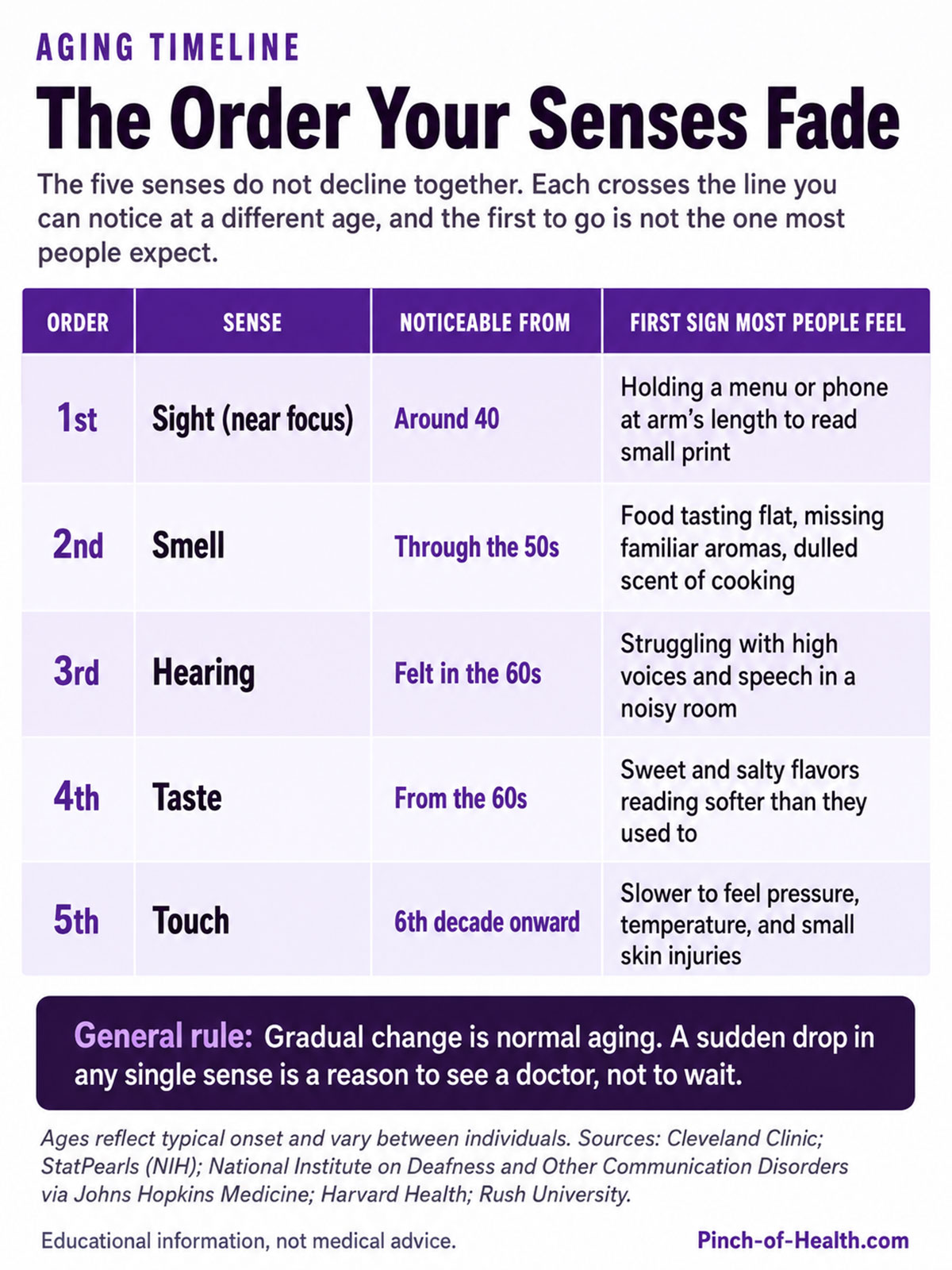
Viewed as a schedule, the sequence is useful rather than alarming. Book an eye exam at 40, get a baseline hearing test in your fifties, keep smoke and gas detectors current, and treat any sudden change in a sense as a prompt to call a doctor. The self-check below maps your own answers against this timeline.
Sensory Changes Self-Check
See how the changes you have noticed line up with the typical aging timeline.
This tool is educational and does not diagnose anything. A sudden change in any sense is a reason to contact a doctor.
Slow is normal, sudden is a signal
The thread running through all five senses is the difference between slow and sudden. Gradual change is the expected price of years. A sharp, fast drop in any sense, vision blurring over days, hearing dropping in one ear, smell vanishing in a week, is the body flagging something else, and it earns a doctor’s visit rather than a shrug.
What all of this comes down to
The sense most people fear losing first is rarely the one that goes first. Sight slips quietly at 40 while we blame the lighting, and by the time hearing makes itself known, three other senses have already begun their descent. There is no stopping the clock, but reading it correctly turns a vague dread into a short list of things you can actually do, a pair of readers, a set of earplugs, a working detector, and the appointment you stop putting off.