Your brain after yoga isn’t just calmer. MRI scans show it’s physically different. Here’s exactly which regions change and how fast.
Feeling calmer is not the same as having a structurally different brain. These are two very different things.
This article is not about mood journals or stress surveys. It’s about MRI scans, gray matter density, white matter integrity, and cortical thickness. Real, measurable changes that show up in clinical imaging after just eight to twelve weeks of consistent yoga practice.
If you’ve ever wanted proof, this is it.
What Neuroplasticity Actually Means
Neuroplasticity is the brain’s ability to physically change its structure based on experience. New neural pathways form. Certain regions grow denser. Others shrink. The brain is not a static organ. It responds to what you repeatedly do and think.
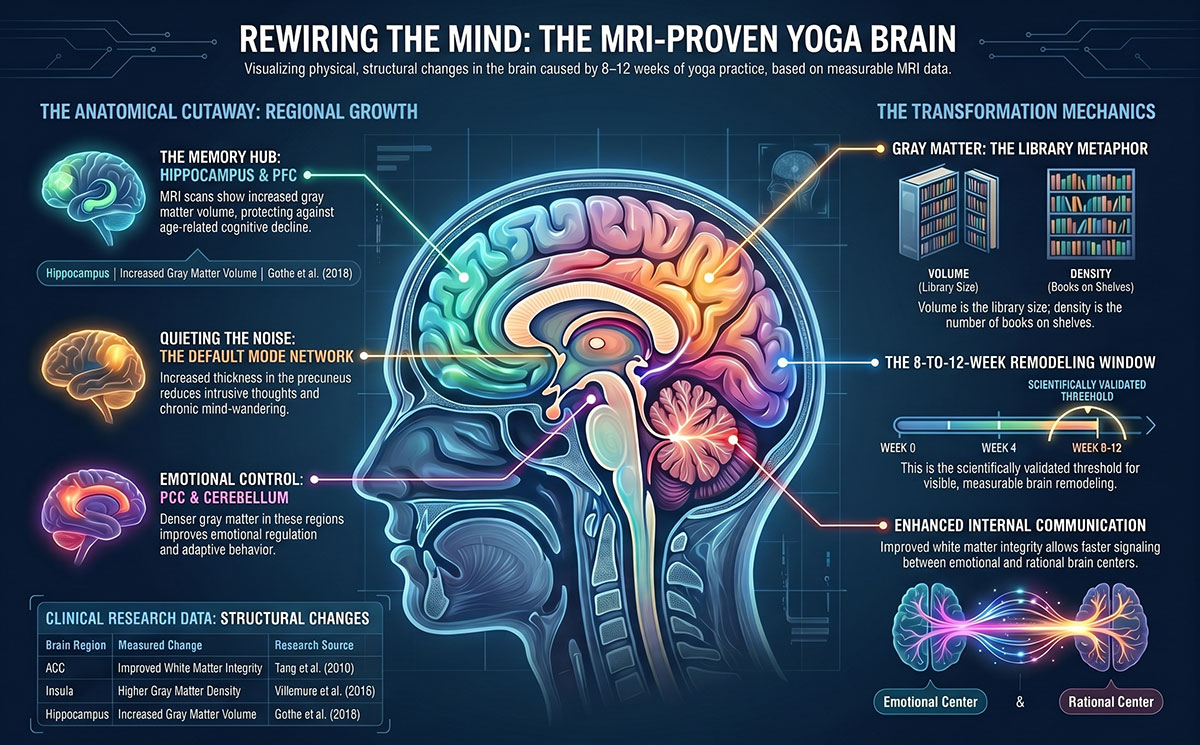
Before going further, it helps to understand two terms you’ll see throughout this article. Gray matter volume refers to the size of a brain region. Gray matter density refers to how many neurons are packed into that space. Both increasing volume and increasing density are signs of a healthier, more active brain region. Think of volume as the size of a library and density as how many books are actually on the shelves.
For decades, scientists believed the adult brain was essentially fixed. That idea is now outdated. Modern imaging tools like functional MRI (fMRI) and Diffusion Tensor Imaging (dTI) let researchers watch the brain reorganize itself in near real time.
The question researchers started asking was simple: does yoga trigger those changes? And if so, how quickly?
The answer surprised a lot of people.
The 8-to-12-Week Window
Clinical trials consistently point to a two-to-three-month window as the threshold for measurable brain remodeling. This isn’t anecdotal. Multiple independent research teams using different populations and imaging methods have landed on the same timeline.
Eight weeks appears to be the floor. Twelve weeks tends to show more pronounced effects. This is the scientifically validated sweet spot where gray matter volume, cortical thickness, and white matter integrity all begin to shift in ways that show up clearly on a scan.
You don’t need years of daily practice. You need consistency within a specific time window.
Quieting the Overthinking Brain: The Default Mode Network
The Default Mode Network (DMN) is active when your mind wanders. It fires during rumination, self-criticism, replaying past conversations, and worrying about the future. It’s the network behind intrusive thoughts and the sensation of being stuck inside your own head.
Chronic DMN overactivity is strongly linked to anxiety and depression. Reducing it is a neurological priority for anyone dealing with persistent mental noise.
Cross-sectional MRI data from Villemure and colleagues (2015) offers some of the clearest structural evidence for how yoga quiets this network. Long-term yoga practitioners showed significantly lower age-related decline in whole-brain gray matter volume compared to non-practitioners. Controls displayed the well-documented pattern of age-related gray matter loss. Yogis did not. The DMN’s anchor regions — the precuneus and posterior cingulate cortex — were among the areas most protected by regular practice. In plain terms: yoga may meaningfully slow the rate at which the overthinking network deteriorates as you age.
The 2014 meta-analysis by Gard and colleagues, which reviewed structural and functional imaging studies across multiple populations and practice styles, confirmed that DMN changes are among the most consistent findings across the yoga neuroimaging literature. These aren’t isolated results from a single lab.
Protecting Memory as You Age: The Hippocampus and Prefrontal Cortex
The hippocampus is the brain’s memory hub. It’s also one of the first regions to shrink with age or chronic stress. Significant volume loss here is a known early marker of cognitive decline.
The prefrontal cortex (PFC) sits just behind your forehead and governs executive function, including planning, decision-making, and impulse control. Sedentary behavior accelerates atrophy in both regions.
Gothe and colleagues’ 2018 cross-sectional study, published in Frontiers in Integrative Neuroscience, compared experienced yoga practitioners to age- and sex-matched non-practitioners using structural MRI. The yoga group showed significantly greater gray matter volume in the left hippocampus. The PFC also showed differences tied to better working memory performance during an in-scanner task. The structural gap between the two groups points directly to the cumulative effect of sustained practice on the very brain regions most at risk from sedentary aging.
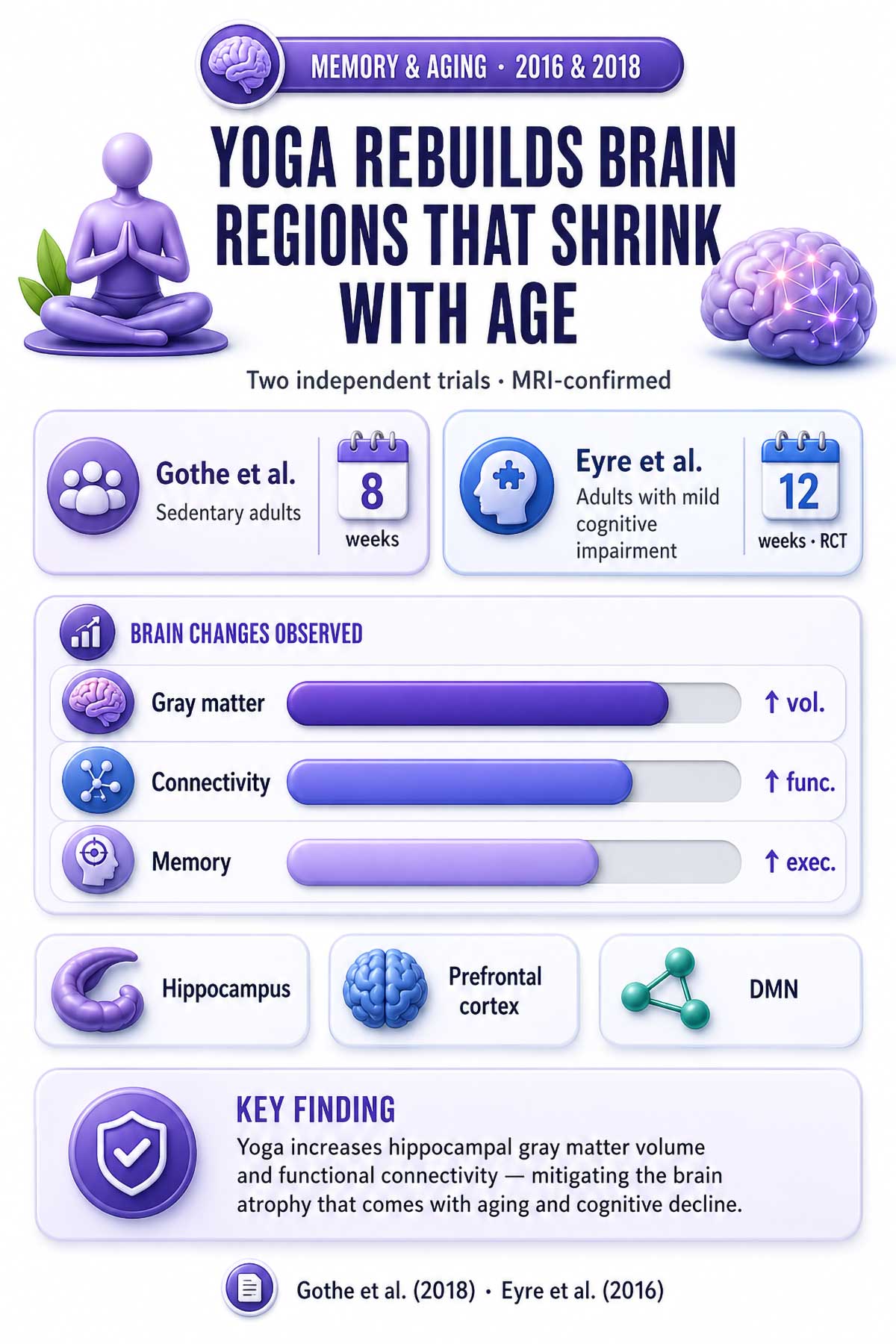
For those already dealing with early memory concerns, the evidence becomes even more targeted. A 2017 randomized controlled trial by Eyre and colleagues, published in International Psychogeriatrics, enrolled older adults with mild cognitive impairment (MCI), a clinical diagnosis that often precedes more serious conditions. After twelve weeks of Kundalini yoga, participants showed increased functional connectivity in the hippocampus and measurable improvements in both verbal memory and executive function. The active control group, which completed memory enhancement training instead of yoga, showed no comparable connectivity changes.
Yoga does not just help you feel less forgetful. The imaging data shows it preserves and functionally strengthens the brain regions most responsible for memory.
Stress Literally Shrinks Your Brain: Here’s What Changes It Back
This next finding tends to stop people in their tracks.
Britta Hölzel and colleagues at Massachusetts General Hospital published a study in 2011 that tracked stressed adults through an eight-week mindfulness-based program that included yoga. Using MRI, the researchers observed significant increases in gray matter density in the posterior cingulate cortex (PCC) and the cerebellum. Both regions play a role in emotional regulation, learning, and self-referential processing.
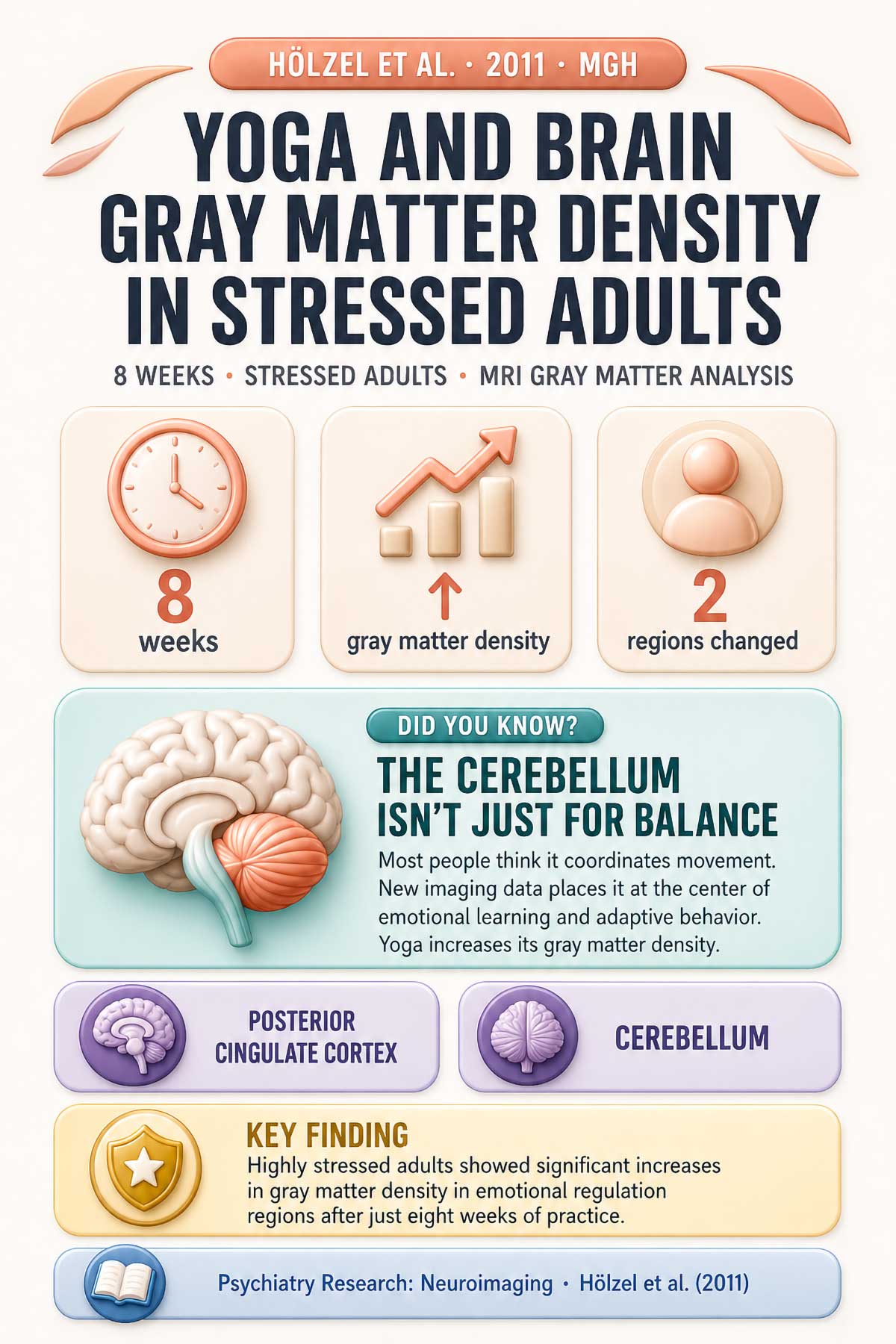
Most people assume the cerebellum is purely a movement organ. That’s a reasonable assumption since it does coordinate balance and fine motor control. But that’s not the whole picture. Recent neuroimaging research has placed the cerebellum at the center of emotional learning and adaptive behavior as well. When gray matter density increases here, it points to improved capacity for processing new experiences and regulating emotional responses. It’s one of the most surprising findings in the yoga-brain research space, and it’s the kind of result that makes you rethink what a physical practice is actually doing beneath the surface.
The PCC, meanwhile, plays a direct role in how we process and regulate emotional experience. More density here means better emotional control under pressure.
Eight weeks. Highly stressed adults. Significant, imaging-confirmed gray matter changes. These aren’t soft outcomes.
Building Body Awareness Into the Brain: The Insula and Somatosensory Cortex
One of yoga’s defining features is its emphasis on interoception. That’s the awareness of what’s happening inside your body: noticing your breath, sensing muscle tension, registering shifts in posture or discomfort. This internal attention turns out to have a direct structural signature in the brain.
The insula is the brain region most closely tied to interoceptive awareness. It maps internal bodily states and links physical sensation to emotional experience. The Villemure et al. (2015) MRI study also compared gray matter density in the insula and somatosensory cortex between experienced practitioners and yoga-naive controls. The experienced practitioners showed significantly higher gray matter density in both regions. These aren’t areas that grow through passive activity. The structural difference points directly to years of deliberate internal attention — the kind that yoga specifically trains.
The Gard et al. (2014) meta-analysis reinforced this finding at scale. Across multiple imaging studies and varied participant groups, the insula consistently emerged as one of the regions most reliably altered by yoga practice. The evidence base for these structural adaptations is well-established across independent research teams.
The Communication Network: White Matter and the Anterior Cingulate Cortex
Gray matter gets most of the attention in neuroplasticity research. But white matter is equally important. White matter consists of myelinated nerve fibers that transmit signals between brain regions. When white matter integrity declines, processing speed and coordination between areas suffer.
A 2010 study by Tang and colleagues, published in PNAS, used Diffusion Tensor Imaging (dTI), a form of MRI that specifically visualizes white matter tracts, to assess short-term training effects. After just four weeks, participants showed significantly improved white matter integrity in the anterior cingulate cortex (ACC).
The ACC sits at the intersection of cognitive and emotional processing. It plays a central role in self-regulation, behavioral control, and conflict monitoring. Better white matter integrity here means faster, more efficient communication between the emotional and rational regions of the brain.
Four weeks was enough to see this change. That puts even early practitioners within range of measurable neurological benefit.
What This Means for You
You don’t need to be an advanced practitioner. You don’t need to stand on your head or hold poses for minutes at a time. The clinical data in these studies comes from ordinary adults: sedentary people, stressed professionals, and older individuals with mild cognitive concerns.
What the research consistently shows is that two to three months of regular practice is enough to trigger real structural changes in the brain. Gray matter grows denser in regions governing memory, emotion, and self-awareness. White matter communication improves. The networks that drive anxious overthinking begin to quiet down.
None of that showed up in mood surveys. It showed up on MRI scans.
Stop measuring your progress by how relaxed you feel walking out of class. The structural changes are happening whether you notice them or not. Your brain is adapting one session at a time, and the imaging data gives you every reason to stay consistent.
Eight weeks is not a long time. It’s enough to start remodeling your brain.