One of these habits is often seen as a strength. Another happens before most people fully wake up. Together, they may be quietly affecting how you think.
Most people assume a sharp mind either holds or fades with age, and that the rest is luck. The research points to a less definitive explanation. A handful of ordinary daily habits, the kind that feel harmless or even productive, are linked to measurably weaker reasoning. Most of us run through several of them before lunch.
None of them are obvious. There is no moment where you feel your judgment dip. The cost is quiet, cumulative, and easy to mistake for getting older or being busy. That framing, the “just getting older” explanation, also allows the real causes to go unexamined.
The stranger part is that one of these habits is something most people treat as a professional strength.
Your brain treats reasoning like an organ, not a talent
Reasoning is something the brain does, not a fixed capacity it simply has. The cluster of mental functions behind it, often grouped under the term executive function, covers three core components: working memory (holding information in mind while you use it), inhibitory control (resisting the impulsive or automatic response), and cognitive flexibility (updating your thinking when new information arrives). Those three underlie almost every nontrivial decision you make.
The ability to follow a complicated argument, hold two conflicting ideas in mind without collapsing one of them, or work through a problem without defaulting to the first available answer depends on the same physical substrate. And that substrate responds to how you sleep, what you eat, how much you move, and where you let your attention go.
The same logic you apply to your heart or your joints applies here. Inputs matter. That is what makes the habits below worth taking seriously.
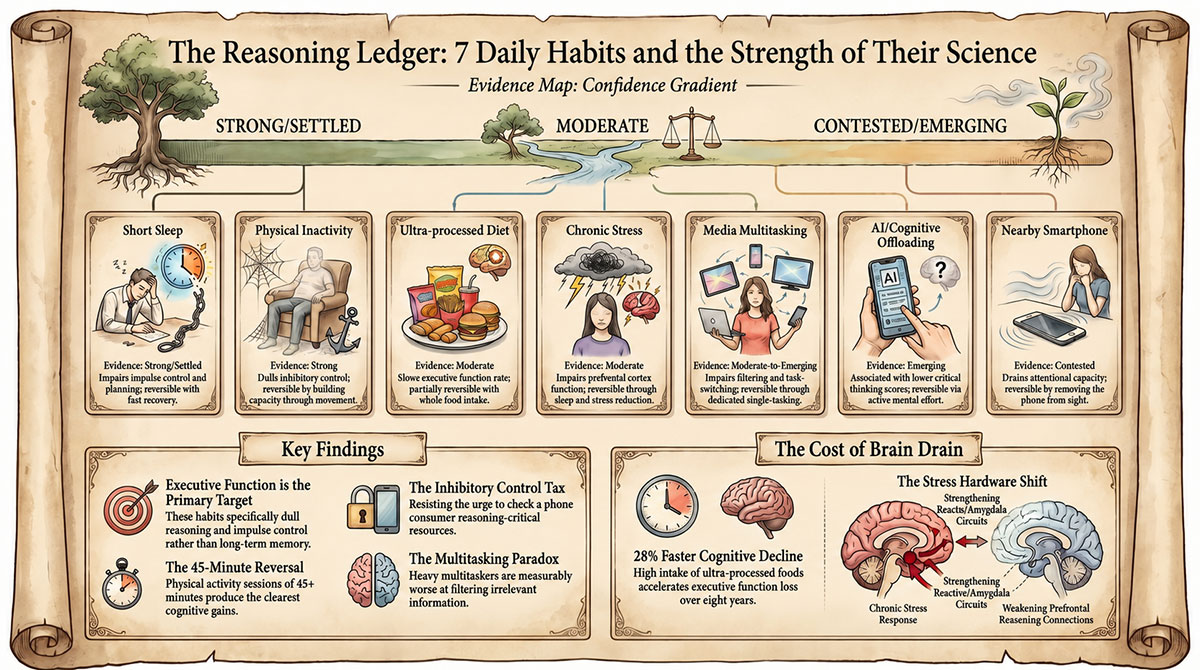
Short sleep goes after reasoning first
The prefrontal cortex, the region that handles deliberate reasoning, planning, and impulse control, is more sensitive to sleep deprivation than almost any other part of the brain. When sleep is limited, it is the first to be impaired, and the rest of the brain compensates by leaning on faster, older, more reactive circuits. You keep functioning, but your reasoning suffers.
The research base here is wide and consistent. A 2017 meta-analysis in Neuroscience and Biobehavioral Reviews pooled 61 studies and found that sleep restriction significantly impaired waking cognition across domains, with executive function taking the clearest hit. Decision-making shifts in a specific direction when sleep is short: a scoping review of the sleep and decision-making literature found that tired people consistently lean toward riskier choices, substituting the slower work of reasoning through a decision for impulsive, faster responses.
One short night dents your judgment the next day. The deficit shows up hardest in exactly the tasks that feel like real thinking. Protecting seven hours is not a wellness preference. For a reasoning brain, it is the single most useful item on this page.
Juggling screens does not sharpen your thinking
This is the habit people have backwards. Constant media multitasking, three open tabs, a phone within reach, a video running in the corner, feels like a practiced skill. Something high-performers do.
Eyal Ophir and his colleagues Clifford Nass and Anthony Wagner at Stanford went looking for the cognitive advantage that heavy media multitaskers must have. Their 2009 study in the Proceedings of the National Academy of Sciences compared people who routinely juggled multiple media streams to those who did not, testing them on attention, memory filtering, and task-switching. The heavy multitaskers expected to have an edge. They did not. They were worse at filtering irrelevant information, slower to switch between tasks, and more easily pulled off course by distractions, including ones they had been explicitly told to ignore.
That finding was slow to gain acceptance. The people who practiced splitting attention all day were not better at it. They were more susceptible to everything competing for it.
A 2021 meta-analysis in Cyberpsychology drawing on 118 assessments confirmed the association, though with a smaller effect size than Ophir’s original results. The link is real, probably more modest than the headlines suggested, and the causal direction is still unresolved: heavy multitaskers may be damaging their attentional control, or people with weaker attentional control may gravitate toward constant input. The research has not resolved that question.
The solution is not glamorous. Do one thing at a time for stretches long enough to matter. Close the tabs you are not using. Single-tasking feels slower in the moment. The output tends not to be.
Why a silent phone on the table still costs you
Adrian Ward, a consumer psychologist at the McCombs School of Business at the University of Texas at Austin, wanted to know whether the mere presence of a phone, not its use, was enough to pull attention away. In a set of experiments with nearly 800 people, the 2017 study by Ward and his team in the Journal of the Association for Consumer Research found that participants performed best on attention tasks when their phones were in a separate room. Performance dipped when the phone sat face-down on the desk, silent and off, simply within eyesight.
Ward’s proposed mechanism is that suppressing the automatic urge to check quietly consumes the same cognitive resources you are trying to direct at the task in front of you. Even resisting an impulse, when the impulse is strong enough, carries a cost. He called it brain drain.
Two competing explanations exist and neither has resolved the question cleanly, because a 2022 replication in Acta Psychologica ran the same conditions and failed to reproduce the effect. This finding belongs in the contested category, not the settled one. The low-cost move is the same either way: when focused thinking matters, put the phone somewhere you cannot see it.
What AI offloading costs your reasoning
The newest entry on this list is the one to read most carefully. Michael Gerlich, a researcher at SBS Swiss Business School in Switzerland, surveyed 666 UK adults and published findings in his 2025 study in the journal Societies showing that frequent AI tool use was associated with lower scores on a validated critical-thinking assessment. The association ran through a pattern Gerlich calls cognitive offloading: handing the mental work to the machine rather than doing it yourself. Younger participants offloaded most and scored lowest.
An important caveat applies here. These are correlational findings, and the direction of cause has not been established. It is entirely plausible that people who are less confident in their own reasoning reach for AI tools more often, rather than the tools producing the lower scores. The research is also recent, months rather than decades old, and larger longitudinal studies have not yet been done.
What can be drawn from the current evidence is modest: use the tool to draft, verify, or summarize. Then produce the reasoning, the objection, or the next question without it before accepting what it handed back.
How Much of Your Day Runs on Brain Drains?
Six quick questions about a typical day. No sign-up, nothing stored beyond your own browser.
What you eat shapes how you reason
Diet research focuses most often on cardiovascular risk or weight. The cognitive signal is real, somewhat quieter, and gets less attention than it deserves.
Researchers tracking nearly 11,000 adults in the long-running Brazilian ELSA-Brasil cohort study published findings in JAMA Neurology in 2022 showing that people eating the most ultra-processed food over roughly eight years had a 28% faster rate of overall cognitive decline and a 25% faster decline in executive function specifically, compared to those eating the least. Packaged snacks, sodas, and ready meals, which now account for more than half of many people’s daily caloric intake, were the common thread.
The mechanism is still being mapped. One leading hypothesis involves chronic low-grade inflammation: ultra-processed foods are associated with higher inflammatory markers, and inflammation disrupts the gut-brain communication pathways that support cognitive function.
A 2026 systematic review of 14 studies found that 78.5% of them reported significant associations between heavy ultra-processed food intake and poorer cognitive outcomes including executive function. The usual caution applies: this is observational work, and heavy processed-food diets co-occur with other risk factors, so diet is a clear suspect but not a proven sole cause.
Shifting even a portion of ultra-processed intake toward whole foods such as vegetables, legumes, fish, and whole grains is consistently supported by the evidence. The change does not need to be total to be worthwhile.
Movement is the habit that has the reverse effect
Every item on this list so far describes something that draws from the brain’s reasoning capacity. This one gives back.
A 2023 meta-analysis in PLOS One, focused specifically on sedentary adults who then took up physical activity, found that exercise improved executive function overall. The clearest gains were in inhibitory control, the ability to hold back the wrong or automatic response. The benefit was strongest when sessions reached 45 minutes or longer, and it held most reliably in adults over 60, though younger sedentary adults showed trends in the same direction.
Forty-five minutes is a brisk walk, a swim, a bike commute, or most group fitness classes. It does not require a gym membership or a structured program. The dose is accessible, and the evidence supporting it comes from randomized controlled trials rather than observation, which puts it on firmer ground than most of the diet and attention research on this page.
Chronic stress changes the hardware, not just how you feel
Most of what gets called stress is treated as a mood problem or a productivity problem. The neuroscience points to something more structural.
Amy Arnsten, a neuroscientist at Yale School of Medicine who has spent decades studying the prefrontal cortex, has shown that prolonged stress exposure measurably alters how the brain processes information. The pathway runs through cortisol: when stress is chronic, persistently high cortisol weakens the connections within the prefrontal cortex while strengthening the more reactive circuits deeper in the brain, particularly those tied to threat response and habit.
The practical result is a brain that defaults more readily to fast, emotionally driven, and habitual responses rather than the slower, deliberate reasoning required for complex problems. This is not imagined: sustained pressure genuinely does impair clear thinking. The architecture is shifting, not just the mood.
What reduces the load matters less than the fact of reducing it. Consistent sleep addresses it directly, since the brain clears stress-related metabolites during deep sleep. Regular movement is one of the most well-studied interventions for cortisol regulation. The overlap between what reduces stress and what supports the other items on this list is not coincidental. They are the same system.
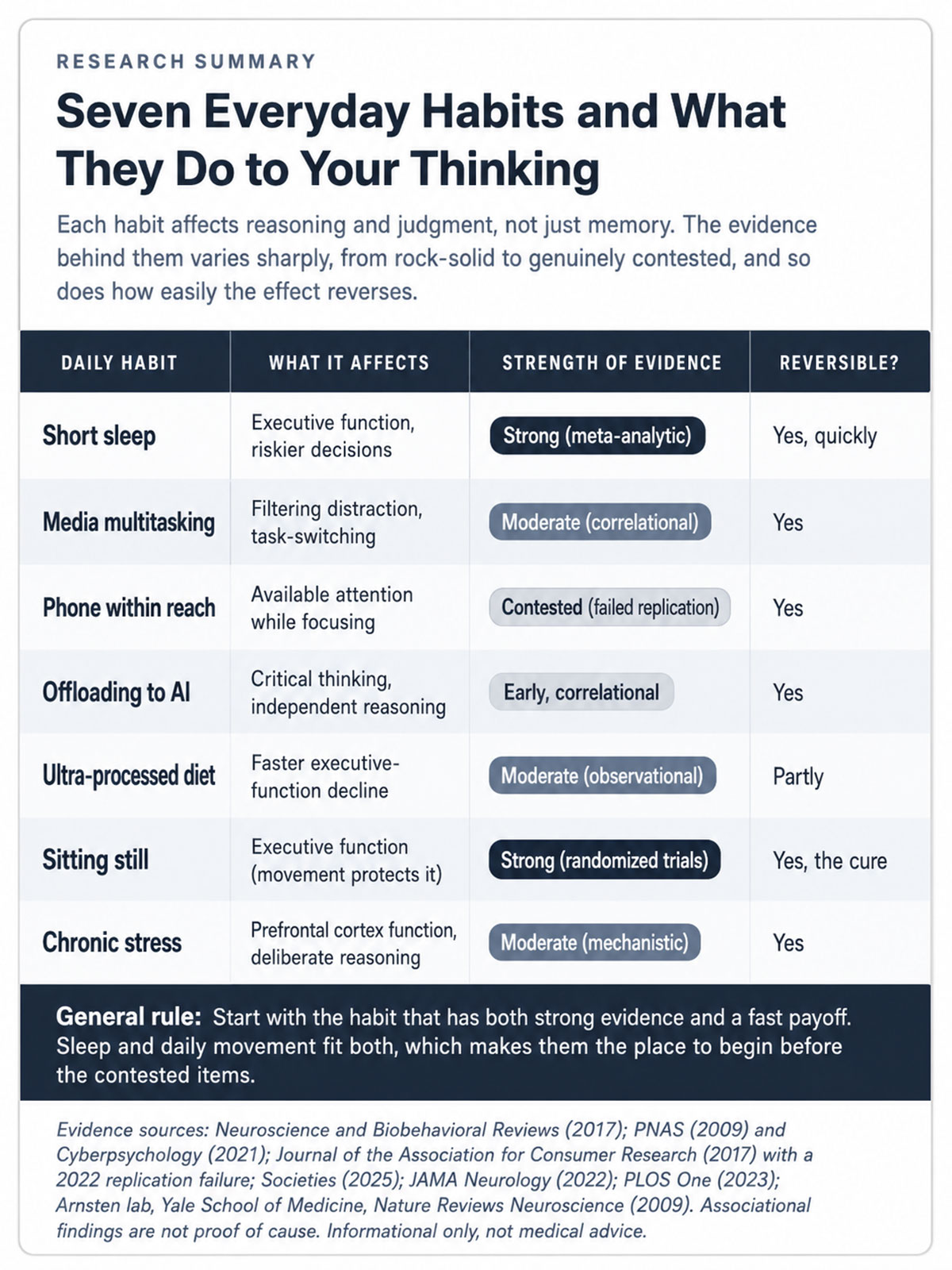
Where this leaves you
Most of what gets called mental sharpness is treated as something you either have or are slowly losing. What the research in this list suggests is more useful: the brain’s capacity for deliberate, clear thought is subject to the same kind of daily input as any other organ, and some of the biggest variables come from the most ordinary places.
Sleep loss cuts into it first, and the capacity recovers fastest once sleep returns. Movement actively builds it back. Chronic stress restructures it from beneath. The habits in between, screens, phones, food, AI, vary in how strong the evidence is and how fast the effects accumulate, and some of that evidence is still being worked out.
Pick the one with the strongest case and the most accessible remedy. For most people, that answer is sleep. Everything else tends to build from there.