Scientists expected to see brains adapt during learning. What surprised them was why those changes didn’t always last.
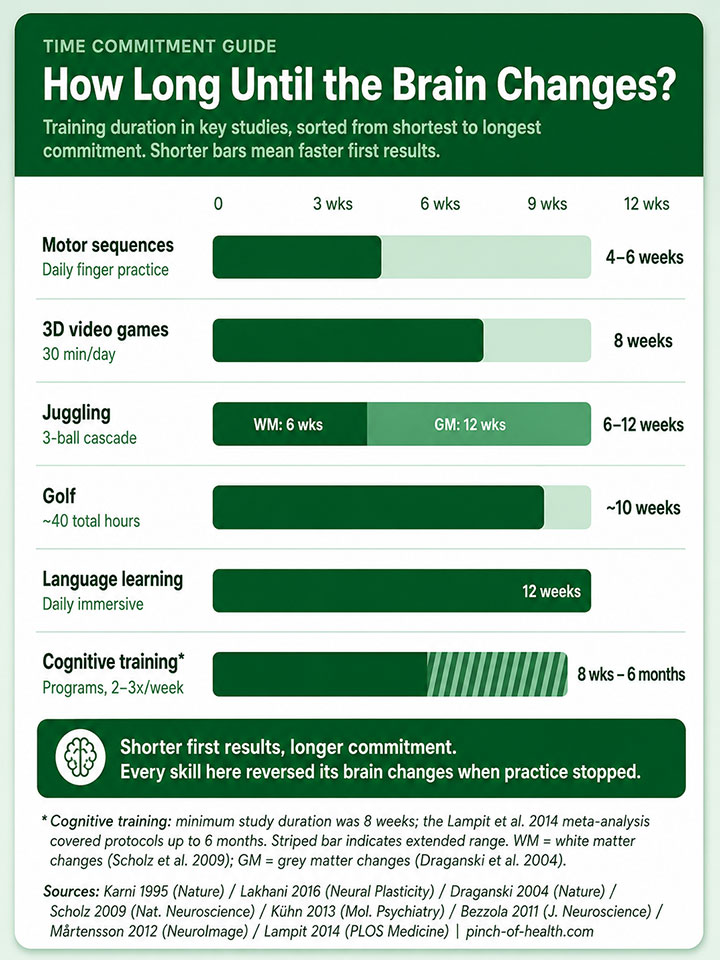
The study that changed how neuroscientists think about adult brain anatomy had a finding buried in the follow-up data. Twelve weeks of juggling grew measurable grey matter in a region of the cortex dedicated to tracking visual motion.
Brain scans confirmed it. Then the researchers stopped the training and brought participants back for a third scan. The grey matter reversed.
The brain had physically built something. Once the demand disappeared, it dismantled what it had made.
That reversal pattern runs through nearly every study in this area, and it reframes the popular version of the neuroplasticity story considerably. The common telling stops at the growth. The research doesn’t.
Over the last two decades, neuroimaging teams have found that healthy adult brains produce real structural changes in response to new learning, but those changes are not permanent by default. They are maintained by continued demand, or they are lost.
Six imaging studies tracked what happened inside healthy adult brains across specific learning tasks, some familiar, some unexpected. The results were not uniform. The brain’s response turned out to depend heavily on what was being learned, who was doing the learning, and whether they kept going after the initial gains appeared.
What Is Neuroplasticity, Exactly?
Think of the brain as a city. Roads get worn down or expanded depending on traffic. Neighborhoods grow or contract based on what gets built there. The city is never finished. It responds to what the people inside it actually need.
Neuroplasticity works by a similar logic. Every time you learn a new skill, the brain rewires itself to handle that task more efficiently. As neuroscientists describe it: neurons that fire together, wire together. Repeat an action enough, and the brain physically builds infrastructure to support it: stronger synaptic connections, denser tissue, faster signal pathways.
Two types of physical change occur during learning. Functional plasticity refers to how the brain reallocates its existing resources (which regions activate during a task and how strongly). Structural plasticity goes further: the physical size and density of brain tissue change. Grey matter grows. White matter thickens. These are the changes that show up on structural MRI scans weeks into a new practice.
For most of the twentieth century, researchers assumed structural changes like these were restricted to childhood. The six studies below are among the clearest evidence that they were wrong.
Skill 1: Sequential Finger Movements Reorganize the Motor Cortex
The question neuroscientists at the National Institutes of Health were trying to answer in the mid-1990s was surprisingly basic: does the adult motor cortex actually change structure when you practice a new movement sequence, or do improvements in performance come entirely from better coordination elsewhere in the nervous system?
To find out, Avi Karni and colleagues had participants practice rapid sequences of finger-thumb opposition for a few minutes each day over several weeks. The primary motor cortex didn’t just become more active during the trained sequence. It physically reorganized its territory to dedicate more real estate to it.
The specificity of the change was what made the finding significant. Improvements didn’t transfer to a matched untrained sequence using the same fingers. The cortex had remapped itself for that particular pattern, not for finger movements in general. Their 1995 paper in Nature was among the first to provide longitudinal evidence that adult M1 reorganizes structurally in response to practice, not only during it.
That finding captured reorganization at the functional level: how activity patterns shift. Later structural imaging added the tissue layer. A 2016 study by Bimal Lakhani and colleagues at the University of British Columbia had 17 healthy adults complete ten sessions of visuomotor skill training, then used multicomponent relaxation imaging to measure myelin directly.
Their paper in Neural Plasticity found significant increases in myelin water fraction in the left intraparietal sulcus and left parieto-occipital sulcus, regions specifically recruited by the training. The motor system was physically rebuilding itself at the tissue level, beyond mere activation-pattern adjustment.
What the Lakhani myelin data adds to the Karni functional result is a tissue-level explanation. The cortex isn’t just processing the movement differently. It’s physically building better wiring for it.

Skill 2: Juggling Grew Grey Matter, and the Reversal Is the More Important Finding
In 2004, Bogdan Draganski and colleagues at the University of Regensburg ran a study with a design simple enough to explain in one sentence: take 24 adults around age 22, teach half of them to juggle a three-ball cascade over three months, scan everyone’s brains before and after, and look at what changed.
The results made headlines. After twelve weeks of training, the jugglers showed a significant increase in grey matter density in the occipito-temporal cortex, specifically the motion-sensitive area known as hMT/V5.
The region that the brain uses to process complex visual motion had physically grown in response to a task that demanded exactly that. Their paper in Nature was among the first to demonstrate macroscopic structural change in healthy adult brains from motor skill training.
Then the researchers stopped the training. The grey matter gains reversed.
That second result is just as significant as the first, and the Draganski team’s description of what they called the “maintenance phase” is what gave it meaning. The brain hadn’t made a permanent investment. It had responded to a temporary demand. When the demand stopped, the tissue reverted.
A separate Oxford team (Scholz and colleagues, Nature Neuroscience, 2009) replicated the juggling paradigm in 24 adults over six weeks and found a related change: fractional anisotropy increases in the white matter underlying the intraparietal sulcus, a region involved in arm movement, grasping, and visual tracking.
Juggling had altered both grey and white matter, in different teams, at different time points. The message of both studies is that use-dependent structural investment runs in both directions.
Most people stop practicing something new once they feel competent. The juggling data suggests that is precisely when the maintenance phase begins.
Skill 3: Learning a Foreign Language Physically Grows the Hippocampus
The hippocampus is best known as the brain’s memory center. Less often noted is that it grows in direct proportion to how hard the learning is.
Johan Mårtensson and colleagues at Lund University found a way to test this at unusual intensity. Swedish military conscripts assigned to an interpreter school were tasked with reaching operational proficiency in Arabic, Dari, or Pashto within three months.
These were languages entirely outside the recruits’ prior experience, and the learning was daily, immersive, and high-stakes. A control group of comparable age completed equally demanding university study in medicine and cognitive science: the same cognitive load, a different type of task.
The interpreter group showed significantly greater brain growth. Hippocampal volume increased. Cortical thickness grew in language-relevant regions: the left middle frontal gyrus, the inferior frontal gyrus, and the superior temporal gyrus. The medicine students’ brain structures showed no comparable change.
Their 2012 paper in NeuroImage directly compared two kinds of demanding cognitive effort and found that language-specific learning drove a structural response that general academic stress did not.
The correlation inside the interpreter group was the more striking finding. Recruits whose hippocampi grew the most were the ones who improved the most in the language. Those who struggled more to master the grammar and vocabulary showed larger increases in the middle frontal gyrus instead, a region associated with effortful processing. The brain wasn’t allocating growth uniformly. It was investing structurally in whatever the specific learning demanded.
Language learning appears to tax several cognitive systems simultaneously: working memory, phonological processing, novel grammar rule application, unfamiliar sound discrimination. That compound demand may be what drives the structural response. The brain appears to build where it is being most heavily used.
Skill 4: 30 Minutes of Super Mario 64 Per Day Rewired the Hippocampus
Thirty minutes. The game Super Mario 64. Every day, for two months. Simone Kühn and colleagues at the Max Planck Institute for Human Development and Charité University Medicine Berlin asked 48 adults to do exactly that, then compared their brain scans against a control group that played no video games at all.
The imaging results were specific enough to be useful. Published in Molecular Psychiatry in 2013, the study found grey matter increases in three regions: the right hippocampus, the right dorsolateral prefrontal cortex (DLPFC), and the bilateral cerebellum.
Each of those regions maps directly to what the task demanded. The hippocampus handles spatial memory and navigation. Learning a complex 3D environment requires both. The DLPFC is involved in planning, working memory, and strategic decision-making.
The game requires all three continuously. The cerebellum coordinates fine motor timing and precision, which a joystick-based platform game demands at a fairly high frequency.
The hippocampal finding was linked to a specific behavioral shift. Participants who showed the largest grey matter increases in that region were also the ones who transitioned from egocentric navigation (tracking position relative to themselves) to allocentric navigation (tracking position relative to landmarks in the environment). The structural change corresponded to a measurable change in how the brain was representing space.
What this study contributes to the broader picture is a point about how to evaluate any task for its neuroplastic potential. The medium (a screen, a controller, an app) is not the question. The relevant question is what cognitive demands the task places on the brain and whether those demands are genuinely novel and progressive.
A 3D spatial navigation game challenges the hippocampus and prefrontal cortex in ways that passive video consumption, or even repetitive casual gaming, does not.
Skill 5: A Golf Hobby Reshaped the Cortex in 40 Hours
Previous motor learning studies had used tightly controlled training protocols: fixed repetitions, controlled durations, lab-based practice environments. What Ladina Bezzola and colleagues at the University of Zurich wanted to know was whether those constraints were actually necessary, or whether leisure-based practice with no fixed protocol could produce the same structural changes.
They recruited golf novices between 40 and 60 years old and had them take up golf as a regular leisure activity, with instruction but without a rigid training regime. Over approximately ten weeks and 40 total hours of practice, participants worked on the swing at their own pace. Before and after MRI scans used voxel-based morphometry to measure grey matter changes.
Their 2011 paper in the Journal of Neuroscience found grey matter increases in a cortical network covering sensorimotor regions and areas of the dorsal visual stream, including parietal regions associated with spatial processing and movement planning.
The degree of change correlated with how much each participant’s performance improved. Participants who practiced with higher intensity and saw faster skill gains showed larger structural changes.
Two things make this finding worth noting separately from the other studies. The participants were 40 to 60 years old, not college students. And the training had no fixed protocol.
Both details matter: the first because it counters the assumption that meaningful neuroplasticity is a young person’s advantage, and the second because they suggest that ecological validity doesn’t undermine the structural effect.
The brain appears to respond to the genuine challenge of a task regardless of whether the environment is a research lab or a golf course on a Tuesday afternoon.
The caveat from elsewhere in this research applies here too: the golf swing is a complex, multi-system motor task. Posture, grip, rotational force, timing, visual tracking, and balance. The researchers note that low-challenge repetitive activities don’t appear to produce comparable structural effects. The challenge is load-bearing.

Skill 6: Cognitive Training Programs Work, Just Not as Much as People Think
The previous five studies each examined one skill, one team, and one imaging result. The cognitive training literature had accumulated dozens of such studies by 2014, most of them pointing in the same direction but varying enough in methods to make summary difficult.
Amit Lampit, Harry Hallock, and Michael Valenzuela at the University of Sydney did the summary work: a systematic review and meta-analysis in PLOS Medicine covering 51 studies and 52 datasets, involving approximately 4,885 cognitively healthy older adults.
The overall effect was small and statistically significant: Hedges’ g = 0.22, with a 95% confidence interval of 0.15 to 0.29. In practice, this means that trained participants outperformed controls on untrained cognitive tests, but by a modest margin. Memory and processing speed showed the strongest gains. Executive function and attention showed no significant effect.
That effect size will disappoint anyone who has been marketed a brain training program promising substantial cognitive enhancement. It should. A g of 0.22 is a real signal but a modest one, and the honest read is that computerized cognitive training is not a robust cognitive intervention in the sense that aerobic exercise appears to be.
What the meta-analysis does establish is that the transfer is real (improvements did generalize beyond the specific tasks being trained), and the most effective protocol was supervised, center-based training done two to three times per week.
Small and consistent across 52 independent datasets is not nothing. Researchers still don’t agree on the mechanism: whether the gains reflect underlying structural change, improved processing efficiency, or learning-to-learn effects. But for older adults specifically, the finding that mental processing is trainable at all carries more weight than the modest effect size might suggest.
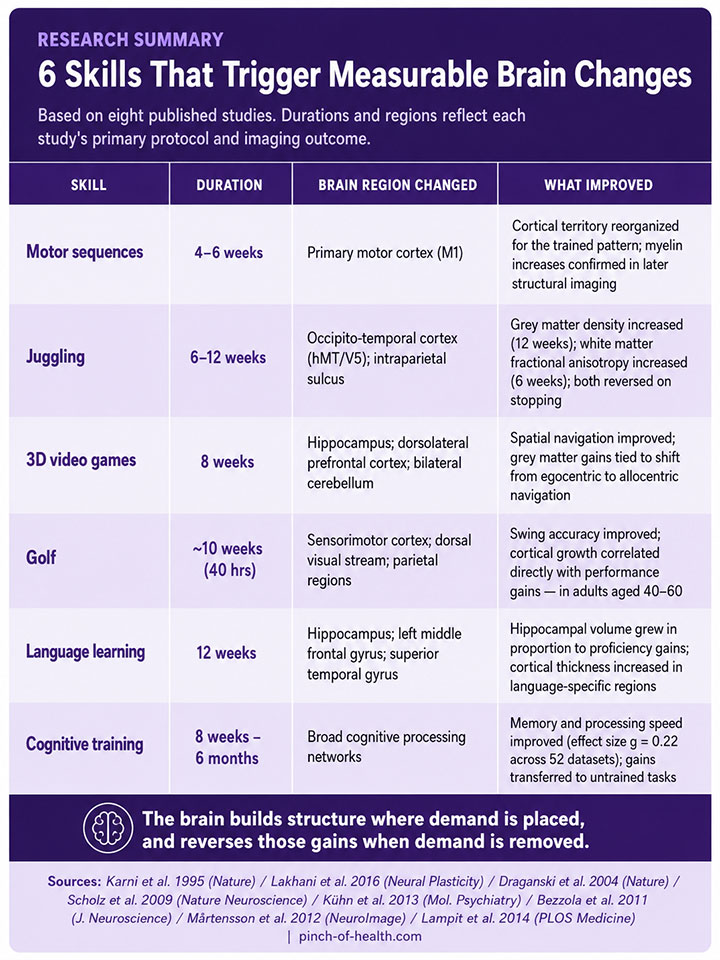
The Research at a Glance: 6 Skills and Their Brain Effects
The table below summarizes each skill, the duration studied, the brain region affected, and what changed functionally. It is designed as a reference, not a prescription: the six studies each used specific populations and protocols that don’t translate directly into individual training recommendations.
How to Run Your Own 12-Week Brain Training Cycle
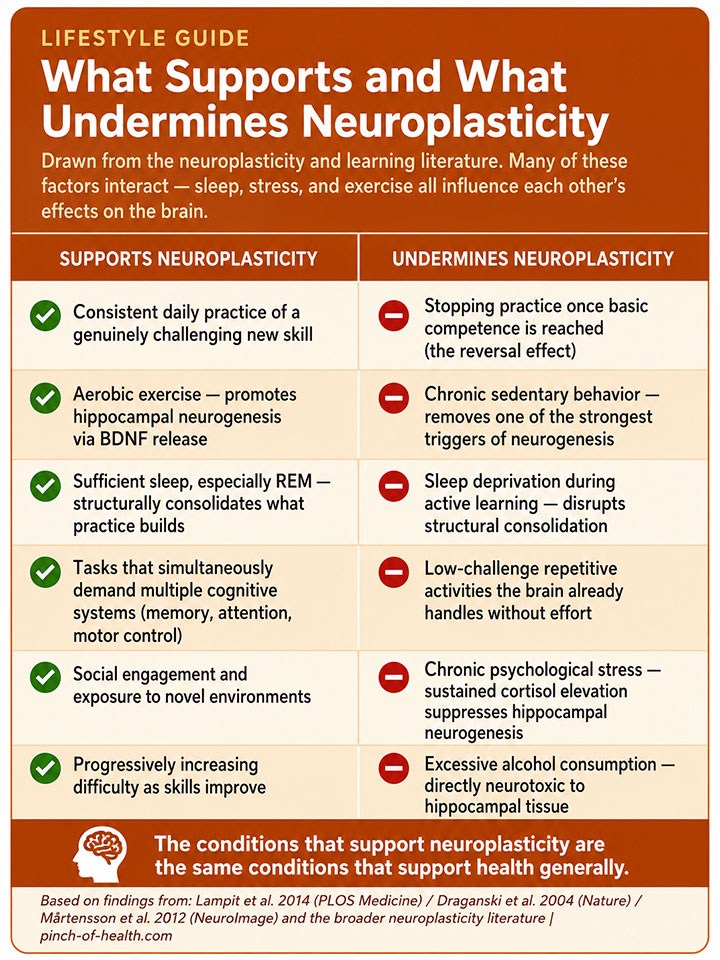
What the six studies above share is less about the skills themselves and more about the conditions that made them work.
In every case where structural change appeared, the task was genuinely hard for the person doing it. Not time-consuming. Difficult. The golf novices who showed the largest cortical changes were the ones whose performance improved fastest.
The language recruits whose hippocampi grew the most were the ones for whom the language was most demanding. The brain does not appear to invest in building new infrastructure for tasks it already handles without effort.
Short daily sessions consistently outperformed long infrequent ones across the motor learning research, from Karni’s finger sequences through to the myelin studies. The brain consolidates incrementally.
What this also means, and what the sleep consolidation literature makes clear, is that cutting sleep short during an active learning period doesn’t just create fatigue. It interferes with the consolidation the practice is trying to build. Session frequency and sleep aren’t independent levers. They operate together.
The juggling reversal is the most useful thing to carry into any new skill acquisition period. Once structural change has occurred, continued practice at reduced intensity appears sufficient to preserve it.
Stopping entirely is enough to lose it. Most people treat the early competence phase as the endpoint. The research suggests it’s better understood as the beginning of the phase that actually matters. Pick something hard. Stay with it longer than feels necessary.
Which Skill Fits You?
Two questions. One research-backed recommendation based on your time and interests.
Conclusion
The twelve-week number appears throughout this research because that’s how long most of the studies ran. The brain didn’t select twelve weeks as a threshold. It responded to whatever demand was placed on it, as quickly as that demand appeared, and maintained the response for as long as the demand continued.
The MRI data across these six studies point to something less tidy than the popular “neuroplasticity is real” summary suggests. The adult brain can grow measurable grey matter and reorganize white matter pathways. It can also take it back. What the research actually establishes is that structural change is a response to sustained demand, not a reward for completing a program.
The practical implication is less about choosing the right skill and more about deciding whether you’re prepared to maintain it. The brain starts building in the first weeks of consistent practice and begins unwinding the week the practice stops. The maintenance phase is the condition under which the investment holds.
Frequently Asked Questions
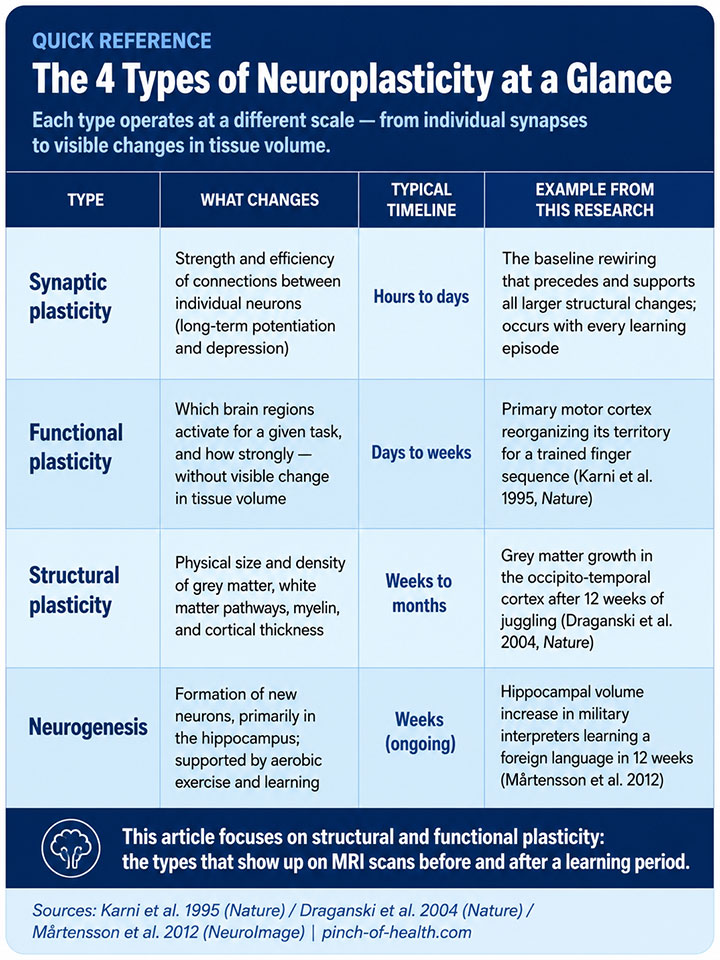
What are the 4 types of neuroplasticity?
The four types most commonly described in neuroscience research are synaptic plasticity (the strengthening or weakening of connections between individual neurons), structural plasticity (changes in grey matter volume, white matter integrity, or cortical thickness), functional plasticity (shifts in which brain regions are recruited for a given task), and neurogenesis (the formation of new neurons, which in adults occurs primarily in the hippocampus).
The studies in this article focus mainly on structural and functional plasticity, since these are the changes that show up on MRI and can be measured before and after a defined learning period.
At what age is neuroplasticity highest?
Neuroplasticity is highest during early childhood, particularly in the first few years of life, when the brain is forming its foundational architecture at a rate it will never replicate. The rate slows across adolescence and into adulthood, but structural plasticity does not disappear.
The studies on juggling, language learning, golf, and cognitive training in this article all involved adults in their twenties through sixties, and all produced measurable structural changes. The Bezzola golf study specifically recruited adults between 40 and 60.
Adult neuroplasticity is more modest in scale than developmental plasticity and requires more sustained effort to trigger, but it is real and documented.
What are the three rules of neuroplasticity?
Three principles consistently emerge from the motor learning and neuroplasticity literature. The first is specificity: the brain builds structure in the regions recruited by the task being practiced, not in broad unrelated areas.
The second is use it or lose it: structural changes reverse when the training stops, as the juggling reversal studies show directly. The third is use it and improve it: the more consistently and appropriately challenging the practice, the stronger the structural response, up to a point where the brain reaches a new stable state and requires novel challenge to continue adapting.
What ruins neuroplasticity?
Several factors consistently appear in the literature as inhibitors of neuroplastic change. Chronic psychological stress raises cortisol levels, which suppress hippocampal neurogenesis and can shrink hippocampal volume over time.
Poor or insufficient sleep disrupts the consolidation process through which learned patterns are structurally stabilized. Sedentary behavior removes one of the strongest known triggers of neurogenesis: aerobic exercise.
Excessive alcohol consumption is directly neurotoxic to hippocampal tissue. Social isolation and low cognitive engagement over extended periods appear to accelerate rather than delay structural decline. The conditions that support neuroplasticity are the same conditions that support health generally.