The first brain scan was only the beginning. What researchers discovered after tracking participants over the following weeks changed the story completely.
For years, the advice was everywhere. Learn something new every day. Take a different route to work.
Brush your teeth with your opposite hand. Somewhere along the way, this became the accepted formula for a sharper, more adaptable brain.
Ten major brain imaging studies, spanning two decades, say otherwise.
When researchers actually scanned the brains of people learning something new, the changes that showed up on the scans never came from sampling a little of everything. They came from doing one thing, the same way, for six weeks or more, without stopping to chase the next new hobby.
Juggling, a second language, a musical instrument. The skill barely mattered. The commitment did.
This article walks through what those ten studies actually measured, one citation the popular version of this advice tends to get wrong, and what a research-backed practice plan looks like for the three skill domains with the strongest evidence behind them.
Your 8-Week Neuroplasticity Quick Start
The short version, for anyone who wants to start today:
- Pick one skill from the three evidence-based options below: a motor skill, a new language, or a musical instrument.
- Block 20 to 30 minutes daily on your calendar for at least eight weeks. Treat the session as non-negotiable.
- Record a baseline. Write down exactly where your ability stands today, using a number you can repeat weekly.
- Track that number every week. Progress that feels invisible day to day is often obvious on a graph.
- Don’t judge the results before week six. That’s roughly where the brain’s slower, structural changes begin catching up to the fast early gains.
The rest of this article explains why that timeline holds, what’s actually changing inside the skull while you practice, and how to build a plan around whichever skill you pick.
Challenging the Popular Wisdom
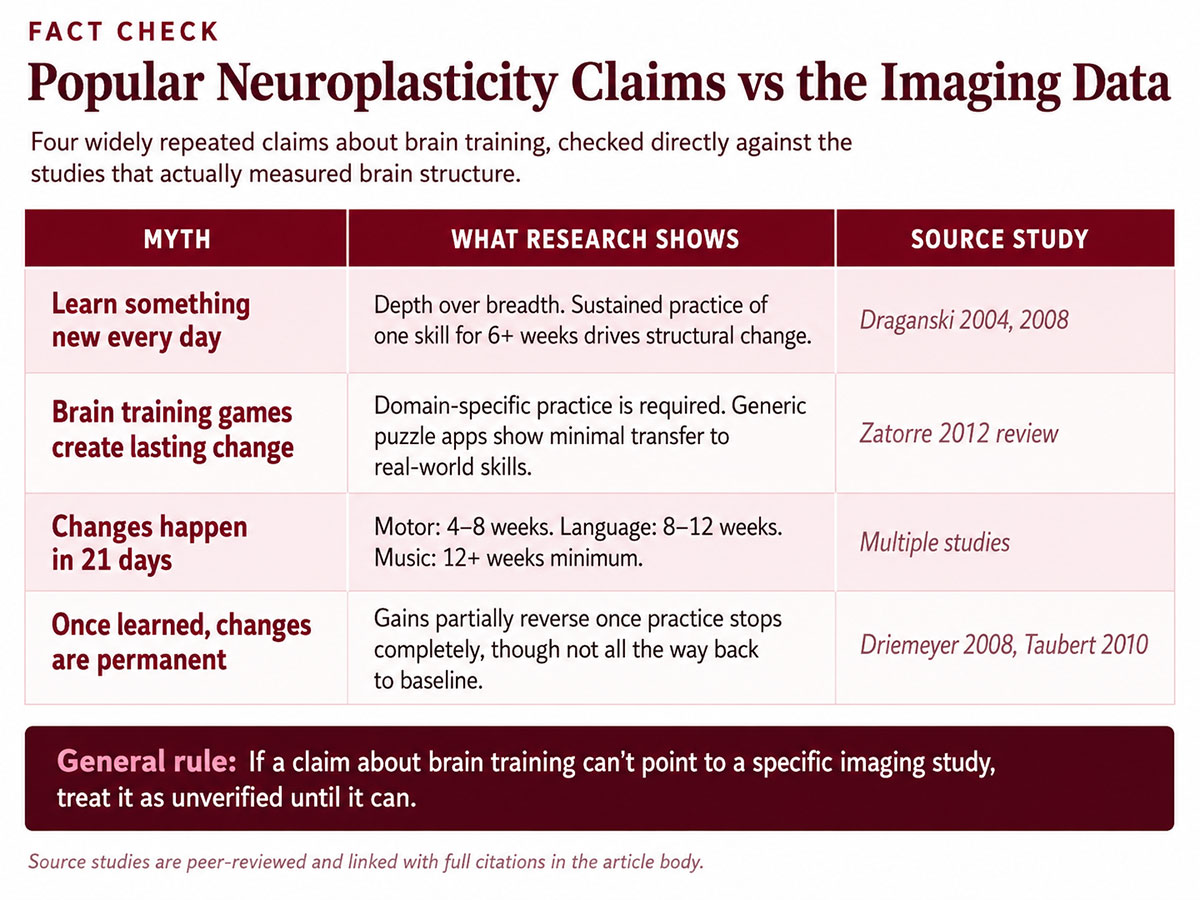
“Learn something new every day” shows up constantly in productivity blogs, wellness newsletters, and health content generally. It sounds intuitively right. Novelty stimulates the brain, and variety keeps life interesting, so more variety should mean more stimulation.
When researchers examined what actually produces measurable neuroplastic change using MRI and diffusion tensor imaging, the pattern looked nothing like that. Meaningful structural and functional brain changes didn’t emerge from trying something different every day. They came from sustained, focused practice of one specific skill, over extended periods, in the same neural circuits, over and over.
Over the past two decades, researchers used functional MRI, structural MRI, and diffusion tensor imaging to track exactly what happens when adults commit to learning to juggle, studying a new language, or training on an instrument.
Across wildly different populations and skill domains, the pattern holds. Depth of engagement drives change. Breadth of exposure mostly doesn’t.
Why the “Learn Something New Daily” Advice Misses the Mark
Where the Advice Comes From
The daily novelty recommendation isn’t invented out of thin air. It borrows from three real findings and stretches them past what they actually support.
Novel experiences do activate the brain and trigger dopamine release, which supports attention and learning in the moment. The concept of cognitive reserve, the brain’s resilience against age-related decline, has genuinely been linked to lifelong learning and varied life experience. Early animal research found that environments with more stimulation and variety promoted neurogenesis and synaptic growth in rodent brains.
Each of those findings got simplified into content-friendly advice to try something new every day. The problem is that activation isn’t the same thing as structural reorganization. A brief exposure followed by moving on provides a jolt of stimulation without the sustained engagement the brain needs before it commits resources to building and strengthening a specific neural circuit.
Cognitive Reserve Is Not the Same Thing as Structural Neuroplasticity
Cognitive reserve describes the brain’s overall resilience, built across a lifetime of experience, education, and mental engagement. It’s a real protective factor against cognitive decline, and it accumulates over decades of varied living.
Structural neuroplasticity, the kind these ten studies measured directly, refers to specific, quantifiable changes in brain tissue organization in response to focused skill practice. Increases in gray matter density. Changes in white matter connectivity. Shifts in functional activation patterns.
These develop over weeks to months, not decades, and they respond to depth of practice rather than breadth of experience.
Both processes matter. They are not interchangeable, and conflating them is where a lot of the popular advice goes wrong.
What Daily Novelty Gets Right, and Where It Breaks Down
To be fair to the “try something new” crowd, they’re not entirely wrong. Novel experiences do engage attention, activate multiple brain regions, and can lift mood through dopamine-mediated reward pathways. Variety supports psychological well-being and likely contributes to cognitive flexibility, the ability to shift between mental frameworks and adapt to new situations.
Cognitive flexibility and structural neuroplasticity are different phenomena, though, and the imaging data draw a clean line between them. When researchers tracked people learning to juggle, studying a new language, or training on an instrument, the structural changes only appeared after sustained, repeated practice over weeks to months. Not after brief, scattered exposure to a dozen different activities.
The Core Principle the Research Reveals
The neuroimaging literature points to a consistent pattern of development. Participants in the successful studies didn’t dabble in a skill for a day or a week before moving to the next thing. They performed the same actions, the same cognitive processes, hundreds or thousands of times, over months.
Bogdan Draganski spent the early 2000s trying to catch an adult brain changing shape in real time, and juggling turned out to be the task that made it visible. His 2004 study in Nature had adults learn a three-ball cascade over roughly three months of daily practice. Brain scans showed a selective increase in gray matter in the brain’s visual-motion processing areas after that sustained stretch of training.
That finding took a while to resonate with researchers because it broke a long-held assumption. Cortical plasticity was thought to be functional, not structural, meaning the brain could rewire how it used existing tissue but not visibly add to it. Draganski’s scans said otherwise.
This is the mechanism underneath everything else in this article. The brain builds and strengthens neural circuits through repeated activation and refinement, not novelty exposure.
Every repetition doesn’t just re-fire the same neurons. It progressively modifies synaptic strength, promotes myelination along the relevant pathways, and produces structural change in gray matter density and white matter connectivity.
None of that happens on a compressed timeline. It requires consistency, which is exactly what daily skill-hopping doesn’t provide.
What Brain Imaging Studies Actually Show
Why This Research Is Credible
Unlike behavioral studies that infer brain change from performance improvement alone, these neuroimaging studies visualized and measured structural modification directly. Researchers used voxel-based morphometry to detect gray matter density changes, diffusion tensor imaging to track white matter connectivity, and functional MRI to capture activation pattern shifts.
Participants underwent baseline scans before training, follow-up scans at set intervals during training, and in several studies, additional scans after training stopped to see whether the changes persisted or reversed. Gray matter density, white matter fractional anisotropy, and functional activation patterns can’t be faked or nudged by what a participant expects to happen. That objectivity is what makes this evidence base worth taking seriously.
What These Measurements Actually Detect
Three terms show up constantly in this literature, and they’re worth unpacking before going further.
Gray matter density reflects more neural cell bodies, synapses, and support cells packed into a specific brain region, similar to how a worked muscle builds more muscle fiber and becomes denser tissue. Researchers measure it with voxel-based morphometry on structural MRI scans.
White matter connectivity consists of myelinated axons, the cables connecting different brain regions. More myelination means thicker insulation and faster signal transmission, something like upgrading from a dial-up connection to fiber optic. Diffusion tensor imaging measures this through fractional anisotropy, an index of white matter structural integrity.
Functional activation patterns capture how selectively and efficiently neurons fire as a skill becomes automatic. An experienced driver uses noticeably less mental effort than a beginner performing the identical maneuver. Functional MRI measures blood oxygen levels during a task to reveal which regions are active and how efficiently they’re working.
The Pattern Across Studies
Despite covering different skills, ages, and training durations, these studies converge on a consistent developmental arc. Neuroplastic change unfolds in stages, moving from early functional shifts toward later structural consolidation.
In the first days to weeks, functional imaging shows altered activation patterns as the brain adjusts its processing strategy. Those functional changes precede and appear to predict the structural changes that follow.
A 2012 review in Nature Neuroscience by Robert Zatorre and colleagues synthesized findings across music, speech, and language learning, drawing on fMRI, structural MRI, and diffusion imaging. Sustained skill practice, the review concluded, produces coordinated change across functional activity, structural gray matter, and white matter connectivity, and the changes show up specifically in brain regions relevant to the skill being practiced.
Visual-motion areas for juggling. Language pathways for a second language. Motor and auditory regions for musical training.
That anatomical specificity is the strongest evidence that these changes come from the particular skill being practiced, not some generic effect of effort or attention.
The Time Course, Study by Study
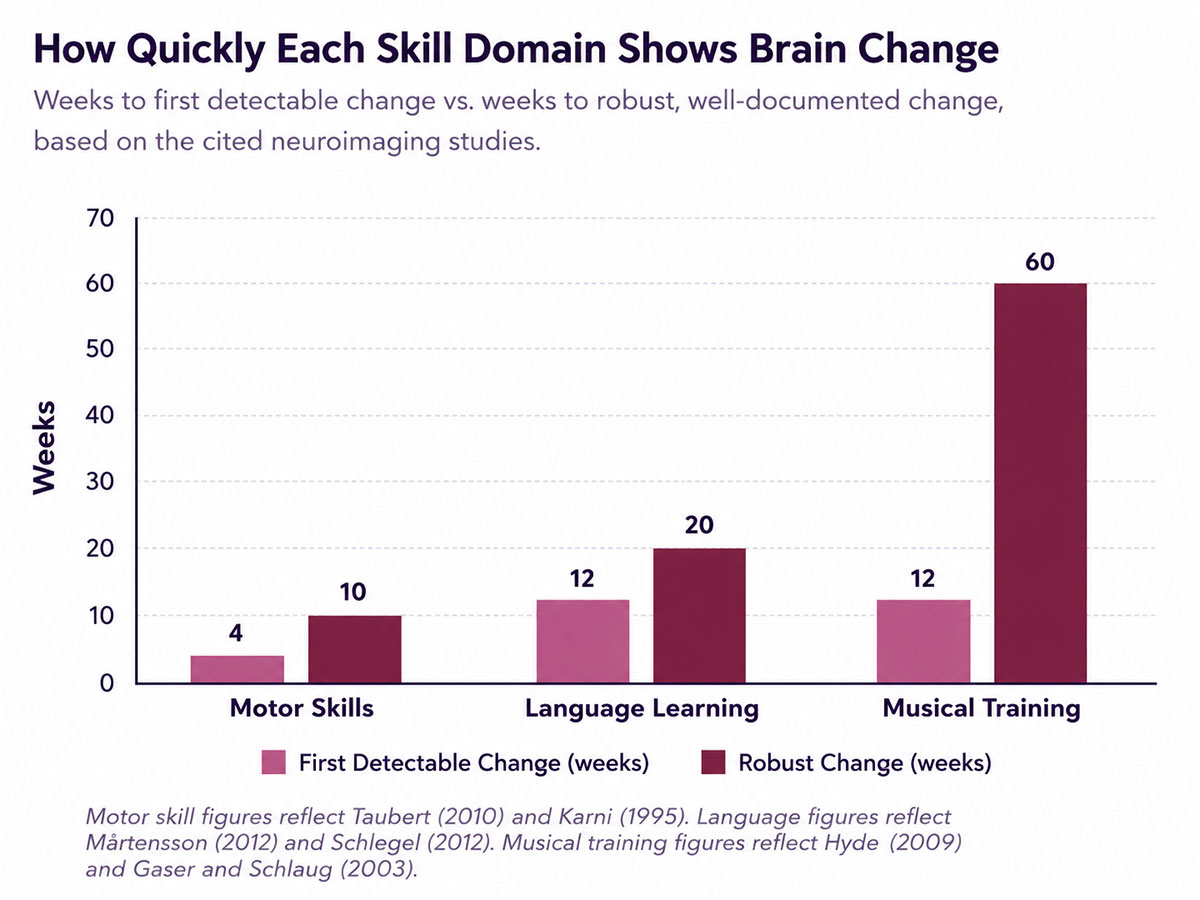
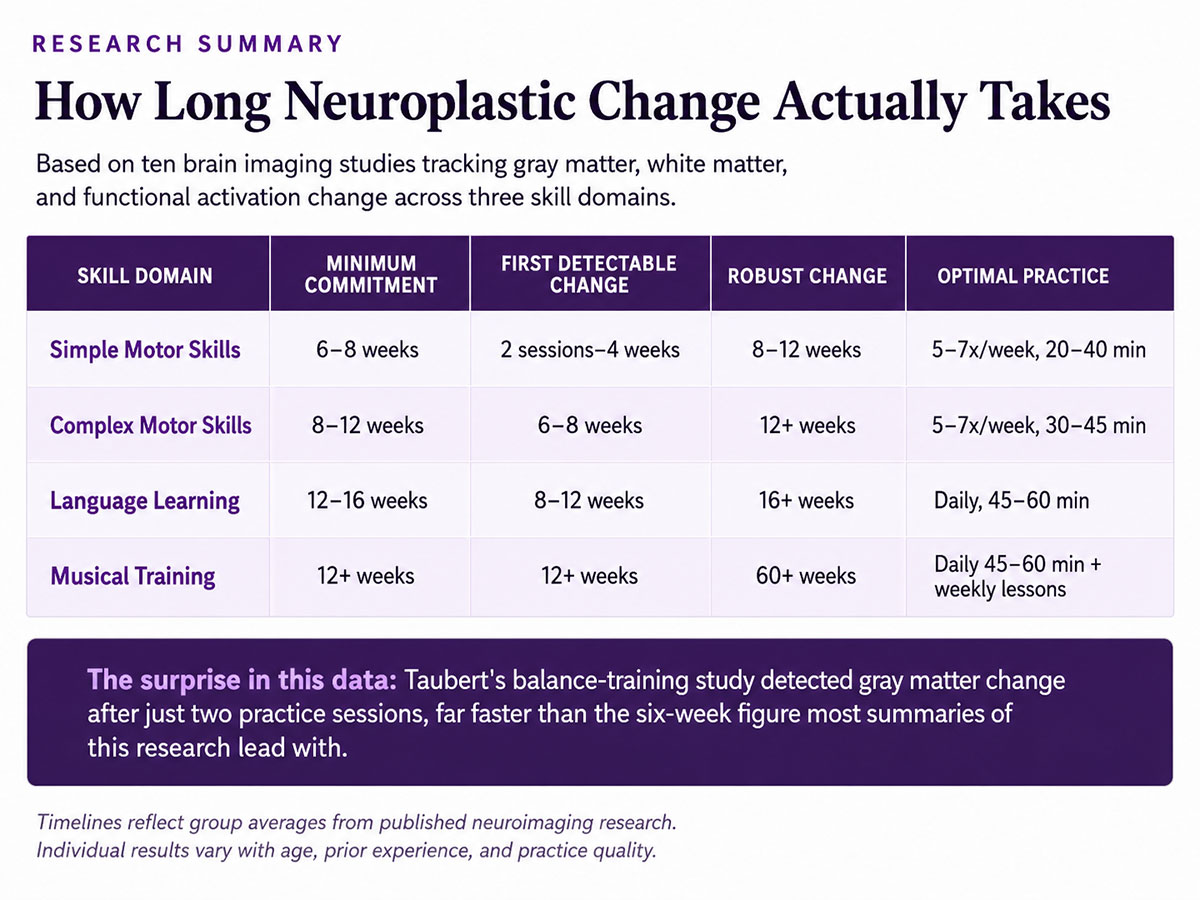
Avi Karni’s 1995 Nature study had adult participants practice a simple finger-tapping sequence repeatedly, and functional MRI revealed a slow, experience-dependent expansion of primary motor cortex activation within four to six weeks of daily practice. It remains one of the fastest documented timelines in this entire literature.
Gray matter can shift in frontal and parietal regions, prominently the prefrontal cortex, after just two practice sessions of a demanding balance task. That’s the finding from Marco Taubert’s 2010 study in the Journal of Neuroscience, and it’s the fastest documented timeline in this entire literature, faster than anyone studying this expected going in.
The volume increase then continued to track performance gains across a six-week learning period, with corresponding white matter changes following the same timeline in fractional anisotropy.
Language learning runs on a slower clock. Johan Mårtensson and colleagues studied military interpreter trainees in a 2012 NeuroImage study, recruits enrolled in a demanding 13-month language program at the Swedish Armed Forces Interpreter Academy.
Structural MRI at the three-month mark showed hippocampal volume increases and cortical thickening in the left middle frontal gyrus, inferior frontal gyrus, and superior temporal gyrus, with the degree of change tracking how much effort a given trainee had to invest to keep pace.
A companion study on the same cohort, led by Alexander Schlegel, tracked white matter over a full nine months of intensive Chinese study and found increased fractional anisotropy in the left arcuate fasciculus, a pathway connecting language processing regions, published in the Journal of Cognitive Neuroscience in 2012.
Both studies point to the same underlying process. Deep, sustained engagement with one language, not casual sampling of several.
Musical training shows the longest documented arc of any domain in this research. Krista Hyde followed children aged five to seven through 15 months of weekly keyboard lessons plus daily home practice in a 2009 Journal of Neuroscience study, detecting structural changes in motor and auditory cortex along with corpus callosum modifications linked directly to how much each child had practiced.
A separate cross-sectional comparison by Christian Gaser and Gottfried Schlaug, published in 2003, found a clean dose-response gradient. Professional musicians showed more gray matter in motor, auditory, and visuospatial regions than amateur musicians, who, in turn, showed more than people who had never played an instrument.
Years of accumulated practice, not innate wiring alone, appear to be doing real work here.
What the Changes Actually Mean
These structural modifications aren’t cosmetic markers sitting on top of a scan. Increased gray matter density in a task-relevant region reflects real neural resources devoted to processing that skill.
White matter change means more efficient communication between regions that need to coordinate during skilled performance. Functional activation shifts show a refined, more selective neural response as expertise develops.
Participants in these studies didn’t just show brain changes in isolation. Their skill performance improved in step with the magnitude of the neural modification. The reorganization enabled more efficient, accurate, and automatic execution of whatever they were practicing.
The Essential Role of Consistency Over Novelty
Depth of practice matters more than breadth of exposure for producing measurable structural brain change. Novel experiences do activate the brain and may support psychological flexibility, but the neuroplastic changes captured in these imaging studies required sustained, repeated engagement with one skill over an extended period.
Why Repetition Drives Structural Change
The mechanism involves progressive strengthening of neural circuits through repeated activation. Practice a skill, and specific populations of neurons fire in coordinated patterns. Repeat it, and synaptic connections between those co-activated neurons strengthen through long-term potentiation.
Unused synapses get pruned for efficiency. Myelin thickens around frequently used axons to speed transmission. Metabolic support expands to meet the energy demand of the newly active circuit.
A single exposure to a novel task activates the relevant regions but doesn’t provide enough repetition for structural consolidation. The brain appears to need a consistent signal that a specific skill matters and will be used repeatedly before it commits resources to building the infrastructure that supports it.
What the Motor Learning Data Shows
Karni’s finger-tapping participants performed the identical sequence hundreds or thousands of times over four to six weeks. Not novelty. Repetition.
The resulting expansion of motor cortex representation emerged specifically because of that sustained, repeated engagement, and a 2011 Neuron review by Eran Dayan and Leonardo Cohen adds an important wrinkle to that picture. Motor learning induces region-specific cortical reorganization through both fast and slow mechanisms, and critically, adaptation continues when task demands keep increasing.
Neuroplasticity requires continued adaptation as the challenge grows, not a one-time skill acquisition.
Taubert’s balance participants practiced the same whole-body task four times weekly for six weeks. Draganski’s jugglers practiced the same three-ball pattern daily for three months. In both cases, the gray matter changes reflected the brain’s structural commitment to a repeatedly practiced skill, not a rotating menu of different challenges.
Language and Music Follow the Same Rule
Mårtensson’s interpreter trainees engaged in intensive, focused study of one specific language over 13 months. The hippocampal and cortical thickness changes captured at three months reflected deep processing of a single linguistic system, vocabulary, grammar, phonology, all practiced intensively and repeatedly rather than sampled across several languages.
Hyde’s young piano students followed the same rule on a different instrument, and the cross-sectional data from Gaser and Schlaug reinforces it from a completely different angle. Musical training isn’t about switching instruments every few weeks. It requires focused development of one technique, one repertoire, over months and years.
The Detraining Evidence
The strongest evidence for why sustained practice matters comes from what happens when it stops. Joenna Driemeyer and colleagues followed up on the original juggling research in a 2008 study in PLoS ONE, extending Draganski’s design to look specifically at what happened once daily juggling practice ended. The increase in gray matter that had built up during training partially reversed once practice stopped.
The same study found something almost nobody expects. Measurable gray matter change showed up after as little as seven days of juggling practice, far sooner than the three-month mark most people associate with this research.
Skeptics have a fair question here. Couldn’t some of this be regression to the mean, or participants simply trying harder because they know a scanner is tracking them? It’s a real limitation worth taking seriously.
The detraining data is hard to explain away as a pure expectation effect, though. Gains that build during active practice and recede once practice stops track the behavior of a genuine biological process responding to use, not a one-time placebo bump that would be expected to hold steady regardless of what participants did afterward.
This is the finding with the most direct implication for anyone building a practice plan. Maintaining neuroplastic change appears to require ongoing engagement, not a single successful training block that locks in permanently.
What About Exercise, Sleep, and the Rest of the Standard Advice?
Anyone who has searched for ways to increase neuroplasticity has come across a familiar list.
Get moving. Sleep well. Try meditation.
None of that advice is wrong, and it would be misleading to write six thousand words on this topic without addressing it directly.
Aerobic exercise triggers a release of brain-derived neurotrophic factor, a protein that supports neuron growth and survival, and it works through a mechanism largely separate from the skill-specific structural change documented in the studies above.
Where Draganski’s jugglers built gray matter in visual-motion areas through repeated visuomotor practice, exercise appears to create a more general neurochemical environment that favors plasticity across the brain.
The two aren’t competing explanations. They’re complementary systems, and someone practicing a new instrument three days a week while also running twice a week is likely stacking two distinct mechanisms rather than wasting effort on redundant ones.
Sleep plays a related but separate role. Consolidation of newly formed memories and skills happens substantially during sleep, which means the practice itself only does half the job. Skipping sleep after a hard practice session may blunt some of the very consolidation that practice was meant to trigger.
None of this contradicts the depth-over-breadth argument running through this article. It complements it. A focused practice plan built around one skill, supported by regular aerobic activity and consistent sleep, is a stronger foundation than any of those three pieces in isolation.
The Optimal Practice Protocol Based on Research
Choose Your Skill Domain Strategically
Motor skills, language learning, and musical training have the strongest evidence base among skill domains, though that reflects which domains researchers have studied most extensively with brain imaging, not a ceiling on what other skills might do.
Motor skills offer the fastest feedback. The motor system is well-mapped neuroanatomically, so changes are comparatively easy to detect and localize, and Taubert’s and Karni’s data show measurable change inside a handful of weeks.
Language learning recruits phonological processing, semantic networks, grammatical analysis, working memory, and auditory-motor integration simultaneously, producing change across a wider set of distributed regions.
Musical training combines motor, auditory, visual, and interpretive demands at once, which is likely why it produces some of the most extensive structural changes documented in this literature, even though it takes the longest to appear.
Commit to the 6+ Week Timeline, With Domain-Specific Expectations
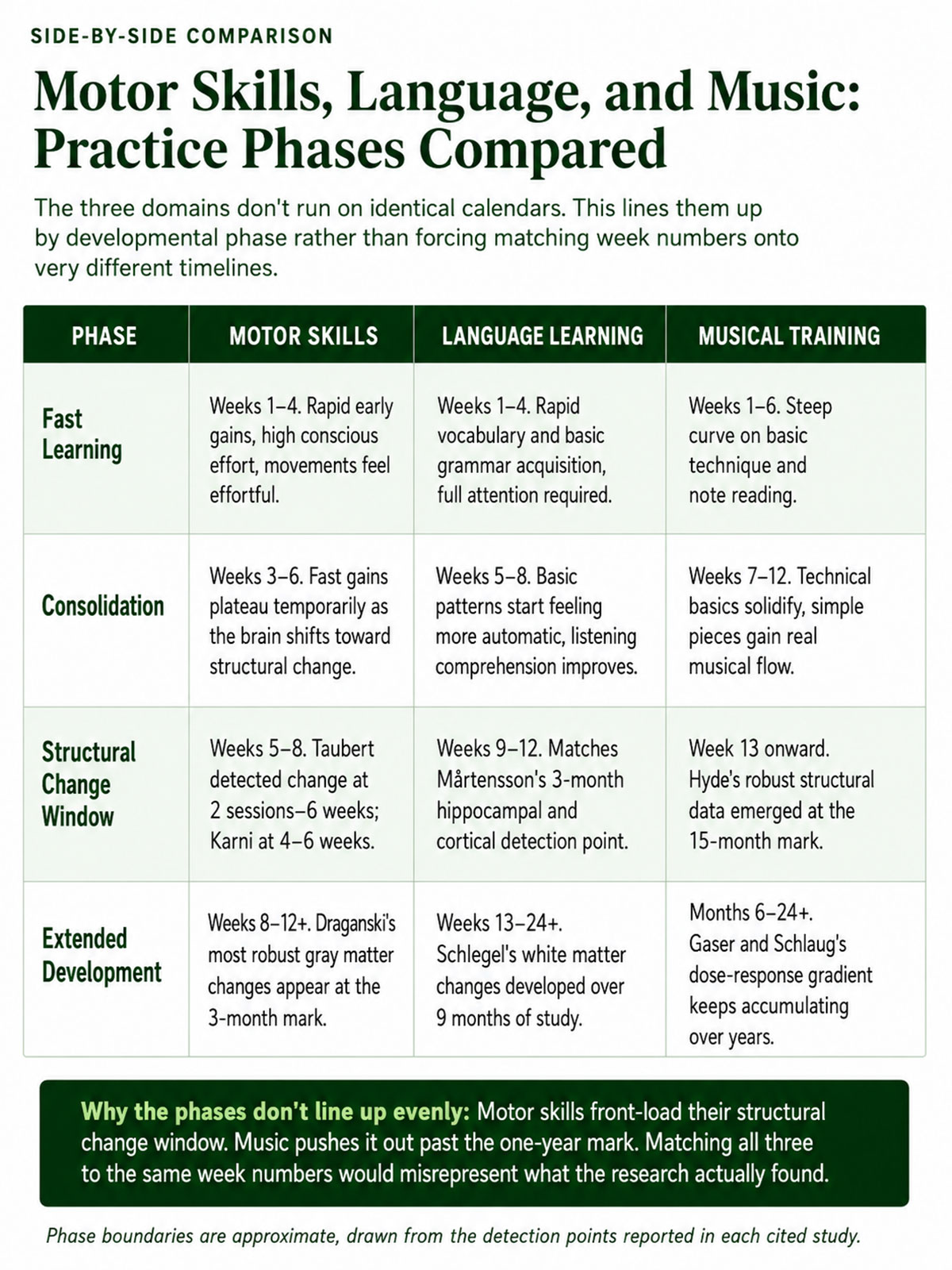
Plan for a minimum of six weeks of consistent practice, with a clear understanding that most robust changes require eight to twelve weeks or longer, depending on the domain.
Motor skills sit at the fast end, for the reasons the Taubert and Karni data above already laid out. The planning implication: don’t schedule a real progress check before week six, and don’t panic if week three still feels effortful. That’s the ordinary shape of this timeline, not a sign the plan isn’t working.
Even Draganski’s juggling data, the source of the popular “three months” framing, needed the full three months for its most robust changes.
Language learning runs longer, building on the Mårtensson and Schlegel timelines covered above. The planning implication is different from motor skills.
Treat the three-month mark as a real turning point worth acknowledging, not a point to judge fluency by. Assessing results before then is premature by the research’s own timeline, and development continues well beyond it as proficiency deepens.
Musical training runs longest of all, consistent with the Hyde and the Gaser and Schlaug data above. The planning implication here is the starkest of the three. Twelve weeks is a reasonable entry point, not a finish line, and expecting parity with the other two domains by that mark will only produce disappointment that has nothing to do with whether the practice is working.
Practice Near-Daily, With Enough Duration to Matter
The successful protocols in this research involved frequent, regular sessions. Taubert’s balance participants trained four times weekly.
Draganski’s jugglers trained daily. Mårtensson’s interpreters studied daily, and Hyde’s young musicians combined weekly lessons with daily home practice.
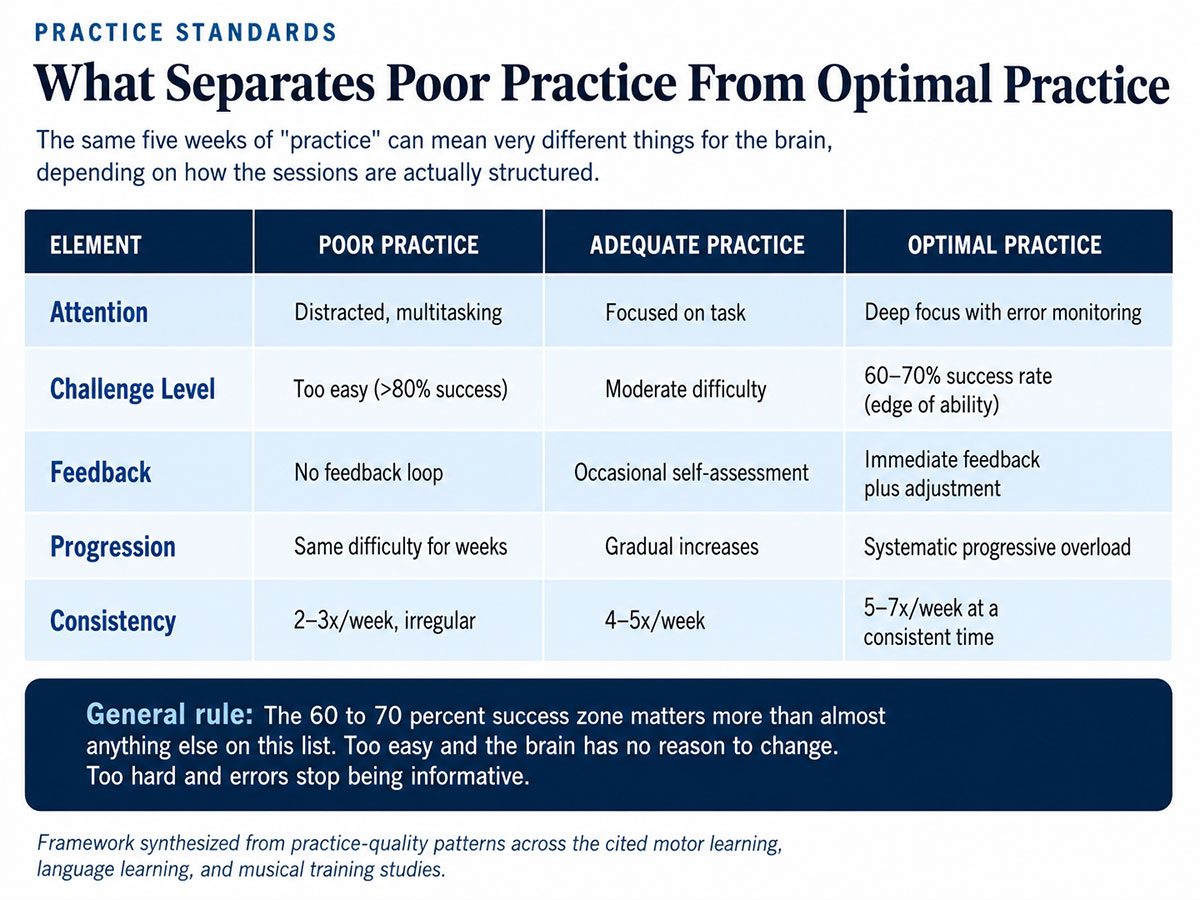
Five to seven sessions a week appear to be the sweet spot for driving measurable change, with sessions typically running 20 to 60 minutes depending on the skill and the person’s available time.
“Daily” doesn’t mean rigid perfection. Missing an occasional session doesn’t erase progress. What matters is consistency across the full training period, not flawless adherence that creates enough stress to trigger burnout and abandonment.
Keep the Practice Deliberate
The changes documented in this research came from engaged, effortful practice, not passive repetition. Karni’s finger-tapping participants had to maintain attention to sequence accuracy even as the movement became more automatic.
Mårtensson’s interpreters were actively memorizing vocabulary, analyzing grammar, and producing spoken language, not passively listening to recordings. Hyde’s young pianists received structured instruction with deliberate correction, not casual, unstructured playing.
Deliberate practice means focused attention on a specific aspect of performance, immediate feedback about accuracy, active correction of errors, and systematic progression to harder material once the current level is fully learned. That active engagement appears necessary for the kind of circuit refinement these studies documented.
Build In Progressive Challenge
Dayan and Cohen’s review found that motor learning keeps producing structural change when task demands increase systematically, and that principle likely generalizes across domains.
As a skill becomes more automatic and requires less conscious attention, increase the difficulty. Faster tempo. More complex sequences. Harder vocabulary.
Progressive challenge appears to be what keeps the neuroplastic stimulus alive once the initial learning curve flattens out.
Neuroplasticity Timeline Calculator
Estimate a realistic timeline based on the research evidence, not guesswork
Your Personalized Timeline
Practical Implementation: Three Evidence-Based Options
Each of the following protocols is built directly on the studies above, translated into something you can actually schedule.
Option 1: Motor Skill Learning
Evidence Foundation
This protocol draws on the Taubert, Karni, and Draganski data already covered above, plus Driemeyer’s confirmation that the resulting changes are real but reversible once practice stops. All three point in the same direction: sustained, repeated practice of a specific movement pattern, not scattered motor novelty.
Practical Protocol
Choose a motor skill that challenges coordination and allows for objective measurement. Juggling follows Draganski’s protocol directly.
Slackline or balance board work follows Taubert’s approach. Dance sequences, martial arts forms, or sport-specific drills follow Karni’s model.
Establish a real baseline before you start. Two-ball exchanges for juggling. Stability duration for balance work. Accuracy and fluency at a set speed for movement sequences.
Practice 20 to 40 minutes daily, or a minimum of four to five times weekly, for at least six to eight weeks. Structure each session with a five-minute warm-up on basics, 20 to 30 minutes of core practice at the edge of your current ability, deliberate attention to error correction rather than mindless repetition, and a five-minute cool-down on an easier variation to end on a positive note.
Timeline and Progress Markers
Weeks one and two bring rapid improvement driven by fast motor learning rather than structural change, and everything feels effortful. Weeks three and four often plateau temporarily as that fast-learning mechanism saturates, even while movements start requiring less conscious attention.
Weeks five and six, based on Taubert’s and Karni’s data, are when structural gray matter change is likely developing, and skills begin to feel noticeably more automatic. By weeks seven through 12, changes align with Draganski’s robust three-month findings, and performance keeps refining as neural efficiency improves.
Past 12 weeks, either deepen the same skill through added difficulty, or shift focus to a new domain while maintaining the developed skill at two to three sessions weekly to blunt the reversal effect Driemeyer documented.
Common Pitfalls and Solutions
Starting with 60-minute daily sessions can lead to burnout within two weeks. Start at 15 to 20 minutes and build to 30 to 45 minutes over two to three weeks instead.
No objective tracking makes progress invisible and motivation harder to sustain, so measure a specific number weekly, consecutive catches, stability duration, and accuracy percentage.
Here’s the moment most people actually quit. Week three or four, right as the fast early gains flatten out and before the slower structural change has had time to show up.
It doesn’t feel like failure in the moment. It feels like the thing stopped working.
Commit to eight weeks upfront, and trust that the flat stretch is the timeline doing exactly what the research says it does.
Option 3: Musical Training
Musical training produces the most extensive documented neuroplastic change of any domain in this research, touching motor, auditory, visual, and integrative systems at once. It also asks for the longest runway, so it’s worth setting expectations honestly before diving in.
Important Considerations Before You Start
Practice quality matters more here than almost anywhere else. Mindlessly repeating a piece you already know well won’t drive the kind of progressive change Hyde and Gaser documented.
Structured lessons matter too. Self-teaching without expert feedback tends to build bad habits into the exact muscle memory you’re trying to establish, and Hyde’s data came from children receiving genuine weekly instruction, not casual noodling.
The dose-response relationship in Gaser and Schlaug’s data cuts both ways. It’s encouraging because it means continued practice keeps paying off over years rather than plateauing.
It also means the fastest results in this article’s other two options won’t apply here. Twelve weeks is where this protocol begins, not where it resolves.
Evidence Foundation and Protocol
This option draws on the Hyde and the Gaser and Schlaug data already covered above. Choose an instrument that genuinely interests you, since sustaining motivation over months depends on it.
Combine a weekly lesson with a qualified instructor (30 to 60 minutes) and daily home practice (30 to 45 minutes minimum, five to seven days weekly), split roughly between technical drills, repertoire work at a comfortable and a challenging level, and attention to tone and musical expression rather than pure note accuracy.
Timeline
The first six weeks bring a steep learning curve on basic technique and note reading, with coordination between hands or between motor action and sound demanding intense concentration. Weeks seven through 12 consolidate those technical basics, and simple pieces start carrying some real musical flow.
From week 13 onward, structural change may be developing in motor and auditory regions, though Hyde’s data suggest the robust, clearly measurable version of that change doesn’t show up until well past the one-year mark. This isn’t a sign of doing it wrong. It’s the nature of the domain.
What happens when a piece stops sounding mechanical and starts sounding like music isn’t easy to put a number on, but most people who stick with it recognize the shift when it arrives, usually somewhere in that second stretch of months.
Where People Get Stuck
The most common failure mode isn’t quitting from boredom. It’s self-teaching without structure, which tends to lock in technical habits that later have to be unlearned at real cost.
A close second is only ever playing pieces already comfortable, which feels productive but stalls the progressive challenge these studies say the brain actually needs. Recording yourself weekly and listening back critically catches both problems early, before they calcify into habits.

Option 2: Language Learning
Evidence Foundation
This option is built on the Mårtensson and Schlegel data already covered above, both pointing to the same conclusion: deep engagement with one linguistic system, not casual sampling of several.
Practical Protocol
Commit to one language with genuine relevance to your life, travel plans, work, or personal interest, since sustained motivation over months depends on caring about the outcome. Dedicate 30 to 60 minutes daily across several components.
Vocabulary through spaced repetition (10 to 15 minutes), grammar and pattern study (10 to 15 minutes, tapering as patterns internalize), listening comprehension with graded materials (10 to 15 minutes), speaking practice with a conversation partner or tutor (15 to 20 minutes, several times weekly at minimum), and reading at or just above your current level (10 to 15 minutes).
Rotating between all five components inside that one language keeps the depth-over-breadth principle intact while still giving each session some internal variety, which matters more than it sounds for sticking with it past the first few weeks.
Timeline
The first four weeks bring rapid vocabulary acquisition and basic grammar, driven by explicit memory and conscious rule application, and everything requires full attention. Weeks five through eight bring some automaticity to basic patterns, with listening comprehension improving noticeably.
Weeks nine through 12, matching Mårtensson’s three-month detection point, are when structural change in hippocampal and cortical regions may be underway, and certain phrases start feeling natural rather than translated.
Weeks 13 through 24 bring the white matter changes Schlegel documented, supporting a more fluent connection between comprehension and production. Development continues well past six months as proficiency deepens.
Casual app-based study for five or ten minutes daily is better than nothing, but it’s not what these studies tested. If limited time is all you have, extend the timeline expectations proportionally rather than expecting the same results on a fraction of the practice volume.
What Tends to Go Wrong
Passive vocabulary review without speaking practice is the most common shortfall, since production appears to drive different neural adaptation than comprehension alone. Relying on a single app without varied engagement across modalities is a close second.
And expecting fluency by week eight or twelve, rather than understanding that this is roughly when structural change begins rather than when it finishes, sets up disappointment that has nothing to do with whether the plan is working.
Some people do everything right, daily practice, all five components, genuine effort, and still feel stuck around week ten. The research reviewed here doesn’t fully explain why some learners consolidate faster than others. It’s one of the honest gaps in this literature, not a hidden mistake in the protocol.
Building Your Personal Neuroplasticity Plan
Depth Over Breadth Is the Core Principle
Effective neuroplasticity requires sustained engagement with a specific skill over weeks to months, not scattered exposure to a rotating list of activities. That doesn’t mean committing to one skill for life. It means sequential depth, giving each skill the six-or-more-week runway it needs before potentially moving to the next one.
Managing Timeline Expectations
Treat “six or more weeks” as the earliest point where change becomes detectable under optimal conditions, not a universal finish line. Most robust structural change genuinely requires eight to twelve or more weeks, depending on the domain. That’s a less catchy pitch than the popular “21 days to change your brain” claim, but it’s the version backed by actual imaging data, which the 21-day claim never had.
Can You Work on More Than One Skill?
Each individual study focused on a single skill for methodological clarity, not because juggling two pursuits is impossible. The real constraint is avoiding simultaneous intensive practice of multiple demanding skills without enough depth in any of them.
A workable pattern is committing to one skill intensively for eight to twelve or more weeks, then transitioning to a new domain while maintaining the first at reduced frequency, two to three sessions weekly, to slow the reversal effect that Driemeyer’s data documented.
Keep Pushing the Challenge
Neuroplasticity doesn’t stop once the initial six to twelve weeks are behind you. Dayan and Cohen’s review found that continued adaptation depends on progressively increasing task demands. Faster, harder, more complex, whatever that means for the specific skill.
Long-term development is about ongoing skill deepening, not a single acquisition phase followed by maintenance mode.
Individual Variation Is Real
These studies report group averages, and individual timelines will vary based on age, related prior experience, genetics, sleep quality, overall health, and the quality of practice itself. That variation doesn’t undercut the core principle.
Sustained, focused practice over weeks to months drives change regardless of exactly where an individual timeline lands relative to a study average. Younger participants generally show faster, more extensive change, but Draganski’s, Mårtensson’s, and Schlegel’s research all involved adults, confirming that adult brains retain real capacity for structural modification well past childhood.
Scaling Beyond One Skill: Long-Term Development
A practical framework for extending this beyond a single eight-week block is to organize skill development into quarterly cycles. Commit fully to one domain for 12 weeks, long enough for even the slower domains to show meaningful change, then decide whether to keep deepening that skill or transition to something new while maintaining the first at reduced intensity.
A full year might look like motor skill development in the first quarter to build fast, confidence-generating results, language learning in the second and third quarters while maintaining the motor skill at low intensity, and musical training beginning in the fourth quarter as a longer-term project that continues well past the year’s end.
Transfer effects across domains exist but shouldn’t be overstated. Motor learning in one skill may build general learning capacity that helps with a second motor skill.
Practicing juggling won’t build language processing ability, and studying vocabulary won’t improve balance. The real value of developing multiple skills over years comes from engaging different brain systems broadly over time, not from expecting broad transfer between unrelated domains.
Measuring Progress Without a Brain Scanner
Nobody implementing this at home has MRI access, but several practical indicators serve as reasonable proxies for the structural change these studies documented directly.
Objective performance metrics come first. Consecutive juggling catches, balance duration, sequence accuracy, vocabulary size through spaced-repetition statistics, or scale speed and repertoire progression for music. Every study in this research correlated brain change with measurable skill improvement, so tracking performance provides real indirect evidence that the underlying neural change is happening.
Effort and automaticity shift as circuits consolidate. A skill that initially demands full conscious attention gradually requires less of it. Documenting this every two weeks, from “requires constant conscious attention” to “feels natural and intuitive,” captures a progression that correlates with the neural efficiency changes fMRI studies pick up directly.
Free tracking tools exist for each domain. Smartphone video for motor skills reveals subtle progress that’s hard to notice day to day. Spaced repetition apps like Anki provide built-in retention statistics for language learners.
Metronome apps with tempo logging track speed progression for musicians, and a simple practice log across any domain reveals patterns that raw memory tends to miss.
Retention after reduced practice is the most direct home version of Driemeyer’s detraining test. After the initial intensive period, drop to two or three sessions weekly for several weeks. Performance that holds steady or keeps improving despite reduced frequency suggests the structural consolidation has genuinely taken hold, not just a temporary functional boost that would decay quickly once the intensive schedule stopped.
Troubleshooting Guide: When Progress Stalls
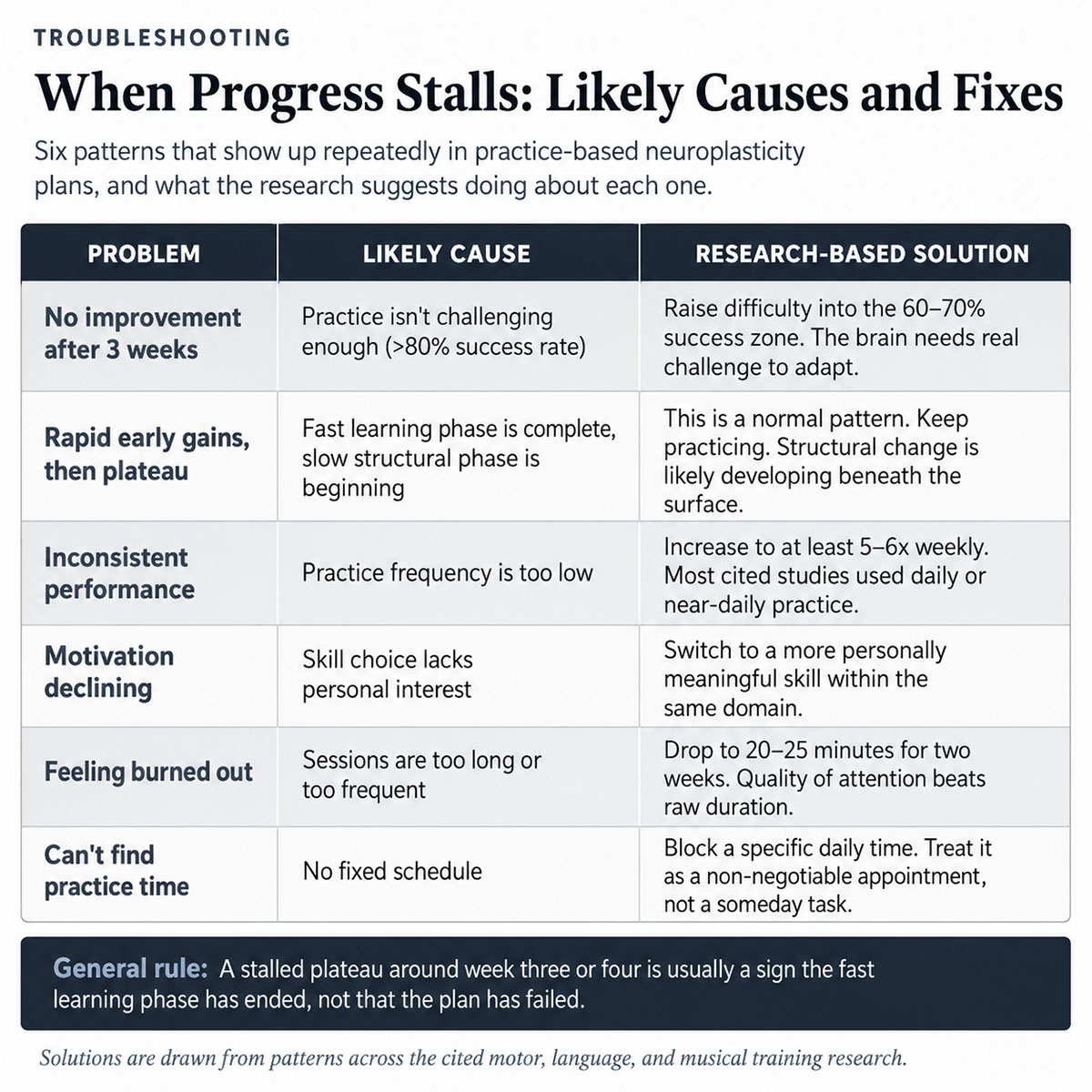
Missed a few days? Occasional gaps don’t erase progress. Consistency across the full training period matters more than perfect daily adherence, so resume the next day rather than trying to make up for lost time.
Performance actually declining? Temporary drops can happen during consolidation, as circuits reorganize. This often precedes a breakthrough rather than signaling failure, so continued practice through a plateau or a dip is usually the right call, not a sign to stop.
Life got in the way for weeks? Partial reversal will happen, consistent with Driemeyer’s detraining data. When you’re able to resume, expect to regain the skill faster than the original learning took, a well-documented phenomenon called savings. The underlying neural pathways stay somewhat established even after a real break.
Conclusion
Ten studies, two decades, one consistent finding. The brain doesn’t build lasting structure from a string of one-off exposures. It builds it from doing one thing, deliberately, for longer than feels necessary at first.
That’s a harder sell than “learn something new every day.” It’s also the version that shows up on an actual MRI scan, which is a distinction worth sitting with the next time a headline promises brain change in three weeks flat. The research doesn’t ask for perfection. It asks for six weeks of showing up to the same thing, past the point where it stops feeling new.
FAQs
How long does it take to see brain changes from learning?
Motor skills show the earliest detectable change, sometimes within days for specific measures and reliably by four to eight weeks for broader change. Language learning needs eight to 12 or more weeks. Musical training needs a minimum of 12 weeks. These mark detectable change, not the point where change stops developing.
Can I practice multiple skills at once?
One primary skill with intensive practice tends to produce greater change than scattered effort across several. A secondary skill can be maintained at two to three sessions weekly while one skill gets the intensive focus.
Do brain changes disappear if I stop practicing?
Partially, yes. Driemeyer’s 2008 follow-up on the juggling research found gray matter increases receded once practice stopped, though not completely. Some consolidation persists even without ongoing practice, but maintaining the full change requires continued engagement, even at reduced frequency.
Is neuroplasticity possible at any age?
Yes. Draganski’s, Mårtensson’s, and Schlegel’s participants were all adults. Change tends to happen faster and more extensively in younger brains, but the capacity for structural modification persists well into adulthood.
What weakens neuroplasticity?
Poor sleep, chronic stress, a sedentary lifestyle, and a lack of new challenge all appear to work against it, largely by interfering with the consolidation processes described earlier in this article. None of the ten studies here directly tested these factors as variables, so this answer draws on the broader neuroscience literature rather than the specific research this article is built on.
What are the three rules of neuroplasticity that people mention online?
Use it or lose it, use it and improve it, and be specific. All three show up throughout this article without being labeled as a formal list. Unused circuits weaken, practiced circuits strengthen, and the strengthening is specific to whatever’s actually being practiced, which is the entire reason juggling builds visual-motion regions rather than language pathways.
At what age is neuroplasticity strongest?
Early childhood shows the highest overall capacity, which is part of why Hyde’s musical training data on five- to seven-year-olds is so striking. That doesn’t make adult neuroplasticity a consolation prize. Every study cited in this article that used adult participants documented real, measurable structural change.
How much practice is enough per day?
A minimum of 20 to 30 minutes of genuinely focused practice. The studies here used 30 to 60 minutes daily. Quality outweighs duration. Twenty minutes of deliberate practice beats an hour of distracted repetition.
Will brain training apps work?
Generic brain training games show limited evidence for producing the kind of structural change documented here. Zatorre’s 2012 review found that meaningful change requires domain-specific practice tied to real-world skills, not abstract puzzle repetition.
Can I apply this to academic learning?
The core principle holds. Sustained, focused study over weeks produces better consolidation than scattered, last-minute sessions. Active recall, spaced repetition, and progressive problem-solving over an extended timeline apply the same depth-over-breadth logic to coursework.
What if I can only manage 10 to 15 minutes a day?
Limited time is better than none, but stretch the timeline expectations proportionally. If a study used 45 to 60 minutes daily and detected change at eight to 12 weeks, a shorter daily session would likely need longer to reach the same point. Make the minutes count with full attention.
How do I know if my practice is deliberate enough?
If it’s possible to practice while distracted or half-watching something else, it isn’t deliberate enough. Deliberate practice means focused attention on a specific component, immediate feedback, active error correction, and progression to harder material once the current level is genuinely solid.
Should I vary my practice or repeat the same thing daily?
Vary within the skill domain, not across unrelated ones. A juggler works the same basic pattern while varying height, speed, or object type. A language learner rotates between vocabulary, grammar, listening, speaking, and reading within one target language. The depth stays inside a single domain even as the specific drills shift day to day.