Most people treat cottage cheese as a diet food. Low-calorie, plain, something you eat when you’re “being good.” But athletes and researchers see it differently. They see a slow-release protein delivery system that works while you sleep.
What actually happens to your body when you make cottage cheese a daily habit—paired with consistent training? And what does 12 weeks of that combination look like, from the inside out?
The answer is more specific than you might think.
More Than Just a High-Protein Snack
Cottage cheese sits in a unique spot in the protein world. A single cup of low-fat cottage cheese delivers roughly 25–28 grams of protein, with the bulk of it coming from casein—the slow-digesting dairy protein that’s been studied closely in muscle research.
Think of casein like a timed-release capsule. Whey protein hits your bloodstream fast and clears out within a couple of hours. Casein forms a slow-digesting gel in your stomach instead. It feeds amino acids into your blood steadily over four or more hours.
That slow drip is the core reason cottage cheese has earned serious attention in muscle-building research. It’s not just how much protein is in it—it’s how that protein gets delivered.
Before we walk through the 12-week timeline, one rule underpins everything here: cottage cheese is an amplifier, not a replacement for training. Every study discussed in this article paired protein intake with resistance exercise. Without consistent lifting, even the best protein source won’t move the needle much. Keep that in mind as we go.
Phase 1 (Weeks 1–2): Flipping the Switch
The first changes aren’t visible. They happen at the cellular level, within the first 48 hours of consistent intake.
Cottage cheese is rich in leucine—an amino acid that acts like a key in a lock for muscle growth. Leucine activates a cellular pathway called mTOR, which is the body’s primary signal to start building muscle protein. Without enough leucine, that switch stays off, even if total protein intake is decent.
A serving of cottage cheese delivers roughly 2.5–3 grams of leucine—enough to cross the threshold needed to stimulate this process. Research shows that approximately 2.5–3 grams of leucine is needed to effectively activate muscle-building pathways, and cottage cheese hits this target with a single serving. Many plant-based proteins fall short of this mark, which is part of why dairy remains a benchmark in muscle nutrition research.
At the same time, adding a meaningful daily protein source starts to shift your body into a positive nitrogen balance. Nitrogen is a marker of protein status in the body. When you’re in a positive balance, your body is holding onto more protein than it’s losing—a basic requirement for muscle growth.
This is also where the science gets particularly interesting. A 2022 study by Vitruk and colleagues tested what happens to muscle protein synthesis (MPS) after eating whole-food cheese. Participants consumed 30 grams of protein from cheese after a resistance exercise session. Compared to a fasted baseline, whole-food cheese increased MPS rates by roughly 50%—both at rest and after exercise. Critically, the researchers found this response was on par with purified dairy protein concentrate.
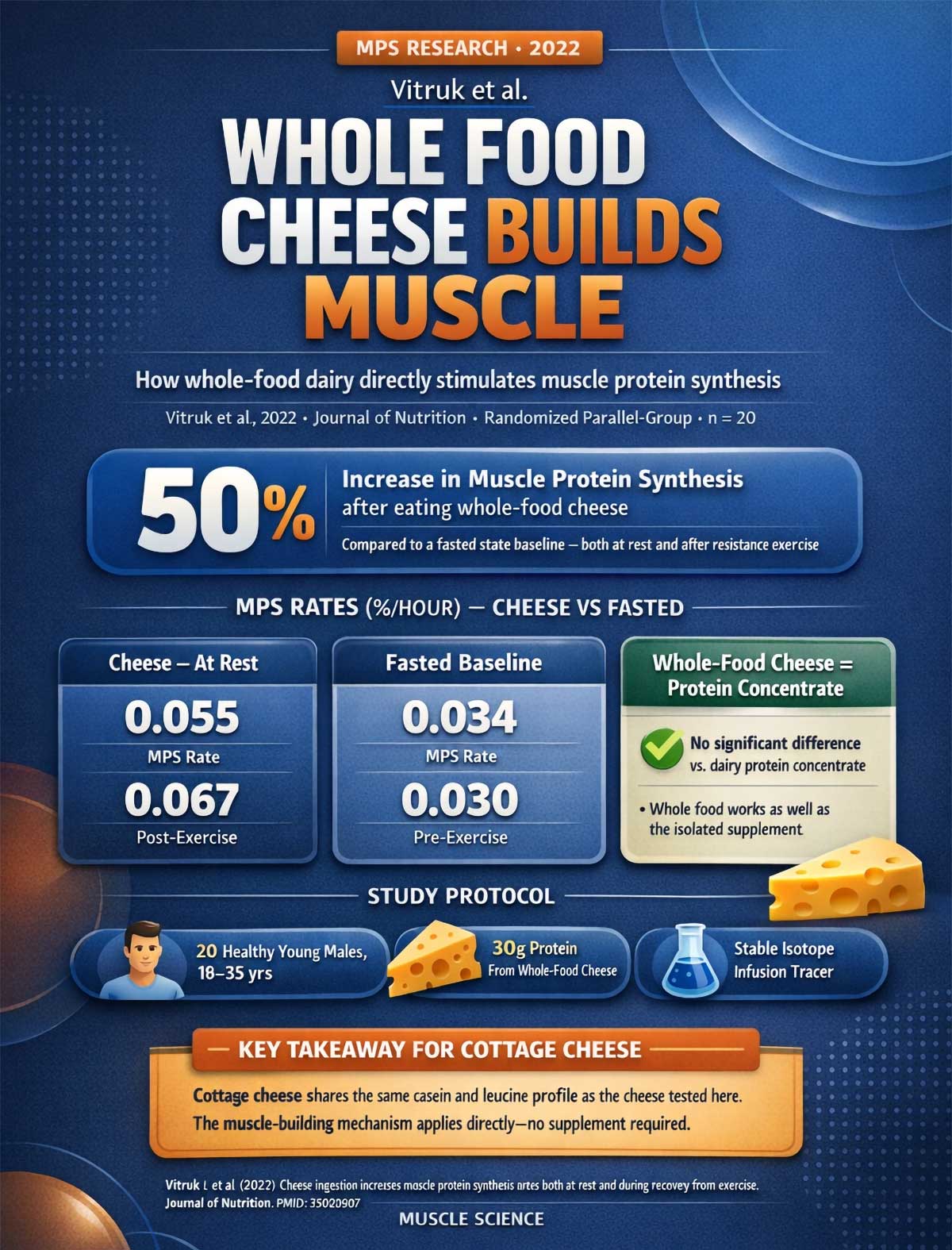
Cottage cheese shares the same protein profile as the cheese used in that study—high casein, high leucine, naturally occurring dairy compounds. The mechanism translates directly. In those first two weeks, each daily serving is actively switching on the building process. The work is quiet, but it’s real.
Phase 2 (Weeks 3–8): The Overnight Anabolic Window
By week three, most people who stick with cottage cheese start eating it before bed. This isn’t just a fitness trend—there’s solid evidence behind pre-sleep casein, particularly in the context of longer training programs.
During sleep, your body enters its longest daily fasting window—typically seven to nine hours. Without a protein source in your system, amino acid levels in the blood drop. When that happens, the body can start breaking down muscle tissue to meet its needs. This is called catabolism, and it works directly against your muscle-building goals.
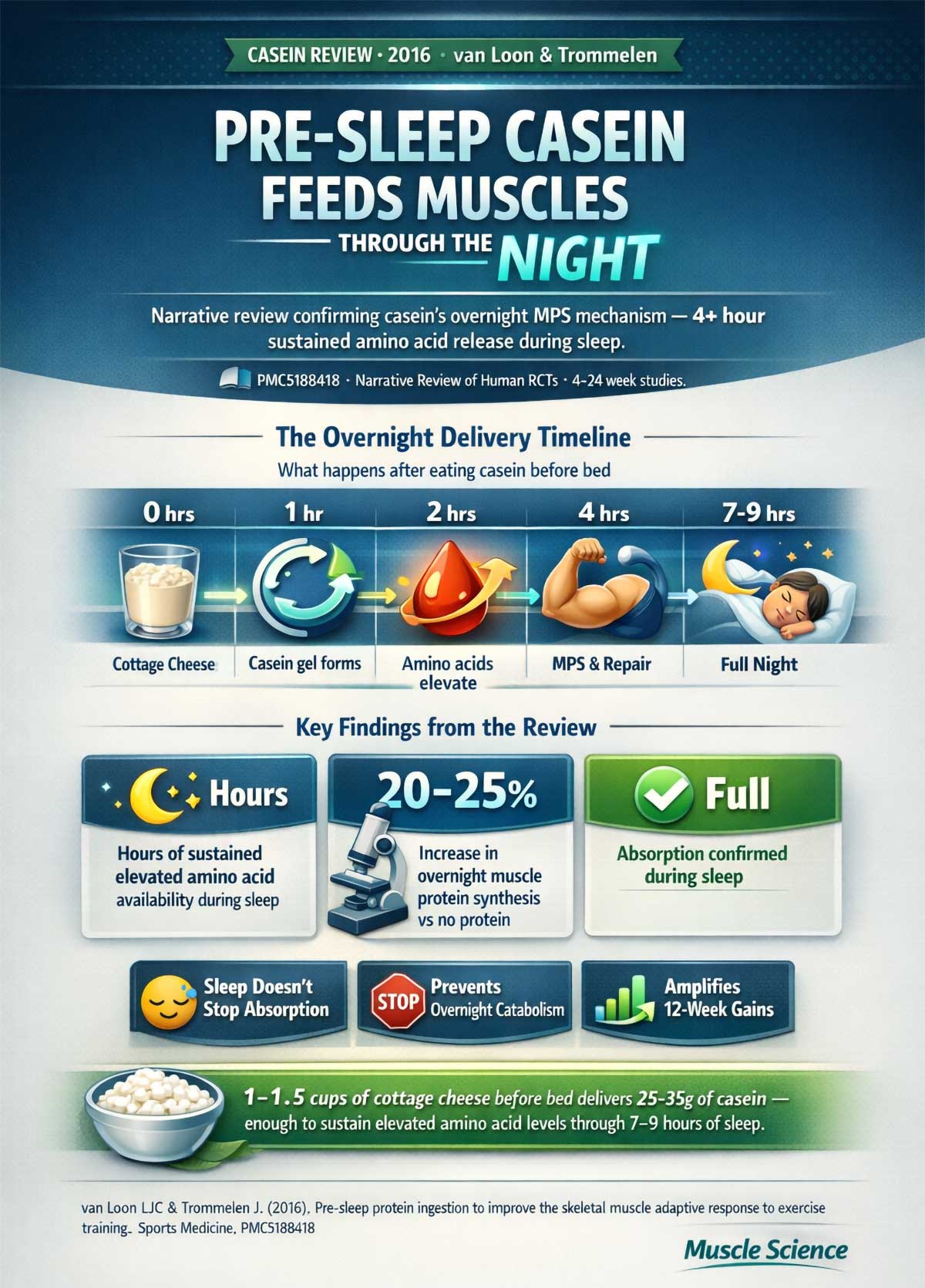
Pre-sleep casein changes this equation. A thorough review by van Loon and Trommelen (2016) examined the available research on pre-sleep protein and overnight MPS. The review found that casein consumed before sleep is digested slowly throughout the night, keeping amino acid levels elevated for four or more hours. This sustained availability increases overnight MPS rates by approximately 20–25% compared to going to bed without protein. The review also confirmed that sleep does not disrupt absorption—the digestive system continues working, and casein is fully used by the body.
Pre-sleep casein has shown particular promise in controlled 12-week training studies, where the extended overnight window appears to provide a meaningful edge. That said, research also shows that total daily protein intake matters more than timing alone—a point we’ll revisit when discussing what actually drives results. Think of pre-sleep cottage cheese as a smart move, not a strict requirement.
Cottage cheese, eaten 30–60 minutes before bed, gives your muscles a steady protein source through the night. Think of it as nighttime maintenance for the muscle tissue your training is trying to build. During weeks three through eight, this overnight supply starts to make a real difference. Muscle repair happens primarily during sleep. Giving your body the raw materials it needs during those hours shifts the balance toward net muscle gain rather than net breakdown.
One practical note: you don’t need a large amount. Roughly one to one and a half cups of low-fat cottage cheese before sleep provides approximately 25–35 grams of protein—enough to sustain overnight amino acid availability without loading up your daily calorie count.
Phase 3 (Weeks 9–12): Visible, Measurable Results
This is where the cumulative work becomes tangible.
By week nine, the daily protein habit and training stimulus have had time to stack. The cellular changes from weeks one and two, combined with the improved overnight recovery from weeks three through eight, start showing up as real changes in strength and lean mass.
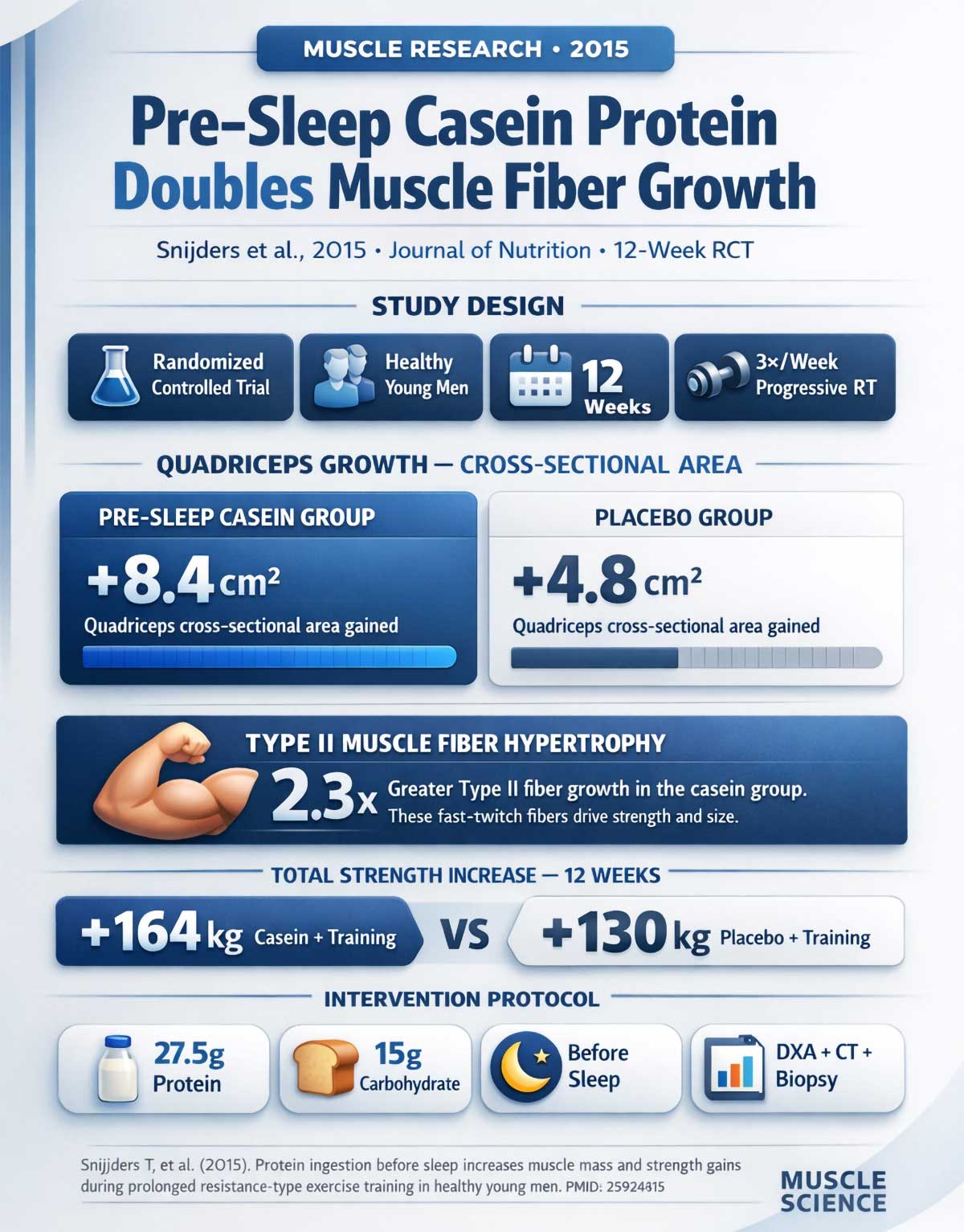
The landmark study here comes from Snijders and colleagues (2015). In a 12-week trial, young men following a progressive resistance training program were split into two groups. One group consumed 27.5 grams of casein protein plus 15 grams of carbohydrate immediately before sleep. The other group took a non-caloric placebo.
The results were striking. The casein group gained 8.4 cm² of quadriceps cross-sectional area, compared to 4.8 cm² in the placebo group. Total strength increased by 164 kg in the casein group versus 130 kg in the placebo group. Most notable was the muscle fiber data: Type II muscle fibers—the ones most responsible for strength and size—grew 2.3 times more in the casein group than in the placebo group. These aren’t marginal differences. They represent a substantial performance edge from pre-sleep protein alone.
Cottage cheese is not a casein isolate—it’s a whole food. But its protein profile is dominated by casein, and it delivers the same core amino acids that drove those results. The Vitruk 2022 study confirmed that whole-food dairy sources produce the same MPS response as isolated dairy protein. The delivery vehicle changes, but the mechanism doesn’t.
Strength gains during this phase also get support from the other nutrients in cottage cheese. A 2021 study by Huschtscha and colleagues followed healthy adults through a 12-week program combining high-protein dairy intake with resistance training. The group combining both dairy and training saw fat-free mass increase and strength improvements of 53–78% across major lifts, including the leg press and chest press. Importantly, dairy alone did not significantly augment mass gains—resistance training was the essential driver. What the dairy did was amplify the training response, producing greater strength outcomes than training with standard protein intake. This confirms what the earlier phases of this article have argued: cottage cheese works best as a training amplifier.
Cottage cheese also fits the lean gains goal well. It’s relatively low in fat (especially the low-fat variety), moderate in calories, and high in protein. Adding it daily gives you a meaningful protein boost without a large caloric surplus—which matters if body composition, not just raw mass, is the goal.
A 2023 umbrella review by Zhang and colleagues examined cheese consumption across multiple health outcomes and found that regular cheese intake showed neutral to favorable associations with cardiometabolic health. Low-fat cottage cheese, with its lean protein profile and minimal saturated fat, fits easily into a daily diet without health concerns.
The Three Rules That Make This Work
The 12-week timeline above assumes you’re doing this right. Here are the three factors that separate real results from wasted effort.
Rule 1: You must be lifting.
No protein source builds muscle on its own. Cottage cheese amplifies the response to resistance training—it does not replace it. Every study that showed significant muscle gains over 12 weeks included a structured lifting program, typically three sessions per week with progressive overload. Without that training stimulus, the extra protein has nowhere to go.
Rule 2: Total daily protein intake matters most.
Pre-sleep timing is useful, but it’s not the whole picture. A meta-analysis by Nunes and colleagues (2022) analyzed 17 randomized controlled trials and confirmed a clear dose-response relationship: more total daily protein leads to greater lean mass and strength gains, with the effect plateauing at roughly 1.6 grams per kilogram of body weight per day. A separate study by Park and colleagues (2018) found that adults consuming 1.2–1.5 grams of protein per kilogram daily gained significantly more lean mass over 12 weeks than those hitting just the standard 0.8 g/kg recommendation.
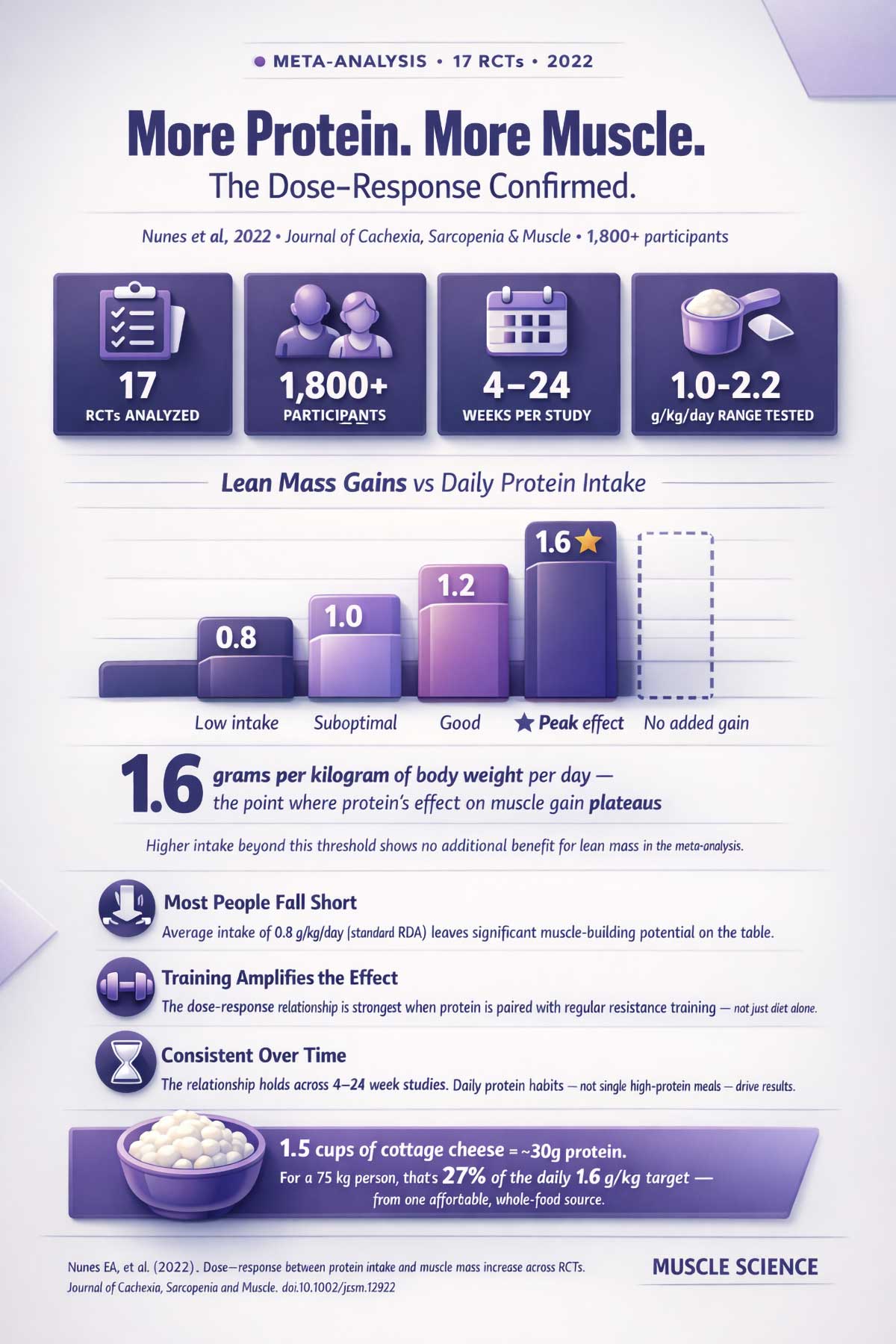
Cottage cheese is a strong tool for reaching these targets. One and a half cups contributes roughly 30 grams of protein toward your daily total. For a 75 kg person targeting 1.5 g/kg, that’s 30 grams out of a 112-gram daily goal—a meaningful chunk from one affordable food source.
Rule 3: Timing helps, but don’t obsess over it.
Pre-sleep cottage cheese is a smart move, and the casein data supports it. But a randomized study by Antonio and colleagues (2017) compared athletes taking the same daily casein dose either first thing in the morning or 90 minutes before sleep. After eight weeks, there was no significant difference in muscle or body composition changes between the two groups.
The takeaway: hitting your total daily protein number is the priority. Pre-sleep timing is a useful refinement, not a strict requirement. If your schedule makes nighttime cottage cheese impractical, eating it in the morning still counts toward your goals.
The Muscle Bowl: Putting It Into Practice
Getting the most from cottage cheese doesn’t require complicated prep. Here’s a simple framework.
Serving size: Aim for one to one and a half cups per day, providing 25–35 grams of protein. This can be one sitting or split across two servings.
Before bed: A plain bowl 30–60 minutes before sleep is the most research-supported approach. Keep it simple or add a small amount of natural nut butter for healthy fats.
Sweet toppings that add value: Fresh berries (antioxidants, low sugar), a tablespoon of flaxseeds (fiber and omega-3s), or a small handful of walnuts (healthy fats and additional protein).
Savory options: Cottage cheese works well with sliced cucumber, cherry tomatoes, cracked black pepper, and a drizzle of olive oil. It can also be stirred into scrambled eggs or used as a base for a protein-rich dip.
Watch the sodium: Standard cottage cheese can run 400–500 mg of sodium per cup. If you’re eating it daily, look for low-sodium varieties or briefly rinse it to cut the salt content. High sodium intake can cause water retention, which may cloud what the scale is telling you. This doesn’t mean the muscle gain isn’t real—it means scale weight alone won’t tell the full story during this period. Tracking how clothes fit or taking progress photos gives you a more reliable picture than daily weigh-ins.
The consistency factor: The best protein source is the one you actually eat every day. Many people find cottage cheese easier to stick with than powdered supplements because it’s a whole food that doesn’t require mixing and works across both sweet and savory meals. If it starts boring you by week six, Greek yogurt, skyr, or whole-milk kefir offer similar casein profiles. Consistency with a good option beats occasional perfection with an ideal one.
Conclusion
Eating cottage cheese every day for 12 weeks won’t transform your physique on its own. That needs to be said plainly.
What it will do—when paired with consistent resistance training and adequate total protein intake—is give your muscles better raw materials to work with. It activates key muscle-building pathways through leucine and mTOR signaling. It supports overnight muscle repair during the hours when recovery matters most. And over 12 weeks, those daily contributions stack into real, measurable changes in lean mass and strength.
The research backs this up from multiple angles: acute MPS studies, 12-week clinical trials, and large meta-analyses all point in the same direction. Casein-rich, whole-food dairy protein is effective. Cottage cheese delivers exactly that—at a low cost, with zero preparation required, and enough flexibility to fit into almost any eating style.
That consistency is the real advantage. And for a lot of people, cottage cheese fits that bill better than anything else in the dairy aisle.