Most people picture brain health as a complex puzzle. Expensive supplements. Strict diets. Hours at the gym. But what if one of the most powerful tools you have is already built into your body?
Walking. That’s it.
Research shows that a simple daily walk — far shorter than you might think — can cut your dementia risk by 25% or more. And the science behind it is hard to ignore.
The 10,000 Steps Myth (And What the Science Actually Says)
For years, the fitness world pushed 10,000 steps as the golden standard. The number sounds official. But it actually traces back to a 1960s Japanese marketing campaign for a pedometer — not clinical research.
So what does the data say?
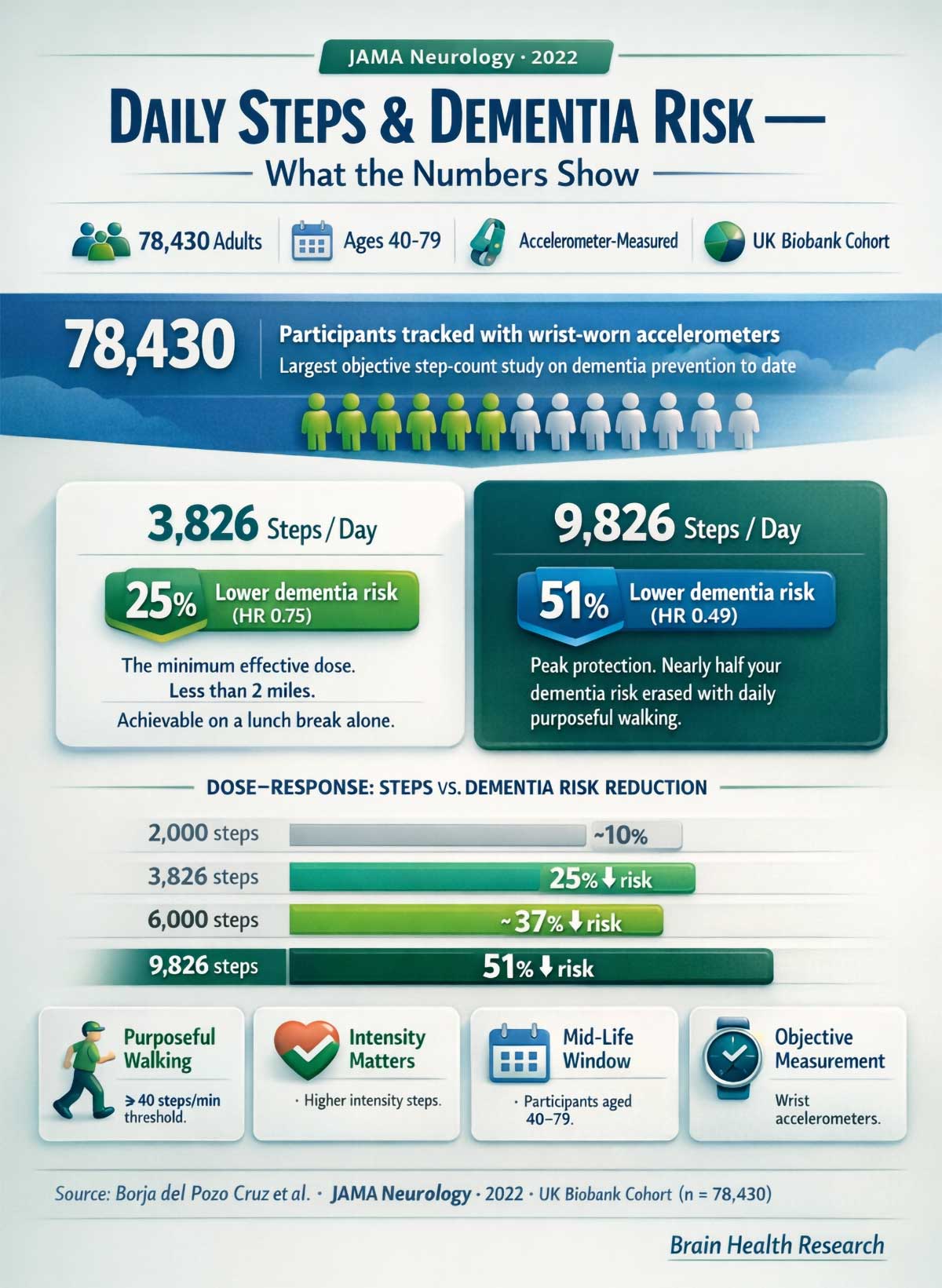
A landmark study published in JAMA Neurology (2022) tracked 78,430 adults between the ages of 40 and 79 using wrist-worn accelerometers. Researchers from the UK Biobank cohort found something striking. You don’t need to hit 10,000 steps to protect your brain in a meaningful way.
At just 3,826 steps per day, participants showed a 25% reduction in dementia risk (HR 0.75). That’s less than 2 miles of walking. For most people, that’s a lunch break plus a short evening stroll.
That number — 3,826 steps — is worth holding onto. Think of it as the entry point. The minimum effective dose for a healthier brain.
What Happens in Your Brain When You Walk
Before going further, it helps to understand why walking works at a biological level.
Your brain is wrapped in a network of tiny blood vessels. When these vessels stay healthy, blood flows freely, carrying oxygen and clearing out waste. That waste includes amyloid proteins — the sticky plaques linked to Alzheimer’s disease.
Physical movement acts like a flush cycle. It raises heart rate, which pushes blood through those capillaries. This supports what researchers call “vascular brain health” — the foundation of long-term cognitive function. A brain with good blood flow is simply better protected.
Walking also triggers the release of brain-derived neurotrophic factor (BDNF), a protein that supports neuron growth and repair. Think of it as fertilizer for brain cells.
The 51% Threshold: Getting More From Your Walk
So 3,826 steps gives you a 25% reduction. But the same UK Biobank study showed that the benefits keep climbing as you walk more.
At around 9,826 steps per day, participants cut their dementia risk nearly in half — a 51% reduction (HR 0.49). That’s not double the steps for double the benefit. It’s roughly two and a half times the steps for twice the benefit. The curve is steep early on, which is actually great news. Most of your gains come from those first few thousand steps.
But here’s something the research makes clear: how you walk matters just as much as how far you walk.
The study found that higher intensity steps produced stronger protective associations. Researchers defined “purposeful walking” as movement at 40 or more steps per minute — roughly the pace you’d use if you were slightly late for a meeting. At that point, your arms swing, your heart rate rises, and your body starts working.
This isn’t a sprint. It’s brisk, deliberate, and consistent.
The Long-Term Picture: Walking and Alzheimer’s Risk
The UK Biobank data is compelling, but it’s not alone.
A 2023 meta-analysis published in Aging Research Reviews pooled data from over 2 million participants across 29 cohorts. The conclusion: higher physical activity is linked to roughly a 28% lower risk of Alzheimer’s disease (HR 0.72), with the strongest effects seen at moderate-to-vigorous activity levels. That’s a massive dataset pointing in the same direction.
An even broader review, published in the British Journal of Sports Medicine (2022), analyzed 58 cohorts covering nearly 258,000 participants. Researchers specifically examined studies with follow-up periods of 20 years or more and found that protective effects remained strong — suggesting this isn’t just about short-term benefits, but lasting brain protection built over decades. The numbers: roughly a 20% lower risk of all-cause dementia, 14% lower Alzheimer’s risk, and 21% lower vascular dementia risk in the most active groups.
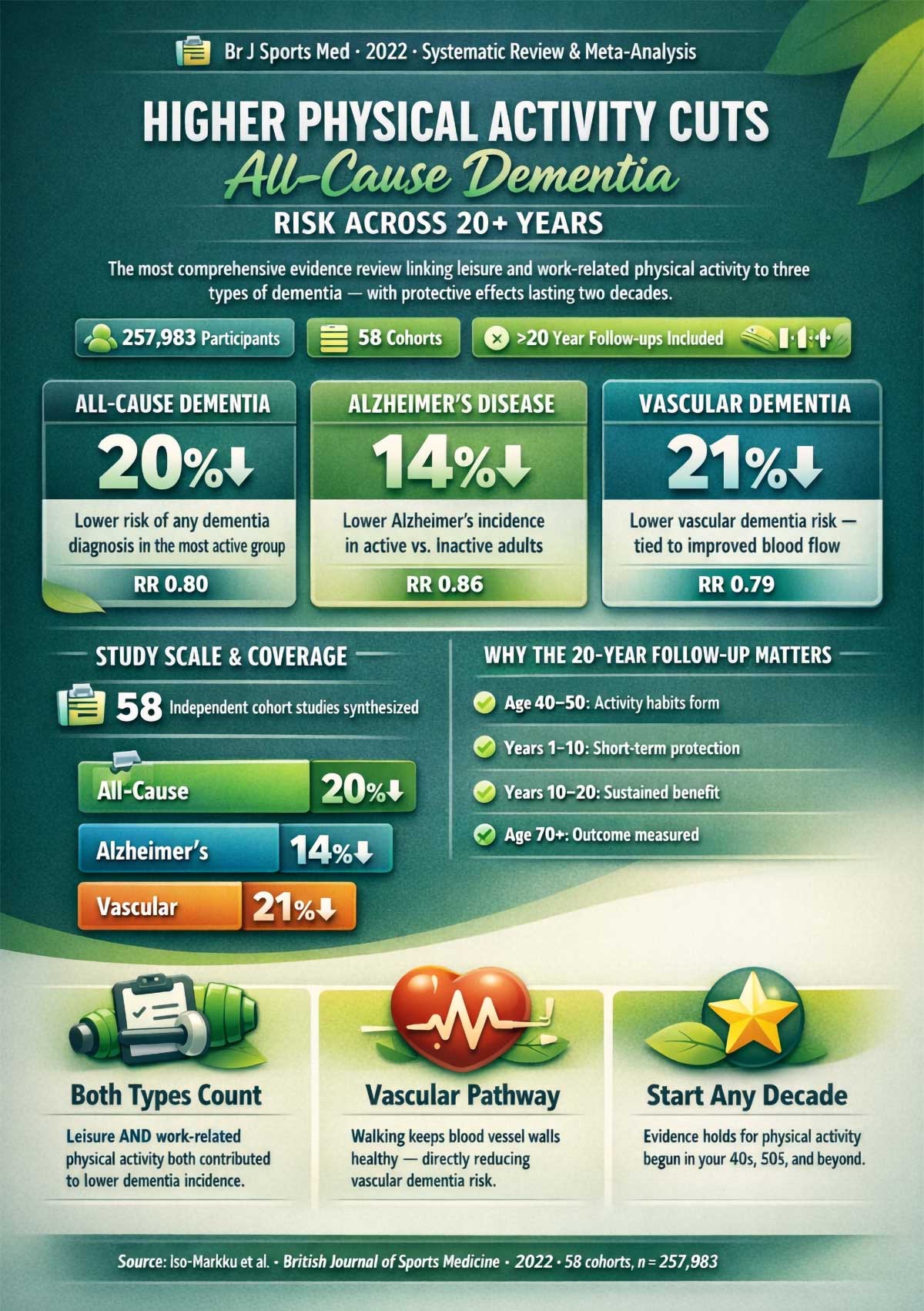
What makes those long follow-up periods so significant is the timing. This isn’t about what you do in your 70s when symptoms start to appear. It’s about what you do in your 40s, 50s, and 60s — the decades that shape your brain’s future.
And if you’ve been sedentary for years and are only reading this now, don’t write yourself off. The research shows that starting a consistent walking habit at any age can meaningfully reduce your dementia risk. It’s never too late to change your brain’s path.
Prevention vs. Treatment: An Important Distinction
Walking is a powerful tool for prevention. But it’s not a cure — and being honest about that matters.
A 2023 systematic review published in BMC Geriatrics looked at 14 randomized controlled trials involving 560 participants who already had Mild Cognitive Impairment (MCI). MCI is the stage between normal aging and full dementia, where memory and thinking begin to slip noticeably.
The findings were sobering. Walking showed no significant improvement in global cognitive function in people already diagnosed with MCI. Participants did improve their physical endurance — walking farther and longer over time — but the interventions didn’t reverse or meaningfully slow cognitive decline in this group.
This isn’t a reason to stop walking if you have MCI. Physical fitness matters for mood, independence, and general health. But it does reinforce something critical: the most powerful use of walking as a brain-health tool is before problems appear — not after.
If you’re in your 40s or 50s and reading this, that’s the window. That’s when it counts most.
5 Ways to Hit Your Target Without Changing Your Whole Life
The beauty of the 3,826-step goal is that it’s achievable without a gym, special equipment, or a major lifestyle overhaul. Here’s how to build it into a typical day.
Park further away. Whether it’s the grocery store, your office, or a medical appointment, parking at the far end of the lot adds 200–400 steps each trip. Do it twice a day and you’ve covered a meaningful chunk of your goal.
Walk while you talk. Phone calls are dead time for your feet. Make it a rule: every call you take, you pace. A 10-minute call at a moderate pace can add 800–1,000 steps without any extra effort.
Take a post-meal stroll. A 10-to-15 minute walk after eating does double duty. It adds to your step count and helps stabilize blood sugar, which protects the small capillaries that feed your brain. Consistently high blood sugar damages those vessels over time — a connection that both type 2 diabetes and vascular dementia research have made clear.
Walk with someone. This is the double benefit approach. Social engagement — real conversation with another person — is independently linked to lower dementia risk. Pairing it with a walk means you’re getting both benefits at once. A regular walking partner also creates accountability, which keeps consistency alive.
Use “snack” walks. You don’t need one long walk to hit your number. Three 10-minute walks throughout the day — morning, lunch, and evening — add up to roughly 2,500–3,000 steps depending on your pace. Add a slightly longer one at the weekend and you’re well past the threshold.
Why Consistency Beats Intensity Every Time
Here’s a trap many people fall into: going hard for two weeks, then stopping. One burst of activity doesn’t build lasting brain protection. Consistency over years does.
Think about it this way. One perfect 15,000-step day followed by six days of 2,000 steps averages out to roughly 3,000 steps daily. But one consistent 3,826-step walk, every single day for a year, is over 1.3 million steps of brain protection. The daily average matters far more than the occasional heroic effort.
The British Journal of Sports Medicine analysis reinforces this. Protective effects remained strong even across the longest follow-up periods studied. That kind of durability doesn’t come from occasional intense exercise. It comes from showing up regularly — even on imperfect days, even when the walk is short.
The goal isn’t perfection. It’s showing up. Week after week. Year after year.
| Daily Steps | Risk Reduction | What This Means |
|---|---|---|
| ~3,826 steps | ~25% lower dementia risk | Roughly 1 in 4 reduction in likelihood |
| ~9,826 steps | ~51% lower dementia risk | Roughly 1 in 2 reduction in likelihood |
Walking as Part of a Bigger Picture
Walking doesn’t work in isolation. It’s one part of a broader lifestyle that keeps your brain healthy over time.
Sleep is another key pillar. During deep sleep, your brain’s glymphatic system — a kind of internal waste-clearing network — flushes out the same toxic proteins that walking helps manage during waking hours. Poor sleep and a sedentary lifestyle work against each other. Combine consistent walking with consistent quality sleep and the effect is stronger than either alone.
Diet plays a similar supporting role. The MIND diet — a version of the Mediterranean diet focused on brain health — has been linked to slower cognitive decline in long-term studies. Foods like leafy greens, berries, nuts, olive oil, and fatty fish give your brain the raw materials it needs to stay sharp. Walking improves blood flow to deliver those nutrients where they’re needed most.
Together, regular movement, quality sleep, and a brain-supportive diet form a lifestyle where each habit makes the others work better.
A 7-Day Challenge to Get Started
If you’re currently averaging 2,000 steps or more daily, this week-long ramp-up works well. If you’re starting from a lower baseline, extend each phase to two weeks for more sustainable progress.
Day 1–2: Aim for 1,500 steps. One short walk after dinner is enough. Day 3–4: Add a brief midday walk. Target 2,500 steps. Day 5–6: Push to 3,000 steps. Pick up the pace slightly for part of the time. Day 7: Hit 3,826 steps. That’s your new baseline.
Use a free step-tracking app on your phone or a basic pedometer to track your progress. Most smartphones count steps automatically with no setup required.
Once 3,826 steps feels easy — and it will — keep pushing toward 6,000, then 8,000. Every step past the threshold adds benefit, even if the gains become more gradual.
Conclusion
The research is clear. You don’t need a gym. You don’t need expensive equipment. You don’t need to run a 5K.
What you need is consistency — and a daily commitment to moving your body in a way that supports your brain for the long haul.
At 3,826 steps, you’re already in the protection zone. At 9,826, you’ve cut your risk nearly in half. And the best time to start was 20 years ago. The second best time is today.