You pick up a jar of sauerkraut at the grocery store. It’s in the “health food” aisle. The label says “fermented.” It costs $9. You feel good about it.
Here’s the thing: that jar might contain zero live bacteria. None. The microbes that were supposed to help your gut? Gone — killed long before the jar reached the shelf.
What you’re actually holding is salty, cooked cabbage in brine. You’re paying a 400–500% markup over regular canned vegetables for a product that, biologically, is no different from anything else on that center shelf.
This isn’t a fringe issue. It’s one of the most common mistakes health-conscious shoppers make. And the food industry has very little incentive to correct it.
The Health Halo Problem
“Fermented” has become one of the most powerful words in food marketing. Gut health is everywhere in health media right now, and fermented vegetables are riding that wave. Sauerkraut, kimchi, lacto-fermented pickles, and kvass now line entire store aisles.
But the word “fermented” on a label is not a legal guarantee of live cultures. The FDA doesn’t require it. A product can be called “fermented” even after it’s been heated to the point where every microbe in it is dead.
That’s the core problem. Shoppers assume “fermented” equals “probiotic.” Food science says otherwise — and the gap between those two ideas is costing consumers both money and health results.
How Fermentation Actually Works
To understand what you’re being sold, it helps to understand what real fermentation looks like.
Traditional lacto-fermentation is simple. You take a vegetable — cabbage for sauerkraut, napa cabbage and radish for kimchi, cucumbers for true fermented pickles. You add salt, which draws water out of the vegetable tissue through osmosis. That salt water creates a brine. The brine becomes an oxygen-poor environment.
In those conditions, naturally present Lactobacillus bacteria thrive. They convert the vegetable’s natural sugars into lactic acid. That acid lowers the pH of the brine, making the environment hostile to harmful bacteria while allowing the beneficial ones to multiply. The result is a sour, tangy food teeming with live microbial activity.
No vinegar. No heat. No preservatives. Just salt, water, vegetables, and time — usually three to seven days at room temperature.
That microbial community is what gives fermented vegetables their health reputation. And it’s exactly what industrial processing destroys.
Fermented vs. Probiotic: They Are Not the Same Thing
This is the distinction most health content misses — and it’s a big one.
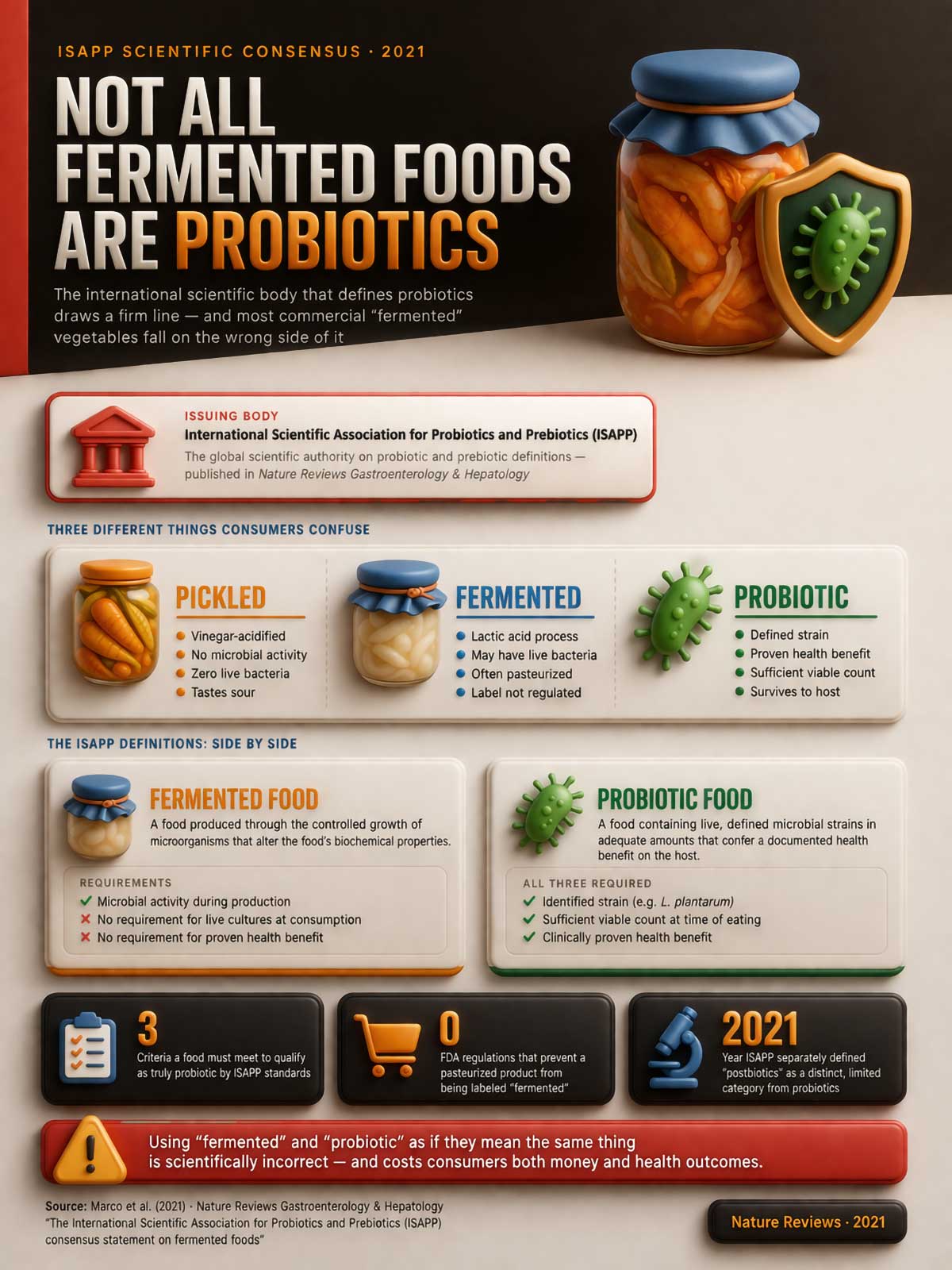
A fermented food is any food produced using microbial activity, such as bacteria or yeast converting sugars into acids or alcohol. That process creates the sour taste of sauerkraut and kimchi. It’s a production method. Nothing more.
A probiotic food is far more specific. According to a 2021 consensus statement led by Marco et al. on behalf of the International Scientific Association for Probiotics and Prebiotics (ISAPP), published in Nature Reviews Gastroenterology & Hepatology, a true probiotic must contain a defined, identified microbial strain at a level that provides a measurable, proven health benefit. Many commercially fermented foods never meet this standard. They lack identified strains, sufficient bacterial counts, or evidence that the bacteria survive long enough to benefit the host.
In short: all probiotic foods are fermented. But most fermented foods are not probiotic — especially the ones sitting on grocery store shelves.
This matters because you can’t feel the difference between a live jar and a dead one. They taste the same. They smell the same. One actively supports your gut microbiome. The other is flavored brine with some fiber.
Red Flag #1 — The Center Aisle Trap
Walk into any grocery store and take note of where the “fermented” vegetables are sitting.
If a jar of sauerkraut or kimchi is at room temperature on a center shelf, that’s your first and clearest red flag. Shelf-stable fermented vegetables have almost certainly been pasteurized — heated to a temperature that kills bacteria to make them safe for long-term, unrefrigerated storage.
Why do food manufacturers do this? Two reasons. First, live fermentation produces CO₂. Jars with active bacteria build internal pressure. On a warehouse shelf over weeks or months, that pressure can cause jars to crack or rupture. Second, regulatory bodies require heat treatment for shelf-stable acidified and fermented foods to prevent pathogen growth during distribution.
The trade-off is absolute: the heat that makes the product shelf-safe kills the probiotic bacteria entirely.
A 2019 systematic review by Dimidi et al., published in the Journal of the Academy of Nutrition and Dietetics, confirmed this directly. The researchers found that industrial pasteurization for shelf stability eliminates the live-culture benefit completely. The food looks identical on the shelf. The nutritional label looks similar. But the bacteria are gone.
The gap between consumer expectation and product reality here is one of the most underreported problems in the functional food market.
Red Flag #2 — The Vinegar Illusion
Here’s the second trap, and it catches even careful shoppers: the vinegar pickle sold as a fermented food.
Many products in the “fermented vegetables” category are not fermented at all. They’re pickled — submerged in distilled vinegar to create a sour taste. No microbial activity happened. No lactic acid bacteria were ever involved. The sourness is chemical, not biological.
The FDA makes a clear regulatory distinction here. Under 21 CFR Part 114, “Acidified Foods” are products where acidity comes from adding vinegar. These are legally required to be heat-processed for shelf stability, which kills any remaining bacteria. True fermented foods achieve their acidity through live lactic acid fermentation — a completely different biological process.
A 2020 global review by Tamang et al., published in Frontiers in Microbiology, analyzed fermented and pickled foods across dozens of cultures. The researchers drew a firm line: vinegar-based pickling and lactic acid fermentation are biologically distinct. Vinegar pickles contain no live probiotics. The sour taste is the only thing they share with genuinely fermented vegetables.
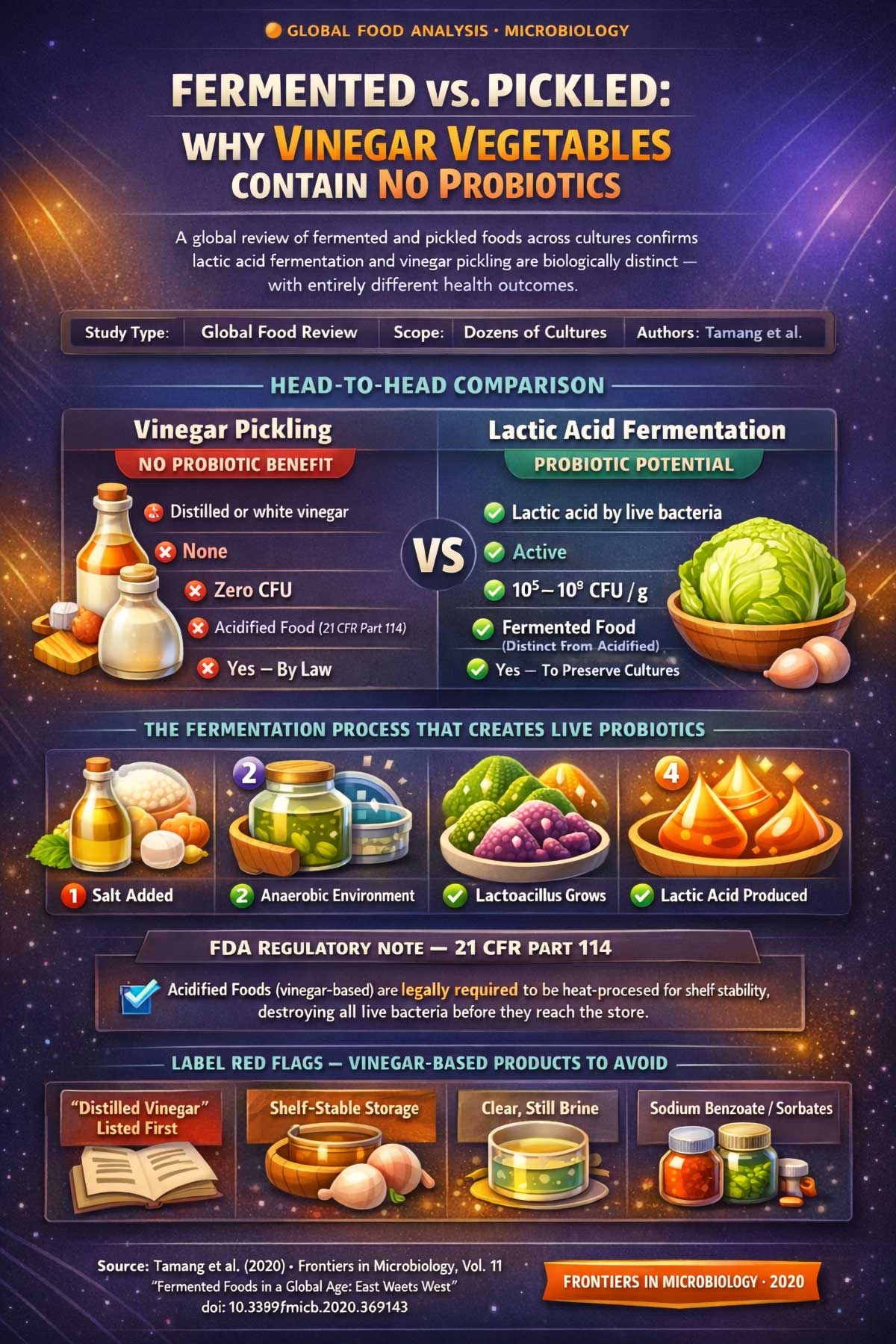
The quick test: Check the ingredient list. If “distilled vinegar” or “white vinegar” appears near the top — before or alongside salt — what you’re holding is a pickled product. Not fermented. No live cultures. No probiotic benefit regardless of what the front label implies.
What the Bacteria Count Actually Looks Like
Let’s put real numbers on this, because the difference isn’t subtle.
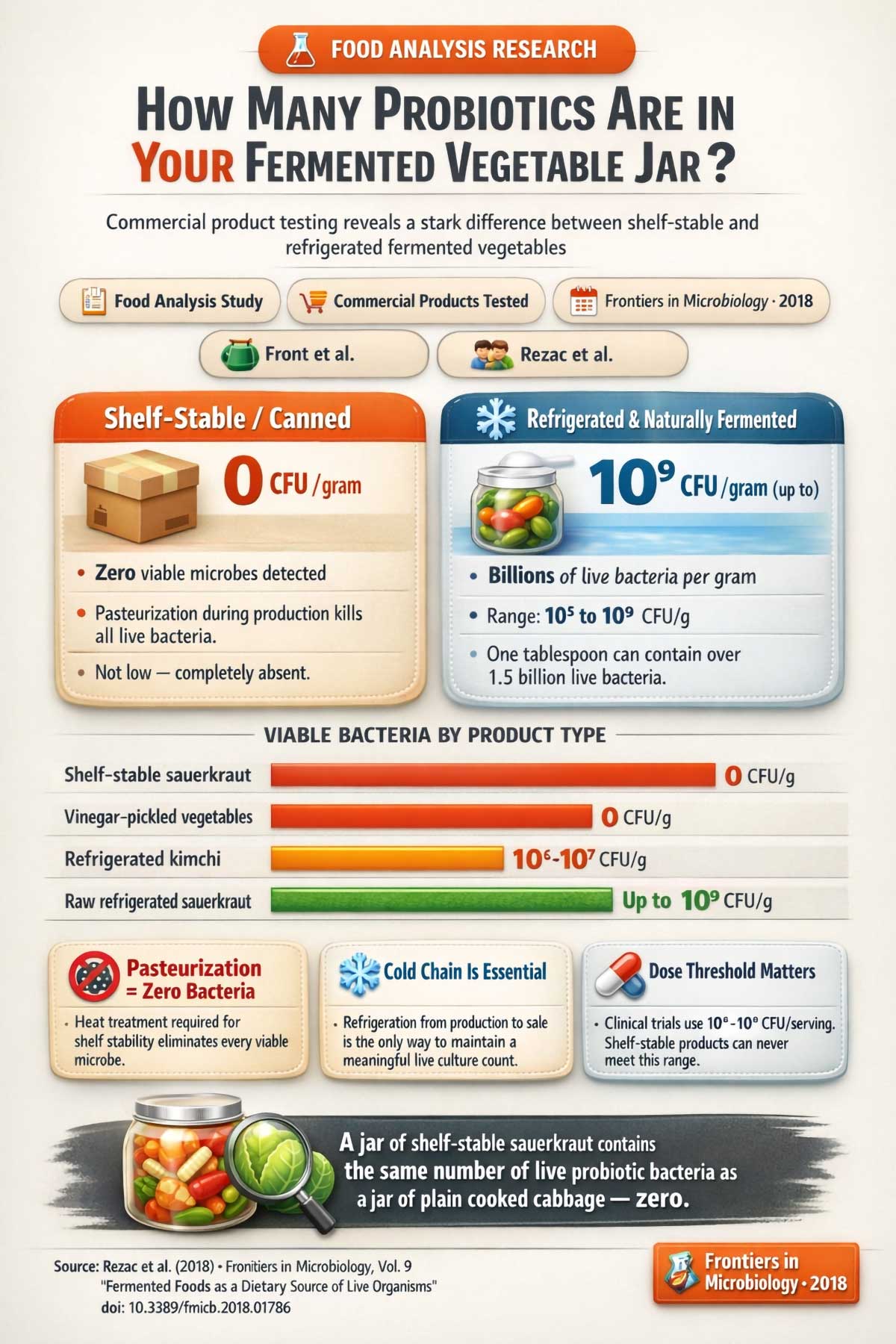
A 2018 study by Rezac et al., published in Frontiers in Microbiology, tested commercial fermented vegetable products side by side. Shelf-stable and canned products contained zero viable microbes. Not low counts — zero. Refrigerated, naturally fermented products contained between 10⁵ and 10⁹ CFU per gram. That’s hundreds of thousands to billions of live bacteria per gram of food.
To put that in practical terms: a single tablespoon (roughly 15g) of a live-culture refrigerated sauerkraut can contain 1.5 billion bacteria or more. The same amount of a pasteurized shelf-stable version contains none.
Many researchers working in this area treat 10⁶ to 10⁸ CFU per serving as a working threshold for meaningful gut effects. Shelf-stable products don’t come close. They sit at the other end of that scale entirely.
That gap isn’t a minor technical detail. It’s the difference between a food that changes your gut microbiome and one that simply doesn’t.
What About the Benefits That Remain After Pasteurization?
This is a fair question, and the honest answer is: some benefits do remain — just not the probiotic ones.
Pasteurized fermented vegetables still contain vitamins, particularly vitamin C and B vitamins produced during fermentation. They contain fiber. They contain organic acids and fermentation byproducts that contribute to their flavor profile and may have some mild digestive effects.
And there’s a third category worth understanding: postbiotics. These are the fragments left behind when bacteria die — cell wall components, metabolic byproducts, and structural proteins. A 2018 study by Bell et al., published in Nutrients, examined the effects of heat-killed bacteria specifically. The researchers found that these remnants can still trigger modest immune signaling and some anti-inflammatory activity in gut tissue.
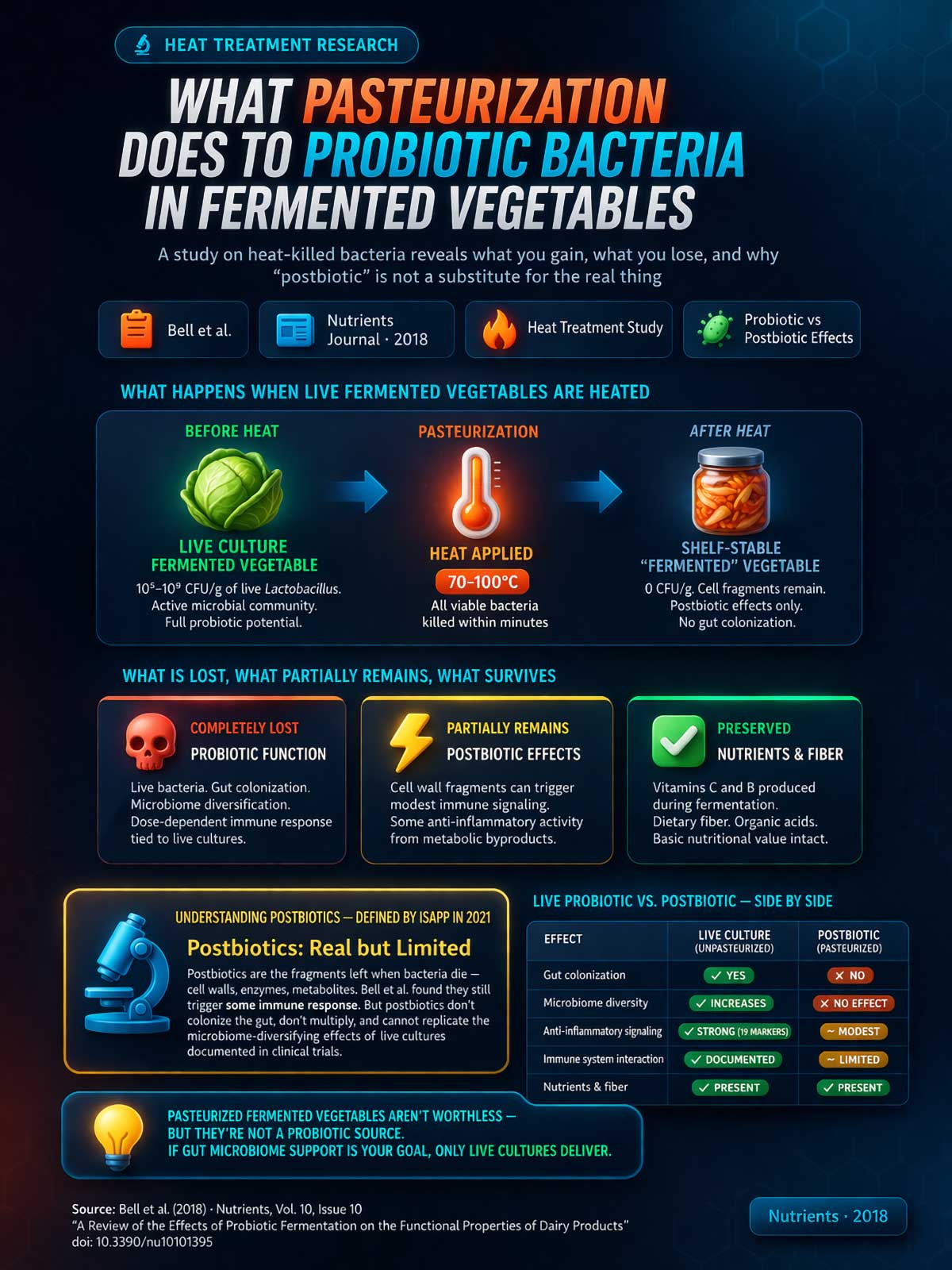
The ISAPP formally defined postbiotics as a separate category in 2021, recognizing them as a legitimate (if limited) class of gut-health ingredient. Their effects are real. They just don’t colonize the gut. They don’t add to your microbiome diversity. They don’t multiply or establish themselves. Think of them as echoes of the benefit you were hoping for — present but faint.
If your goal is microbiome support — increased diversity, reduced inflammation, improved gut barrier function — pasteurized products won’t deliver that. You need live cultures to get live results.
The Clinical Evidence: What Happens When You Eat the Real Thing
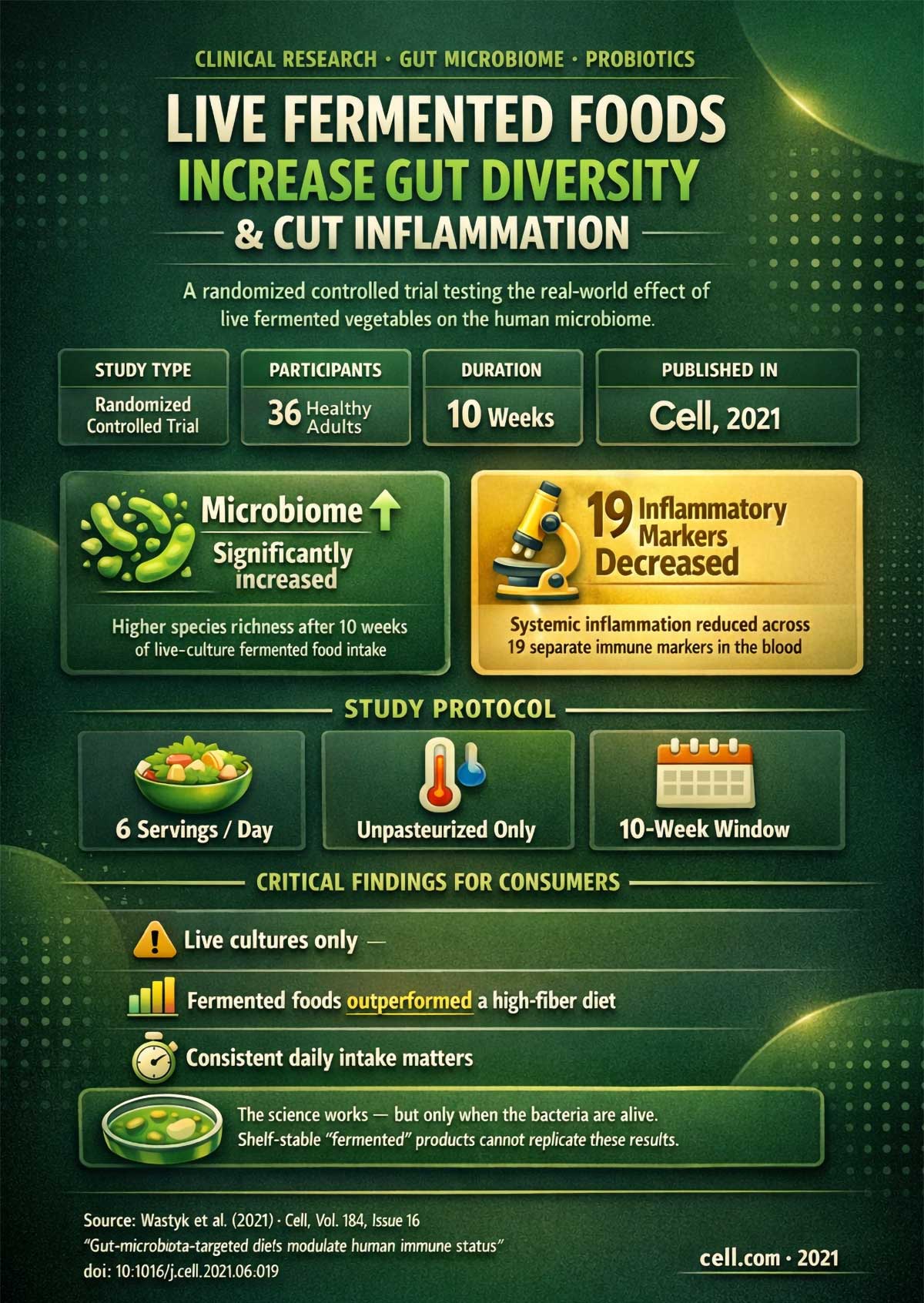
In 2021, a landmark randomized controlled trial by Wastyk et al., published in Cell, put live fermented foods to a rigorous test. Thirty-six healthy adults consumed a diet high in live-culture fermented foods — six servings per day for ten weeks. A serving here was roughly 100–200g, about half a cup. The results were clear. Microbiome diversity increased significantly, and 19 separate markers of inflammation decreased across the group.
Six servings per day is a high intake level, and the researchers acknowledged that. But even at more modest amounts — one to two servings per day — other research shows measurable shifts in microbial composition within two to four weeks of consistent intake. Microbiome changes from dietary shifts generally become detectable within that window, though meaningful, lasting changes tend to take longer.
The critical point from Wastyk et al. is one the article itself emphasized: the study used live-culture products throughout. The findings don’t transfer to pasteurized or vinegar-pickled versions. The biological mechanism depends on living bacteria reaching the gut. Remove the living bacteria and you remove the mechanism.
That’s not a technicality. That’s the whole argument.
The Shopping Checklist: 6 Ways to Spot a Real Probiotic Fermented Vegetable
Here’s what to actually look for next time you’re at the store.
1. The Cold Chain Rule
Only buy fermented vegetables from the refrigerated section. This is the single most reliable indicator. Live cultures are fragile and sensitive to heat. Any product that doesn’t need refrigeration has either been pasteurized or was never truly fermented with live bacteria. Start in the cold aisle and stay there.
2. Look for “Live & Active Cultures”
Don’t stop at “fermented” or “probiotic-rich” on the front label. Look for the specific phrase “live and active cultures” or “contains live cultures” — preferably on the back label near the ingredient list. This language signals that cultures were measured and confirmed to be present after processing, not just during it.
3. Check for Signs of Carbonation and Pressure
When you open a jar of live fermented vegetables, you may notice a slight hiss, a few bubbles rising through the brine, or mild pressure when the lid pops. This CO₂ is a byproduct of active microbial metabolism. It’s a good sign. Dead products are biologically inert — no fizz, no hiss, no sign of ongoing life.
Look at the lid itself too. Some live-culture brands use vented lids or inductive seals that bulge very slightly outward from internal CO₂ pressure. A perfectly flat, vacuum-sealed lid on a “fermented” product is actually a sign of pasteurization — the vacuum seal is created by heat processing, not fermentation. Slightly domed lids on refrigerated products can indicate live microbial activity.
4. The Three-Ingredient Rule
A genuinely fermented vegetable should contain: the vegetable, salt, and water. That’s the complete list for a basic product. Spices, garlic, ginger, and chili are fine additions. What you don’t want to see: vinegar, sodium benzoate, calcium chloride, potassium sorbate, or any preservative. Preservatives exist to kill or suppress microbial growth. Their presence in a “probiotic” product is a direct contradiction.
5. Cloudy Brine, Not Clear
Clear brine is a warning. In a live fermented product, lactic acid bacteria and their metabolic byproducts make the liquid visibly cloudy or slightly milky. That cloudiness is physical evidence of microbial activity — proteins, bacterial cells, and organic compounds suspended in the brine. Crystal-clear liquid in a jar of sauerkraut or kimchi almost always means the product has been filtered, heated, or was never properly fermented in the first place.
6. Watch What You Do After Buying
Buying the right product is only half of it. A few common mistakes undo all the benefit. Don’t store the jar at room temperature after opening — the live cultures will degrade quickly. Don’t heat the product in cooking (adding live sauerkraut to a hot pan kills the bacteria). And don’t eat too little to matter: a teaspoon as a garnish won’t move your microbiome. Aim for at least two to four tablespoons per serving to reach a meaningful bacterial load.
Small Batch vs. Big Food: Why Scale Is the Enemy of Live Culture
Large commercial producers face a fundamental conflict. Selling fermented vegetables nationally means managing shelf life, distribution logistics, and food safety standards across thousands of stores and months of transit. Pasteurization solves all of those problems at once. It’s inexpensive, it’s consistent, and it eliminates pathogen risk entirely.
Small-batch local producers don’t face the same pressures. A local fermentery selling through farmers markets, co-ops, or specialty stores can keep products refrigerated from day one, sell within weeks of production, and skip heat treatment altogether. The microbial content of these products is almost always higher and more diverse than mass-market alternatives.
If you can find a small local brand — or a fermented vegetable producer at your local farmers market — that’s your most reliable source for live cultures. Regional brands sold in the refrigerated section of health food stores are a workable second option. National brands sold shelf-stable are, based on the evidence, not probiotic products at all.
The DIY option deserves more than a passing mention. Home fermentation using fresh vegetables, non-iodized salt, and filtered water is the only method that gives you complete control. The process is straightforward: pack shredded vegetables tightly into a clean jar, dissolve roughly two grams of salt per 100ml of water to make a brine, submerge the vegetables fully, and leave the jar at room temperature for three to seven days. Taste it daily from day three. When the sourness is where you want it, seal and refrigerate. What you get is a living food at peak microbial activity, at a fraction of the price of any store-bought product.
Quick Reference: Buy This, Not That
| Buy This | Avoid This |
|---|---|
| Refrigerated section only | Shelf-stable / center aisle |
| “Live and active cultures” on label | No culture claim or vague “probiotic-rich” |
| Cloudy, slightly fizzy brine | Clear, still liquid |
| Vegetables + salt + water (simple list) | Distilled vinegar, sodium benzoate, calcium chloride |
| Naturally fermented or unpasteurized | Pasteurized or heat-treated |
| Slightly domed or vented lid | Perfect flat vacuum seal |
| Small-batch, local, or cold-chain brands | National shelf-stable mass-market brands |
| CFU count listed on label (bonus) | No microbial information at all |
Note: “Unpasteurized” products are an excellent choice for most healthy adults. Those who are pregnant, immunocompromised, or managing a serious illness should consult a healthcare provider before consuming unpasteurized foods, as a general food safety precaution.
What to Realistically Expect — and When
One more thing that most articles skip: timeline.
Gut microbiomes don’t change overnight. If you switch from a pasteurized product to a live-culture fermented vegetable and start eating it daily, you’re unlikely to notice anything dramatic in the first week. Research on dietary microbiome shifts — including the Wastyk et al. trial mentioned earlier — suggests that detectable changes in microbial composition typically begin within two to four weeks of consistent intake. Meaningful, lasting changes in inflammation markers or microbiome diversity take longer, often six to ten weeks of regular consumption.
Start with a small amount — two tablespoons per day — and increase gradually over two weeks. Some people experience temporary bloating or gas when introducing fermented foods. This is a normal adjustment response as the gut adapts. It typically passes within seven to ten days. If it doesn’t, reduce the amount and increase more slowly.
Consistency matters more than quantity. Two tablespoons of live-culture sauerkraut every day beats half a jar on weekends.
Conclusion
The fermented food category has a science problem dressed up as a wellness trend. Most products labeled “fermented” on grocery store shelves are either pasteurized, vinegar-based, or both. They may taste good. They may provide fiber and some nutritional value. But they won’t deliver the live-culture probiotic benefit that the clinical research supports.
The research on what live-culture fermented vegetables can actually do — increasing microbiome diversity, lowering inflammatory markers, supporting gut barrier function — is genuinely strong. That science applies to the real product. Not to the shelf-stable imitation.
The good news is that finding and using genuinely probiotic fermented vegetables isn’t complicated once you know what you’re looking for. Stay refrigerated. Read ingredients. Check for cloudiness. Watch for carbonation. Keep it simple. Eat it consistently.
Your microbiome is worth the extra 30 seconds at the shelf.
FAQs
Does store-bought sauerkraut have probiotics?
It depends entirely on the product. Refrigerated sauerkraut sold in the cold section — with “live and active cultures” on the label and a simple ingredient list — can be a genuine source of live bacteria. Shelf-stable sauerkraut sold at room temperature has almost certainly been pasteurized and contains no live cultures. Check the storage location and ingredient list before assuming.
Is jarred kimchi from a grocery store good for your gut?
Some of it is, some of it isn’t. Refrigerated kimchi from a Korean specialty store or health food brand with a simple ingredient list (napa cabbage, radish, gochugaru, garlic, ginger, salt) and no vinegar is likely to contain live cultures. Shelf-stable kimchi, or any product with vinegar or preservatives in the ingredient list, will not provide probiotic benefit. Kimchi is among the most studied fermented vegetables for microbiome effects, but only in its live, traditionally fermented form.
How do I know if my fermented vegetables have live cultures?
Look for four things: refrigerated storage, cloudy brine, a simple ingredient list with no vinegar or preservatives, and some sign of carbonation when you open the jar (a hiss, bubbles, or slight lid pressure). A label that states “live and active cultures” is the most direct claim, though not all live-culture brands use that exact phrase. When in doubt, contact the producer directly — a reputable small-batch fermentery will know the CFU count of their product.
Can I get the same probiotic benefits from fermented vegetables as from probiotic supplements?
Fermented vegetables and probiotic supplements work differently. Supplements contain specific, identified strains at precisely measured doses. Live fermented vegetables contain a more varied and less controlled community of bacteria — but that diversity may itself be beneficial. The Wastyk et al. study found that fermented foods outperformed a high-fiber diet at increasing microbiome diversity, suggesting the mixed microbial community has real value. Neither is strictly better. They serve different purposes and can complement each other.
Does cooking with fermented vegetables kill the probiotics?
Yes. Heating live fermented vegetables above roughly 46°C (115°F) begins to kill lactic acid bacteria. Standard cooking temperatures are well above this threshold. If you want the probiotic benefit, add fermented vegetables after cooking — as a garnish, side condiment, or finishing ingredient — rather than incorporating them into hot dishes.