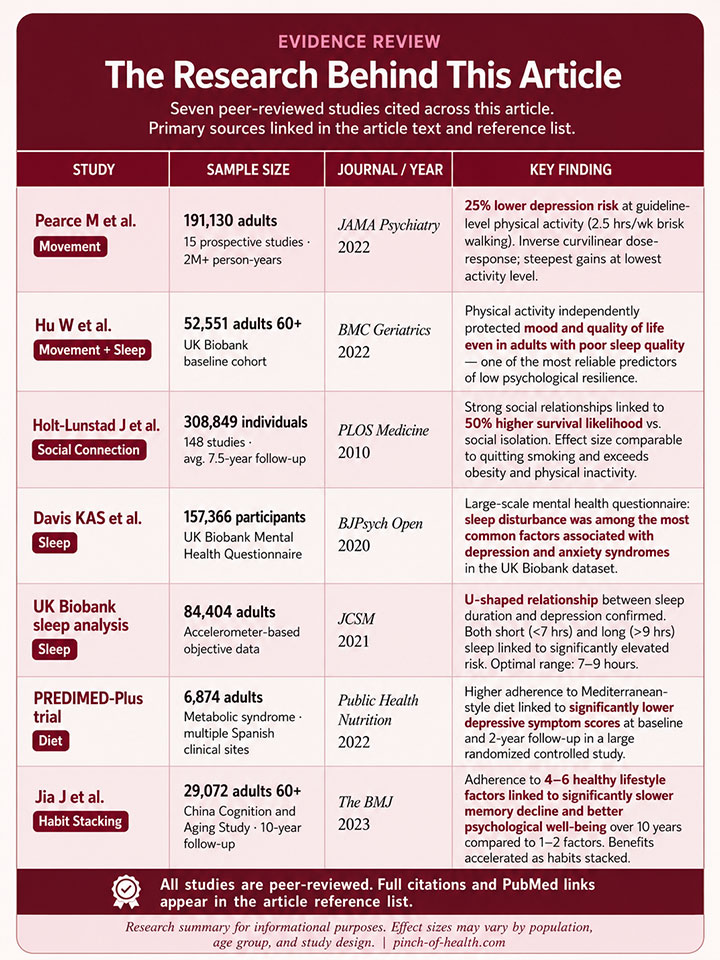
Most people think mental resilience is something you’re born with. Research involving more than 800,000 people suggests it’s built through five surprisingly simple daily habits.
Over the past decade, researchers have built a very different picture of resilience, one drawn from the health data of millions of ordinary people. Not elite athletes. Not clinical populations. People making daily choices about sleep, food, movement, and connection.
When you look across large-scale studies with combined data from more than 800,000 participants, a clear pattern appears. Mental resilience is not a fixed personality trait. You build it daily through a small set of biological habits.
This is not self-help. It is epidemiology.
Before you feel overwhelmed by five recommendations, know this: the research shows meaningful benefits from each habit individually. You do not need all five to see real change.
These habits are adaptable to almost any budget or lifestyle. Walking is free, canned fish and frozen vegetables count toward diet quality, and a two-minute text exchange maintains social connection just as reliably as a long dinner.
The 4 Types of Resilience
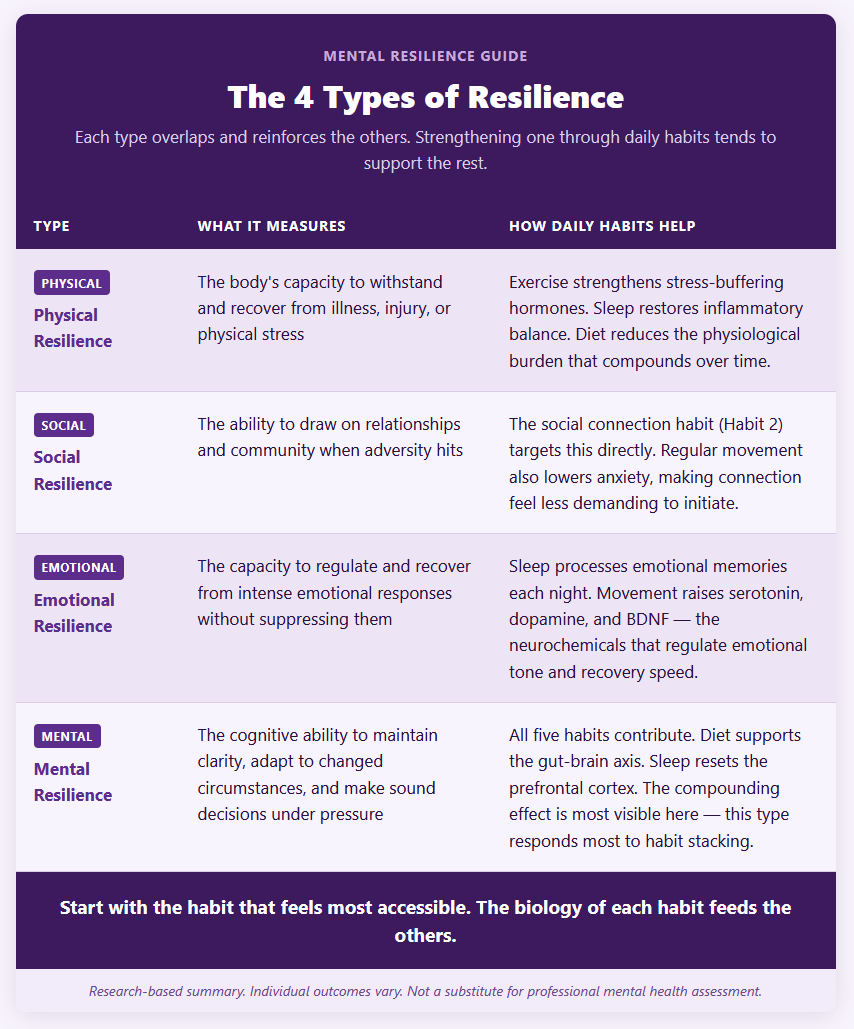
Researchers working in positive psychology recognize four distinct but connected forms. Physical resilience is the body’s capacity to withstand and recover from illness, injury, or physical stress. It is shaped most directly by fitness, nutrition, and sleep quality.
Social resilience refers to the ability to draw on relationships and community during adversity. It is less about personality than about the density and reliability of the connections already in place.
Emotional resilience is the capacity to regulate and recover from intense emotional responses without suppressing them. It determines how long a setback continues to affect mood and day-to-day function.
Mental resilience, the specific type this article focuses on, is the cognitive ability to maintain clarity, adapt to changed circumstances, and keep making sound decisions under pressure. All four types interact. Strengthening one tends to support the others, which is part of what makes the research on habit-stacking so striking.
Each of the five habits below targets more than one type simultaneously.
The Difference Between “Toughing It Out” and Being Built for It
There is a widespread idea that mentally strong people simply think differently, that they “stay positive,” “accept change,” and “reframe” hard situations.
That advice is not wrong. It is incomplete.
What large-scale research keeps showing is that the strongest predictors of mental resilience are not cognitive habits at all. They are physical inputs: how you move, how you sleep, what you eat, and who you stay close to.

Think of it this way. A car engine does not run well on bad fuel regardless of how skilled the driver is. The brain works the same way.
Here are the five daily habits the data keeps returning to.
Habit 1: Movement (The Dose Is Much Lower Than You Think)
You do not need to run marathons.
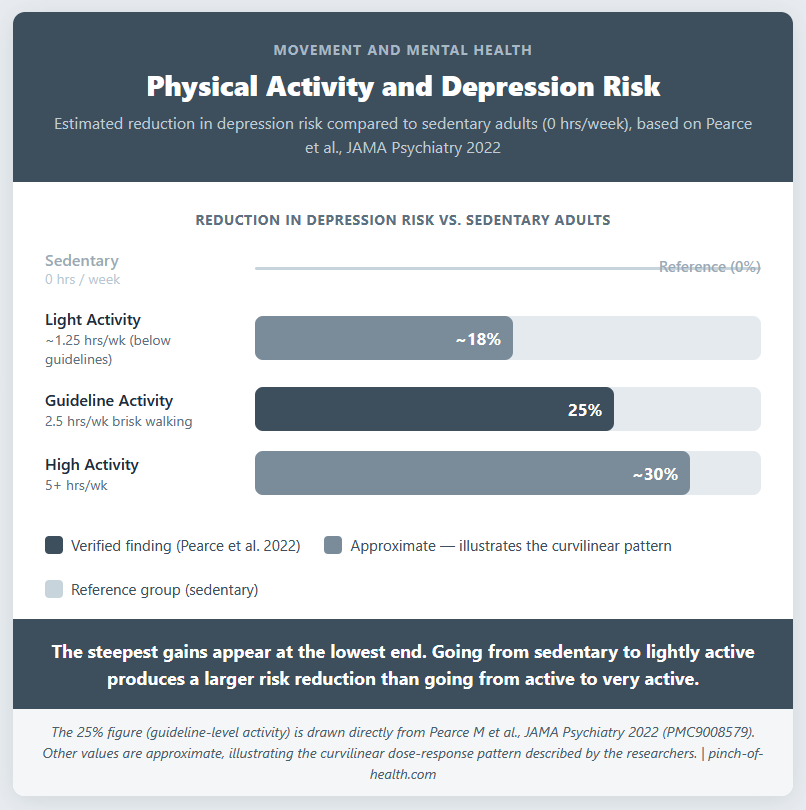
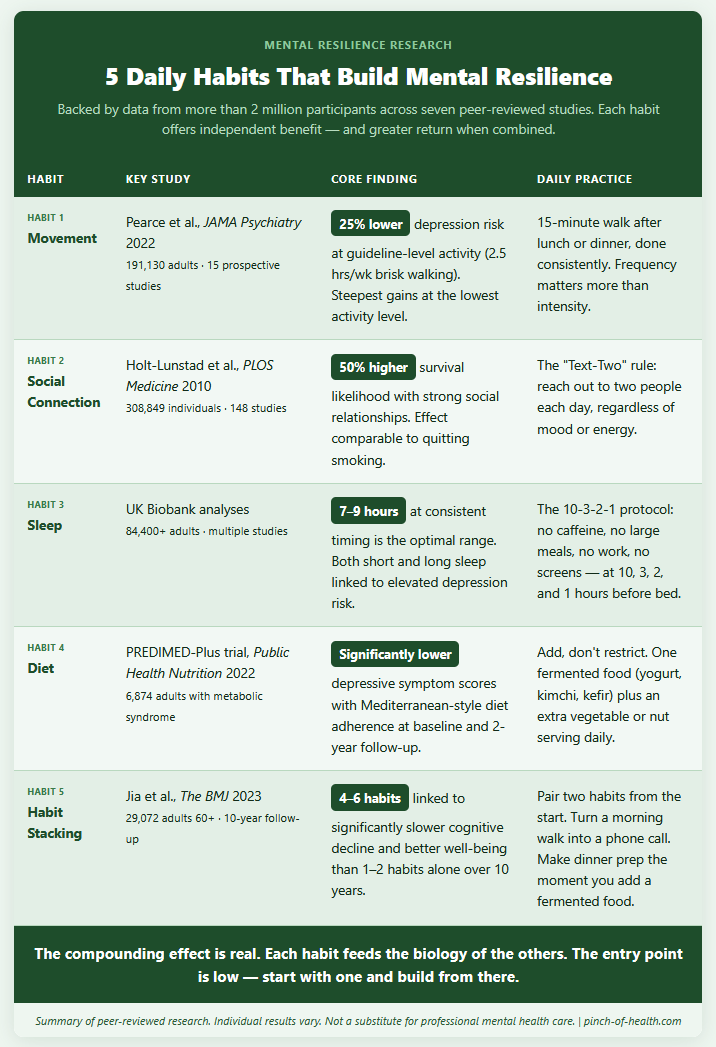
Researchers wanted to know precisely how much physical activity it takes before mental health benefits appear. What Pearce and colleagues found in a 2022 systematic review and meta-analysis published in JAMA Psychiatry, drawing on 15 prospective studies covering 191,130 adults across more than 2 million person-years of follow-up, is that the relationship between activity and depression risk follows a clear dose-response curve.
More activity generally meant lower risk. But the curve is not linear. The steepest gains appear at the low end: the transition from completely sedentary to lightly active matters far more than the jump from active to very active. Adults who met current physical activity recommendations, roughly 2.5 hours of brisk walking per week, had a 25% lower risk of depression compared to those reporting no activity.
The chemistry is not complicated. Movement raises serotonin, dopamine, and BDNF (brain-derived neurotrophic factor), a protein that drives the growth of new neural connections. More connections mean more pathways to reroute stress before it accumulates.
Hu and colleagues, in a 2022 UK Biobank analysis of 52,551 older adults, answered a different question. Among people already dealing with poor sleep quality, one of the most reliable predictors of low mental resilience, did movement still help?
It did. Regular physical activity still acted as a protective factor for both mood and health-related quality of life, independent of sleep. Movement helped even when sleep could not.
What the data does not settle is the first day. Fifteen minutes is the threshold most researchers point to, not because it is the dose that maximizes benefit, but because it is below the point where most people argue with themselves about whether to bother.
Frequency matters more than intensity. Showing up is the mechanism.
Habit 2: Social Connection Is a Survival Mechanism
The numbers from this one are still arresting, years after the study was published.
Julianne Holt-Lunstad and colleagues at Brigham Young University spent years assembling what would become the most wide-ranging analysis of social relationships and mortality risk ever conducted.
Their meta-analysis, published in PLOS Medicine in 2010, pooled data from 308,849 individuals across 148 separate studies, with an average follow-up of 7.5 years. People with strong social relationships had a 50% higher likelihood of survival compared to those who were isolated.
Fifty percent is not a small number. The magnitude of that effect is comparable to quitting smoking. It exceeds many well-known risk factors for early death, including obesity and physical inactivity.
Social isolation does not just feel bad. It registers in the body as a threat. Research in this area consistently links loneliness to elevated cortisol, increased low-grade inflammation, and disrupted sleep, all of which reduce psychological resilience over time.
What the Holt-Lunstad data showed is that the number of people you know matters less than the quality and consistency of those connections. Being genuinely embedded in a network of relationships appears to function as a biological safety net.
Two to three close, reliable relationships appear to offer significant protection. The implication is a little strange: you can lower your inflammation markers by returning a friend’s text.
What the data does not tell you is how to want to reach out when you do not want to. That is the gap the research does not close. The “Text-Two” rule, reaching out to two people each day regardless of how you feel, works because it moves the decision before the feeling does.
Habit 3: Sleep Is Where Resilience Gets Built or Lost
Sleep is the one habit that shows up everywhere. Every major dataset. Consistently.
The UK Biobank mental health questionnaire, completed by 157,366 participants as reported by Davis and colleagues in BJPsych Open in 2020, documented sleep disturbances among the most common factors associated with depression and anxiety syndromes in the dataset.
Poor sleep quality has appeared as one of the strongest individual predictors of poor mental well-being across multiple large analyses, holding its association with depression even when physical activity and diet are accounted for separately.
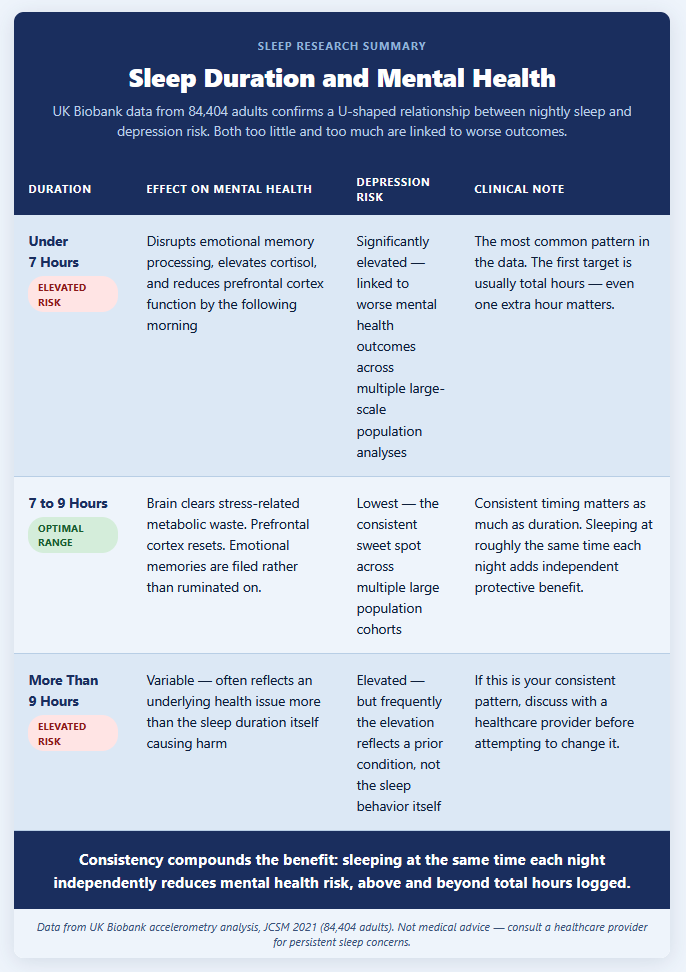
An accelerometer-based UK Biobank analysis of 84,404 adults confirmed the pattern other large datasets have also found: the relationship between sleep duration and depression follows a U-shaped curve. Both short and long sleep were linked to significantly worse outcomes. The consistent sweet spot in the data is 7 to 9 hours per night.
A caveat worth adding: regularly sleeping more than 9 hours may reflect an underlying health issue rather than the sleep duration being inherently harmful. If that is your pattern, the data suggests you discuss it with a healthcare provider rather than treating it as an isolated habit variable.
It also turns out that consistent sleep timing matters as much as total hours. Research tracking sleep regularity across large cohorts has found that sleeping at roughly the same time each night independently supports emotional resilience and mental clarity, over and above the effect of sleep duration alone.
A consistent sleep routine is not just a comfort habit. It is a biological one.
During deep sleep, the brain processes emotional memories and clears stress-related metabolic waste. Poor sleep does not just leave you tired. It reduces the neurological resources available to handle pressure the next day.
The micro-habit: Try the “10-3-2-1” protocol for your evening routine. No caffeine 10 hours before bed. No large meals 3 hours before. No work 2 hours before. No screens 1 hour before. Each step targets a specific physiological barrier to deep, consistent sleep.
Habit 4: Your Diet and Your Brain Are More Connected Than You Think
There is a direct signaling pathway between the digestive system and the central nervous system that researchers call the gut-brain axis. What you eat has a measurable effect on mood, stress tolerance, and cognitive function, though the degree of effect varies between individuals and no single dietary change operates in isolation.
One of the strongest pieces of evidence comes from the PREDIMED-Plus trial, a large randomized controlled study involving 6,874 adults with metabolic syndrome across multiple Spanish clinical sites.
Higher adherence to a Mediterranean-style diet, rich in vegetables, legumes, fish, nuts, and olive oil, was associated with significantly lower depressive symptom scores at baseline and at 2-year follow-up. PREDIMED-Plus represents one of the few areas in nutrition research where a controlled trial directly supports what observational data had long suggested about diet and mental health.
The likely driver is inflammation. A diet low in fiber and high in processed foods increases low-grade inflammation. That inflammation disrupts gut-brain signaling, raises baseline anxiety, and reduces stress tolerance over time.
The mechanism is not fully mapped, but the directional finding has appeared consistently across independent research groups in different populations.
Researchers still do not fully agree on which components of a Mediterranean-style diet drive the effect. The gut microbiome, omega-3 fatty acid intake, and reduced inflammatory load are all plausible contributors, and the honest answer is that the research has not yet separated them cleanly.
The micro-habit: Focus on adding, not restricting. Add one serving of a fermented food to your daily routine. Yogurt, kimchi, and kefir all contain probiotics, beneficial gut bacteria that appear to support the gut-brain signaling pathway. Add an extra handful of nuts or vegetables to one meal. Small additions shift the gut environment without the psychological friction that caloric restriction tends to generate.
Habit 5: The Compounding Effect (Why Stacking Habits Changes Everything)
Each habit above offers its own protection. The most striking finding in the research, though, is not about any single behavior. It is about what happens when several combine.
A 10-year study published in The BMJ in 2023 by Jia and colleagues followed 29,072 adults aged 60 and older from the China Cognition and Aging Study. Researchers measured adherence to six healthy lifestyle factors: regular physical activity, a healthy diet, active social contact, cognitive engagement, non-smoking, and limited alcohol use.
People who maintained four to six of these factors showed significantly slower memory decline and better psychological well-being compared to those who followed just one or two. Each additional habit added incremental protection. The benefits accelerated as habits stacked.
The 10-year follow-up period is meaningful on its own. It tells you these habits compound across years, not days. Many people do notice improvements in stress tolerance and mood within two to three weeks of consistent changes, particularly with sleep and movement.
Short-term improvements in how quickly you return to baseline after a stressful event tend to appear before gains in longer-term cognitive recovery patterns.
What happens when the habits stack is not simply additive. Better sleep provides the energy needed to move. Regular movement reduces anxiety, which makes social connection feel less demanding.
Strong social bonds buffer stress, which in turn supports sleep quality. The chain runs in all directions.
The accumulation is the point. Any single habit on this list is worth adopting. What the 10-year data keeps showing is that the biology of each habit feeds the others, and that compounding here is not a metaphor. It is a mechanism.
Signs You Are Building Mental Resilience
Progress in psychological resilience is rarely visible the way physical fitness changes are. The signs tend to be more subtle than you might expect. You may find that you recover from setbacks more quickly than you used to, not that setbacks no longer happen.
Difficult conversations feel less avoidable. You sleep through moderate stress rather than lying awake cataloging it.
These are the changes the research on habit-stacking predicts, and they tend to appear gradually rather than all at once. The underlying shift is in recovery rate, not in the severity of what you encounter.
Signs that psychological resilience may be lower than you would like include being overwhelmed by stressors that previously seemed manageable, persistent difficulty maintaining sleep, withdrawal from relationships that previously felt natural, and a narrowing of the kinds of problems you feel equipped to handle. These patterns are worth paying attention to, and they are also the patterns most directly addressed by the five habits above.
Mental Resilience Self-Assessment
Five questions — one per habit domain. See where your foundation stands today.
Conclusion
What more than 800,000 people’s worth of data points to is not complicated. Mental resilience is not a gift distributed unevenly at birth. It is the output of biological inputs you can adjust, and the entry point is lower than most people expect.
The common thread across all five habits is not willpower. It is recovery rate.
Sleep, movement, diet, and connection do not make difficult things disappear. They change how quickly you return to baseline after difficult things happen.
That distinction matters, because most advice about mental resilience targets the moment of stress. The research keeps pointing somewhere else: at what you did in the days before it arrived.
Frequently Asked Questions
What are signs of strong mental resilience?
People who score high on psychological resilience measures tend to recover from setbacks faster than average, maintain functioning during conditions of moderate stress, draw on relationships during difficulty rather than withdrawing, and adapt their thinking when a situation changes rather than insisting the situation change first. Resilience does not measure the absence of negative emotion. It measures whether that emotion persists or impairs function at the same rate.
How long does it take to build mental resilience?
Short-term improvements in stress tolerance and mood tend to appear within two to three weeks of consistent changes in sleep and physical activity. Longer-term changes in cognitive response patterns and social connection typically take months rather than weeks. The compounding effects seen in 10-year cohort studies suggest the accumulation continues across years. Patience is part of the mechanism, not a workaround for it.
Can I build mental resilience if I am already struggling?
Yes, and starting while struggling is more common than starting from a stable baseline. The research on low-dose physical activity is particularly relevant here. The steepest gains appear at the transition from sedentary to lightly active, not from active to very active.
The same pattern holds across the other habits. The entry point matters less than consistency over time.