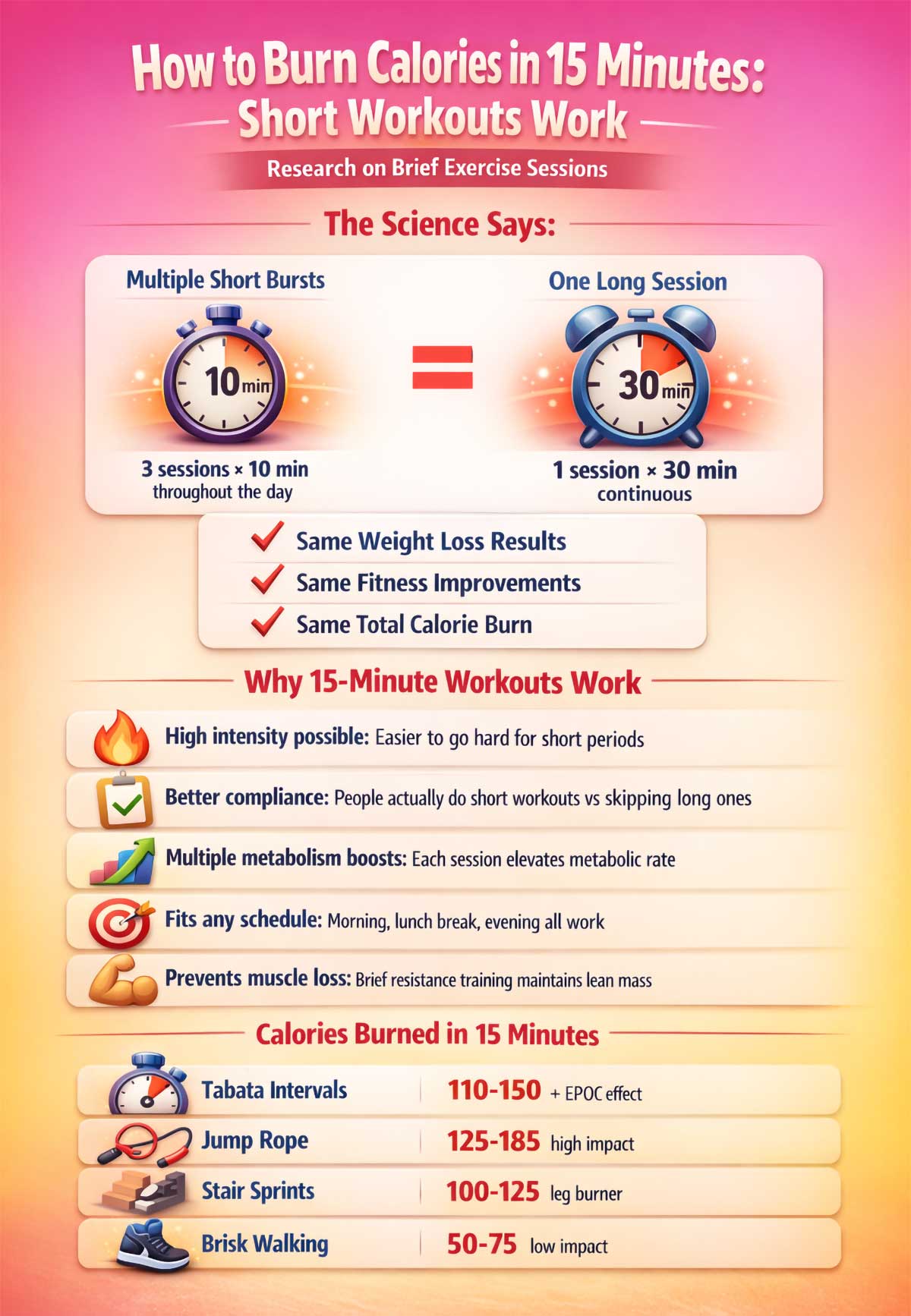
Science shows that short bursts of activity work just as well as long workouts when it comes to burning calories and keeping your metabolism humming. Research published by the American College of Sports Medicine confirms that breaking exercise into brief sessions throughout the day adds up to real health benefits. In fact, studies show that people who do multiple short workouts burn just as many calories and lose similar amounts of weight as those who exercise for one continuous hour.
This article gives you 20+ proven ways to torch calories in 15 minutes or less. These methods fit into your busy holiday schedule. No gym required. No special equipment needed for most of them.
The Power of the “Micro-Burn”: Understanding the Science
Why does 15 minutes matter so much?
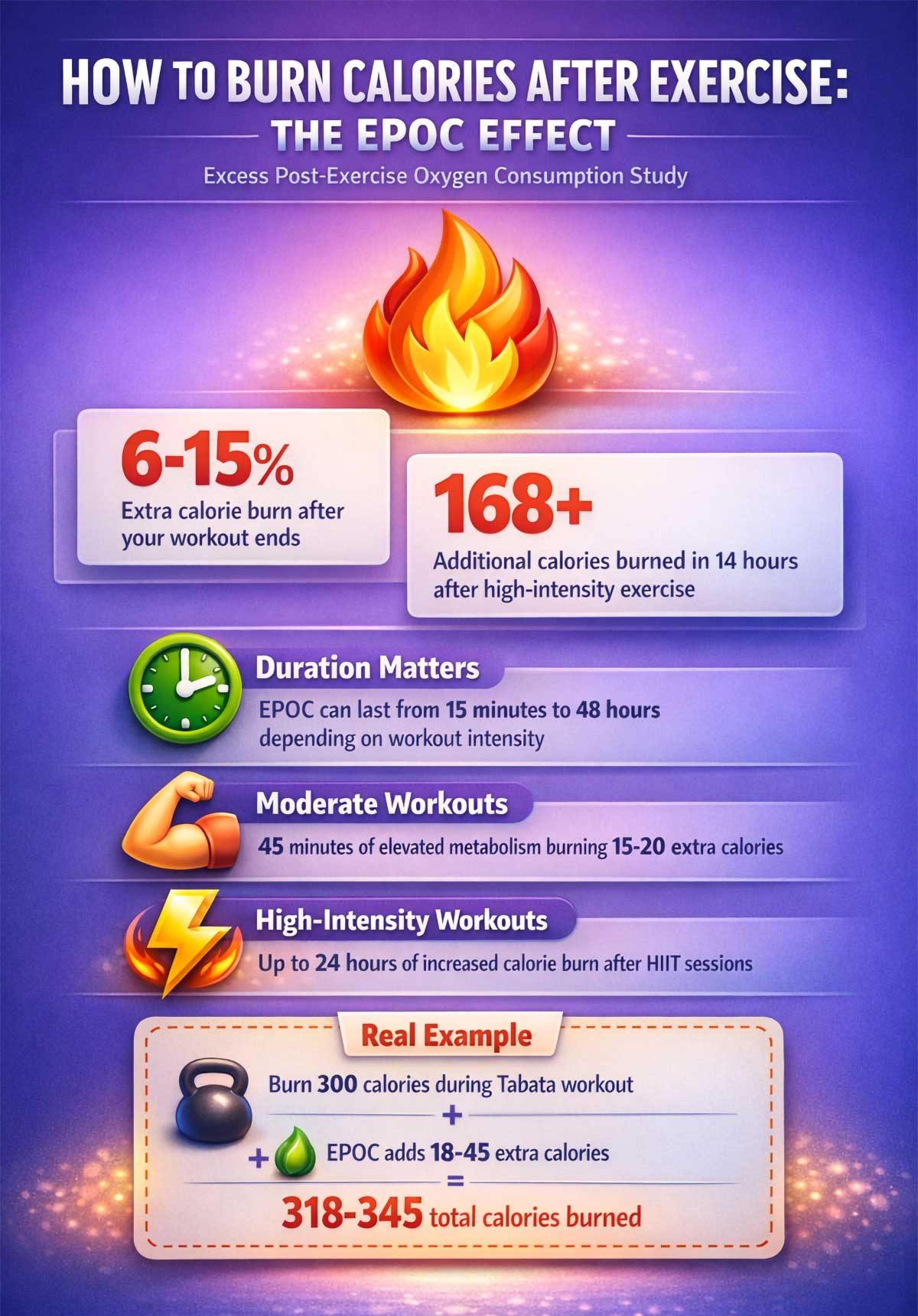
Your body doesn’t care if you exercise for one hour straight or break it into smaller chunks. What matters is the total work you do. When you move intensely for short periods, your body keeps burning extra calories for hours afterward. Scientists call this EPOC—Excess Post-exercise Oxygen Consumption.
Here’s what actually happens: studies show EPOC produces a 6-15% increase in overall calorie burn. So if you burn 300 calories during a quick workout, you might burn an extra 18-45 calories from EPOC alone. Think of it as your metabolism staying revved up long after you’ve stopped moving.
Research shows that EPOC is about 7% of the calorie expenditure of an exercise session on average. The duration varies based on intensity. After a 30-45 minute moderate workout, your metabolic rate stays elevated for about 45 minutes, burning an extra 15-20 calories. But here’s the key: both resistance training and high-intensity interval training can result in at least 168 additional calories burned in the 14 hours after exercise.
Short activity bursts also help control blood sugar spikes after big meals. When you eat a heavy dinner, your blood sugar rises. A quick walk or workout helps your muscles grab that sugar from your bloodstream and use it for energy instead of storing it as fat.
Here’s another bonus: you’re more likely to actually do a 5-minute workout than skip a 60-minute one you keep putting off. Consistency beats perfection every time.
Understanding Your Baseline Calorie Burn
Before we jump into the methods, let’s talk about how many calories your body already burns. The average person burns between 1,300 and 2,000 calories daily just by existing. This is your Basal Metabolic Rate (BMR).
Each pound of relaxed muscle burns about 6 calories per day, while the same amount of fat burns 2 calories. While that might not sound like much, it adds up when you consider muscle tissue is one of the most abundant tissues in your body.
The methods in this article will add 300-600 extra calories to your daily burn. Over a month during the holiday season, that’s enough to prevent 2-4 pounds of weight gain. That’s the difference between starting January with work to do versus starting from scratch.
Calorie Burn by Body Weight: What to Expect
Different body weights burn different amounts of calories. Here’s what you can expect for various activities in 10-15 minutes:
| Activity (10-15 min) | 125 lbs | 155 lbs | 185 lbs |
|---|---|---|---|
| Tabata Intervals | 90-120 | 110-150 | 130-175 |
| Jump Rope | 100-150 | 125-185 | 150-225 |
| Staircase Sprints | 80-100 | 100-125 | 120-150 |
| Kettlebell Swings | 85-110 | 105-135 | 125-160 |
| Shadowboxing | 75-95 | 90-115 | 110-140 |
| Brisk Walking | 40-60 | 50-75 | 60-90 |
| Bodyweight Squats | 55-70 | 70-85 | 80-100 |
| Power Cleaning | 50-65 | 60-80 | 75-95 |
These numbers are estimates. Your actual burn depends on intensity, fitness level, and how hard you push yourself.
That's enough to prevent 2.5-5 pounds of holiday weight gain!
Section 1: High-Intensity Power Bursts (The 5-10 Minute Burners)
These moves get your heart pounding fast. They burn a ton of calories in minimal time and keep your metabolism elevated for hours.
1. Tabata Intervals
Four minutes. That’s all you need.
Pick any exercise—burpees, jumping jacks, mountain climbers, or high knees. Do it as hard as you can for 20 seconds. Rest for 10 seconds. Repeat 8 times. Total time: 4 minutes.
This protocol was developed by Japanese researcher Dr. Izumi Tabata. His studies showed that these ultra-short, high-intensity intervals improve fitness as much as moderate exercise done for much longer. The key is going all-out during those 20-second work periods.
Burpees burn about 10-15 calories per minute, which means a 4-minute Tabata session using burpees could torch 40-60 calories during the workout, plus the EPOC effect afterward.
Your muscles will burn. Your lungs will gasp. That’s good. That means you’re triggering maximum calorie burn and that precious afterburn effect.
Modifications:
- Beginners: Remove the push-up and jump
- Intermediate: Standard burpees
- Advanced: Add a tuck jump at the top
2. Staircase Sprints
Got stairs? You’ve got a free calorie-burning machine.
Sprint up your stairs as fast as safely possible for 20 seconds. Walk down slowly. Rest for one minute. Repeat 3 times. This takes about 5 minutes total and works your entire lower body while spiking your heart rate.
Research shows that stair climbing burns more calories per minute than jogging. The vertical challenge forces your glutes, quads, and hamstrings to work harder than they do on flat ground.
Can’t do full sprints? No problem. Walk up briskly. You’ll still get benefits.
Pro tip: Hold the railing lightly for balance, but don’t pull yourself up. That reduces the work your legs do.
3. Jump Rope Blitz
You can burn 240-300 calories by jumping rope for 15 minutes. That’s more than 30 minutes of moderate jogging.
Jump rope engages your calves, core, shoulders, and arms all at once. It also improves your coordination and bone density. Jump rope burns 10-16 calories per minute depending on intensity and body weight.
If you can’t jump continuously for 10 minutes yet, try intervals: jump for 30 seconds, rest for 30 seconds. Build up gradually.
Don’t have a rope? Pretend you do. The jumping motion alone gives you most of the benefits.
Intensity levels:
- Light: 100 jumps per minute (10-12 cal/min)
- Moderate: 120 jumps per minute (12-15 cal/min)
- High: 140+ jumps per minute (15-20 cal/min)
4. Kettlebell Swing Intervals (EMOM Style)
This move is a calorie-destroying powerhouse.
Set a timer to beep every minute (that’s what EMOM means: Every Minute On the Minute). When it beeps, do 10-15 kettlebell swings. Rest until the next beep. Do this for 10 minutes. That’s 100-150 swings total.
Kettlebell swings work your hips, glutes, core, and back. The explosive hip thrust burns serious energy. Studies on resistance training show that full-body exercises like this increase your resting metabolic rate, meaning you burn more calories even while sitting on the couch later.
No kettlebell? Use a heavy book, a gallon water jug, or even a backpack loaded with stuff.
Form check:
- Keep your back flat
- Push your hips back
- Drive through your heels
- The power comes from your hips, not your arms
5. Shadowboxing
Punch the air like you mean it for 10 minutes.
Throw jabs, crosses, hooks, and uppercuts. Add in some knee strikes and footwork. Keep moving the entire time. This low-impact cardio option torches calories while being easy on your joints.
Boxers use shadowboxing to build endurance and speed. You can use it to burn off that slice of pie you had at lunch. Put on some upbeat music and pretend you’re training for a fight. Your heart rate will soar.
Basic combo for beginners:
- Jab-jab-cross (1-1-2)
- Rest and move your feet
- Repeat for 30 seconds
- Rest 15 seconds
- Continue for 10 minutes
Section 2: Post-Meal Metabolic Hacks
These strategies work especially well right after you eat. They help your body process food better and prevent that sluggish, bloated feeling.
6. The 15-Minute Post-Meal Walk
This might be the single most effective thing you can do after a big holiday dinner.
Studies show that walking for just 15 minutes after eating significantly lowers blood sugar levels. One study found that three 15-minute walks after meals controlled blood sugar better than one 45-minute walk at another time of day.
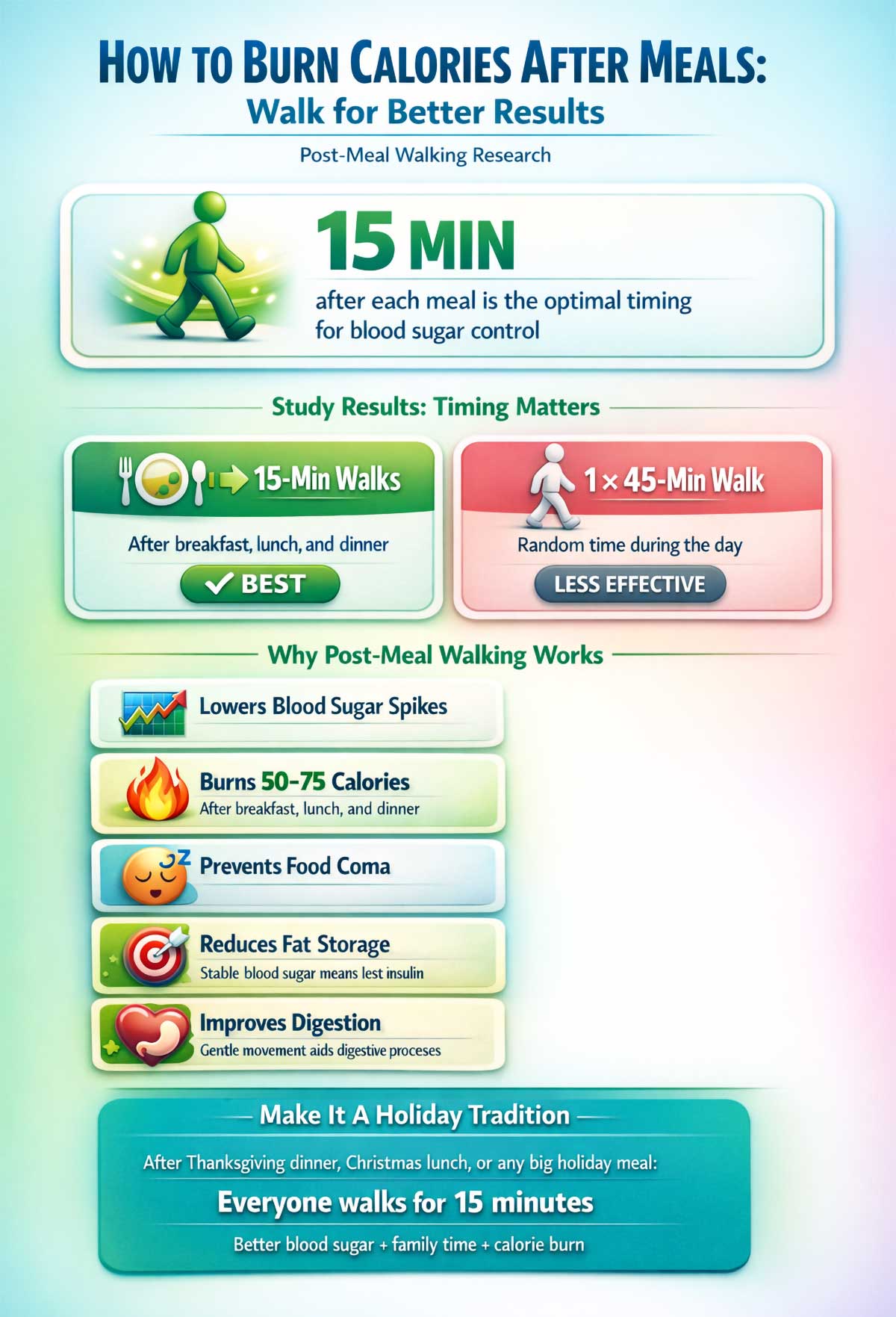
When your blood sugar stays stable, your body stores less fat. Simple as that. Make it a family tradition: everyone walks around the block after Thanksgiving dinner. You’ll feel better and burn calories at the same time.
Walking pace guide:
- Casual: 2-2.5 mph (social pace, talking easily)
- Moderate: 3-3.5 mph (purposeful pace, can talk but breathing harder)
- Brisk: 4+ mph (fast pace, talking takes effort)
A 155-pound person burns about 50-75 calories during a 15-minute brisk walk, but the blood sugar benefits are worth even more.
7. Slow Eccentric Bodyweight Squats
Focus on the lowering phase.
Take 5 seconds to lower yourself down into a squat. Stand up quickly. That’s one rep. Do 3 sets of 10-15 reps. This takes about 5-7 minutes.
Why go slow? The eccentric (lowering) phase of an exercise causes more muscle fiber recruitment. More muscle fibers working means more calories burned. It also builds strength faster than regular-speed squats.
Your legs will shake. That’s your muscles working hard.
Form tips:
- Feet shoulder-width apart
- Push your hips back first
- Keep your chest up
- Knees track over your toes
8. Extended Walking Routes
Park farther away on purpose.
Going to a holiday party? Park 10 minutes away from the entrance. Heading to the mall? Choose the farthest spot. These extra steps add up fast.
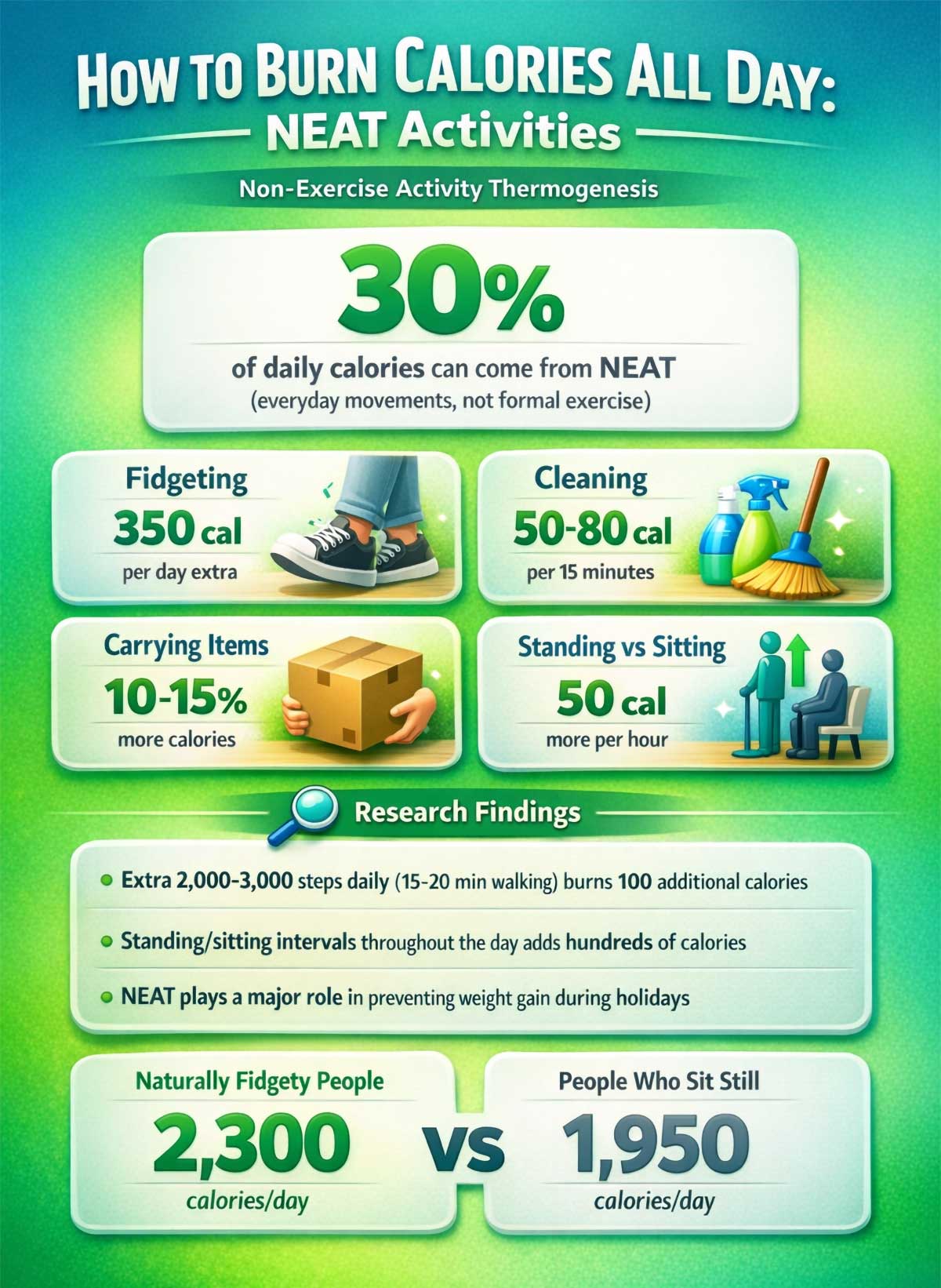
Research on non-exercise activity shows that people who take an extra 2,000-3,000 steps daily (about 15-20 minutes of walking) burn an additional 100 calories. Over a week, that’s 700 calories. Over the holiday season, it could mean the difference between gaining weight and maintaining it.
Daily step goals:
- Sedentary baseline: 3,000-5,000 steps
- Lightly active: 7,500-10,000 steps
- Active: 10,000-12,500 steps
- Very active: 12,500+ steps
Adding 2,000 extra steps equals about 1 mile or 100 extra calories for most people.
9. Wall Sits During TV Time
Commercial break? Time to burn.
Put your back against a wall and slide down until your thighs are parallel to the ground. Hold for 30-60 seconds. Rest. Repeat 3-5 times during a typical commercial break.
This isometric exercise activates your quads and glutes—two of your body’s largest muscle groups. When big muscles work, your metabolic rate increases. Plus, you can do this while watching your favorite holiday movie.
Challenge levels:
- Beginner: 20-30 second holds
- Intermediate: 45-60 second holds
- Advanced: 60+ seconds or add weight in your lap
10. Stand and Sit Intervals at Your Desk
If you work from home or spend time at a desk during the holidays, try this.
Set a timer for 15 minutes. Stand up. After 15 minutes, sit down. Keep switching. This simple pattern keeps your lipase enzyme active. Lipase breaks down fat in your bloodstream. When you sit for hours straight, lipase activity drops by 90%. Standing brings it back up.
Studies show that people who alternate between sitting and standing throughout the day burn about 50 more calories per hour than those who just sit. That might not sound like much, but it adds up to hundreds of calories over a full day.
Practical schedule:
- 8:00 AM – Standing
- 8:15 AM – Sitting
- 8:30 AM – Standing
- Continue pattern all day
Section 3: NEAT and Hidden Calorie Burners
NEAT stands for Non-Exercise Activity Thermogenesis. It’s all the movement you do that isn’t formal exercise. This category is huge—for some people, NEAT accounts for up to 30% of their daily calorie burn.
11. Cold Exposure Sessions
Take a cold shower for 30 seconds at the end of your regular shower. Or take a brisk 10-minute walk outside in cold weather without overdressing.
Why? Cold exposure activates brown fat—a special type of fat tissue that burns calories to generate heat. Studies show that regular cold exposure can increase your daily calorie burn by 100-300 calories. That’s like a free 30-minute workout.
Your body works hard to keep you warm. Let it.
Cold exposure protocol:
- Week 1: 15-30 seconds cold at end of shower
- Week 2: 30-45 seconds
- Week 3: 45-60 seconds
- Week 4: 1-2 minutes
Safety notes:
- Start gradually
- Never use ice baths without medical clearance
- If you have heart issues, consult your doctor first
- Cold walks should be below 50°F for best effect
12. Power Cleaning Sessions
Clean your house like you’re getting paid by the calorie.
Vacuum vigorously. Scrub the bathroom tiles hard. Mop with purpose. Fifteen minutes of intense cleaning can burn 50-80 calories, depending on your body weight and effort level.
The key word is “intense.” Move quickly. Use full-body motions. Reach high. Squat low. Turn cleaning into a workout and your house gets spotless while you burn off breakfast.
High-intensity cleaning moves:
- Vacuuming with lunges
- Scrubbing with circular arm motions
- Mopping with squats
- Window cleaning with full arm extensions
13. Dynamic Fidgeting
Tap your feet. Bounce your leg. Shift in your seat. Stand up and stretch frequently.
Researchers have found that naturally fidgety people burn up to 350 more calories per day than people who sit still. That’s substantial. While you might not be able to force yourself to fidget constantly, you can make a conscious effort to move more throughout the day.
During holiday gatherings, don’t just sit. Stand while talking. Pace while on the phone. Move while you chat. These tiny movements add up.
Micro-movements that count:
- Tapping your feet while seated
- Shifting weight from foot to foot while standing
- Gesturing while talking
- Getting up to refill water frequently
- Stretching every 30 minutes
14. Vertical Loading with Groceries
Carrying groceries or presents? Take them one at a time instead of loading yourself up.
Each trip increases your step count and adds resistance training. Your muscles work harder when carrying weight, which burns more calories than walking empty-handed. Plus, you reduce your risk of dropping everything or hurting yourself by carrying too much at once.
Think of it as built-in strength training for your daily life.
Calorie boost: Carrying 10-20 pounds increases calorie burn by 10-15% compared to walking unloaded.
15. Wait-Time Micro-Workouts
Waiting for coffee to brew? Do calf raises.
Microwaving leftovers? Do glute squeezes.
Standing in line at the store? Practice standing on one leg for balance.
These micro-movements seem small, but they add up. Ten sets of 20 calf raises throughout the day works your calf muscles more than you’d think. Glute squeezes activate the largest muscle in your body. Balance exercises engage your core.
Make it a game: never wait idle. Always move something.
Wait-time workout menu:
- Coffee brewing (2 min): 40 calf raises
- Microwave (1 min): 30 glute squeezes
- Bathroom break: 10 squats
- Phone call: Pace or do standing leg lifts
Section 4: Diet-Driven Calorie Burning
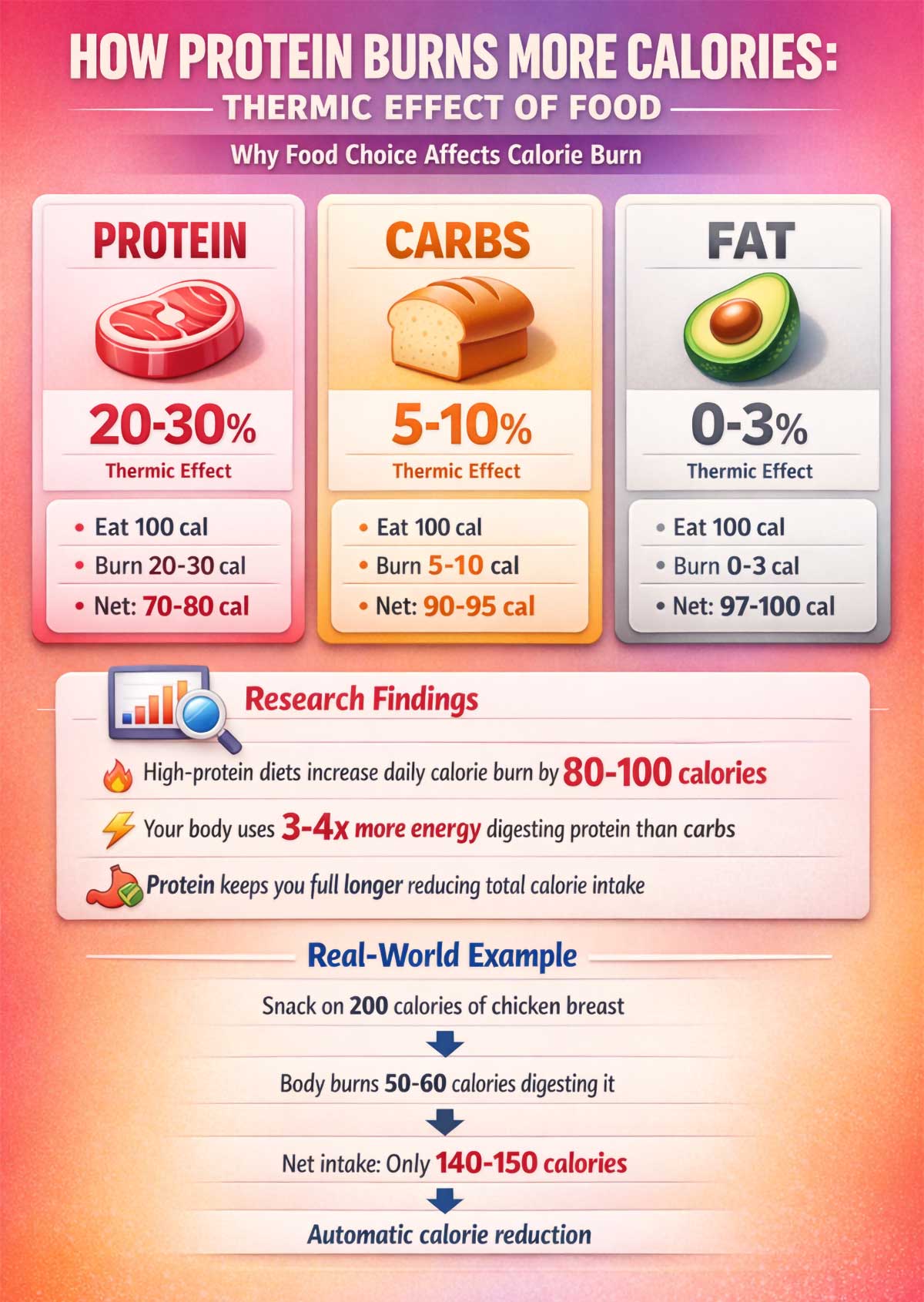
What you eat affects how many calories your body burns to digest food. This is called the Thermic Effect of Food, or TEF.
Understanding TEF (Thermic Effect of Food)
Not all calories are equal when it comes to digestion. Your body uses different amounts of energy to break down different types of food.
TEF by macronutrient:
| Nutrient | Calories per gram | TEF (% of calories) | Net calories per 100 eaten |
|---|---|---|---|
| Protein | 4 | 20-30% | 70-80 |
| Carbs | 4 | 5-10% | 90-95 |
| Fat | 9 | 0-3% | 97-100 |
Protein has a thermic effect of 20-30% compared to carbohydrates at 5-10% and fat at 0-3%. This means if you eat 100 calories of chicken breast, your body uses 20-30 of those calories just to digest it.
16. Choose Protein-First Snacks
When hunger strikes between holiday meals, reach for protein.
Protein has the highest thermic effect of all nutrients. Your body uses about 25-30% of protein’s calories just to digest it. Compare that to carbs (5-10%) and fat (0-3%).
Grab some turkey, Greek yogurt, hard-boiled eggs, or beef jerky instead of cookies. You’ll stay full longer and burn more calories just by digesting your snack. Studies show that high-protein diets increase daily calorie burn by 80-100 calories compared to lower-protein diets.
High-protein snack ideas with calorie info:
| Snack | Protein (g) | Calories | TEF burn | Net calories |
|---|---|---|---|---|
| 2 hard-boiled eggs | 12 | 140 | 35 | 105 |
| Greek yogurt (6 oz) | 17 | 100 | 25 | 75 |
| Turkey slices (3 oz) | 21 | 90 | 23 | 67 |
| Beef jerky (1 oz) | 9 | 80 | 20 | 60 |
17. Drink Cold Water Throughout the Day
Down 16 ounces of cold water.
Research shows that drinking cold water temporarily boosts your metabolic rate by up to 30% for about an hour. Your body has to warm that water to body temperature, which costs energy. Two liters of cold water throughout the day might burn an extra 70-100 calories.
It’s not magic, but it’s free and easy. Plus, staying hydrated helps every system in your body work better. During the holidays, when you’re eating rich foods, extra water helps digestion too.
Hydration schedule:
- Wake up: 16 oz cold water
- Mid-morning: 16 oz
- Before lunch: 8 oz
- Afternoon: 16 oz
- Before dinner: 8 oz
- Evening: 8 oz
- Total: 72 oz (about 70-100 extra calories burned)
18. Add Spice to Your Meals
Hot peppers contain capsaicin, a compound that increases calorie burn.
Studies show capsaicin can boost metabolism by 5-10% for several hours after eating. It also reduces appetite in some people. Add hot sauce to your holiday leftovers. Use red pepper flakes on your eggs. Cook with jalapeños or cayenne.
Not everyone tolerates spicy food well, so start small. But if you enjoy heat, this is an easy way to add a small metabolic boost to your meals.
Spicy recipe: Metabolism-Boosting Turkey Chili Prep time: 10 minutes | Cook time: 20 minutes | Serves: 4
Ingredients:
- 1 lb ground turkey
- 1 can black beans
- 1 can diced tomatoes
- 1 diced jalapeño
- 2 tbsp chili powder
- 1 tsp cayenne pepper
- 1 diced onion
- 2 cloves garlic
Instructions:
- Brown turkey in a large pot
- Add onion and garlic, cook 3 minutes
- Add remaining ingredients
- Simmer 15 minutes
- Serve hot
Nutritional info per serving: 280 calories, 32g protein, TEF burn: ~80 calories
19. Green Tea Before Activity
Drink a cup of green tea 30 minutes before a walk or workout.
Green tea contains both caffeine and catechins—compounds that work together to increase fat burning. Research shows that green tea extract can boost calorie burn by 4-5% and increase fat burning by 10-16%.
The caffeine gives you more energy for your workout. The catechins help your body break down fat cells. Together, they make your short workout more effective.
Timing tips:
- Morning walk: Green tea at 7:00 AM, walk at 7:30 AM
- Afternoon workout: Green tea at 2:00 PM, workout at 2:30 PM
- Best results: 2-3 cups daily
20. Deep Breathing for Stress Reduction
Stress makes you store belly fat. The holidays can be stressful. Combat this with deep breathing.
Sit comfortably. Breathe in slowly through your nose for 4 counts. Hold for 4 counts. Exhale slowly through your mouth for 6 counts. Repeat for 5 minutes.
This activates your parasympathetic nervous system, which lowers cortisol—your main stress hormone. High cortisol makes your body store fat around your midsection. Studies show that people who practice daily stress reduction techniques have less belly fat than those who don’t.
Plus, deep breathing itself burns a few calories. Not many, but combined with the stress reduction benefits, it’s worth doing.
5-minute breathing protocol:
- Find a quiet spot
- Set a timer for 5 minutes
- Breathe: 4 counts in, 4 hold, 6 out
- Focus on your breath
- Repeat 8-10 times
- Benefit: Lower cortisol, better fat distribution, 10-15 calories burned
Bonus Methods for Extra Calorie Burn
21. Dance While Doing Chores
Put on your favorite music and dance while cooking, cleaning, or wrapping presents. Dancing burns 150-250 calories per 30 minutes, depending on intensity. Even 10 minutes of kitchen dancing while preparing meals adds up.
22. Carry Items Up Stairs
Instead of leaving items at the bottom of the stairs, make multiple trips. Each trip carrying items up stairs burns 2-3 times more calories than walking up empty-handed.
23. Play Actively with Kids or Pets
Chase your kids around the yard. Play fetch with your dog. Active play burns 200-300 calories per 30 minutes and doesn’t feel like exercise.
Equipment Guide: What You Need (and Don’t Need)
| Method | Equipment Needed | Alternative Options |
|---|---|---|
| Tabata | None | Just your bodyweight |
| Stairs | Stairs | Step platform |
| Jump Rope | Jump rope ($10-20) | Jumping without rope |
| Kettlebell | Kettlebell ($20-40) | Backpack with books, water jug |
| Shadowboxing | None | Optional: light hand weights |
| Walking | Comfortable shoes | Already have them |
| Squats | None | Add weight when ready |
| Cleaning | Cleaning supplies | What you already own |
| Cold Exposure | None | Your shower/outdoors |
| Protein Snacks | Food | Shop your kitchen first |
Total potential investment: $0-60 for everything
Your 7-Day Quick-Start Plan
This plan helps you implement these strategies without getting overwhelmed. Pick three methods per day from different categories.
| Day | Morning (5 min) | Midday (5-10 min) | Evening (5-10 min) | NEAT Activities |
|---|---|---|---|---|
| Monday | Tabata intervals | Post-lunch walk | Wall sits during TV | Cold shower, protein snacks |
| Tuesday | Jump rope | Power cleaning | Deep breathing | Stand/sit intervals, fidgeting |
| Wednesday | Staircase sprints | Bodyweight squats | Shadowboxing | Vertical loading, wait-time workouts |
| Thursday | Kettlebell swings | Post-meal walk | Dance while cooking | Cold walk, spicy dinner |
| Friday | Tabata intervals | Extended walking route | Wall sits | Green tea, protein snacks |
| Saturday | Jump rope | Play with kids/pets | Post-dinner walk | Power cleaning, cold exposure |
| Sunday | Rest or light walk | Light movement | Gentle stretching | Fidgeting, deep breathing |
Weekly total burn estimate: 1,400-2,100 extra calories (enough to offset 2-3 holiday meals)
Common Mistakes to Avoid
1. Going Too Hard Too Fast
The mistake: Jumping into multiple intense workouts daily when you haven’t exercised in months.
The fix: Start with 2-3 methods daily. Build up over two weeks. Your body needs time to adapt.
Warning signs you’re overdoing it:
- Extreme soreness lasting 3+ days
- Joint pain
- Fatigue instead of energy
- Sleep problems
2. Skipping Warm-Ups
The mistake: Launching into Tabata or sprints without warming up.
The fix: Even 5-minute workouts need 1-2 minutes of warm-up. March in place, do arm circles, and do some light movement first.
Quick warm-up (90 seconds):
- 30 seconds: March in place
- 30 seconds: Arm circles
- 30 seconds: Leg swings
3. Not Tracking Consistency
The mistake: Doing random workouts without a plan or tracking.
The fix: Use the tracking tool below. Check off each session. Seeing progress motivates you.
4. Expecting Immediate Results
The mistake: Weighing yourself daily and getting discouraged.
The fix: Give it 2-4 weeks. Weight fluctuates daily due to water, food, and hormones. Track how you feel and how clothes fit instead.
Realistic timeline:
- Week 1: More energy, better sleep
- Week 2: Clothes fit better, less bloating
- Week 3-4: Measurable changes in weight/measurements
5. Compensating by Eating More
The mistake: Burning 300 calories, then eating 500 calories “because you earned it.”
The fix: These workouts help offset holiday meals, not give you permission for extra desserts. Stay mindful of portions.
“Stack Your Methods” for Maximum Impact
Combining methods strategically multiplies your results. Here are proven combinations:
The Morning Energizer (15 minutes total)
- Cold shower (30 seconds) → Wakes you up, activates brown fat
- Tabata intervals (4 minutes) → Maximum calorie burn
- Protein-rich breakfast (eggs, Greek yogurt) → High TEF, lasting fullness
- Green tea → Metabolism boost
Total bonus burn: 100-150 calories + elevated metabolism for hours
The Desk Worker Special (Spread throughout day)
- Stand/sit intervals (every 15 minutes) → Keeps lipase active
- Wait-time micro-workouts (multiple times) → Adds up
- Post-lunch walk (15 minutes) → Blood sugar control
- Wall sits during breaks (3 sets) → Activates large muscles
Total bonus burn: 200-300 calories + reduced sitting time
The Evening Wind-Down (20 minutes total)
- Post-dinner walk (15 minutes) → Best blood sugar control
- Light cleaning (10 minutes) → Productive calorie burn
- Deep breathing (5 minutes) → Lowers cortisol
- Wall sits during TV (3 sets) → Passive workout
Total bonus burn: 150-200 calories + better sleep + cleaner house
The Holiday Party Prep (30 minutes before event)
- Extended walking route to venue (10 minutes) → Pre-burn
- Staircase sprints at home first (5 minutes) → EPOC activation
- Protein snack before leaving (Greek yogurt) → Appetite control
- Cold water (16 oz) → Temporary metabolism boost
Total bonus burn: 100-150 calories + less likely to overeat at party
Understanding the “Holiday Calorie Offset”
Let’s do some real math to show how these methods help:
Typical holiday meal breakdown:
- Thanksgiving dinner: 3,000 calories
- Normal day: 2,000 calories
- Holiday surplus: 1,000 extra calories
Your micro-burn arsenal:
- Three 5-minute workouts: 150-225 calories burned
- EPOC effect (7% bonus): 10-15 calories
- Post-meal walks: 150 calories
- NEAT activities throughout day: 200-300 calories
- Protein snacks (TEF boost): 50-80 calories
- Cold water intake: 70-100 calories
Total daily offset: 630-970 calories
This means you can offset 60-95% of your holiday meal surplus with these quick strategies. Over a 6-week holiday season, that’s the difference between gaining 5-8 pounds versus gaining 1-2 pounds (or maintaining your weight entirely).
Before You Start: Safety Guidelines
When to Get Medical Clearance
Talk to your doctor before starting if you:
- Haven’t exercised in 6+ months
- Have heart disease or high blood pressure
- Have joint problems or arthritis
- Are pregnant or recently gave birth
- Have diabetes (exercise affects blood sugar)
- Are over 50 and sedentary
Warning Signs to Stop Immediately
Stop exercising and seek help if you feel:
- Chest pain or pressure
- Severe shortness of breath
- Dizziness or lightheadedness
- Nausea
- Sharp joint pain
- Irregular heartbeat
Injury Prevention Basics
Warm-up essentials (even for 5-minute workouts):
- 1-2 minutes of light movement
- Gradually increase intensity
- Never start cold with maximum effort
Cool-down tips:
- Walk slowly for 1-2 minutes
- Stretch major muscle groups
- Breathe deeply
Listen to your body:
- Good pain: Muscle fatigue, burning sensation
- Bad pain: Sharp, joint pain, doesn’t go away
Exercise Intensity Scale
Understanding how hard you’re working helps you get better results safely.
| Level | % Max Heart Rate | Can You Talk? | Breathing | Examples | When to Use |
|---|---|---|---|---|---|
| Light | <50% | Full conversation | Normal | Casual walking, stretching | Warm-up, cool-down, recovery days |
| Moderate | 50-70% | Short sentences | Slightly harder | Brisk walking, light cleaning | Daily movement, post-meal walks |
| Hard | 70-85% | Few words | Harder, can hear it | Tabata, jump rope, sprints | Short workouts, calorie burning |
| Maximum | >85% | Can’t talk | Gasping | All-out sprints, burpees | 20-second Tabata intervals only |
How to find your maximum heart rate: 220 – your age = max heart rate
Example: If you’re 40 years old:
- Max heart rate: 180 bpm
- Moderate zone: 90-126 bpm
- Hard zone: 126-153 bpm
- Maximum zone: 153+ bpm
You don’t need a heart rate monitor. The “talk test” works just as well.
Partner and Family Activities
Make calorie burning social. You’ll have more fun and stay consistent.
With Your Partner
- Staircase sprint races: Who can do more rounds?
- Shadowboxing challenges: Take turns calling out combos
- Post-meal walks: Great time for conversation
- Wall sit competitions: Who can hold longer?
With Kids
- Dance parties: 10 minutes burns 50-75 calories for adults
- Backyard tag: Burns 200-300 calories in 15 minutes
- Stair races: Kids love competition
- Jump rope contests: Who can do most jumps without stopping?
With Family Groups
- Post-dinner tradition: Everyone walks together
- Holiday chores race: Who can clean their area fastest?
- Step count challenges: Use free phone apps
- Active game nights: Dancing games, charades, active Pictionary
High-Protein Snack Recipes
These recipes maximize TEF (Thermic Effect of Food) to burn more calories through digestion.
Greek Yogurt Power Bowl
Prep time: 3 minutes | Serves: 1
Ingredients:
- 1 cup plain Greek yogurt (non-fat)
- 1/4 cup berries
- 2 tbsp sliced almonds
- 1 tsp honey
Nutritional info:
- Calories: 220
- Protein: 25g
- TEF burn: 50-60 calories
- Net calories: 160-170
Turkey and Avocado Roll-Ups
Prep time: 5 minutes | Serves: 1
Ingredients:
- 4 slices deli turkey
- 1/4 avocado, sliced
- Mustard
- Lettuce leaves
Nutritional info:
- Calories: 180
- Protein: 24g
- TEF burn: 45-54 calories
- Net calories: 126-135
Hard-Boiled Egg Snack Pack
Prep time: 10 minutes (batch cook) | Serves: 1
Ingredients:
- 2 hard-boiled eggs
- Everything bagel seasoning
- Cherry tomatoes
Nutritional info:
- Calories: 160
- Protein: 14g
- TEF burn: 32-48 calories
- Net calories: 112-128
Troubleshooting Common Issues
“I don’t feel like I’m working hard enough”
Solution: Use these intensity checks:
- Can you maintain this pace for 10+ minutes? Too easy.
- Can you only do it for 10-20 seconds? That’s right.
- Are you breathing hard but not gasping? Perfect for moderate work.
Add intensity by:
- Moving faster
- Adding resistance (wear a backpack)
- Reducing rest time between sets
- Increasing range of motion
“I’m too sore to continue”
Solution: Soreness is normal for 1-2 days. Severe soreness means you overdid it.
Recovery strategies:
- Light movement (walking) increases blood flow
- Gentle stretching
- Adequate protein (0.7-1g per pound bodyweight)
- Good sleep (7-9 hours)
- Stay hydrated
When to rest completely:
- Pain persists 3+ days
- Soreness prevents normal activities
- You have sharp, localized pain
“I don’t have time even for 5 minutes”
Solution: You don’t need dedicated time blocks. Layer movement into what you’re already doing.
Examples:
- Brush teeth → Do calf raises (2 minutes)
- Make coffee → Do wall sits (1 minute)
- Watch TV → Do exercises during commercials
- Take phone calls → Walk and talk
- Wait for dinner to cook → Do squats
If you can watch TV, scroll social media, or stand in line, you have time to move.
“I’m not seeing results”
Solution: Results take time. Check these factors:
Are you being consistent?
- Doing activities 5+ days per week? Good.
- Doing them 2-3 days per week? Increase frequency.
- Skipping multiple days in a row? That’s your answer.
Are you compensating with extra food?
- Track your food for 3 days honestly
- Are you eating more “because you exercised”?
- Are portions creeping up?
Are you tracking the right things?
- Weight fluctuates daily (water, food, hormones)
- Track measurements, energy, how clothes fit
- Take monthly photos (changes are gradual)
Timeline expectations:
- Week 1-2: Feel better, more energy
- Week 3-4: Clothes fit better
- Week 6-8: Visible changes, measurable weight loss
Making It Permanent
These methods work year-round, not just during the holidays.
January Transition Strategy
When January arrives and life returns to normal, you have options:
Option 1: Maintain the micro-burn approach Continue doing 3-5 methods daily. This is sustainable long-term and prevents weight regain.
Option 2: Build to longer workouts Use these methods as a foundation. Add 1-2 longer workouts (30-45 minutes) weekly while keeping daily micro-burns on other days.
Option 3: Mix and match Long workout days: 2-3 per week Micro-burn days: 3-4 per week Rest days: 1-2 per week
Adjusting Intensity as Fitness Improves
As you get fitter, your body adapts. Keep challenging yourself:
Month 1-2: Focus on consistency and proper form Month 3-4: Increase intensity or add resistance Month 5-6: Try advanced variations or longer durations Month 7+: Consider adding traditional workouts or sports
Signs you need to increase intensity:
- Exercises feel easy
- Heart rate stays low
- No muscle fatigue
- Can talk easily throughout
Building Long-Term Habits
Make these strategies automatic:
Habit stacking: Attach new habits to existing ones
- “After I pour coffee, I do calf raises”
- “When I brush teeth, I do wall sits”
- “After dinner, I walk”
Environment design: Make movement easier
- Keep jump rope by TV
- Put stairs between you and things you need
- Stand-capable workspace
Social accountability: Get others involved
- Family challenges
- Friend check-ins
- Online communities
Track streaks: Don’t break the chain
- Mark calendar with X for each active day
- Aim for 5-6 days weekly
- One missed day isn’t failure—two in a row needs attention
Conclusion
You don’t need hours to burn calories. You need intensity, consistency, and smart choices.
The science is clear: short bursts of activity work. They’re easier to fit into busy schedules. They’re less intimidating than long workouts. And most people actually do them instead of putting them off forever.
This holiday season, think small. Five minutes here. Ten minutes there. A few extra steps. Some fidgeting. Cold water. Protein snacks. These tiny actions compound into real results.
Your action steps starting tomorrow:
- Pick your three daily methods from different sections
- Print the tracking sheet and put it somewhere visible
- Tell one person what you’re doing (accountability works)
- Start tomorrow morning with one 5-minute burst
- Track everything for at least 2 weeks
Will these methods completely cancel out that third slice of pie? Probably not. But they’ll help you feel better, reduce how much weight you gain, and set you up for success when January arrives.
The best workout is the one you actually do. And a 5-minute workout you do beats a 60-minute workout you skip.
So move a little. Move often. Make it fun. Your body will thank you.
Share your progress: Tag your micro-burn workouts on social media. Inspire others. Build community. We’re all in this together.
Remember: Small consistent actions create big changes over time. You’ve got this.
FAQs
Can I do all 20+ methods in one day?
No. That would be exhausting and counterproductive. Pick 3-5 methods daily. Rotate through different ones throughout the week. Quality and consistency beat quantity.
Will this replace my regular workouts?
These methods supplement, not replace, regular exercise. If you already work out 3-4 times weekly, these methods help on off days and during busy periods. If you’re currently sedentary, start here and build up to longer workouts later.
How long until I see results?
- Energy and mood: 3-7 days
- Better sleep: 1-2 weeks
- Clothes fitting better: 2-4 weeks
- Measurable weight change: 4-6 weeks
- Visible body changes: 6-12 weeks
Consistency matters more than perfection.
Can complete beginners do this?
Yes. Start with the easier methods:
- Post-meal walks
- Standing intervals
- Wait-time micro-workouts
- Protein snacks
- Cold water
Build up to higher-intensity methods over 2-4 weeks.
What if I have joint problems?
Focus on low-impact options:
- Walking (all speeds)
- Swimming or water movement
- Shadowboxing (no jumping)
- Wall sits (isometric, no impact)
- Deep breathing
- Cold exposure
Avoid:
- Jump rope
- Burpees
- Sprint stairs
- High-impact Tabata moves
Do I need any equipment?
No. The majority of methods require zero equipment. Optional items that help:
- Jump rope ($10-20)
- Kettlebell or dumbbells ($20-40)
- Comfortable walking shoes (you probably own these)
Total potential cost: $0-60 for everything.
Can I do this while traveling for holidays?
Absolutely. These methods are designed for busy schedules and limited space.
Hotel room options:
- Tabata intervals
- Shadowboxing
- Bodyweight squats
- Wall sits
- Deep breathing
Travel-friendly methods:
- Extended walking routes
- Staircase sprints (hotels have stairs)
- Post-meal walks
- Cold showers
- Protein snacks
Will this work for holiday weight maintenance or weight loss?
Both. If you’re currently at a healthy weight, these methods help you maintain through the holidays. If you want to lose weight, combine these methods with mindful eating for a 300-500 calorie daily deficit.
What about rest days?
Take 1-2 complete rest days per week. Your body needs recovery. On rest days, gentle movement is fine (casual walking, light stretching), but skip the intense stuff.