You’re not losing your edge to age or stress. A behavior you repeat dozens of times an hour is quietly degrading the brain you’re trying so hard to protect.
There’s a tiredness sleep can’t fix. You do everything right, eight hours, clean eating, rigorous exercise, and still arrive at your afternoon workday feeling dimmed. Scattered. Slow to connect ideas. Reading the same sentence three times.
Most people blame stress, age, or not enough coffee. Rarely do they suspect the behavior they repeat dozens of times an hour, every single day, is the one quietly degrading their ability to think.
The Brain Doesn’t Actually Multitask
The idea that skilled people can genuinely do two complex things at once is flattering and wrong. Research by the American Psychological Association, based on the work of Rubinstein, Meyer, and Evans (2001), shows that the brain doesn’t run tasks in parallel. It switches between them rapidly, paying a cognitive toll each time. Those tolls add up. Over the course of a workday, task-switching can cut productivity by close to 40%.
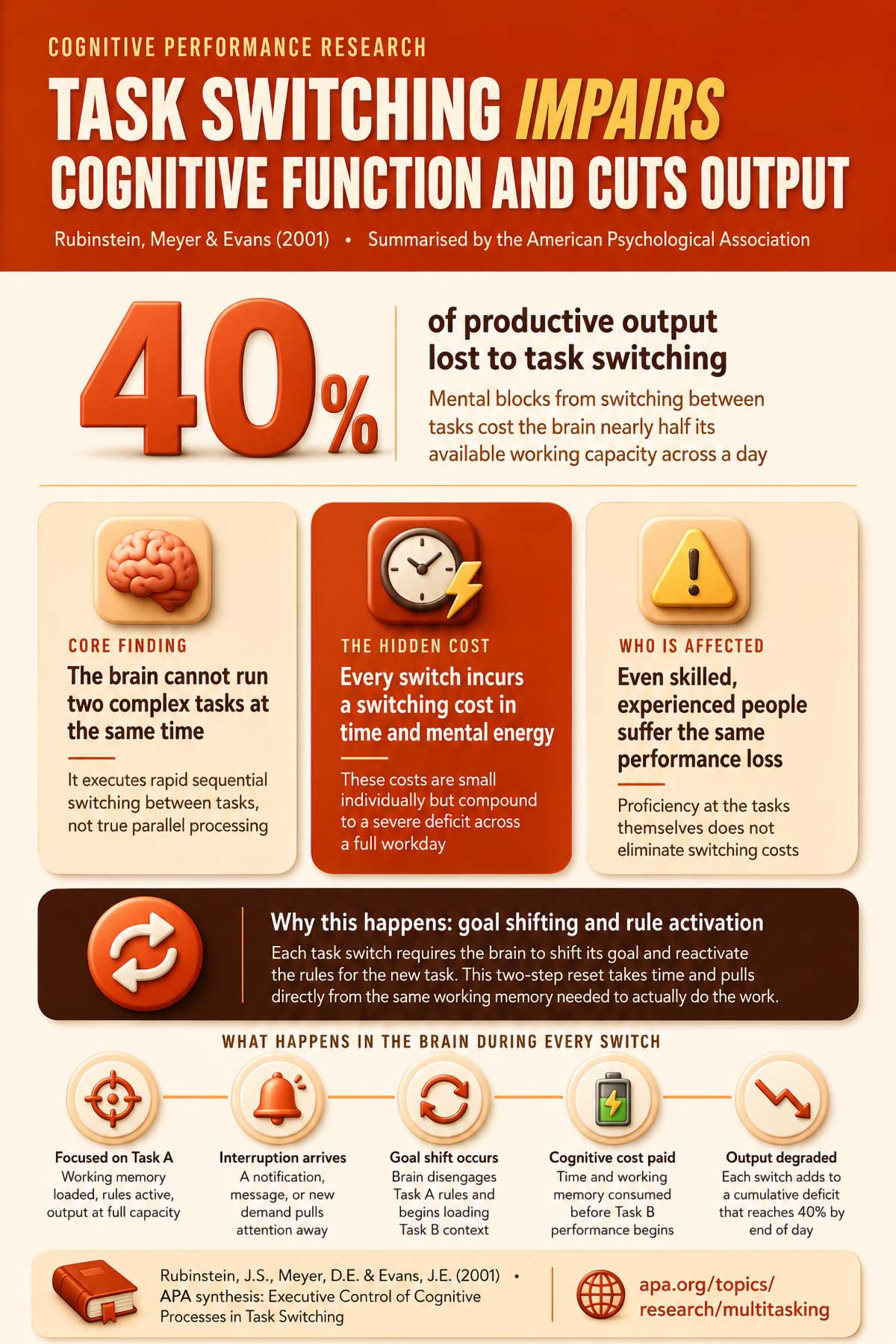
That’s not a minor inefficiency. That’s nearly half your available mental output lost to the friction of constantly changing gears.
Switching Tasks Leaves a Ghost Behind
The switching cost isn’t just at transition. Sophie Leroy, in Organizational Behavior and Human Decision Processes (2009), identified “attention residue”: when you leave one task unfinished and move to another, part of your attention stays anchored to what you left behind.
The first task pulls on working memory even while you’re engaged elsewhere. Time pressure makes it worse. An unfinished project under a deadline doesn’t just follow you mentally; it actively degrades your performance on the next task.
Think of it less like switching lanes and more like dragging an anchor. The car moves, but not freely.
This matters because most modern work is built wrong for the brain. Back-to-back meetings end unresolved. Emails arrive mid-task. Slack threads demand responses before a thought is finished. By afternoon, your cognitive workspace is cluttered with the unfinished business of everything that has been interrupted since 9 a.m.
You Don’t Have to Touch Your Phone for It to Cost You
Research gets uncomfortable here. Ward, Duke, Gneezy, and Bos (2017) found that a smartphone on a desk, face down, silenced, screen off, measurably reduced working memory and fluid intelligence compared to leaving the phone in another room. The researchers called it a “brain drain” effect. Suppressing the impulse to check the phone uses the same cognitive resources as the task itself.
Worth noting: a 2022 replication by Ruiz Pardo and Minda did not reproduce this effect, which puts the finding in contested territory. The original study remains widely cited and influential in the field, but it shouldn’t be treated as a settled fact. The two studies together suggest that the relationship between phone proximity and concentration warrants further examination, even if the precise mechanism remains under investigation.
A Notification You Ignore Still Does Damage
If the contested phone-on-desk finding made you skeptical, this one has a stronger footing. A study published in the Journal of Experimental Psychology: Human Perception and Performance by Stothart, Mitchum, and Yehnert (2015) found that receiving a phone notification, without picking up the phone, without reading the message, without doing anything at all, disrupted sustained attention at roughly the same level as actively using the phone to text or talk. The ping alone sent the mind wandering. Choosing not to check produced no meaningful protection against the distraction.
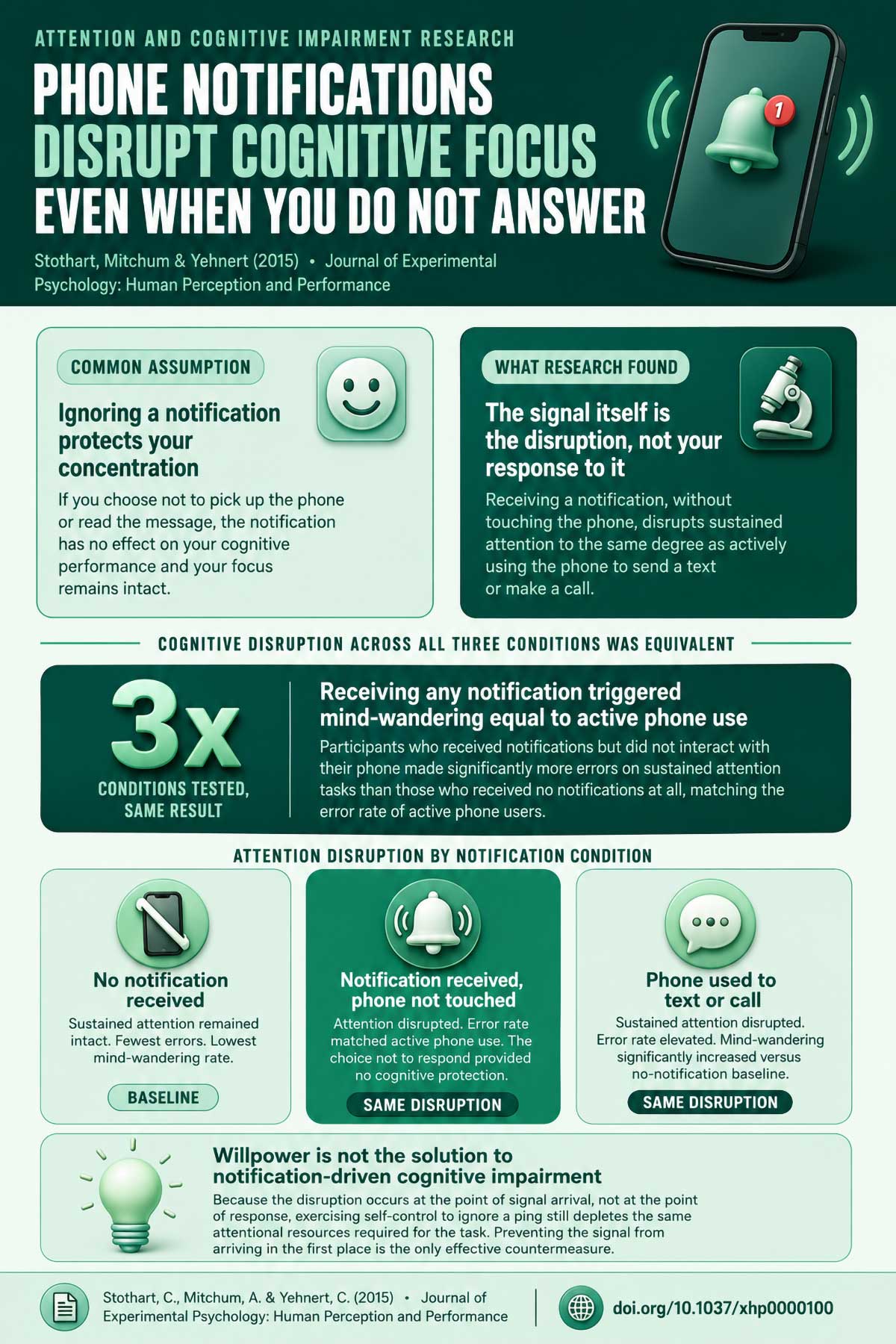
The implication is harder to sidestep than most people want to admit. Discipline isn’t the answer if the signal itself is the problem.
Heavy Media Multitaskers Filter Reality Worse
People who juggle multiple media, checking messages while watching something, half-listening to a podcast, don’t just get worse at single tasks. They develop a deficit in processing their environment. Ophir, Nass, and Wagner (2009) found that heavy media multitaskers performed worse at filtering out irrelevant information, both from external sources and their own minds. They were more easily distracted and had more trouble ignoring stray thoughts.
Light multitaskers, by contrast, were better at keeping out irrelevant stimuli. The reference wasn’t minor. And it showed up consistently across multiple tests, not just once.
What makes this finding particularly uncomfortable is that the researchers expected heavy multitaskers to outperform on at least some attention tasks, the assumption being that people who constantly juggle inputs must have developed some compensatory skill. They hadn’t. The heavy multitaskers weren’t better at anything the study measured. They were worse across the board, including on tasks that should have benefited from a wider attentional field.
What People Actually Report in Their Daily Lives
Lab findings are one thing. Wiradhany and Koerts (2019) in Media Psychology compiled research and found that people who multitask across media report more frequent attentional failures. More mind-wandering during conversations. More trouble staying on task. Attention feels harder to direct. These aren’t diagnoses, just the texture of a mind pulled in too many directions.
The gap between “I can handle a lot at once” and “I’m constantly distracted, and I don’t know why” is smaller than most people expect.
Bad Sleep Closes the Loop
Smartphone use fragments attention during waking hours and disrupts sleep. Iqbal and colleagues (2021) found that excessive smartphone screen time strongly associates with poor sleep quality, exposure, melatonin suppression, delayed sleep, and reduced restoration. Poor sleep then impairs attention, memory, and cognition. The result is a cycle: fragmented attention by day feeds into disrupted sleep at night, which returns as impaired cognition in the morning.
The afternoon fog, the slowed thinking, the inability to hold a train of thought, for many people, the chain starts the night before and never fully breaks.
What’s Happening Inside the Brain
The behavioral effects have a physical correlate that’s harder to dismiss. Loh and Kanai (2014), in PLOS ONE, found that people with higher media multitasking scores showed lower gray matter density in the anterior cingulate cortex (ACC), a region central to attention regulation, cognitive control, and emotional processing.
This is a correlational finding. It can’t tell us whether multitasking reduces gray matter, whether people with less gray-matter density are naturally drawn to multitasking, or whether a third factor drives both. But the structural difference is real, and it sits in exactly the region you’d expect to be affected, even compared to everything else in this research.
The ACC is, among other things, the part of the brain responsible for detecting when attention has slipped. Its involvement here is not incidental.
Can the Damage Be Reversed?
The Loh and Kanai finding raises a question the study itself doesn’t answer: if the structural differences are real, are they permanent? The honest answer is that the research hasn’t followed people long enough to know for certain.
What cognitive science does tell us is that the brain retains plasticity, the ability to reorganize and strengthen connections, well into adulthood. Gray matter regions associated with sustained attention have been shown to increase with practices that demand focused, single-task engagement over extended periods.
Meditation research is probably the most cited example here, though the effect sizes are debated. More practically, any activity that requires sustained, undivided attention, reading long-form text, extended physical training, and deep work without notification interruption appears to exercise the same attentional circuits that fragmented media use erodes.
The brain responds to the demands placed on it. The problem is that most modern environments are structured to demand short bursts rather than sustained effort, so the circuits that support deep focus rarely get the training they need.
There’s also a shorter-term recovery dimension worth knowing. Cognitive performance on attention-demanding tasks reliably improves after periods of genuine rest, not passive scrolling, but actual disengagement. Even brief exposure to natural environments has been shown to have measurable effects on directed attention capacity in multiple studies. The brain isn’t broken. It’s depleted, and its recovery may differ from that of structural gray-matter loss.
What You Can Actually Do
The research doesn’t prescribe a specific protocol, but the patterns across studies point clearly enough in one direction: unbroken blocks of single-task work protect cognitive performance in ways that constant switching doesn’t. Finishing one task before starting another reduces attention residue.
Removing the phone from a workspace, not silencing it, physically removing it, eliminates the signal before it can interrupt. Evening screen time, particularly in the hour before sleep, sits at the beginning of the chain of sleep disruption.
The notification problem deserves specific attention. Because the Stothart et al. finding shows that the interruption occurs at the point of the signal, not the point of response, the only effective countermeasure is to prevent the signal from arriving during focused work. Do Not Disturb modes, app notification settings, and scheduled check-in windows all address the same root issue: reducing the number of attention-hijacking pings per hour.
Leroy’s attention residue research points toward a different kind of fix for meeting-heavy schedules. Ending a task or meeting with a brief written note that states where you are, what the next step is, and what’s unresolved gives the brain a place to “park” the incomplete work rather than carry it into the next task. It’s not a perfect solution, but it reduces the cognitive load of holding open loops in working memory.
Sleep hygiene gets discussed almost entirely in terms of duration. The Iqbal findings suggest device timing matters as much as hours logged. Specifically, blue-light exposure within 60 to 90 minutes before bed is the window during which blue light most disrupts sleep onset. Shifting heavy screen use to earlier in the evening, or using blue-light filtering settings after dark, addresses the physiological mechanism directly rather than just hoping for better sleep.
None of this requires a dramatic lifestyle overhaul. It requires treating attention less like a renewable resource that refreshes automatically and more like a battery that drains with every unnecessary draw.
The Part Worth Noting
Modern professional life rewards the appearance of high output. Responding quickly, handling multiple threads simultaneously, and always being reachable read as competence. The research suggests they’re also the behaviors most likely to erode the underlying capacity that enables genuine competence.
That’s an uncomfortable trade-off to confront, especially when the tools facilitating the fragmentation are the same ones used to manage almost everything else. There’s no clean resolution to that tension. But knowing the cost is different from not knowing it, and most people have never been given accurate information about what their habits are quietly doing to their ability to think.