Researchers scanned people’s brains while they named their emotions. What happened next may explain why some people stay calm under pressure while others spiral.
Most people treat emotional intelligence the way they treat height: either a person received a generous share of it, or they did not, and there is not much to be done either way.
The research points somewhere more interesting and more hopeful. The skill behaves less like a fixed trait and more like a muscle, and the single most effective way to train it is so small that most people dismiss it.
Before reaching the habit itself, a prior question requires settling: is any of this trainable, or is the advice to “work on your EQ” merely a kinder way of telling someone they are stuck?
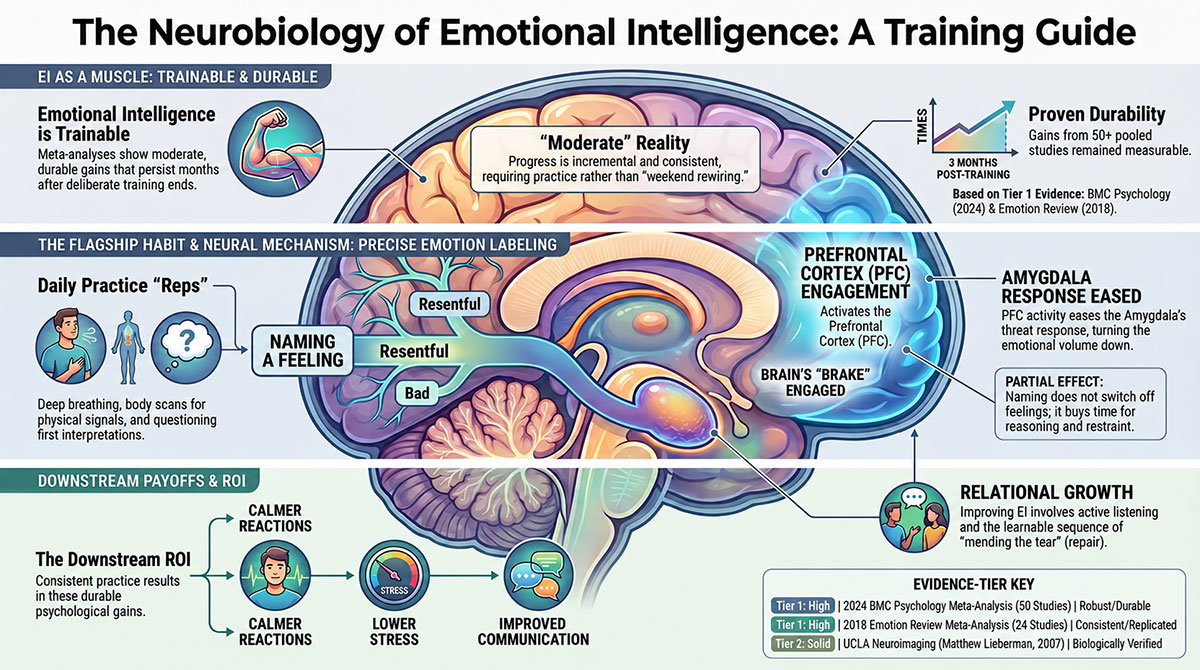
A 2018 meta-analysis in Emotion Review pooled two dozen studies that tried to raise emotional intelligence through training, and found a moderate gain that held steady at follow-up. A larger 2024 review in BMC Psychology, covering fifty studies, reached the same place: emotional skills moved measurably after training, and the gains were still present more than three months later.
Moderate improvements were seen. Nobody rewires their temperament over a weekend. But the direction is consistent across hundreds of participants, which is more than can be said for the assumption that emotional intelligence is something a person is simply born with or without.
The Habit That Does the Most Work
The flagship habit is almost insultingly simple: name the feeling in a precise word, the moment it arises.
Matthew Lieberman, a neuroscientist at UCLA, ran the study that put this on the map. In 2007, in Psychological Science, his team scanned people’s brains while they looked at emotional faces. When participants picked a word for the emotion, activity dropped in the amygdala, the small region that drives the threat response, and rose in the prefrontal cortex, the part that handles reasoning and restraint.
“When you attach the word ‘angry,’ you see a decreased response in the amygdala,” Lieberman told a UCLA reporter. The naming does not erase the feeling. It passes the feeling to the slower, more deliberate region of the brain before that feeling can drive behaviour.
A word of caution about the claim circulating online. Numbers such as a fifty percent reduction in amygdala activity are often attached to this finding. Those figures are not in the original paper. A 2018 review by Torre and Lieberman described the effect more carefully: real, replicated across two decades, and partial. Naming a feeling turns the volume down. It does not switch it off.
The catch is precision. “Bad” does little. “Embarrassed,” “resentful,” or “uneasy” does more, because a more precise label gives the prefrontal cortex something specific to act on. That is why a wider emotional vocabulary is the foundation underlying the habit.
The ability to tell apart shades of feeling, not just good and bad, has its own name and its own surprising payoff.
Building the Pause
Several of the daily habits share a single function. They widen the gap between a feeling and the reaction it wants to trigger.
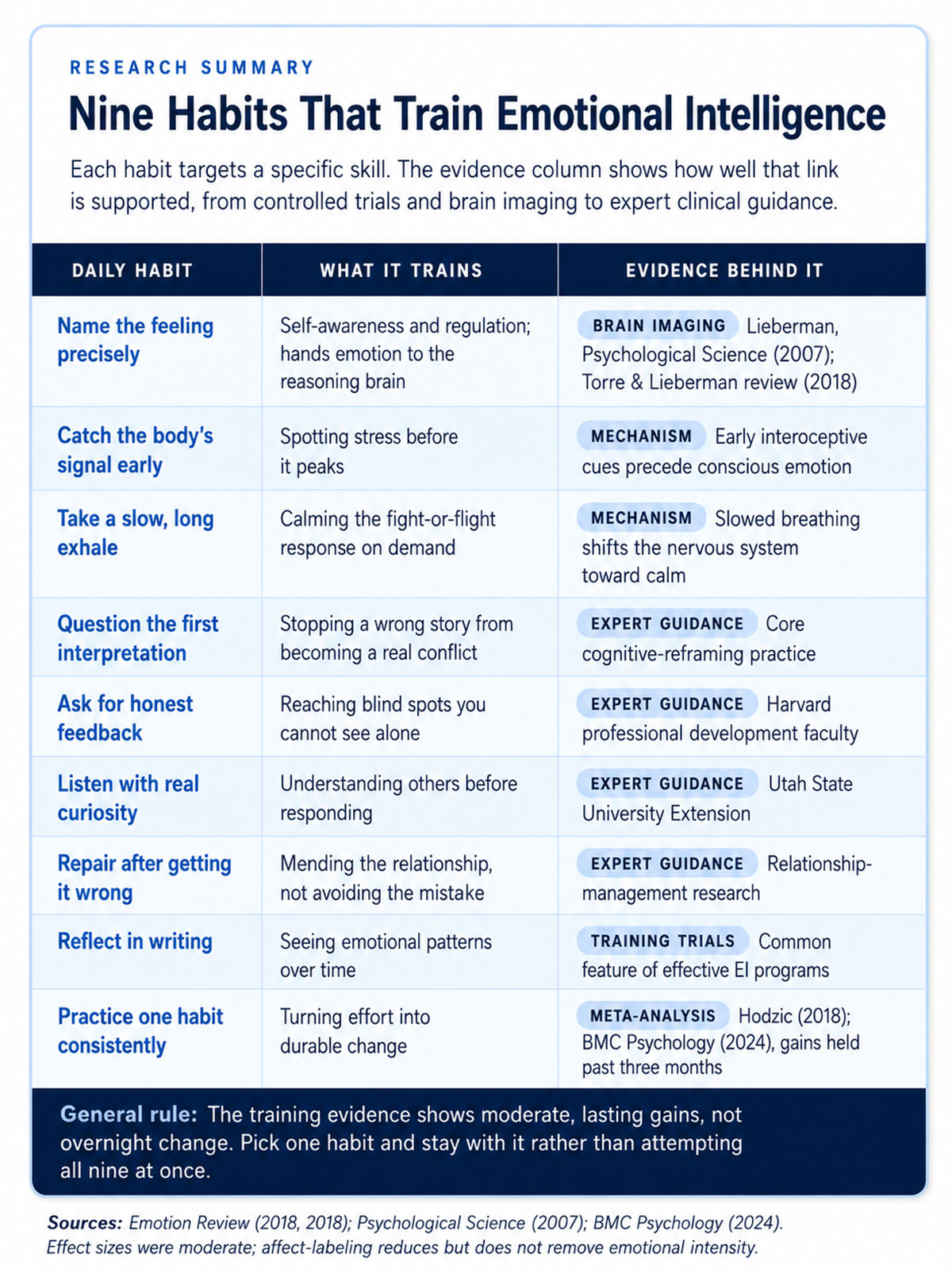
The first is noticing the body before the mind catches up. A tight jaw, a faster pulse, heat in the face: these physical signals arrive seconds ahead of the thought “I am angry.” People who notice the physical signal early have a longer window in which to choose their response.
The second is the deliberate breath. It may sound like advice from a waiting-room poster, and yet it is one of the few techniques that calms the nervous system on demand. A slow exhale, longer than the inhale, nudges the body out of fight-or-flight and creates a few seconds of clarity.
The third is questioning the first interpretation. The story a person tells in the first instant, that a short reply signals contempt, that silence signals rejection, is often wrong, and reacting to it as though it were true is how minor incidents become significant ones. Treating that first read as a guess rather than a fact is a habit that can be practised.
Stacked and repeated, they constitute the daily practice that the training studies were measuring.
Tuning In to Other People
Self-management addresses half the picture. The other half is directed outward, where emotional intelligence ceases to be private and begins to appear in how others experience a person.
Asking for honest feedback is the most uncomfortable habit on the list, and one that Harvard’s professional development faculty places near the top. A person cannot see their own blind spots, so the only route to them runs through someone willing to provide a candid assessment.
Genuine listening is the next one, and most people do it badly without knowing. Genuine listening means staying curious long enough to understand the other person’s state, rather than waiting for a pause in which to insert a rebuttal. Relationship researchers at Utah State University Extension point to open-ended questions and validating the other person’s feelings as the core moves.
Then there is repair. Emotionally skilled people are not the ones who never get it wrong. They are the ones who return afterward and repair the rupture, a learnable sequence rather than a personality gift.
How Long Before Any of This Works
Here, honesty matters more than encouragement. The training research did not produce overnight transformations, and any source promising that is selling something.
What the studies did show is durability. The gains in the BMC Psychology review were still measurable months after the training ended, which suggests the habits reshape something real rather than producing a temporary lift. Emotional intelligence training also correlated with lower stress and improved communication, the downstream outcomes that make the daily effort worthwhile.
The realistic picture is closer to disciplined physical training than to an immediate transformation. A few weeks of consistent practice before anything feels different, and those who sustain the practice are the ones who select one habit and maintain it, rather than attempting all nine simultaneously.
Emotional Intelligence Habit Self-Check
A short reflection, not a test or a score
This reflection points to a starting place, not a measure of your worth or your character. Emotional intelligence training shows moderate, lasting gains in the research, and the people who improve are the ones who pick one habit and stay with it.
Where to Start
If one takeaway emerges from the evidence, it is the naming habit: it demands the least and returns the most. When something stings, finding the most precise word for the feeling and observing its effect on the urge to react is a worthwhile experiment.
The larger point is one the research keeps making, and most people keep resisting. Emotional intelligence is not a verdict handed down at birth. It is a set of small, repeatable actions, and the brain that performs them is more willing to change than the old assumption ever allowed.
FAQs
Is emotional intelligence a skill you can actually learn?
Yes, and the evidence is clearer on this than most people expect. Two meta-analyses, one in Emotion Review and a larger 2024 review in BMC Psychology, both found that deliberate training moves EQ scores measurably, with gains that held at follow-up assessments months later.
The keyword in both is “moderate.” EQ is not infinitely malleable. Some emotional tendencies sit close to stable personality traits and resist change. But a significant portion responds to practice, and treating the whole thing as a fixed verdict is the main barrier between most people and real progress.
How long does it take to improve emotional intelligence?
The BMC Psychology review tracked people after training ended and found gains still present more than three months later. That is a useful anchor for realistic expectations.
Three months is not the wait before anything shifts. Most people report smaller changes, calmer reactions, fewer responses they regret, within a few weeks of consistent practice. The timeline depends heavily on which habit is selected and how often it is repeated. What the research reflects is consistency over intensity: brief daily practice beats an occasional deep dive.
Can you improve emotional intelligence in a relationship?
The same skills translate directly. In a relationship, the ones that matter most are self-regulation (not reacting while flooded with feeling), genuine listening (staying curious about the other person’s state rather than preparing a rebuttal), and repair (returning after conflict to mend rather than letting resentment sit).
Relationship researchers consistently identify these moves as the difference between partnerships that hold steady under stress and those that do not. The habit-building process is identical to general EQ development. The context is simply higher-stakes and more immediate, which means the feedback on whether a habit is working tends to arrive faster.
Do people with a high IQ tend to have low emotional intelligence?
Not as a rule, but the two are largely independent. General intelligence and EQ measure different things and correlate only weakly with each other, which is why someone can score exceptionally high on one and quite low on the other without anything contradictory occurring.
The cleaner pattern in the literature is that IQ predicts analytical performance while EQ predicts outcomes that depend on navigating emotions: stable relationships, effective leadership, and managing chronic stress. One does not override the other. They cover different ground, which also means that someone who tests well academically has no automatic advantage when it comes to emotional skill, and no exemption from the need to build it.
How will I know if my emotional intelligence is actually improving?
The signs are behavioral rather than scored: a reaction is caught before it becomes a response; the precise word for a feeling replaces a vague descriptor; there is genuine curiosity about the other person’s experience rather than defensiveness about one’s own position; and a disagreement is addressed rather than left for the other person to initiate repair.
The training research did not measure improvement through self-report alone. It tracked changes in how participants handled real emotional situations. The evidence of growth shows up in daily behavior, not in a number on an assessment. That is worth remembering the next time a difficult moment arrives and something in the response is quieter than it used to be.