You forget a name, misplace your keys, or walk into a room and draw a blank. Neurologists say the real signal isn’t the lapse itself. It’s something else entirely.
At least half the patients neurologist Dr. Daniel Lesley sees each day ask him the same thing. Not about a specific diagnosis. Not about medication. Just: is what’s happening to me something I should be worried about?
“People have an absolute terror of losing their memory and thinking they’re losing themselves,” Lesley, who works at Remo Health, has said. “They don’t know what’s normal, what’s potentially a sign of something bad, and what’s reversible.”
Most of them never find out. They say nothing to their partner, and hope the next episode doesn’t happen. According to the Alzheimer’s Association, only 40% of people experiencing symptoms they’re concerned about actually see a doctor about it.
The problem isn’t that people are wrong to wonder. The problem is that the question most of them are asking, “Is my memory getting worse?”, is clinically speaking almost the wrong question. The one that matters more is something else entirely.
What Actually Changes as the Brain Ages
Memory is not one thing. The brain handles different kinds of information through different systems, and those systems age at very different rates. Understanding this matters because most memory anxiety is based on a simpler mental model: memory either works or it doesn’t.
What slows down with age is primarily retrieval speed. The brain’s ability to locate and pull up stored information takes slightly longer as processing speed declines. Long-term memories (facts, language, procedural skills like riding a bike) remain largely intact. What becomes more effortful is encoding new episodic information: the name of someone you just met, where you put your phone, why you came downstairs.
Neurologist Zaldy Tan, MD, director of the Platzer Lynn Family Memory and Healthy Aging Program at Cedars-Sinai, puts it plainly: starting in middle age, the speed of memory retrieval can slow down. That’s aging. That’s not a disease.
There’s also a less-discussed reason that memories feel harder to retrieve as people get older: interference. Professor Alexander Easton, a psychologist at Durham University, points out that the more experiences a person accumulates, the harder it becomes to separate individual memories that share a lot in common.
If you’ve only ever taken one vacation to Spain, you’ll remember it vividly. If you’ve taken eight, sorting out which one something happened on requires more effort. Not because your memory is failing, but because there’s more overlapping material to sift through. That’s the brain doing something sophisticated, not something broken.
None of this stops the anxiety, of course. Knowing the mechanism doesn’t always quiet the fear that something has shifted. Which is partly why the clinical distinction that comes next is worth understanding.
The Single Test Neurologists Use That Most People Have Never Heard Of
Clinicians use something that doesn’t have a catchy name but is worth knowing about. Call it the cue test.
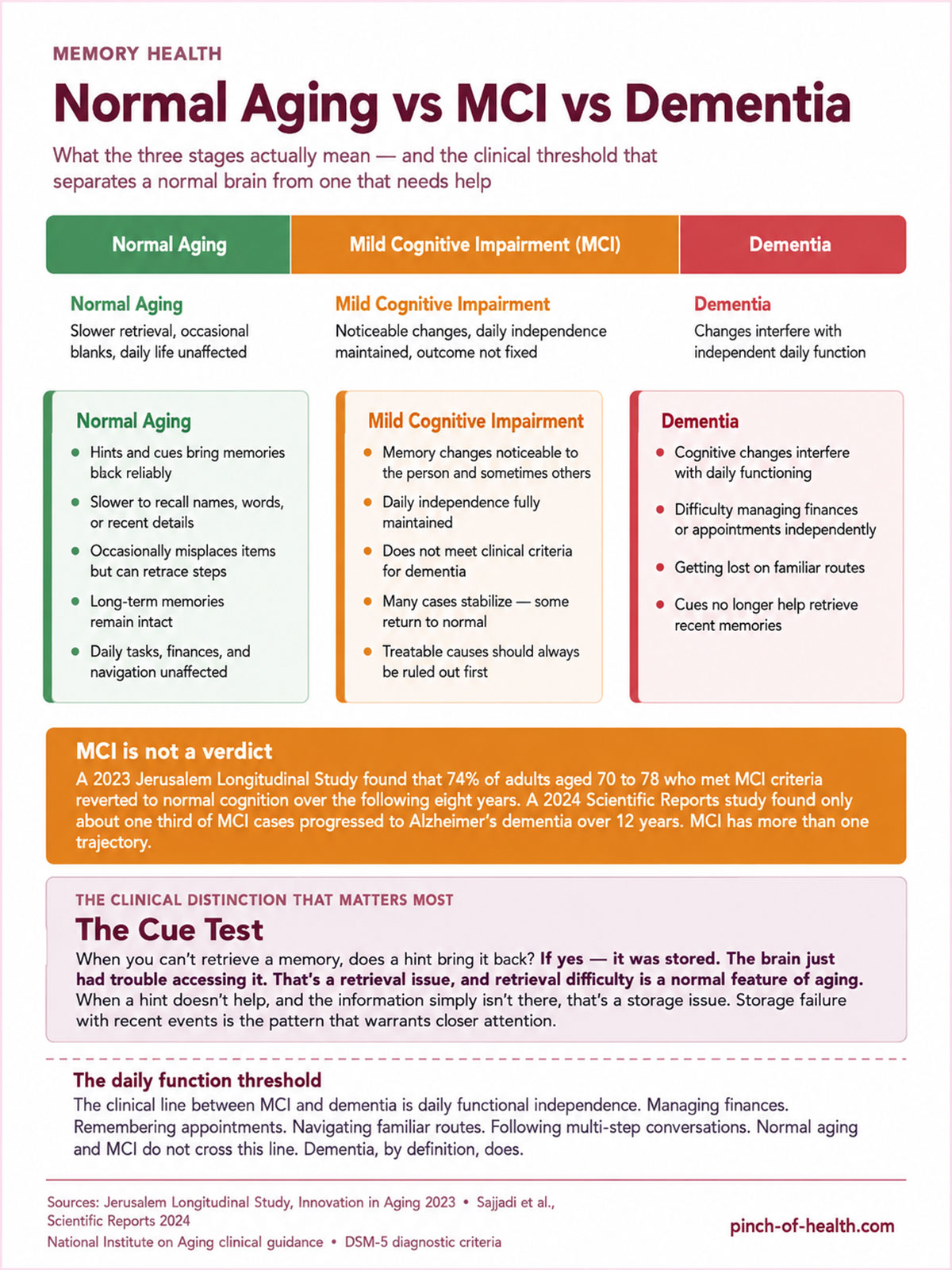
When someone can’t retrieve a memory, the question that matters is whether a hint brings it back. You blank on a colleague’s name, but the moment someone says “starts with J,” you have it. That means the information was stored correctly. The brain just had trouble accessing it on demand. That’s a retrieval issue, and retrieval difficulty is a normal feature of an aging brain.
When the hint doesn’t help, when the memory simply isn’t there (not slowed down but absent), that’s a storage issue. Something went wrong during encoding. That’s the pattern that warrants closer attention, especially when it happens with recent events rather than old ones.
The distinction sounds subtle. In practice, it’s quite different from experience. You misplace your keys and find them later, suddenly remembering you set them by the sink. That’s retrieval. You find keys you have no memory of placing anywhere and no idea when that happened. That’s closer to a storage problem. The first one is almost universal. The second is worth tracking.
The Middle Zone Most People Don’t Know Exists
Between normal aging and dementia lies a condition called mild cognitive impairment, or MCI. It’s probably the most misunderstood category in cognitive health, partly because most general-audience content skips over it and jumps straight from “normal” to “dementia.”
MCI means noticeable memory changes, changes the person is aware of and that might be apparent to people around them, that don’t interfere with the ability to live independently. Managing finances, driving familiar routes, following a conversation: all still intact. The change is real, but it hasn’t crossed the threshold that defines dementia.
What happens next is more variable than most people assume. A 2023 study published in Innovation in Aging from the Jerusalem Longitudinal Study, which tracked a community cohort over decades, found that among adults aged 70 to 78 who met criteria for MCI, 74% reverted to normal cognition over the following eight years. That figure drops sharply with age: by 90 to 95, only about 7% reverted. But for the age group where MCI anxiety tends to peak, most people in that zone do not proceed to dementia.
A 2022 study published in Scientific Reports, which followed MCI patients across 12 years using the Alzheimer’s Disease Neuroimaging Database, found that only around a third progressed to Alzheimer’s dementia. Researchers are still working out which biomarkers reliably predict who will convert and who won’t. There’s no easy self-administered answer yet, and that uncertainty is uncomfortable to sit with.
When Worry Itself Becomes the Signal
Here’s something where the research complicates the reassurance: the worry matters, but not in the way most people assume.
A 2025 study published in Diagnostics from the Sydney Memory and Ageing Study, which followed 873 community-dwelling older adults over 10 years, found that self-reported cognitive worry predicted incident dementia, specifically when that worry increased over time, not when it was present in isolation. A single episode of concern, or stable low-level anxiety about memory, had a weaker predictive value than worry that kept growing.
There’s also a distinction between who notices. The study found that when someone close to the person (a partner, a sibling, a close friend) independently noticed memory changes, that was a stronger signal than self-reported concern alone. People with early cognitive changes sometimes lose awareness of their own decline. The person best placed to notice is occasionally not the one experiencing it.
This creates a frustrating situation. The reader who worries privately every few weeks and then moves on is probably not the one in trouble. But it’s hard to know from the inside whether your worry is stable or accumulating. That distinction matters clinically, and most people don’t have a good way to track it.
The Conditions That Look Like Dementia and Aren’t
Before any conversation about dementia risk gets too far, there’s a category of causes that gets less attention than it deserves: memory changes that resolve when an underlying condition is treated.
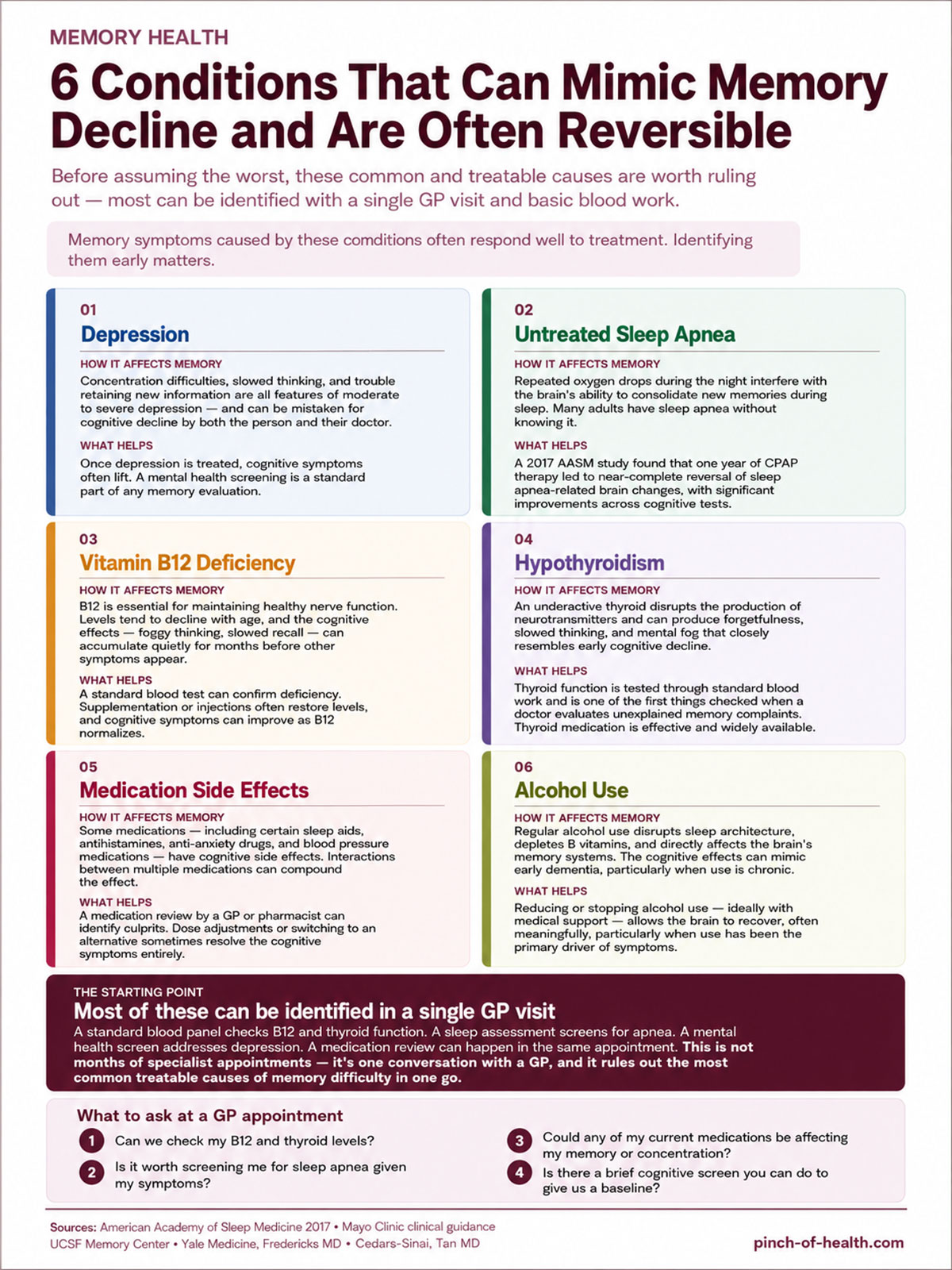
Depression is probably the most common of these. Concentration difficulties, slowed thinking, and trouble retaining new information are all features of moderate to severe depression that can be mistaken for cognitive decline, by the person experiencing them and sometimes by clinicians doing a quick assessment. Once the depression is treated, the cognitive symptoms often lift.
Untreated obstructive sleep apnea is another one that tends to go unrecognized. Repeated drops in oxygen during the night directly interfere with the brain’s ability to consolidate new memories during sleep.
A 2014 study published in Sleep found that one year of CPAP therapy led to near-complete reversal of the white matter brain abnormalities associated with sleep apnea, alongside significant improvements across a range of cognitive tests. This is a condition affecting a large number of adults who either don’t know they have it or have never been tested.
Vitamin B12 deficiency, hypothyroidism, and certain medication interactions round out the most common reversible causes. B12 levels tend to decline with age, and the cognitive effects (foggy thinking, slowed recall) can accumulate quietly for months before other symptoms become obvious. Standard blood work can identify both B12 and thyroid issues in a single visit.
Dr. Carolyn Fredericks, a Yale Medicine neurologist who specializes in cognitive and behavioral conditions, notes that treatable causes are worth ruling out early: “Someone’s thyroid could not be functioning properly. That’s something we can treat, and then they get better.” The same applies to sleep apnea. Identifying a reversible cause doesn’t require months of specialist appointments. It starts with a GP and basic bloodwork.
Stress deserves a mention here too, though it’s more complicated. Acute stress and chronic anxiety measurably impair memory retrieval. They don’t cause structural brain damage, but they can make normal retrieval feel dramatically more effortful, which can amplify worry about decline that isn’t actually occurring. That loop is worth being aware of, even if it’s hard to step outside of.
The tricky part is that none of this is mutually exclusive. Someone can have undertreated depression and a real storage issue developing at the same time. Ruling out the reversible causes doesn’t clear the picture entirely; it just removes noise from it.
The Line Doctors Actually Draw
Dementia, by clinical definition, is not a memory problem. It’s a level of cognitive decline that interferes with a person’s ability to function independently in daily life. That threshold is what separates it from MCI and from normal aging.
The practical version of this test is fairly concrete. Managing finances without assistance. Remembering scheduled appointments consistently. Navigating familiar routes without getting disoriented. Following a multi-step conversation or a set of instructions. Recognizing people who are part of regular life.
These aren’t arbitrary criteria. They’re the activities of daily living that define functional independence, and they’re what clinicians assess when determining where on the spectrum someone sits.
Normal aging and MCI don’t touch these. Forgetting what you had for lunch, occasionally blanking on a name, losing ten minutes looking for your glasses: none of that is a functional impairment. When the lapses start affecting bill payments, when a person gets lost driving a route they’ve taken for years, when conversations require constant repetition to follow, that’s when the threshold becomes relevant.
The Ohio State neurologist Dr. Douglas Scharre, who developed a widely used self-administered cognitive screening tool called the SAGE test, offers a distinction that’s easier to hold onto than a checklist: in normal aging, a cue helps.
You forgot where you left the keys and you can retrace your steps to find them. In early dementia, the cue doesn’t land. You find the keys in a strange place and have no memory of how they got there, and no chain of logic to follow backward. The information was never stored. It can’t be retrieved because there’s nothing to retrieve.
If You’re Worried About Someone Else
Caregivers and adult children searching on behalf of a parent or spouse occupy a slightly different position in this question. The Sydney Memory and Ageing Study finding mentioned above applies directly here: when the person close to someone notices changes that the person themselves hasn’t brought up, that observation carries genuine clinical weight. People in early cognitive decline sometimes lose awareness of their own symptoms before the people around them do.
The practical version of this is not to push or alarm, but to document. If you’re noticing repeated instances of the same forgotten conversation, or a pattern of confusion in situations that used to be routine, keeping a simple log (what happened, when, how often) gives a GP something concrete to work with rather than a general concern to triage.
It’s worth knowing that a GP visit for memory concerns doesn’t commit anyone to a diagnosis. It typically starts with a conversation, some basic cognitive tests, and blood work to rule out the reversible causes. Most people leave that appointment either reassured or pointed toward something treatable. Very few leave with a dementia diagnosis at a first visit.
What the Threshold Actually Tells You
The daily function test isn’t just a clinical tool. It also reframes the original anxiety in a way that’s more useful than scanning every forgotten name for significance.
If the forgetting is staying inside the lane of normal daily life, frustrating sometimes, occasionally alarming in the moment, then the question to hold isn’t “am I declining?” but “is there a reversible cause I haven’t ruled out, and am I doing the things that support long-term cognitive health?” Those are questions with actionable answers.
If the forgetting is starting to cross into daily function (missed appointments that matter, repeated conversations that leave someone genuinely confused, disorientation in familiar places) that’s when a GP visit stops being something to consider and becomes something worth scheduling.
Most people reading this are in the first group. The fear is real and the question is legitimate, but the answer is more often about maintenance than about medicine.
The things that support long-term cognitive health are worth paying attention to regardless: sleep quality, cardiovascular exercise, diet, and staying mentally and socially engaged. These aren't cures for anything — they're maintenance, and the evidence for them is fairly solid.
Depression, untreated sleep apnea, vitamin B12 deficiency, and thyroid function can all produce memory symptoms that closely resemble something more serious. A standard blood panel and a brief conversation about sleep can rule these out in a single appointment. Many people who make this visit leave either reassured or pointed toward something very manageable.
An early assessment is worth more than a delayed one. It opens access to proper testing, the possibility of identifying a treatable cause, and, if needed, early support and care planning. Starting with your GP and asking for a referral to a neurologist or memory specialist is the most direct path.
A Note on Acting Early
For the people who are in the second group, or close to it, early evaluation is worth more than delayed reassurance. An early diagnosis of MCI or Alzheimer’s, even one that carries difficult news, opens access to treatment conversations, legal and care planning, and lifestyle interventions that have a better chance of making a difference earlier in the process. The instinct to wait and see is understandable. It tends to cost more than it saves.
The option that gets used least often is also one of the most useful ones: a standard GP visit, framed not as “I think something is wrong” but as “I want to rule some things out.” That framing is accurate because ruling things out is genuinely what the first visit does, and it tends to lower the barrier to going.