The food that ranked highest for keeping people full is the same one many diets tell you to limit. Here’s why those two ideas aren’t as contradictory as they seem.
Every standard low-carb eating plan tells you to cut potatoes. The only scientific index ever published ranking foods by how full they make you, calorie for calorie, puts the potato in first place, scoring 323 on a scale where white bread scores 100, more than three times as filling per calorie as pasta or rice.
A medium baked potato, plain with skin, contains 161 calories. That is the accurate, verified starting number. It also delivers more potassium than a banana, nearly 30 percent of your daily vitamin C, and a starch structure that varies depending on whether the potato is eaten hot or cold. The calories are simple. The context around them is more interesting.
Baked Potato Calorie Quick-Reference Chart
A small potato (140g) comes in at 130 calories. A medium (170g) lands at 161. A large (300g) reaches 280. The extra-large restaurant portion (typically 370g) sits at 345 calories before a single topping is added.
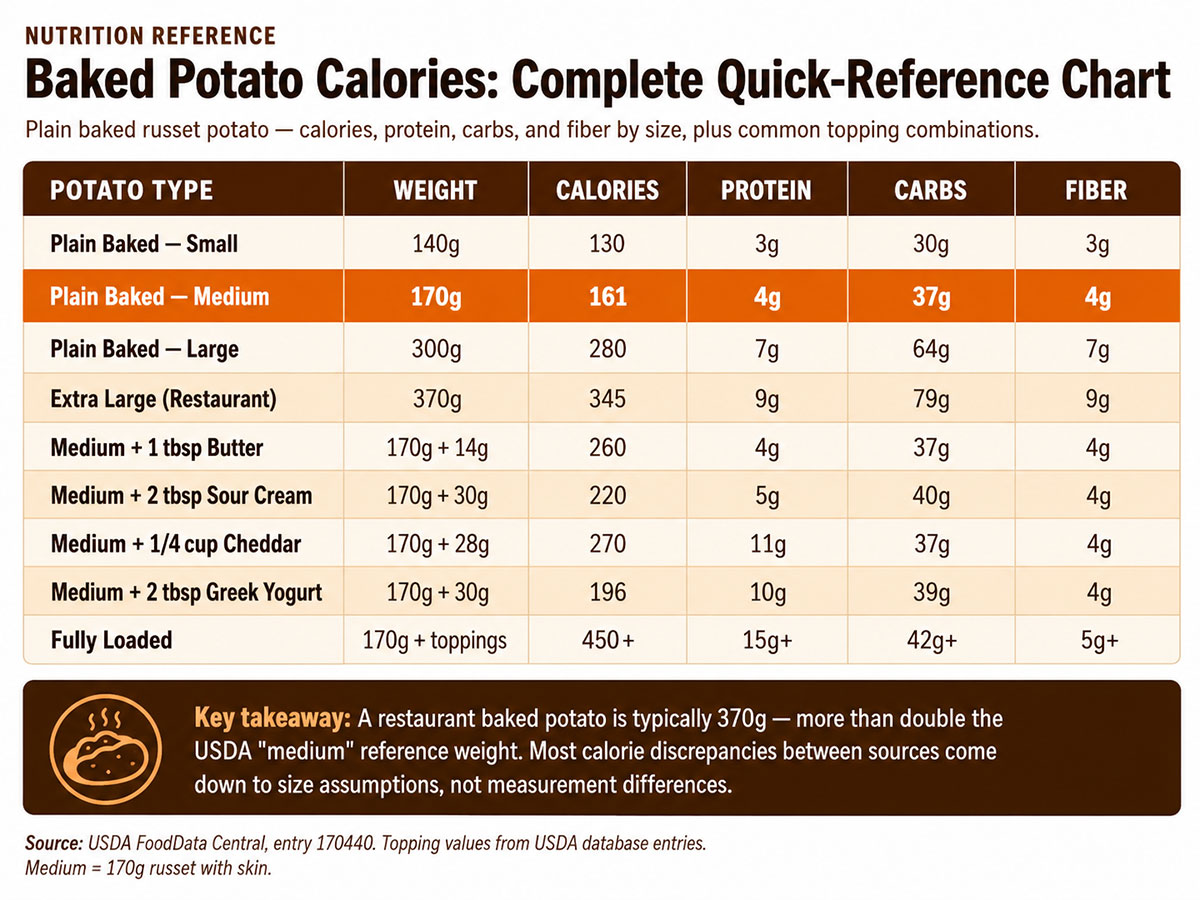
The size difference matters more than most calorie counts acknowledge. A standard restaurant baked potato is typically more than double the weight of what USDA nutrition data uses as its “medium” reference point. That single fact explains most of the confusion around calorie figures you’ll find across different sources.
Nutrition Facts for a Plain Baked Potato
A medium baked potato has a stronger nutritional profile than its reputation as a “carbohydrate food” suggests.
The vitamin C content (17mg, about 28% of the daily value) places it ahead of many fruits per calorie. Potassium at 610mg represents 26% of the recommended daily intake, which is relevant to blood pressure regulation. A medium potato provides 27% of the daily value for vitamin B6, which supports neurotransmitter synthesis and protein metabolism.
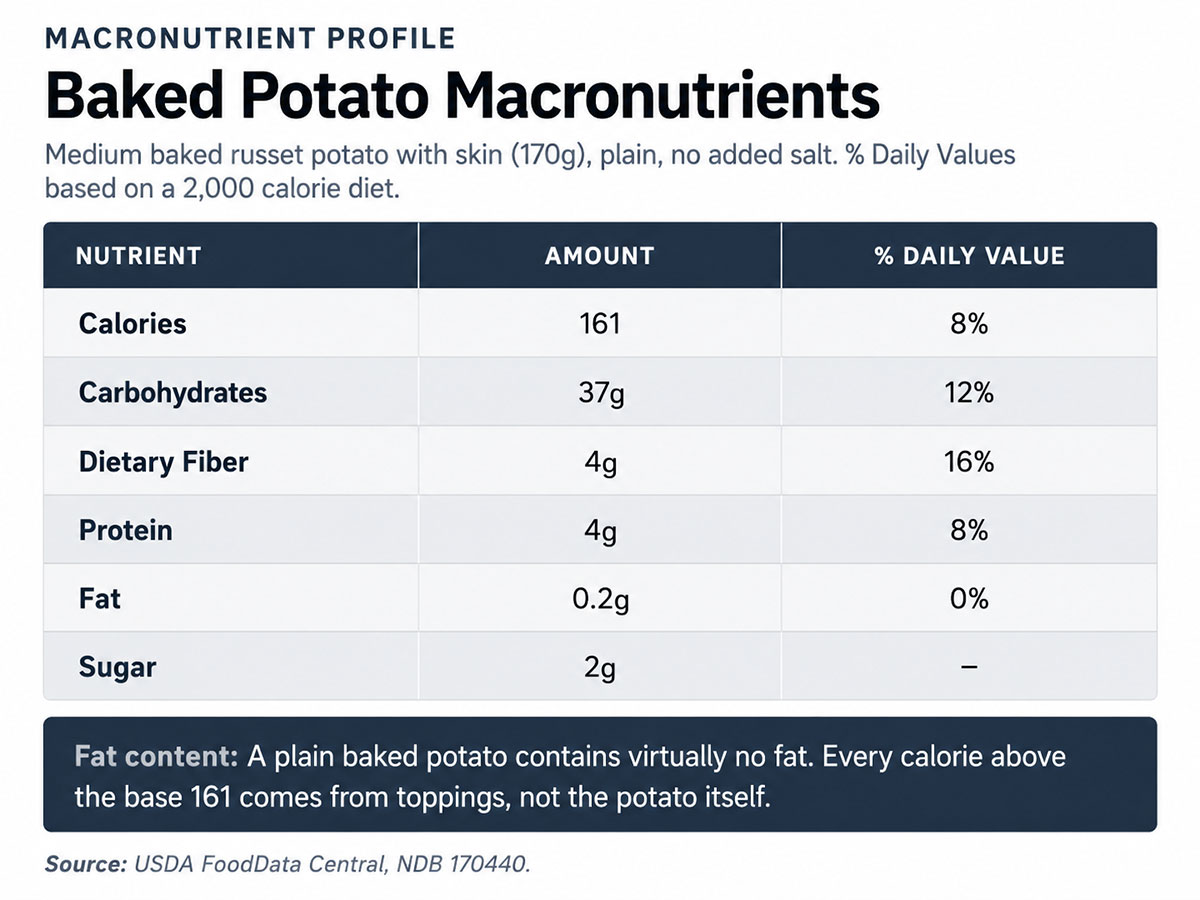
Baked Potato Macronutrients Breakdown
Baked Potato Vitamin and Mineral Content
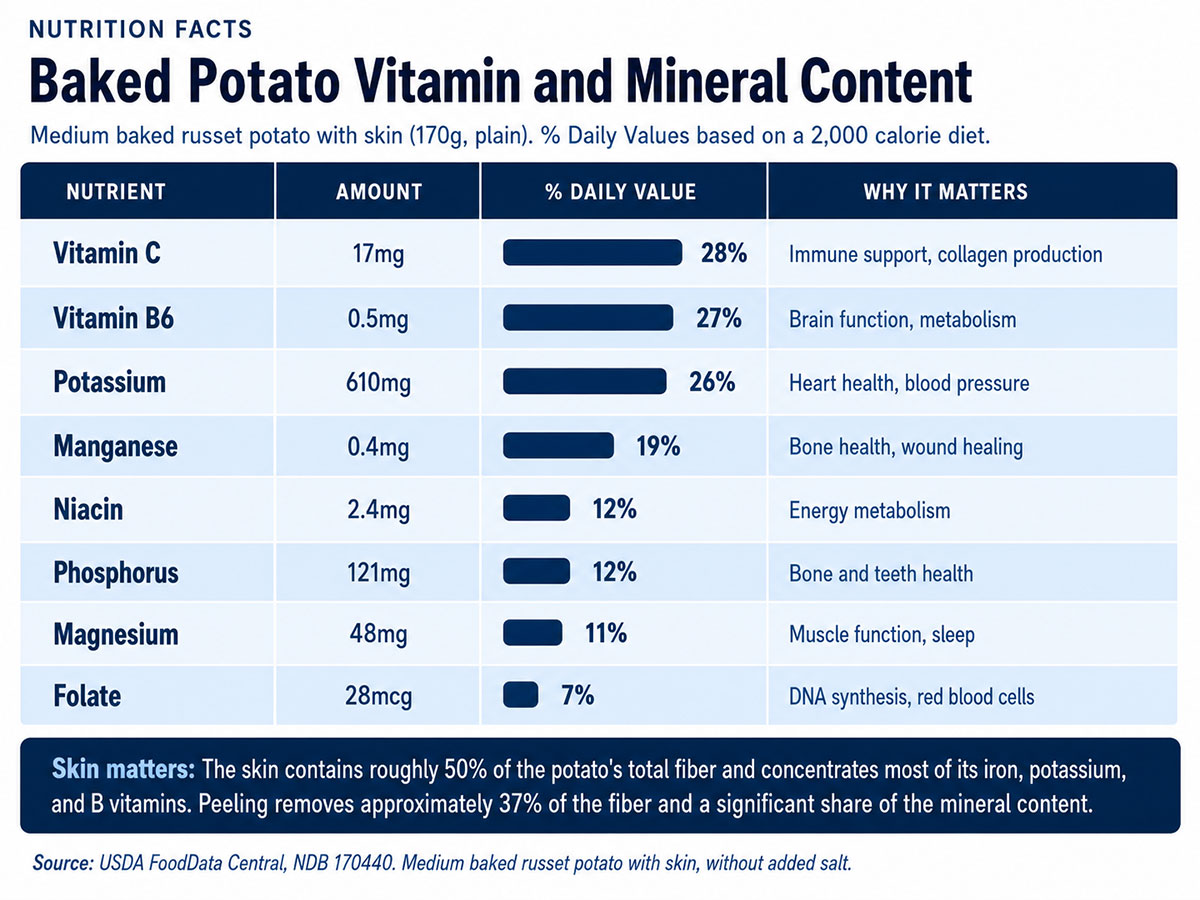
Data from USDA FoodData Central, entry 170440. The skin holds roughly half the fiber in the whole potato and concentrates most of its iron, potassium, and B vitamins in the outer layers.
Baked Potato Calories With Skin vs. Without Skin
Removing the skin from a medium baked potato saves approximately 10 to 15 calories. It also removes about 37% of the fiber.
The skin concentrates the potato’s iron, potassium, and B vitamins. A skin-on medium potato delivers roughly 4g of dietary fiber. Without the skin, it drops to about 2.5g. Keeping the skin adds roughly 10–15 calories and subtracts none of the nutrition. Removing it costs far more.
Scrub the skin firmly under running water before baking. No need to soak or peel. That removes surface residue without sacrificing the fiber and minerals in the outer layers.
How Toppings Change the Calorie Count
The 161-calorie figure applies to a plain potato with skin. Add toppings and that number can double or triple. The tables below cover every common topping by calorie tier.
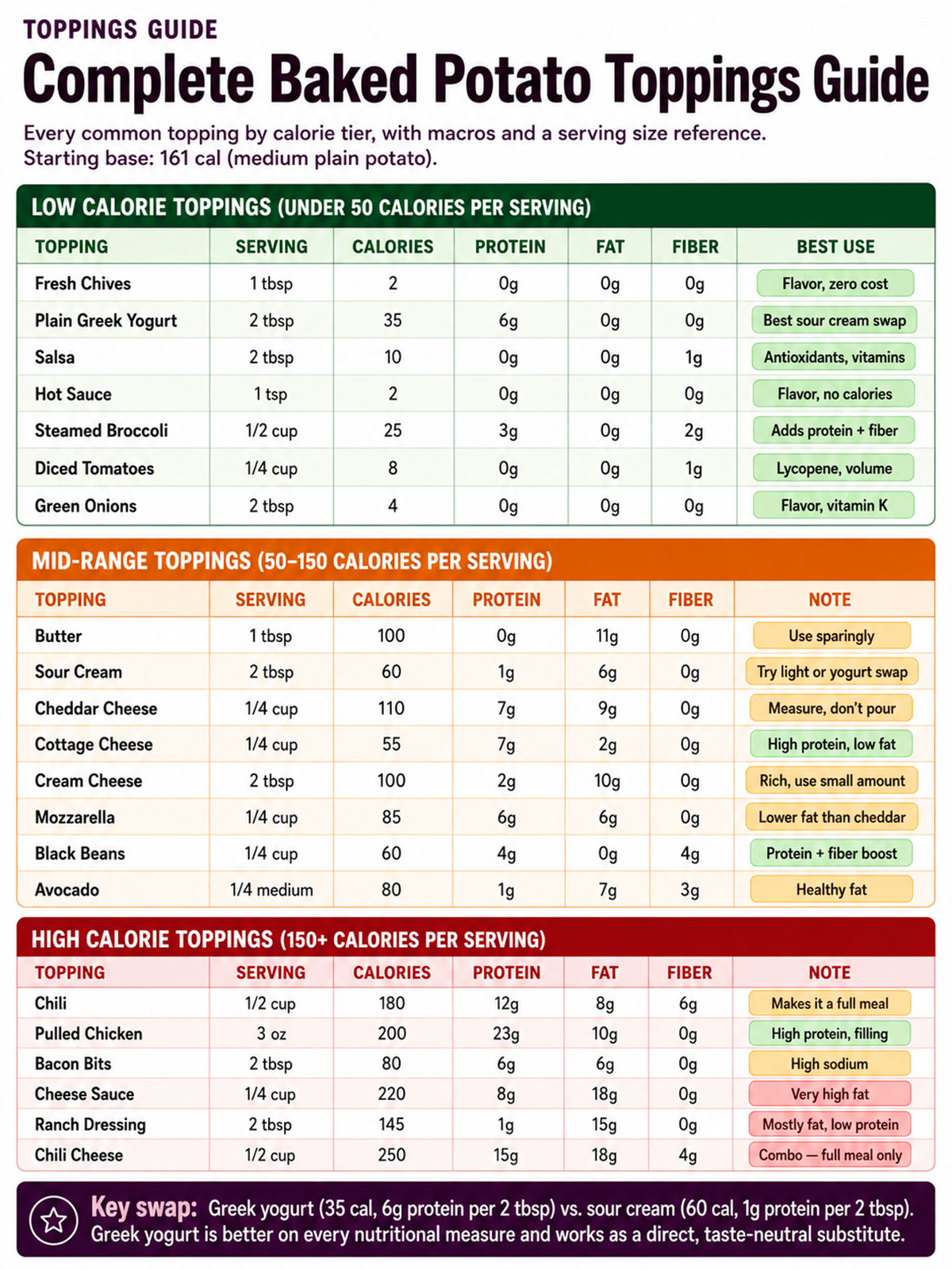
The pattern across all three tiers is consistent: the potato itself rarely drives the final calorie count. Two tablespoons of plain Greek yogurt deliver 6 grams of protein at 35 calories. Two tablespoons of sour cream provide 1 gram of protein at 60 calories. Greek yogurt performs better on every nutritional measure and works as a direct substitute.
Loaded Baked Potato Calories
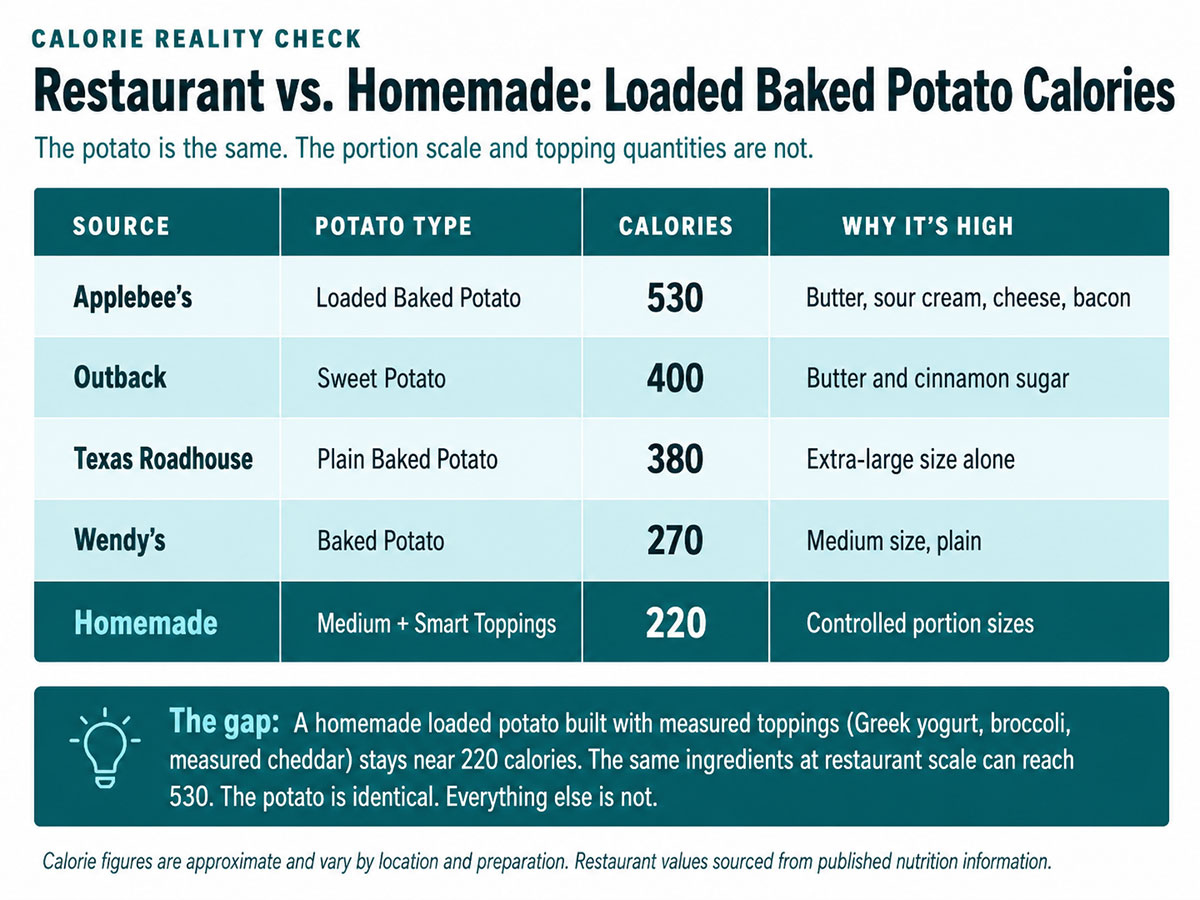
A restaurant’s loaded baked potato and a homemade one differ less in ingredients than in portion scale. The industry-standard restaurant potato runs roughly 370g, and toppings are applied at a different scale than most people picture when reading a recipe.
Use the calculator below to build a loaded potato from any starting size and as many toppings as you want. The totals update in real time.
Loaded Baked Potato Calorie Calculator
Choose your potato size, then add as many toppings as you like.
A homemade loaded potato with measured toppings can stay near 220 calories. The same ingredients at restaurant scale regularly cross 500. The potato is identical. The portion is not.
Potato Varieties: How They Compare
The russet gets all the attention, partly because its high starch content makes it the best baker and partly because it is what most restaurants mean when they say “baked potato.” That also makes it the variety with the highest glycemic index score in the group. If that number concerns you, it is worth knowing what the alternatives look like.
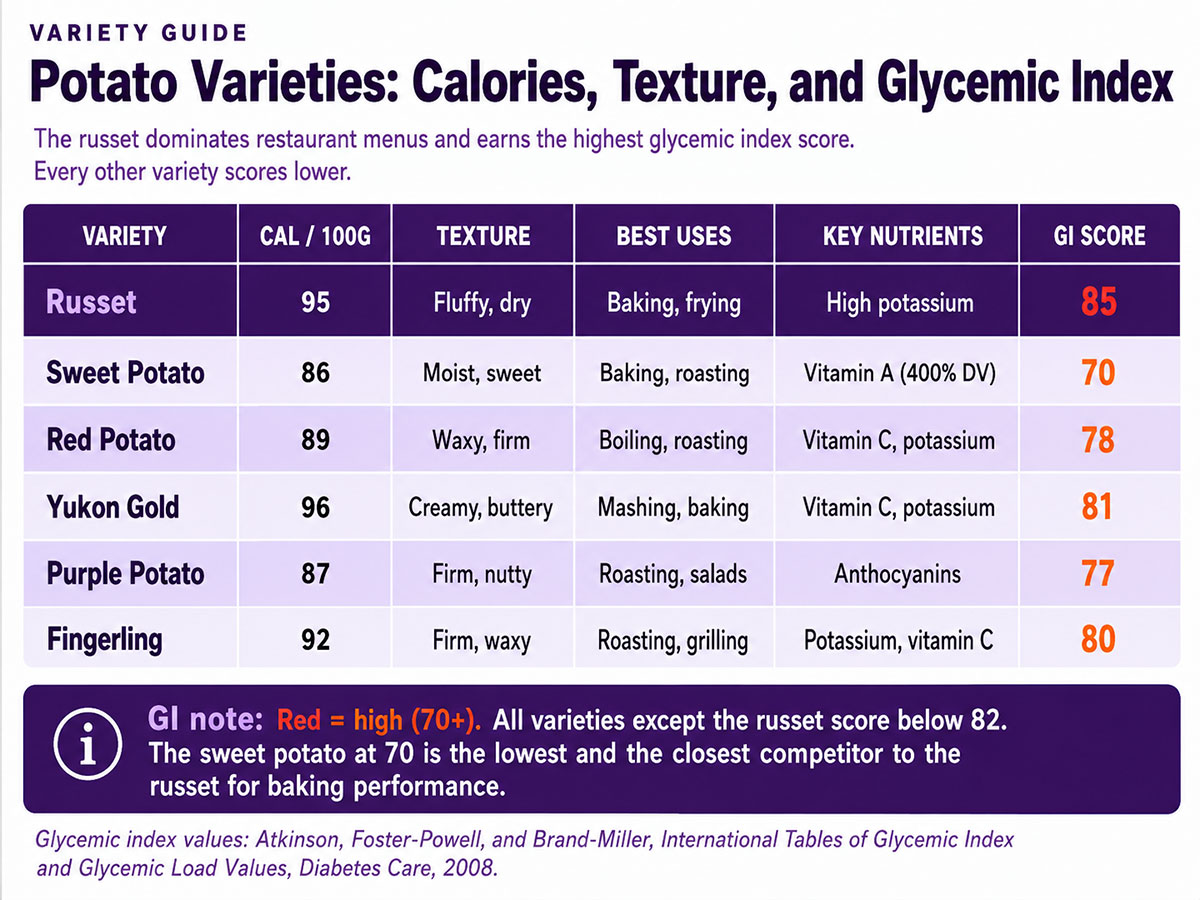
Glycemic index values from the International Tables of Glycemic Index and Glycemic Load Values (Atkinson, Foster-Powell, and Brand-Miller, Diabetes Care, 2008).
Is a Baked Potato Good for Weight Loss?
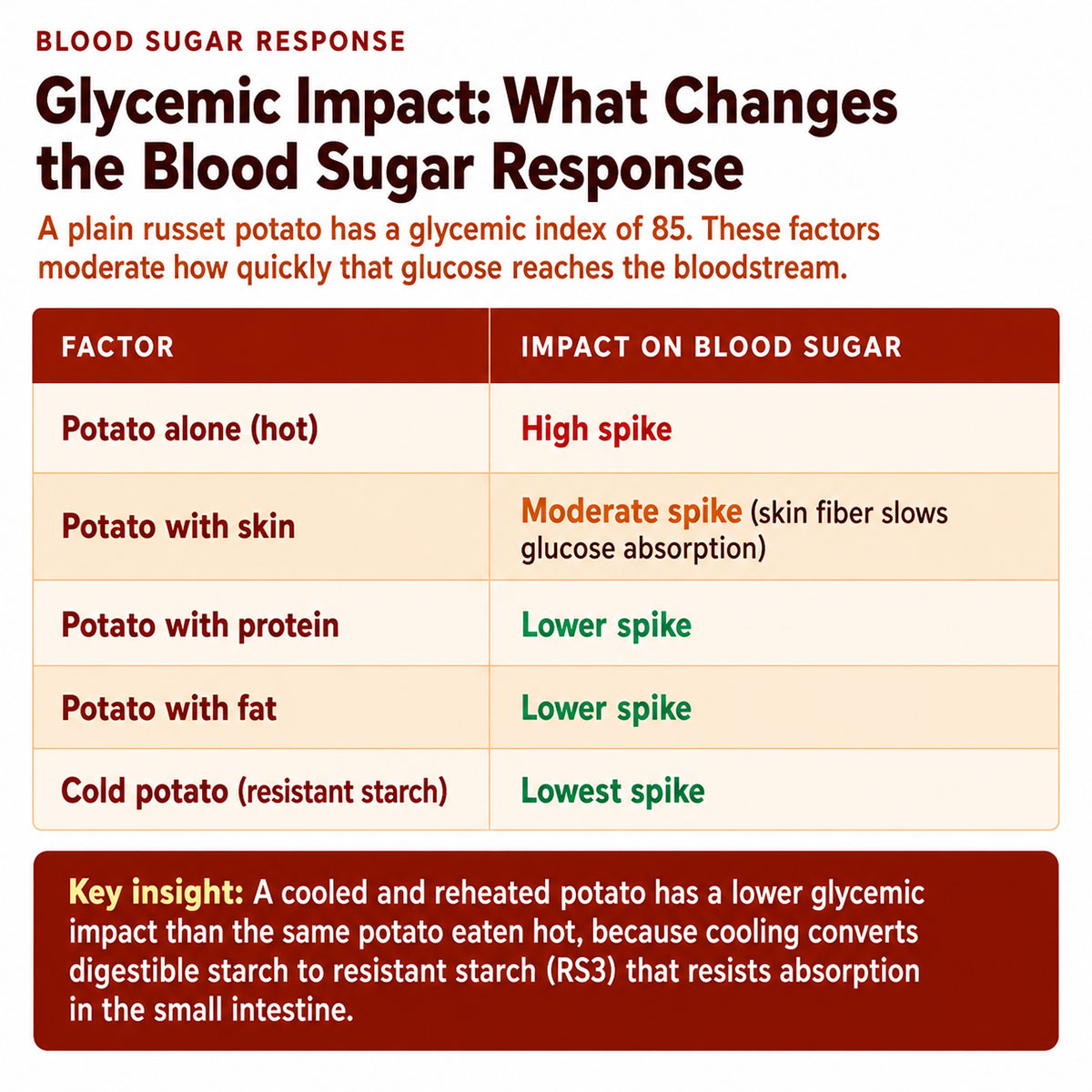
A russet potato has a glycemic index of 85. That number is accurate, and it is genuinely high. The glycemic index measures how quickly 50 grams of available carbohydrate from a food raises blood glucose, and a russet’s starch is rapidly digested. That is the core reason the potato acquired its reputation as a food to cut down on.
The problem with that reasoning is what it leaves out.
The same potato that sits near the top of the glycemic index chart also occupies first place on every satiety measurement ever published. In 1995, Susanna Holt was trying to solve a practical nutrition problem: calorie counts tell you how much energy a food contains, but not how much of it you will eat before stopping.
She and her team at the University of Sydney fed 240-calorie portions of 38 different foods to participants and tracked their fullness every 15 minutes over two hours. Boiled potatoes scored 323 on the resulting satiety index (European Journal of Clinical Nutrition, 1995). White bread scored 100. The next closest food was fish at 225. No other food tested has come close in subsequent research.
The glycemic index measures how fast glucose enters the bloodstream. The satiety index measures how long a food keeps you from wanting to eat again. Scoring high on both scales simultaneously is unusual. In practice, it means a potato raises blood sugar faster than most carbohydrates and keeps you genuinely full for longer than most carbohydrates. Those two facts do not cancel each other out. Understanding both changes how you use the food.
One note on the research: the original Holt study used boiled potatoes. Baked potatoes share a broadly similar profile, but the precise 323 score applies to the boiled preparation. The directional finding is consistent across both methods.
The Science Behind Potato Satiety
Resistant starch adds a second layer. When a cooked potato cools, a portion of its digestible starch converts to resistant starch (RS3), which behaves more like dietary fiber in the gut. Resistant starch resists digestion in the small intestine and travels to the large intestine, where it feeds beneficial bacteria.
A 2021 pilot randomized controlled trial published in the Journal of Human Nutrition and Dietetics (Sanders et al.) found that consuming cooked, then chilled potatoes improved markers related to insulin sensitivity in adults at risk for type 2 diabetes, compared to equal-calorie carbohydrate foods.
A separate 2022 study in Nutrients confirmed that regular potato resistant starch intake altered gut microbiota composition in ways associated with improved metabolic outcomes. The insulin sensitivity finding is preliminary. The 2021 trial was a small pilot study, and the benefit should be understood as directional rather than established. The gut microbiota effect is more consistently supported across the literature.
Baked Potato Glycemic Impact: The Full Picture
Weight Loss Strategies That Work
A plain baked potato is more filling per calorie than almost anything else in the research literature. The challenge is that very few people eat plain baked potatoes.
A medium potato (161 cal) with plain Greek yogurt (35 cal) and steamed broccoli (25 cal) delivers 221 calories with 10 grams of protein, 7 grams of fiber, and a fullness profile that competes with foods at twice the calorie count. That combination exists in the data. Whether it becomes a habit is a different question.
How Cooking Method Affects Nutrition and Calories
Most of the difference between cooking methods relates to water contact. Boiling leaches water-soluble vitamins (vitamin C and B6) into the cooking liquid, reducing retention to roughly 70% compared to the raw vegetable. Baking and microwaving involve no direct water contact and preserve a higher proportion of these nutrients.
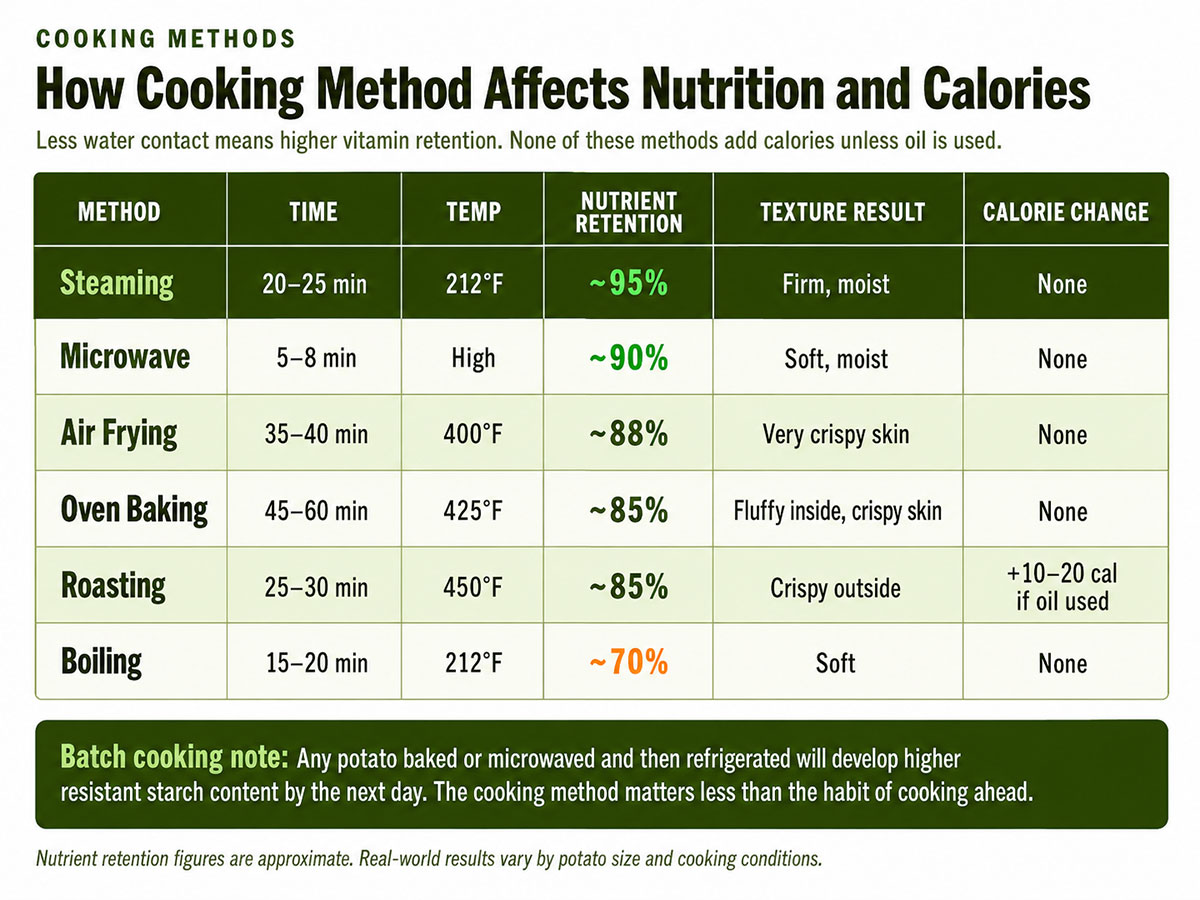
One finding from the earlier satiety section applies directly here. Any potato baked or microwaved and then refrigerated for the next day will develop higher resistant starch content as it cools. The cooking method matters less than the habit of cooking ahead.
Nutrient retention percentages are approximate. Values vary by specific vitamin, preparation technique, and water-to-potato ratio, and real-world results depend more on potato size and individual cooking conditions than this table implies. Treat the figures as directional.
Oven Method
- Preheat the oven to 425°F.
- Scrub the potato clean and pat it dry.
- Pierce the skin 8–10 times with a fork.
- Bake 45–60 minutes, depending on size.
- Test doneness by squeezing gently (the potato should yield without resistance).
Microwave Method
- Pierce the skin 8–10 times with a fork.
- Place on a microwave-safe plate.
- Cook 5 minutes, flip, then cook another 3–5 minutes.
- Rest for 2 minutes before handling.
Air Fryer Method
- Pierce the skin and apply a light coat of oil if you want a crisper exterior.
- Cook at 400°F for 35–40 minutes.
- Flip once halfway through.
Baked Potato vs. Other Starches
Potatoes outperform most common grain-based starches on satiety per calorie. The comparison below is worth looking at before choosing your carbohydrate of the day.
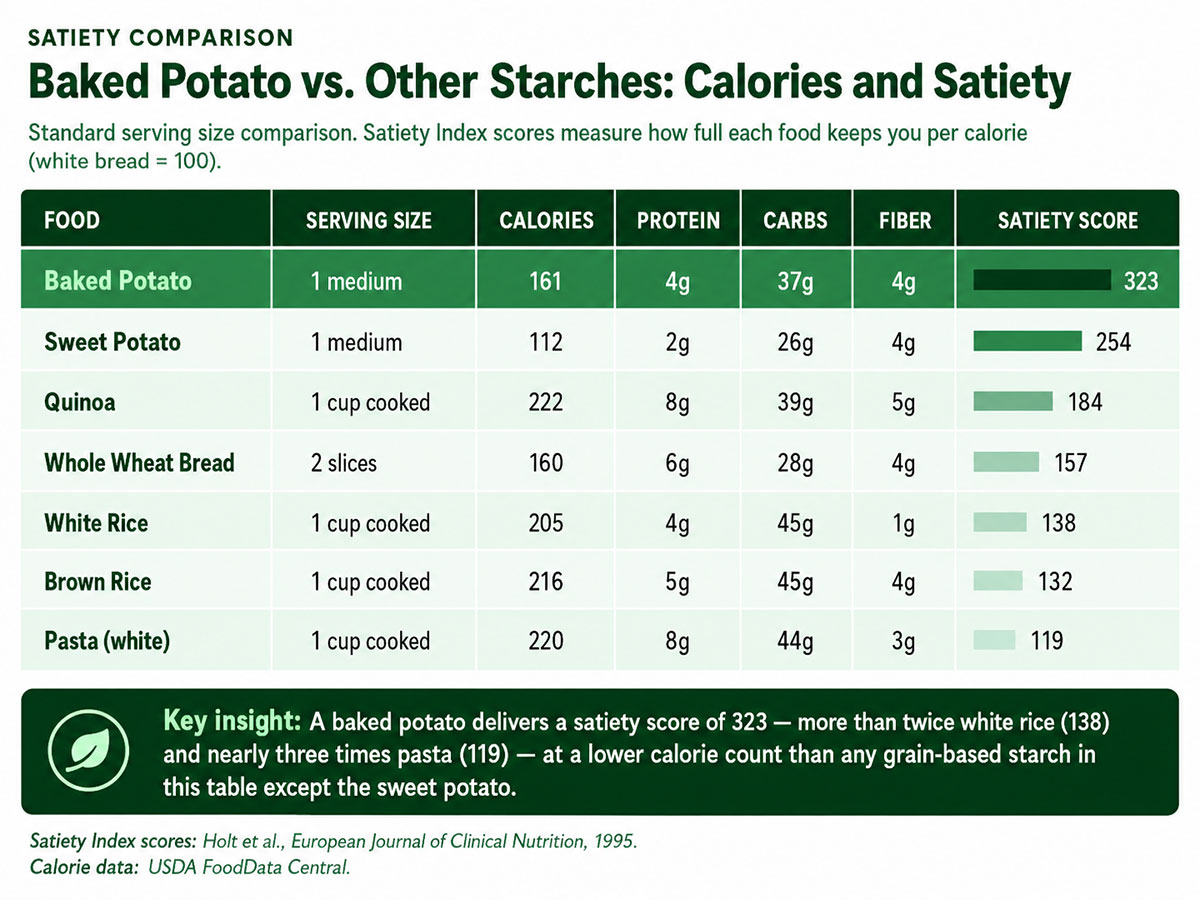
Brown rice and pasta both score below 45% of the baked potato’s satiety index score while delivering more calories per standard serving. White rice at 138 and pasta at 119 are less than half as filling per calorie. The sweet potato, at 254, is the closest competitor.
Meal Planning With Baked Potatoes
A plain baked potato is a practical meal base. It keeps in the refrigerator for up to five days after cooking, accepts almost any protein or vegetable as a topping, and comes together in a batch of 6–8 on a Sunday for use through the week.
Practical Meal Combinations
A medium potato (161 cal) with 3 oz of canned tuna (100 cal) and steamed greens (30 cal) reaches roughly 290 calories with 27 grams of protein. A small potato (130 cal) with two fried eggs and a handful of vegetables runs about 300 calories with 18 grams of protein, a reasonable breakfast with high satiety return.
Batch cooking pays off here. Bake 6–8 potatoes at once, store them in the refrigerator for up to five days, and reheat in the microwave for 2–3 minutes. A cooled and reheated potato has a higher resistant starch content than a freshly baked one. That is a practical reason to make them ahead.
Storage and Selection Tips
Look for firm potatoes without soft spots or a green tinge. Green coloring indicates solanine, a naturally occurring compound that can cause digestive problems in larger amounts. Choose similarly sized potatoes if baking a batch. Consistent cooking requires consistent size across the tray.
Store raw potatoes in a cool, dark place away from onions (they accelerate each other’s spoilage). Do not refrigerate raw potatoes. Cold temperatures convert starch to sugar and affect both texture and taste. Cooked potatoes keep in an airtight container in the refrigerator for up to five days. To reheat: 2–3 minutes in the microwave, or 15–20 minutes at 350°F in the oven, with the potato wrapped loosely in foil.
Conclusion
The potato’s reputation in calorie-conscious eating was shaped primarily by the glycemic index, a useful but incomplete measurement. A food that raises blood sugar quickly and keeps you genuinely full for hours afterward is nutritionally different from a food that does neither. The potato does the first thing. A significant portion of the dietary advice about it assumes it does the second.
161 calories for a medium plain potato with skin is a reasonable number for a food that outperforms nearly everything else on the fullness scale. What inflates the total is the 200 to 350 calories that come from toppings, typically applied at restaurant-style portions without much thought. Get the size right and measure the toppings. The satiety takes care of the rest.
FAQs
Can you eat a baked potato on a low-calorie diet?
Yes. A plain medium baked potato at 161 calories is one of the more efficient options for a satisfying meal component. The challenge is the toppings. Build the potato with Greek yogurt (35 cal), steamed vegetables (30 cal), and chives (2 cal), and the total stays under 230 calories with meaningful protein and fiber included. In a low-calorie eating plan, the potato is rarely the obstacle. The toppings typically are.
What’s the healthiest way to eat a baked potato?
Bake or microwave it with the skin on, then top it with protein-rich options rather than fat-heavy ones. Plain Greek yogurt instead of sour cream, black beans, cottage cheese, or pulled chicken all improve the nutritional profile without pushing the calorie count significantly. The skin is non-negotiable from a fiber and micronutrient standpoint. It holds about half the potato’s fiber and most of its iron and B vitamins.
How many calories are in the potato skin?
The skin adds roughly 10–15 calories to a medium potato. It also delivers about half the potato’s total fiber and a large share of its iron, potassium, and B vitamins. The nutritional value of the skin is disproportionate to its calorie contribution.
Is it healthier to eat the potato skin?
Yes. The skin holds half the potato’s fiber and most of its iron and B vitamins. Don’t peel it.
Is a baked potato healthier than fries?
A medium baked potato has 161 calories. A medium order of French fries runs 300 calories or higher, plus significantly more sodium and, depending on preparation, trans fats or partially hydrogenated oils. The comparison is not close.
Is a baked potato healthier than white rice?
A medium baked potato (161 cal, 4g fiber, 4g protein) has more fiber, higher satiety per calorie, more potassium, and more vitamin C than a cup of cooked white rice (205 cal, 1g fiber, 4g protein). White rice scores 138 on the satiety index versus 323 for boiled potatoes. Both are valid carbohydrate sources, but the potato’s profile is stronger on most measures that matter for sustained fullness.
How can I make a low-calorie loaded baked potato?
Use Greek yogurt (35 cal per 2 tbsp) instead of sour cream (60 cal). Add steamed broccoli, diced tomatoes, and chives for volume and flavor with minimal calorie cost. Measure one quarter-cup of shredded cheddar rather than applying it by eye. A fully loaded potato built this way stays near 270 calories with 15+ grams of protein.
Can I eat potatoes on a low-carb diet?
A medium potato contains 37 grams of carbohydrates, which places it outside strict low-carb and ketogenic ranges. In moderate-carb approaches (100–150g carbohydrate per day), a small potato fits without difficulty. Whether it fits your approach depends on your specific daily carbohydrate target, not on the potato’s absolute carb count.
Do potatoes cause weight gain?
The controlled research says no, and the direction of the evidence is stronger than most people expect. The satiety index data suggest that plain potato consumption correlates with lower subsequent meal intake, not higher. The more interesting question is why potatoes have the weight-gain reputation they do. The cultural association formed during the low-carb era of the early 2000s has proven difficult to dislodge from popular nutrition advice despite the evidence. The answer is almost certainly the toppings and the portion scale, not the potato itself.
Are potatoes inflammatory?
Standard research does not support the claim that potatoes are inflammatory for most people. Potatoes contain antioxidants, including vitamin C and chlorogenic acid, that may reduce oxidative stress. Some individuals with autoimmune conditions avoid nightshade vegetables, though evidence that nightshades worsen inflammation in the general population is limited.
What’s the difference between baking and boiling potatoes nutritionally?
Baking preserves more water-soluble vitamins than boiling. Boiling leaches vitamin C and B6 into the cooking water, reducing retention to roughly 70% compared to the raw vegetable. Baking retains closer to 85%. If preserving vitamin C and B vitamins is a priority, baking or microwaving is preferable to boiling.
Can diabetics eat baked potatoes?
Yes, with attention to preparation and portion. A plain russet’s glycemic index of 85 means it raises blood glucose relatively quickly in isolation. Eating the potato with a protein source, fat, or the skin’s added fiber moderates that response. A cooled and reheated potato has a lower glycemic impact due to increased resistant starch content. Portion size and total carbohydrate intake for the meal are the variables that matter most. Discuss specific targets with a registered dietitian or physician.
How long do baked potatoes last in the fridge?
Cooked potatoes keep safely for 3–5 days in an airtight container in the refrigerator. Reheat thoroughly and don’t leave them at room temperature for more than two hours.
Are purple potatoes healthier than regular potatoes?
Purple potatoes contain anthocyanins (the same class of antioxidants found in blueberries and red cabbage) that give them their color. The calorie and macronutrient profile is similar to that of standard potatoes. The anthocyanin content may offer additional antioxidant protection, though the research on purple potato consumption in humans is more limited than the broader potato literature.