For decades, people believed the answer was more side crunches. Research tells a very different story, and it completely changes how this 10-minute routine actually works.
Researchers have tested the idea that working a muscle burns the fat sitting directly on top of it. The evidence keeps saying no.
Yet a focused routine can still change how love handles look and feel, just not for the reason most people assume. The fat itself has to go through a calorie deficit, diet, or otherwise.
What ten minutes of targeted work actually does is build and tighten the oblique muscles underneath that fat, so the same amount of tissue sits differently against a waistband. That distinction changes how you should think about the routine below before you do a single rep.
Why This Spot Refuses to Cooperate
Love handles sit at the intersection of two separate problems: fat storage that favors the midsection specifically, and an oblique muscle group that most routines barely touch. Untangling the two explains why endless crunches rarely move the needle.
Cortisol and insulin are two of the biggest drivers of where fat settles in the first place. A 2011 review in the journal Metabolism found that when the two hormones act together, fat cells in the abdomen store lipids more readily than fat cells elsewhere on the body.
That is not a metaphor. It is a measurable, hormone-driven bias toward the waist.
The next question is whether that specific fat can be exercised away directly, and a 2022 systematic review and meta-analysis in Human Movement pooled the available trials to find out. Trained limb against untrained limb, comparison after comparison: no consistent advantage for the side doing the work. Spot reduction, the review concluded, does not hold up.
That finding took decades to settle, and it changes what a targeted routine is actually for. It is not a fat-burning shortcut. It is a way to build and tighten the obliques and the transverse abdominis, the muscles that give the waist its shape once the fat covering them has receded through diet and overall activity.
That same muscle work strengthens the deep core support that keeps your spine stable during almost everything else you do.
Does This Work the Same Way for Men and Women?
Men and women do not store this fat identically, and the difference isn’t only cosmetic.
Men tend to accumulate fat centrally, wrapped around the abdomen, in a pattern researchers call android distribution that tracks closely with testosterone and other androgens. For guys carrying most of their extra weight around the middle, that’s good news: central fat tends to be the first place where noticeable change shows up as overall body fat drops.
Women more often carry fat through the hips and thighs before menopause, a pattern called gynoid distribution. A review in the European Journal of Clinical Nutrition found that pattern shifts toward the more central, male-typical distribution after menopause, as estrogen drops. How much of that shift is the hormone and how much is simply aging is unclear.
None of that changes which exercises help, though it does change what to expect. A woman in the same calorie deficit as a man may see her hips and thighs change before her waist does, simply because of where her body stores fat to begin with. Knowing which pattern applies to you is worth more than another rep.
The 10-Minute Routine
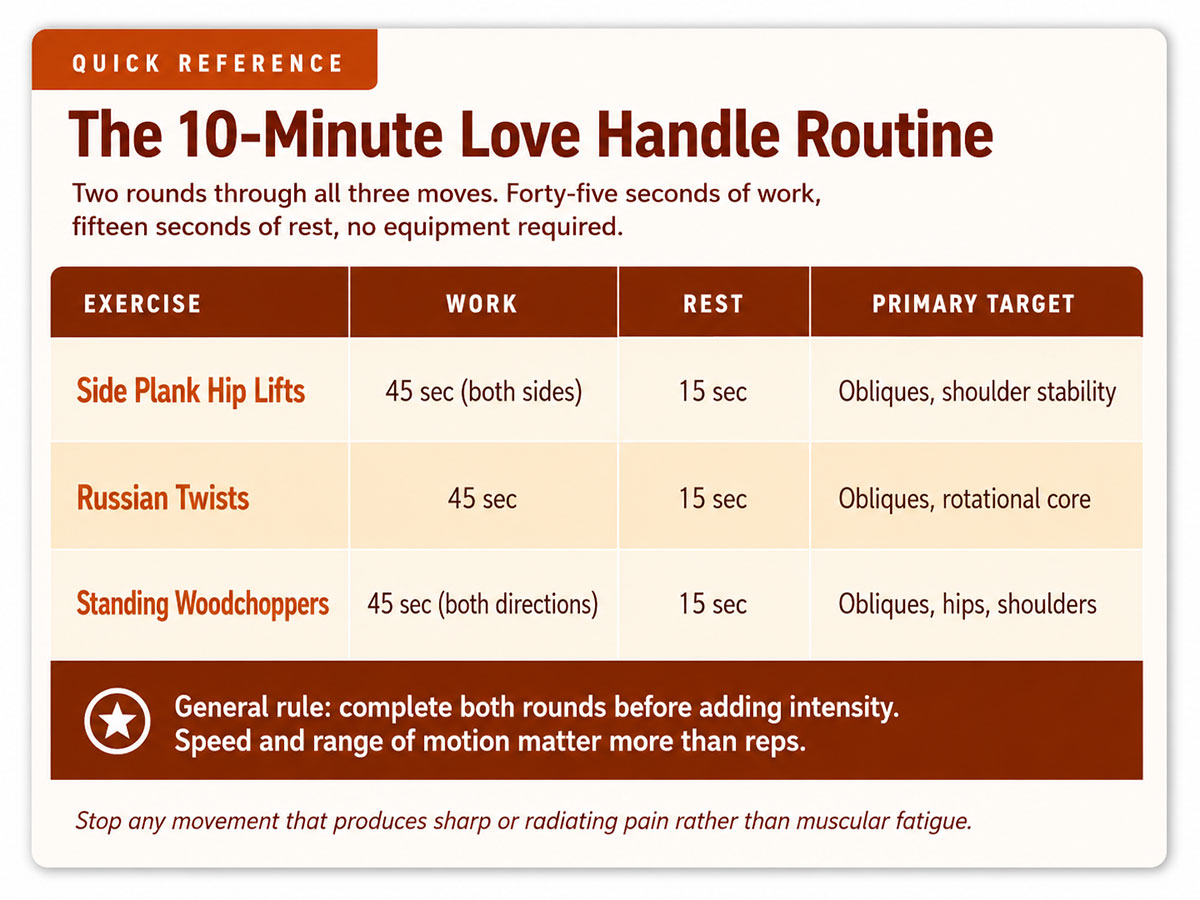
Three moves, two rounds, ten minutes total. Forty-five seconds of work, fifteen seconds of rest, straight through the circuit twice.
Side Plank Hip Lifts
The most common mistake happens before the first rep: rushing into the plank without stacking your shoulder directly over your elbow. That single alignment error is where most of the shoulder strain in this move comes from.
- Lie on your side with your forearm on the floor and your elbow stacked directly under your shoulder.
- Stack or stagger your feet for balance, then lift your hips until your body forms a straight line from shoulder to ankle.
- Lower your hips toward the floor without touching down, then lift again, keeping the motion controlled rather than bounced.
- Hold the top position for one full breath, then switch sides at the halfway point of your working time.
Russian Twists
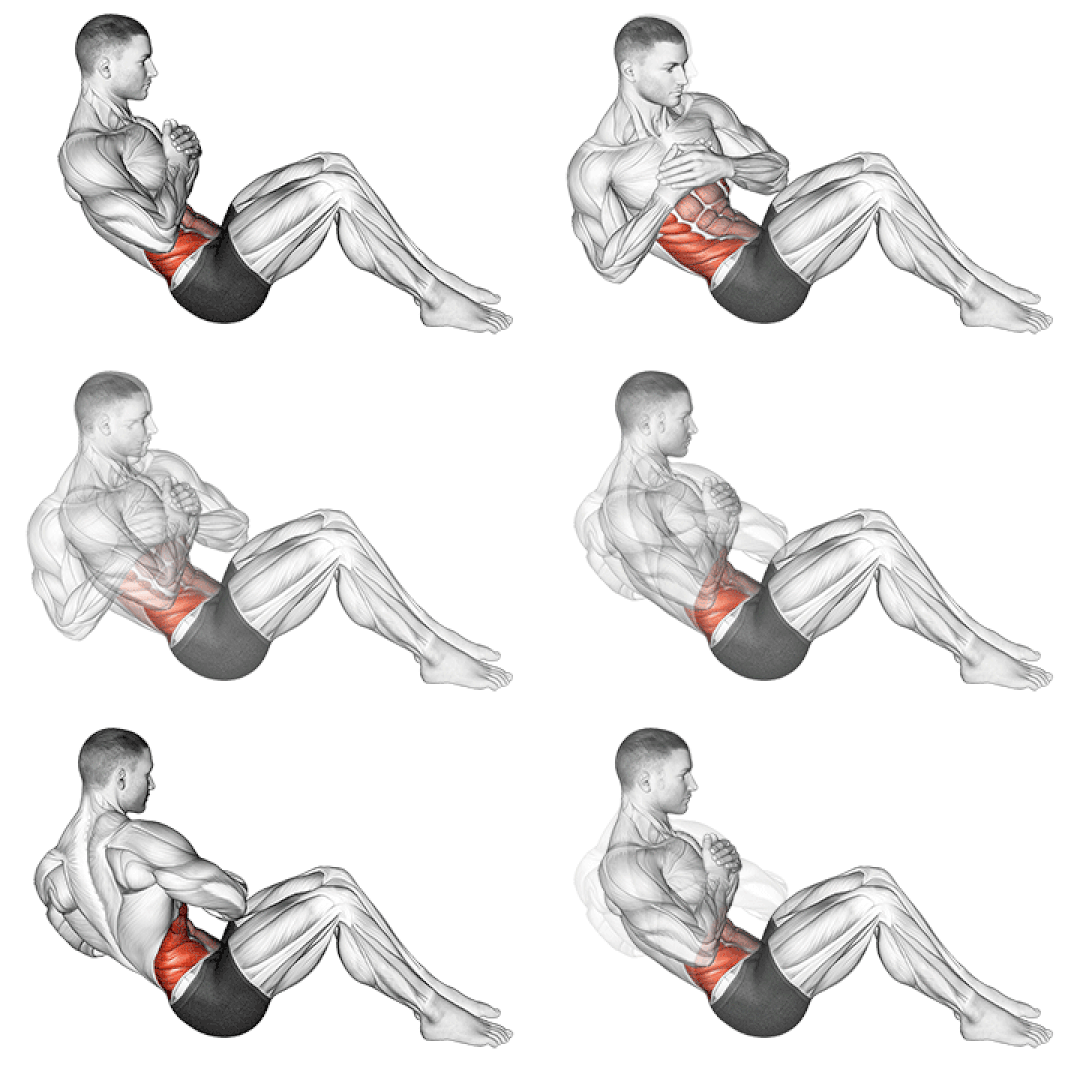
Think of the twist as wringing out a towel through your midsection. The rotation is where the work happens, not the reach.
This is the most direct oblique move in the entire routine, and the one most likely to come up if you search for which exercise burns fat around the waist. Russian twists rotate the trunk against resistance, which is exactly the action the obliques are built for. Burning “side fat” on its own is not something any single exercise can promise, given the spot-reduction evidence above, but no other move here works the muscle more directly.
- Sit with your knees bent and heels on the floor, then lean your torso back to roughly 45 degrees.
- Lift your feet slightly off the floor if your core allows it, or keep your heels down for a gentler version.
- Rotate your torso to tap the floor beside your hip, then rotate to the opposite side.
- Keep the motion coming from your ribs turning over your hips, not from your arms swinging.
Standing Woodchoppers
Woodchoppers ask more of you than the other two moves. The rotation runs diagonally, from one shoulder to the opposite hip, which pulls the shoulders and hips into the work along with the obliques.
- Stand with your feet shoulder-width apart, clasping both hands together in front of your chest.
- Raise your arms to shoulder height on one side, then rotate your torso and hips as you sweep your arms diagonally down toward the opposite hip.
- Keep your arms mostly straight through the sweep, letting the rotation come from your torso rather than your shoulders alone.
- Reverse back to the starting position, then switch directions at the halfway point of your working time and repeat the sweep going the other way.
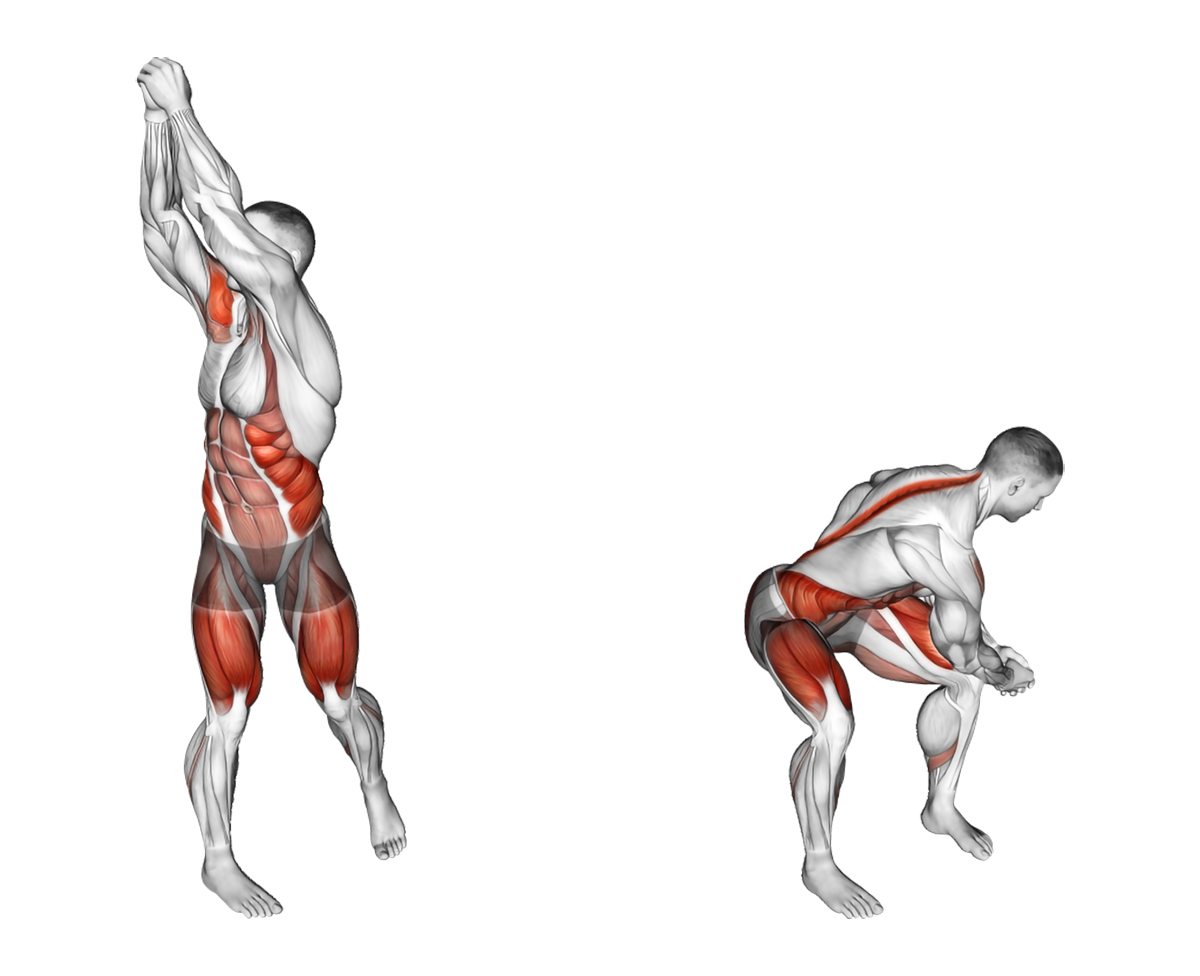
Whether that diagonal pull feels natural by the second round or still awkward through the entire set says something about how much rotational strength you started with.
Love Handle Routine Timer
45 seconds work, 15 seconds rest, two rounds
What Actually Helps to Move the Needle Over and Above the Routine
None of this works in isolation. The routine builds and preserves muscle. What actually removes the fat covering it is the same handful of factors that determine fat loss anywhere else on the body.
Start with sleep, because it undoes willpower faster than almost anything else does. Researchers at the University of Chicago restricted twelve healthy young men to four hours in bed for two nights running, then measured their hormones the next day.
Leptin dropped. Ghrelin rose. In a 2004 study published in Annals of Internal Medicine, hunger and appetite ratings climbed right along with them.
Two bad nights of sleep can make a person hungrier before they have made a single dietary decision.
Protein plays a narrower but still meaningful role. A 2007 study in the journal Obesity put women on a matched calorie deficit, split into a higher-protein group and a standard-protein group. The higher-protein group preserved nearly twice as much lean muscle for the same amount of weight lost and reported less hunger in the process.
Water gets credited with more than it delivers, and the “eight glasses a day” figure is part of the problem. A 2021 review in the European Journal of Nutrition traced that number back to a guess with no real evidence behind it, putting a more realistic range at 2.5 to 3.5 liters daily, adjusted for body size and activity, and best judged by the color of your own urine rather than a fixed count of glasses.
Adjusting the Routine When Something Doesn’t Cooperate
Hip discomfort, wrist sensitivity, or limited spinal rotation can each get in the way of one of these three moves specifically. Each has a workaround rather than a reason to skip the whole routine.
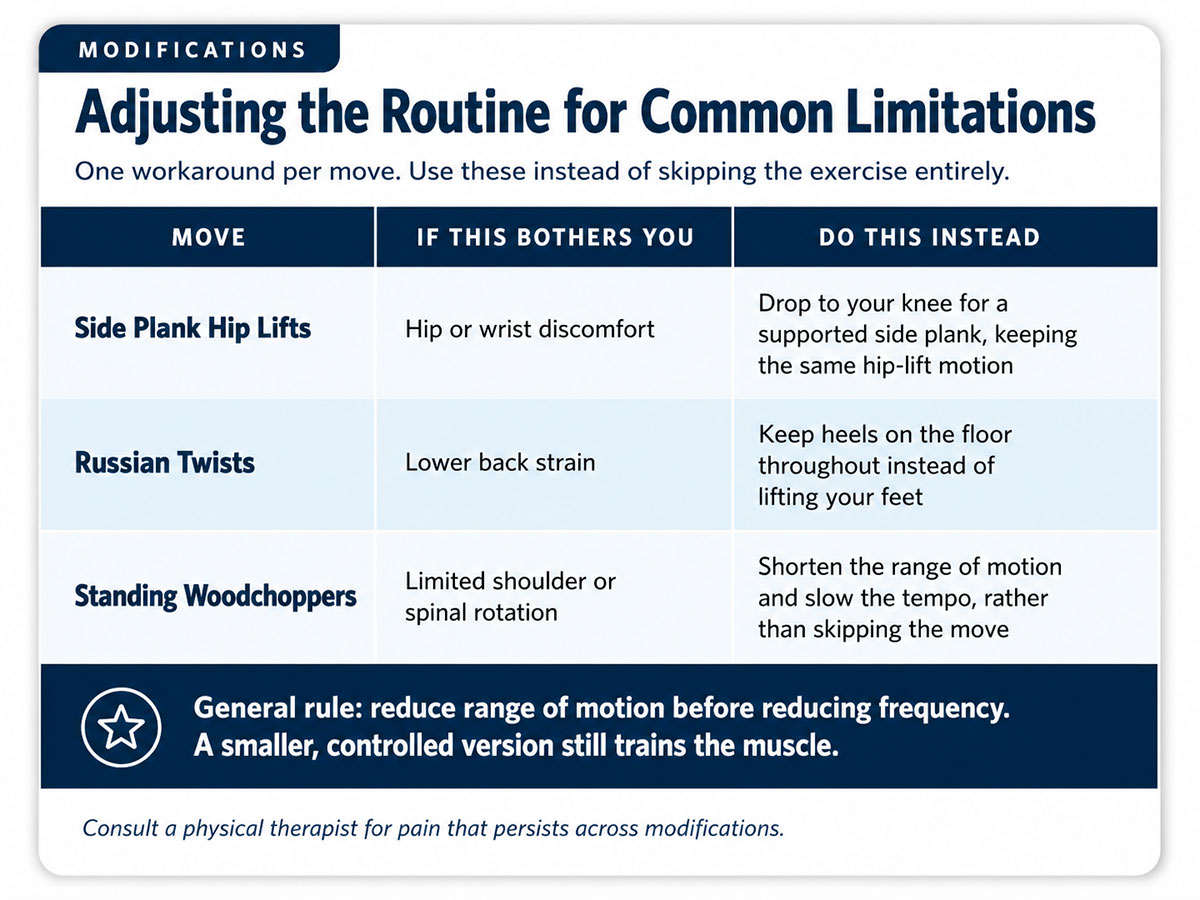
The same principle extends beyond this specific routine. If you are working on softness through the arms as well as the waist, the underlying approach barely changes: build the muscle, and let the deficit do the rest.
Progression: What Changes, and When
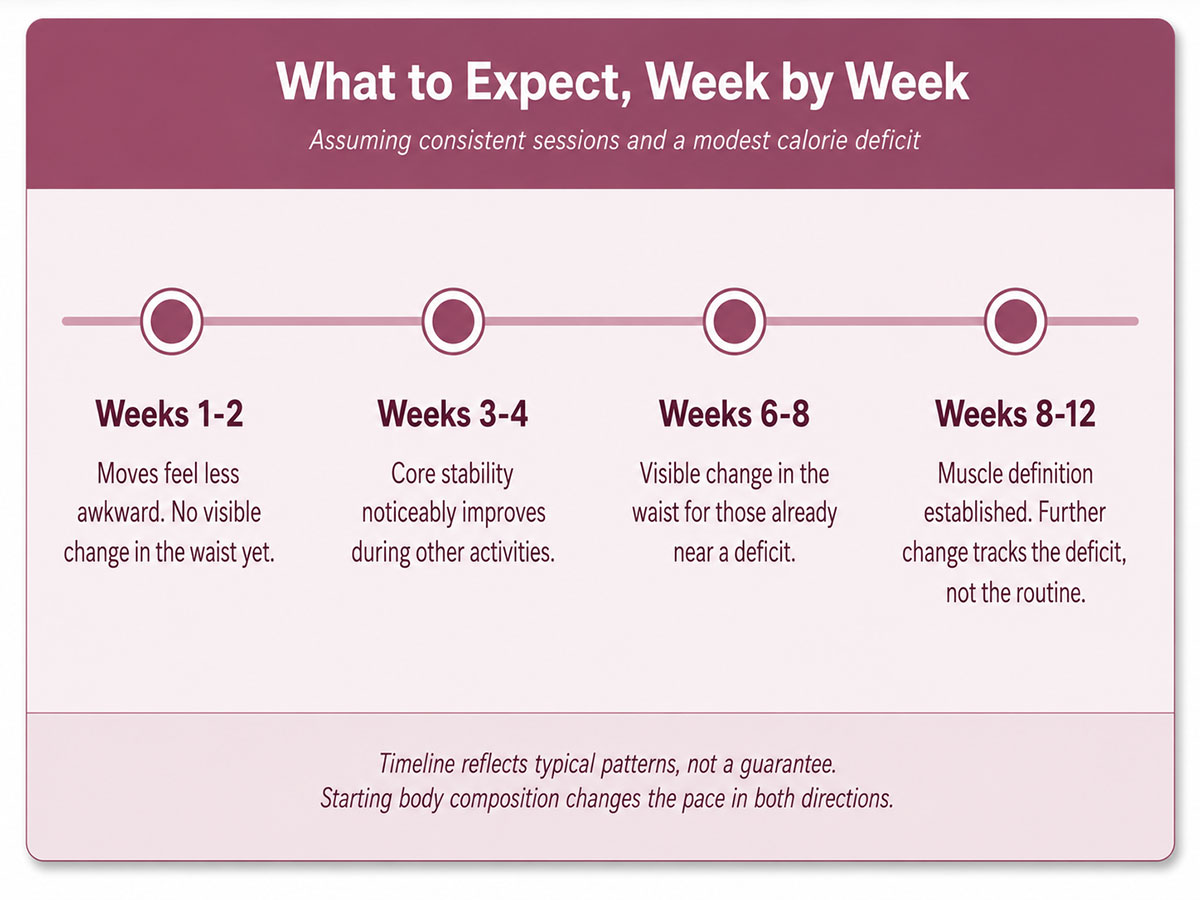
Ten minutes stays ten minutes. What changes over the following weeks is how much of that time actually challenges you.
Most people feel the work differently within the first two weeks. The moves get less awkward, not necessarily easier.
Visible change in the waist tends to show up on a six-to-eight-week horizon for people already close to a calorie deficit, and later for everyone else. No routine changes that timeline, no matter what a video promises.
The Part That Isn’t About the Ten Minutes
The spot-reduction evidence doesn’t make the ten minutes worthless. It relocates the real question to what happens in the other twenty-three hours and fifty minutes of the day.
The muscle work matters. But the quieter, less exciting math, sleep debt, protein intake, the size of the deficit, is what actually decides whether the fat covering that muscle goes anywhere.
Ten minutes a day is the easy part. Showing up for the parts that don’t feel like exercise is where most routines, including good ones, fail.
FAQs
Can I do this routine every day?
Yes, since it is bodyweight work at a moderate intensity. If soreness through the obliques or lower back builds up, one rest day between sessions is enough to recover.
Do I need any equipment at all?
No. All three moves use bodyweight only. A yoga mat helps with comfort during the plank and twist, but it is not required.
Will this routine work if I’m not overweight but carrying extra in this one area?
The muscle-building effect works the same no matter what the scale says. Whether the fat covering that muscle actually changes comes down to calorie balance, not your starting weight. Plenty of people at a completely normal weight carry extra here anyway, for reasons closer to genetics than anything they’re doing wrong.
What if I feel it more in my lower back than in my obliques?
That usually means the hips are doing work meant for the torso, most often during woodchoppers. Slow the rotation down and focus on turning your ribs over a stable pelvis rather than swinging your whole body.