You finish a task and immediately think about the next one. You finally get time off and somehow feel worse. Psychologists explain why.
It’s Sunday afternoon. The week is over. There is nowhere to be, nothing urgent, no reason to open a laptop. And yet something in the body won’t settle. A low-grade restlessness that has no object. A voice, not quite conscious, that starts tallying what hasn’t been done. The book on the nightstand goes unread. The walk gets skipped. Within an hour, the phone is out. Not to scroll, but to check email, just once, just to see.
Most people in this situation have a word for it: guilt. They assume it means they’re bad at relaxing, or that they take their work too seriously, or that they need a vacation. What they rarely consider is that the guilt might not be about productivity at all. It might be about self-worth, and that distinction matters more than almost anything else the productivity industry has told them.
Psychology researchers have spent decades studying what happens when people structure their sense of personal value around what they produce. The pattern has a name, a measurable mechanism, and a documented set of consequences, none of which show up in the average listicle about morning routines or focus techniques. Understanding it doesn’t just explain the guilt. It explains why working harder never seems to close the gap.
What Toxic Productivity Actually Is (And What It Isn’t)
Toxic productivity isn’t the same as working hard. The distinction sounds simple, but it tends to get blurred in most descriptions of the phenomenon. Hard work, ambition, and high output are not the problem. The problem is a specific psychological relationship to that output, one in which a person’s sense of being genuinely okay as a human being rises and falls with how much they accomplish.
Jennifer Moss, a workplace researcher and author of The Burnout Epidemic, describes it as “an unhealthy compulsion to be productive at all times, often at the expense of mental and physical well-being, relationships, and overall quality of life.” Natalie Dattilo, an instructor of psychology at Harvard Medical School who treats anxiety and depression, notes that it isn’t a clinical diagnosis.
There is no entry for it in the DSM-5 or ICD-11. What it maps onto most closely in the research literature is workaholism, though the two aren’t identical. Workaholism typically refers to compulsive overwork in professional contexts. Toxic productivity is broader: it extends to exercise, hobbies, parenting, and self-improvement. Every domain of life gets recruited into the performance.
One useful way to think about the difference between healthy drive and its toxic version: a person with healthy ambition finishes a project and feels satisfied. A person caught in toxic productivity finishes the same project and immediately adds three more items to the list. The work is never evidence of enough. It can only ever be evidence of what remains.
That asymmetry, where output produces more pressure instead of relief, is the clearest diagnostic signal, and it points directly to what’s happening underneath.
The Self-Worth Mechanism Researchers Have Been Studying Since the 1990s
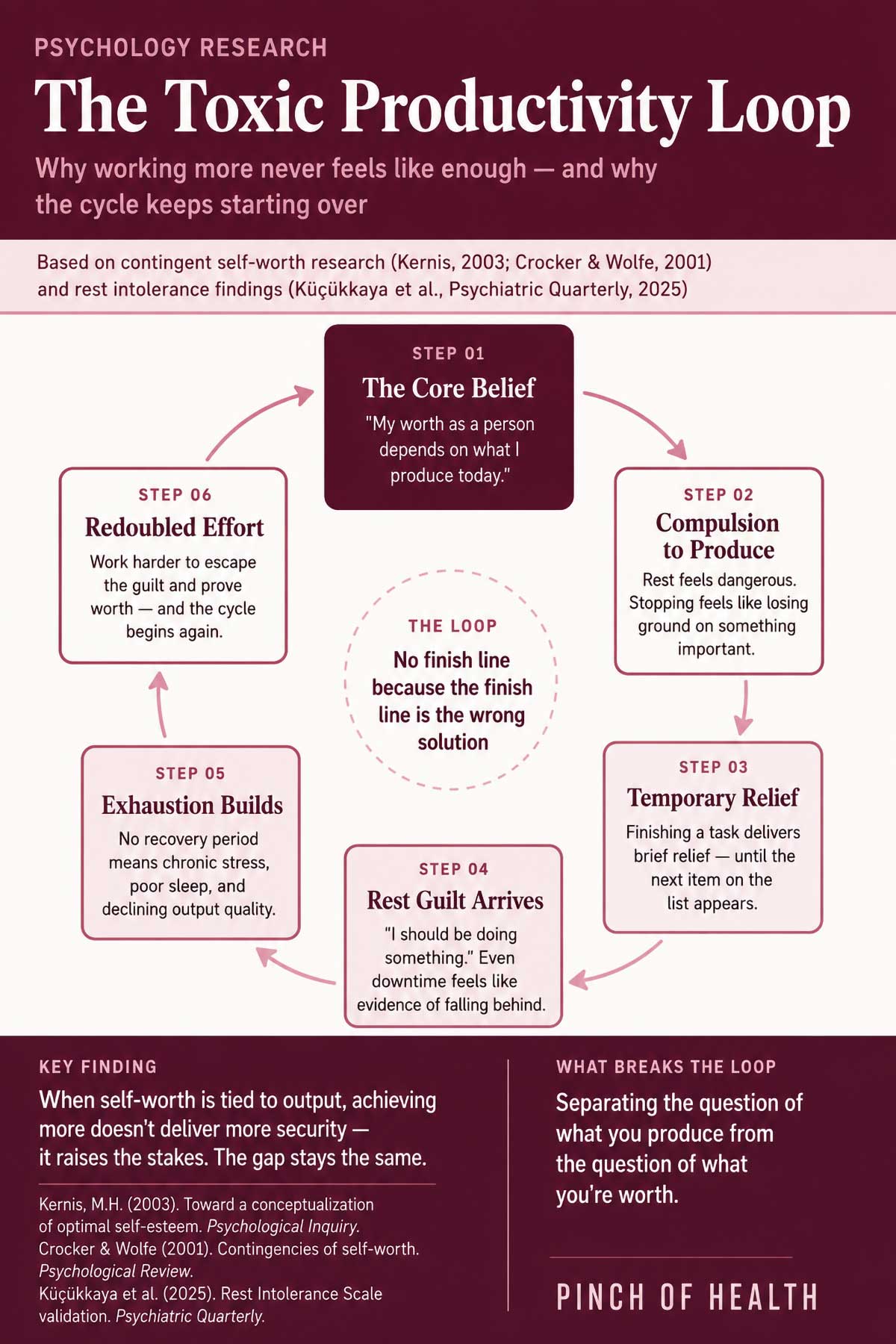
Michael Kernis, a psychologist then at the University of Georgia, spent years studying what he called contingent self-esteem: the degree to which a person bases their sense of self-worth on meeting specific internal or external standards. One of his scale’s items reads: “An important measure of my worth is how competently I perform.” Another: “My overall feelings about myself are heavily influenced by how much I accomplish.”
The research on contingent self-worth, which has accumulated across multiple labs since the early 2000s, consistently finds that basing self-esteem on external outcomes: achievement, appearance, others’ approval. This tends to produce greater emotional volatility and lower general wellbeing than basing it on internal factors.
The more fragile the foundation, the more threatened the person feels when that foundation is absent. For someone whose self-worth is productivity-contingent, every period of rest isn’t neutral. It registers as an active threat.
Jennifer Crocker, a social psychologist at Ohio State University whose work built on Kernis’s, found that people with external contingencies pursue achievements not primarily because they want the achievements, but because they need them to maintain a stable sense of self. The achievement delivers temporary relief. Then the standard shifts upward, and the relief has to be earned again.
Crocker’s research, published in Psychological Review, connects this pattern to increased stress, emotional dysregulation and, in some populations, disordered eating, drug use, and aggression. The specific contingency changes. The structural problem doesn’t.
For the person who can’t stop working on a Sunday afternoon, this framework offers something more useful than advice: an explanation. The drive isn’t ambition misfiring. The brain is doing exactly what it’s been trained to do when the source of self-worth disappears.
The Number of People Affected Is Larger Than Most Estimates Suggest
In 2023, researchers published the first systematic review and meta-analysis on the prevalence of workaholism in Frontiers in Psychology. They searched across ten academic databases, identified 42 qualifying studies, and ran a trim-and-fill adjustment for publication bias.
The pooled estimate: roughly 14 out of every 100 workers meet criteria for workaholism. In studies using representative national samples, the figure drops to somewhere between 8 and 10 percent. In professional and high-achievement populations, it climbs considerably higher.
The same research base that established those prevalence figures also mapped the associated health consequences: anxiety, burnout, cardiovascular disease, depression, and persistent sleep problems appearing consistently across populations and measurement instruments.
A separate integrative review of workaholism in nurses found that burnout, stress, and anxious and depressive symptoms were the most common outcomes, with poor sleep quality and low professional effectiveness following closely. The pattern held regardless of nationality or work setting.
Workaholism research isn’t perfectly clean. Most studies are cross-sectional. They measure people at a single point in time, which limits what can be said about cause and direction. Self-reported outcomes are vulnerable to social desirability bias, particularly in high-achievement populations who may underreport distress.
What the literature does establish fairly clearly is association: the more compulsively a person overworks, the worse their health outcomes tend to be, and the less satisfied they report feeling with their lives despite the hours invested.
One finding from the Bergen meta-analysis tends to get overlooked: workaholics consistently report lower life satisfaction than average workers. Not comparable. Lower. The hours go up and the satisfaction goes down.
Rest Guilt Has a Clinical Name, And It’s Getting Attention
Researchers have started studying what happens specifically during periods of rest for people in this pattern. A 2025 paper in Psychiatric Quarterly validated a psychological construct called rest intolerance, defined as the experience of guilt, shame, and related negative emotions that arise specifically when a person tries to rest.
The lead author, building on earlier work by researcher M. Koo, notes that “leisure guilt,” meaning the experience of distress associated with rest rather than work, with guilt as its predominant emotion. People who experience rest intolerance don’t just prefer working. They find not working genuinely aversive.
The 2025 study, which involved 475 young adults, found that self-compassion and what the researchers called a resilient mindset both acted as buffers. Participants with higher self-compassion reported less emotional distress and fewer sleep complaints even when their rest intolerance scores were elevated.
The mediation pathway suggests that the problem isn’t rest itself. It is the relationship the person has with their own internal states during rest. The guilt arrives; what determines the downstream harm is whether the person can hold that guilt with some degree of steadiness rather than amplifying it.
This is a relatively new area of formal research. The rest intolerance scale was validated in a single country with a young adult sample, so the findings need broader replication before much can be firmly claimed. But the concept itself matches something a large number of people describe without having any name for it: the experience of lying on the couch on a Sunday afternoon and feeling, against all logic, worse.
Social Media Has a Specific Role in Making This Worse
Research on social comparison (the tendency to evaluate oneself in relation to others) has established fairly consistently that upward comparisons (perceiving that others are better off) produce decreases in self-esteem and increases in depressive symptoms. Most of this research has been done in the context of appearance: Instagram and body image. But the mechanism doesn’t care about the content category.
A 2025 study published in Frontiers in Psychology tracked the relationship between social media use and self-esteem across two separate samples. Upward comparisons mediated the relationship between Instagram and Facebook use and lower global self-esteem in both studies. A separate meta-analysis, published in 2023, confirmed decreased self-esteem as a consistent outcome of exposure to upward comparison targets on social media, across platforms and populations.
Productivity content on social media functions as an upward comparison engine. The 4am morning routine video, the “I built a business while working full-time” post, the founder who runs a company and trains for a triathlon and journals every morning.
These create the same psychological conditions as a fitness influencer does for body image. They’re not aspirational for everyone. For the person with productivity-contingent self-worth, they’re a direct measurement against a curated standard of output that no one actually lives at consistently.
There’s also a gender dimension here. Multiple studies find that women are more negatively affected by upward social comparisons, both in terms of self-esteem reduction and depressive symptom increases. Given that women often carry productivity pressure across professional, domestic, and caregiving domains simultaneously, the amplification effect of social media’s hustle content tends to land harder.
The complication that most advice articles skip: telling someone to simply use social media less doesn’t address the underlying contingency. A person who has connected self-worth to output will find other measurement systems if the social media one is removed. The comparison is a symptom of the belief, not its cause.
What the Research on Self-Compassion Actually Found (And Why It Surprises People)
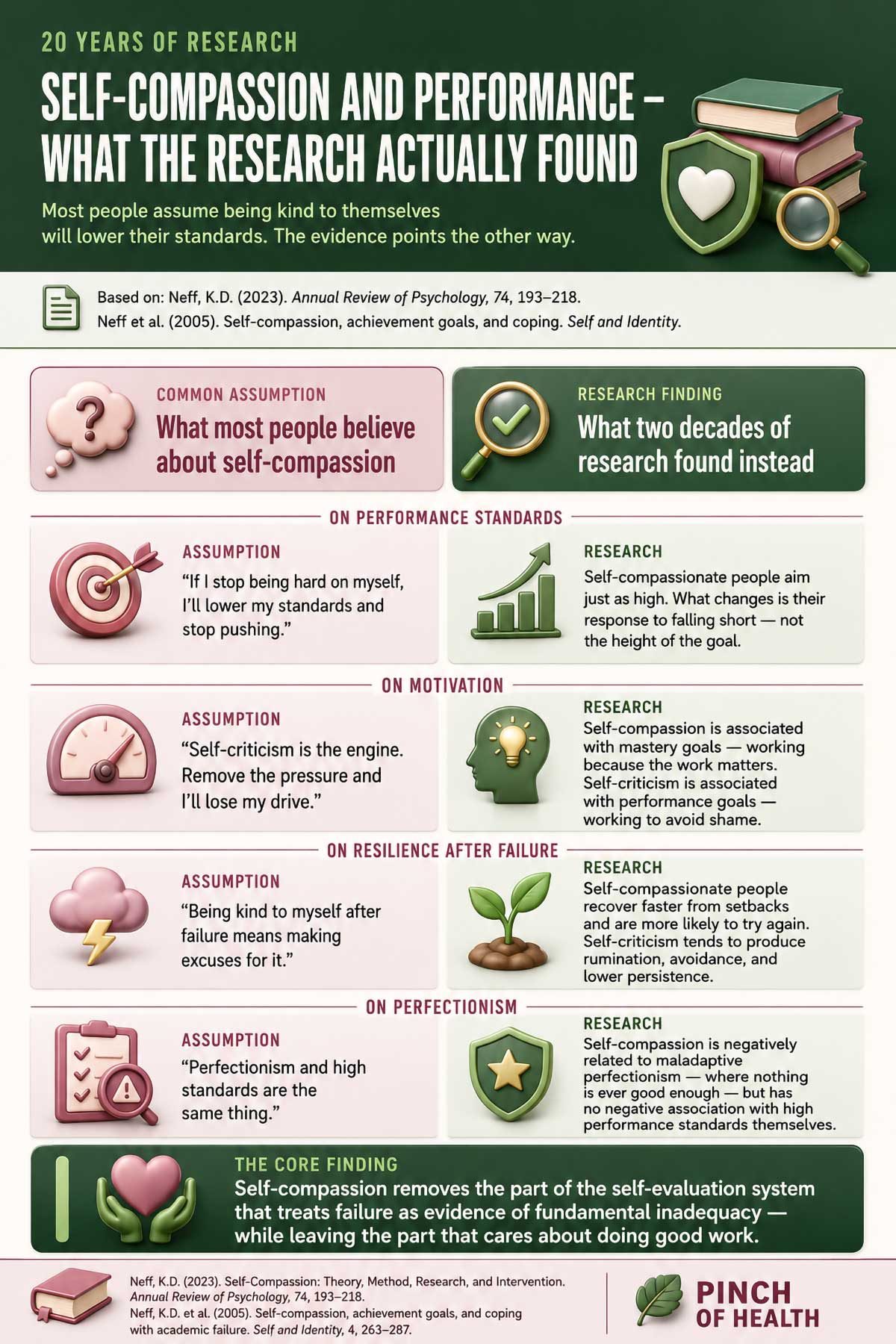
The most common objection to reducing performance pressure on oneself sounds roughly like this: if I stop being hard on myself, I’ll stop achieving. The implicit model is that self-criticism is the engine of performance, that the guilt, the impossible standards, and the constant self-evaluation are functionally necessary for high output.
Kristin Neff, an educational psychologist at the University of Texas at Austin who has spent over two decades studying self-compassion, has published research that challenges this directly. In a 2023 review in the Annual Review of Psychology synthesizing decades of her lab’s work and independent replications, Neff reports that self-compassionate people tend to aim just as high as their self-critical counterparts.
What changes is not the standard. What changes is the response to falling short of it. Self-compassionate individuals are less devastated by failure, recover faster, and are more likely to try again.
The distinction she draws between self-compassion and self-esteem is relevant here. Self-esteem, in her framing, requires positive self-evaluation: standing out, succeeding, performing above average. It’s inherently contingent. Self-compassion doesn’t require any particular performance.
It extends to the person regardless of output. That’s why it doesn’t undercut motivation: it removes the part of the self-evaluation system that treats failure as evidence of fundamental inadequacy, while leaving the part that cares about doing good work.
A 2005 paper from Neff’s lab, published in Self and Identity, found that self-compassion is positively associated with mastery goals (the intrinsic motivation to learn and grow) and negatively associated with performance goals, which are primarily about managing how others perceive you.
The person working from self-compassion is working because the work matters. The person working from toxic productivity is working to keep the inner judge quiet. Those are different engines, and only one of them is sustainable.
The Cognitive Beliefs That Drive the Pattern, And Whether They Can Change
McMillan and colleagues identified two specific cognitive distortions that appear to drive compulsive overwork: equating self-worth with productivity, and fear of failure. Both are beliefs, not personality traits or fixed temperament or hard-wired neurology. They’re learned ways of interpreting the self, and they respond to the same interventions that work on other cognitive distortions.
Cognitive behavioral therapy targeting perfectionism, which shares significant architecture with toxic productivity’s underlying beliefs, has now been studied across multiple randomized controlled trials. A 2022 meta-analysis in Cognitive Behavior Therapy found moderate effect sizes for reductions in perfectionism scores, with medium effects carrying through to reductions in depression and anxiety. Guided internet-based CBT for perfectionism has shown comparable results to in-person delivery, with some follow-up data extending gains beyond the treatment period.
The mechanism that CBT targets here isn’t effort or ambition. It’s the conditional logic: “If I am not producing, I am not worthy.” Restructuring that belief doesn’t require a person to work less. It requires separating the question of what they produce from the question of what they’re worth.
That sounds obvious stated plainly. For someone who has run on conditional self-worth for a decade, it doesn’t feel obvious at all. Early CBT sessions often surface how deep the belief goes and how much the person has organized their life around it.
The evidence base for CBT targeting these patterns is fairly solid. Most studies use self-reported outcomes, which is a limitation worth noting. Long-term follow-up data beyond six months is limited. And therapy access remains a practical barrier for a large share of the people who might benefit from it.
What the Research Suggests About Starting to Shift the Pattern
None of the following is a substitute for professional support in cases where the pattern is severe, persistent, or accompanied by clinical anxiety or depression. What the research does offer are a few starting points that don’t require dismantling the entire belief system before anything improves.
The self-compassion literature suggests that the most accessible entry point is noticing the internal judge without immediately obeying it. When the guilt arrives during rest, the goal isn’t to argue it out of existence. Neff’s work describes an approach she calls “common humanity,” meaning that the experience of failing to feel like enough is not a personal abnormality. It’s something close to universal among people who care about doing meaningful work. That recognition doesn’t eliminate the guilt, but it does reduce the layer of self-judgment that gets added on top of it.
The rest intolerance research, limited as it is, points toward self-compassion as a mediating variable: it may matter less whether you feel guilty during rest and more whether you can hold that guilt without escalating it into a verdict about your character. This is harder than it sounds, particularly for people who have used self-criticism as a performance tool for years. The first few attempts at deliberate rest with any kind of self-compassion framing can feel faintly absurd, like a person trying to convince themselves of something they don’t believe.
On the structural side, the cognitive behavioral research suggests that externalizing the belief by actually writing it down in explicit form helps create enough distance to examine it. “If I am not productive today, I am failing as a person” is a lot harder to maintain uncritically when it’s sitting on a page in front of you. Therapy is the most reliable context for this work. Journaling can be a useful first pass.
The social media dimension has a simpler intervention than it might appear: reducing exposure to productivity-as-identity content. Not because comparison is uniquely harmful in that context, but because the upward comparison research suggests that frequency and intensity of exposure both matter for self-esteem outcomes. Choosing what to expose the contingency-sensitive brain to is one of the few levers a person can pull without waiting for deeper belief change.
Psychology researchers studying contingent self-worth — the pattern of tying personal value to what you produce — have identified a cluster of experiences that tend to show up together. This isn't a clinical screening tool. It's a recognition exercise, based on the emotional patterns described in the academic literature on workaholism and productivity-linked self-esteem.
Read each statement and answer as honestly as you can.
Worth Taking Note Of
Productivity culture rarely asks what the productivity is for. The implicit answer is that more output will eventually produce the sense of mattering that feels just out of reach. That is the part the research most consistently fails to support. The contingent self-worth literature doesn’t suggest that people with this pattern are wrong to care about their work.
Most of them care deeply. What the research suggests is that the belief driving the compulsion, that their value as a person depends on what they produce, is doing active harm to the people it’s supposed to protect.
The relief that the pattern promises has a structural problem: it requires a moving target. When the output goes up, the standard follows. The gap stays the same. This isn’t a discipline failure or a motivation problem.
For the people it affects, it’s a very human response to having learned, somewhere along the way, that worth has to be earned. The evidence suggests it doesn’t. Most people have a harder time believing that than they expect.