More walking won’t fix it. Squats won’t either. The muscle that actually drives every step you take is one most people have never trained once.
There’s a moment most people can name. You’re crossing a parking lot, or keeping pace with someone you’ve always walked beside, and something feels off. You’re working harder than you used to. The gap between you and whoever is ahead takes a little longer to close. It’s easy to file this under “getting older” and move on.
The trouble is that explanation lets you off the hook from a problem that actually has a mechanical cause and, for many people, a mechanical fix. Most advice about declining walking speed points to cardiovascular fitness, body weight, or generic aging. Those things matter. But they miss something structural about how human walking actually works and why the engine fails in a very specific, largely ignored place.
That place is not your lungs. It’s not even your knees or hips, despite what most people assume. The answer sits much lower. And it’s quietly deciding how fast, how safely, and in some very real ways, how long you move through the world.
The Vital Sign Nobody Checks
Doctors measure blood pressure, heart rate, and cholesterol without thinking twice. They rarely measure walking speed. That’s a significant gap, because the research suggests gait speed belongs in the same category as those other numbers.
A landmark pooled analysis published in JAMA, Studenski et al., 2011, followed over 34,000 older adults across nine separate studies for up to 21 years. The finding was striking: gait speed predicted 5- and 10-year survival just as well as a full panel of clinical data, including age, sex, chronic disease history, blood pressure, BMI, and hospitalization history combined. Walking a bit faster at age 75 didn’t just reflect better health. It tracked with a much longer life. At that age, predicted 10-year survival for men ranged from 19% to 87% depending on how fast they walked, and from 35% to 91% for women.
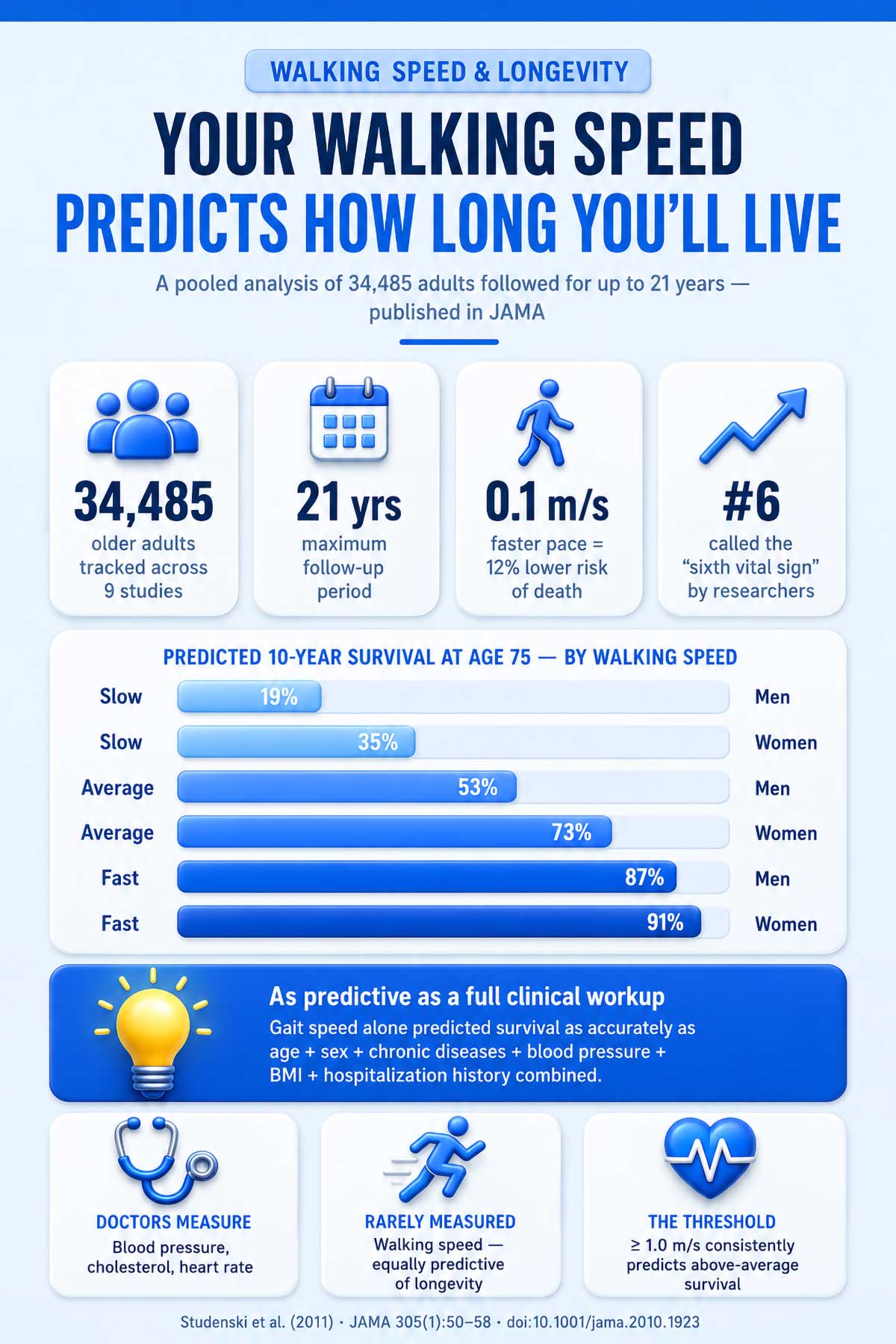
This doesn’t mean walking fast makes you live longer in a simple cause-and-effect way. What it means is that gait speed acts as a visible expression of everything happening inside the body: muscle function, nerve coordination, heart and lung efficiency, and skeletal strength, all compressed into one number. Some researchers now call it a “sixth vital sign.” The question worth asking is not what your average walking speed is, but what’s causing it to slip.
→ See what actually helps maintain bone density after 60
The Engine That Actually Drives You Forward
Here’s the assumption most people carry: walking is powered by the big muscles. The quads that lift the knee. The glutes that push the hip forward. It feels that way, especially going uphill. But the mechanics of level-ground walking tell a different story, and it changes what you should actually be training.
The real propulsive engine is the ankle push-off. That’s the moment just before your foot leaves the ground when the calf muscles contract hard, pointing the toes down to propel the body forward and launch the leg into its swing phase. Zelik and Adamczyk (2016) established this clearly, showing that the ankle push-off provides the main energy for both accelerating the body’s center of mass and starting the swing of the leg.
Older research had mistakenly given most of that credit to the hip. Meinders et al. (1998) confirmed that the vast majority of push-off energy comes from the ankle plantar flexors and goes directly toward getting the leg airborne. The hip isn’t the engine. The ankle is. The hip is more like the chassis.
This matters because most people who start “working on their walking” either walk more or do squats and leg presses. Both largely bypass the ankle push-off. You can build real quad and glute strength and still walk at the same pace, because you haven’t touched the actual propulsive system.
What Aging Does to the Ankle Engine
The decline in walking speed that comes with age isn’t random. It follows a very specific pattern. Franz and colleagues (2016) documented it clearly: as people age, ankle push-off power drops, and the body compensates by shifting more work to the hip. The workload moves from the smaller, faster muscles down near the foot up to the bigger, slower muscles higher in the leg. The hip can fill in for a weakening ankle to some degree. It just isn’t good at it. The result is a shorter, slower stride that costs more energy per step.
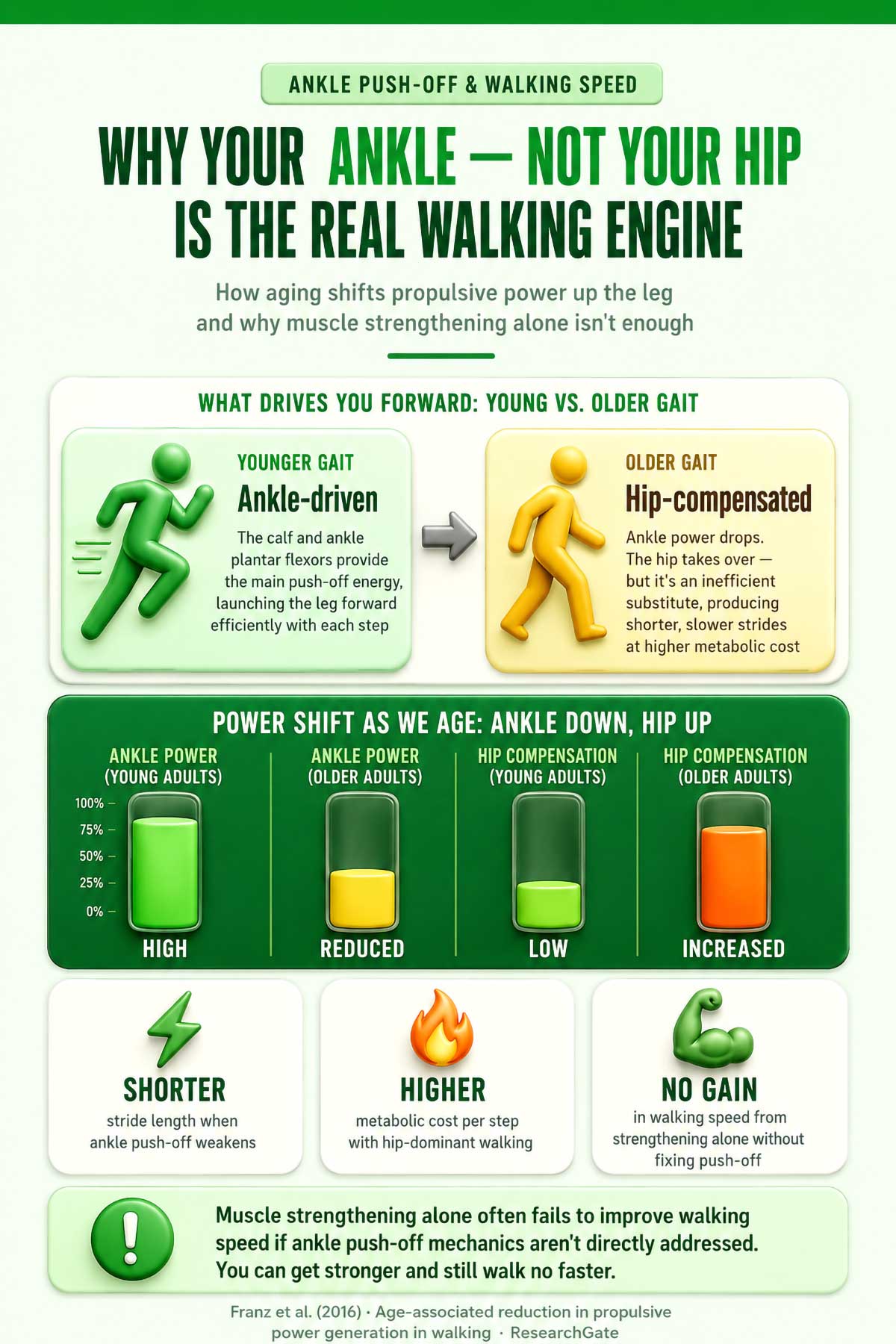
That last part is worth sitting with. Hip-dominant walking burns more fuel to cover the same distance. People who have shifted to this pattern often feel winded or tired at a pace that used to feel easy, not because their fitness has collapsed, but because the body is working harder than it needs to. The effort feels bigger than the speed suggests it should.
The other thing that research makes clear is what it means for training. Muscle strengthening alone, the kind most people would attempt if they attempted anything, often fails to improve walking speed when the push-off mechanics haven’t been fixed. You can get stronger in general terms and still walk no faster, because stronger hip muscles don’t restore ankle push-off timing or power. They just work harder at the wrong job.
Balance, the Achilles Tendon, and the Fall No One Sees Coming
Declining ankle function does more than slow your pace. It takes stability with it, in two distinct ways. Hernández-Guillén et al. (2021) found that plantar flexor strength was a key predictor of static balance (the kind you use when standing still), while dorsiflexion strength (lifting the front of the foot) predicted dynamic balance during movement. Two different ankle capabilities, both declining, both linked to fall risk in older adults who otherwise consider themselves healthy.
Research published in PLOS ONE by Smith et al. (2024) adds a layer that most people haven’t considered: it’s not just muscle weakness driving the instability. Reduced Achilles tendon stiffness, which also comes with age, was directly tied to reduced side-to-side gait stability and higher fall risk. Tendons aren’t just passive connectors. They store elastic energy during loading and release it during push-off, the way a spring loads and fires.
A stiffer tendon returns that energy cleanly. A less stiff one absorbs it instead. So even when calf muscle strength is partly maintained, a looser Achilles undermines the whole push-off system. Strengthening the muscle without addressing the tendon’s spring-like behavior is only part of the solution, and that’s exactly where the drill design matters.
The Neural Side of the Problem and Why the Drill Works
Here’s where it gets genuinely interesting. The shift away from ankle push-off doesn’t only reflect muscle weakness. It also reflects a coordination problem. The brain has, over time, deprioritized the ankle and handed the job to the hip. The body takes the path of least resistance, and if ankle push-off goes underused, the nervous system stops calling on it as a main driver.
Browne and Franz (2019) showed something important here: older adults retain the capacity for full ankle power output. When participants received real-time feedback prompting them to push off more through the ankle, the hip-dominant pattern reversed. The ankle reclaimed its role as the primary driver. That result points to a movement pattern the nervous system has learned to avoid, not an ability that’s been permanently lost. It’s a very different kind of problem, and a much more solvable one.
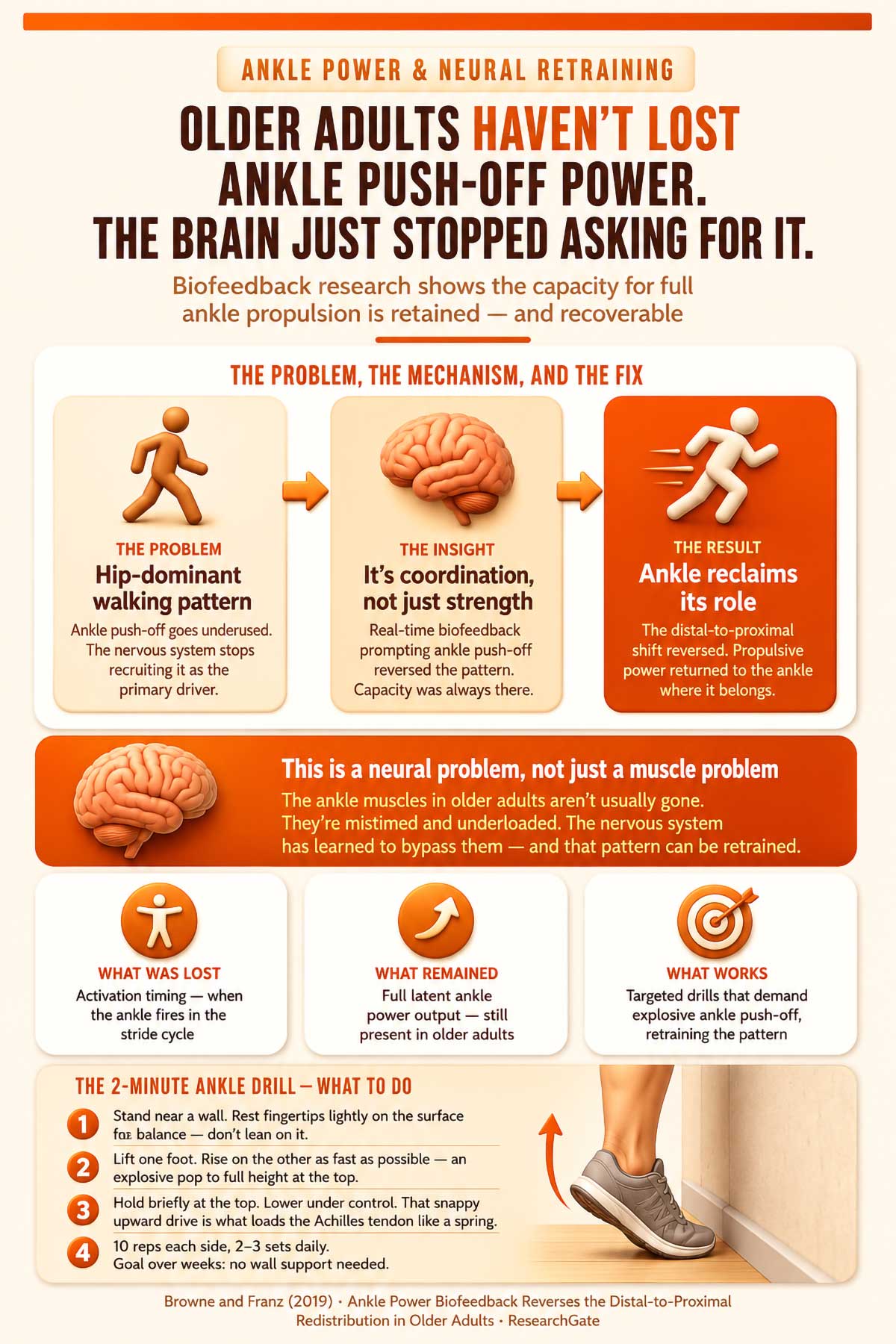
Work in stroke rehab offers a useful parallel. Knarr et al. (2013) found that when stroke survivors changed the timing of their plantar flexor activation through gait retraining, walking speed rose alongside forward center-of-mass push by the ankle muscles. These subjects had nerve damage that doesn’t map directly onto healthy aging, so the comparison isn’t exact. But the core finding, that better plantar flexor timing produces faster walking, appears to hold more broadly. The ankle muscles in older adults aren’t usually gone. They’re mistimed and underloaded.
The 2-Minute Ankle Drill
The goal isn’t simply to strengthen the calf. It’s to train the push-off pattern: explosive, full-range, and loaded, the way it gets used during actual walking. That means targeting the Achilles tendon’s spring-like behavior, not just the muscle’s raw output. A slow calf raise builds some muscle, but it doesn’t teach the tendon to act as a spring. A snappy, explosive pop at the top of the movement is what recruits the tendon’s elastic properties. You’re not just building a stronger calf. You’re training the Achilles to store and release energy more efficiently with every step.
Two minutes, done daily. Perform single-leg standing heel raises: 10 on each side, for two or three sets. Focus on the speed of the rise and the height at the top. Start with your hands lightly touching a wall for balance. The goal over days and weeks is to do them with no support at all. This isn’t a gym exercise. It’s a deliberate rehearsal of the push-off pattern your walking depends on. The speed of the movement matters as much as the effort. You’re not grinding out slow reps. You’re retraining the nervous system to fire the ankle quickly and fully at the right moment in each stride.
For anyone who finds single-leg raises difficult at first, both-feet heel raises are a fair starting point. But the move to single-leg is where the real transfer to walking mechanics happens, because walking is a single-leg activity. One foot is always bearing full load just before push-off, and that’s the position the drill needs to replicate.
What This Actually Changes
The standard advice to walk more isn’t wrong. Volume matters. But if the ankle push-off is already degraded, more steps just reinforce the hip-dominant, high-cost pattern. You log more miles with the same mechanical problem, feel more tired than the pace seems to justify, and nothing structurally improves. Fixing the ankle first changes what those extra miles do for you. The steps start building the right pattern instead of cementing the wrong one.
Walking speed is the number you can see. Ankle push-off is the mechanism you can’t. And the gap between what most people do about the first problem and what actually addresses the second is where a lot of avoidable decline accumulates without anyone naming it correctly.
Two minutes a day. One foot at a time. That’s the starting point most people have been skipping entirely.