The labels make big promises, but decades of clinical research tell a very different story. Some supplements consistently deliver. Others mostly drain your wallet.
Walk into a supplement store, and the shelves present fifteen different powders, each one claiming to be the reason your next workout finally sticks. Only two of them have actually earned that claim.
We went back through the clinical research on the seven most talked-about muscle-building supplements and checked every study against the original source. We ranked them by evidence strength rather than marketing budget. Some held up.
A couple did not hold up the way their labels suggested. One turned out to have a real effect that’s smaller than its reputation, which is a different problem than having no effect at all.
Here’s how the seven actually stack up.
The Undisputed Champions: Supplements Backed by Hard Science
These two have decades of research behind them and almost no serious dissent in the literature. If your budget only stretches to two supplements, this is where it goes.
1. Creatine Monohydrate: The King of Strength
Creatine monohydrate isn’t new, and it isn’t flashy. It’s also the most heavily researched performance supplement in existence, and the research keeps landing in the same place.
Here’s the mechanism. Your muscles run on ATP, a molecule your cells burn for quick energy. During heavy lifting, the supply drains fast.
Creatine helps regenerate it faster, which means more usable power for each rep. It also draws water into muscle cells, a process that appears to help trigger growth signals rather than simply adding harmless bulk.
The International Society of Sports Nutrition’s 2017 position stand, one of the most heavily cited reviews in sports nutrition, calls creatine monohydrate the single most effective legal supplement currently available for increasing high-intensity exercise capacity and lean body mass during training. That conclusion holds across trained and untrained lifters alike, and that’s unusual. Most supplements only move the needle for beginners.
The strength of the case is not one lonely study. Decades of consistent replication back it, and that kind of consistency is rarer in this field than people assume.
How to Use It
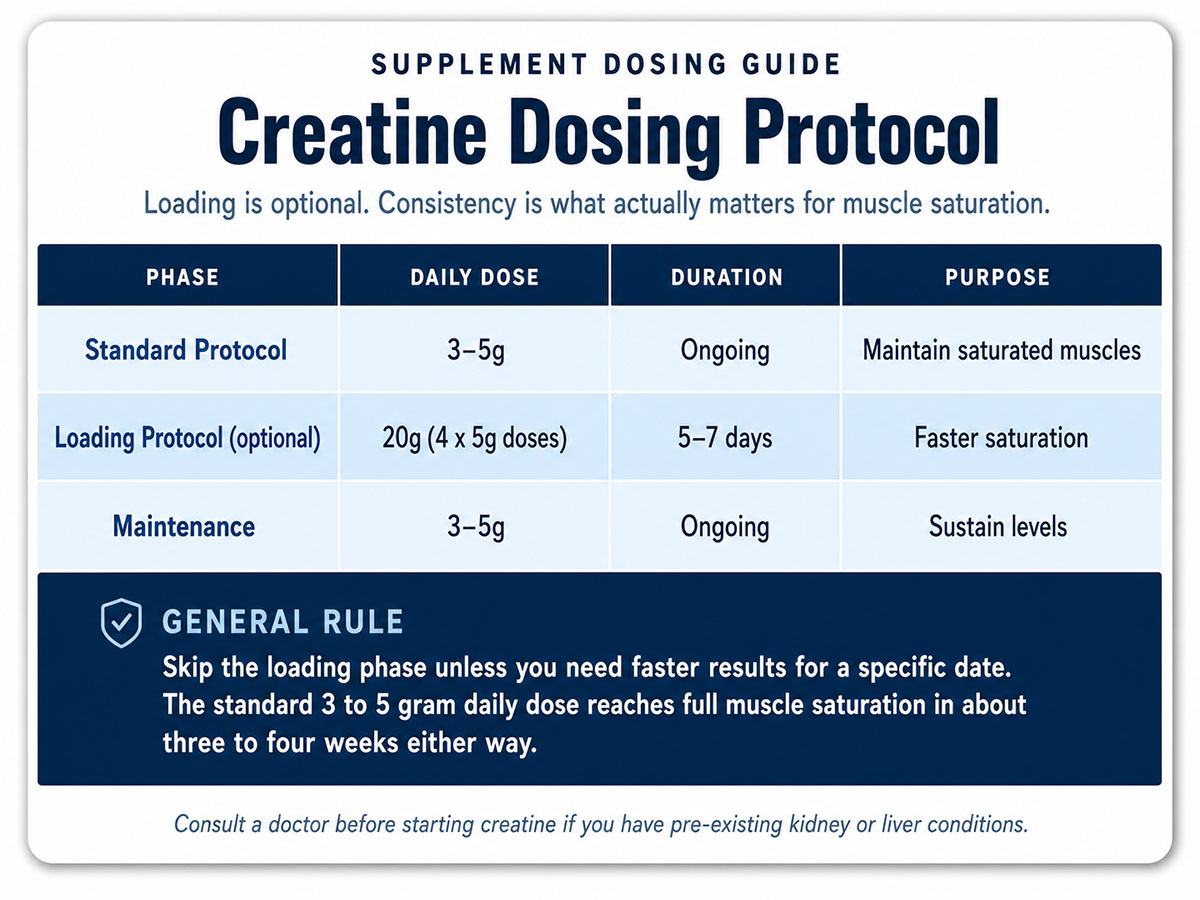
Take 3 to 5 grams daily. Loading isn’t required, and cycling off isn’t either.
Consistency matters more than timing. Mix it into water or toss it into your post-workout shake.
What to Look For
Choose plain creatine monohydrate over pricier forms like creatine ethyl ester or buffered creatine. Monohydrate remains the most studied and cheapest option, and a Creapure seal on the label is a reasonable quality signal.
Possible Side Effects
Some people notice mild water retention. That’s intramuscular water, not the kind that makes you look puffy, and it’s part of the same mechanism that supports growth. Stay hydrated, and check with a doctor first if you have existing kidney issues.
Myth: You Need to Cycle Off Creatine
No evidence supports this. The body doesn’t build tolerance to creatine the way it might to a stimulant. Researchers have tracked continuous use for up to five years without turning up adverse effects, about as long a safety runway as sports nutrition research gets.
2. Protein Powder (Whey and Casein): The Essential Building Blocks
Protein powder is food in a more convenient form. That convenience is the entire pitch, and it turns out to matter quite a bit.
Lifting weights creates small tears in muscle fibers. Protein repairs those tears, and the repair process is what makes muscle bigger and stronger over time.
The number that actually matters here is 1.6. That’s the grams-per-kilogram breakpoint that a 2018 meta-analysis in the British Journal of Sports Medicine landed on after pooling 49 studies, led by McMaster researcher Stuart Phillips, and it’s the point past which extra protein stops adding measurable benefit in the pooled data.
For someone who weighs 180 pounds, 1.6 g/kg works out to about 130 grams of protein daily. Whole foods can get you there. Chicken, eggs, and fish all count.
Protein powder just makes hitting the number easier on a busy day.
Whey digests fast, which makes it a natural post-workout choice. Casein digests slowly, which is why some people take it before bed to keep protein synthesis running overnight.
A Rough Protein Target
Multiply your body weight in pounds by 0.73 to estimate your daily minimum in grams. A 200-pound person lands around 146 grams a day.
Whole Foods Versus Powder
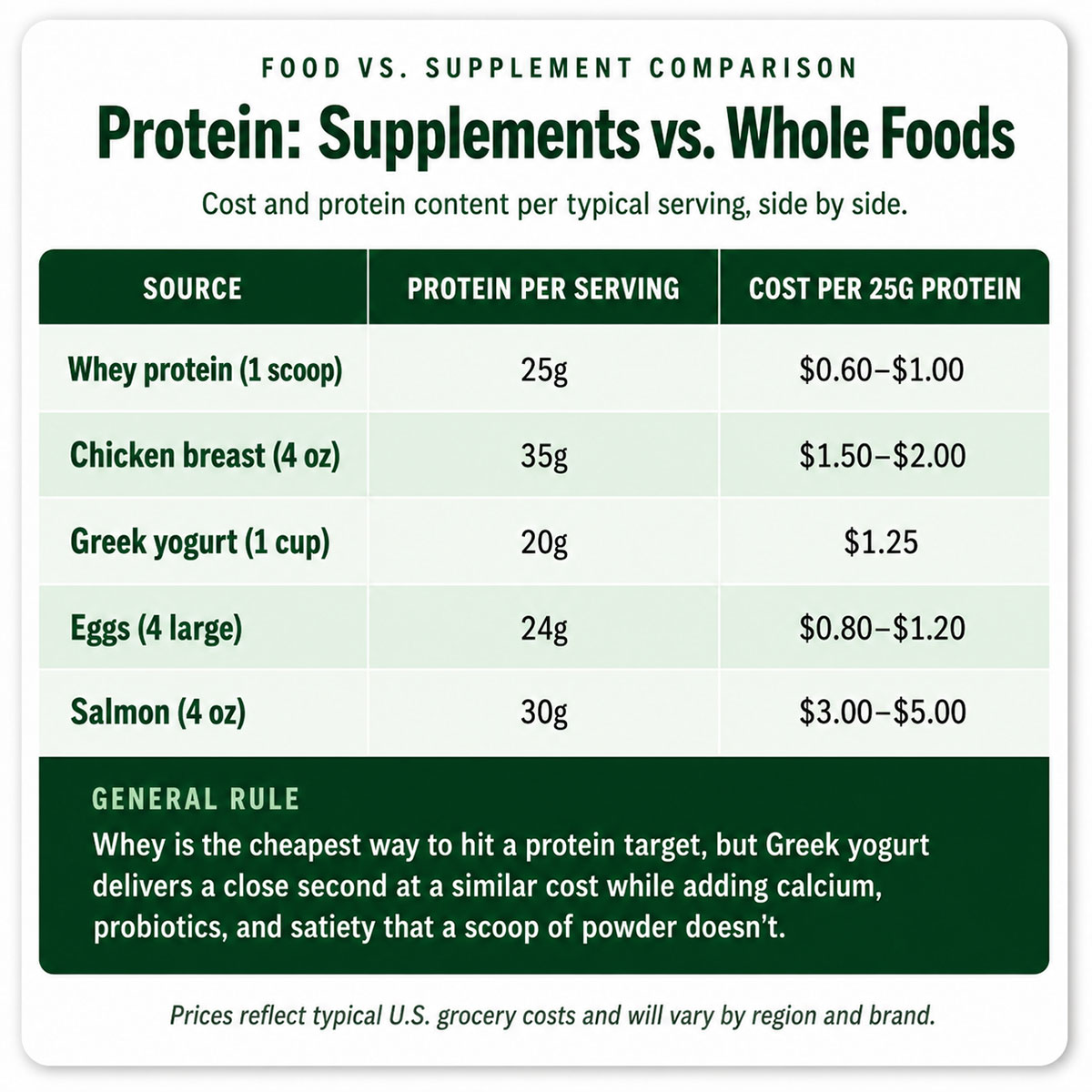
Whole foods should still do most of the work. They carry vitamins, minerals, and fiber that a scoop of powder doesn’t. Greek yogurt is one of the better whole-food options for hitting a protein target without much extra effort, and it shows up in the comparison table below alongside a few other staples.
Best Types
- Whey isolate: fastest absorbing, low in lactose, a strong post-workout pick.
- Whey concentrate: slightly slower to digest, more affordable, a solid all-purpose option.
- Casein: slow-digesting, useful before bed to support overnight recovery.
- Plant-based blends: pea, rice, or hemp protein for anyone avoiding dairy. Look for a complete amino acid profile on the label.
Myth: Protein Powder Damages Your Kidneys
This one doesn’t hold up in people with healthy kidneys. The research on high protein intake in that population consistently finds no measurable harm to kidney function. Anyone with pre-existing kidney disease should still check with a doctor before increasing protein intake substantially, since that’s a genuinely different population with different risks.
High-Protein Recipes That Work
A protein target only matters if you actually hit it. Three quick options:
Post-Workout Power Smoothie
Blend one scoop whey protein, one banana, one cup spinach, one tablespoon almond butter, one cup unsweetened almond milk, 5g creatine monohydrate, and ice. Roughly 35g protein and 400 calories. Three minutes, start to finish.
Overnight Muscle Recovery Oats
Combine one scoop of casein protein, half a cup of rolled oats, one cup of Greek yogurt, one tablespoon of chia seeds, and berries. Mix and refrigerate overnight. About 45g protein and 450 calories.
High-Protein Pancakes
Whisk together one scoop of vanilla whey protein, two eggs, one mashed banana, and half a teaspoon of baking powder. Cook on medium heat. Roughly 40g protein and 380 calories.
The Specialists: Effective, But for the Right Job
These two work. They don’t work for everyone, and pretending otherwise is where a lot of supplement marketing goes wrong.
3. Beta-Alanine: The Endurance Extender
Beta-alanine doesn’t build muscle on its own. What it does is let you do more work before your muscles give out, and more work over time tends to produce more growth.
The mechanism runs through carnosine. Beta-alanine combines with another amino acid to produce carnosine, which buffers the acid that builds up in muscle during intense effort. Less acid buildup means you can keep pushing before fatigue forces you to stop.
The effect is real but modest, according to a 2017 systematic review and meta-analysis in the British Journal of Sports Medicine led by Bruno Saunders that pooled the available evidence on beta-alanine and exercise capacity. It’s most useful for high-intensity efforts lasting somewhere between half a minute and ten minutes.
Sprinting and high-rep training both fall in that window. A max single-rep deadlift does not.
That’s a narrower use case than the marketing usually admits. It doesn’t make the supplement useless. It makes it situational.
This works best for athletes doing high-intensity training. CrossFit competitors, sprinters, and bodybuilders running high-rep schemes tend to benefit most. Pure strength lifters working in low rep ranges get less out of it.
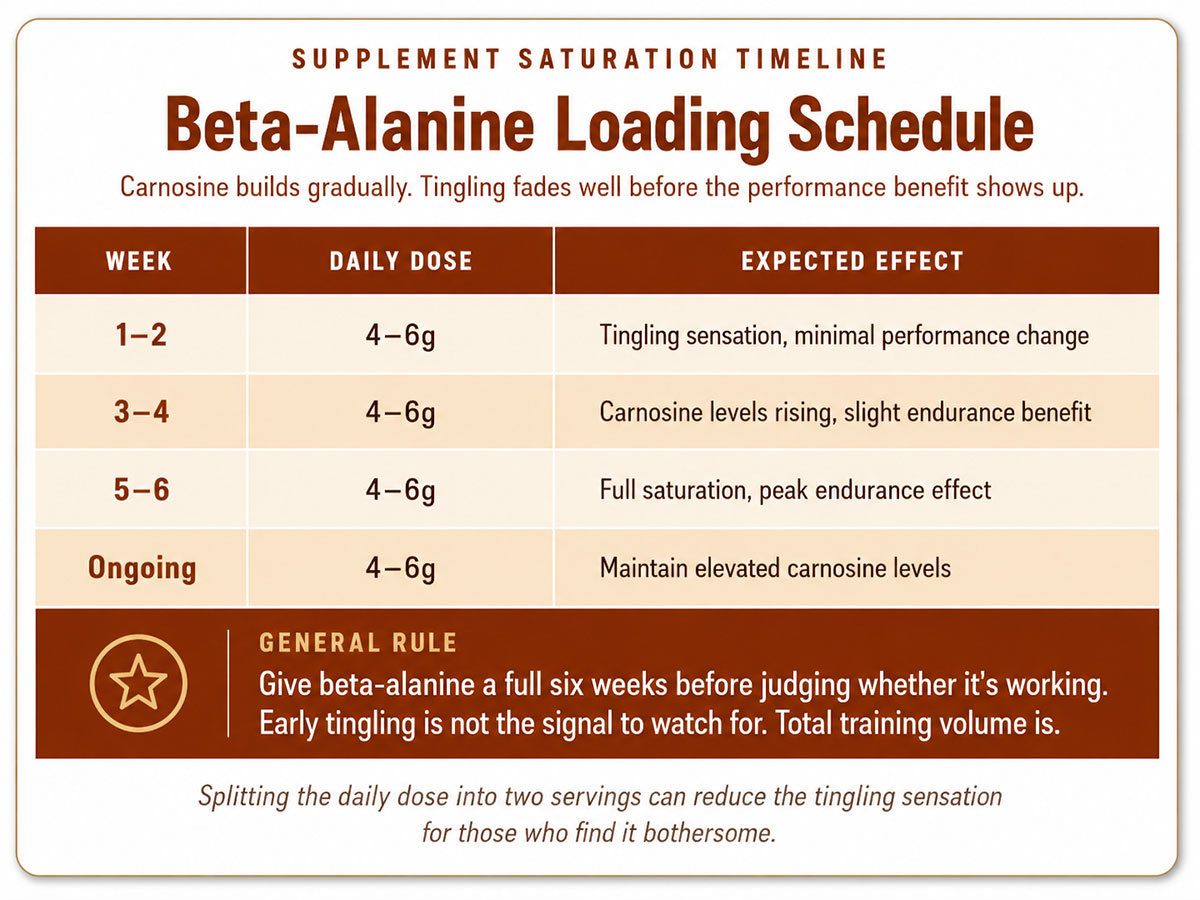
The typical dose is 4 to 6 grams daily. Expect a tingling sensation called paresthesia, which is harmless and usually fades after a few weeks of consistent use.
4. Omega-3 Fatty Acids: The Unsung Hero for Recovery and Growth
Omega-3s get talked about for heart and brain health constantly. Their role in muscle growth gets a lot less attention, and that’s a little strange given what the research actually shows.
Omega-3s are fats found in fish oil, and the two that matter most here are EPA and DHA. They reduce inflammation, and less inflammation generally means faster recovery between hard sessions.
Bettina Mittendorfer’s team at Washington University published a study in the American Journal of Clinical Nutrition in 2015 testing omega-3 supplementation specifically in healthy older adults doing resistance training.
The group taking fish oil showed greater increases in muscle protein synthesis and bigger strength gains than the placebo group. The researchers’ interpretation was that omega-3s make muscle tissue more responsive to the signals that protein and exercise send it, not that omega-3s do the building themselves.
That responsiveness effect shows up most clearly in middle-aged and older adults. Someone younger who already eats fish regularly probably won’t notice much from adding a supplement on top of that.
The Dose
2 to 3 grams of combined EPA and DHA daily. Check the label for actual EPA and DHA content rather than total fish oil weight, since a lot of cheap products pad the number with filler oils.
The Overhyped and Overpriced: Proceed With Caution
This is where the picture gets less flattering for the supplement industry. These three are heavily marketed. The evidence for actual muscle growth ranges from thin to close to nonexistent once your diet is already doing its job.
5. HMB: The Disappointment for Trained Lifters
The marketing pitch is that HMB prevents muscle breakdown and adds gains on top of training. The research tells a much smaller story, and the gap between the two is bigger for HMB than for almost anything else on this list.
HMB is a metabolite of leucine, the amino acid most associated with triggering muscle growth. That mechanism is real. What it doesn’t do is survive contact with people who are already training seriously.
Trained and competitive athletes see close to nothing from it, according to a 2018 meta-analysis in the Journal of Science and Medicine in Sport led by Javier Sanchez-Martinez. Whatever benefit HMB offers shows up mainly in untrained beginners and in older adults trying to prevent muscle loss, not in people who are already training seriously.
The likely explanation is that a well-trained body has already adapted to use the nutrients it’s given efficiently. HMB doesn’t add much on top of a system that’s already running well.
Verdict
Skip it if you’ve been training seriously for a while. If you’re a complete beginner or an older adult specifically trying to prevent muscle loss during illness or inactivity, it might offer a small edge. Even then, protein and creatine remain the better investment.
6. Citrulline Malate: The Pump Provider With Unproven Growth Benefits
The pump is real. Whether it means anything beyond the mirror is a separate question, and it’s the one that actually matters for muscle growth.
Citrulline malate is a popular pre-workout ingredient that raises nitric oxide production, which improves blood flow and produces that pump during a session. The evidence on whether it does anything past that is genuinely mixed, not the quiet disappointment HMB’s evidence is.
Some trials show citrulline reduces fatigue and adds a rep or two. Others show no measurable benefit at all, and the split doesn’t obviously track training status or dose in a way that resolves the disagreement.
Dosing turns out to be part of the story, and it’s a more interesting complication than it first looks. Most commercial pre-workouts include a fraction of the 6 to 8 grams used in the trials that do show a benefit, which means a lot of people dismissing citrulline as useless have never actually taken an effective dose of it.
Performance and growth are not the same outcome, and a supplement can genuinely help one without touching the other.
Verdict
A reasonable pre-workout ingredient for the pump and possibly a small performance edge. Don’t count on it for direct muscle gains, and if you’re taking it, make sure you’re actually getting at least 6 grams per dose rather than a token amount.
7. BCAAs: A Real Effect That’s Smaller Than the Hype
Companies market BCAAs as essential for growth and recovery, which is technically true and mostly beside the point. Leucine, isoleucine, and valine are the three amino acids in question, grouped together because of their chemical structure, and your body genuinely can’t make them. Neither can it make the other six essential amino acids, which is the detail the marketing tends to leave out.
Researcher Sarah Jackman and colleagues at the University of Exeter tested this directly in a 2017 study in Frontiers in Physiology. Trained men who took 5.6 grams of BCAAs after resistance exercise saw muscle protein synthesis rise by about 22 percent compared to placebo.
That’s a real, measurable effect. It’s also roughly half of what the same research group had previously measured from a dose of whey protein containing a similar amount of BCAAs.
That gap took the researchers by surprise. BCAAs alone appear to stimulate growth signaling, not as completely as a full protein source does, which tracks with the incomplete-lineup problem from earlier: three amino acids acting alone can only do so much.
Verdict
BCAAs aren’t a scam. They’re a smaller, more expensive slice of what a scoop of whey already gives you.
If you’re already hitting your daily protein target, adding standalone BCAAs on top adds very little. Put that money into better whey or casein instead.
What’s Your Supplement IQ?
Ten questions on what the research actually supports, not what the label promises.
Supplement IQ Quiz
Test what the research actually supports
Ten questions on muscle-building supplements, built from the studies covered in this article. See how many you get right before checking the answers.
Building and Keeping Muscle After 50: What Changes
Age changes the equation. After 50, muscle becomes more resistant to the growth signals that protein and exercise normally send, a phenomenon researchers call anabolic resistance. The good news is that resistance is not the same as immunity.
The Science of Aging Muscle
A 2019 study in Nutrients looked at muscle protein synthesis in older adults and found they need considerably more protein per meal to trigger the same growth response younger people get from a smaller amount. The figure was roughly 40 grams per meal, compared with 20 to 25 grams for a younger adult.
Age also accelerates muscle loss on its own. After 50, someone who isn’t resistance training can lose 1 to 2 percent of muscle mass every year, a condition called sarcopenia.
Priority Supplements for the Over-50 Crowd
Protein Powder, Even More Critical
Older adults should aim for the higher end of the range, 1.6 to 2.0 grams per kilogram daily, spread across meals at 30 to 40 grams each rather than loaded into dinner alone.
Creatine, an Anti-Aging Ally
A 2021 meta-analysis in Nutrients is worth a look here, since it was specifically built on 22 randomized trials of adults with a mean age between 57 and 70. Older adults who combined creatine with resistance training gained significantly more lean tissue mass and strength than those who trained without it. Creatine’s benefits in this population may extend past muscle into bone density and cognitive function, both of which decline with age.
Omega-3s, Close to Non-Negotiable After 50
The same fish oil research cited earlier in this piece specifically targeted this age group, and the stronger muscle-building response it found doesn’t apply as strongly to younger, already-fish-eating adults.
Vitamin D, the Missing Link
Low vitamin D is common among older adults and has been linked to muscle weakness and higher fall risk in the clinical literature. Getting tested is worth doing before supplementing blindly, and 2,000 to 4,000 IU daily is a reasonable target for someone confirmed deficient.
A Note on GLP-1 Medications and Muscle Loss
A newer question has been showing up alongside the older ones: what happens to muscle when someone loses a large amount of weight quickly on a GLP-1 medication like semaglutide or tirzepatide. The honest answer is that rapid weight loss of any kind, drug-assisted or not, tends to take some lean mass along with the fat unless a person actively works against it.
The defense here isn’t a special supplement. It’s the same foundation this article already covers: enough protein to hit your daily target, resistance training at least two or three times a week, and creatine as a reasonable add-on given its safety profile and its specific evidence in older or weight-losing populations. Anyone on one of these medications should treat protein and resistance training as the priority, not an afterthought to the drug itself.
Training Considerations for Older Adults
Supplements only work on top of training, and training itself needs a few adjustments after 50.
- Longer warm-ups to prepare joints and tendons for load.
- A focus on compound movements like squats and presses rather than isolation work.
- More recovery time between hard sessions than a younger lifter needs.
- Form is prioritized over chasing heavier numbers.
- Mobility work is built into the week to maintain range of motion.
Research on older adults doing structured resistance training consistently finds that meaningful strength and mass gains remain possible well after 50. The rate slows. It doesn’t stop.
The Over-50 Supplement Stack
The Foundation
- Protein powder, one scoop two to three times daily.
- Creatine, 5 grams daily.
- Omega-3s, 3 grams combined EPA and DHA daily.
- Vitamin D, 2,000 to 4,000 IU daily if testing confirms a deficiency.
Optional Additions
- Beta-alanine if doing high-intensity training.
- Collagen, 10 to 15 grams daily, for joint health, though the evidence here is thinner than for the foundation four.
Real Talk for the Over-50 Lifter
You won’t build muscle at the pace of a 25-year-old. That’s biology, not a failure of effort. What you can do is get meaningfully stronger and add real muscle, and the research on this is not ambiguous.
The difference is that you need to be smarter about it than you were at 25. Skipping meals and expecting to grow doesn’t work anymore.
Training hard seven days a week without adequate recovery doesn’t work anymore either. What works is more protein, better sleep, and supplementation applied with some intention instead of guesswork.
Muscle built after 50 does more than look good. It protects bone density, supports a healthier metabolism, and keeps you capable of doing the physical things that matter to you, whether that’s carrying groceries unassisted or keeping up with grandkids at the park. That’s worth more than any pump in the gym.
How to Stack Supplements for Maximum Results
Don’t buy everything on this list at once. Build the stack in stages that match your training experience and your budget.
Level 1: The Foundation (Everyone Should Start Here)
- Creatine monohydrate, 5 grams daily.
- Protein powder, enough to hit your 1.6 g/kg daily target.
These two supplements carry the strongest research backing on this entire list, and they work for beginners and advanced lifters alike. This is the 80/20 of supplementation: most of the benefit, a fraction of the spend.
Level 2: The Performance Tier (Serious Athletes)
- Beta-alanine, 4 to 6 grams daily, split into two doses.
- Omega-3s, 2 to 3 grams combined EPA and DHA daily.
This tier makes the most sense for people training four to six days a week with real intensity, particularly athletes over 40 who benefit disproportionately from the omega-3 effect.
Level 3: The Experimental (Deep Pockets Only)
- Citrulline malate, 6 to 8 grams pre-workout.
- Vitamin D if a blood test confirms deficiency.
The gains here are marginal and partly psychological. Reasonable for someone who has already maxed out training and nutrition and wants to chase every remaining edge.
When to Take What: A Daily Timeline
- Morning, with breakfast: omega-3s, vitamin D if supplementing, and creatine if you’d rather not save it for post-workout.
- Pre-workout, 30 to 60 minutes before: beta-alanine, 2 to 3 grams, and citrulline malate, 6 to 8 grams, if using.
- Post-workout: whey protein, 25 to 30 grams, and creatine, 5 grams, if not already taken.
- Evening, with dinner: omega-3s and beta-alanine.
- Before bed: casein protein, one scoop, optional, if you haven’t hit your daily protein target yet.
Creatine timing genuinely doesn’t matter much. Take it daily and don’t overthink the clock.
Is It Worth It? Cost-Benefit Analysis
Supplements aren’t cheap, so it’s worth being honest about what you’re actually paying for.
The Reality Check
These numbers assume you’re already training hard and eating well. Supplements do nothing without those fundamentals in place.
A gym membership runs $30 to $60 a month. Quality food runs $200 to $400 a month. If those two aren’t locked in yet, supplements are the wrong place to spend next.
In priority order: gym access first, then food, then sleep, which is free but easy to shortchange, then creatine and protein, then everything else only if the budget stretches that far.
Budget Strategies
At $20 a month, buy creatine and get protein from whole foods. At $50, add a basic whey protein to the creatine. At $100 or more, layer in beta-alanine and omega-3s and consider buying in bulk.
Buy unflavored protein where possible, since it’s cheaper and mixes into more things. Buy creatine in bulk, since a 5kg bag lasts months. Skip proprietary blends entirely, since they exist to obscure dosing rather than to help you.
Your Supplement Strategy by Experience Level
Complete Beginner (0 to 6 Months Training)
Priorities in order: proper form, consistent training three to four days a week, and hitting 1.6 g/kg of protein from food. Protein powder is fine for convenience. Everything else can wait.
Beginners respond to almost any training stimulus, which means rapid progress without supplements. Add supplements once that progress starts to slow.
Intermediate (6 Months to 2 Years)
Once training and eating are consistent, creatine becomes the logical first purchase, followed by protein powder as needed. Beta-alanine is worth considering for anyone doing high-intensity or high-volume work. HMB, BCAAs, and most pre-workouts still aren’t worth the money at this stage.
Advanced (2-Plus Years)
The foundation stays the same: creatine daily, protein at 1.6 to 2.0 g/kg. Beta-alanine, omega-3s, and vitamin D become reasonable fine-tuning additions. Citrulline and different protein sources are worth experimenting with if the budget allows and curiosity is genuine.
At this level, most further progress comes from training and nutrition refinement rather than a new supplement. Periodization and deload weeks matter more than anything on this list.
Quality and Safety: What to Look For
Not all supplements sitting on the same shelf are created equal.
Third-Party Testing to Look For
NSF Certified for Sport tests for banned substances and verifies label claims, and it’s the standard most professional athletes rely on. Informed-Choice runs batch-by-batch testing and is common on UK and European products. USP Verified checks purity, potency, and manufacturing practices independently.
Pieter Cohen’s research group at Harvard Medical School published a 2023 analysis in JAMA Network Open that tested 57 sports supplements marketed with botanical performance ingredients. Twelve percent contained at least one FDA-prohibited substance not listed on the label, and close to 40 percent of the products missed their labeled dose by more than 10 percent.
That took the researchers by surprise, given how routine third-party certification has become in the industry. If you’re a tested athlete, certification isn’t optional. For everyone else, it’s still the smarter default.
Red Flags to Avoid
- Proprietary blends that hide exact ingredient doses behind a single combined number.
- Claims like “build 20 pounds of muscle in 4 weeks,” which is a lie whenever you see it.
- Celebrity endorsements standing in for actual research.
- Prices so low that they imply corners were cut somewhere in manufacturing.
- Pre-workouts with 30-plus ingredients, most in doses too small to matter.
- Unverified third-party sellers, since counterfeit products remain a real problem on open marketplaces.
How to Read a Supplement Label
- Check the serving size against realistic use. Some products need six capsules to hit an effective dose.
- Confirm the active ingredients list and exact amounts you can compare against research doses.
- Scan other ingredients for allergens, artificial sweeteners, or unnecessary fillers.
- Look for a manufacturer’s address and phone number you could actually use.
- Check for a lot number and expiration date, which allow batch tracking if something goes wrong.
The Smart-Growth Blueprint: Your Action Plan
The Winners: Start Here
Creatine and protein powder remain non-negotiable if you’re serious about results. Hundreds of studies back them. They work across almost every population studied, and they’re both safe and affordable.
The Specialists: Add These Next
Add beta-alanine and omega-3s once you’ve used creatine and protein consistently for three-plus months, you’re training hard four or more days a week, and your budget has room. Omega-3s matter more the older you get.
The Overhyped: Skip These
HMB, citrulline malate, and BCAAs are heavily marketed and thinly supported. Each might help in a narrow situation. For most lifters with an adequate diet, they’re a lower priority than almost anything else on this list.
Your Foundation First
Before any of this, lock in the fundamentals: progressive overload, three to five resistance sessions a week, 1.6 to 2.0g/kg of protein, mostly whole foods, 7 to 9 hours of sleep, and consistency measured in months rather than days. Supplements build on a good foundation. They don’t fix a missing one.
Expected Timeline and Results
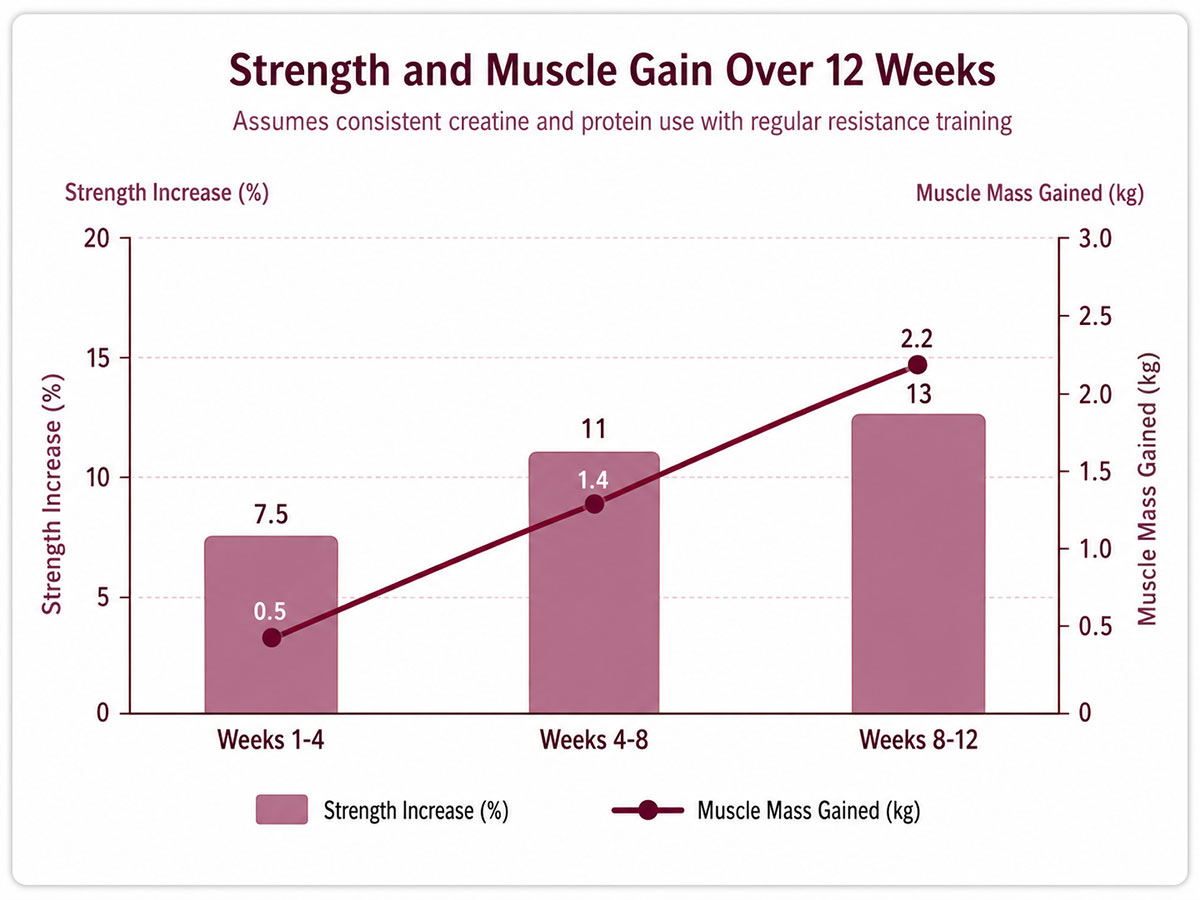
Weeks 1 to 4: creatine loading is complete, a pound or two of water weight shows up, and strength climbs 5 to 10 percent if protein intake is on target.
Weeks 4 to 8: strength gains continue, beta-alanine reaches full saturation if you’re using it, and visible muscle changes start showing up for lifters with training and nutrition dialed in.
Weeks 8 to 12: strength typically sits 10 to 15 percent above baseline, and measurable muscle gain in the 1 to 3 kilogram range is realistic for someone training with real intensity.
These timelines assume consistent training and adequate nutrition throughout. Genetics, training age, and effort all shift the actual numbers, sometimes considerably, and a longer, more realistic breakdown of what to expect month by month lives in a separate piece worth reading before you get discouraged at week six.

Your Evidence-Based Supplement Checklist
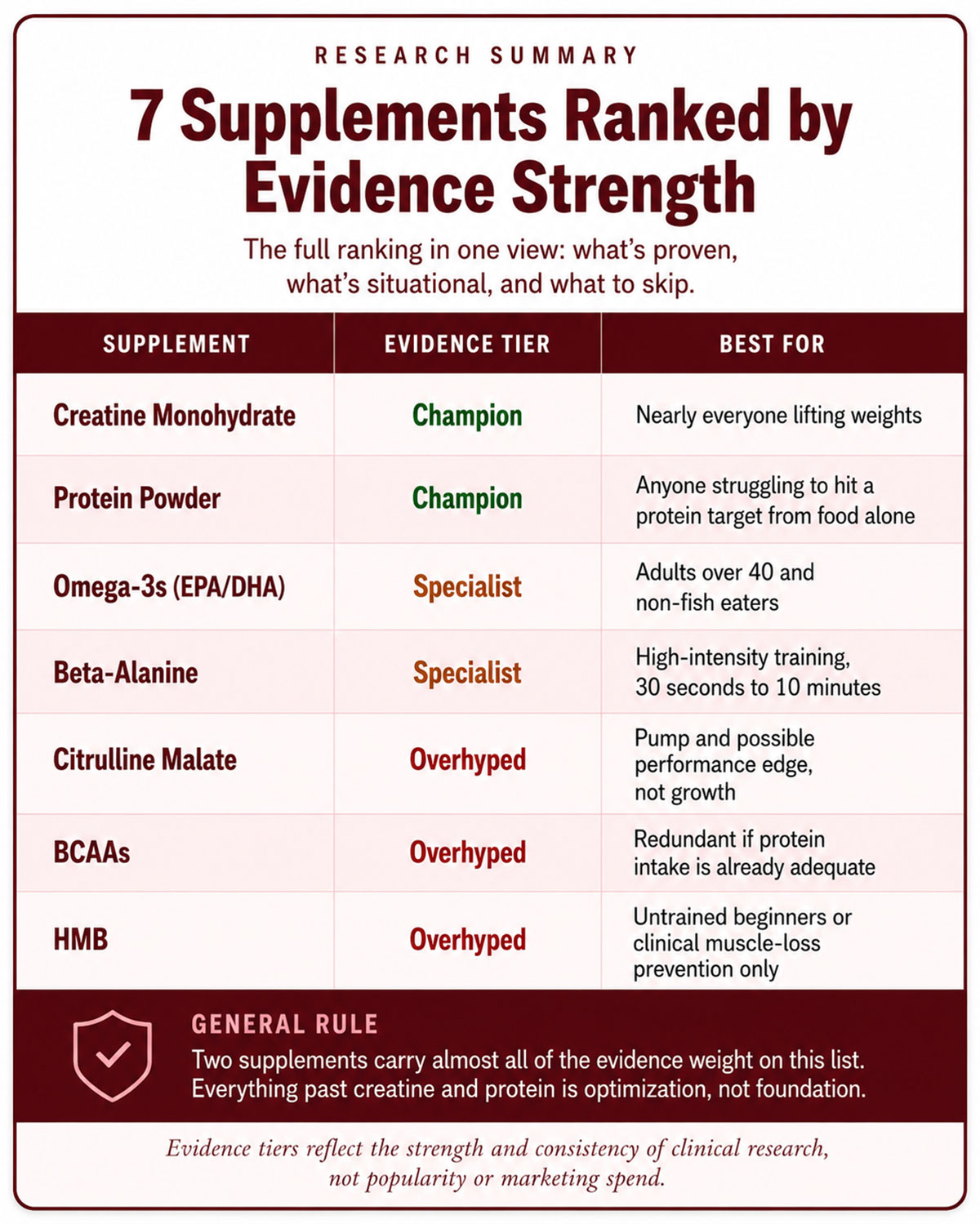
Monthly Investment Totals (Approximates based on 2026 prices)
Essential only: $40 to $75. Essential plus specialists: $75 to $130. Everything useful included: $90 to $155.
Supplements are the cherry on top, not the cake. Training hard, eating well, and sleeping enough is the cake.
Frequently Asked Questions
Can I take all these supplements together?
Yes. Creatine, protein, beta-alanine, and omega-3s can be combined safely with no known negative interactions. Start with creatine and protein, then layer in the rest gradually.
Do supplements work if I don’t train hard?
No. Every supplement on this list works by building on a training stimulus that has to already exist. Without consistent resistance training, they’re close to worthless.
How long before I see results?
Creatine: 2 to 4 weeks for strength gains, with some water weight showing up in week one. Protein: 6 to 8 weeks for visible muscle change, though recovery improves faster than that.
Beta-alanine: 4 to 6 weeks to full saturation. Omega-3s: 8 to 12 weeks before inflammation and recovery markers shift meaningfully.
Are supplements safe for women?
Yes, and the research includes both sexes for creatine and protein specifically. Creatine doesn’t produce masculine features, and protein doesn’t cause unwanted bulk. Dosing for creatine tends to be the same absolute amount regardless of sex, 5 grams daily, while protein needs scale with body weight rather than gender.
Will creatine make me bloated?
You might retain a pound or two of water, but it’s intramuscular water sitting inside muscle cells, not the subcutaneous kind that makes you look puffy. If you notice stomach discomfort, try taking creatine with food or splitting the dose across the day.
Do I need supplements if I’m vegetarian or vegan?
Creatine is worth prioritizing here specifically. Dan Burke and colleagues published a 2003 study in Medicine and Science in Sports and Exercise showing that vegetarians start with lower baseline creatine levels than meat-eaters, since dietary creatine comes almost entirely from animal sources.
That lower starting point means vegetarians tend to see a larger jump in muscle creatine content, and often a larger performance benefit, once they start supplementing. Plant-based protein blends combining rice and pea protein can round out an amino acid profile that single plant sources often miss.
Can teenagers take these supplements?
Protein powder is food in a different form and is fine for teenagers who train seriously. Creatine is generally considered safe for teens aged 13 and older who train under proper supervision, a position the International Society of Sports Nutrition has supported since its original 2007 stand on creatine safety and reaffirmed in its 2017 update.
Whole foods should still come first for a growing body, with supplements filling specific gaps rather than replacing meals. Parents with concerns should check with a doctor and start conservatively.
What about pre-workout formulas?
Most pre-workouts are caffeine plus small, often underdosed amounts of the ingredients already covered here. Buying the individual components separately is usually cheaper and lets you control the actual dose, especially for beta-alanine and citrulline, which frequently show up at a fraction of an effective amount in commercial blends.
Will supplements help me lose fat?
Not directly. Everything here builds or preserves muscle, and more muscle raises metabolism slightly, but the effect is small.
Protein helps indirectly by keeping you full and preserving lean mass during a calorie deficit. Fat loss itself still comes down to a sustained calorie deficit, adequate protein, resistance training, and sleep.
How do I know if a supplement is working?
Track something objective. Creatine progress shows up as heavier weight on the bar and higher rep counts. Protein progress is easier to see in body composition and recovery between sessions than on the scale.
Beta-alanine is different. Watch total training volume and how much work you can do before hitting failure. Photos and measurements taken every four weeks beat relying on how you feel day to day.
Can I take creatine if I’m trying to look lean?
Yes. The water retention is intramuscular, which makes the muscles look fuller rather than bloated, and plenty of physique competitors take it year-round. Some drop it briefly before a photo shoot or competition, but for everyday leanness, there’s no reason to stop.
What if I miss a day of supplements?
Not a problem. Creatine builds up in muscle over time, so one missed day doesn’t undo weeks of consistent use.
Protein is about hitting your daily total, so missing a shake but eating extra chicken later still gets you there. Consistency beats perfection by a wide margin.
Are there any supplements that actually burn fat?
Most fat burners are caffeine plus unproven extras. Caffeine does raise metabolism slightly, worth maybe an extra 50 to 100 calories a day, roughly one apple.
The ingredients that historically did show a stronger effect, like ephedrine, are banned for safety reasons. Quality food and consistent training remain the better investment.
Should I cycle supplements?
Creatine and beta-alanine don’t need cycling since the body doesn’t build tolerance to either. Protein is food, so cycling doesn’t apply, and omega-3 benefits are cumulative rather than dependent on a break.
The cycling idea mostly comes from anabolic steroid use, where it serves a genuinely different biological purpose that doesn’t apply to anything on this list.
What about supplement timing around workouts?
Pre-workout, 30 to 60 minutes out: caffeine if you use it, beta-alanine, citrulline if using. During training, water matters more than anything else, and BCAAs add little if you already ate protein beforehand.
Post-workout, within two to three hours: protein and creatine. Total daily protein intake still matters more than hitting a precise window, since research on the so-called anabolic window has widened that timeframe considerably from the 30-minute rule that used to circulate.
What builds muscle the fastest?
Progressive overload in training, not any single supplement. Add weight, reps, or sets over time, hit your protein target consistently, and sleep enough to recover. Creatine and protein powder are the two supplements that meaningfully speed that process up, and neither one works without the training driving it.
What are the “big 5” supplements?
The phrase usually refers to creatine, whey protein, beta-alanine, citrulline, and caffeine, the five most commonly stacked pre- and post-workout ingredients in commercial products. This article ranks seven instead of five because it separates omega-3s and HMB out for a fuller picture, and because two of the “big 5,” citrulline and caffeine-adjacent pre-workout ingredients, land in the overhyped-for-growth category here even though they’re popular for performance.