Daily kefir did not affect every gut the same way. The biggest improvements appeared in one group, while others saw surprisingly little change.
Kefir is sold as a gut reset in a bottle. The most carefully controlled human trials tell a different story. When researchers gave healthy adults kefir every day for a month and sequenced their gut bacteria, the unexpected result was how little shifted on the measures most people assume it changes.
That is not the whole picture, and the gap between the marketing and the measurements is where this gets interesting. Kefir does change the gut. It just does not change every gut the same way, and the people it helps most are not always the ones the label is aimed at.
Here is what four weeks of daily kefir does to your digestive system, what the research can actually back, and where the honest answer is still “we don’t fully know yet.”
The Science Behind Kefir’s Unique Makeup
What Makes Kefir Different From Yogurt
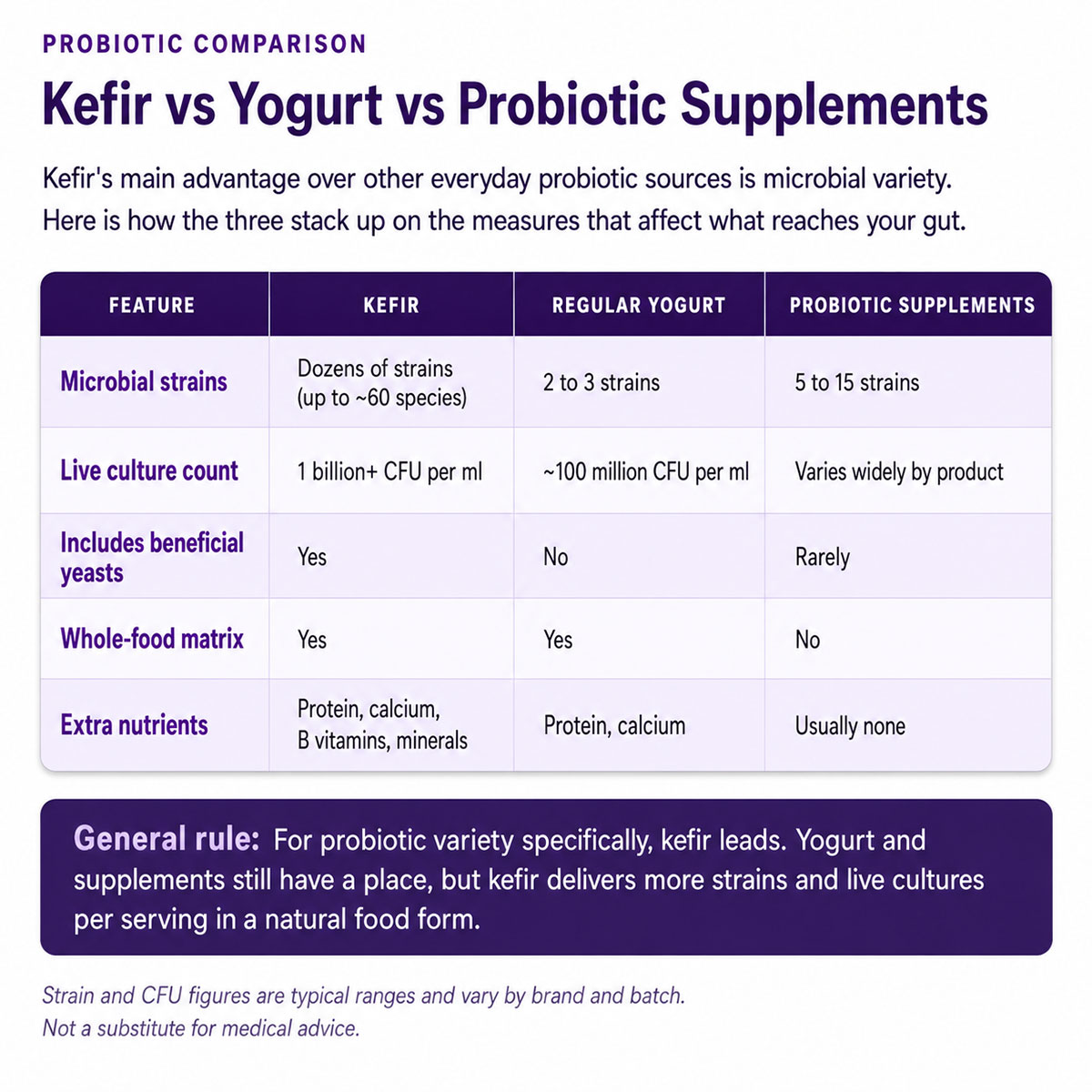
Kefir is not simply a thinner yogurt. A single serving can carry a wide mix of bacteria and yeasts, with some analyses identifying dozens of distinct microbial species in traditional grains. Regular yogurt usually relies on two or three.
That diversity is the headline. Kefir grains commonly contribute species such as Lactobacillus kefiranofaciens, Lactobacillus kefiri, and a range of Lactococcus and yeast strains, alongside the lactic acid bacteria you would also find in cultured milk.
What Kefiran Actually Does
Kefir grains produce a soluble fiber called kefiran. In laboratory and animal studies, kefiran has shown anti-inflammatory and gut-supportive activity, and it helps give the grains their structure. Its role in humans is still being mapped, so treat it as a promising compound rather than a proven active ingredient.
Getting the Dose Right Before You Start
Why You Should Not Start With a Full Glass
Your gut already holds trillions of microbes. Adding a concentrated dose of new ones overnight is the fastest route to a few uncomfortable days. Start small and build up.
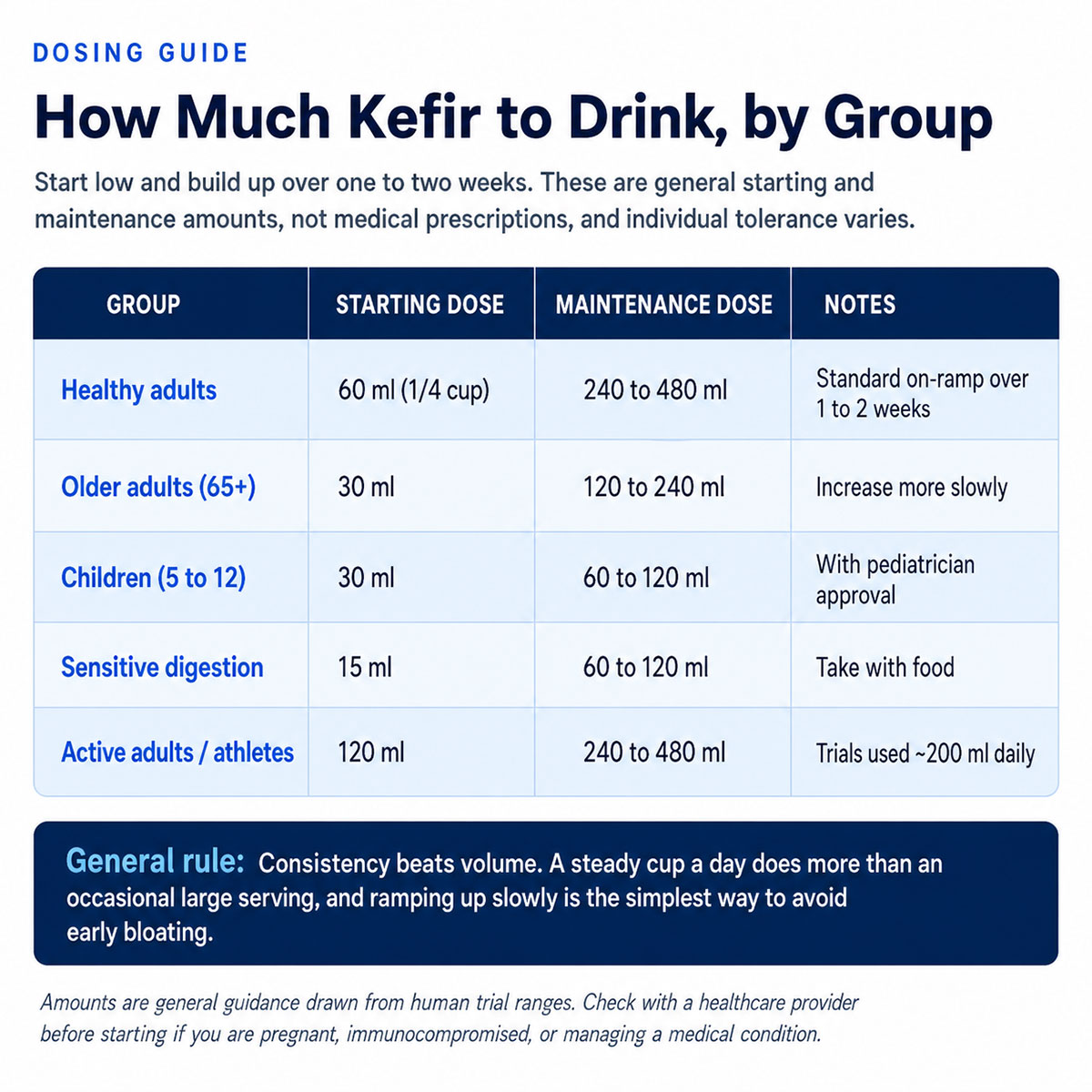
A gentle on-ramp works for most people. Begin with about a quarter cup (60 ml) for the first three days, move to half a cup (120 ml) through the end of week one, then step up toward three-quarters of a cup in week two and a full cup (240 ml) by weeks three and four. Maintenance for most adults sits at one to two cups a day.
Human trials have used a wide dose range. The studies reporting clearer effects often used 400 to 500 ml daily across several weeks, while smaller daily amounts of 100 to 180 ml have also been tested. More is not automatically better, and consistency matters more than volume.
🎯 Gut Health Baseline Assessment
Discover your current gut health status before starting your kefir journey
Week 1: Your Gut Meets the New Arrivals
What the First Few Days Feel Like
When you start drinking kefir, you are introducing new microbial residents to an established community. Some people notice nothing. Others feel gassy or bloated for the first few days.
That early discomfort is usually the gut adjusting, not a warning sign. It tends to settle within a week as your system adapts to the steady supply of live cultures.
One of the clearer early-stage findings comes from people with gut disease rather than healthy volunteers. In a 2019 randomized trial in the Turkish Journal of Gastroenterology, patients with inflammatory bowel disease drank 400 ml of kefir daily for four weeks. Their stool Lactobacillus levels rose, and they reported less abdominal pain and a better sense of well-being over the short term.
Week 2: Digestion Starts to Settle
By the second week, most regular drinkers report that the early bloating has eased and digestion feels steadier. Bowel habits often become more predictable as the lactic acid bacteria establish themselves.
Here is the part that is harder to square with the marketing. In a 2023 study in npj Science of Food, healthy adults drank traditional kefir every day for 28 days, and researchers sequenced their gut bacteria before and after. Overall microbial diversity did not change in any significant way, and none of the clinical markers shifted either. The one consistent effect was a rise in a single kefir-associated species, Lactococcus raffinolactis, in a subset of participants.
That result matters more than its size suggests, because of who was in the study. These were healthy adults with no digestive complaints, which is exactly the profile of someone reading an article about what kefir does to a healthy gut. For that person, week two on paper may not look much different from week one. The takeaway is not that kefir does nothing. It is that in an already-balanced gut, the measurable changes are subtle and often limited to a few species rather than a wholesale remodel.
Week 3: Where the More Interesting Changes Appear
The Bacteria Worth Knowing About
Two species come up repeatedly in the kefir research, and both matter for the gut lining.
Akkermansia muciniphila feeds on the mucus layer that coats the intestinal wall, and higher levels are associated with a stronger gut barrier. Faecalibacterium prausnitzii produces butyrate, a short-chain fatty acid that helps reduce inflammation in the gut and is linked to better metabolic health.
Both showed up in a 2025 trial in Nutrients that followed professional female soccer players. Twenty-one athletes drank 200 ml of kefir daily for 28 days. The kefir group showed greater microbial diversity and higher levels of these two short-chain-fatty-acid producers, and those increases tracked with better endurance test scores.
It is a small, single-team study, and that is worth keeping in mind. But the same two species, Akkermansia and Faecalibacterium, are the ones that came up in the IBD and metabolic-syndrome trials discussed elsewhere in this article. Three different studies, in three very different groups, keep landing on the same pair of bacteria. That kind of repetition across unrelated trials is one of the more convincing signals in this body of research, even though no single study proves much on its own.
Week 4: A New Baseline, With Limits
The Gut Barrier and the Metabolome
After four weeks, many people have reached a steadier baseline. A healthier gut lining does two jobs at once, blocking harmful substances from crossing into the bloodstream and supporting more measured immune activity.
Kefir can also nudge the metabolome (the full set of small molecules your body produces). The same npj Science of Food trial from week two found that the rise in Lactococcus raffinolactis corresponded to shifts in participants’ urine metabolome. Even where the headline result was “no significant change,” something downstream still moved.
How Solid Is the Four-Week Evidence?
This is the part many kefir articles skip. The human research is genuinely mixed, and a 2025 review in Nutrients on kefir and the human gut and oral microbiome said so plainly: high-quality clinical trials are still limited, and effects depend heavily on who is drinking it.
A 2026 overview in the journal Healthcare went further. After pooling 28 human clinical trials of kefir, the authors concluded that the drink shows promise for gut bacteria, metabolic markers, inflammation, and digestion, but that the strength of the evidence stays limited because studies differ so much in their kefir dose and duration. The honest conclusion is that kefir is plausible on many fronts and proven on very few.
The pattern across studies is consistent in one way. Kefir tends to produce the clearest changes in people whose gut balance is already disrupted, and the smallest changes in healthy adults. Researchers still do not agree on how long the introduced microbes persist once you stop drinking it. The honest answer is that nobody has measured that well yet.
Beyond the Gut: What Else the Research Suggests
Heart and Metabolic Markers
Kefir’s effect on metabolic health has been tested directly. In a 2019 metabolic syndrome trial in Nutrients, patients drank kefir or unfermented milk for several weeks. The kefir group showed shifts in gut bacteria, though most clinical metabolic markers did not improve significantly more than they did with plain milk. The cardiovascular promise is real enough to study and not yet strong enough to be called proven.
Immune Activity
Kefir produces compounds that suppress some illness-causing bacteria, including E. coli and Salmonella. In laboratory conditions, these effects can rival antibiotics against specific organisms, and unlike antibiotics, kefir does not wipe out beneficial bacteria along the way. That distinction holds in the lab, but it has not been shown to treat infection in people, so it is a mechanism worth knowing rather than a home remedy.
Inflammation
The probiotics in kefir produce short-chain fatty acids that could lower inflammation in the gut, which is one proposed route to easing conditions such as arthritis flare-ups, allergies, and some skin problems. The evidence here is strongest at the level of gut markers and weakest at the level of treating named diseases.
🥛 Kefir Starter Calculator
Your Personalized Kefir Protocol
*These recommendations are for educational purposes. Consult your healthcare provider before making significant dietary changes.
Making Your Own Kefir at Home
A Simple Starter Method
Homemade kefir is cheaper than store-bought and lets you control the ingredients. You need live kefir grains, milk, a glass jar, and a plastic strainer.
- Place 1 to 2 tablespoons of kefir grains in a clean glass jar.
- Add 2 cups of milk and stir gently.
- Cover with a cloth or a loose lid to let air move.
- Leave at room temperature for 12 to 24 hours, away from direct sunlight.
- Strain through a plastic strainer into a clean container.
- Save the grains to start the next batch.
Homemade batches often carry a wider range of strains than commercial versions and cost a fraction as much per cup. The trade-off is upkeep, since the grains need feeding every day or two. Store-bought kefir is more convenient, keeps longer, and still delivers live cultures when it carries a “live and active cultures” label.
Easy Ways to Use Kefir
Plain kefir is tart, so most people prefer to work it into something. A breakfast smoothie is the simplest option: blend one cup of kefir with berries, a tablespoon of ground flaxseed, and a handful of spinach for fiber that feeds the bacteria you are adding.
It also works layered with oats and fruit as an overnight parfait, or stirred with a little ginger and honey for a gentler drink if your stomach is sensitive. Keep the heat low or absent, because high temperatures kill the live cultures.
Side Effects and How to Handle Them
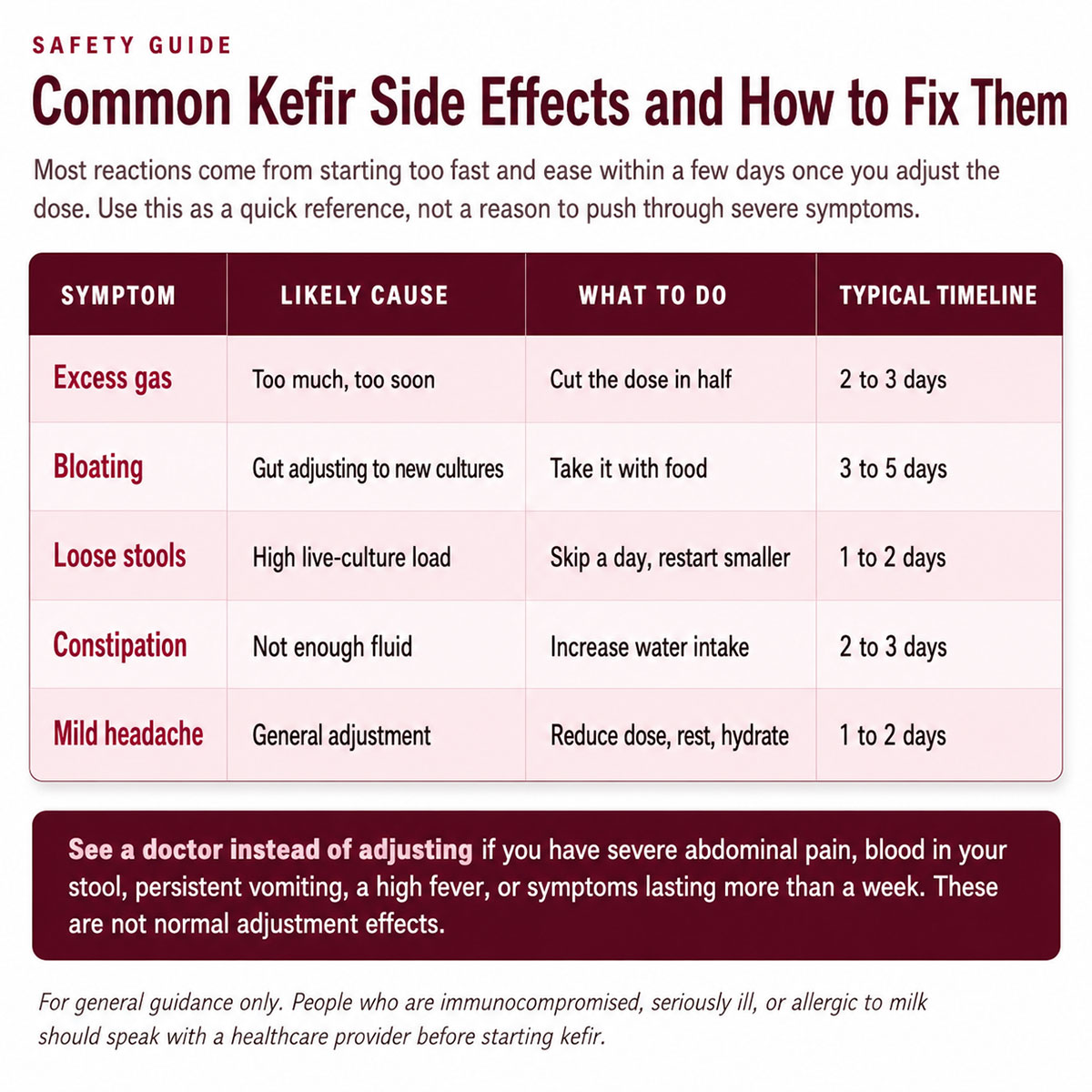
Most side effects are mild, temporary, and tied to starting too fast. The common ones are digestive: gas, bloating, mild cramping, and looser or firmer stools as your gut adapts. They usually settle within about a week, and cutting the dose tends to resolve them in a day or two.
Three Effects the Marketing Rarely Mentions
Fermentation produces a trace amount of alcohol, usually under one percent. It is negligible for most people, but anyone in recovery from alcohol use or highly sensitive to it may want to factor that in.
Kefir is also naturally high in histamine, as fermented foods tend to be. People with histamine intolerance can react with headaches, flushing, or digestive upset, and for them, a low-histamine probiotic may sit better than kefir.
Blood sugar is the third. Plain kefir has a low glycemic index, yet research has noted a relatively high insulinemic response, meaning it can prompt an insulin rise out of step with its sugar content. Flavored versions compound this with added sugar. If you manage diabetes, choose plain kefir and keep an eye on your own readings.
When to Speak to a Healthcare Provider
Stop and contact a doctor if you notice severe abdominal pain, blood in your stool, persistent vomiting, a high fever, or symptoms that last longer than a week. These are not normal adjustment effects.
Medication Interactions to Watch
Take kefir at least two hours apart from antibiotics, since the timing protects both the drug and the cultures. If you take blood sugar medication, monitor your levels, because fermented foods can affect them. Anyone on immune-suppressing drugs should check with their doctor before starting.
Kefir for Specific Groups
Lactose Intolerance
Many people who react to milk tolerate kefir well, because fermentation breaks down much of the lactose. Start with a small amount to test your own response, and switch to water kefir if dairy still causes trouble.
Pregnancy and Breastfeeding
Pasteurized kefir is generally considered safe during pregnancy and nursing, and the cultures may support the baby’s developing gut. Choose pasteurized products and confirm with your healthcare provider first.
Children and Older Adults
Both groups can benefit from kefir’s cultures, with smaller starting doses and a lookout for any reaction. For young children, get a pediatrician’s approval before making it a daily habit.
Water Kefir: The Dairy-Free Option
Water kefir uses different grains that ferment sugar water rather than milk. It delivers live cultures without dairy, which suits vegans and anyone avoiding milk, and it tends to be lighter and lower in calories.
The trade-off is that water kefir carries fewer bacterial strains and far less protein than milk kefir. It is a reasonable alternative for the probiotics, not a nutritional match.
How to Choose a Good Kefir
The label tells you most of what you need. Look for “live and active cultures,” a short ingredient list, minimal added sugar, and a recent date, and confirm it has been kept cold.
Skip products built on high-fructose corn syrup, artificial sweeteners and flavors, heavy thickeners, or long ingredient lists. Plain, whole-milk kefir with two or three ingredients is usually the strongest choice, and a count of at least one billion CFU per serving is a reasonable floor.
Tracking Your Own Response
Numbers in studies are averages. Your own experience is the measure that matters, so it helps to note a few things as you go: how regular your digestion is, how you feel after meals, your energy through the afternoon, and your sleep.
Check in weekly rather than daily. Gut changes are gradual, and checking too often turns normal day-to-day variation into false alarms.
Is Kefir Safe to Drink Long-Term?
For most healthy adults, daily kefir appears safe over extended periods, and many people drink it for years without trouble. The cultures in fermented dairy have a long history of human use, and the doses used in research sit well within everyday amounts. Clinical trials have run daily kefir for several months at a time without flagging safety concerns, which is reassuring even if those studies were not designed to track decades of use.
There are sensible limits. Flavored versions can carry a lot of sugar, so plain is the better daily option. People with weakened immune systems, serious illness, or a true milk allergy should treat kefir as something to clear with a doctor rather than a default. Long-term human data is still thinner than the enthusiasm around kefir suggests, which is a reason for steady, moderate use rather than mega-doses.
Getting More From Your Daily Glass
Kefir works better alongside the foods its bacteria feed on. Pairing it with prebiotic fiber from fruit, vegetables, and beans gives the cultures something to eat, and combining it with other fermented foods widens the range of microbes you take in.
Timing is flexible. Many people drink it in the morning on an empty stomach, though taking it with a meal can ease digestion if mornings leave you queasy. The best time is the one you will actually keep to every day.
The Honest Bottom Line on Kefir
The lesson buried in the kefir research is about starting points. The drink does change the gut, but how much you notice depends on how balanced things were to begin with. People whose digestion was already steady tend to register the smallest shift, while those whose balance was off have the most to gain.
That is worth thinking about. If your digestion has been fine for years and you are curious whether kefir will do something noticeable, the honest answer is probably not much, and that is fine. But if you read this article because something has felt off, after a course of antibiotics, through a stretch of IBS, during a period of stress, you are closer to the people in the studies where kefir made a real difference. The same glass means something different depending on which of those you are.
That reframes the question. Kefir works less like a cure that lands the same way for everyone and more like an input whose payoff scales with need. For a healthy adult, it is a low-risk, nutrient-dense habit with a gentle upside. For someone whose gut has been struggling, the evidence is more promising. Either way, the honest expectation is steady support for the bacteria you want, not a remade microbiome. Drink it as a good habit, and judge it by your own response.
FAQs
What happens when you first start drinking kefir?
Reactions split two ways. Some people feel nothing and simply carry on. Others get mild gas, bloating, or looser stools for the first few days as the gut meets a concentrated dose of new cultures. Starting with a quarter cup and building up slowly is the simplest way to land in the first group.
Should you drink kefir in the morning or at night?
Morning on an empty stomach is a common choice and may help the cultures reach the gut before food. If that leaves you uncomfortable, take it with a meal or in the evening. Either works, so pick the time you will stick with.
Is Greek yogurt or kefir better for your gut?
Kefir generally carries more microbial diversity and higher live-culture counts than yogurt, plus beneficial yeasts that yogurt lacks. Greek yogurt has its own strengths, including high protein. For probiotic variety specifically, kefir has the edge.
Is supermarket kefir any good?
Yes, provided it has been kept cold and the label lists “live and active cultures.” Plain versions with short ingredient lists are best. Budget and store-brand options can still deliver live cultures, so check the label rather than the price.
Is there a downside to drinking kefir?
Beyond the short adjustment period, the downsides are specific rather than general. Flavored versions can be high in added sugar, the lactose still bothers very sensitive people, and the trace alcohol and histamine from fermentation can affect a small group. Very large daily amounts can also keep the gut unsettled. For most people, plain kefir in moderate servings sidesteps all of these.
How long do kefir side effects last?
For most people, the early gas, bloating, or stool changes settle within about a week as the gut adjusts. If you reduce the dose, they often ease within a day or two. Anything that persists beyond a week, or that feels severe, is worth raising with a doctor rather than waiting it out.
Who should not drink kefir?
People with a true milk allergy, a severely weakened immune system, or serious acute illness should check with a healthcare provider first. Those with severe lactose intolerance may do better with water kefir or a lactose-free version.
Do doctors and gastroenterologists recommend kefir?
Many gastroenterologists view kefir favorably as part of general gut care and after antibiotics, while noting the evidence is still developing. A 2024 ICU trial in BMC Medicine found kefir safe and feasible in critically ill patients, which supports its safety profile in a fragile group.
Is kefir good for you, according to the NHS?
The NHS does not single out kefir by name, but it supports including fermented foods as part of a varied diet for gut health. Kefir fits that general guidance.
Is kefir good for IBS?
It can help some people with IBS by supporting bacterial balance, but the lactose may worsen symptoms in others. Start with 15 to 30 ml, consider lactose-free or water kefir, and ask your gastroenterologist for advice specific to your triggers.
Can kefir heal the gut lining?
Kefir supports the gut lining indirectly, through bacteria that produce butyrate and other short-chain fatty acids that strengthen the intestinal barrier. It is a contributor to gut-lining health rather than a standalone cure.
What does kefir do to your bowel movements?
Most people find that their bowel habits become more regular within one to two weeks. Some notice looser stools at first, which usually normalizes as the gut adjusts. Persistent changes are worth raising with a doctor.
Is it OK to drink kefir every day?
For most healthy adults, yes, and daily use is how the research is usually set up. The main exception is people with a weakened immune system, who should clear it with a doctor first, since live cultures carry a small infection risk in that group. Otherwise, the only real rule is to settle on an amount your gut tolerates.
What should you not mix with kefir?
Avoid adding kefir to hot food or drinks above about 110°F (43°C), since heat kills the cultures. Keep it at least two hours away from antibiotics. Fruit and other cold ingredients are fine.
Is Yeo Valley or Aldi kefir any good?
UK options, including Yeo Valley and Aldi’s own-brand kefir, can be solid choices when they list live cultures and keep added sugar low. Check the label for “live and active cultures” and a short ingredient list, which matters more than the brand name.
Does kefir help with inflammation?
Kefir’s cultures produce short-chain fatty acids associated with lower gut inflammation, and some studies link regular fermented-food intake to reduced inflammatory markers. The effect is most consistent at the level of gut markers rather than treating specific inflammatory diseases.
Can kefir cause liver damage?
There is no evidence that kefir harms the liver in healthy people. If anything, some early research points the other way, with fermented dairy studied for possible benefits to liver markers. The query usually comes from confusing kefir with alcohol or high-sugar drinks. Plain kefir is neither. If you have existing liver disease, run any dietary change past your doctor.