Everyone has a moment of self-doubt. For some people, that doubt fades by bedtime. For others, it’s still running at 3:00 AM, louder than ever.
What separates these two groups isn’t willpower. It isn’t confidence, either. The real gap lies in something most people have never heard of, and something that almost no mainstream advice addresses.
Popular self-help tells you to “think positive.” Research says that backfires. When you force a positive thought on top of genuine doubt, your brain notices the conflict. It flags it as unresolved. The loop starts again.
The real driver is what you believe the doubt means, and what you believe overthinking will do about it. Psychologists call these metacognitive beliefs, and they’re the one factor almost no one is talking about.
The One Thing Mainstream Advice Misses: Metacognitive Beliefs
Psychologist Adrian Wells spent decades studying why some people can’t stop ruminating. His work at the University of Manchester led to a framework called Metacognitive Therapy, built around a concept called the Cognitive Attentional Syndrome (CAS).
The CAS describes a specific mental pattern: repeated negative thinking, unhelpful coping strategies, and a set of underlying beliefs about your own thoughts. Wells and colleagues, writing in a 2020 editorial in Frontiers in Psychology, identified these underlying beliefs as the real engine of the loop.
Here’s what that means in plain terms: you don’t just have doubts. You have beliefs about your doubts. Two of these beliefs are especially damaging.
The first is that overthinking is useful. “If I think about this long enough, I’ll figure it out.” The second is that overthinking is uncontrollable. “I can’t help it. My brain just does this.” Both beliefs are wrong, and both keep the loop going.
When your brain believes that rumination is solving the problem, it won’t stop. It’s doing its job, as far as it’s concerned. And when it believes the process is uncontrollable, you stop trying to interrupt it. You become a passenger.
This is why telling yourself to “just stop overthinking” never works. You haven’t changed the belief driving the behavior.
Why Your Brain Gets Stuck: The Seven Upstream Drivers
The metacognitive framework tells us how the loop runs. But to understand why so many people are caught in it, we need to look further back. There are seven key factors that set the stage for chronic self-doubt and overthinking, and most of them start long before adulthood.
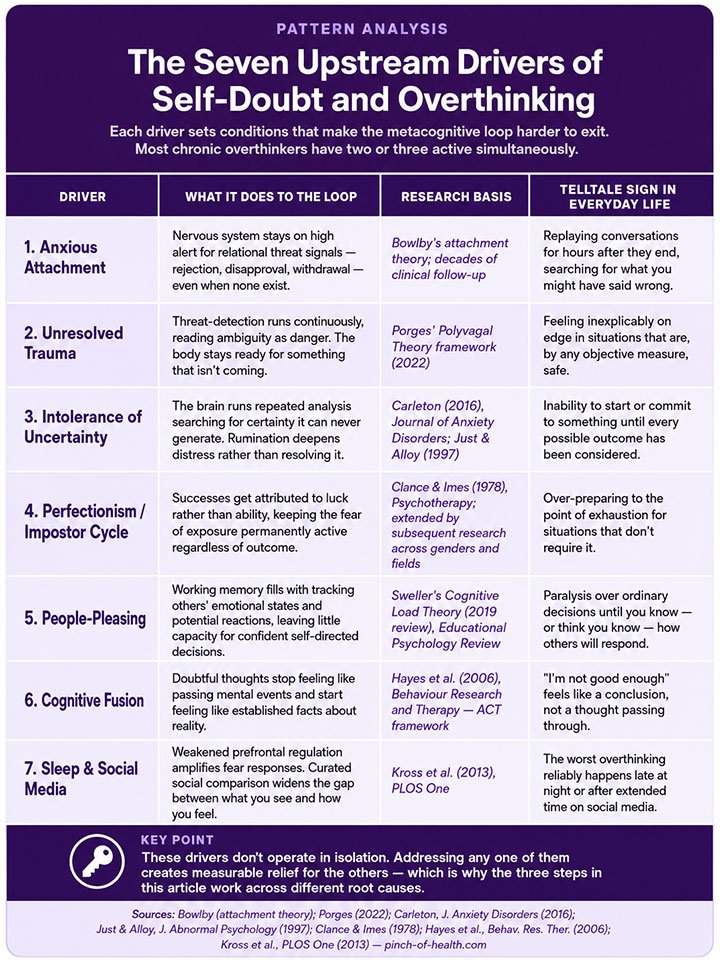
1. Anxious Attachment and the Hypervigilant Brain
John Bowlby’s foundational work on attachment theory, extended by decades of subsequent research, identified something that took clinical psychology a long time to fully absorb: the patterns formed in early caregiving relationships don’t stay in childhood. They get encoded into the nervous system and travel into adult life.
Anxious attachment develops when early caregiving is inconsistent, when love or approval feels unpredictable rather than reliable. The nervous system responds by staying alert. It learns to monitor relationships for signs of rejection, disapproval, or withdrawal, even when none are present.
In adult life, this shows up as overthinking after social interactions. Did I say the wrong thing? Does she seem cold today? Why hasn’t he replied? From the brain’s perspective, the doubt is a safety behavior, a learned survival strategy designed to prevent the pain of rejection before it lands. The problem is that safety behaviors require constant mental energy. The scanning never stops.
Most people who live with anxious attachment don’t recognize it as a pattern. It feels like caring a lot about what people think.
2. Unresolved Trauma and a Permanently Activated Threat System
The nervous system has a reset mechanism. Something dangerous happens, the threat passes, and the body returns from high alert. That’s the design. In people with unresolved trauma, the reset doesn’t fully engage.
Neuroscientist Stephen Porges proposed a framework called Polyvagal Theory to describe how chronic trauma can keep the autonomic nervous system running at low-level threat alert even in environments that are objectively safe. T
he model has been widely applied in trauma therapy and has generated ongoing debate within academic neuroscience about the specifics of its anatomical claims. What the broader body of trauma research consistently supports is the core clinical observation: unresolved trauma leaves many people in a state of ambient readiness for danger that they cannot simply will away.
The connection to overthinking is direct. When the nervous system is already running hot, ambiguity reads as a threat. A vague text message. A manager’s closed door. Silence after a question. These become signals of danger, and the brain responds by trying to solve the threat through analysis. The more uncertain the situation, the harder the brain thinks. It mistakes overthinking for protection.
3. The Need for Control and the Paralysis of “Not Knowing”
R. Nicholas Carleton, a psychologist at the University of Regina, spent years building the research case that one fear sits underneath most anxiety disorders: the fear of not knowing.
A 2016 paper in the Journal of Anxiety Disorders argued that intolerance of uncertainty may be the most fundamental transdiagnostic driver of anxiety-related conditions. The term describes a dispositional difficulty tolerating the absence of sufficient information, regardless of how objectively uncertain the situation is.
Self-doubt is a form of uncertainty. “Am I good enough?” has no clean, final answer. For someone with high intolerance of uncertainty, that open-endedness is genuinely unbearable. The brain responds by searching for certainty through repeated analysis.
Rumination doesn’t generate certainty. Just and Alloy, testing Susan Nolen-Hoeksema’s response styles theory in a 1997 study in the Journal of Abnormal Psychology, found that non-depressed people who reported ruminating in response to low mood were significantly more likely to experience a depressive episode over the following 18 months.
The brain searches for certainty and finds more distress instead. The control-seeker enters a loop: uncertainty triggers analysis, analysis deepens distress, distress produces more uncertainty. There’s no exit built into that sequence.
4. Perfectionism and the Fear of Being “Found Out”
In 1978, psychologists Pauline Rose Clance and Suzanne Imes published a paper in Psychotherapy: Theory, Research and Practice that named an experience many high-achievers recognized immediately. They called it the Impostor Phenomenon.
Their original research focused specifically on high-achieving women, a detail that often gets dropped when the finding is referenced today. Subsequent studies extended the observation across genders, fields, and career stages.
But the original paper remains instructive: the people most likely to feel like frauds are often the ones with the clearest external evidence of their competence. Success actually increases the fear, because more success means more to lose.
Clance later detailed the Impostor Cycle: a new task arrives, anxiety spikes, the person either over-prepares obsessively or procrastinates to the last minute, succeeds anyway, and then attributes the success to luck rather than ability.
The cycle repeats with the next challenge. Success can’t fix the cycle because the internal attribution never updates. Each win gets reassigned to luck, timing, or the specific conditions that won’t exist next time.
Overthinking is the engine of over-preparation. It masquerades as diligence when it’s actually fear-driven hypervigilance, burning cognitive resources on scenarios that never arrive. This is also where the metacognitive belief that overthinking is useful gets its most powerful reinforcement: over-prepare enough to succeed, and the brain files the outcome as evidence that the analysis worked.
5. People-Pleasing and the Collapse of Inner Certainty
People-pleasers carry an invisible burden: they must constantly track the emotional states of everyone around them. Is she upset with me? Did I disappoint him? Will they think less of me if I say no?
Think of it like an app running in the background of your phone: you’re not actively using it, but it’s draining the battery all the same. Cognitive Load Theory, developed by educational psychologist John Sweller, explains why: working memory has a limited capacity. When it’s consumed by tracking other people’s potential reactions, there’s very little left for clear, confident decision-making.
The result is chronic second-guessing. People-pleasers often find it nearly impossible to trust their own judgment, not because they lack intelligence, but because the cognitive system is overloaded. Every decision runs through an extra filter: “But what will they think?” That filter slows everything down and amplifies self-doubt.
What makes this particularly difficult to untangle is that the monitoring feels like consideration for others, not like a deficit. It feels like being a good person.
6. Fusing With the Doubt: When Thoughts Feel Like Truth
Psychologist Steven Hayes developed Acceptance and Commitment Therapy (ACT) through the late 1980s and 1990s, and the framework’s model and evidence base were reviewed in a 2006 paper in Behaviour Research and Therapy. One of ACT’s central observations is also one of the subtler reasons why self-doubt becomes so sticky: cognitive fusion.
Cognitive fusion describes the tendency to get so entangled with a thought that you treat it as literal reality rather than as a mental event. For chronic overthinkers, cognitive fusion means that “I’m not good enough” doesn’t feel like a passing thought. It feels like a fact. The doubt stops feeling like something you’re having and starts feeling like something you are.
Hayes also identified what he called the literalization of thought: the process by which mental events get treated as direct descriptions of reality rather than as one interpretation among several. This is why you can’t simply decide to stop overthinking. You’re dealing with what feels, at a gut level, like truth, not a thought you can dismiss.
Low distress tolerance makes this worse. When uncomfortable emotions feel intolerable rather than merely unpleasant, the brain will do almost anything to reduce them. Overthinking becomes a coping tool, a way to stay busy so the raw feeling of doubt never has to be fully felt. The loop serves a function: it keeps something worse at bay, which is precisely why it’s so hard to talk yourself out of it.
7. The Physical and Digital Accelerants
Two modern factors make an already difficult situation considerably worse. Neither is psychological in origin, and both are almost always addressed last, if they’re addressed at all.
The prefrontal cortex is the brain’s regulator. It helps dampen the amygdala’s fear response and brings rational perspective to emotional reactions. Chronic sleep deprivation physically weakens this regulation. A tired prefrontal cortex can’t hold the amygdala in check, so doubt triggers stronger fear reactions and the loop spins faster.
Then there’s social media. Ethan Kross and colleagues at the University of Michigan tracked 82 young adults over two weeks using experience-sampling, texting participants five times daily to report their mood.
Their findings, published in PLOS One in 2013, showed that Facebook use directly predicted declines in both moment-to-moment wellbeing and overall life satisfaction. That study focused on Facebook specifically, and the platform’s role in people’s lives has shifted considerably since 2013.
But the comparison mechanism it identified, namely passive consumption of curated content generating a gap between what you see and how you feel about yourself, continues to appear in research across platforms.
Sleep deprivation plus passive scrolling is a particularly damaging combination for anyone already prone to self-doubt. One lowers the brain’s defenses. The other supplies an endless stream of comparison material. If the other six drivers feel too deep to address immediately, start here.
Which Driver Is Fueling Your Loop?
7 questions. Find your dominant pattern and where to start.
Each of the seven upstream drivers fuels the overthinking loop differently. Most people have more than one active — but one tends to dominate.
These questions identify which driver is likely running loudest for you right now, and recommend the most relevant starting step from the three evidence-based approaches in this article.
There are no right or wrong answers. Answer based on how you actually experience things, not how you think you should.
How to Overcome Self-Doubt and Overthinking: Three Evidence-Based Steps
Understanding the roots of the cycle is powerful, but the goal is to interrupt it. Here are three approaches backed by solid research.
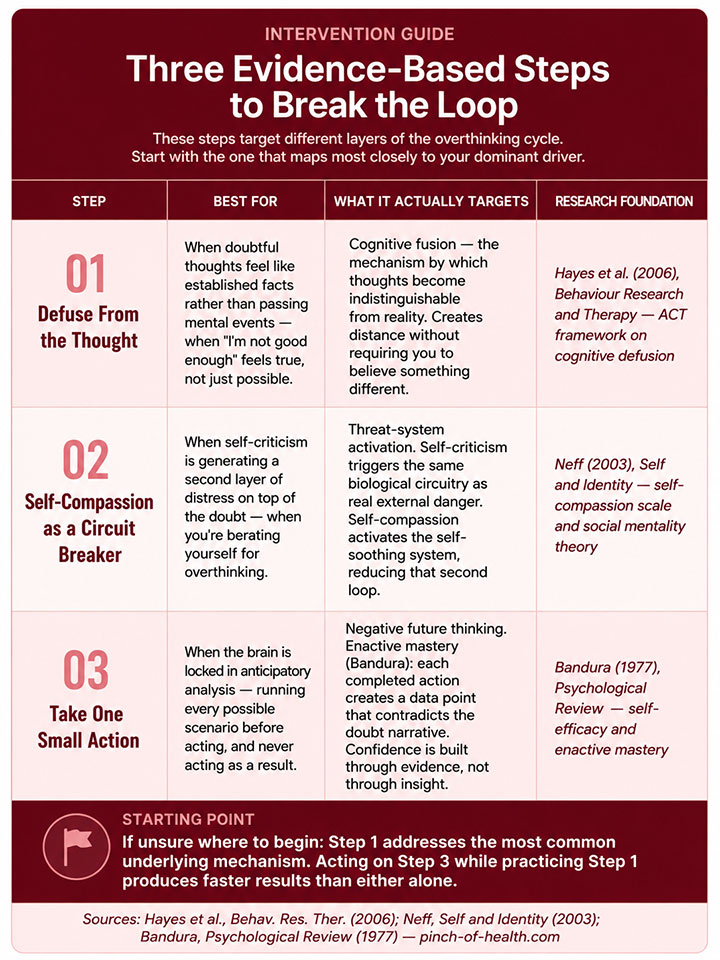
Step 1: Defuse From the Thought
The first step is to stop treating the doubt as a fact. ACT calls this defusion: creating distance between yourself and your thoughts so you can observe them without being driven by them.
In practice, this looks simple but feels different from anything you’ve tried before. Instead of thinking “I’m not good enough,” you tell yourself: “I’m having the thought that I’m not good enough.” That small shift does something concrete. It moves the thought from the foreground to the background. The movement puts you outside it, watching.
Hayes’ research shows that defusion reduces the behavioral impact of difficult thoughts without requiring you to change or suppress them. There’s no requirement to replace the doubt with something more optimistic. Stopping the old thought from feeling like gospel is enough.

Step 2: Use Self-Compassion as a Circuit Breaker
Kristin Neff’s work, formalized in a 2003 paper in Self and Identity and built on by decades of follow-up research, defines self-compassion as three interlocking components: self-kindness instead of harsh self-judgment, a sense of common humanity instead of isolation, and mindfulness instead of over-identification with painful feelings.
The clinically relevant dimension is the neurological effect. Research drawing on social mentality theory shows that self-criticism activates the threat system, the same biological circuitry that handles real external danger. When you berate yourself for doubting, you’re adding a threat response on top of an already dysregulated nervous system.
Self-compassion activates what researchers describe as the self-soothing system, linked to feelings of safety and secure connection. It acts as a neurological brake on the threat loop, stopping the critical second layer that turns doubt into a full spiral.
Most overthinkers double down on self-criticism when they notice themselves ruminating. “Why can’t I just stop this? What’s wrong with me?” Every harsh question adds another loop. Basic decency, the kind you’d extend to a friend who was struggling, is what breaks that second layer.
Step 3: Take One Small Action to Rebuild the Feedback Loop
The foundational research here comes from Albert Bandura’s work on self-efficacy, articulated in a landmark 1977 paper in Psychological Review and elaborated across four subsequent decades of study. Bandura’s central finding was that self-efficacy, meaning belief in your own capability, grows from what he called enactive mastery: actually doing things and succeeding at them, even at a small scale.
When self-doubt is high, the brain gets locked in what Bandura described as negative future thinking, an anticipatory over-analysis of all the ways things could go wrong. This is a form of paralysis dressed up as preparation.
Acting first, before the doubt resolves, is what breaks the cycle. Confidence is the collection of small, undeniable proofs that you are capable. The doubt doesn’t need to disappear first. One completed action, even a minor one, creates a data point that contradicts the doubt narrative. Over time, those data points outweigh the stories the doubtful brain tells.

When Self-Doubt and Overthinking Signal Something More
Self-doubt and overthinking are common human experiences. They become a clinical concern when they persist regardless of context, intensify over time, or start interfering with daily functioning. At that point, they’re often symptoms of an underlying condition rather than standalone experiences.
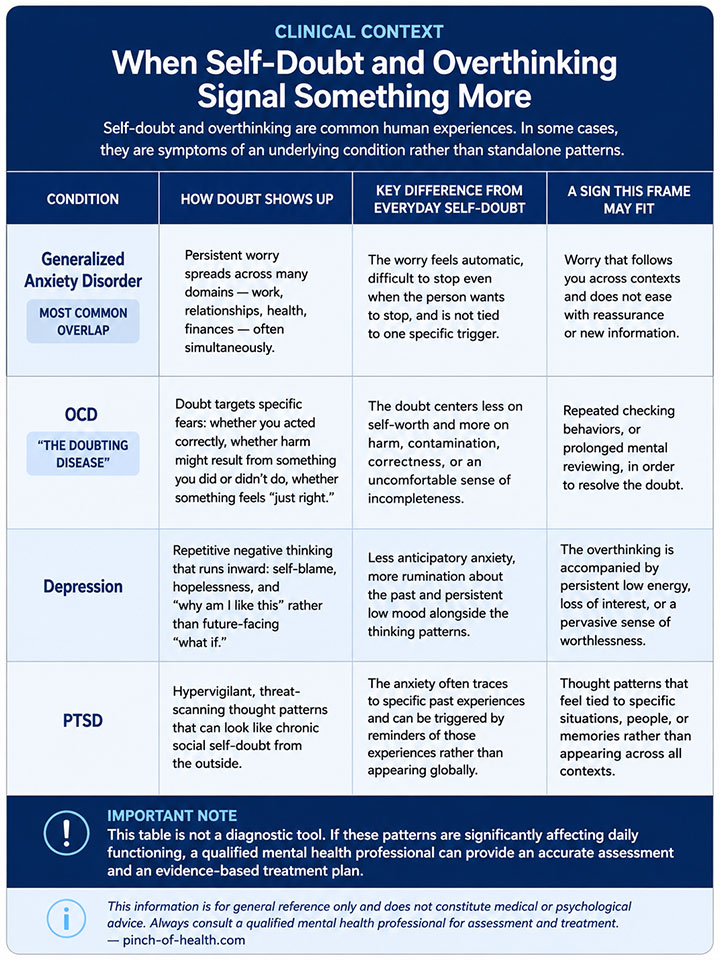
Chronic anxiety is the most common overlap. People with generalized anxiety disorder tend to worry persistently across multiple domains, including work, relationships, health, and finances, and typically report that the overthinking feels automatic and difficult to stop, even when they want to.
OCD has a specific relationship with doubt that’s worth naming directly. The disorder has been described as “the doubting disease” in clinical literature for well over a century, because pathological doubt is central to its presentation across subtypes.
A 2022 analysis in Behaviour Therapy confirmed that the experience of doubt is consistent across all OCD presentations, not just the varieties most people picture. If your doubt centers less on self-worth and more on whether you acted correctly, whether harm might result from something you did or didn’t do, or whether something is “just right,” OCD may be the more accurate frame.
Depression can also produce repetitive negative thinking, though it tends to run inward toward self-blame and hopelessness rather than outward toward worst-case scenarios. PTSD produces hypervigilant, threat-scanning thought patterns that can look like chronic social self-doubt from the outside but originate differently and respond to different treatment approaches.
None of this is a diagnosis. If the loop has been running for a long time and the strategies in this article aren’t making a meaningful dent in it, that’s a reasonable signal to bring a qualified mental health professional into the picture. Having a name for the experience changes the relationship to it. The loop stops being personal pathology and becomes a documented pattern with documented treatment approaches.
What This All Means
The loop doesn’t dissolve because you understand it. Understanding is necessary but not sufficient.
The research, and Bandura’s decades of self-efficacy work, keep returning to the same point: confidence gets built the same slow way self-doubt does, one experience at a time, accumulated until the weight of evidence shifts. The overthinking loop was built through years of relational wiring, nervous system responses, and beliefs that calcified gradually. It doesn’t undo itself in an afternoon.
What it does respond to is evidence. Small, undeniable, repeated evidence that you can navigate uncertainty without thinking your way through every last scenario. That evidence accrues rather than arrives in a single breakthrough.
Mainstream advice is aimed at the surface. Self-compassion exercises, journaling, and positive reframing can all be useful. But the metacognitive beliefs underneath, the attachment patterns, the nervous system that never fully resets: those things don’t respond to affirmations. What shifts them is accumulated experience: the repeated evidence of surviving things you were certain you couldn’t handle.