Researchers studying older adults found something unexpected: small improvements in balance often began long before people noticed stronger muscles.
The most common response to a balance scare is avoidance. Skip the uneven path. Sidestep the crowded room. Hold the wall on the stairs. The instinct is protective.
Avoidance removes the challenge that balance systems need to stay calibrated. The muscles that catch a stumble weaken. The nerve endings in the feet that report ground texture to the brain become less sensitive from disuse.
And the mental alarm that fires at the first wobble grows louder, which tends to produce more avoidance. Researchers have a name for this: the cycle of fear-induced deconditioning. Most people just call it getting older and assume it’s inevitable.
It isn’t inevitable. And the speed at which specific yoga training can reverse the process surprised even the researchers running the early trials.
What’s Actually Driving Balance Decline After 50
Your body uses three systems simultaneously to keep you upright. Vision tells your brain about the surrounding environment. The vestibular system in your inner ear senses head position and movement. And proprioception, the least familiar of the three, tells your brain exactly where your limbs are in space without you having to look.
Think of proprioception as a continuous status report from thousands of tiny sensors in your joints, muscles, and feet. After 50, that reporting slows. The nerve endings lose density. The signal processing takes a fraction of a second longer. That gap, small as it sounds, is often the difference between catching a stumble and not catching it.
Muscle loss compounds the problem. Adults lose roughly 3 to 5 percent of muscle mass per decade after 30, and the rate accelerates after 60. The leg muscles most responsible for keeping you upright tend to decline earliest. At the same time, vestibular function becomes less reliable as the small crystals in the inner ear, called otoliths, dislodge more easily with age and produce dizzy spells unrelated to physical weakness.
Medications add another layer. Blood pressure drugs, sleep aids, and many antidepressants affect balance as a side effect, and the more a person takes, the higher their fall risk. Vitamin D deficiency also links to reduced muscle strength, though the case for supplementation is more qualified than popular coverage suggests. The clearest data supports correcting a deficiency, not loading on doses above what the body needs.
After a decade coaching competitive karate, I can describe what happens to balance with age in the simplest terms I know. Young athletes wobble constantly during one-leg holds. What changes as they train isn’t that the wobble disappears. What changes is the speed of the correction.
A trained 16-year-old and a deconditioned 60-year-old can wobble by the same amount in the first half-second. The trained athlete catches it almost before it registers. The person whose balance pathways haven’t been challenged for months may not catch it at all. Yoga trains the catch. Not by eliminating instability, but by shortening the gap between wobble and response.
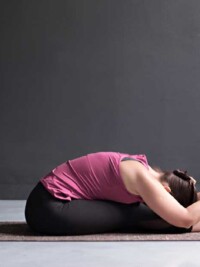
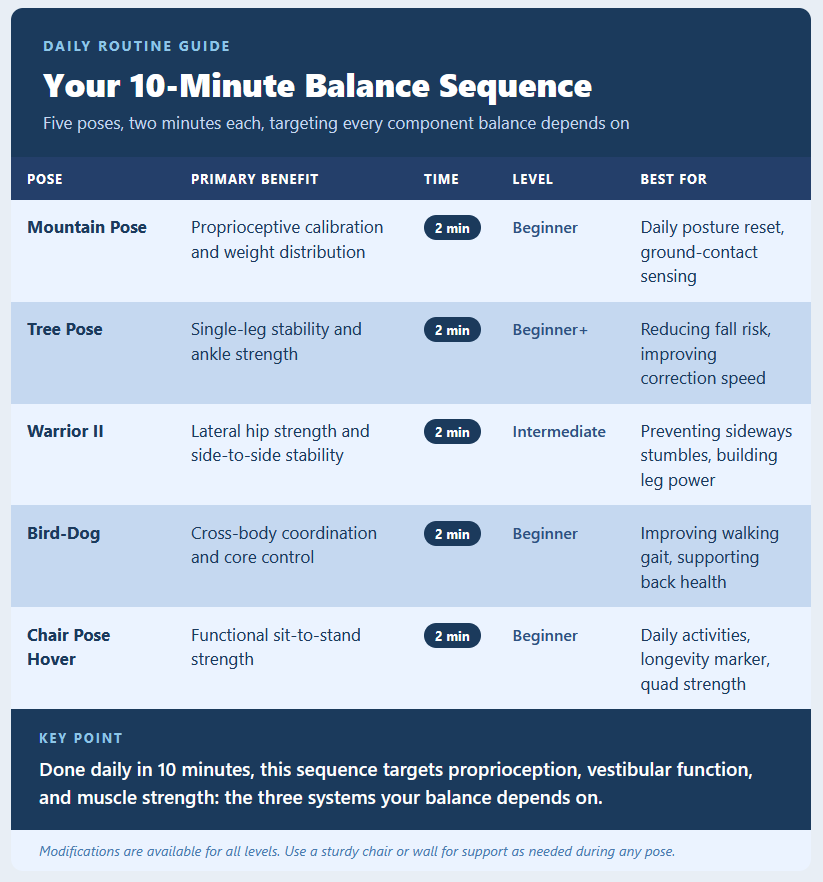
Your 5-Pose Daily Routine
The five poses below target each component of balance: proprioceptive feedback, lateral hip stability, cross-body coordination, ankle strength, and the sit-to-stand pattern that predicts how well balance holds up in daily life. Done together in ten minutes, they form a system rather than a list. Select your level before you start.
1. Mountain Pose with Heel-to-Toe Focus (2 Minutes)
This pose looks like standing. It is actually a proprioceptive calibration exercise that most adults over 50 have quietly stopped doing. Passive standing uses the minimum sensory input from the ground. Mountain Pose asks for all of it.
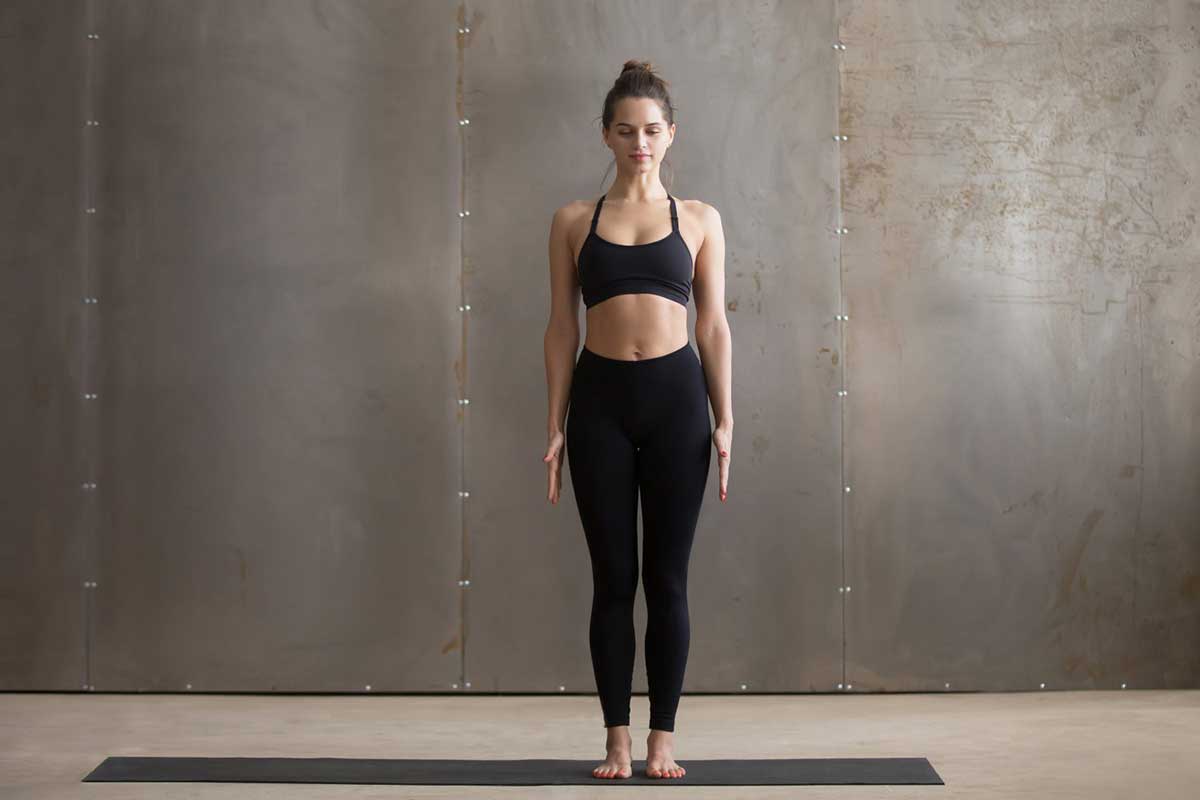
- Stand with feet hip-width apart and your back about one inch from a wall, close enough for security but not touching.
- Spread your toes wide and press evenly through three points on each foot: the ball under your big toe, the ball under your pinky toe, and the center of your heel.
- Tighten your thigh muscles, lift your chest, and lengthen the back of your neck.
- Close your eyes for ten seconds, then open them and breathe. Repeat five times.
The eyes-closed intervals are not optional. Removing vision forces your proprioceptive system to carry the full load. The wobble you feel the first time you close your eyes is the feedback signal doing exactly what it should.
Modification: Keep one hand near the wall throughout. Touching it when needed doesn’t reduce the training effect. You’re building the nervous system response, not proving anything.
2. Modified Tree Pose (2 Minutes)
Single-leg stability is the clearest predictor of fall risk in adults over 50. Tree Pose trains it directly, and because it’s quantifiable (you can time how long you hold it), you’ll have an immediate measure of improvement week to week.
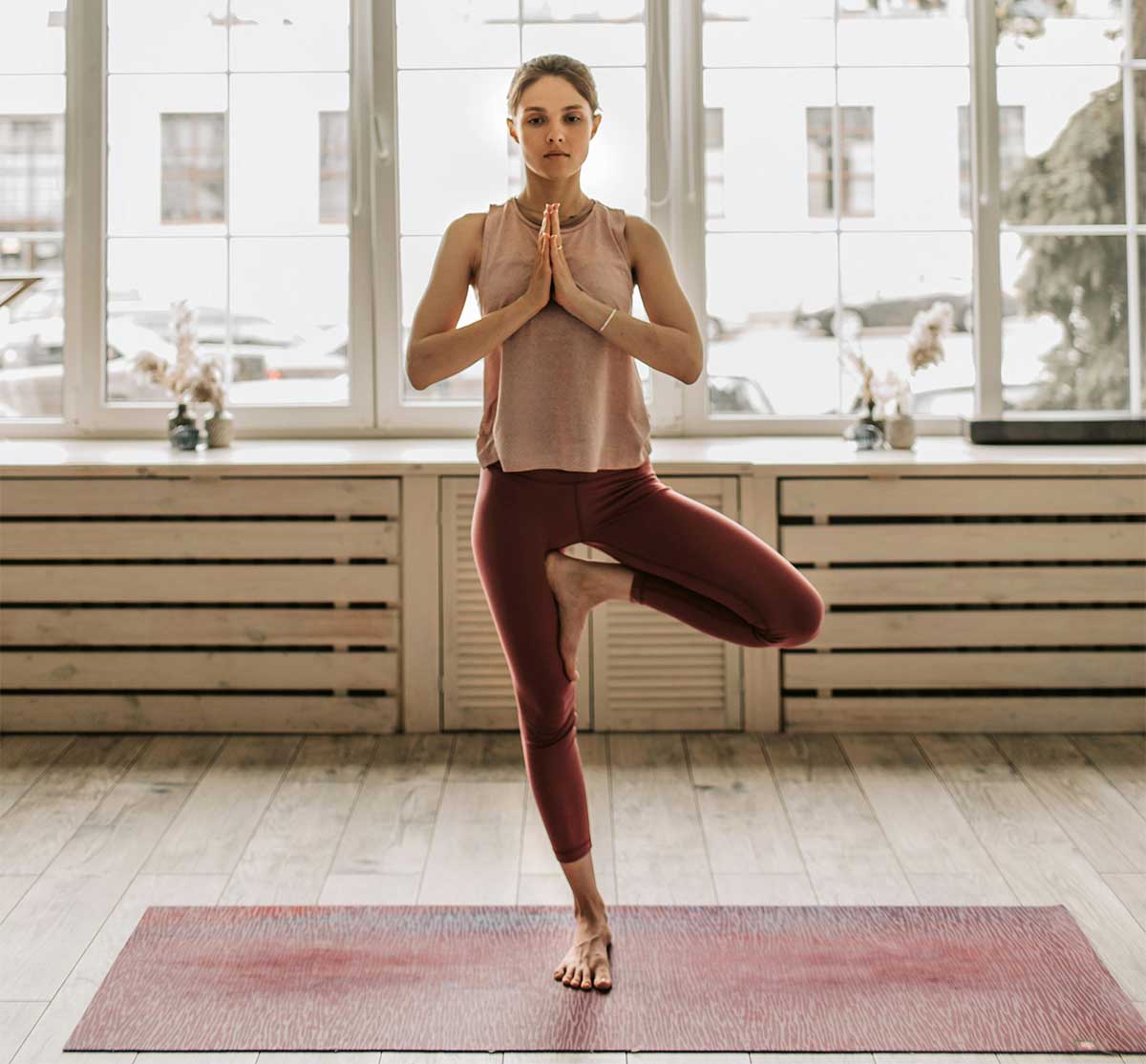
- Stand beside a sturdy chair with one hand resting on the chair back for support.
- Shift your weight fully to your right foot and lift your left foot to rest against your right ankle or calf. Do not place it against the side of the knee.
- Find a fixed point on the floor about six feet in front of you and hold your gaze there without letting it wander.
- Hold for 30 seconds, lower your foot, and switch sides. Repeat the cycle twice.
If you wobble, good. The stabilizer muscles in your standing foot and ankle are contracting to make micro-corrections. That is the training. Gripping the chair harder to eliminate the wobble reduces the feedback loop you’re trying to build.
Modification: Full hand on the chair for as long as you need it. Progress to fingertips, then no hand, over several weeks rather than days.
3. Warrior II for Lateral Hip Stability (2 Minutes)
Falls happen in all directions, but most balance training focuses on front-to-back stability because it’s the easier axis to address. Side-to-side stability demands a different muscle group: the lateral hip stabilizers. These are the muscles you need when stepping off a curb or reaching across your body for something on a high shelf. Warrior II targets them specifically.
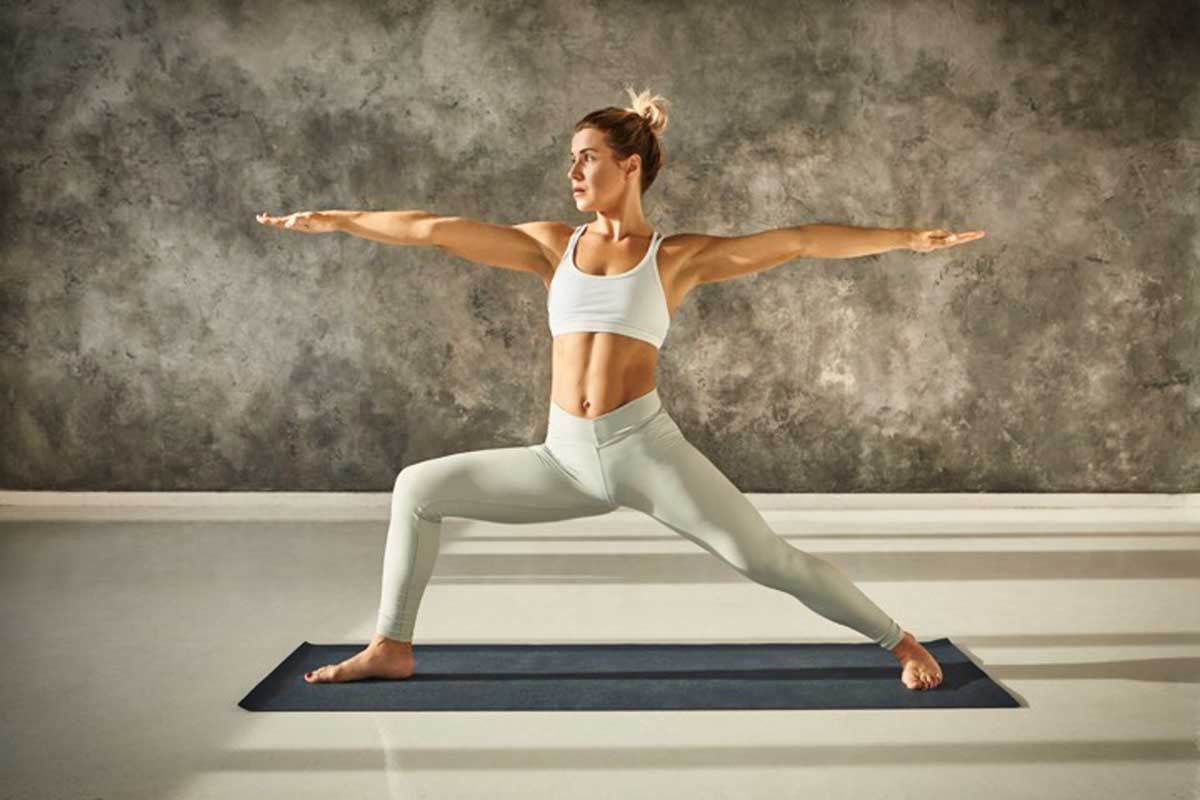
- Stand with your feet about three feet apart. Turn your right foot out 90 degrees and your left foot in slightly.
- Bend your right knee until it sits directly over your right ankle, not in front of it.
- Extend both arms to the sides at shoulder height, palms facing down.
- Hold for 30 seconds, then raise your arms overhead on an inhale and lower them back to shoulder height on the exhale. Do ten arm cycles, then switch sides.
A shorter stance, six to eight inches narrower than the standard version, reduces strain on the inner thighs and knees without significantly affecting the hip-strengthening effect. Start narrower and widen as your confidence builds.
4. Bird-Dog for Cross-Body Coordination (2 Minutes)
Walking is a cross-body movement. Your right arm swings forward when your left leg steps, and vice versa. This pattern, called the cross-crawl, is the neurological basis for a smooth, stable gait, and it degrades in adults who aren’t regularly challenging it. Bird-Dog trains the connection from the floor up.
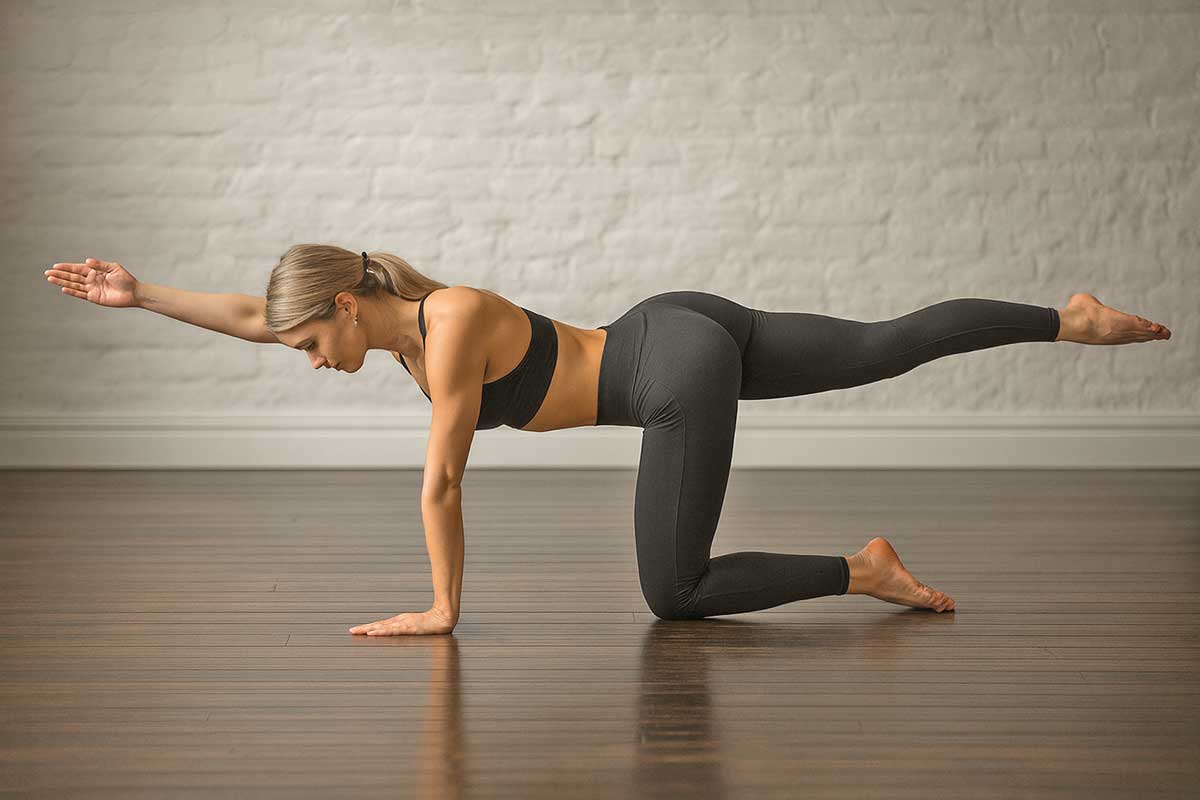
- Start on your hands and knees with hands under your shoulders and knees under your hips.
- Keep your spine neutral and tighten your core slightly without holding your breath.
- Extend your right arm forward and your left leg back simultaneously, keeping your hips level throughout the movement.
- Hold for ten seconds, return to start, and repeat on the opposite side. Do five controlled repetitions per side.
Modification: Leave the toes of your extended leg lightly touching the floor. This creates a third point of contact and reduces the demand on your core while you build strength. Lift incrementally higher each week.
5. Chair Pose Hover (2 Minutes)
The ability to rise smoothly from a chair without pushing off the armrests is one of the most reliable indicators of functional longevity in older adults. It captures quad strength, glute activation, and core control working in sequence. Chair Pose Hover trains that exact pattern in a way you can control and progressively challenge.
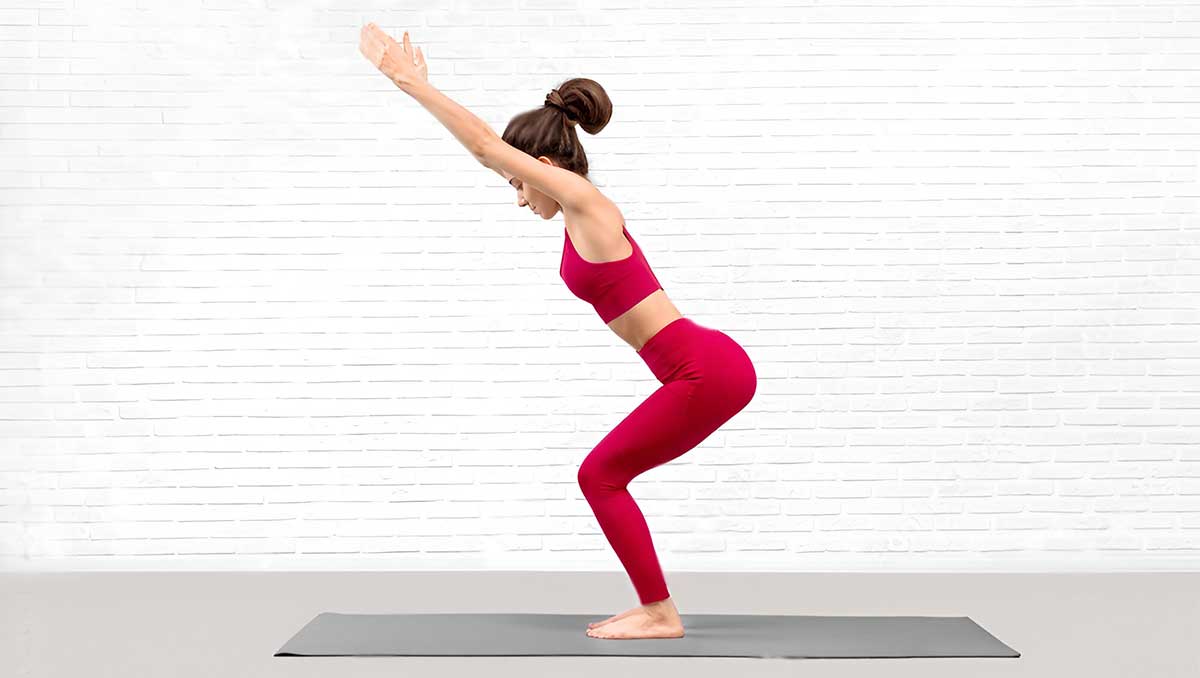
- Stand directly in front of a sturdy chair, facing away from it.
- Shift your weight back into your heels and bend your knees to lower toward the seat.
- Stop when hovering about one inch above the seat. Keep your chest lifted and your arms extended forward for counterbalance.
- Hold for three seconds, sit down fully, rest for three seconds, and stand back up. Repeat ten times.
Control over the descent matters more than the hold time. If you’re dropping to the seat rather than lowering to it, slow down.
Three Practice Tips Worth More Than Extra Repetitions
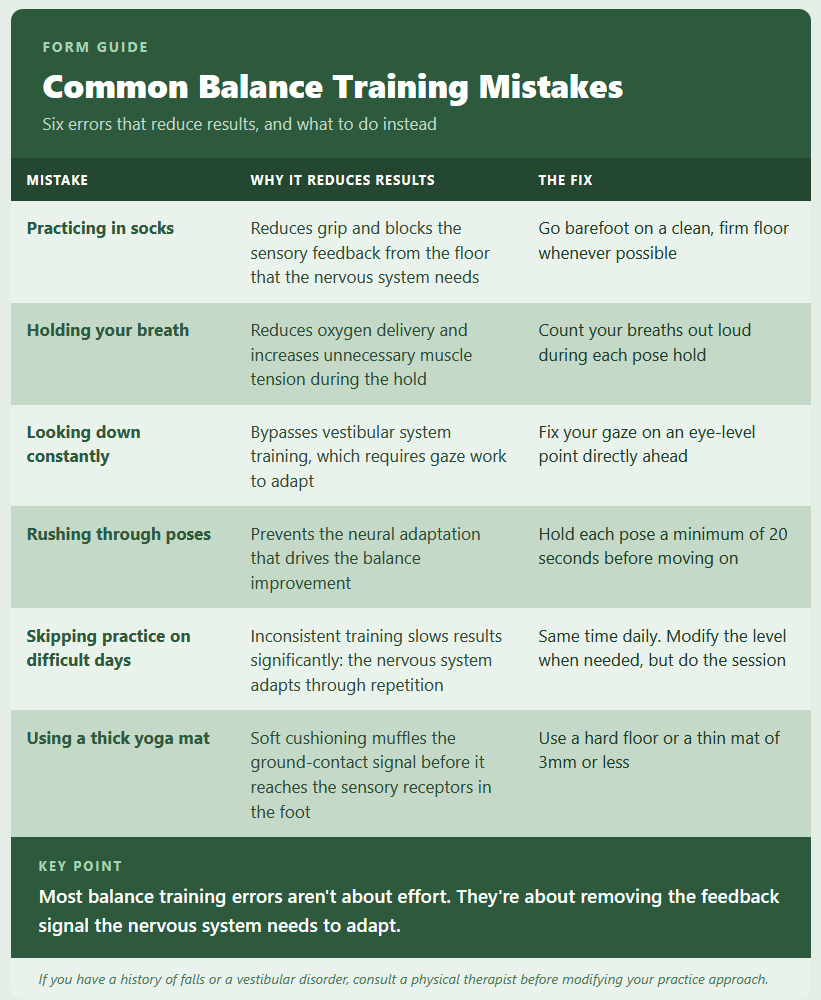
Practice on a Firm Surface
A thick, cushioned yoga mat feels comfortable underfoot. For balance training, it works against you. Balance depends on feedback from the ground, which travels through the soles of your feet to the sensory pathways in your ankles and legs. A soft surface muffles that signal before it reaches the receptors. The sensory nerves in the sole of your foot are calibrated to detect micro-variations in surface texture, and a thick mat compresses that information into noise. A hard floor, or a thin mat of three millimeters or less, sends a clearer signal.
Train Your Eyes Separately From Your Body
Balance in real life happens while your eyes are moving. A bird overhead, a car reversing, a grandchild running past: your body maintains stability while your gaze shifts constantly. Most balance exercises don’t train this. Once you can hold Mountain Pose or Tree Pose steadily, try moving only your eyes (up, down, side to side) while your head stays still. The system that coordinates eye movement with head position, called the vestibulo-ocular reflex, shares circuitry with the balance correction response. Training one trains the other.
Practice Barefoot
Your feet contain 26 bones, 33 joints, and a dense network of small muscles. Shoes restrict all of them. Even grippy yoga socks reduce the sensory input reaching your nervous system from the floor.
The abductor hallucis, the muscle along the inside of your foot that spreads your big toe and contributes to arch stability, shortens in most adults from years of narrow footwear. Ten minutes of barefoot standing a day is enough to begin reversing that pattern. A clean, hard floor works better than any mat.
How to Measure Whether It’s Working
Balance training without measurement is guesswork. The single-leg stand test is the most practical tracking tool available. It takes 30 seconds, costs nothing, and gives you a number you can compare week to week.
Stand near a wall for safety, lift one foot slightly off the floor, and time how long you can hold it with your eyes open. Record the number. Test yourself at the same time each week, always starting with the same leg. Most people notice improvement within two to four weeks of consistent practice.
The table below shows age-based averages for the most common balance assessments. These are reference points, not targets. If your number falls below average, that tells you where you’re starting. If it’s above average, you’re maintaining something worth protecting.
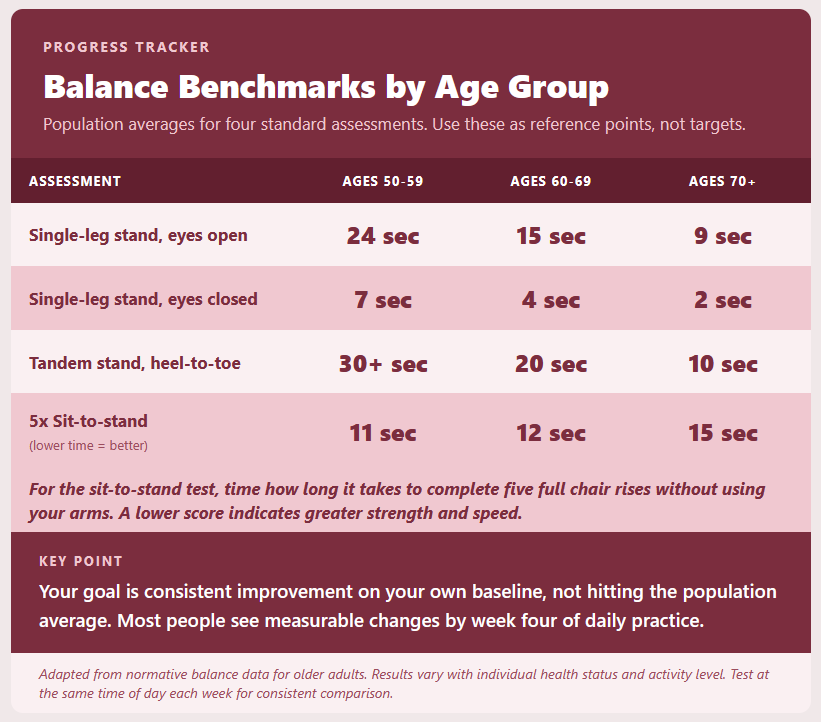
Track four numbers at week one, week four, and week eight:
- Single-leg stand, eyes open, stronger side: ___ seconds
- Single-leg stand, eyes open, weaker side: ___ seconds
- Single-leg stand, eyes closed, stronger side: ___ seconds
- Tandem stand, heel-to-toe: ___ seconds
The gap between your stronger and weaker side is as informative as the raw scores. An asymmetry of more than a few seconds is common and typically narrows with practice. Adding an extra 15 seconds to your weaker-side Tree Pose each session is enough to start closing it.
Progressions for When the Routine Feels Easy
The difficulty selector above runs three versions of each pose. Work through the Beginner level until the 10 minutes feel genuinely comfortable, then move to Intermediate. Add one progression at a time, give it one to two weeks, and then continue. Adding several challenges at once makes it difficult to identify what’s actually working.
The general principle across all five poses is the same: reduce support first (chair, wall), then reduce stability (eyes closed, folded towel underfoot), then add duration or load. That ordering matters. Removing the chair from Tree Pose before you can hold the pose without it doesn’t build confidence. It removes the safety margin that would have told you when you were ready to remove it.
When to See a Doctor Before Starting
These poses are appropriate for most adults, but specific symptoms warrant a medical assessment before beginning any balance program.
- Sudden onset of dizziness or balance changes appearing within days rather than developing gradually over months
- A spinning sensation lasting more than a few seconds, which may indicate BPPV or another vestibular disorder
- Hearing loss or ringing in the ears alongside balance problems
- Balance changes following a head injury or concussion
- Numbness or tingling in the feet or legs
- Balance that worsens consistently after starting a new medication
- More than one fall in the past year
These symptoms don’t rule out balance training. Many of the conditions above respond well to targeted exercise. They mean a clinician should be involved in deciding what that training looks like from the start.
What You Eat Affects Balance More Than Most People Expect
Three nutrients are worth paying attention to if balance is a current concern. Protein comes first: adults over 50 need roughly 25 to 30 grams per meal to maintain the muscle mass that keeps them upright, more than many people are currently eating.
Magnesium supports the same neuromuscular signaling that balance training depends on, and most adults over 50 fall short of the recommended 320 to 420 mg daily. Dark leafy greens, nuts, and seeds are the most reliable sources.
Vitamin D supports both muscle function and nerve signaling, and deficiency links specifically to increased fall risk rather than only reduced calcium absorption. The blood test to check your level costs under $50 and tells you more than any supplement label will.
What the Research Actually Shows
The study that shifted early thinking on yoga and balance came from Anne Tiedemann at the George Institute for Global Health in Sydney. Tiedemann and her team enrolled 54 community-dwelling adults with a mean age of 68, none of whom had practiced yoga or Tai Chi before.
The intervention group attended twice-weekly Iyengar yoga classes focused on standing postures for 12 weeks. The control group received only a fall prevention education booklet. By the end, the yoga group showed measurable improvements in standing balance and one-leg stance time that the booklet group did not. The Journals of Gerontology published the findings in 2013.
A pilot study published in 2010 in the Archives of Physical Medicine and Rehabilitation tracked 14 adults over 65, all of whom reported a fear of falling. After a 12-week biweekly yoga program at a retirement community in Indiana, fear of falling decreased by 6 percent and static balance improved by 4 percent.
That last number matters slightly less than the first. Schmid, Van Puymbroeck, and Koceja were among the first researchers to document that fear reduction was part of what yoga was actually treating. When people stop being afraid of falling, they move more. Moving more keeps the pathways active.
Researchers wanted to know how yoga compared directly to other established balance interventions. Ni and colleagues at the University of Miami randomized 39 older adults with a history of falling across three 12-week programs: yoga, Tai Chi, and standard balance training.
All three groups improved significantly on balance field tests including single-leg stance and functional reach. Between-group differences were not statistically significant. For anyone who has been told that Tai Chi is the proven option and yoga is secondary, that’s a useful finding: over 12 weeks with this population, the difference between the approaches wasn’t detectable.
The cognitive dimension of balance is worth a separate note. Gothe, Kramer, and McAuley at the University of Illinois enrolled 108 adults between 55 and 79 in eight weeks of Hatha yoga three times weekly and compared them to a stretching control group.
The yoga group finished with significantly faster reaction times on attention and memory tests. The connection to balance isn’t incidental: reaction speed, the neural lag between detecting a wobble and responding to it, is part of what determines whether a stumble turns into a fall. This was a 2014 study about cognition, and the balance implications follow directly from the results.
The broadest view comes from a 2019 systematic review out of the University of Edinburgh. Sivaramakrishnan and colleagues pooled 22 randomized controlled trials and found significant improvements in balance, walking speed, and lower-body strength across the yoga groups. Effect sizes ranged from small to medium. The results held across different yoga styles and age groups. The benefit isn’t particular to one type of practice or one study population.
Frequently Asked Questions
Can yoga improve balance?
Yes, and the finding is more durable than most exercise research. It holds across yoga styles, practice frequencies, and age groups from 55 to 80. The mechanism isn’t complicated: any practice that requires you to hold still on one leg while staying attentive is training the proprioceptive pathways this article describes. The frequency that shows up most consistently in the research is two to three sessions per week over eight to twelve weeks.
Does yoga help seniors with balance?
The research is specifically strongest in adults over 60. The foundational trials that established how yoga affects balance were run in older community-dwelling populations, and one consistent finding stands out: fear of falling declined alongside physical stability, often within the same 12-week window. That pairing matters because fear drives avoidance, and avoidance is how balance declines in the first place. Iyengar yoga with props and chair yoga are the most studied formats for this age group.
What is the single best balance exercise for seniors?
Single-leg standing, with progressive challenge added over weeks, has the most direct evidence for reducing fall risk in older adults. It works best alongside something that builds functional leg strength, like the Chair Pose Hover, and a cross-body coordination exercise, like Bird-Dog. No single exercise covers all three components that balance depends on.
I can’t stand on one leg for more than five seconds. Should I skip Tree Pose?
Don’t skip it. Use the chair and hold for however long you can. Three seconds still counts as a training stimulus. Your nervous system doesn’t need long holds to adapt: it needs repetition. Add one or two seconds per week and the improvement will follow.
My knees hurt in Warrior II. What am I doing wrong?
The most common cause is the front knee tracking inward instead of tracking over the ankle. Pull the hip back slightly so the knee aligns with the second toe. A shorter stance also reduces the load on the inner knee. If discomfort continues after both adjustments, substitute additional Mountain Pose time for that week and consult a physical therapist before pushing further.
How long before I see real results?
Most people notice small improvements in daily stability within two to three weeks: better balance when putting on shoes, less bracing on stairs. Measurable changes in single-leg stand time typically appear by week four. The nervous system adapts faster than muscle tissue, so the felt sense of improvement tends to come before the numbers confirm it.
I have osteoporosis. Are these poses safe?
Most are safe, and the standing poses (Mountain, Tree, Warrior II, Chair Hover) carry the added benefit of applying bone-stimulating load. Bird-Dog is generally appropriate, but avoid forward bending if your osteoporosis is severe and keep the spine neutral throughout. Consult your physical therapist or physician before starting if you’ve had a vertebral compression fracture.
What gets called “balance decline” is largely a training deficit. The systems are still there. The pathways still fire. They need more challenge than passive daily life provides to stay calibrated. Ten minutes of deliberate, progressive standing practice, done consistently, is enough to start closing the gap.
The more interesting finding from the fear research is that what changes first often isn’t measurable. People start doing things they’d quietly stopped doing. The uneven path they’d been avoiding. The dance floor. The birthday party with the grandkids. That behavioral shift, not the single-leg stand time, is what the ten minutes is actually training for.