You’ve heard the old saying: “An apple a day keeps the doctor away.” But what if I told you that two apples a day could actually lower your cholesterol in just 8 weeks? And not just by a little—we’re talking measurable, scientifically proven changes to your lipid levels.
This isn’t folklore. It’s backed by clinical trials that tracked real people eating real apples. The results might surprise you.
The Power of Two: Why This Specific Amount Matters
Most health advice stays vague. “Eat more fruits and veggies.” “Cut back on saturated fats.” But the research on apples and cholesterol gets specific: two whole apples per day, weighing about 340 grams total.
Why two? That’s the amount used in multiple clinical trials that showed actual results. It’s also the sweet spot for getting enough soluble fiber and plant compounds to make a difference.
While clinical trials measured results at the 8-week mark, understanding what happens in your body during that time means piecing together research on fiber digestion, polyphenol absorption, and gut bacteria changes. Here’s what the science tells us occurs during those 8 weeks.
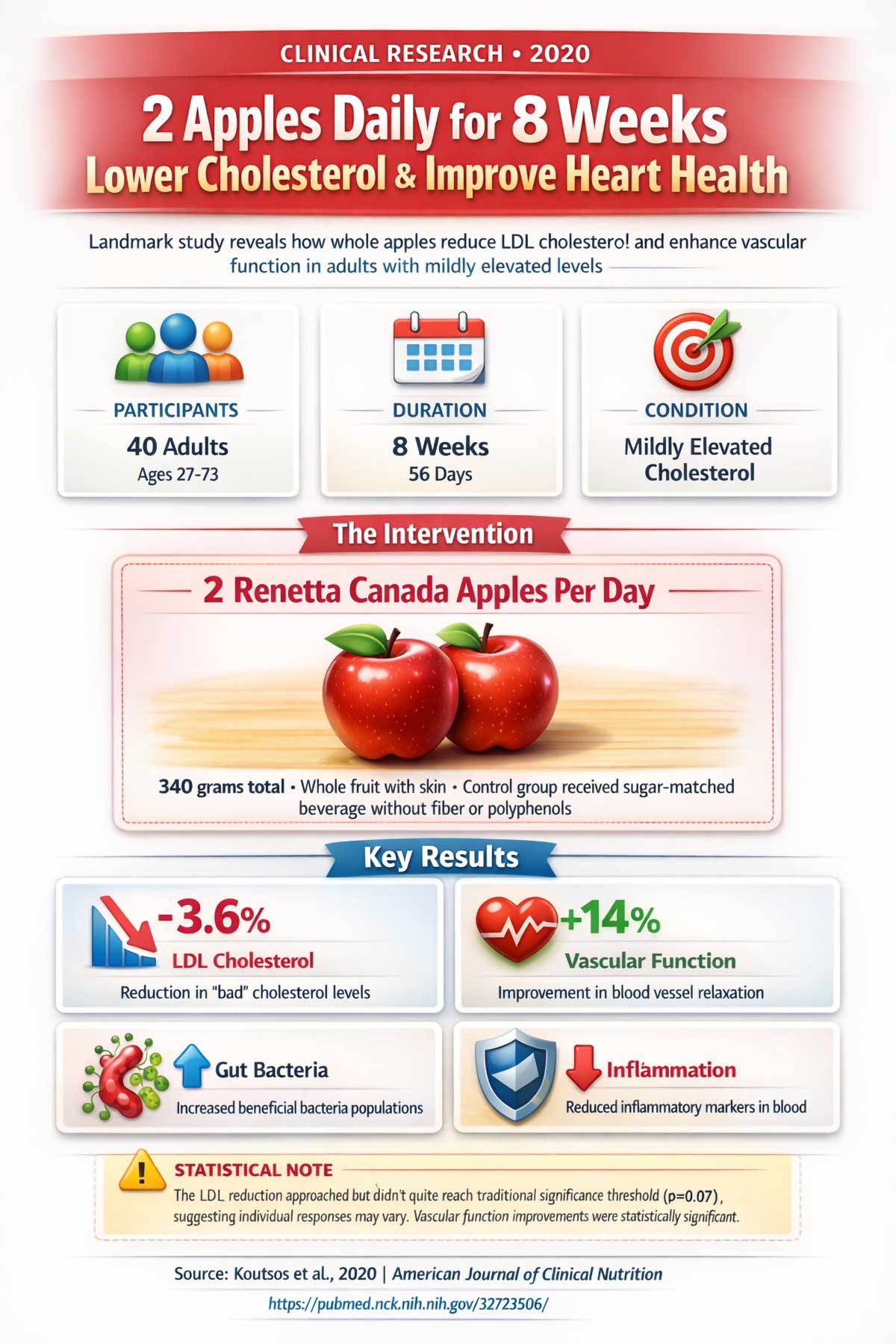
In an 8-week study published in 2020, researchers gave 40 adults with mildly high cholesterol two Renetta Canada apples every day. The control group got a sugar-matched drink instead. After 56 days, the apple eaters showed a 3.6% drop in LDL cholesterol—the “bad” kind that clogs your arteries. Their blood vessel function also improved.
That might not sound like much. But for someone with cholesterol levels hovering around 200 mg/dL, a 3.6% reduction could mean the difference between needing medication or managing levels through diet alone.
Week 1-2: Your Gut Starts Binding Cholesterol
Here’s what happens in your body during the first two weeks.
Apples contain a type of soluble fiber called pectin. When you eat an apple, this pectin dissolves in your digestive tract and forms a thick, gel-like substance. Think of it as a microscopic sponge moving through your intestines.
This sponge does something clever: it traps bile acids. Your liver makes bile from cholesterol to help digest fats. Normally, your body recycles about 95% of this bile. But when pectin binds to it, the bile gets swept out of your system instead.
Your liver notices the missing bile. To replace it, the liver pulls LDL cholesterol from your bloodstream. Less LDL in your blood means lower cholesterol readings.
This process starts within days of eating your first apple. But it takes consistent daily intake to see measurable changes.
A 2013 study with 110 healthy adults compared whole apples to apple juice (both clear and cloudy) and a no-apple control group. After 4 weeks, the whole apple group showed lower total cholesterol compared to the control group. The juice drinkers showed less benefit than whole apple eaters, though cloudy juice retained some fiber and showed modest effects.
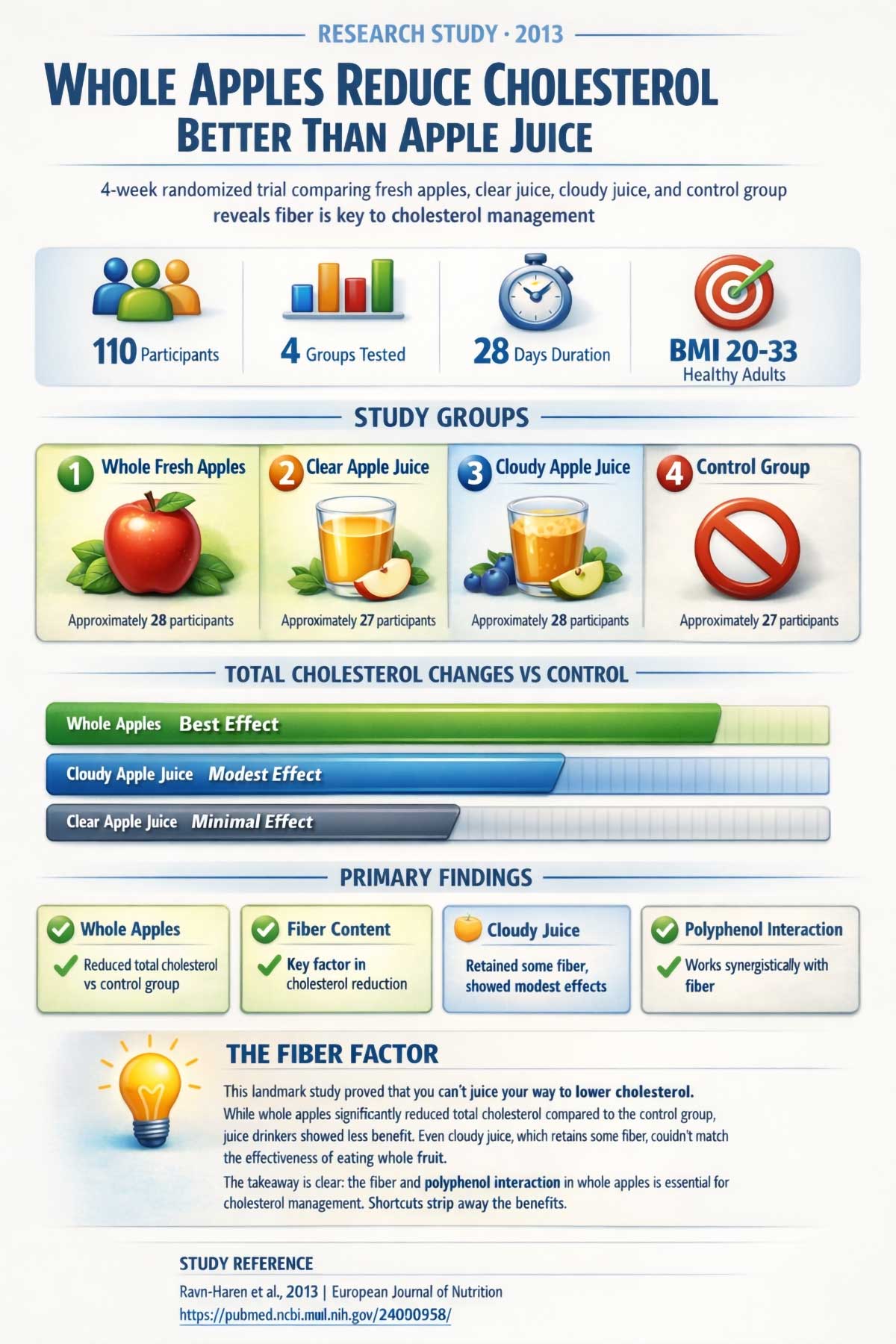
The difference comes down to fiber. When you juice an apple, you strip away most of the pectin. You’re left with sugar, water, and some vitamins—but not the full cholesterol-lowering power.
Week 3-4: Protection Against Artery Damage
Lowering LDL is only half the story. The other half involves preventing oxidation.
LDL cholesterol isn’t inherently bad. The real problem starts when LDL particles get oxidized—damaged by free radicals in your bloodstream. Oxidized LDL is sticky. It clings to artery walls and starts building plaque. That’s what leads to heart disease.
Apple skins contain compounds called polyphenols. These act like tiny shields, protecting your LDL from oxidation. The majority of an apple’s polyphenols—estimates suggest 70-80%—are concentrated in the peel, which is why eating the whole fruit matters.
A 2007 study tested this with apple polyphenol extract. Seventy-one adults with borderline-high cholesterol took either 600mg of extract daily or a placebo for 12 weeks. The extract group showed reduced LDL oxidation markers. But here’s the catch: their actual LDL levels didn’t budge.
This tells us something important. Polyphenols help protect your arteries, but they work best when paired with the fiber in whole apples. You need both to get the full effect.
By weeks 3 and 4, your body has accumulated enough polyphenols to start making a difference. Your LDL isn’t just lower—it’s also less likely to cause damage.
Week 5-6: Your Gut Bacteria Start to Shift
Your intestines contain trillions of bacteria. Some help you. Some don’t. The balance between them affects far more than digestion—it influences inflammation, immune function, and even heart health.
Apples act as food for the helpful bacteria. Scientists call this a prebiotic effect. The fiber in apples (especially pectin) feeds beneficial microbes like Bifidobacterium and Lactobacillus. These bacteria ferment the fiber and produce short-chain fatty acids.
These fatty acids do two things: they lower inflammation and improve how your blood vessels function.
The 2020 study that tracked people eating two apples daily for 8 weeks found significant changes in gut bacteria populations. The apple eaters had more of the good bacteria and better blood vessel function. Their arteries relaxed more easily, allowing better blood flow.
This matters because stiff, inflamed blood vessels contribute to high blood pressure and heart disease. By the end of 8 weeks, studies show your gut microbiome has shifted enough to start supporting your cardiovascular system in ways that go beyond just lowering cholesterol numbers.
Week 7-8: The Numbers Tell the Story
After 8 weeks of eating two apples daily, what can you actually expect?
Based on the clinical evidence, here’s what the data shows:
LDL Cholesterol: A drop of 3.6% to 4% has been observed in studies, though the statistical significance varies. The 2020 study found a 3.6% reduction that approached but didn’t quite reach traditional significance thresholds (p=0.07), suggesting individual responses may vary. For context, every 1% reduction in LDL is associated with roughly 1% reduction in cardiovascular risk. For someone starting at 130 mg/dL of LDL, a 3.6% drop brings levels down to about 125 mg/dL.
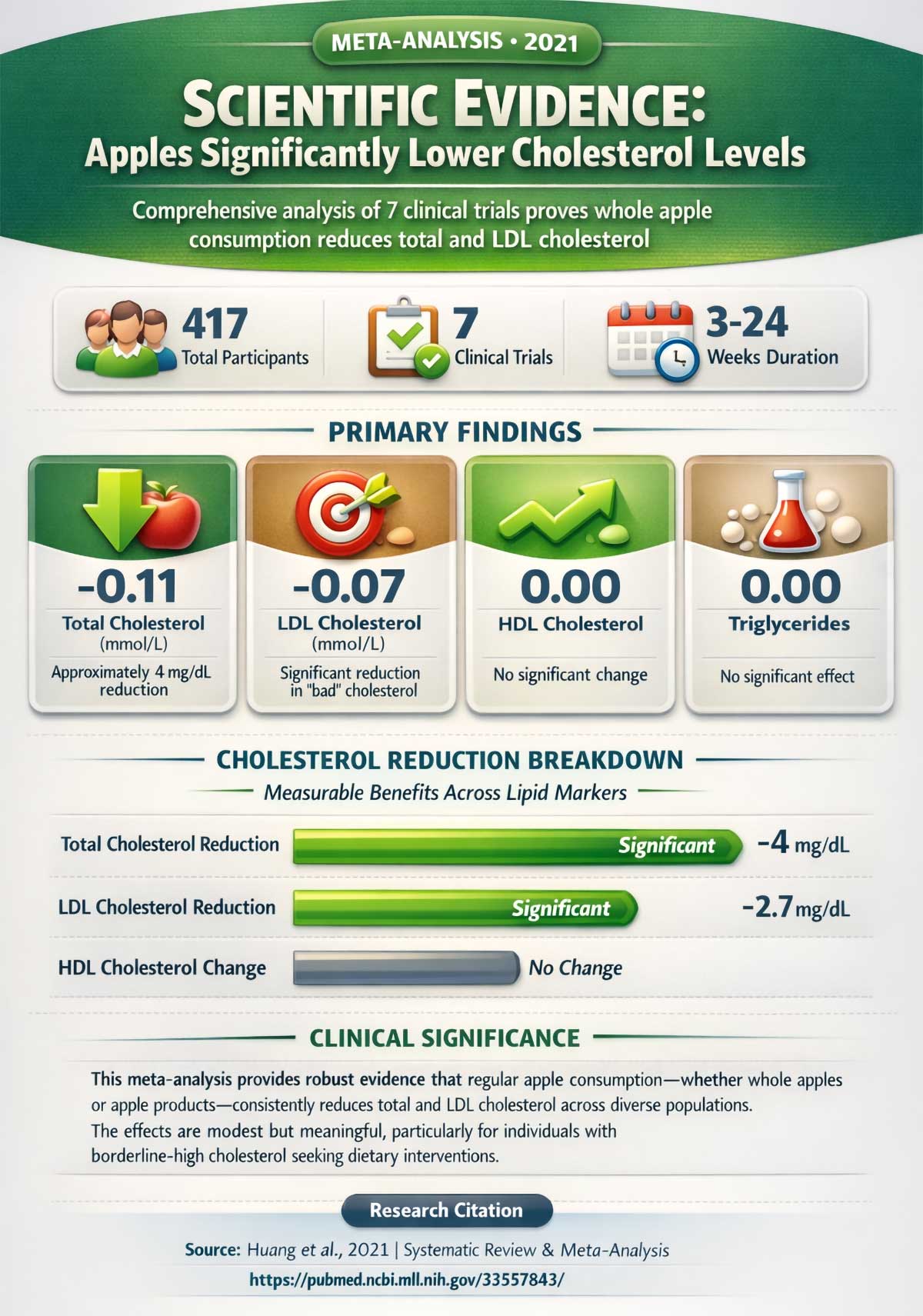
Total Cholesterol: A meta-analysis of 7 randomized trials (417 participants total) found that apple consumption lowered total cholesterol by an average of 0.11 mmol/L. This translates to roughly 4 mg/dL—a modest but meaningful reduction for people with borderline cholesterol levels.
LDL Oxidation: Reduced markers of oxidized LDL, meaning less artery-damaging potential.
HDL Cholesterol: Most studies show no significant change in HDL (the “good” cholesterol). That’s actually fine—you don’t need to raise HDL as long as you’re lowering LDL.
LDL/HDL Ratio: This improves because LDL drops while HDL stays stable. A better ratio means lower cardiovascular risk.
Not everyone sees the same results. A 2000 study with 26 adults who had mild high cholesterol found no significant changes in lipids after 12 weeks of eating apples or drinking apple juice. Their antioxidant levels went up, but cholesterol stayed the same.
Why the difference? Factors like genetics, baseline diet, medication use, and even the apple varieties consumed may influence individual results. It could also be genetic factors, baseline diet, or even the apple variety used. The studies that showed the best results used specific types: Renetta Canada and Golden Delicious.
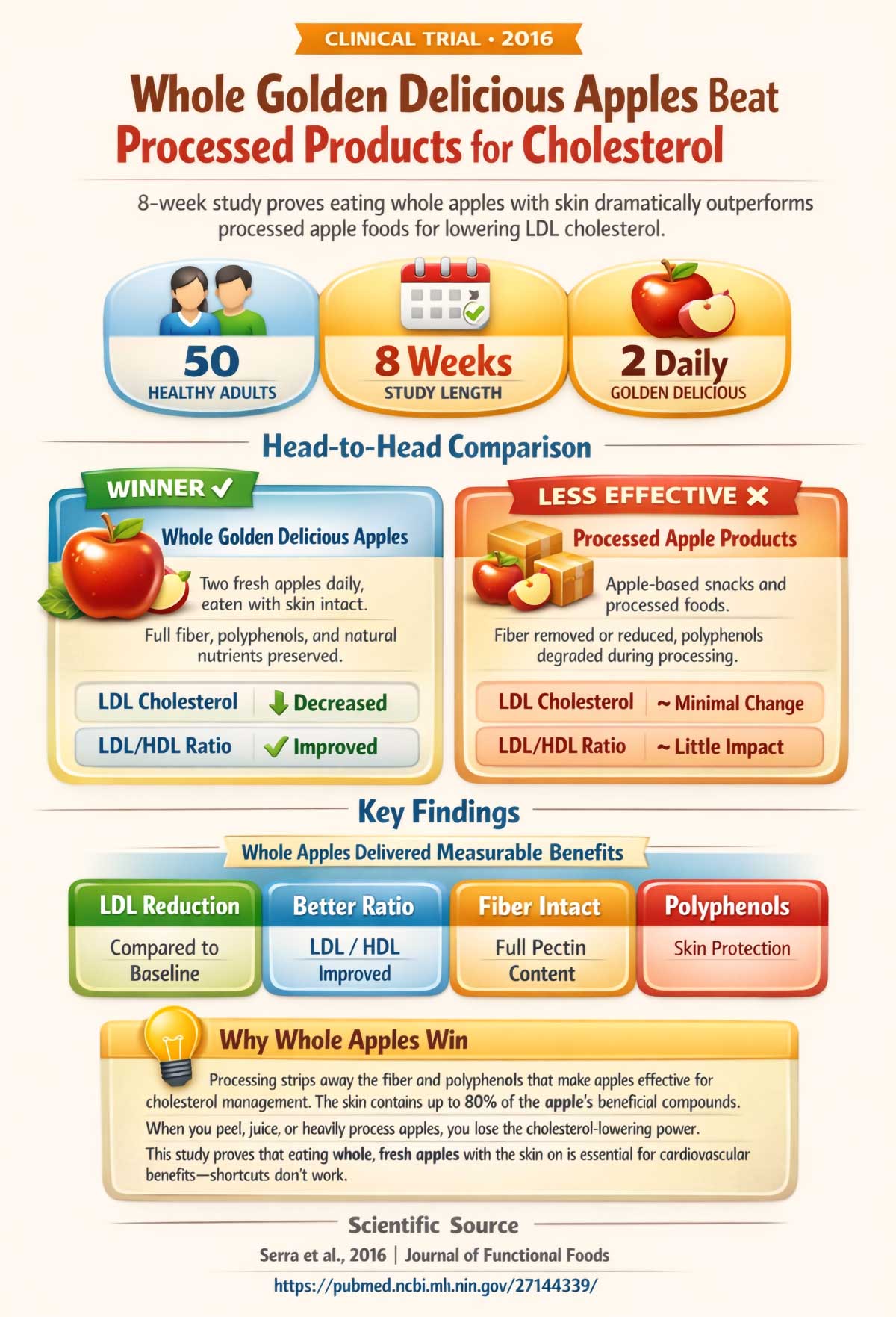
A 2016 study compared these two varieties against processed apple products. Fifty healthy adults ate two Golden Delicious apples daily for 8 weeks. Their LDL dropped compared to their starting levels, and their LDL/HDL ratio improved. Those eating processed apple products saw smaller benefits.
<100
100-129
130-159
160+
Your 8-Week Apple Strategy: What Actually Works
Not all apples are equal. Here’s how to maximize the cholesterol-lowering effect:
Keep the Skin On
The majority of an apple’s polyphenols—estimates suggest 70-80%—are concentrated in the peel. Peeling your apple means losing most of its protective power. Wash it well, but don’t peel it.
Choose the Right Varieties
The studies that showed the strongest results used Renetta Canada and Golden Delicious apples. These varieties have higher pectin and polyphenol content than some other types. If you can’t find these, Granny Smith and Red Delicious are decent alternatives.
While these specific varieties were used in research, any apple with the skin on will provide pectin and polyphenols. Choose what you’ll actually eat consistently—adherence matters more than the perfect variety.
Skip the Juice
Apple juice—even the “healthy” cloudy kind—doesn’t work the same way. The 2013 study proved this. Whole apples beat juice every time because fiber is essential to the cholesterol-lowering process.
Eat Two Daily Without Fail
Consistency drives results. Missing days disrupts the gut bacteria changes that take weeks to build. Set a routine: one apple with breakfast, one as an afternoon snack.
Don’t Rely on Extracts
Polyphenol supplements and apple extract pills don’t replicate the benefits of whole fruit. The 2007 extract study showed this clearly—oxidation protection without cholesterol reduction.
What Apples Can’t Do (And What They Can)
Let’s be clear: apples are not a replacement for statins if you have severely high cholesterol or existing heart disease. If your doctor prescribed medication, keep taking it.
But for people with borderline-high cholesterol (200-239 mg/dL total cholesterol), apples offer a food-based approach worth trying. A 3-4% reduction in LDL might be enough to move you out of the “at-risk” category without medication.
The systematic review of multiple studies in 2012 looked at 345 participants across various trials. The pattern was consistent: whole apple consumption led to lower LDL and total cholesterol across different populations and study designs.
Apples also improve vascular function. Better blood vessel flexibility means better circulation, lower blood pressure, and reduced strain on your heart. These benefits accumulate over time.
Think of apples as part of a bigger strategy. They work best when you’re also:
- Limiting saturated fats
- Exercising regularly
- Managing stress
- Avoiding smoking
- Getting enough sleep
Beyond Week 8: Making It Last
After 8 weeks, don’t stop. The benefits of eating apples continue as long as you keep eating them.
The microbiome changes that support heart health need ongoing fuel. The pectin that binds bile acids works every single day. The polyphenols that protect your LDL don’t build up in your system—you need a fresh supply.
Some people worry about the sugar in apples. Two medium apples contain about 38 grams of natural sugar. But this sugar comes packaged with fiber, which slows absorption and prevents blood sugar spikes. The research shows no negative effects on blood glucose or insulin levels from eating whole apples.
Conclusion
The research suggests that two apples a day for 8 weeks can reduce your LDL cholesterol by 3-4% and improve your vascular health, though individual responses vary and some studies show borderline statistical significance. The effect comes from a combination of soluble fiber, polyphenols, and beneficial changes to your gut bacteria.
This won’t replace medical treatment for people with serious heart disease. But for those with borderline cholesterol who want to avoid medication, apples offer a proven, low-cost tool.
The key is consistency. Whole fruit. Skin on. Every single day.